Feeds:
Posts
Comments

Archive for the ‘Judges’ Category

In the evolving efforts by public officials (mostly elected and appointed political toadies) to prevent you from having unfettered access to public records, three tactics have emerged:

  • CRAPP (Crazed Retaliation Against Public Participation).

This is the strategy employed by Sheriff Jerry Larpenter of Terrebonne Parish.

https://www.washingtonpost.com/news/volokh-conspiracy/wp/2016/08/30/louisiana-sheriff-jerry-larpenter-illegally-uses-criminal-libel-law-to-unmask-a-critic/?utm_term=.e2a1770cf5a0

When a local blogger posted critical stories about him and his political cronies, the good sheriff of Terror-Bonne got a friendly judge (who must’ve received his law degree from eBay) to sign off on a search warrant whereby Larpenter could conduct a raid on the blogger’s home.

All the offending blogger, who obviously was a dangerous criminal on a par with John Dillinger, Willie Sutton, and Bonnie and Clyde, had done was illustrate how the family tree of Terror-Bonne elected officials has no branches—that it’s all just one main trunk, sucking the life out of everything around it.

Deputies seized his laptops and about anything else they could lay their hands on in an attempt to discourage him from writing further disparaging comments about the fine public servants of Terror-Bonne, the First Amendment to the U.S. Constitution notwithstanding.

Of course, a federal judge quickly ruled the raid unconstitutional and gave Larpenter a stern lecture on Civics—not that it did any good.

And then there’s the second approach:

  • BLAPP (Blowhard’s Letter Against Public Participation).

With this method, a public body like, say, the Gravity Drainage District 8 of Calcasieu Parish, has an attorney, say Russell Stutes, Jr., to write a nasty letter to a citizen, say, Billy Broussard, who had performed extensive work for the drainage district for which he was not paid following Hurricane Rita, threatening Broussard with jail time if he persisted in making public records requests. https://louisianavoice.com/2016/12/05/hurricane-cleanup-contractor-threatened-by-attorney-over-requests-for-public-records-from-calcasieu-drainage-district/

Stutes wrote that all Calcasieu Parish employees “have been instructed not to respond to any additional requests or demands from you associated with the project,” neglecting for the moment that any citizen has a right to request any public record and that it is patently illegal for a public official, i.e., the custodian of the records, to ignore a legal request.

“Accordingly, the next time any Calcasieu Parish employee is contacted by you or any of your representatives with respect to the project, we will proceed with further civil actions and criminal charges,” Stutes continued. “A rule for contempt of court will be filed, and we will request injunctive relief from Judge (David) Ritchie. Given Judge Ritchie’s outrage at your frivolous claims last year, you and I both know the next time you are brought before him regarding the project, it will likely result in you serving time for deliberately disregarding his rulings.”

Stutes ended his asinine communiqué by writing, “Consider this your final warning, Mr. Broussard. The harassment of Calcasieu Parish employees must completely and immediately cease. Otherwise, we are prepared to follow through with all remedies allowed by law.”

I wrote then and I’ll say it again: What a crock.

  • SLAPP (Strategic Lawsuits Against Public Participation)

This is the preferred ploy being employed these days to shut down criticism—or inquiries—from the nosy citizenry.

The first two (CRAPP and BLAPP) are the acronyms created in the not-so-fertile mind of yours truly, although the events are very real as are SLAPP actions that are more and more often employed. The most recent cases involve two such lawsuits right here in Louisiana.

In the 3rd Judicial District (Ouachita and Morehouse parishes), judges, of all people, filed a lawsuit against a newspaper, The Ouachita Citizen, for seeking public records, even while admitting the records being sought were indeed public documents. https://lincolnparishnewsonline.wordpress.com/2015/05/19/judges-admit-dox-are-public-records-in-suit-against-newspaper/

More recently, Louisiana Superintendent of Education John White filed a SLAPP lawsuit against a citizen, James Finney, who was seeking information related to school enrollments and statistical calculations. http://www.huffingtonpost.com/mercedes-schneider/la-superintendent-john-wh_b_10216700.html

The Reporters Committee for Freedom of the Press, a nonprofit association dedicated to assisting journalists created in 1970, says SLAPPs “have become an all-to-common tool for intimidating and silencing critics of businesses, often for environmental and local land development issues.”

https://www.rcfp.org/browse-media-law-resources/digital-journalists-legal-guide/anti-slapp-laws-0

The California Anti-SLAPP Project (CASP), a law firm specializing in fighting SLAPPs and in protecting the First Amendment, says protected speech and expression on issues of public interest that may be targeted by SLAPPs include:

  • Posting a review on the internet;
  • Writing a letter to the editor
  • Circulating a petition;
  • Calling or writing a public official;
  • Reporting police misconduct;
  • Erecting a sign or displaying a banner on one’s own property;
  • Making comments to school officials;
  • Speaking a public meeting;
  • Filing a public interest lawsuit;
  • Testifying before Congress, the state legislature, or a city council.

SLAPPs are often brought by corporations, real estate developers, or government officials and entities against individuals or organizations who oppose them on public issues and typically claim defamation (libel or slander), malicious prosecution, abuse of power, conspiracy, and interference with prospective economic advantage. https://www.casp.net/sued-for-freedom-of-speech-california/what-is-a-first-amendment-slapp/

CASP says that while most SLAPPs are legally meritless, “they can effectively achieve their principal purpose (which is) to chill public debate on specific issues. Defending a SLAPP requires substantial money, time, and legal resources, and thus diverts the defendant’s attention away from the public issue. Equally important, however, a SLAPP also sends a message to others: you, too, can be sued if you speak up.”

In 1993, Florida Attorney General Robert A. Butterworth released a Survey and Report on SLAPPs in that state. Five years later, in urging the Florida Legislature to enact a strong anti-SLAPP statute, the Attorney General wrote: “The right to participate in the democratic process is a cherished part of our traditions and heritage. Unfortunately, the ability of many Floridians to speak out on issues that affect them is threatened by the growing use of a legal tactic called a Strategic Lawsuit Against Public Participation or SLAPP. A SLAPP lawsuit is filed against citizens in order to silence them. The theory is that a citizen who speaks out against a proposal and is sued for thousands of dollars for alleged interference, conspiracy, slander or libel will cease speaking out. And, as demonstrated in a report prepared by this office on SLAPPs in 1993, the tactic is successful. Even though the SLAPP filers rarely prevailed in court in their lawsuits, they achieved the desired aim—they shut down the opposition.” http://news.caloosahatchee.org/docs/SLAPP_2.pdf

Fortunately, there are options for those who are victimized by SLAPP lawsuits.

The Public Participation Project and the Media Law Resource Center grade each state on the basis of existing or absence of anti-SLAPP laws.

Whereas only five states (Texas, California, Oregon, Nevada and Oklahoma) and the District of Columbia have what are considered as excellent anti-SLAPP state laws with grades of “A,” Louisiana is one of seven states (Georgia, Vermont, Rhode Island, Indiana, Illinois, and Kansas are the others) which have what are considered to be good anti-SLAPP laws on the books. These seven states were given a grade of “B.”

Sixteen states, Idaho, Montana, Wyoming, North and South Dakota, Wisconsin, Iowa, Michigan, Kentucky, Mississippi, Alabama, North and South Carolina, Ohio, New Hampshire, and New Jersey, have no such laws and are rated “F.”

A key feature of anti-SLAPP statutes is immunity from civil liability for citizens or organizations participating in the processes of government, including:

  • Any written or oral statement made before a legislative, executive, or judicial body or in any other official proceeding authorized by law;
  • Any written or oral statement made in connection with an issue under consideration or review by a legislative, executive, or judicial body or in any other official proceeding authorized by law;
  • Any written or oral statement made in a place open to the public or in a public forum in connection with an issue of public interest; and
  • Any other conduct in furtherance of the exercise of the constitutional right of petition or the constitutional right of free speech in connection with a public issue.

When a citizen or organization is sued for protected activities, anti-SLAPP statutes provide for expedited hearing of a special motion to dismiss the SLAPP suit. The burden is placed on the plaintiff to prove that the defendants had no reasonable factual or legal grounds for exercising their constitutional rights and that there was actual injury suffered by the plaintiff as a result of the defendants’ actions. No action can be taken in furtherance of a SLAPP suit unless the plaintiff first demonstrates to the court that there is a “probability” of success. Attorneys’ fees and court costs are awarded to SLAPP defendants who win dismissal.

TOMORROW: A look at how one city council member’s questions produced not one, but four separate SLAPP lawsuits in a coordinated effort shut him up.
Read Full Post »

Ha·be·as cor·pus

[ˌhābēəs ˈkôrpəs]

NOUN

A writ requiring a person under arrest to be brought before a judge or into court, especially to secure the person’s release unless lawful grounds are shown for their detention.

Habeas corpus is the legal procedure that keeps the government from holding you indefinitely without showing cause. It’s been a pillar of Western law since the signing of the Magna Carta in England in 1215. The Founders of our nation believed habeas corpus was so essential to preserving liberty, justice, and democracy that they enshrined it in the very first article of the United States Constitution.


Ex·tor·tion

[ikˈstôrSH(ə)n]

NOUN

The practice of obtaining something, especially money, through force or threats.


RICO

[ˈrēkō]

ABBREVIATION

Racketeer Influenced and Corrupt Organizations Act.


Trudy White has been a judge in the 19th Judicial District of Louisiana since 2009. The district encompasses East Baton Rouge Parish. Before being elected a state district judge, she served for 10 years as a Baton Rouge city judge.

Cleve Dunn, Jr., served as Chairman of Judge Trudy White’s Campaign Committee, according to a campaign finance report filed on March 19, 2014 (scroll down to the second page of White’s campaign finance report by clicking HERE).

Cleve Dunn, Sr., who was paid $250 by Judge White’s campaign on Nov. 14, 2014, for marketing, is the operator of Rehabilitation Home Incarceration (RHI). RHI (see corporate filing record  HERE) has profited by its association with Judge White and is now a named defendant, along with Dunn and East Baton Rouge Parish Sheriff Sid Gautreaux, III, in a class action lawsuit filed in U.S. District Court for Louisiana’s Middle District.

REHAB PETITION

RHI is one of several private companies that offer pretrial supervision services for the court but is the only approved on Judge White’s website, the petition says. Judge White also assigns defendants a company called Street Crimes Alternatives for pretrial supervision, but, the petition says, that company is also run by Dunn.

A check by LouisianaVoice, however, revealed two other vendors for home incarceration on Judge White’s web page: Home Bound Monitoring Pretrial and Probation Services and Criminal Justice Service. There was no indication as to when those two were added to Judge White’s WEB PAGE.

Additionally, Judge White paid Frederick Hall and his wife, Gloria Hall, $250 each for campaign support activities on the same date as her campaign’s payment to Dunn. Hall is a former employee of RHI and, with his wife, now owns a bond company to which RHI routinely refers defendants, the lawsuit says.

Lead plaintiffs in the litigation, filed by the Southern Poverty Law Center, are Henry Ayo and Kaiasha White (no relation to Judge White).

Ayo was arrested for attempted theft of an air conditioning unit and Kaiasha White for simple and aggravated battery following an argument. Both appeared before Judge White on August 8, 2016.

“Since Judge White’s re-election … in 2014, she has assigned arrestees to supervision by RHI,” the lawsuit says. “White does so without conducting in open court an individualized determination of, or providing an opportunity for arrestees to be heard on, the need for, or the conditions of, RHI supervision.”

The lawsuit said that Judge White appears to make the RHI assignments before the defendants even appear in her court nor does she inquire of arrestees whether or not they can afford to pay bond or RHI’s initial or monthly fees. White, the petition says, usually sets the duration of RHI’s supervision at 90 days or for an indefinite time, “irrespective of the supervisee’s next court date.”

White does not typically impose specific supervision terms for RHI to enforce nor does she order a curfew, house arrest or payment of the initial or monthly fee as a condition of release from the parish prison. RHI takes it upon itself to set all those conditions in an arbitrary manner, the suit says.

RHI demands an initial fee of $525 and arrestees typically learn of this only when they or family members attempt to post bail or at their first meeting with RHI at the prison. Those who cannot immediately pay the initial RHI fee may wait in jail for days or weeks until they can pay despite their having already posted bail.

Through an agreement with RHI, the lawsuit says, East Baton Rouge Parish Sheriff Gautreaux and Parish Prison Warden Dennis Grimes “created and enforce a policy that the prison will not release arrestees from the prison until it receives permission from RHI—permission that comes only after RHI is satisfied with the initial payment made.”

Upon their release, they are required by RHI to sign a contract setting forth RHI’s future fees and conditions of supervision which require the arrestee to pay a monthly fee of $225 to their assigned RHI officer, or “monitor,” during their supervision term. The contract also sets a curfew for supervisees, restricting them from spending the night anywhere other than at their reported residential address.

“RHI monitors and Dunn himself threaten supervisees with re-arrest if they fail to make financial payments or comply with RHI’s costly supervision conditions—without affirmatively inquiring into their ability to pay,” the suit says. “Accordingly, supervisees pay (or attempt to pay) the fee out of fear of re-arrest and bond revocation by scraping together money from friends or family.”

Ayo was told his fees were in part to pay for an ankle monitor even though he was never provided one. When he and his wife were unable to make timely payments, RHI would assess him with late fees.

The federal RICO statute is invoked in the lawsuit because, it says, “Dunn has conducted the affairs of RHI through a pattern of racketeering to achieve the common purpose of unlawfully extorting money from plaintiffs Ayo and White and the proposed class. These racketeering acts are an integral part of RHI’s regular course of business.”

The petition says that Dunn “has committed multiple, related predicate acts of extortion by refusing to authorize the release of plaintiffs and the proposed class from the prison until they paid money towards the RHI initiation fee. Additionally, by unlawfully using the fear of arrest and jail by East Baton Rouge law enforcement or RHI officials, Dunn on numerous occasions extorted from plaintiffs and the proposed class a monthly supervision fee, along with fees for classes or other requirements imposed at the discretion of RHI employees.”

It said Dunn’s use of RHI to extort money from arrestees assigned by Judge White “constitutes a pattern of racketeering activity.”

The lawsuit listed a number of questions for the proposed class:

  • Whether RHI, independent of Judge White, sets terms for an arrestee’s release and the fees for its supervision services;
  • Whether Dunn, RHI, and Gautreaux, in his official capacity, have an agreement that individuals assigned to RHI by Judge White may not be released from the prison until they have paid RHI’s initial fee and RHI notifies the prison of such payment;
  • Whether RHI and Gautreaux, in his official capacity, enforce such agreement against the proposed class without determining whether individuals can afford to pay RHI’s initial fee;
  • Whether Gautreaux has a policy, practice, or custom of detaining arrestees until obtaining RHI’s permission to release them;
  • Whether RHI’s standard contract provides for an initial fee and monthly fees;
  • Whether RHI’s standard contract provides for arrest and jailing for failure to pay its fees;
  • Whether Dunn directs RHI employees to threaten to arrest and jail individuals who do not pay the monthly supervisory fees and other mandated fees to RHI
  • Whether Dunn’s operation of RHI through a pattern of racketeering activity, specifically, extorting money from (arrestees) by unlawfully detaining them in the prison until they pay RHI’s initial fee, then threatening them additional jailing if they fail to pay RHI monthly fees once released, violates the Louisiana and federal RICO acts;
  • Whether Gautreaux and RHI’s practice of detaining individuals because they could not pay RHI’s initial fee violates arrestees’ rights under the 14th Amendment to due process and equal protection;
  • Whether Gautreaux and RHI’s detention of arrestees after they posted bonds constituted an unreasonable seizure in violation of the 14th Amendment, and
  • Whether RHI lacks any legal authority or right to collect fees from arrestees.


Read Full Post »

Terrebonne Parish Sheriff Jerry Larpenter does not tolerate criticism and he will go after those who dare to step over that line.

The raid on the Houma police officer’s home has been well documented (CLICK HERE) as was the ruling (CLICK HERE)  by the First Circuit Court of Appeal which said the raid was clearly unconstitutional.

Earlier this year, the officer and his wife filed a lawsuit in federal court against Larpenter and about half of Terrebonne Parish’s political power brokers. (SEE HERE).

But long before the fireworks between Larpenter and former deputy and Houma police officer Wayne Anderson, Larpenter went after his own brother and sister-in-law, proving that, in this case, at least, blood is not thicker than water. That dispute has been non-stop for at least 12 years now.

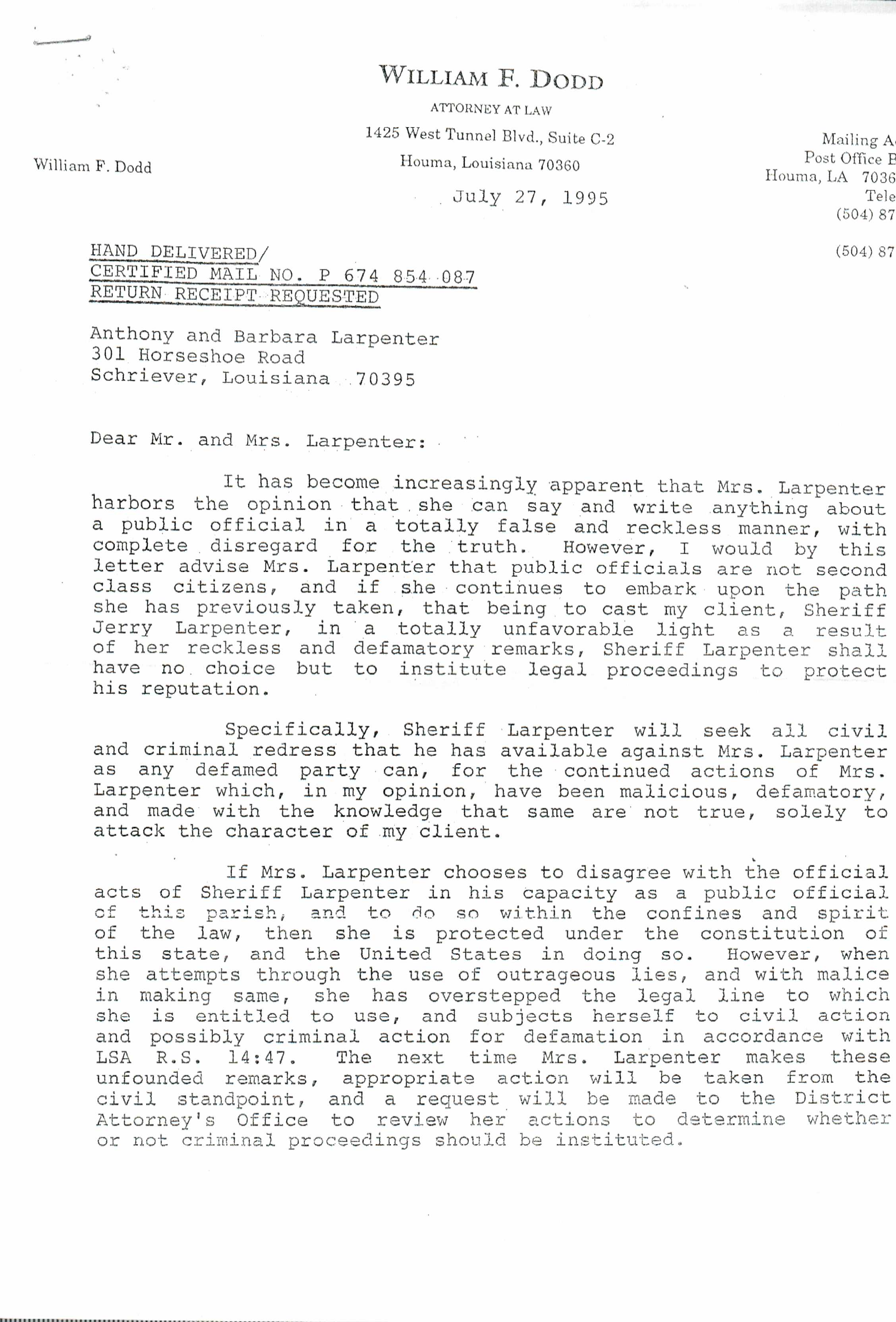
It was July 27, 1995, when Larpenter called upon his legal counsel, Houma attorney William F. Dodd (if that name seems familiar, it’s probably because his pappy, William J. Dodd, served as state auditor, lieutenant governor, and state superintendent of education and twice ran—and lost—for governor) to fire off a two-page threatening letter to brother Anthony Larpenter and his wife, Barbara.

There are those who are going to accuse LouisianaVoice of dredging up old news but the letter and the subpoenas that followed less than two months later represent a mindset in the Terrebonne Parish Sheriff’s Office, a pattern, if you will. Let’s face it, you have to have a pretty thin skin to call down the powers of your office on ordinary citizens whose most grievous offense was criticism of the manner in which you run that office.

The letter is the typical letter of legal intimidation, filled as it was with the usual attorney bluster, demands and threats but in the end, nothing but a loud, bullying, cheap tactic to stymie free speech.

“…I would by this letter advise Mrs. Larpenter that public officials are not second-class citizens, and if she continues to embark upon the path she has previously taken, that being to cast my client, Sheriff Jerry Larpenter, in a totally unfavorable light as a result of her reckless and defamatory remarks, Sheriff Larpenter shall have no choice but to institute legal proceedings to protect his reputation,” Dodd wrote.

“…The next time Mrs. Larpenter makes these unfounded remarks, appropriate action will be taken from the civil standpoint, and a request will be made to the district attorney’s office to review her actions to determine whether or not criminal proceedings should be instituted,” Dodd said.

There is an obscure state statute (R.S. 14:47)under which criminal charges may be brought against an individual for defamation. The maximum penalty under that statute is a fine of $500 or imprisonment of up to six months, or both.

Now I’m not an attorney, but I have to believe that criminal prosecution for defamation, libel or slander under this statute—unless, that is, you are making written or verbal physical threats against the well-being of someone—would be an extremely risky move for any politician. And Dodd’s letter makes no mention of any such threats, so it’s a little puzzling how he thinks he can morph disparaging remarks against an elected official into criminal action.

Once that precedent is set, television campaign ads will cease to exist since distorted attacks and outright lies are all they consist of and no one would ever be allowed to talk about an elected official again. That’s a slippery slope that can only lead to a totalitarian form of government.

Of course, Dodd’s letter also could have been nothing more than legal puffoonery, which is far more likely.

Less than two months later, on September 12, Larpenter, as a precursor to what the Andersons could expect 11 years later, had subpoenas served on his brother and sister-in-law. The subpoena demanded that they “produce the original taped conversation between deputy Gary Sanders and Deputy Jed Boquet on or about January 6, 1995.”


There was no indication as to what the conversation between the two deputies was about but it obviously was of considerable concern to Sheriff Larpenter.

Dodd ended his July letter on a really ugly and sinister note when he wrote, “I would point out that in the event a civil action is filed, and Sheriff Larpenter is successful, this being a community property state, and assuming that Mrs. Larpenter has no separate property agreement, any judgment that might be obtained in favor of Sheriff Larpenter, could be entered against this total community property owned by both of you.”

Translation: Mr. Larpenter, you’re the man of the house; you need to shut your wife up.

Well, Sheriff, those days are long gone. Forever. You’re still living back in the 1940s and ‘50s if you think this still plays. Women have a loud voice today and they do not have to ask permission to speak. Edith Bunker doesn’t exist anymore.

But you and Mr. Dodd would be wise to listen.

Read Full Post »

If you ever decide to step out of your routine and launch a search for the poster child for corruption within the Louisiana justice system, you might wish to begin your search in New Orleans.

It will be a short but successful search. Guaranteed.

Without delving too far into Orleans Parish’s sordid history, there was the removal of U.S. District Judge G. THOMAS PORTEOUS JR. by the U.S. Senate in 2010 and four more judges got themselves caught up in the FBI OPERATION WRINKLED ROBE in adjacent Jefferson Parish back in 2003.

Corrupt judges are bad enough but after three straight administration changes, it appears the Orleans Parish District Attorney’s Office still can’t get its act together.

The most egregious was the late Harry Connick, Sr., HARRY CONNICK, SR., who earned a well-deserved national reputation for consistently withhold exculpatory evidence that would have exonerated defendants he sent to Angola for extended prison terms—one of whom spent 18 years on death row before the discovery of withheld evidence finally freed him.

He was followed by the derby-wearing Eddie Jordan, who previously served on the federal prosecuting team that won a conviction of former Gov. Edwin Edwards.

The first hint that things were a bit askew was when Jordan, a black, began handing out pink slips to white employees who saw red and sued in federal court, ultimately winning a major reverse discrimination DECISION in 2005. That, along with a somewhat bizarre story of a robbery suspect who showed up at Jordan’s HOME in October 2007, finally forced him to RESIGN from office only a week later.

Then, on July 14, LouisianaVoice received this otherwise benign press release from Department of Public Safety and Corrections Secretary James M. LeBlanc:

Louisiana Justice Hall of Fame Announces 2017 Honorees

Inductees to be honored today during ceremonies

BATON ROUGE, La. –  Louisiana Department of Public Safety and Corrections Secretary James M. Le Blanc, Louisiana State Penitentiary Warden Darrell Vannoy, and the Louisiana State Penitentiary Museum Foundation are proud to announce the following highly distinguished individuals as 2017 inductees to the Louisiana Justice Hall of Fame:

  • The Honorable Dennis R. Bagneris, Sr., 4th Circuit Court of Appeals Judge, Retired, New Orleans
  • The Honorable Leon A. Cannizzaro, Jr., District Attorney, New Orleans
  • The Honorable Jimmy N Dimos, 4th Judicial District Judge, Retired, Monroe
  • Sheriff Marlin N. Gusman, Orleans Parish Sheriff’s Office
  • Major General Bennett C. Landreneau, Retired, Alexandria
  • The Honorable Marc H. Morial, President & CEO of The National Urban League
  • Sheriff Newell Norman, Jefferson Parish Sheriff’s Office
  • Rabbi Arnold S. Task, Alexandria

The new inductees will be honored and inducted into the Hall of Fame today during ceremonies at the Louisiana State Penitentiary Museum and at LSU’s Lod Cook Alumni Center. The Louisiana State Penitentiary Museum is proud home to the Louisiana Justice Hall of Fame.

Okay, what’s wrong with that, you ask?

Not much except that the Southern Poverty Law Center has just filed a 61-page official COMPLAINT against Cannizzaro with the Louisiana Office of Disciplinary Counsel in Baton Rouge following an excellent series of investigative stories in The Lens, a non-profit New Orleans watchdog online news service.

The basis for the complaint—and of The Lens stories—was the routine issuance of non-legal subpoenas intended to intimidate subjects to report to the district attorney’s office to answer questions by prosecutors. Those subpoenaed were not necessarily suspected of any wrongdoing.

The fake subpoenas were not signed by a judge, a requirement under law to make the subpoena legal and enforceable. Instead, they were issued as ploys to intimidate those served into coming into the DA’s office.

http://thelensnola.org/2017/04/28/woman-who-got-fake-subpoena-from-orleans-parish-da-said-she-was-told-she-could-be-jailed-if-she-ignored-it/

http://thelensnola.org/2017/06/14/new-orleans-prosecutor-used-fake-subpoena-to-seek-arrest-warrant-for-victim-of-alleged-domestic-violence/

http://thelensnola.org/2017/05/03/will-prosecutors-who-sent-fake-subpoenas-face-any-consequences/

http://thelensnola.org/2017/05/05/da-we-cant-say-how-often-fake-subpoenas-are-used-and-its-too-hard-to-look/

http://thelensnola.org/2017/05/12/orleans-parish-da-sued-over-refusal-to-turn-over-witness-subpoenas-real-and-fake/

http://thelensnola.org/2017/05/15/the-lens-is-suing-orleans-parish-da-leon-cannizzaro-to-force-him-to-turn-over-fake-subpoenas/

http://thelensnola.org/2017/05/19/notices-sent-to-witnesses-on-north-shore-werent-called-subpoenas-but-they-looked-real-enough/

http://thelensnola.org/2017/06/14/new-orleans-prosecutor-used-fake-subpoena-to-seek-arrest-warrant-for-victim-of-alleged-domestic-violence/

http://thelensnola.org/2017/05/22/defense-attorney-asks-judge-to-force-orleans-parish-district-attorney-to-disclose-whether-it-used-fake-subpoenas-in-home-invasion-case/

On July 11, an Orleans Parish JUDGE ordered the DA’s office to provide the ACLU complete records related to its use of fake subpoenas.

But apparently, the practice has bled over into adjacent JEFFERSON PARISH, where fake subpoenas are also reportedly being issued.

So while Donald Stumped and his shrinking army of unquestioning loyalists fret and fume over so-called fake news, there is the very real issue of fake subpoenas being used by those charged with upholding the Constitution of the United States to trample on the rights of its citizens.

Leon Cannizzaro attended and graduated from law school. We know that because you must be a licensed attorney to be a district attorney.

By virtue of that law degree (a juris doctorate, we assume), he is fully aware that a subpoena, to be legal, must be issued by a court, i.e., signed by a judge.

He also must be aware that the actions of his office, for which he must take full responsibility, were blatantly illegal, unconstitutional, unethical and immoral—and that the practice casts a long shadow of doubt as to the credibility and legal ethics of yet another Orleans Parish district attorney.

Unless, of course, he was absent on subpoena and/or legal ethics days.

The Southern Poverty Law Center said it best in its complaint in such a succinct manner that it bears repeating:

  • Subpoenas are, by definition, orders issued by a court.
  • By law, district attorneys may only seek to have subpoenas issued with court authorization.
  • The Orleans Parish District Attorney’s Office routinely lied about individuals’ obligation to speak to district attorneys and the penalties for failing to do so.
  • The District Attorney’s Office now acknowledges ethical violations but continues to resist transparency and the voluntarily (sic) regulation of this practice.

The bogus subpoenas carry a bold-face notice that says, “A fine and imprisonment may be imposed for failure to obey this notice.”

We can’t help but wonder what the penalty for badgering, intimidation, misrepresentation, and lying by an officer of the court might be.

But congratulations for that Justice Hall of Fame thingy.

Read Full Post »

Troy Hebert just won’t go away.

But in this case, he’s probably like to.

The former commissioner of the Louisiana Office of Alcohol and Tobacco Control (ATC) is scheduled in U.S. District Court Monday as a federal racial discrimination LAWSUIT  against him and ATC cranks up.

The lawsuit, to be tried before U.S. District Court Judge John W. DeGravelles, was filed by former ATC agent Charles M. Gilmore of Baton Rouge, Daimin T. McDowell of Bossier Parish, and Larry J. Hingle of Jefferson Parish.

The three claim that Hebert made working conditions so bad that employees had to take medical leave or were forced to resign. Each of the three filed separate complaints with the Equal Employment Opportunity Commission and received “right to sue” notices.

LouisianaVoice first reported the filing of the lawsuit three years ago, in July 2014. https://louisianavoice.com/2014/07/14/forcing-grown-men-to-write-lines-overnight-transfers-other-bizarre-actions-by-troy-hebert-culminate-in-federal-lawsuit

The lawsuit says five African-American supervisors worked in the ATC Enforcement Division when Hebert, a former state senator from Jeanerette, was appointed by then-Gov. Bobby Jindal in November 2010. “By means of the manipulative actions by Troy Hebert…there are now no African-American supervisors within the ATC Enforcement Division,” the petition says.

Prior to Hebert’s appointment, the three “had unblemished records with no prior disciplinary actions,” the suit says. “Each…had been promoted to supervisory positions at ATC before Troy Hebert’s arrival.”

The suit says Hebert “deliberately acted in disregard of the plaintiffs’ clearly established rights to be free from racial discrimination, race-based harassment and retaliation.

Gilmore worked for 10 years as a corrections sergeant and Louisiana State Police trooper before joining ATC in 1998 where he worked his way up to Special Agent in Charge until he was “constructively discharged” by Hebert on Sept. 27, 2013, the lawsuit says.

“Constructive discharge” is when working conditions become so intolerable that an employee cannot stay in the position or accepts forced resignation.

McDowell was hired by ATC in 2005 and in his seven years was promoted three times. Hingle was hired in 1991. During his 21 years of employment, he was also promoted three times.

The lawsuit also alleges that on Aug. 22, 2012, two days after taking leave, Gilmore and McDowell were told by fellow agent Brette Tingle that Hebert intended to break up the “black trio” a reference to Gilmore, McDowell and Supervising Agent Bennie Walters. Walters was subsequently fired on Sept. 7.

Read Full Post »

« Newer Posts - Older Posts »


