Feeds:
Posts
Comments

Archive for the ‘House’ Category

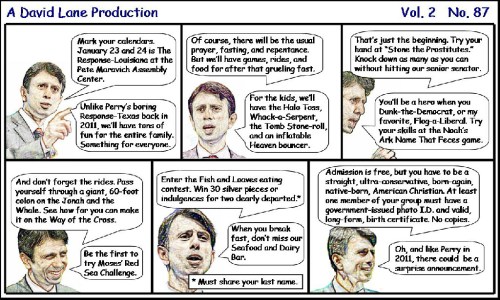
JINDAL PRAYER BREAKFAST(CLICK ON IMAGE TO ENLARGE)

You’ve got to hand it to Gov. Bobby Jindal. If he ever knew when to shut up, he’s doing a dandy job of concealing that knowledge.

Team Jindal is an e-mail blast by an outfit calling itself Friends of Bobby Jindal providing those of us lucky enough to be on the mailing list a timely update on the governor’s travels, TV appearances, and op-ed writings. We’re not altogether certain how we managed to get on the mailing list but we’re glad we did.

Before we go any further, let the record show that there is no Google link to any such organization but there is a link at the bottom of the e-mail to this web page: www.bobbyjindal.com. It even has a prominent “Donate” button at the top of the page, just to right of the imposing—and more than a little official-looking—“Bobby Jindal Governor” banner.

As we said in an earlier post, we’re not sure why he needs donations given the fact that he is term limited and cannot run for governor for another five years and he remains an unannounced candidate for the Republican presidential nomination (though few doubt that is his intent).

But we digress.

Whoever sends out these e-mails does a much better job of keeping current than the person responsible for the web page. The e-mails come at least on a weekly basis while the last blog posting on www.bobbyjindal.com was on Aug 22 of this year. Given that, you’re just going to have to take our word for what we are about to quote Jindal on in the latest e-mail release.

Along with stories about Jindal’s most recent appearances on Fox News, there was a story about the governor’s welcoming Education Secretary Arne Duncan to New Orleans, a video of him promoting his upcoming prayer rally at the Pete Maravich Arena on the LSU campus, an announcement of a new plant to be built in Cameron Parish, a release about his executive order to better protect sexual assault victims, his participation in the opening of a new section of the National World War II Museum in New Orleans, and this quote from Jindal calling the CIA Report a partisan attempt to attack the record of President George W. Bush:

  • “It is clear that the Democrats wrote and released this report in an attempt to once again attack President Bush. I remain very proud to have worked for him, and proud that he kept America safe in the aftermath of 9/11. This report is one-sided and partisan. The Left hates the former President, they always have, and now, six years after he left office they are still campaigning against him. The undeniable truth of the matter is this – President Bush kept America safe after 9/11 from terrorists that wanted to kill us. This is simply a fact. President Bush is a good man and I am honored to have served in his Administration.”

Naturally, we were curious as to how the governor of Louisiana, who admittedly was smart enough to be a Rhodes Scholar but who has never served in the military, could be so knowledgeable about the methods employed to extract military intelligence from detainees.

So, fueled by that curiosity and lucky enough to catch Jindal in Baton Rouge between trips to Iowa, New Hampshire and the Fox News studios, we requested—and got—an interview with him. And anyone who knows of his reluctance to grant interviews to local media has to know what a journalistic coup that was.

We wanted to know his position on other controversial issues involving Republican presidents and he graciously agreed. Without bothering to go into lengthy explanations of our questions, we instead will simply list the name of the president (or other individual) and the issue most closely associated with him (in bold), followed by the governor’s take on that topic (in italics).

Abraham Lincoln and the Emancipation Proclamation:

  • “Look, as much as everyone seems to think of Lincoln, he was really overrated as a president. Two things: First, he got us into an ugly war that produced more casualties than any other war in our history, a war that took years for us to recover from. He had Gen. Sherman burn Atlanta to the ground and what did Atlanta ever do to the country besides to give us Tara, Rhett Butler and Scarlett O’Hara? Second, he freed the slaves who already had good homes and were taken care of by their kindly masters. That was just another example of federal overreach. Look, Phil Robertson said it best when he said a year ago, and I’m quoting now: ‘I never, with my eyes, saw the mistreatment of any black person, not once. Where we lived was all farmers. The blacks worked for the farmers. I hoed cotton with them. I’m with the blacks, because we’re white trash. We’re going across the field…. They’re singing and happy. I never heard one of them, one black person, say, ‘I tell you what: These doggone white people’—not a word! Pre-entitlement, pre-welfare, you say: Were they happy? They were godly; they were happy; no one was singing the blues.’ Now that’s Phil Robertson speaking, not Bobby Jindal, and we know how smart Phil is…” http://www.huffingtonpost.com/2013/12/19/phil-robertson-black-people_n_4473474.html

Theodore Roosevelt and trust busting:            

  • “I just want to say this: Theodore Roosevelt was a RINO—a Republican in Name Only. He was the Democrats’ best friend. Make no mistake, he was a Roosevelt and a cousin to that other Roosevelt. And let me say this: Theodore Roosevelt was the true father of the welfare state. He is personally liable for the ill effects of the Sherman Anti-Trust Act. He had the audacity to try and browbeat a great American, J. P. Morgan, and even told Mr. Morgan right there in the Oval Office that any interest of his that had done anything wrong was in danger of being prosecuted. How can capitalism and American Exceptionalism function with that kind of pressure? http://www.ushistory.org/us/43b.asp 
  • And if you thought Roosevelt stopped there, you would be wrong. He had the taste of runaway power that only Washington can administer. He made Washington the nanny state for meat inspections just because a few pounds of bad hamburger meat made it to market. I say if you don’t like tainted meat, don’t eat it. That’s the American way.”

Warren G. Harding and the Teapot Dome scandal:

 Herbert Hoover and the Great Depression:

  • “Two things you have to understand: The Great Depression was unfortunate but those are the breaks. Stuff happens. And those displaced homeowners living in those Hoovervilles? What would you expect the President to do? Give them a handout and make them even more dependent on government? No! You have to make people self-reliant, instill pride in their determination to rise above their circumstances. There were New York stockbrokers to worry about; they’re the ones who make the country go. And while the situation with the Okies was certainly dire, the President must first concern himself with the captains of industry.” https://www.google.com/search?q=hoovervilles&hl=en&biw=1280&bih=607&tbm=isch&tbo=u&source=univ&sa=X&ei=WD-OVNwMw_OgBIfSgvAJ&sqi=2&ved=0CDYQsAQ

Sen. Joe McCarthy:

  • The liberal media killed him. He was a great American who had the commies in the State Department running scared until they framed him with that Edward R. Murrow interview.

Richard Nixon and Watergate:

  • “Two words: national security. Pentagon Papers. Nixon was a patriot. He was a member of the House Un-American Activities Committee and brought down Alger Hiss.”

Republican deregulation agenda:

  • “The Dodd-Frank bill was a disaster. When you tie the hands of Wall Street, you tie the hands of the American economy. What could be more un-patriotic? The financial collapse of 2008 was all Obama’s fault; everyone knew he was running for the Democratic nomination and it caused a panic. Wall Street needs to be encouraged, not hog-tied. Wall Street is a microcosm of American capitalism. Where else can a CEO make $300 million a year and retire with a $200 million cash-out of his stock options and still draw $100 million a year. That’s the American dream.
  • Look, if it’s good for the Koch brothers, it’s got to be good for America. Why do you think they have invested so much of their personal fortunes into getting the right people elected? It’s because deep down, they care. Like former director of the Office of Management and Budget Gary Bass, I look at the current trend toward Republican control of Congress and the move toward deregulation and rollbacks of stifling regulation as the Contract with America on steroids. And that’s a good thing.

 President Obama’s energy policy:

Climate change:

(The last two quotes regarding Obama’s energy policy and climate change are verbatim utterances by Jindal—grammar, syntax and all.)

Thank you for your time, Governor.

“Any time. Well, not anytime…unless you’re Fox News.”

(Disclaimer: Although some quotes in this attempt at satire are accurately attributed, the actual interview never occurred and is not to be taken seriously. Do not read this while operating heavy machinery. May cause nausea, weak knees, enlarged ego, skin rash, or dizziness. Other possible side effects include rickets, diarrhea, constipation, blurred vision, temporary anger, swollen tongue, sudden increase or decrease in a desire for real news or unexpected or unusual stimulation of previously suppressed sense of humor. If you are up laughing more than four hours, consult a doctor. If you believed this was a real interview, see a shrink.)       

Read Full Post »

Former Gov. Edwin Edwards, who has been uncharacteristically quiet in his campaign to succeed U.S. Rep. Bill Cassidy for Louisiana’s 6th Congressional District seat, came out swinging at his opponent at Monday’s appearance before the Baton Rouge Press Club.

At the same time, the campaign of his opponent, Garret Graves, Gov. Bobby Jindal’s hand-picked candidate, appears to be doing everything it can to go into a self-destruct mode with Graves following smear tactics against a first primary opponent with a vitriolic email-writing campaign to reporters perceived by him to be antagonistic.

One veteran Baton Rouge reporter described Graves’ strange behavior as the campaign enters its stretch drive as “weirdly Nixonian.”

Edwards was also critical of Graves’ role in attempts to stifle the lawsuit against 97 oil and gas companies by the Southeast Louisiana Flood Protection Authority-East (SLFPA-E). “Someone needs to restore our coastal lands and who better than the ones who destroyed it?” he asked.

The event was intended to serve as a face-off between the two candidates, but Graves chose not to attend.

Edwards, meanwhile, took the opportunity of renewing earlier claims of $130 million contracts awarded to Graves’ father under his watch as President of the Coastal Protection and Restoration Authority (CPRA) and director of the Governor’s Office of Coastal Activities.

“Not only was he responsible for $130 million in contracts to his father’s engineering company,” Edwards said, “but 18 sub-contractors got another $66 million in contracts. Those companies gave $250,000 to Graves’ campaign and $360,000 to Gov. Jindal’s campaign. This is a scheme by Jindal and Graves to maintain and to perpetuate the control of the flow of dollars from the Corps of Engineers and the BP spill.

“Gov. Jindal took $160 million in BP grant funds and wasted it on the construction of a sand berm and gave the contract to a Florida firm. That berm, as was predicted, is long gone.

“Jindal then took another $35 million to $40 million to build the million-square-foot Water Campus in Baton Rouge,” Edwards said.

He said the Water Campus office complex and research center under construction in Baton Rouge, will house the agency Graves once headed. The leasing agent for office space in the facility, Edwards said, is Randy White, Graves’ brother-in-law. “They’re going to lease one million square feet of office space at probably $25 to $50 per square foot,” he said. “At a commission of 2 or 3 percent, that’s a $1 million a year. I guess it would be accurate to say Graves is a family man.”

More recently, Graves has ramped up an email-writing campaign to reporters that borders on paranoia, accusing veteran reporters of ganging up on him, not liking him, and being against him. The emails more resemble incoherent rants than logical communications with some making wild accusations, a tactic that has puzzled various recipients.

Edwards reserved most of his disgust, however, for Graves’ smear campaign against Paul Dietzel, III, in the Nov. 4 primary election. Graves intimated during the campaign that Dietzel, grandson of legendary former LSU football coach Paul Dietzel, was gay.

“At the time, the contest for the runoff position was between Graves and Dietzel,” Edwards said. “Dietzel is a fine young man and he never recovered from that scurrilous attack.” Dietzel finished third in the primary with 13.55 percent of the vote. Graves finished second to Edwards with 27.36 percent.

Edwards said that while he has not spent any money on media advertising “because I really didn’t think it was necessary,” he intends to begin a media blitz early next week.

He and Graves are scheduled to meet in their only scheduled head-to-head debate in Denham Springs next Tuesday.

Read Full Post »

You wouldn’t ordinarily expect to see the names of two prominent former congressmen bob to the surface when discussing a health care benefit program for state workers in Louisiana.

But when Office of Group Benefits (OGB) switched to MedImpact, a San Diego company, to provide its prescription drug benefit management services on Jan. 1, the state awarded an 18-month, $350 million contract to a company tied to the 2007 Republican presidential nomination quest of former U.S. House Speaker Newt Gingrich. http://hl-isy.com/Products-and-Services/Pharmacy-Benefit-Evaluator/PBE-Abstracts/2012/MedImpact

And those who listened to testimony last week before the Louisiana House Appropriations Committee learned that the company has proved to be less than satisfactory in handling claims for pharmaceutical benefits.

Gingrich launched the Center for Health Transformation as part of an ambitious consulting and communications conglomerate to let consumers, not health maintenance organizations (HMOs), choose their doctors, medical treatments and hospitals.

While the concept might be a good one on the surface, Gingrich failed to reveal that his idea would greatly benefit drug manufacturers, health insurers and other health care professionals who paid up to $200,000 annually to participate in the center’s operations.

MedImpact was one of those companies who ponied up the big bucks for that privilege.

Sid Wolfe, director of health research for the watchdog group Public Citizen, called Gingrich’s taking money from organizations like MedImpact and then using the weight of his name to advance the interests of those organizations “a massive financial conflict of interest.”

And when Gingrich again flirted with seeking the GOP presidential nomination in 2012, one of the men he chose to co-chair his Florida chairman was Alan Levine, former Secretary of Louisiana Department of Health and Hospitals under Gov. Bobby Jindal (R-Iowa, R-New Hampshire, R-Anywhere but Louisiana) and former Secretary of Health Care Administration for former Florida Gov. Jeb Bush.

Even former Congressman Billy Tauzin of Louisiana has entered the picture as co-chair of Medicine Access and Compliance Coalition (MACC), an assortment of health care providers who advocate lower drug prices through the federal 340B Program. http://www.huffingtonpost.com/2013/08/13/billy-tauzin-drugs_n_3719468.html

Section 340B of the Public Health Service Act requires pharmaceutical manufacturers participating in the Medicaid drug rebate program to provide outpatient drugs at discounted prices to taxpayer-supported health care facilities that provide care for uninsured and low-income people. http://www.aha.org/content/13/fs-340b.pdf

The program allows eligible hospitals and community health centers to reduce pharmaceutical costs to patients.

That would seem to be a radical departure from Tauzin’s previous position as head of the Pharmaceutical Research and Manufacturers of America (PhRMA).

You may remember how in one of his last official acts as Congressman from Louisiana’s 3rd District Tauzin of Chackbay in Lafourche Parish, pushed through that 2003 bill that prohibited the federal government from negotiating pharmaceutical costs for Medicare patients. http://www.nola.com/politics/index.ssf/2013/08/ex_rep_billy_tauzin_smack_in_t.html

Right after that legislative coup, the Democrat-turned-Republican went to work for PhRMA, eventually earning an eye-popping $11.6 million per year. http://www.bloomberg.com/news/2011-11-29/tauzin-s-11-6-million-made-him-highest-paid-health-law-lobbyist.html

No sooner had MedImpact came forward with its presentation on ways in which hospitals may be missing out on opportunities to profit from 340B. In that presentation, MedImpact promised hospitals that it could work “with any wholesaler, pharmacy or claims processing service,” providing hospitals “with the lowest prices, maximum flexibility and revenue.”

Then, last December, OGB sent a letter to its members informing them that MedImpact would begin providing pharmacy benefit management (PBM) on Jan. 1. CCF10032014_0001

Medicare-eligible retirees and their Medicare-eligible dependents would be covered by MedGenerations, a subsidiary of MedImpact, supposedly under that same $350 million contract given that there was no separate contract listed for MedGenerations.

Horror stories about MedImpact and MedGenerations began emerging almost immediately.

A Nightmare called Bobbycare: prelude to healthcare ruin (alternate headline: the time has come to privatize Jindal)

Henry Reed, a retired State Fire Marshal’s office employee, testified before the House Appropriations Committee on Sept. 25 that he fought FEMA for hurricane recovery money on behalf of the state but has experienced nothing but frustration with the state’s pharmaceutical management service. A victim of both epilepsy and narcolepsy, Reed said he has to take one medication that costs $2,000 per one-month supply.

His doctor prescribed two pills per day of that medication but “Medimpact informed me they would pay for only one pill per day. Apparently someone sitting at a desk in California knows more about my condition than my doctor.

“I thought I had a good health plan,” Reed said. “I called OGB and they referred me to Medimpact.”

The company simply refused to even approve prescription medications for the son of OGB member Dayne Sherman until he was forced to jump through all types of bureaucratic hoops to get the prescription approved.

So, what is the motivation for Medimpact to arbitrarily cut medications in half or to refuse them outright? Does it get to keep that part of the $350 million that isn’t spent on medications? Does it receive some other incentive to deny or reduce claims? Has it taken lessons from the McKinsey Group, which taught Allstate and State Farm how to delay, deny and defend claims stemming from Hurricane Katrina?

And for that matter, what do MedImpact’s employees think of their employer?

A sampling of postings on a web page that lets employees rate their employers anonymously is not kind to the company:

  • “They can pay you well and give good benefits in exchange for your soul.”
  • “No one is encouraged to think about what they are doing and try to make it better. The leadership team is completely disconnected.”
  • “Great people to work with; lousy leadership.”
  • “Strange, secretive leadership. A lack of clarity, vision and generally poor downward communication.”
  • “Lack direction, unorganized and management sucks.”
  • “Upper management tends to chase bright shiny objects. Burnout is high.”

You can read more here: http://www.glassdoor.com/Reviews/MedImpact-Reviews-E40035.htm

Read Full Post »

Listening to Commissioner of Administration Kristy Kreme Nichols’ responses to questions during last Thursday’s House Appropriations Committee hearing over changes to the state Office of Group Benefits (OGB) health plans, one word kept coming to mine: bromides.

Bromide is defined by Merriam-Webster as “a statement that is intended to make people feel happier or calmer but (which) is not original or effective,” and by Wikipedia as “a phrase or platitude that, having been employed excessively, suggests insincerity or a lack of originality in the speaker.”

No matter which definition one might choose, that is precisely what legislators and members of the audience were treated to during the seven-hour hearing at the State Capitol.

Keep in mind as you read this that subsequent to the hearing last Thursday, the administration of Gov. Bobby Jindal (R-Iowa, R-New Hampshire, R-Anywhere but Louisiana) retreated from its plans of the gang rape of 230,000 state employees, retirees and dependents so that the administration can follow the law for a change and proceed through the legal process of obtaining approval of the proposed benefit changes for OGB members. https://louisianavoice.com/2014/09/30/in-need-of-aloe-vera-after-being-burned-by-appropriations-committee-last-week-ogb-announces-enrollment-extension/

Katrina Jackson (D-Monroe), for example, sparred with Nichols on the issue of the $1.3 million contract with Ansafone, Inc. of San Diego and Ocala, Florida to field phone calls from OGB members. “Where is the project work plan?” Jackson asked. “No one at OGB knew what it was when I called. No one on the committee has received any project work plan. We have a $1.3 million contract for phone service. Is this something that Blue Cross/Blue Shield (BCBS) should be doing?”

“We had no other choice but to ramp up our customer service for open enrollment,” Nichols said.

Jackson again asked if fielding questions from members should be something BCBS should be doing to which Nichols responded, “OGB has always retained a customer service component.”

Jackson said legislators were told three years ago that privatization of OGB “would be helpful to members, not harmful. We fixed something that was not broken and now it’s broken. We were doing pretty good but then for some reason we offered the business to BCBS, everyone shifts to that and our utilization costs go up.”

Jackson finally got Nichols to concede that utilization is a major issue. “Vendors have to 100 percent accountable for managing utilization with us. To the extent that the request for proposals (RFP) and current contract did not explicitly mandate that, we need to in the future.”

We’re glad we could clear that up for you.

Kenny Havard (R-Jackson) asked Nichols why the Administrative Procedures Act, which lays out a step by step procedure for the adoption of rule changes. For a complete list of APA requirements, click here: apa

“We are,” Nichols said.

“You’re doing that now,” Havard countered. “But you didn’t before. If you’d done it before, we wouldn’t be here now. Who decides what laws we have to follow and which ones we do not have to follow in this?”

“The legislature sets laws and we try to follow,” Nichols replied.

“Everything we do lately ends up in court and that’s exactly where this is heading,” Havard shot back. “We’ve created a problem that we’ve put on the backs of state workers. We have people making $500 a month and you’re about to raise their insurance (costs) and somebody needs to answer for it because we’ve created a problem and blaming it on somebody else. I don’t support Obamacare but I also don’t support Jindalcare.

“We lowered premiums so the state would not have to put up its share and now the fund balance is dwindling,” he said. “I just want to know who made the decision that we didn’t have to follow the APA.”

“We are following the APA,” Nichols continued to insist. In our opinion, the plan of benefits does not have to be promulgated because it’s in the OGB authority.”

State Sen. Ed Murray (D-New Orleans) attempted to question Nichols but soon grew frustrated at her evasiveness and gave way to Rep. Greg Cormer (R-Slidell) who asked but did not receive a definitive answer: Did an actuary give the opinion on the rate decrease of 7 percent? Cormer told OGB CEO Susan West, “If you were a private insurer, the Department of Insurance would have already taken you over” because of the agency’s mismanagement.

Jack Montoucet (D-Crowley) asked Nichols, “Where would OGB be today had we not made all the changes, if we’d left them alone and let them do their job? To me, it wasn’t broken. I never got a call in six years (prior to privatization) complaining about OGB. Today, I gotta tell you, Jesus Christ, I’m getting phone calls every day and this (new plan) hasn’t even been implemented. That’s scary.”

Nichols, as she did most of the day, stammered and fumbled for an answer. “All public employee health plans are experiencing the same thing,” she finally said, but then said that the cost increases “could have been prevented if we’d structured the HMO correctly in the beginning.”

Joe Harrison (R-Gray) went further than the others in calling for a special legislative session to deal with the OGB crisis and noted that there were no problems with the agency during the tenure of Tommy Teague, who was fired as CEO on April 15, 2011.

“Mr. Teague had a solvent plan and I’ve yet to hear any in the administration tell me why we moved away from that plan,” Harrison said.

“I would ask that we have a special session on this,” he said. We have more than 200,000 lives we are adversely affecting. There are other options to this. Many in the insurance and health care industry have looked at this and (have) said there are better ways to go.”

The hardest questions, however, came from Rep. John Bel Edwards (D-Amite). Following up on a question asked earlier by Rep. Greg Cromer (R-Slidell), Edwards asked if the recommendations for premium decreases three consecutive years were made by an actuary.

“I was not with OGB then,” West said. “I don’t have that information with me…”

“It’s been three hours since that question first came up,” Edwards said.

“I don’t have that information with me,” West repeated.

“It’s been three hours since that was asked,” Edwards said again. “That’s three hours in which those reports could have been brought over here. Who made the decision to reduce premiums by 9 percent total in fiscal years 2013 and 2014?”

“Ultimately, the administration,” Nichols said.

“The OGB director?”

“I wasn’t at DOA in fiscal year ’13,” Nichols said. “I don’t know where the recommendation came from.

When Edwards elicited testimony from Nichols and West that the OGB policy board had not met in more than a year even as the OGB fund balance was dwindling by $16 million per month, he asked, “Was there a lack of a quorum because there weren’t enough members appointed to the board (by the governor) or that they weren’t showing up for meetings?”

“A combination of both,” West said.

“So we have a situation where (the decision was made) to reduce premiums by 2.25 percent in 2012 which drained the fund balance by 3 percent knowing costs were going up 6 percent, and an additional reduction of over 7 percent the next year and an additional reduction of almost 2 percent the following year all the while with costs of health care going up and we were surprised that the fund balance went down?

“This is a self-manufactured crisis that you are now saying is an emergency because we had a fund balance that was healthy,” Edwards said. “We had OGB members who were relatively happy with the plan and today we have an unhealthy fund balance and OGB members who are very unhappy. In fact, I would not that not a single OGB member came to testify today who support any of those plans—not a single one of them.”

Edwards if there was to be discussion of stability for OGB, “we can’t leave it in the hands of whoever’s been running it for the last two years…”

He then asked Nichols when the decision was made to follow the rule of promulgation as mandated in the APA.

“The general counsel advice to OGB,” Nichols said, “was a plan of benefit changes should not be required to be promulgated…”

DOA general counsel Liz Murrill stopped texting long enough to interject, “We had the conversation at the beginning of September.”

“When was the decision made?” Edwards repeated.

“At the beginning of September,” Murrill said.

“The (OGB policy) board looked at what you wanted to do in July so you knew what you wanted to do by July 30. If you had started the rule promulgation process by August 30, you could get through the entire process before January 1. You didn’t do that.”

Nichols, in a weak attempt to defend the emergency rule procedure in lieu of promulgation, asked, “Why was OGB allowed to implement 41 emergency rules in the past?”

“I suspect because nobody challenged it,” Edwards shot back. “Typically, you don’t follow the law unless you get challenged and that’s the real precedence that you’re following.”

Saying a Pew Survey shows that Louisiana is the third stingiest state in the nation in providing health coverage for public employees, Edwards said there is a “tremendous disconnect between saying we had an inflated reserve fund that it needs to be right-sized and today saying we have an emergency because the fund balance is not enough and it’s on its way (from a high of $520 million) to $8 million.”

He then again asked the question that no one had answered to that point. “In fiscal year 2012 there was a 3 percent erosion of the fund balance. Yet, in fiscal 2013, there was a 7.11 percent reduction in premiums followed by 1.8 percent even though health care costs were going up by 6 percent. What actuary told you those reductions were sound?”

“Buck Consulting recommended a 2.25 decrease for calendar 2012,” Nichols said.

“If you don’t have an emergency, then what you’re going to start on January 1 is invalid and you’re causing a bigger problem than if you simply go through the ordinary rule making process,” Edwards said. “Anyone who’s adversely impacted by having to pay a higher deductible or higher co-pays by an invalid emergency rule has a right to have that money returned to them.

“The safest thing to do if you are really worried about the taxpayers of the state of Louisiana is to give very serious thought to stopping the emergency rule making process, go forward with the ordinary rule making process and have whatever plans survive that process implemented in a year that doesn’t start until they (the rules) become final.

“Public meeting notices, meeting requirements, and oversight by the legislature are all very, very important. We had people today saying this was the first opportunity that they had to come and voice their objections. That’s an important part of this whole process.”

Read Full Post »

LouisianaVoice has not posted a story on last Thursday’s House Appropriations Committee hearings on the Office of Group Benefits because we did not want to do what the mainstream media under the pressure of a deadline must necessarily do: get the story out quickly and without going into a lot of detail—in short, an overview.

This is not a criticism but simply an observation of the nature of the job. Reporters must report the highlights of such lengthy hearings without going into too much detail. Both time and newspaper space (air time for TV news) dictate this.

We are not bound by such constrictions. Nor are we always tied down to deadlines. While the story is important, we would rather review the entire seven hours of testimony and give you the mood of the hearings, both the adversarial sparks and the heart-wrenching emotion of some of those who gave their testimony.

Accordingly, we will offer two installments on the hearing. The first will concentrate on the testimony of state employees and retirees who will be adversely affected if the proposed plans are implemented, with retirees taking the hardest hits. The second installment will relate the exchanges between the administration representatives and members of the legislature, most of whom ignored the warnings of three years ago when the administration first proposed firing about 150 OGB employees and hiring a third party administrator (Blue Cross Blue Shield of Louisiana) and now must deal with the consequences of an angry constituency.

The hearing was one of repeated confrontation between legislators and the administration, and while both sides attempted to adhere to legislative protocol and professionalism, there were times when each side’s contempt for the other surfaced, albeit briefly. But it was sufficient for observers to see that members of the legislature, after six and one-half long years, have finally reached a point that they no longer trusts or have any real patience with the administration of Gov. Bobby Jindal (R-Iowa, R-New Hampshire, R-Anywhere but Louisiana).

In 2011 then-Commissioner of Administration Paul Rainwater said the state did not need to be in the insurance business but now, a short three years later, the administration has embedded itself in the day to day operations of the Office of Group Benefits, even to the point of bringing in two former BCBS executives to assist CEO Susan West in finding her bearings.

The following year, in 2012, Jindal attempted to “reform” state employee pensions. Our best example of what those reforms would have done, a story we’ve told several times now, is the one of the state employee who planned to retire after 30 years. If she never received another raise before her retirement, her pension, under the current retirement plan, would be $39,000 per year. Under Jindal’s plan, her retirement would have been slashed to $6,000 per year—a $33,000 per year hit—with no social security.

The courts ruled his retirement plan unconstitutional, so now he’s coming after health care benefits.

Rainwater’s successor, Kristy Kreme Nichols and West (the third or fourth CEO since the administration fired Tommy Teague—to tell you the truth, we’ve lost track) alternated in dodging questions, fumbling explanations and being generally unsuccessful in providing simple yes or no answers in their sparring with legislators. Division of Administration (DOA) Executive Counsel Liz Murrill, meanwhile, spent much her time sitting behind the witness table texting, seemingly oblivious to heartbreaking testimony of those who are seeing their coverage costs skyrocketing.

She texted, for example, while Janice Font, an art teacher from West Baton Rouge Parish, told the committee that she must take eight medications daily and can barely make the co-payments on her prescription drugs now. “And now you tell me I’ve got to pay double?”

Murrill continued texting as Font said she had to take five months disability “making $200 a month less than my house note” and how she “can’t even call the company to fix my air conditioning.”

The texting continued as Font implored legislators to explain to her what she had done to deserve such treatment. “I am a good teacher. I do a good job. And I’m barely making it. I don’t deserve this. I would like for somebody to come down here and tell me why this is being done to me.”

Henry Reed, a retired State Fire Marshal’s office employee, said he fought FEMA for hurricane recovery money on behalf of the state but has seen little in the way of gratitude on the part of that same state since his retirement. A victim of both epilepsy and narcolepsy, Reed said he has to take one medication that costs $2,000 per one-month supply.

His doctor prescribed two pills per day of that medication. “OGB changed to Medimpact (a San Diego company OGB contracted with in January to pay prescription drug claims) and Medimpact informed me they would pay for only one pill per day. Apparently someone sitting at a desk in California knows more about my condition than my doctor.

“I thought I had a good health plan,” Reed said. “I called OGB and they referred me to Medimpact.”

Roy Clement is retired from the Department of Environmental Quality (DEQ). “I’m being asked to choose between plans that will decrease my benefits while increasing my costs,” he said. “In 2011 Paul Rainwater came before the committee and said OGB funds would not be directed to other programs after privatization. But if you cut premiums, the funds that were not earned (the state’s 75 percent contribution to premiums) go someplace else.

“Tommy Teague was forced out after he had more than $500 million (in the OGB trust fund). Now the fund is going broke.

“Our mandate at DEQ was to help the people of Louisiana,” he said. “Yet we’ve seen an administration plunder every agency for their use.”

Kay Prince, a retired school teacher from Ruston, said she and her husband “chose to work for the state because of good retirement and excellent benefits. Now that we’re older and not in as good health as when we were younger, we need these benefits and we feel we are not being treated as fairly by the state as we treated the state by giving of ourselves everything we had. This is not a good situation. OGB was a wonderful thing and that was what largely influenced us in our decision to remain in Louisiana.”

Vicky Picou said simply, “If you need one of these (proposed) plans, you can’t afford it. Most increases are loaded heavily on those least able to pay.

“It’s not open access if the costs are more than your monthly income. This administration has found deep pockets to subsidize corporations (but) has found nothing but contempt for OGB members who are ill. Under this administration, OGB has seen its CEOs come and go, its workers get terminated and now this administration wants to see its ill and elderly shoved off the OGB plans.”

Neil Carpenter said OGB is not living up to its own philosophy and goals. “Never in my career have I seen half a billion dollars played with so capriciously and arbitrarily,” he said. “I would at least think you would have an actuarial report whereby you could set premiums. From what I’ve seen, they’re based on nothing. There’s no methodology to the madness.” (We will have much more on this in tomorrow’s story.)

“I know the money was not transferred from the reserve fund to the general fund,” he said. “I know that. But if you reduce the amount coming out of the general fund by underfunding premiums that are supposed to be going to the insurance program, you have effectively done the same thing.

“Somehow, we were paying too little to fund the plans and our reserve fund got too big and now we’re broke because we had too much money.”

Ann Curry, a retiree from the Office of Juvenile Justice pointed out that because members from East and West Feliciana parishes are on the Vantage Health plan, they have been going to doctors in Baton Rouge but because of the structure of the new proposals, those members will not be eligible for the less expensive plan because the Baton Rouge doctors will not be in that network. Consequently, they would have to opt for the more expensive plan.

Mary-Patricia Wray, legislative director for the Louisiana Federation of Teachers, said the administration’s idea of “right-sizing” the OGB plan really meant right-sizing for the administration. “The right-sizing, according to this plan, means it will be suffered by state workers and teachers only. The costs to the state stay the same. Deductibles, co-pays, out-of-network costs will be going up—way, way up. Whenever the state’s position in right-sized, it comes out on top. The last time it right-sized, it saved $95 million by decreasing premiums. That decision led to financial problems and now the state is being ‘same-sized,’ not right-sized. Members of OGB will bear the burden of that poor decision.”

Frank Jobert, executive director of the Louisiana Retired Employees Association said the administration created the crisis. “This entire conversation today would not be necessary had we not reduced premiums and created the problem that exists today that you’re trying to solve on the backs of employees and retirees.”

Jobert said he had been told some legislators do not want to get involved in the OGB discussion “because they’ll be blamed. But if you don’t get involved, you’re going to share the blame. You’re going to leave some people out in the cold.

“This program was fine,” he said. “It was functioning; we were happy with the premiums and nobody was complaining. Now we’re doing everything in a completely different manner, adding confusion, giving programs new names and no one is happy. We need your help,” he told the legislators. “It’s your job. We elected you to do this for us.”

Tommy Teague, who was fired as executive director of OGB on April 15, 2011, when he failed to embrace Jindal’s privatization plan, was one of the last non-legislator to testify. His firing followed that of his wife Melody six months earlier for testifying before Jindal’s streamlining committee. And though she appealed and got her job back, the firing of the two gave birth to the often used term “teagued” as synonymous with being fired or demoted by Jindal.

Teague now serves as general counsel and Vice President of Provider Relations for the newly formed Louisiana Health Cooperative.

“There was never a rule change undertaken at OGB without going through the Administrative Procedures Act (APA),” he said. “We followed the APA every time there was a change in a benefit plan. We allowed for complete oversight of all changes as the APA called for.”

Legislators, as we will see in tomorrow’s installment, were highly critical of the administration’s reluctance to comply with the APA.

“I do have a business motive for being here,” Teague admitted. “Louisiana Health Cooperative is a new start-up health maintenance organization (HMO).

“OGB is required to seek out any Louisiana HMOs that would like to participate in the state employee health coverage during open enrollment. We asked OGB for an opportunity and they refused to let us participate even though we believe the law requires the solicitation process to include us. We offer a plan very similar to the current HMO plan and could save the state millions of dollars.

“We would encourage the oversight process and that you push back the open enrollment (now scheduled for Oct. 1—Oct. 31) and that we be allowed to participate and offer our plan through the open enrollment process.”

Then, deliberately and emphatically, Teague said, “When I was fired (from OGB) in 2011, the fund balance was $506 million and the Office of Group Benefits was running like a top.”

And Liz Murrill texted.

Read Full Post »

« Newer Posts - Older Posts »

