Feeds:
Posts
Comments

Archive for the ‘Higher Education’ Category

By the time the dust from the gubernatorial primary election had settled late Saturday night, there were several conclusions that can be drawn from the results, all of which can be traced back to one overriding fact:

David Vitter is in trouble. And it shows.

Moreover, based on what transpired in the campaign leading up to Saturday’s voting, we can reasonably predict that the next four weeks before the Nov. 21 General Election will see more of the same attack ads by David Vitter, this time aimed at State Rep. John Bel Edwards.

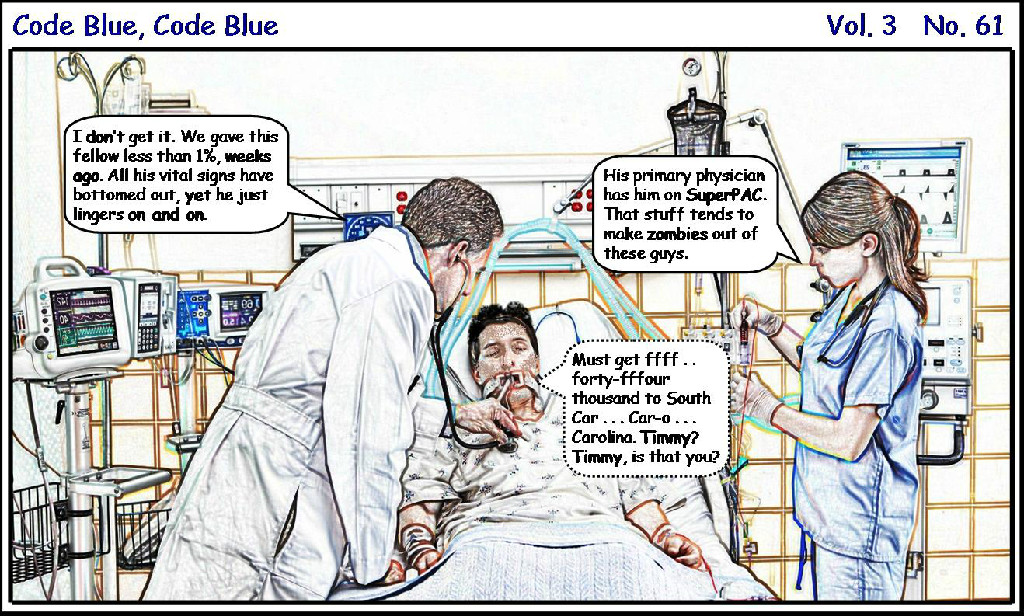
Edwards entered the race with little name recognition outside the Florida parishes of Louisiana. He was pitted against three Republican incumbents: Public Service Commissioner Scott Angelle, popular Lt. Gov. Jay Dardenne and the state’s senior U.S. Senator David Vitter who had—and still has—more money than his three opponents combined, thanks to a Super PAC formed on his behalf. That Super PAC, the Fund for Louisiana’s Future, ironically is headquartered not in Louisiana, but in Washington, D.C.

But Vitter had that enormous negative—his reputation as a whoremonger who reportedly cavorted with prostitutes in Washington and New Orleans.

But despite the lack of name recognition and a campaign war chest that nowhere approached that of Vitter, Edwards, a state representative from Tangipahoa Parish, still managed to pull in 40 percent of the vote to only 23 percent for Vitter.

Granted, Edwards was the only major Democratic candidate in the primary but still, fully 77 percent of those who voted preferred someone other than Vitter as our next governor.

Angelle received 19 percent of the vote while Dardenne got 15 percent.

Vitter led or won outright in 10 parishes while Angelle won a majority or plurality in nine. Edwards won or led in the remaining 45.

That leaves Edwards needing only another 11 percent from Angelle’s and Dardenne’s 34 percent and the 3 percent that went to three other minor candidates to put him over the top while Vitter needs to pick up 28 percent.

There’s no love lost between Vitter and his two Republican opponents.

In fact, on Saturday, the campaigns of both Dardenne and Angelle campaigns sent out emails to supporters calling attention to the arrest of a private investigator working on behalf of the Vitter campaign. http://www.jaydardenne.com/vitter-staffer-arrested/?utm_medium=email&utm_source=sp&utm_campaign=20151024_23829285_Jay%20Dardennne&utm_content=body_txt_directlink&action=email_click&ha1=

Vitter’s campaign has paid J.W. Bearden & Associates of Dallas $135,000 since August of 2014 and on Friday, an employee of the firm, Robert Frenzel of Dallas, was arrested for secretly recording Jefferson Parish Sheriff Newell Normand, a Dardenne supporter, and State Sen. Danny Martiny of Metairie.

Bearden acknowledged that Frenzel worked for the firm but Vitter campaign spokesman Luke Bolar said the intent was to conduct surveillance on an Edwards supporter and not Normand. Oh, well, that’s different.

When arrested, Frenzel was found to have in his possession a dossier on New Orleans blogger Jason Brad Berry who recently has been publishing a series of interviews with prostitutes who claim to have had sexual relations with Vitter, including one who says Vitter fathered a child by her in 2000.

The email from Dardenne’s campaign said of Frenzel’s arrest, “I hope that you will share this with every one of your family and friends. We’re no strangers to political corruption, but usually these crooked politicians wait until after they get elected to betray our trust. We now know the real David Vitter.” Dardenne added, “He’s cheated, he’s lied and now he’s been caught spying.”

Likewise, Angelle said, “A man who has been unfaithful to his wife and (who has) been caught spying on Louisiana citizens does not have the moral character to be governor of our great state.” Angelle, like Dardenne, did not endorse anyone in the runoff.

So, why is it that two Republicans who failed to make the runoff have thus far refused to endorse fellow Republican Vitter?

For that, Vitter has no one but Vitter to blame. His onslaught of negative ads—he had more than twice as many TV ads as Angelle, his nearest competitor—had to leave a sour taste in Angelle’s and Dardenne’s mouths. Vitter relentlessly attacked the records and characters of both men which could force each of them to simply sit on the sidelines with no indication to supporters on whom to support.

Vitter’s ads against the two were particularly vitriolic in their content and now that he has disposed of them, he will no doubt turn his guns on his Democratic opponent. But Edwards made it clear on Saturday night that he was prepared.

“This is going to be a real tough runoff to watch unfold on TV,” he told supporters. A West Point graduate, Edwards referenced the West Point Honor Code which says, “A cadet will not lie, cheat, steal or tolerate those who do.” He then said to a chorus of cheers, “David Vitter wouldn’t last five minutes at West Point. He’s desperate and all he offers are lies.”

Edwards predicted that Vitter would do everything possible to link him to President Obama and Vitter didn’t let him down. In his own address to supporters following Angelle’s concession, Vitter said, “Voting for John Bel Edwards would be like voting for Barack Obama to be governor of Louisiana.”

Edwards, calling Vitter “Jindal on steroids,” noted that all four candidates supported “in some form or other,” expansion of Medicaid for Louisiana so that more low-income families can have health care.

Saying that he had avoided negative ads, Edwards then fired a shot across Vitter’s bow when he said, “If David Vitter wants to talk about who we associate with, I’m more than ready to do that.”

From hookers to private investigators illegally intercepting others’ communications, Vitter’s obnoxious behavior goes back at least to 1993 when then-State Rep. Vitter physically assaulted a woman who questioned his vote against killing a bill that would protected gays and lesbians from employment discrimination. http://cenlamar.com/2015/03/24/in-1993-david-vitter-physically-assaulted-woman-accusing-him-of-supporting-gay-rights/

Not only does Vitter have The Fund for Louisiana’s Future, a Super PAC, but Baton Rouge lobbyist and attorney Jimmy Burland, writing on Vitter’s behalf, sent an email last week to several hundred state lobbyists in which he solicited individual $5,000 contributions from each in a series of Vitter meet-and-greet events which began today (Sunday, Oct. 25). He said in his email that the Vitter campaign needed to raise $3 million.

It didn’t take long to get a reaction to that brazen pay-to-play proposal. The Louisiana Association of Educators (LAE) on Oct. 23, two days after LouisianaVoice published news of the email solicitation, announced that it had severed all ties with the Burland and Associates lobbying and political affairs group, effective immediately.

“The parting of ways comes in light of a recent letter distributed by the firm’s owner, James Burland, soliciting contributions for the David Vitter campaign. LAE President and LAE-FCPE Chair Debbie Meaux said the move is troubling, as it is a blatant contradiction of the whole foundation of the firm’s business focus,” LAE said in a news release.

So now it comes down to choosing between a graduate of West Point and platoon leader of the Army’s 82nd Airborne who fought Bobby Jindal for eight years or a man who spies on opponents, cheats on his wife, physically attacks women who question him, avoids answering questions about his records, avoids debates or appearing at venues at which he does not have pre-screened questions and who has any reporter who questions him fired.

That’s the choice, folks. Forget about the Democrat and Republican labels and for once, let’s vote for leaders, for character, for trustworthiness. For all you people out there who puff up your chests and proclaim that you “don’t vote for the party but for the best candidate,” now is the time to put up or shut up.

If Vitter wins this election, LouisianaVoice will be watching his every move.

If Edwards wins and the Republican legislature attempts to block his programs which we believe would be best for the state, we will track campaign contributions, contracts and legislative votes that benefit large donors like banks, oil companies, pharmaceutical firms, nursing homes and insurance companies like never before. Votes on equal pay for women, anti-discrimination, higher education and health care will be scrutinized and chronicled for all to see.

If an Edwards administration becomes a smaller version of Congress where Republicans use parliamentary moves to block good legislation or if they try to tack on amendments like the infamous Mike Edmonson retirement enhancement amendment, we will by-God subject you to more exposure than you ever dreamed possible.

You are on notice.

One more thing: The Fund for Louisiana’s Future and all other out-of-state PACs need to stay the hell out of Louisiana politics. Forever. We don’t need outside money telling us how we should vote. We’ve seen what big money does to politics: it amplifies the voices of the special interests while muting our own.

And we don’t like that.
Read Full Post »

With all that’s going on with the Louisiana State Police, it has become easy to overlook the fact that we will be voting in a little more than two weeks for someone to try to undo the damage done by eight years of the Jindal carnage inflicted upon this state. (Don’t worry, we’ll get back to the State Police in a day or so.)

The governor’s race, unlike those of past years, has failed to generate a lot of interest among voters. That’s probably because the media has convinced us that U.S. Sen. David Vitter is a lock to be our next governor. I mean, who could possibly get excited over an election when we’re being told that it’s inevitable that the pariah of femininity will be our next governor?

Speaking of the media, the questions posed in the televised debates thus far have been nothing short of disgraceful. It’s no wonder that people are turned off by this year’s election. How, after all, does Kim Davis even begin to figure in the issues facing Louisiana’s next governor? That question was just plain stupid and a huge waste of time.

And who put the media in charge of anointing winners even before an election? Do our votes actually count anymore? (We will be addressing those questions shortly.)

First of all, what self-respecting Republican woman in Louisiana would ever cast a vote for someone like Dave Vitter? For that matter, what Republican woman would ever allow her husband to vote for this man who has only contempt for women as exhibited by the fact that:

  • He frequented prostitutes in Washington, D.C. and New Orleans;
  • He kept an aide, Brent Furer, on his payroll for more than a year after Furer held his ex-girlfriend hostage, threatened to kill her and in fact, attacked her with a knife. Vitter denied Furer was assigned to women’s issues. Furer’s title? Legislative Assistant on Women’s Issues.
  • He voted a year ago to block the Paycheck Fairness Act despite the fact that Louisiana ranks second-worst in the nation in gender pay disparity.

We say Republican women only because we feel it’s a foregone conclusion no Democrat woman would ever vote for this man who continues to refuse to address his personal and public issues with women.

But all that aside, let’s look at the real reason that Vitter is considered a favorite to make the runoff against Democrat John Bel Edwards.

Money. Lots of money.

And that brings us to the questions we posed earlier: Who anoints the winners and do our votes really count?

First of all, a super PAC is established for his benefit. Super PACs are the scourge of the democratic process, folks. End of discussion. And his Super PAC, ironically dubbed The Fund for Louisiana’s Future in what must have been someone’s idea of a cruel joke, had more than $3 million on hand at the end of 2014. And that doesn’t even count the money he has raised directly in corporate and special interest contributions.

The very existence of the Super PAC teetered on the edge of legality and was approved only after a court fight. Super PACs are barred from coordinating with candidates’ campaigns but if you believe Vitter has not involved himself in the decision-making process of The Fund for Louisiana’s Future, I’ve got some beautiful beachfront property near that Bayou Corne sinkhole in Assumption Parish for sale really cheap.

If you trust Vitter even for a nano-second, I’ve got a straitjacket in just your size.

His Super PAC aside, Vitter has another $4 million on hand as we head into the final stretch for the first primary on Oct. 24. As anyone not in a coma must surely know, The Fund for Louisiana’s Future has already initiated a media blitz attacking Vitter’s two Republican opponents, Lt. Gov. Jay Dardenne and Public Service Commissioner Scott Angelle on the assumption that he must eliminate them to get into the runoff. He apparently is holding off on attacking State Rep. John Bel Edwards until the second primary.

Compare that to $1.6 million for Darden who has yet to crank up his TV ad campaign, $1.4 million for Edwards, and $1 million for Angelle.

Far more telling, however, is an examination of who contributes and where those contributions are coming from.

For that, we pulled only the contributions of those giving the maximum allowable $5,000. To go deeper would have just taken far too much space.

Before we begin our look into the contributions, ask yourself this question: If you give $100 or even $250 to a candidate and he is elected and down the road your interests conflict with a donor who coughed up the $5,000 maximum, who do you think will get the politician’s ear? What chance would you have in such a scenario? We thought so.

This is not a hypothetical, folks. This is real. It’s not Monopoly money. It’s money poured into campaigns by special interests who have a reason for parting with their money—and the reason is not their hunger for good, honest government that motivates them.

Remember that if you remember nothing else when you walk into that voting booth on Oct. 24.

You are a moving part in a very large machine that is being lubricated with cash in order to turn out legislation that benefits any number of special interests, none of whom even knows who you are. When you exit the voting booth, that big money has no more use for your services—until the next election cycle.

Cold? Callused? Jaded? Yes, yes, and yes. But we at LouisianaVoice are pragmatists, not idealists. We as a society do not pledge allegiance to the flag; we pledge allegiance to the oil companies, the banks, Wall Street, and major contractors. Sorry if we burst anyone’s bubble, but facts are facts, unpleasant though they may well be. Here’s another little factoid: the Pledge of Allegiance was written by a socialist. Chew on that for a while, tea partiers.

Looking just at $5,000 contributions, we find that Vitter had 970 donors putting up the maximum, or $4.85 million. That’s a huge—very huge—chunk of his total contributions. Of that 970, there were 164 (17 percent) from out of state. That’s $820,000—more than the total of all the $5,000 contributions to Edwards and only $30,000 less than those of Dardenne.

Angelle barely had a third as many $5,000 contributors (340 for $1.7 million). Of those 340, no fewer than 81 (24 percent) were from out of state. Like Vitter, the $5,000 contributors made up a sizable block of his total campaign contributions. Where does that leave the $5, $10 and $20 contributors in the overall scheme of things?

From those figures, the numbers dropped precipitously for Dardenne and Edwards. Dardenne received 170 contributions of $5,000 each for a total of $850,000, about half of his total contributions, according to records obtained from the State Ethics Commission. Sixteen, or 9.4 percent, were from out of state.

Edwards recently issued a press release touting the low number of out-of-state contributors to his campaign. Records show that he received 114 contributions of $5,000 each for a total of $570,000. Only three of those, or 2.6 percent, were from out-of-state, in his case, all three from Texas.

This is an important election and Louisiana citizens need to get up off the couch, put down that bag of chips and forget about football for the few minutes that it takes to act on this state’s future.

No matter who wins, it is going to be difficult, if not impossible, to get this state back on the course of recovery after eight years of neglect, abuse, and outright corruption. The new governor is going to inherit a massive deficit, all manner of problems from higher education and public education, the state hospital privatization mess, a world-leading incarceration rate, corporate welfare (Stephen Waguespack’s protestations notwithstanding), and one of the highest poverty rates in the country, to name but a few.

So here is one last question to ask yourself before you enter that voting booth:

Do you vote for the candidate who had the most money to saturate the television airwaves with ads containing half-truths and outright lies, a candidate who is bought and paid for by Wall Street, the pharmaceutical firms, big oil, the major banks and similar special interests or do you vote for the candidate who you truly feel will devote his efforts to addressing the state’s problems head-on?

The state’s future dos not belong to The Fund for Louisiana’s Future. That vote-buying Super PAC is not even in Louisiana; it’s in Washington, D.C.

The state’s future instead belongs to you.

The choice is yours.

Read Full Post »

In a state drowning in consulting contracts, what’s one more?

Bobby Jindal is a lame duck governor who long ago set his sights on bigger and better things. He has abdicated every aspect of his office except the salary, free housing and state police security that go with the title. In reality, he has turned the reins of state government over to subordinates who are equally distracted in exploring their own future employment prospects.

His only concerns in almost eight years in office, besides setting himself up to run for President, have been (a) appointing generous campaign donors to positions on state boards and commissions and (b) privatizing state agencies by handing them over to political supporters.

To that end there has been a proliferation of consulting contracts during the Jindal years. The legislative auditor reported in May that there were 19,000 state contracts totaling more than $21 billion.

So as his term enters its final months and as Commissioner of Administration Kristy Nichols has less than a month before moving on to do for Ochsner Health System what she’s done for the state, what’s another $500,000?

LouisianaVoice has learned that Nichols signed off on a $497,000 contract with ComPsych Corp. and its affiliate, FMLASource, Inc. of Chicago, to administer the state’s Family and Medical Leave Act (FMLA) program. FMLA CONTRACT

It is no small irony that Nichols signed off on the contract on May 19, less than two weeks after the legislative auditor’s report of May 6 which was highly critical of the manner in which contracts are issued with little or no oversight.

The latest contract removes the responsibility for approving FMLA for state employees and hands it over to yet another private contractor.

Apparently FMLA was just one more thing the Jindal administration has determined state employees are incapable of administering—even though they have done so since the act was approved by Congress in 1993.

Because no state employees stand to lose their jobs over this latest move, the contract would seem to simply be another consulting contract doled out by the administration, obligating the state to more unnecessary expenditures.

Whether it’s farming out the Office of Risk Management, Office of Group Benefits, funding voucher and charter schools, or implementing prison or hospital privatization—it’s obvious that Jindal has been following the game plan of the American Legislative Exchange Council (ALEC) to the letter. That plan calls for privatizing virtually every facet of state government. If you don’t think the repeated cuts to higher education and health care were calculated moves toward ALEC’s goals, think again.

The contract runs from May 17, 2015 through May 16, 2016, and the state agreed to pay FMLAServices $1.45 per state employee per month up to the yearly maximum of $497,222.

Agencies for which FMLAServices will administer FMLA include the:

  • Division of Administration;
  • Department of Economic Development;
  • Department of Corrections;
  • Department of Public Safety;
  • Office of Juvenile Justice;
  • Department of Health and Hospitals;
  • Department of Children and Family Services;
  • Department of Revenue;
  • Department of Transportation and Development.

The legislative auditor’s report noted that there is really no way of accurately tracking the number or amount of state contracts. STATE CONTRACTS AUDIT REPORT

“As of November 2014, Louisiana had at least 14,693 active contracts totaling approximately $21.3 billion in CFMS. However, CFMS, which is used by OCR to track and monitor Executive Branch agency contract information, does not contain every state contract.

“Although CFMS, which is a part of the Integrated Statewide Information System (ISIS), tracks most contracts, primarily Executive Branch agencies use this system. For example, Louisiana State University obtained its own procurement tracking system within the last year, and most state regulatory boards and commissions do not use CFMS (Contract Financial Management System). As a result, there is no centralized database where legislators and other stakeholders can easily determine the actual number and dollar amount of all state contracts. Therefore, the total number and dollar amount of existing state contracts as of November 2014 could be much higher.”

The audit report also said:

  • State law (R.S. 39:1490) requires that OCR (Office of Contractual Review) adopt rules and regulations for the procurement, management, control, and disposition of all professional, personal, consulting, and social services contracts required by state agencies. According to OCR, it reviews these types of contracts for appropriateness of contract terms and language, signature authorities, evidence of funding and compliance with applicable laws, regulations, executive orders, and policies. OCR also reviews agencies’ procurement processes against competitive solicitation requirements of law. The contracting entity is responsible for justifying the need for the contract and conducting a cost-benefit analysis if required.
  • However, state law does not require that a centralized entity approve all state contracts.
  • According to the CFMS User Guide, OCR is only required to approve seven of the 20 possible contract types in CFMS. The remaining 13 types accounted for 8,068 contracts totaling approximately $6.2 billion as of November 2014. Exhibit 2 lists the 20 types of contracts in
  • CFMS and whether or not OCR is required to approve each type, including the total number and dollar amount of these contracts.
  • In fiscal year 2014, 72 agencies approved 4,599 contracts totaling more than $278 million.

The Office of Contractual Review was since been merged with the Office of State Procurement last Jan. 1.


Read Full Post »

JINDAL ON LIFE SUPPORT

We couldn’t resist this one from our favorite cartoonist. (CLICK ON IMAGE TO ENLARGE)

The timing could not have been better—or worse, depending upon your perspective.

But all things considered, Wednesday was a bad day for a certain Louisiana governor flailing away in a doomed quest for the Republican presidential nomination.

If he posed so much as a remote threat against any of his Republican opponents for the Republican presidential nomination, today’s events would surely be used against him in an campaign ad blitz. But he doesn’t and they won’t.

On the one hand, there was the survey released Wednesday (Sept. 24) by 24/7 Wall Street, the service that publishes all sorts of survey results from the best-selling cars to the worst-performing state governments. The latest survey shows Louisiana to be the fifth worst-educated state in the nation.

On the other, there was the story, also on Wednesday, that said Louisiana’s public colleges and universities have been told to “be prudent” with their current budgets—a not-so veiled way of saying get ready for more budget cuts.

The U.S., in case you haven’t been paying attention, has some of the most expensive college educations in the world—and the expenses have risen to record highs, the survey said. In fact, the cost of a college education has increased faster than the rate of inflation—24 percent just since 2012,

Only 22.9 percent of adults in Louisiana hold at least a bachelor’s degree, which ranks 46th in the nation and well below the national average of more than 30 percent. That puts the state two notches behind Alabama’s 23.5 percent and ranked higher than only Kentucky (22.2 percent), Arkansas (21.4 percent), Mississippi (21.1 percent), and West Virginia (19.2 percent). Massachusetts had the highest with 41.2 percent of its adults having attained at least a bachelor’s degree.

In fact, Louisiana ranks just ahead of our next door neighbor in so many surveys that rumor has it there may be a bill introduced in the next legislative session to change the state’s motto from “Union, Justice and Confidence” to “Hey, At Least We Aren’t Mississippi.”

Louisiana had the fourth lowest percentage (83.6 percent) of high school graduates.

Louisiana also ranked seventh lowest with a median household income of $44,555 in 2014 and even those among the 22.9 had the seventh lowest median earnings ($46,903) for bachelor degree holders. Even more depressing is the fact that the median income for holders of bachelor’s degrees managed to pull the overall median average up by less than $2,500 per year.

Nearly one in five Louisianians live below the poverty line, the third highest poverty rate in the nation. This, in a state with three of the 10 busiest ports in the nation (including the busiest, the Port of South Louisiana, and the 4th and 10th busiest, New Orleans and Baton Rouge) and three of the nation’s largest refineries (Marathon in Garyville, Exxon in Baton Rouge, and Citgo in Lake Charles).

Moreover, the state is embarrassingly rich in chemical plants, oil and gas reserves, sulfur, agriculture and seafood. But still we consistently lag behind the rest of the nation in every conceivable measure of progress and prosperity.

And yet, here we are, teetering at the edge of yet another midyear budget shortfall, or as State Treasurer John Kennedy said, “We have hit the trifecta, but not in a good way.” He was talking about the news that we have just learned that we’re going to have to make up for last fiscal year which ended June 30 with a deficit (though Bobby Jindal and Commissioner of Administration Kristy Nichols won’t say how much). Together, Kennedy said, the combined shortfalls for last fiscal year and the current year combine to paint a bleak picture for next year as well, as the combined deficit is expected to approach $1 billion.

(Note to Kristy: Don’t let the door hit you on the backside as you exit next month on the way to grab your golden parachute with Ochsner Health System.)

Though the Jindal administration isn’t saying much about the latest crisis (you have to wonder how Bobby will spin this in his fiscal responsibility message on the GOP presidential campaign trail), Kennedy at least doesn’t duck the issue. He estimates it to be more than $100 million.

This budgetary news comes on top of the Medicaid shortfall of more than $300 million, a TOPS fund which is projected to be $19 million short and word that Jindal’s ill-fated hospital privatization plan has hit yet another major setback.

LSU, citing a breach of the public purpose, terminated its cooperative endeavor agreement with the Biomedical Research Foundation of Northwest Louisiana (BRF) barely two years after the foundation took over operation of two north Louisiana hospitals.

Saying all avenues to resolve differences had been exhausted, LSU President F. King Alexander said that Academic Health of North Louisiana Hospital Management Co., Inc., will take over operation of University Health Shreveport and University Health Conway.

It was so bad for Jindal that he missed a golden opportunity when the Pope spoke to a joint session of Congress on Wednesday.

When President Obama visited New Orleans on the 10th anniversary of Hurricane Katrina last month, Jindal sent a message asking that the President not talk about climate change when he came here. But when he had the opportunity to offer that same advice to Pope Francis, Jindal, a Roman Catholic, remained mute.

Perhaps he was just too busy traveling around Iowa telling anyone who would listen (that would be Timmy Teepell and Kyle Plotkin) what a great job he has done as governor of Louisiana and how he is uniquely qualified to run the country.

We are reminded of the Winston Churchill quote about Clement Atlee that could be adapted so easily to our governor: An empty taxi pulled up in front of the Iowa caucus and Bobby Jindal got out.

Read Full Post »

The next time you see a couple of state troopers escorting Les Miles or Nick Saban at an LSU or Alabama football game, don’t get angry that the coach, surrounded by about 100 beefy football players, feels the need for additional protection from fans. It turns out they’re not there to protect the coaches; they’re there to carry their bulging wallets.

Of the highest paid public employees in each state, 40 are college football and basketball coaches who combined, pull in an eye-popping $129.1 million, according to 24/7 Wall Street, a service that provides research in several areas of business, education, economics and politics.

That’s an average of $3.225 million per year.

The remaining 10 highest paid were mostly in academics, including four college presidents, three state medical school professionals, a nursing supervisor, a commissioner of higher education and an associate professor.

Of the 40 coaches, only six—four football coaches and two basketball coaches—are paid less than $1 million a year and one of those, University of Massachusetts basketball coach Derek Kellogg, receives $994,500 per year.

The 28 football coaches make a combined $95.6 million, an average of $3.41 million per year in salary while the 12 basketball coaches combined to make $33.5 million, an average of $2.79 million annually.

The University of Alabama’s Nick Saban had been the highest-paid football coach at $6.95 million but the University of Michigan is paying first-year coach Jim Harbaugh a whopping $7 million a year. LSU’s Les Miles is paid $4.3 million a year.

For the most part, of course, their salaries are not primarily funded by taxpayers. Generally, their paychecks are underwritten by foundations supported by ticket sales and advertising deals. Harbaugh, for example, receives only $500,000 of his $7 million package from the school.

Still, the disparity in the salaries of coaches and typical state employees is enough to rankle some state employees. At Boise State University, for example, both the football and basketball coaches make a more modest salary of $500,000 but that is still more than 10 times the $40,000 or less earned by more than a third of Idaho state employees.

To counter criticism of the high salaries, some college athletic programs point out that successful coaches can bring a university tens of millions of dollars in revenue. Saban is an example of that. Before he was named head coach at ‘Bama, the school’s athletic program brought in $68 million. In 2013-2014, revenue was $153 million.

Still, critics say that athletic programs at the top tier schools like Alabama, constitute a business and coaches should not receive a cent of public funds in salary.

Which may have prompted the fable of a coach’s retort (and we paraphrase here): “I never saw anyone pay to watch a chemistry class.”

Here is the list of each state’s highest paid public employee:

ALABAMA:                NICK SABAN                FOOTBALL COACH              $6.95 M

ALASKA:                    JAMES JOHNSEN      COLLEGE PRES.                    $325,000

ARIZONA:                  SEAN MILLER            BASKETBALLCOACH          $3.07 M

ARKANSAS                BRET BIELEMA         FOOTBALL COACH              $4 M

CALIFORNIA             JAMES MORA            FOOTBALL COACH              $3.35 M

COLORADO               MIKE MacINTYRE     FOOTBALL COACH              $2.01 M

CONNECTICUT          KEVIN OLLIE             BASKETBALL COACH         $3 M

DELAWARE               EKEOMA WOGU       NURSING SUPERVISOR      $236,156

FLORIDA                    JIMBO FISHER          FOOTBALL COACH              $5 M

GEORGIA                   MARK RICHT             FOOTBALL COACH              $4 M

HAWAII                      NORM CHOW             FOOTBALL COACH              $550,000

IDAHO                        BRYAN HARSIN         FOOTBALL COACH              $800,000

ILLINOIS                    JOHN GROCE             BASKETBALL COACH          $1.7 M

INDIANA                    TOM CREAN              BASKETBALL COACH          $3.05 M

IOWA                          KIRK FERENTZ          FOOTBALL COACH              $4.08 M

KANSAS                     BILL SELF                    BASKETBALL COACH          $4.75 M

KENTUCKY               JOHN CALIPARI        BASKETBALL COACH          $6.01 M

LOUISIANA                LES MILES                  FOOTBALL COACH              $4.3 M

MAINE                        SUSAN HUNTER        COLLEGE PRESIDENT        $250,000

MARYLAND              MARK TURGEON        BASKETBALL COACH          $2.248 M

MASSACHUSETTS     DEREK KELLOGG     BASKETBALL COACH        $994,500

MICHIGAN                 JIM HARBAUGH        FOOTBALL COACH              $7 M

MINNESOTA              JERRY KILL                  FOOTBALL COACH              $2.5 M

MISSISSIPPI                HUGH FREEZE           FOOTBALL COACH           $4.3 M

MISSOURI                  GERY PINKEL               FOOTBALL COACH           $4.02 M

MONTANA                 CLAY CHRISTIAN     COMM. HIGHER ED              $351,000

NEBRASKA                MIKE RILEY               FOOTBALL COACH              $2.7 M

NEVADA                     KAYVAN KHIABANI   ASSOC. PROFESSOR          $981,475

NEW HAMPSHIRE   MARK HUDDLESTON   COLLEGE PRES.             $333,658

NEW JERSEY             KYLE FLOOD             FOOTBALL COACH              $1.25 M

NEW MEXICO            BOB DAVIE                FOOTBALL COACH              $772,690

NEW YORK                SHASHIKANT LELE  MED SCH. DEPT. CHAIR    $551,000

NORTH CAROLINA MARK GOTTFRIED   BASKETBALL COACH          $2.06 M

NORTH DAKOTA ROBERT STICCA       UNIV. SURGERY CHAIR      $758,000

OHIO                           URBAN MEYER         FOOTBALL COACH              $5.8 M

OKLAHOMA              BOB STOOPS              FOOTBALL COACH              $5.25 M

OREGON                    MARK HELFRICH      FOOTBALL COACH              $3.15 M

PENNSYLVANIA       JAMES FRANKLIN    FOOTBALL COACH              $4.1 M

RHODE ISLAND        DAN HURLEY            BASKETBALL COACH          $627,500

SOUTH CAROLINA  STEVE SPURRIER     FOOTBALL COACH              $4 M

SOUTH DAKOTA     MARY NETTLEMAN MED. SCHOOL DEAN           $500,000

TENNESSEE               BUTCH JONES           FOOTBALL COACH              $2.96 M

TEXAS                         CHARLIE STRONG    FOOTBALL COACH              $5.1 M

UTAH              KYLE WHITTINGHAM          FOOTBALL COACH              $2.6 M

VERMONT                  TOM SULLIVAN        COLLEGE PRES.                    $429,093

VIRGINIA                   FRANK BEAMER       FOOTBALL COACH              $2.42 M

WASHINGTON           MIKE LEACH             FOOTBALL COACH              $2.75 M

WEST VIRGINIA        BOB HUGGINS       BASKETBALL COACH          $3.25 M

WISCONSIN               BO RYAN                   BASKETBALL COACH          $2.75 M

WYOMING                 CRAIG BOHL             FOOTBALL COACH              $832,000

28 FOOTBALL COACHES:             $95.6 MILLION ($3.41 MILLION AVERAGE)

12 BASKETBALL COACHES:         $33.5 MILLION ($2.79 MILLION AVERAGE)

50 TOTAL COACHES:                     $129.1 MILLION ($3.225 MILLION AVERAGE)

10 ACADEMIC, OTHER:                 $4.72 MILLION ($472,000 AVERAGE)

TOTAL:                                              $133.73 MILLION ($2.67 MILLION)

Read Full Post »

« Newer Posts - Older Posts »


