Feeds:
Posts
Comments

Archive for the ‘Fraud’ Category

The movies Dawn of the Planet of the Apes, Terminator, Jurassic park 4, Ender’s Game, and G.I. Joe: Retaliation were all shot in New Orleans. More specifically, they are all filmed in the Big Easy Studios in New Orleans. http://www.bigeasystudiosneworleans.com/aboutus.php

Geostorm, starring Gerard Butler as a satellite designer who goes into space to thwart climate-controlling satellites from creating catastrophic storms, just started shooting in the Big Easy Studios which are housed, appropriately enough, in the Michoud Assembly Center which once built the space shuttle’s external tanks before the shuttle project was scrapped by NASA.

All of which begs two single overriding questions: did Big Easy Studios receive favorable treatment in landing the lease of the 1.8 million-square-foot facility and were other Louisiana-based studios afforded the same opportunity to compete for a similar deal with NASA?

Taking the questions in reverse order, we will probably never know what chances, if any, other studios had to vie for the space but at least one competitor said there was no open competition for the facility.

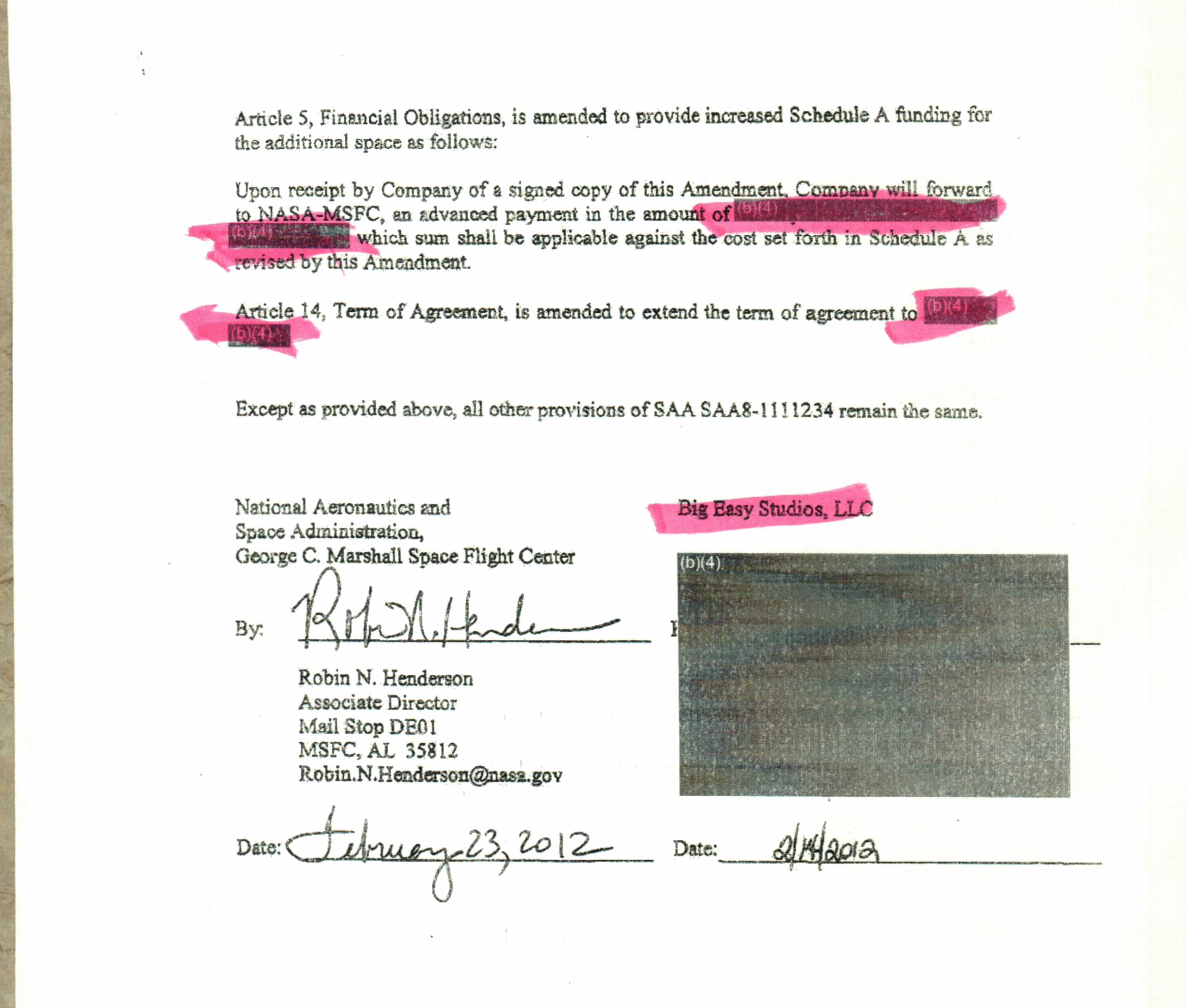
The answer to the first is shrouded in secrecy as lease terms, including rental and payments, as well as the very signatures of Big Easy principals signing the lease were redacted throughout the 28-page lease document. We suppose lease payments may be some kind of protected state secret which fall under the heading of national security.

IMAG0384

(CLICK ON IMAGE TO ENLARGE)

Still, with conspiracy theorists out there who continue to insist the 1969 moon landing was staged, one would think NASA would be a little skittish about leasing out its facilities for movie making.

But there are more serious issues involving NASA’s decision to lease the gigantic facility to a movie production company. For openers, NASA’s rules say that any deal with an outside entity must serve the agency’s mission. NASA’s response was that anything that brings the federal government revenue serves NASA’s mission. Taking that logic to its extreme, it would seem safe to say a meth lab or house of ill repute could conceivably qualify under that definition.

NASA rules also dictate that any lease agreement must recover the full cost of the rented space and must not create unfair competition with the private sector by undercutting its lease terms. Yet, competing studios maintain that first, they were not given the opportunity to compete for the lease and the lease arrangements with Big Easy Studios and second, that they pay higher rent per square foot than Big Easy Studios.

So just how did Big Easy gain such an advantage, if indeed it did?

To answer that, we must take a look at the two principals of Big Easy Studios.

Herbert W. Gains, an independent filmmaker, was in New Orleans in 2010 to film Green Lantern, much of which was shot at the Lakefront Airport.

At the same time, The Lathan Co. of Mobile, Alabama, was under contract to perform major repairs and restoration work to the airport which had been heavily damaged by Hurricane Katrina. http://www.lathancompany.com/portfolio/lakefront.html

Lathan Co. President Jerry Lathan, a member of the Alabama Republican Party’s State Executive Committee who had worked in the presidential campaigns for Bob Dole and both Presidents Bush as well as other local, state and national Republican candidates, also had contracts for restoration of a number of other structures, including four others in New Orleans and one at East Louisiana Hospital in Jackson.

http://www.lathancompany.com/projects.html

Lathan, who reportedly likes to boast of his political contacts, would probably have had connections at the U.S. Space & Rocket Center in Huntsville, Alabama, through which he could have assisted Gains in acquiring access to NASA.

http://algop.org/jerry-lathan/

Big Easy Studios was incorporated on Nov. 9, 2011, with Gains and Lathan as the only officers, and the lease with NASA was signed by an unidentified officer of the new company (remember, that name was redacted) 16 days later, on Nov. 22, 2011. An amendment to the contract was signed less than three months later, on Feb. 14, 2012, by Robin Henderson of the George C. Marshall Space Flight Center but again, the names and signature of the Big Easy officer were again redacted.
IMAG0386

(CLICK ON IMAGE TO ENLARGE)

Stephen Moret, secretary of the Louisiana Department of Economic Development (LED), said his office had “many conversations” with NASA about the need to offer more competitive lease rates at Michoud to better position the facility to attract “advanced manufacturing projects.”

The director of operations for one competing studio told the Baton Rouge Business Report in 2012 that he had heard from producers that Big Easy received lease rates more favorable than his studio. “The taxpayers didn’t fund Michoud to make movies,” he said. “The lease with Big Easy Studios was a done deal before we even knew the facility was available.”

http://businessreport.com/article/20120917/BUSINESSREPORT0112/120919831/

While, studios located in Louisiana once received 40 percent infrastructure tax credits—discontinued in 2009—the movies filmed in those studios still receive movie production tax credits and the system quickly led to widespread abuses that prompted the conviction and a 70-month prison sentence for for Martin Walker of Baton Rouge for his activity involving the buying and selling of Louisiana motion picture investor tax credits. He also was ordered to pay more than $1.8 million in restitution to 24 victims of his fraud.

In 2009, revisions to state incentives guaranteed a tax credit of 30 percent of expenditures provided a production spends more than $300,000 in Louisiana. Major productions like Twilight: Breaking Dawn can receive state tax credits of $10 million to $30 million.

Because most productions don’t owe any taxes in Louisiana, there is no need to claim the credits but they can transfer those credits to the state and the state will cut the companies a check for 85 percent of the face value of the credits. Thus, if a production company earns $1 million in Louisiana tax credits, those credits can be transferred back to the state and the state will issue the company a check for $850,000.

Another option, a variation of which landed Walker in hot water, allows production companies to sell their credits to individuals or corporations who do owe taxes in the state at a discount. Should an individual or corporation owe the state $1 million, for example, and a production company holds a $1 million tax credit, the production company may sell its tax credit to a speculator for say, $500,000 and that person in turns sells the credit for $750,000 to the individual or corporation owing the $1 million in taxes who then receives a $1 million tax credit—and each party profits $250,000.

That means when production companies sell their credits to the private sector, state taxpayers end up subsidizing tax breaks for high income individuals and corporations.

In Walker’s case, though, he sold bogus tax credits with a face value of more than $3.8 million to 24 investors for $2.5 million.

Louisiana Inspector General Stephen Street said of the Walker matter, “This sort of blatant fraud undermines the entire tax credit program and cannot be tolerated. We will continue working with the FBI and United States Attorney to make sure that those who engage in this sort of corruption face criminal consequences.”

Former State Film Commissioner Mark Smith described the movie industry in Louisiana as “smoke and mirrors.” He said in Los Angeles and New York, “I can see the headquarters and see who the real players are. In places like Louisiana, who can see it?”


Read Full Post »

When Jeff Skilling took over as President and Chief Operating Officer of Enron in June of 1990, he did so only after insisting that the company convert from conventional accounting principles to a method preferred by his former employer, McKinsey & Co.

In 2001, hedge fund manager Richard Grubman said to Skilling, “You are the only financial institution that can’t produce a balance sheet or cash flow statement with their earnings.” By October of that same year, Enron had begun its death spiral in a historic collapse that would pull the giant accounting firm Arthur Andersen down with it.

The key to Enron’s failure was the mark-to-market accounting method, where anticipated revenues and profits are entered into the company’s books before they are ever received. The system allowed Enron to conceal losses and to inflate profits for nearly 11 years before its house of cards came crashing down.

On Thursday (Oct. 8), nearly seven years into his administration, Gov. Bobby Jindal (R-Iowa, R-New Hampshire, R-Anywhere but Louisiana) rolled out a new accounting formula with an alarmingly familiar ring to it.

Jindal, like Skilling, is a McKinsey alumnus.

Commissioner of Administration/Surrogate Gov. Kristy Kreme Nichols announced that the state, instead of having a deficit of $141 million as claimed by State Treasurer John Kennedy, will suddenly have a surplus of $178.5 million, a gaping difference of $319.5 million.

Nichols did not reveal how the $178.5 million was arrived at but Kennedy said the administration is switching to a cash balance form of accounting instead of the modified accrual basis employed by state governments. “If we use the methodology we have always used,” he said, “we don’t have a surplus. We have a $141 million deficit.

“The commissioner says the calculation has been inaccurate for years and it needs to be changed,” he said. “They have to explain why we have been doing it wrong all these years and why the Revenue Estimating Conference is doing it wrong.”

Nichols, an appointed state employee, was less than deferential to Kennedy, a statewide elected official when she sniped back at Kennedy, saying, “I’m surprised the treasurer is not reporting this.” She added that Kennedy is obligated to report available revenue. “He should probably do a review of the accounts to ensure there are no more outstanding revenues he is not reporting.”

Kennedy and Jindal have been at odds for years over fiscal policy, so it was no surprise to see Kristy Kreme, with her super-sized ego, get a little mouthy with the state treasurer. After all, she bolted from a House Appropriations Committee hearing on the Office of Group Benefits on Sept. 25 to take her daughter to a One Direction boy band concert at the New Orleans Smoothie King Arena where she watched from the comfort of Jindal’s executive suite.

Just as Enron misrepresented its finances for years, it now appears that the Jindal administration may be attempting the same tactic, prompting one political observer to say, “If cooking the books isn’t malfeasance, what is? The bond rating agencies and others rely on the CAFR (Comprehensive Annual Financial Report), where the year-end position is officially reported in decision making and they are not going to like this.”

Another Jindal critic asked rhetorically, “What happens when a state ends a fiscal year with a deficit of $141 million but the administration of the day pretends that there is actually a surplus of $178 million? I don’t think there is any precedent for such a thing ever happening anywhere. This is starting to sound like Enron!”

Odd as it may seem to make that comparison, the similarities between Jindal and Enron run much deeper than the latest developments surrounding the new accounting methods. Here are some points about Enron lifted from The Smartest Guys in the Room: the Amazing Rise and Scandalous Fall of Enron (Penguin Books, 2003), a probing book by Bethany McLean and Peter Elkind about the failed energy company: http://www.goodreads.com/book/show/113576.The_Smartest_Guys_in_the_Room

  • The Deutsche Bank once described Enron as “the industry standard for excellence.” Jindal boasted of instituting the “gold standard for ethics” in Louisiana.
  • When the chief accounting officer of Enron Wholesale expressed concern about wholesale electricity sales, she was reassigned. When another employee questioned Skilling on his claim that Enron was going to make $500 million, she was laid off that same day. When state employees or legislators complain or do not vote with the administration, they are teagued.
  • Pollster Frank Luntz said instability and chaos were defining features at Enron and the six company reorganizations in just 18 months were a “running joke” and that Enron’s lack of discipline was “destructive and demoralizing.” Jindal’s penchant for reorganization and reform has created a similar atmosphere within state government.
  • Enron sold assets and booked the one-time proceeds as recurring earnings. Nearly 40 percent of Enron’s 1998 and 1999 earnings came from sales of assets rather than from ongoing operations. Jindal over the past several years has sold state property, buildings, and entire agencies and turned state hospitals over to private entities.
  • Both Skilling and Jindal are alumni of the blue-chip consulting firm, McKinsey & Co., which wrote the Enron business plan and as far back as 1986, advised AT&T there was no future in the market for cell phones. McKinsey also was an advocate of mark-to-market accounting practices.
  • Both Skilling and Jindal thought—and think—like a consultant. Skilling felt that a business should be able to declare profits at the moment of the signing of an agreement that would earn those profits. But just because traders were reporting earnings under mark-to-market accounting, it did not necessarily follow that the money was in hand. See this link: http://theadvocate.com/news/10494146-123/jindal-budget-surplus-questioned
  • A Wall Street banker said of Skilling: “He’s either compulsively lying or he’s refusing to recognize the truth.” Another banker worried that Enron executives were not carrying out their fiduciary duties and questioned “sweetheart deals” negotiated by them.
  • Skilling believed that social policies designed to temper the markets were “wrongheaded” and counterproductive. “Wrongheaded” has been a favorite term invoked by Jindal whenever he has suffered setbacks at the hands of the courts on issues ranging from education reform to a revamp of state retirement plans.
  • When asked a question he didn’t like, Skilling, in a tactic learned from his days at McKinsey, responded by dumping “a ton of data on you.” Jindal’s one outstanding skill is to spew statistics and factoids in rapid-fire fashion that can overwhelm and confuse challengers.
  • Skilling, like Jindal, was considered brilliant and extremely articulate. He, like Jindal, always seemed to have the right answer and whenever he was asked about problems it was always someone else’s fault.
  • Skilling displayed no remorse for his own actions, nor did he have any sense that he hired the wrong people or emphasized the wrong values. (See above.)
  • Enron founder Ken Lay saw himself as a business visionary, much as Jindal portrays himself as a policy guru. Lay traveled the world to offer his wisdom on everything from energy deregulation to corporate ethics to the future of business. (Ditto)
  • At the end, Enron employees’ accounts were frozen even as top executives were walking away with fortunes.
  • Efforts by Enron and Arthur Andersen to avoid reporting $500 million in losses “only pushed the problem further off and added another tangle to the fragile web of accounting deceptions.” Do we really need to elaborate here?
  • Enron executives accepted the argument that wealth and power demanded no sense of broader responsibility which in turn led them to embrace the notion that ethical behavior requires nothing more than avoiding the explicitly illegal, that refusing to see the bad things happening in front of you makes you innocent and that telling the truth is the same thing as making sure no one can prove you lied.
  • Enron’s mission was nothing more than a cover story for massive fraud, much as Jindal’s administration is being exposed almost daily as a sham. The story of Enron, like that of Jindal, was a story of human weakness, of hubris and greed and rampant self-delusion, of ambition run amok, of a business model that didn’t work and of smart people who believed their next gamble would cover their last disaster—and most of all, of people who couldn’t—or wouldn’t—admit they were wrong.
  • Enron once aspired to be “the world’s greatest company” but rather became a symbol for all that was wrong with corporate America, exposing Lay’s flaws as a businessman that could no longer be hidden behind Enron’s impressive but misleading façade and Skilling’s glib rhetoric.
  • Despite Enron’s efforts to camouflage the truth, there was more than enough in the public record to raise the hackles of any self-respecting analyst (read: reporter). Analysts (read: reporters) are supposed to dive into a company’s financial records, examine footnotes and even elbow their way past accounting obfuscations. Their job, in short, is to analyze (re: report).

In the end, of course, Enron crumpled under the weight of its own corruption and mismanagement, destroying thousands of lives and even taking down one of the big five accounting firms in the process.

The Jindal administration with each passing day, with every revelation of some new scandal (the Edmonson Amendment, CNSI, the Murphy Painter fiasco, et al) and with each new flawed policy (the Office of Group Benefits debacle), is looking more and more like a train wreck that will adversely affect Louisiana citizens for years to come.

Just call it Enron East.

Read Full Post »

A directive to craft a request for proposals (RFP) in such a way as to favor a specific vendor during a meeting of top administrative officials in 2010 may have violated the state’s bid laws and opened the door to charges of bid-rigging, according to a former State Senator who spoke with LouisianaVoice on Wednesday.

That meeting may also have been instrumental in the decision by then-Commissioner of Administration Angéle Davis to resign her position in early August of 2010.

Former State Sen. Butch Gautreaux (D-Morgan City), who was the State Senate’s representative on the Office of Group Benefits (OGB) Board of Directors, told LouisianaVoice that the meeting was held to discuss an RFP from vendors to provide health care coverage to state workers in northeast Louisiana.

Gautreaux said he was told by then-OGB Executive Director Tommy Teague that he (Teague) was directed by Timmy Teepell to “write a tightly-written RFP” so that only one company could meet the bidding criteria.

Teepell was Gov. Bobby Jindal’s Chief of Staff at the time of that meeting. Besides Teague and Teepell, also in attendance at that meeting were Jindal’s Executive Counsel Steve Waguespack who would succeed Teepell as Chief of Staff, and Davis.

Teague, contacted Wednesday by LouisianaVoice, confirmed the substance of Gautreaux’s story, though he said he was by now somewhat vague as to who was in attendance. “That happened so long ago,” he said, “but the gist of what he says is correct.”

Davis announced her resignation on June 24, 2010, though she stayed on until Aug. 8 when she was succeeded by Paul Rainwater. Teepell resigned in October of 2011.

The vendor that Teepell was most likely referring to was Vantage Health Plan of Monroe which currently holds two separate contracts with OGM worth a combined $53 million.

One of those contracts, for $45 million, is a one-year contract to provide a health maintenance organization (HMO) and hospitalization provider network plan and runs from Jan. 1, 2013 through Dec. 31 of this year. The second, for the same time period, is for $8 million to provide a Medicare Advantage plan for eligible OGB retirees. That plan, similar to ones offered by Peoples Health and Humana in South Louisiana, would be available only to those retirees eligible for Medicare. Retirees hired prior to 1986 and who have never worked in the private sector long enough to qualify for Social Security would not be eligible for the latter plan.

Vantage Health Plan has held 11 state contracts in all, totaling nearly $325 million at least as far back as former Gov. Mike Foster’s second term. The first, for $6.7 million, was for three years, from July 1, 2000, to June 30, 2003, to provide medical services for active and retired plan members.

Under Foster and into former Gov. Kathleen Blanco’s term, Vantage held two contracts: one for $46 million that ran three years, from July 1, 2003, to June 30, 2006 to provide an HMO program, physician and hospital provider network, and a one-year contract, from July 1, 2006 to June 30, 2007, was for $30 million to provide HMO services for state employees.

In Jindal’s first year in office, 2008, OGB issued a $9.925 million contract that ran for 30 months, from July 1, 2008, through Dec. 31, 2010, for Vantage to provide a Medicare Advantage plan for eligible retirees.

The following year, a $20 million contract for only 10 months—from Sept. 1, 2009, to June 30, 2010—was awarded to Vantage to provide an HMO plan to OGB members.

In 2010, Vantage received its biggest contract for $70 million for only 22 months, to run from July 1, 2010 to Aug. 31, 2012 for an HMO plan. That contract was one of four contracts with Vantage totaling $161 million that overlapped between July 1, 2010 and June 30, 2013.

Other contracts included:

  • One running from Jan. 1, 2011 to Dec. 31, 2012 for $14 million for Medicare Advantage plan for eligible retirees;
  • One for $10 million for only three months, from Sept. 1, 2012 to Dec. 31, 2012 for a medical home HMO plan for members;
  • One for $65 million for two years, from July 1, 2011 to June 30, 2013 for an HMO plan.

The obvious question is: Why Vantage?

For openers, Vantage and its officers have been active in writing checks for state politicians.

Gary Jones, president of Vantage, has personally contributed at least $20,000 to state politicians since 2003, including $10,000 to Jindal and $5,000 to former Gov. Blanco.

Michael Ferguson, a director of Vantage Holdings, Vantage Health Plan’s predecessor, gave $4,000 to state office holders, including $1,500 to Rep. Frank Hoffman (R-West Monroe) who serves as vice chairman of the House Health and Welfare Committee; Matthew Debnam, also a director of Vantage Holdings, $1,000 to Hoffman, and Terri Odom, also a Vantage Holdings director, $500 to Hoffman.

But it is Vantage Health Plan itself that is the biggest player in lining the pockets of state politicians.

Vantage, since Jan. 1, 2003, has kicked in no less than $61,900 to candidates. These include $1,000 to Jindal, $2,000 to former legislator Troy Hebert who now serves as director of the Office of Alcohol and Tobacco Control (AGC), $1,500 to House Speaker Chuck Kleckley (R-Lake Charles), $16,000 to Insurance Commissioner Jim Donelon and $5,000 to Sen. Mike Walsworth (R-West Monroe), among others.

While these contributions are all legal, they do raise the recurring issue of influence buying at all levels of government. And it is the $70 million contract in 2010 that raises the issue of possible bid-rigging. And while there may well have been no such attempt, if Teepell did indeed issue instructions to Teague to craft the RFP in such a way that only Vantage would meet the bid criteria, then the administration crossed a serious legal line for which it must be held accountable.

It was subsequent to that 2010 meeting and only weeks before the contract was awarded that Davis submitted her resignation and Teague was gone the following year on April 15, 2011.

This claim should spark investigations by the Inspector General’s office, the Attorney General, the East Baton Rouge District Attorney’s office and the U.S. Attorney’s office—the latter because federal Medicare funds were involved in several other Vantage contracts.

Read Full Post »

Board of Elementary and Secondary Education (BESE) member Walter Lee has been indicted by a state grand jury and the FBI is investigating State Rep. Joe Harrison (R-Gray)—both for double billing for travel.

Investigators may want to take a look at the expense records of State Rep. and Shreveport mayoral candidate Patrick Williams (D-Shreveport).

Lee’s indictment by a DeSoto Parish grand jury accuses him of the felony theft of $3,968 in fuel expenses and $1,578 in lodging in meals charged to both BESE and to the DeSoto Parish School Board at a time when Lee was simultaneously serving as DeSoto School Superintendent and as a member of BESE.

A state audit used as the basis of Lee’s indictment said he collected travel expenses from BESE for attending state board meetings even though he used a parish school system credit card to pay for those expenses and failed to reimburse the school system after receiving payment from BESE.

DeSoto District Attorney Richard Johnson, Jr. said Lee also terminated a lease early on a vehicle which cost the school system around $10,000 and then got a substantial discount on the purchase of another vehicle shortly thereafter.

Williams’ expense reimbursements, however, more closely resemble those of his colleague in the House.

Harrison has been ordered by federal investigators to produce travel expense records after the New Orleans Times-Picayune revealed in a lengthy investigative series that Harrison was reimbursed more than $50,000 by the House for travel in his district from 2010 to 2013—travel that he had also charged to his campaign.

House reimbursement records and campaign expense records reveal that in 2012 alone, Williams systematically doubled his campaign and the House for more than $4,000 for expenses that included postage, subscriptions to the Shreveport Times, travel to and from Baton Rouge, hotel accommodations in Washington, D.C., airport parking, cab fare, and air travel.

LouisianaVoice was alerted to Williams’ expense payments by former Shreveport attorney Michael Wainwright who now lives in North Carolina.

Wainwright said Williams accepts campaign contributions which then pays “thousands of dollars” in travel and other expenses. “Rep. Williams then bills the taxpayer for those same expenses (and) then keeps the reimbursement checks. He has converted the money to his personal use.”

Wainwright said the practice “is conduct which seems to fall squarely within the definition of theft,” which he said is defined under Louisiana Criminal Law as “the misappropriation or taking of anything of value which belongs to another, either without the consent of the other to the misappropriation or taking, or by means of fraudulent conduct, practices or representation.”

He provided us with a detailed itemization which we verified through our own check of Williams’ campaign expense report and House reimbursement records.

The following list includes the month of the House expense report, the amount and purpose. In the case of each expense item listed, Williams also billed his campaign:

  • January: $113.73—Purchase Power Postage;
  • February: $52.88—Shreveport Times Subscription;
  • April: $85.51—Pitney Bowes Postage;
  • May: $53.95—Shreveport Times Subscription;
  • May: $107.99—Pitney Bowes Postage;
  • June: $65.68—Pitney Bowes Postage;
  • August: $17.98—Shreveport Times Subscription;
  • October: $37.04—Shreveport Times Subscription;
  • October: $85.48—Pitney Bowes Postage;
  • November: $17.98– Shreveport Times Subscription;
  • December: $17.98—Shreveport Times Subscription;
  • November 5: $70.00—Fuel & Travel to Baton Rouge;
  • November 29: $50.32—Fuel & Travel to Baton Rouge;
  • December 4-8: $40.00—Shreveport Airport Parking;
  • December 4-7: $838.16—Hilton Hotel, Washington, D.C. (Campaign billed for entire $912.71 amount);
  • December 4-8: $169.94—Washington Travel Expense (Note: Rep. Williams was paid $745.00 in per diem expenses by the State of Louisiana while attending a NCSL conference in Washington, DC Williams also charged his campaign account $169.94 for the following per diem expenses related to this trip: Delta Airlines Travel baggage ($25), Supreme Airport Shuttle ($13), Hilton Hotel ($103), Meals ($28.44);
  • February 1: $158.00—Holiday Inn, Lafayette;
  • March 12-16: $197.00—In Session Fuel & Mileage (This amount was billed to his campaign while the House paid $291.38);
  • March 17-20: $327.04—In Session Fuel & Mileage (billed to campaign; House paid $582.75);
  • March 31-April 13: $373.09—In Session Fuel & Mileage (billed to campaign; House paid $582.75);
  • April 14-27: $335.00—In Session Fuel & Mileage (billed to campaign; House paid $582.75);
  • April 28-May 11: $257.00—In Session Fuel & Mileage (billed to campaign; House paid $582.75);
  • May 12-25: $262.12—In Session Fuel & Mileage (billed to campaign; House paid $582.75)
  • May 26-June 4: $146.00—In Session Fuel & Mileage (billed to campaign; House paid $582.75);

This is the same Rep. Patrick Williams who in 2011 authored House Bill 277 which would have required the posting of the Ten Commandments in the State Capitol. There’s no word as to whether his bill proposed deleting the Eighth Commandment.


Read Full Post »

Back in the spring of 2011, LouisianaVoice predicted that higher premiums and reduced benefits would by the immediate by-product of privatization of the Office of Group Benefits Preferred Provider Organization (PPO).

The administration initially—but only temporarily—proved us wrong by reducing premiums as the lead-in to contract with Blue Cross/Blue Shield of Louisiana as the third party administrator for the PPO.

If we wished to be vain about that move, we could have said that Gov. Bobby Jindal made that move just to prove us wrong. But it wasn’t nearly as simple as that; there was, in fact, a far more sinister reason for the premium reduction.

Because the state pays 75 percent of state employees’ premiums, cutting those premiums reduced the financial obligation to the state, thus allowing Jindal to divert money that normally would have gone to health care for some 230,000 state employees, retirees and dependents to instead be used to plug gaping holes in what has become an annual budget shortfall, thanks to slipshod management of state finances by the governor.

The recent developments pertaining to impending radical changes that will force eligible retirees onto Medicare and out of Group Benefits are not about who is right and who is wrong; it’s about people. It’s about people like you and me (yes, I’m a state retiree who is one of the lucky ones who is eligible for Medicare by virtue of my hire date after April 1, 1986 and by virtue of some 25 years of newspaper reporting work in the private sector).

In all the rhetoric coming out of the office of Kristy Nichols, the people she and her boss serve appear to be the forgotten element as Jindal has become a 100 percent absentee governor while he chases the impossible dream of becoming POTUS.

FAQs

Tragically, retirees with no private sector experience and who began with the state prior to April 1, 1986, are ineligible for Medicare and the steep premium increases looming on the near horizon—open enrollment is Oct. 1 through Oct. 31—can mean only one thing for them: financial devastation. A new premium increase to go with the one that took place on July 1 is scheduled to go into effect Jan. 1, placing an additional financial burden on enrollees.

Of course, if you look back, you will see how the administration fed us a string of outright lies in 2011. Thanks to loyal reader Kay Prince of Ruston, we have a copy of a letter written by then-Commissioner of Administration and who later served as Jindal’s Chief of Staff until his unexpected resignation last March which can only be described as a laundry list of lies to state employees and retirees.

Read the text of Rainwater’s letter here: https://www.groupbenefits.org/portal/pls/portal30/ogbweb.get_latest_news_file?p_doc_name=4F444D324D5441344C6C4245526A51344E7A413D

If one has to wonder where this latest political assault on state employees originates, one has only to Google “ALEC Health Care Agenda” for the answer.

HHS_2013_SNPS_35_Day

ALEC, of course, is the acronym for the American Legislative Exchange Council, the non-profit political arm of the Koch brothers and the Walton Family of Wal-Mart fame. ALEC, which drafts “model bills” for its member legislators to take back home for passage, includes sweeping changes to health care benefits for public employees as one of its primary objectives.

While we don’t normally advocate political boycotts, perhaps state employees should give serious consideration to a complete boycott of Wal-Mart and Sam’s Club as a response to the ALEC-inspired medical benefit cuts you are about to experience. A word or two to friends and relatives might not be a bad idea either.

For a comprehensive look at the ALEC agenda as it pertains to medical benefits, go here:

http://www.alecexposed.org/wiki/Health,_Pharmaceuticals,_and_Safety_Net_Programs

Here is a list of Louisiana legislators, both present and past, who are now or once were members of ALEC. http://www.sourcewatch.org/index.php/Louisiana_ALEC_Politicians

Girod Jackson (D-Marrero), who was charged with fraud and failure to file taxes, resigned and is no longer in the legislator and it is our understanding that Sen. Bob Kostelka (R-Monroe) is no longer a member of ALEC.

And certainly, let’s not forget that until recently, BCBS was a member in good standing of ALEC and BCBS was listed as a member of ALEC’s Health and Human Services Task Force and ponied up $10,000 for a “Director” level sponsorship of ALEC’s annual conference held in New Orleans at which Jindal received the organization’s Thomas Jefferson Award. BCBS of Louisiana paid an additional $5,000 and served as a “Trustee” level sponsor of that 2011 conference.

And ALEC continues to have its logo prominently displayed on the Louisiana Legislature’s web page. http://www.legis.la.gov/legis/OtherGovSites.aspx

Despite all the spin from Kristy Nichols, the Aug. 11 report to the Joint Legislative Committee on the Budget by the Legislative Fiscal Office paints a much truer picture of what’s in store for members.

Read the LFO report here: LFO_OGBReport_August_2014

Apparently, the working media also do not buy into the Kristy Kreme version of “it’s all good,” as the proposed changes are attracting the attention of Capitol reporters like Melinda Deslatte, a very capable reporter for Associated Press: http://www.shreveporttimes.com/story/news/local/louisiana/2014/08/26/health-benefit-changes-planned-state-workers/14651363/

As a barometer of just how serious the proposed changes are and the impact they will have on members, House Speaker Chuck Kleckley, apparently in response to the request of State Rep. John Bel Edwards (D-Amite) is apparently willing to buck Boss Jindal and call a special meeting of the House as a Committee of the Whole as reported here by the Baton Rouge Advocate’s Marsha Shuler: http://theadvocate.com/home/10100116-123/house-group-benefits-meeting-possible

Undaunted, Nichols trudges on like a good soldier. Today, state employees arrived at work to find emails, mass distributed via the state’s “Bulletin Board,” attempting to address the “incorrect” information “distributed over the last few weeks” regarding the anticipated health insurance changes.

Basically, she denied all negative information, threw up administration smoke screens, made lame excuses and (ho-hum, yawn) blaming the Affordable Care Act (Obamacare), which has absolutely nothing to do with the Office of Group Benefits.

While Kristy rants that premium increases will be negligible (if one can consider a 47 percent bump negligible), we would remind her it’s not about the premiums; it’s about the benefits. It’s about the co-pays. It’s about the deductibles. Kristy, you can’t ignore the elephant in the room indefinitely.

As state workers peruse Kristy’s latest missive, it is important to refer back to the aforementioned Paul Rainwater letter of April 29, 2011, to get a quick refresher as to just how capable the administration is of clouding an issue with misinformation and outright lies.

They lied then so what’s to keep them from lying now?

The fact is the Jindal administration, what’s left of it, does not nor has it ever cared about the welfare of state employees.

Jindal is joined at each hip by his former—and only—private sector employer McKinsey & Co. on one side and ALEC on the other and both have the same agenda: the destruction of working Americans in favor of ever increasing corporate profits. Together, they guide each and every step Jindal takes.

McKinsey & Co., it should be noted, is also a member of ALEC and is the same company that once consulted General Motors into bankruptcy, advised AT&T there was no future in the cell phone market and which structured the corporate plan for Enron.

These are the ones who are maneuvering to control the health care future of 230,000 state employees, retirees and dependents.

Only last November, the state flirted with McKinsey & Co. for the purposes of retaining the firm to put together a Business Reengineering/Efficiencies Planning and Management Support Services proposal.

Apparently Jindal opted to go with the less expensive Alvarez & Marcel (A&M) for that contract that has grown from $4.2 million to $7.5 million for A&M to find $500 million in savings over a 10-year period.

But McKinsey did submit a 406-page proposal and a two-page cover letter to Ruth Johnson of the Division of Administration (DOA) which LouisianaVoice has obtained.

Much of McKinsey & Co.’s proposal was redacted by DOA before its release to us—including every word in the proposal dealing with health benefits.

That’s correct. Not a single word about health benefits as proposed by McKinsey was readable. Skip down to page 37 for the redacted health benefits section to see what we mean.

Read the McKinsey report here: McKinsey – State of LA Cost Proposal – Final

In case you don’t have a lot of time, here is a shorter proposal from McKinsey: McKinsey – State of LA Cost Proposal – Final

Are you sufficiently comfortable with that to sit back and trust this administration to do what’s best for you?

Read Full Post »

« Newer Posts - Older Posts »
