Feeds:
Posts
Comments

Archive for the ‘Fraud’ Category

Former Gov. Edwin Edwards, who has been uncharacteristically quiet in his campaign to succeed U.S. Rep. Bill Cassidy for Louisiana’s 6th Congressional District seat, came out swinging at his opponent at Monday’s appearance before the Baton Rouge Press Club.

At the same time, the campaign of his opponent, Garret Graves, Gov. Bobby Jindal’s hand-picked candidate, appears to be doing everything it can to go into a self-destruct mode with Graves following smear tactics against a first primary opponent with a vitriolic email-writing campaign to reporters perceived by him to be antagonistic.

One veteran Baton Rouge reporter described Graves’ strange behavior as the campaign enters its stretch drive as “weirdly Nixonian.”

Edwards was also critical of Graves’ role in attempts to stifle the lawsuit against 97 oil and gas companies by the Southeast Louisiana Flood Protection Authority-East (SLFPA-E). “Someone needs to restore our coastal lands and who better than the ones who destroyed it?” he asked.

The event was intended to serve as a face-off between the two candidates, but Graves chose not to attend.

Edwards, meanwhile, took the opportunity of renewing earlier claims of $130 million contracts awarded to Graves’ father under his watch as President of the Coastal Protection and Restoration Authority (CPRA) and director of the Governor’s Office of Coastal Activities.

“Not only was he responsible for $130 million in contracts to his father’s engineering company,” Edwards said, “but 18 sub-contractors got another $66 million in contracts. Those companies gave $250,000 to Graves’ campaign and $360,000 to Gov. Jindal’s campaign. This is a scheme by Jindal and Graves to maintain and to perpetuate the control of the flow of dollars from the Corps of Engineers and the BP spill.

“Gov. Jindal took $160 million in BP grant funds and wasted it on the construction of a sand berm and gave the contract to a Florida firm. That berm, as was predicted, is long gone.

“Jindal then took another $35 million to $40 million to build the million-square-foot Water Campus in Baton Rouge,” Edwards said.

He said the Water Campus office complex and research center under construction in Baton Rouge, will house the agency Graves once headed. The leasing agent for office space in the facility, Edwards said, is Randy White, Graves’ brother-in-law. “They’re going to lease one million square feet of office space at probably $25 to $50 per square foot,” he said. “At a commission of 2 or 3 percent, that’s a $1 million a year. I guess it would be accurate to say Graves is a family man.”

More recently, Graves has ramped up an email-writing campaign to reporters that borders on paranoia, accusing veteran reporters of ganging up on him, not liking him, and being against him. The emails more resemble incoherent rants than logical communications with some making wild accusations, a tactic that has puzzled various recipients.

Edwards reserved most of his disgust, however, for Graves’ smear campaign against Paul Dietzel, III, in the Nov. 4 primary election. Graves intimated during the campaign that Dietzel, grandson of legendary former LSU football coach Paul Dietzel, was gay.

“At the time, the contest for the runoff position was between Graves and Dietzel,” Edwards said. “Dietzel is a fine young man and he never recovered from that scurrilous attack.” Dietzel finished third in the primary with 13.55 percent of the vote. Graves finished second to Edwards with 27.36 percent.

Edwards said that while he has not spent any money on media advertising “because I really didn’t think it was necessary,” he intends to begin a media blitz early next week.

He and Graves are scheduled to meet in their only scheduled head-to-head debate in Denham Springs next Tuesday.

Read Full Post »

By Guest Columnist Robert Burns

Tom recently posted that Louisiana Sen. Rick Gallot may have used his influence to expedite and circumvent safety standards for a private school.  Another Louisiana Senator, Francis Thompson (D-Delhi) may have well had his son, Brant, utilize his dad’s status to obtain fair and equitable treatment from the Louisiana Auctioneer Licensing Board (LALB).  He was fully entitled to such fair and equitable treatment, but it begs the question as to why other Louisiana citizens, especially elderly widow auction victims, are given the shaft.

In early 2012, Brant Thompson allegedly consigned merchandise to auctioneer Bruce Miller.  I use the word “allegedly” because, at a May 6, 2014 hearing, LALB investigator Jim Steele, as evidenced by this 4-second video clip, said, “There’s no indication that Mr. Thompson was a consignor at this auction whatsoever.”  Nobody knows what may have happened to Mr. Thompson’s items, and auctioneer Bruce Miller died of a massive heart attack two days after his last auction.  Mr. Thompson never received a dime for his items, nor did he ever even see his merchandise again.  Understandably, Mr. Thompson got upset and justifiably filed a complaint with the LALB.  Like so many other complainants, Mr. Thompson was frustrated when he received this brief letter from LALB attorney Anna Dow dated 1/16/14 indicating that, because the LALB could not ascertain if a violation had occurred, it was “closing the investigation……No further action will be taken.”

Thompson, like many other aggrieved complainants, wasn’t happy, so he drafted this terse two-page response dated 2/3/14.  He indicated that he “takes exception” to the finding and states that “The system designed to protect me failed.”  He emphasized that he was aware auctioneers carry a bond, and he relayed that he expected that bond to cover his alleged losses.  Mr. Thompson is correct in his assessment that the LALB failed him, but it has done the same for a litany of other complainants.  Mr. Thompson, however, was shrewd enough to copy Ms. Holly Robinson, Gov. Jindal’s then-Heard of Boards and Commissions.  Obviously, Ms. Robinson would be very familiar with the fact Brant is Francis’ son.  What transpired upon Robinson’s receipt of the letter?  Who knows, but we do know this:  in lightening-fast speed, the LALB, in an unprecedented move, not only “reopened” a closed investigation, but it actually conducted a full-blown hearing (on a deceased auctioneer) on 5/6/14.  Remember Mr. Thompson’s goal of collecting on Miller’s bond.  Now, watch this brief one-minute video clip excerpt from the hearing.  Notice how Mr. Thompson is gently guided regarding the bond’s parameters (that it’s for $10,000 and has a 3-year filing period in which the LALB can file for him).  Mr. Thompson, who speaks in a smooth and cavalier manner, is spoken to in turn by LALB members and its attorney in an almost reverent-like manner.  The LALB not only filed the bond for Mr. Thompson, but in breakneck speed, he received a $3,500 check from the bonding company in early October of 2014 even though the company said the itemized list it was provided depicted ordinary household items that were “virtually worthless.”

Let’s contrast Mr. Thompson’s revered status as a Louisiana senator’s son with the tone and attitude taken with complainant Judy Fasola.  In late 2012, Ms. Fasola contracted with notoriously-problematic auctioneer Ken Buhler for the disposition of her terminally-ill, 93-year-old mother’s estate.  Ms. Fasola asserted at her hearing, which was in March of 2013, that Mr. Buhler adamantly refused to place reserves on her marque items and instead, over time, just kept defiantly selling them at pennies on the dollar (Fasola relayed she later learned Buhler sold many marque items to his own mother, mother-in-law, and other Buhler relatives) against her express desire and instructions.  When she threatened an LALB complaint, he finally returned what few items he hadn’t sold in defiance of her instructions, and Fasola relayed he did so in a fit of anger, slamming her items on her floor and breaking most items in the process.  Fasola filed an LALB complaint, and the LALB fined his father, Mac, who is not an auctioneer but was deemed the responsible party for Ken’s company, Estate Auction Services, $500 for “sloppy recordkeeping.”  Due to Ken’s license being revoked from 2005-2010 (due to massive consignor losses), the LALB insisted that Mac oversee all negotiations and communication with customers.  Ken had defied that restriction in negotiating with Ms. Fasola, but she was unaware of the LALB restrictions on Ken’s license.  Ms. Fasola, like Brant, repeatedly asked the LALB to file a bond claim for her, but the LALB has steadfastly refused to do so.  When Ms. Fasola learned of Mr. Thompson’s ease of obtaining a bond payment, she was understandably upset and requested to be heard on the matter at the 11/5/14 meeting to air her frustrations.  Let’s examine, mainly through video excerpts of the meeting, just how she got treated.

Fasola began by giving an introductory statement relaying how she, like Brant, felt the system had failed her, and she asked if she may have been treated more fairly “if I were the daughter of a Louisiana State Senator?”  LALB Vice Chairman James Sims tersely denied any knowledge that Brant was the son of a Louisiana senator until “seven days after the hearing.”  There simply is no way to adequately place in words the hostility shown toward Ms. Fasola (and me, for that matter) at the meeting, so I ask readers’ indulgence in watching a 9-minute video clip of the highlights of Ms. Fasola’s presentation, along with captions wherein Ms. Fasola catches board members, attorneys, and the executive director in one contradiction and falsehood after another (proven by video clips merged into this 9-minute video clip which I strongly encourage readers to watch).  In watching the video, it becomes apparent why I videotape these meetings because these board members flat-out misrepresent what they’ve said and done in prior meetings.

Now, in the above 9-minute video clip, considerable focus was placed on the above-mentioned restrictions on Ken Buhler’s license.  When Estate Auction Services (Mac Buhler) was fined $500 and found guilty in March of 2013, the bonding company immediately canceled its bond.  As mentioned above, Ken, pursuant to the restrictions on his license, was totally dependent upon his dad to remain in business; however, his dad could no longer operate due to lack of a bond.  How did the LALB solve Ken’s problem in that regard?  They simply convened another “hearing” on May 20, 2013 for the sole purpose of removing all restrictions on Ken’s license.  Nevertheless, as evidenced by the video clip, LALB Vice Chairman James Sims kept insisting (incorrectly, on no less that three occasions) that the restrictions were lifted prior to Fasola’s auction.  In reality, the restrictions were lifted after and as a result of Fasola’s auction.  Hence, as Fasola pointed out, Buhler was actually rewarded for his victimizing of her!  Also, although LALB Chairman Tessa Steinkamp literally blew a gasket at the 6:27 mark of the video when Fasola referenced concerns for her personal safety when dealing with Ken Buhler, Ms. Fasola had genuine reason for concern.  Even as she was dealing with him, he was arrested and criminally charged for domestic abuse against his wife (the latest court date is Monday, 11/10/14).  Additionally, Mr. Buhler was also found to have civil liability for the fraudulent use of interstate commerce instrumentalities in Federal Court in mid-2011.  The LALB was notified of that fact, but they were completely indifferent to the fact it transpired, notwithstanding the fact that his liability entailed securities fraud directly related to his auction business.

As evidenced by the preceding video clip, the LALB basically continued to tell Ms. Fasola to “go to hell” regarding its filing her bond claim for her.  Quite a contrast to the reverent tone taken with Brant Thompson, son of State Sen. Francis Thompson, huh?  What’s alarming is the sheer number of elderly victims of auctioneers.  Let me provide the following table of four such instances that readily come to mind:

Auction Victim’s Name Reason for Auction Auctioneer and Appx. Date
Ms. Linda Williams Liquidating 91-year-old mother’s belongings days before her death.  Click here to listen to an impassioned plea by Ms. Williams for the LALB to NOT reinstate Ken Buhler’s license in 2010. Ken Buhler. Months prior to his auction license being revoked in 2005.
Mr. David Swift Liquidating the belongings of his 80-something father soon after his death. Gary & Randy Hayes (business applicants like Mac Buhler), two guys who, to their credit, told the LALB at their 1/14 hearing, “We never should have been granted a license.”   They went on to relay they’d lost over $100,000 of their retirement savings and would NEVER be in the auction business again.
Ms. Judy Fasola Liquidating 93-year-old terminally-ill mother’s belongings months before her imminent death. Ken Buhler. September, 2012.
Ms. Betty Story Liquidating her belongings (and two homes) in order to move into an assisted living facility in Alexandria, LA.  LA Voice readers may recall this 9/27/14 post on what a disaster her auction was.  I’m happy to report that Ms. Story, serving as a pro se litigant (at 84 years old!!), scored a major victory in 36th JDC on 10/29/14 when Judge Martha O’Neal stopped the trial after Ms. Story presented only her second witness, with Judge O’Neal saying, “I’ve heard all I need to hear.”  When auctioneer Schmidt asked if he’d be permitted to put on his defense and call witnesses, O’Neal said, “Yes, but you’re not going to be able to undo the damage you’ve already done on this witness stand in answering my questions,” (Story had him on the witness stand under direct examination).  Click here if you’d like to watch a post-trial interview with Ms. Story.  Her LALB litigation remains ongoing. Marlo Schmidt. November   17, 2012.


I recently made a public records request of the LALB seeking all bond claims it has ever filed.  They could produce only two:  Mr. Thompson and Mr. Swift.  It’s interesting to note that these two claims were likely filed (beyond Thompson’s status as a Louisiana Senator’s son) because there would be no auctioneer pushback in either case.  Mr. Miller is dead, so he won’t get upset.  Gary and Randy Hayes, as evidenced by the brief video clip above, readily stated they’ll never be in the auction business again (hence no pushback from them).  In sharp contrast, Ken Buhler and Marlo Schmidt are active auctioneers who would be very upset with LALB members if claims were filed against their bonds!

I’d like to conclude this Louisiana Voice post by expressing gratitude to Tom because I’ve presented the above cases to MSM outlets in Baton Rouge.  While an Advocate reporter has expressed strong interest in publishing LALB elderly victimizations, his editors have said, “It’s a small board and nobody will read the article.”  Further, 13 months ago, Ms. Linda Williams, the first victim listed above, suggested that I contact Chris Nakamoto of Channel 2 here in Baton Rouge.  I still maintain a computer folder of numerous emails back-and-forth between Mr. Nakamoto and myself regarding a television investigative report on elderly abuse by auctioneers.  He did qualify any such potential report, however, with the fact that, like the Advocate reporter, his editors too had to give the “thumbs up.”  All I can tell Louisiana Voice readers is that, days prior to New Year’s Day of 2014, Mr. Nakamoto ceased all communication with me without even so much as a courtesy explanation of why he’d gone from responding to my emails within hours (often minutes) to suddenly no response at all.

In closing, if you or anyone you know is considering hiring an auctioneer, you owe it to yourself to visit Consumer Option # 2 on LAPA’s website, which is an alphabetical index of auctioneer issues since LAPA’s archive began in 2010 and also Consumer Option # 3 on LAPA’s website, which is guidance on conducting auctioneer due diligence.  If it’s not conducted, the results, as illustrated above, can be devastating.

Lastly, anyone knowing of an elderly person (or the caretaker of such an individual) who is considering hiring an auctioneer, please bookmark this post and forward it to them.  Why?  Because auctioneers exist out there who view such elderly prospective clients just like lambs headed for slaughter.

Regrettably, we have a Governor and his LALB appointees who are only too happy to help with hoisting the guillotine.

Read Full Post »

What kind of person, serving as a municipal fire chief, would purchase ribbons and decorations of previous conflicts from a military surplus store and pen them on his own uniform?

Apparently the kind of person that Deputy Secretary of the Department of Public Safety (DPS) and Gov. Bobby Jindal would want to protect even to the point of prevailing upon an ally in the legislature to file an amendment to abolish the very agency conducting an investigation of that and other offenses.

At the same time State Fire Marshal Butch Browning was being reinstated in May of 2012 by his boss, Mike Edmonson who serves as both State Police Superintendent and Deputy Secretary of DPS, State Rep. Joe Harrison (R-Napoleonville) was introducing an amendment to House Bill 1, the state’s operating budget, to pull the $1.7 million funding for the Office of Inspector General (OIG) in the middle of OIG’s investigation of allegations of payroll fraud and a sloppy inspection of a carnival ride in Greensburg only seven hours before teenage siblings were injured by the ride.

The timing of the amendment was enough to make you toss your lunch of stone cold ethics and hot back room politics.

Browning “retired” on April 18 in the middle of that investigation but returned just 12 days later, on April 30, with an $8,000-per-year increase in pay after being “cleared” by Edmonson of any wrongdoing—six months before an investigative report by OIG was even issued.

But if Jindal and his co-conspirators intended to thwart the investigation by abolishing the agency led by Stephen Street, those efforts wilted in a backlash of public support for the office immediately ensued which caused the legislature—and Jindal—to back down from the effort despite a favorable 11-5 vote on Harrison’s amendment by the House Appropriations Committee.

Remember, this is the same governor who two years later would attempt to sneak through another amendment granting Edmonson a lucrative $55,000-a-year increase in retirement benefits only to have that plan crash and burn when LouisianaVoice learned of the implications of the amendment by State Sen. Neil Riser (R-Columbia).

OIG serves as white-collar watchdog and as an internal affairs division within state government but Harrison, in offering his amendment, argued that OIG’s functions overlapped those of State Police and the Attorney General’s Office.

As we have already seen, State Police, under the direction of Edmonson, gave Browning high marks in exonerating him from any wrongdoing and as we have also seen in other matters, the Attorney General’s Office is more than a little reluctant to involve itself in the investigation of any state agency—except of course in a situation such as that of former Department of Health and Hospitals Secretary Bruce Greenstein where the feds are already actively investigating a questionable contract with Greenstein’s former employer.

In that case, Attorney General intervention made good press.

In fact, since the 1974 State Constitution was adopted over the objections of then-Attorney General Billy Guste, the Attorney General’s duties are primarily restricted to defending state agencies, not investigating them and can generally enter a local matter at the express invitation of the local district attorney. In fact, the Attorney General has even begged off certain investigative matters, citing a potential conflict of interest should his office be called to defend or represent the agency.

Hammond attorney and state government watchdog C.B. Forgotston, former chief counsel for the House Appropriations Committee disagreed with Harrison’s contention that the OIG is “pretty much redundant.”

Forgotston said the office might be redundant “if any other agency in the state was stopping waste and fraud within the executive branch. Nobody at the state level is pursuing corruption in Louisiana,” he said.

Street said he linked his office’s funding to the amount of money it uncovers through wrongdoing by state officials and contractors. OIG’s annual report in 2012 showed the office had uncovered $3.2 million in fraud and waste the previous fiscal year, nearly double the office’s $1.7 million budget appropriation.

The reaction to Harrison’s bill and to Jindal’s transparent ploy was immediate.

“Is it a bargain to spend $1 to root out nearly $2 in fraud in Louisiana?” the Lake Charles American Press asked in a May 15, 2012, editorial. http://www.americanpress.com/AP-Editorial-5-16-12

“Apparently, some members of the state Legislature don’t think so,” the editorial said, adding that Harrison had admitted that he did not agree with the OIG’s investigation of Browning. He said there should have been no investigation in the first place but Street said his office had received a complaint (from the New Orleans Metropolitan Crime Commission) about how Browning was doing his job and so he launched an investigation. “I was told if you do this (job) right, you’ll eventually have people trying to shut you down,” Street was quoted by the paper as saying.

The editorial disagreed with Harrison’s claim that State Police and the Attorney General’s Office could take up the slack. “The attorney general in Louisiana is too much of a political species to launch investigations into wrongdoing by other politicians or political agencies,” it said in something of an understatement. “An office that ferrets out nearly $2 in fraud for every $1 it costs is too valuable to Louisiana to eliminate.”

The non-partisan Public Affairs Research Council (PAR) agreed. “The state needs a self-motivated watchdog agency to stop waste, mismanagement, abuse and fraud in executive-branch government,” it said in a May 7, 2012, news release. http://www.parlouisiana.com/explore.cfm/parpublications/commentariesandletters/100092

“Stephen Street… is a former criminal staff lawyer with the Third Circuit Court of Appeal, a former public defender and a former Section Chief with the state Attorney General’s Insurance Fraud Support Unit who handled white-collar prosecutions. He has extensive experience teaching courses on white-collar crime investigation,” the PAR release said.

“A sudden halt in funding of the Inspector General would terminate ongoing investigations and send a message nationwide that Louisiana government is open for corrupt or wasteful business. Lawmakers who oppose continued funding of the office while also criticizing particular ongoing investigations are running the risk of deeply politicizing the state’s law enforcement systems. If these efforts at shutting down the Inspector General’s office are successful, their effect will be to strongly encourage further political interference in the law enforcement profession throughout the state,” the release said.

James Gill, then a columnist for the New Orleans Times-Picayune, wasn’t nearly as charitable. As only he can, Gill noted that Edmonson had exonerated and reinstated Browning even before Street’s investigation was complete. Then came Gill’s zinger: “Perhaps Edmonson forgot that he had claimed Browning’s resignation had nothing to do with the allegations against him.” http://www.nola.com/opinions/index.ssf/2012/05/battle_over_funding_for_louisi.html

Gill quoted Harrison as claiming that he had thought for two years that Louisiana did not need an inspector general. “Anyone but a politician would be carted off to the funny farm for saying that,” he wrote, adding that despite Harrison’s claim that his amendment had nothing to do with Browning, he launched into “a passionate denunciation of the inspector general’s office over its treatment of browning.” Gill quoted Harrison as saying no good investigator “would bring it (the investigation) to this point without verifying information.”

“Even a politician deserves a trip to the funny farm for spouting such nonsense,” said Gill at his derisive best.

But even more to the point, Gill observed that “Since Browning has already been returned to duty, it may not matter much what conclusions the inspector general reaches.”

May not indeed. This administration is, after all, the gold standard of ethics.

Read Full Post »

While some observers might correctly point out that the re-hashing of stories about State Fire Marshal Butch Browning is old news, we feel there is relevance in demonstrating the Jindal administration’s general acceptance of and a high tolerance for questionable and inappropriate behavior on the part of his appointees and their subordinates.

The flagrant abuse of power has become so rampant in the offices of the State Fire Marshal, State Police Superintendent and the Louisiana Office of Alcohol and Tobacco Control that even if the governor’s office feels it can afford to ignore the brewing problems, we cannot.

Besides the FEMA billings in connection to work his subordinates performed in the 2011 tornado cleanup in Alabama—more than $11,000 in overpayments to 13 employees was eventually refunded—and his wearing of unauthorized military medals from two wars and a third military engagement, State Fire Marshal Butch Browning also came under investigation by State Police and the Louisiana Office of Inspector General (OIG) for another matter involving injuries to two teenagers in St. Helena Parish.

Browning managed to emerge from the three-pronged probe virtually unscathed, “retiring” in April of 2012 in the middle of the investigations only to be reinstated 12 days later in his same positon but with a raise in pay of $8,000 per year, state Civil Service records show.

Despite the allegations of fraud and mismanagement leveled against Browning, his boss, State Police Superintendent and Deputy Secretary of the Department of Public Safety (DPS) Mike Edmonson, gave him a clean bill of health and the Louisiana Legislature, acting as surrogate for the Jindal administration, acted quickly. The House Appropriations Committee aimed its retaliatory guns on the second investigative agency, the Office of Inspector General and its Director Stephen Street, placing them squarely in the administration’s crosshairs.

Even as his boss, State Police Superintendent and Deputy Secretary of the Department of Public Safety (DPS) Mike Edmonson, was praising Browning on the occasion of what turned out to be a 12-day “retirement,” saying citizens of Louisiana were “fortunate” to have him as State Fire Marshal and that his commitment to fire safety and prevention was “unparalleled,” a state trooper had been assigned in April of 2012 to work alongside OIG to investigate “several complaints.”

We touched on the allegations of payroll fraud and of his wearing unauthorized military combat medals from wars that ended before he was born. Among the decorations worn by Browning were the Army Occupation Medal, the Meritorious Service Medal, the Air Force Good Conduct Medal, the Defense Meritorious Service Medal, the Kosovo Campaign Medal, the Legion of Merit, the Korean Service Medal, the Army Reserves Overseas Training Ribbon, the Marine Security Guard Ribbon, the National Defense Service Medal, and the Navy Expeditionary Medal. Apparently, the only military branch in which he did not distinguish himself was the U.S. Coast Guard.

But there were other, more serious incidents almost a year before which the OIG was also investigating—obstruction of information about a carnival ride accident and Browning’s improperly selling used weapons to employees—which would ultimately lead to attempts to strip OIG of its legislative appropriation, in effect abolishing the office.

We prefer to simply call it teaguing after Gov. Bobby Jindal’s infamous practice of fire and demoting dissidents as he did Tommy and Melody Teague, the husband and wife team he fired six months apart, beginning first with Melody Teague.

On May 14, 2011, a ride called the “Zipper” malfunctioned at a Greensburg carnival in St. Helena Parish northwest of Hammond and injured two teenage siblings as they were getting off the ride only seven hours after deficiencies were ignored by a State Fire Marshal’s Office inspector only seven hours earlier. The ride’s emergency brake should also have been checked during the inspection, but it was not, the OIG investigation revealed. http://oig.louisiana.gov/assets/docs/reports/CID-12-035.pdf

Carter and a second Fire Marshal investigator, Joseph LeSage, both told investigators that the accident would not have occurred had a properly installed parking brake and control switches been installed according to manufacturer’s specifications, the report said.

Failure to check emergency brakes is in violation of National Association of Amusement Ride Safety Officers guidelines.

Browning, however, suppressed the report by insisting that the accident was caused by operator error, the report said.

Even more serious, Fire Marshal Investigator Donald Carter told Browning “several times at the accident scene” that the inspector’s allowing the ride to operate with improper equipment may expose the Fire Marshal’s office to legal liability, the OIG report said. That statement is important because of the blanket defense of Browning subsequently thrown over the entire investigation by Edmonson in a letter to Street.

The OIG report also said Browning authorized the sale of guns in violation of regulations. While law enforcement officers may purchase weapons being retired from service, non-law enforcement personnel are ineligible to purchase the weapons. Browning nevertheless authorized their sale to employees who were not commissioned law enforcement officers.

It was in the middle of the two concurrent investigations that Browning announced his “retirement” to accept a superintendent at an unnamed petrochemical plant in Ascension Parish only to return 12 days later with an $8,000 per year pay raise and complete exoneration from Edmonson even though the OIG’s report accusing Browning of suppressing the carnival ride investigative report would not be released for another six months.

But even though the OIG report would not be released until Nov. 13, 2012, someone must have had an inkling of what it would say for the wheels were put in motion by the administration mere days after Browning’s pay raise and return to work.

Joe Harrison (R-Napoleonville), State President of the American Legislative Exchange Council (ALEC), offered an amendment to House Bill 1, the state’s operating budget, to pull the $1.7 million appropriation for Street’s office, a move that would have effectively shut down its operations for the first time since it was created in 1988.

Wow, talk about reprisals! Harrison said the OIG was “pretty much redundant” and that its functions overlapped those of the State Police and the Attorney General’s office. The House Appropriations Committee apparently agreed, approving the amendment by an 11-4 vote.

But invoking the name of the State Police and the Attorney General as a justification for abolishing the OIG is hardly a sound argument given the performance of the State Police in its investigation of Browning and Edmonson’s thinly disguised attempt to pad his retirement benefits and the Attorney General’s oft-demonstrated reluctance to get involved in any investigation of wrongdoing on the part of state agencies other than jumping on board the FBI investigation of former Department of Health and Hospital (DHH) Secretary Bruce Greenstein.

While newspaper editorials and columnists and the Public Affairs Research Council came to the defense of OIG, Browning’s boss, Col. Mike Edmonson fired off a scathing, eight-page letter in which he vehemently attacked the OIG report and defended Browning unconditionally.

In our next installment, we will examine the political fallout from the OIG investigation initiated by a Jindal legislative ally as well as Edmonson’s response to that investigation which was hand-delivered to Street’s office and media comments supportive of OIG.

All in all, it’s just another behind-the-scenes look at how the administration attempts to shape and mold the legislative process to the benefit of Jindal and his appointees and to the detriment of anyone who happens to get in his way.

Read Full Post »

Given the chance, a reality TV show profiling our state elected officials and political appointees would surely eclipse Duck Dynasty in the ratings—except viewers outside Louisiana would swear the stories were nothing but lowbrow fiction.

When Gov. Bobby Jindal announced the appointment of Butch Browning as State Fire Marshal shortly after taking office in 2008, for example, it turned out to be one of a series of appointments that have come back to embarrass the administration [aside from the fact that the administration appears immune to embarrassment]. Yet, as with almost all the other poor choices, he is resistant to making needed changes in leadership—thereby solidifying his image as a Stand by My Man governor.

The lone exception to that mindset is Bruce Greenstein, former Secretary of the Department of Health and Hospitals—but that dismissal came only after word leaked out of a federal investigation of possible improprieties surrounding a contract Greenstein awarded to his former employer.

While Troy Hebert, Director of the Office of Alcohol and Tobacco Control (ATC) and State Police Superintendent Mike Edmonson have garnered the lion’s share of negative attention, Browning, for the most part, has managed to fly beneath the radar despite several events that occurred during his watch that probably should have demanded closer examinations and, in just about any other administration, dismissal.

Over the next few days, LouisianaVoice will be conducting the scrutiny that Jindal obviously eschews as we look at some of the eye-opening events and practices within the State Fire Marshal’s office.

Browning was appointed on March 8, 2008, barely a month after Jindal began his first term. “Ensuring the safety of Louisiana children and families is an incredibly important mission and the state has benefitted from his leadership, knowledge and service,” Jindal said in a canned press release at the time.

Browning began his public career as a deputy sheriff for East Baton Rouge Parish in 1986 and was named Gonzales Fire Chief in 1998.

“I passionately share the vision of Gov. Bobby Jindal and Col. Mike Edmonson to come together as one,” he said somewhat prophetically at the time of his appointment.

Browning managed to keep his nose relatively clean for a couple of years but in mid-April of 2012 Browning resigned, albeit briefly, in the midst of a pair of simultaneous investigations of his office to accept a job in an area plant, saying the offer was “too good to pass up,” only to return—with a substantial raise in pay—less than two weeks later.

His brief retirement and return just happened to coincide with an investigation launched that, oddly enough, Browning claimed later to be unaware of and which prompted efforts in the Legislature to abolish the investigating agency, a subject to which we will return later in this series. It’s all part of the surreal Louisiana political atmosphere to which we seem to have become inured.

His problems actually originated when the Metropolitan Crime Commission in New Orleans forwarded allegations of mismanagement and fraud against Browning in late 2011.

Among those allegations were claims that Browning’s employees traveled to Tuscaloosa, Alabama, in May of 2011 as one of many recovery teams dispatched there following a series of deadly tornadoes. Those employees, the accusations said, were instructed to bill the Federal Management Emergency Administration (FEMA) for 18-hour work days. The complaint said the hours were billed even though the employees took two days off to attend LSU-Alabama baseball games. It also said that while FEMA did not pay the firefighters, the state did. FEMA, however, was unable to confirm whether or not it had paid the firefighters.

Two other allegations accused Browning of suppressing a finding that a certificate should not have been issued by one of his inspectors for a carnival ride on which two teenagers were subsequently injured and that he paid two members of his office to serve as drivers and security for attendees to a National State Fire Marshal’s conference in New Orleans.

Meanwhile, it was learned that Browning was making public appearances in his dress uniform, complete with military medals from World War II and the Korean War—except for one inconvenient little oversight: he never even served in the military, much less served in either of the two wars. In fact, he wasn’t even born until well after the conclusion of both wars.
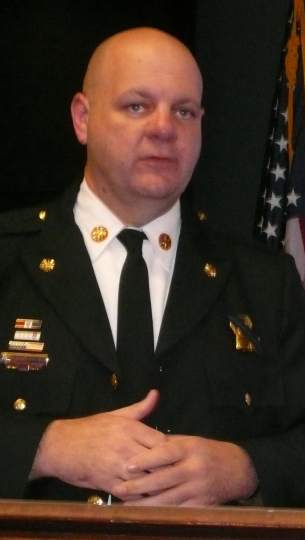
BUTCH BROWNING

Browning proudly wears military medals in this file photo.

There also is the pesky federal law called the Stolen Valor Act, which makes it a federal misdemeanor for anyone to wear military commendations they did not earn.

That brought the wrath of veterans down upon Browning. “We take pride in what we wear,” said one Marine officer. “Marines don’t hand out ribbons like candy. You have to earn it.” A couple of others called his wearing the medals and ribbons “disrespectful” and U.S. Rep. Steve Scalise (R-New Orleans) said, “There’s nothing more disgraceful than trying to present yourself as someone who served in the military when you didn’t.”

“We’ve been informed that Mr. Browning never served in the military, yet he was wearing military ribbons awarded to every branch of the military service that span World War II, the Korean war and the Kosovo campaign,” said Rafael Goyeneche, President of the Metropolitan Crime Commission who called Browning’s wearing the ribbons “problematic.”

Every branch of the military service? Well, at least he was an equal opportunity fraud, though he did explain that he received the ribbons from the Gonzales Fire Department where he served as chief before his appointment to the State Fire Marshal’s post by Jindal.

On April 18, 2012, Browning, while denying that he was the target of any investigation, suddenly announced his “retirement,” saying he was accepting a job offer as a superintendent at a petrochemical plant in Ascension Parish that he described as “too good to pass up.” His resignation was effective immediately, he said.

But passion apparently trumped too good to pass up for on April 30, just 12 short days later, he was reinstated as he gushed, “my passion is public service.”

But his return reportedly presented a problem. Sources told LouisianaVoice that when he resigned, he was paid for 300 hours of unused annual leave, or about $13,000. When he returned, he was required to repay the money but those same sources said he no longer had the money.

But records show that State Police Superintendent Mike Edmonson, who doubles as Deputy Superintendent of the Department of Public Safety (DPS) and apparently as DPS problem solver, simply bumped Browning’s salary by $8,000 per year, from $92,000 to $99,000 even though he returned at the same Assistant Secretary position as before—apparently so he could afford to repay the $13,000. How many of us would quit our jobs for 12 days in exchange for an $8,000 raise in pay?

Problem solved.

Well, not quite.

While Edmonson was laudatory in welcoming Browning back into the fold, Goyeneche was not nearly so forgiving of Browning—or of Edmonson, for that matter—and the political fallout was almost instantaneous.

Edmonson, metaphorically spreading rose petals in Browning’s path, said the DPS Internal Affairs Section had investigated the allegations and found “no factual evidence” to support the claims. “That investigation has shown me that Butch did not abuse his power or violate the public trust,” he added.

This from a man who, only two years later, would attempt to engineer a lucrative $55,000 a year increase to his own retirement through a furtive, last-minute amendment to an otherwise unrelated Senate bill steered past an unsuspecting and distracted legislature in the closing hours of the 2014 session—with the abetting of Gov. Bobby Jindal and the author of the amendment, State Sen. Neil Riser (R-Columbia).

Edmonson said Browning’s worst sin was to sign papers as a matter routine but which he did not thoroughly read but which were done with no criminal intent or fraud. He said he told Browning he wanted him back on the job—apparently sans military decorations—after an “outpouring” of public support.

Goyeneche, meanwhile, was livid and described the expedited exoneration of Browning as “Louisiana politics at its worst” (see the LouisianaVoice masthead) and unconscionable. “I think this is a political decision and not a decision based on its merits as Fire Marshal,” Goyeneche said. “If the standard is going to be whether Butch Browning broke the law then this is a sad day in Louisiana. State police make decisions every day to discipline officers on administrative issues and this is someone who has made several managerial blunders.”

Browning, for his part, said he welcomed input that would result in positive changes. “The integrity of the Office of State Fire Marshal is one of my top priorities,” he pontificated with self-puffery. “It’s what the public expects.”

In the coming days, we will examine how Browning, with a little help from his friends, manages to continue to survive integrity breaches and how a critical report by one state investigative agency result in a legislative effort to abolish the agency—kill the messenger, as it were—rather than consider correcting deficiencies investigators cited in Browning’s office.


Read Full Post »
« Newer Posts - Older Posts »


