Feeds:
Posts
Comments

Archive for the ‘Fraud’ Category

By Robert Burns (Special to LouisianaVoice)

When Hurricane Gustav struck south Louisiana on Sept. 1, 2008, almost three years to the day after Katrina, it set in motion a series of events that would ultimately:

  • upset the Livingston Parish political structure;
  • leave the parish facing a bill for more than $40 million in cleanup costs;
  • see a call for but never a follow up on an investigation into the formation of a fictitious corporation (at a fictitious address headed by a fictitious person) which somehow managed to be the only bidder on a lucrative contract;
  • result in the arrest of another contractor who was also serving as an FBI informant to help root out fraud, and
  • leave residents more than six years later still wondering who are the good guys and who are the bad guys.

First, some background.

The massive cleanup that followed Gustav required fast action and, regrettably, such fast action oftentimes opens the door for governmental abuse. The Federal Emergency Management Agency (FEMA) declared that to be the case in Livingston Parish’s cleanup, and the agency denied an astounding $59 million in clean-up costs.

Crucial to FEMA’s decision was Corey delaHoussaye, a contractor hired by Livingston Parish to assist with U.S. Army Corps of Engineers permitting issues nearly a year after the storm struck.  DelaHoussaye, coincidentally, also served as an FBI informant during the cleanup.  Livingston Parish District Attorney Scott Perrilloux, along with the State Office of Inspector General (OIG), have accused  delaHoussaye of submitting his own fraudulent invoices for hours they assert he did not perform work as part of his $2.3 million billings.  DelaHoussaye attorney, John McClindon, contends that the OIG got a search warrant for delaHoussaye’s residence on July 17, 2013 but delayed executing it and arresting delaHoussaye for eight days so it would coincide with a council meeting to approve delaHoussaye’s final $379,000 in invoices.  DelaHoussaye wasn’t paid, and he sued the parish for nonpayment.

Meanwhile, Perrilloux sought an indictment against delaHoussaye, but he came up one vote short in an 8-2 vote of the grand jury in December of 2013.  Undeterred, Perrilloux proceeded with a bill of information containing 81 counts, including 73 of filing false public records, but last Friday Perrilloux dropped 19 of those 73 counts.

On Monday, 21st Judicial District Judge Brenda Ricks ruled that insufficient evidence exists to proceed with a trial—a major victor for delaHoussaye.  Perrilloux presented only one witness during Monday’s hearing: OIG investigator Jessica Webb, who testified that, during times delaHoussaye charged the parish for hours worked, he sometimes was at an anti-aging clinic, at Greystone Country Club playing golf, or at Anytime Fitness working out.

McClindon, calling the OIG’s investigation “half baked,” said the OIG’s office seized his client’s computers and “looked at what they wanted to look at,” ignoring emails and failing to talk with anyone.

Similarly, at the trial of Murphy Painter, former director of the State Office Alcohol and Tobacco Control (ATC), former OIG investigator Shane Evans testified that he merely “wrote down” what ATC employee Brant Thompson said to him regarding Painter’s being “manic depressive, out of control, and selectively enforcing alcohol statutes,” and admitted the OIG did zilch to corroborate Thompson’s assertions even though it was Thompson’s initial characterization that reportedly prompted Gov. Bobby’s firing of Painter. (Subsequent details later revealed Painter’s firing was steeped in the time-honored tradition of Louisiana politics as usual.) https://louisianavoice.com/2013/02/06/emerging-claims-lawsuits-could-transform-murphy-painter-from-predator-to-all-too-familiar-victim-of-jindal-reprisals/

A company called Comprehensive Business Solutions, with an address on Coursey Boulevard in Baton Rouge, was created by someone named Patterson Phelps of Mandeville in March of 2010, according to corporate records filed with the Secretary of State’s office.

That date was just prior to the Livingston Parish Council’s issuing invitations to bid on a lucrative contract for cleanup.

The only problem is there is no such business at the address given and in fact, never was, and no one has been able to ascertain who Patterson Phelps is, other than speculation that it was an alias for a member of the parish council who was attempting to obtain the contract for himself.

A spokesperson for the Secretary of State said the corporate papers were filed electronically with payment made by credit card and that no records exist that would reveal who was actually responsible for creating the shell company.

The parish council did indicate it would instruct Perrilloux to conduct an investigation into the identity of the mystery person, but no results of any investigation, if it was ever conducted, have been made public.

Perrilloux, apparently fuming over Ricks’ ruling, said after the hearing that he would proceed with trial anyway and added, “Just because they wear a black robe doesn’t mean they know everything.” Legally, Perrilloux cannot proceed with a trial unless Ricks’ ruling is overturned by the First Circuit Court of Appeal or the Louisiana Supreme Court. He later said he would appeal the decision.

Brian Fairburn was Livingston Parish’s Emergency Manager and Coordinator for Homeland Security at the time Gustav struck.  His job was to hire monitors who would oversee operations to ensure FEMA reimbursement eligibility.

Fairburn testified that Mike Grimmer, then-Livingston Parish President, indicated to him that he had grave concerns regarding some of the itemized charges on the FEMA project worksheet and likely would not sign off on it.  When asked why, Fairburn indicated Grimmer told him, ‘“The costs are too high and we have permitting issues.’ (He) specifically told me we were taking kickbacks, that we were just out there creating work for these contractors to do.”  When asked whom Grimmer asserted was taking kickbacks, Fairburn responded, “Jimmy McCoy (Councilman from District 2), and he included me as being in on it also.” Fairburn added that Grimmer, “tried to ruin McCoy,” and that he “wanted to show that there was trouble, corruption, and crime in the parish.”  Fairburn also testified that he was terminated soon after the Gustav project but added that when Layton Ricks defeated Grimmer for parish president, he was rehired.

Brian Fairburn testified that during a meeting on November 26, 2008, Eddie Aydell of Alvin Fairburn and Associates (no relation to Brian) expressed serious reservations about proper permitting with the Army Corps and that Aydell was “scared” the Corps would assert that permits should have been issued before work was begun.

It was at that juncture that delaHoussaye was hired to assist with permitting issues.  Brian Fairburn said that McCoy said that the parish “would not” be obtaining any Corps permits and that Grimmer “shut the project down,” after which the Corps issued a cease and desist order on drainage projects.

FEMA’s attorneys were not happy with state and parish attorneys’ attempts to turn the hearing into a trial of delaHoussaye, and they strongly objected to 20 exhibits and depositions, including photographs of delaHoussaye and his son, which they said were unrelated to the hearing.  FEMA attorney Linda Litke said, “delaHoussaye was hired a year after the disaster in 2009 to basically go through the documentation and clean up the mess……  The parish attempted to criminally indict him…..They have now attempted to proceed with criminal action against him without an indictment.  It is reprehensible that they would bring this documentation in this case……DelaHoussaye is a confirmed FBI informant.  He was a whistleblower, and that is why the parish has gone after him.”

Perhaps the most riveting testimony was that of former Parish President Mike Grimmer, who testified that McCoy signed a contract addendum even though Grimmer was the only one with authority to do so.  He said he was “unaware the contract addendum was even out there.”  He indicated the addendum greatly increased the prices, including an increase in the per linear foot price.

Grimmer stated that he got calls from irate homeowners regarding crews, “trespassing on their properties….. and the trees had been taken with no permission.”  Grimmer also testified he obtained invoices for payment on work performed at local schools and North Park which had already been paid by other local agencies.  He referenced Legislative Auditor Daryl Purpera’s report which he testified that he’d requested.  He said it reinforced his concerns about documentation problems for cleanup operations. Grimmer’s response took “no exception” to the report.

That report also cited a contractor for hiring direct family members of Council members McCoy and Don Wheat which the report said may have violated ethics laws, so the matter was referred to the Louisiana Ethics Board.  Wheat, Councilman from District 6, responded angrily to the report and stated that Gov. Jindal’s GOHSEP’s Office had indicated the FEMA report was “fundamentally flawed” and on appeal and that Purpera, “continued with the same flaws and I urge you to correct your mistakes.”

Grimmer expressed shock when he attended an Office of Emergency Preparedness (OEP) meeting in May of 2009 and a $42 million tab for wet debris removal was “dropped in my lap.”  Grimmer asked for a breakdown and, on June 9, 2009, he got one and an indication that the final tab was estimated at $92 million.  He refused to sign off on the $42 million and verbally instructed all work to cease, and the Army Corps followed up with a written cease and desist order shutting down all drainage work.

FEMA attorneys then provided the panel with a handout of a power point presentation created by Grimmer entitled, “The Truth about the Debris Cleanup.”  Slides were presented depicting:

  • an oak tree removal for $8,415;
  • two other single-tree removals for $6,570 and $4,600, and
  • a pile of limbs for $2,805.

Grimmer said those types of vastly inflated costs prompted his decision to shut down the entire project.

Grimmer, over the objections of state and parish attorneys, last May told a three member arbitration panel that he alone would have been accountable to Purpera if he’d approved the project worksheet and that contractors, monitors, councilmen, and others would all be “gone and happy.”  He expanded on how the whole episode and his decision had adversely impacted him in the community, with long-time friends and business associates distancing themselves from him and people being angry at him but that, “at the end of the day,” he felt he’d made the right decision and felt vindicated by Purpera’s report.

Cross examination at that hearing focused on Grimmer’s frosty relationship with council members and his having referenced five such members as “the five amigos.”  Grimmer confirmed McCoy and Wheat were included in the five.  Grimmer admitted that delaHoussaye shared the fact that FBI investigator Steven Sollie had contacted him and that he was cooperating in an FBI investigation of the Gustav cleanup operations.  State and parish attorneys sought to get Grimmer to admit that he “had no interest” in the project’s costs until he obtained knowledge of the ongoing FBI investigation, a charge Grimmer vehemently denied.  Grimmer also indicated that, though he couldn’t remember which one, a FEMA monitor was paid $20,000 to make debris FEMA-eligible.

The panel ruled in FEMA’s favor.

If Perrilloux follows through and if the state’s and parish’s appeal hearing of FEMA’s decision is any guide, a trial is likely to air some of the dirtiest elements of Livingston Parish political corruption.  Louisiana Voice has obtained a transcript of the 2,197 page appeal hearing, and the contents are interesting, to say the least.

Perhaps that may be why delaHoussaye attorney McClindon said after Ricks’ ruling, “It would probably be best for us all to sit down and work this whole thing out.”

Read Full Post »

75b6e117b785e594d770c9bcc52fd34e_2phq_lt4o[1]

(CLICK ON IMAGE TO ENLARGE)

“That clanking sound you heard,” says blogger C. B. Forgotston, “was Louisiana’s proverbial fiscal can hitting the end of the road.” And he has been around state government long enough to know the signs.

“Like a kid behaving badly, we’ve been placed on probation,” added State Treasurer John Kennedy.

Both men’s assessments were in response to the double whammy of two investor rating services’—Moody’s and Standard & Poor’s—action to move Louisiana’s credit outlook from stable to negative on Friday and to threaten the more severe action of a downgrade.

“This should be a wake-up call that we need to stop spending more than we take in,” Kennedy said.  “We’ve drained our trust funds, we’ve relied on nonrecurring money and we’ve had to cut the budget in the middle of the fiscal year for too many years now.  Many have been warning that this day would arrive, and it has.”

The dual action by the two ratings services impacts $2.7 billion in outstanding general obligation debt and $1.25 billion in related debt.

Moody’s warned that continued structural imbalances, steep growth in pension costs, deterioration in financial liquidity and failure to contain costs in the state’s Medicaid system will result in a credit rating downgrade, making it more costly for the state to borrow money.

S & P added a warning that “Should budget adjustments fail to focus on recurring solutions or if the structural gap grows with continued declines in revenue or material reductions in federal program funding to the state, we could lower the rating” even further.

Gov. Bobby immediately attempted to put a positive spin on the bad news (or as Forgotston described it, tried to pour perfume on the manure pile to change the smell but not the content) by saying that the agencies didn’t lower the ratings on the existing outstanding General Obligation bonds.

But what Gov. Bobby did not say, according to Forgotston, was that the rating on those bonds was not lowered because the Louisiana State Constitution gives those bonds first call, even before employee retirement benefits, on all the money in the state treasury. “In other words, if the state goes bankrupt, those bonds will be paid,” he said, adding that future state borrowing will also cost more.

It could also mean that in the event of default, retirees won’t be getting their pension checks, something that should get the gray panthers up in arms.

At this point, we feel it important to point out—just in case anyone still needs reminding—that Gov. Bobby has been traveling all over the country (well, mainly to Iowa and Washington, D.C.) spewing his rhetoric about how he has cut the number of state employees, how Louisiana’s economy is out-performing other states, how new industry is locating to Louisiana, and how little it costs to attend LSU.

Except it’s all part of his big lie—except, of course, the part about hauling state workers out to the curb.

But if he is so hell-bent on claiming and then taking credit for all these wonderful events and trends (of course he never mentions the state’s high poverty rate, poor health care availability, our second lowest median household income, the eighth lowest percentage of citizens with a bachelor’s degree or higher, or our fifth highest violent crime rate), then he must shoulder the blame for the bad news as well.

Any coach will tell you that’s the way the game is played; if you take credit for the wins, you have to take the blame for the losses.

And of course, he never, never does that. Everything out of his mouth is about all the great accomplishments of his administration, and always spouted off in such rapid-fire fashion as to give little chance for argument from dissenters. It’s his style to overwhelm with statistics quoted by rote in his boring staccato delivery.

Well, Bobby, your rhetoric—and for that matter, you as well—are wearing a little thin.

The doubt began creeping in here in Louisiana midway of your first term and has continued to build until now the national media have caught on. Only last week, three or four national stories revealed the pitiful shape you are leaving our state in for your unfortunate successor to attempt to clean up.

Unfortunately, whoever follows you will most likely be a one-term governor because no one can clean up your mess in a single term and the voters are likely to grow weary of whoever is unfortunate enough to follow you and turn him or her out of office after four years in a desperate attempt to find a quick solution that in reality may take decades. You have set this state back that far (Thank you, Gov. Mike Foster for inflicting this plague upon us).

And, Gov. Bobby, you can just mothball your national political ambitions. Being President is a far distant fantasy by now and any prospects of a cabinet position are just as surely disappearing like so much sand through your fingers. You can now only accept that you will go down as one of, if not the most vilified governor in the history of this state. You have succeeded, by comparison, in making Earl Long appear to have been in full control of his mental faculties back in 1959.

And lest anyone think we are giving the legislature a free pass on this situation, think again. With only a handful of exceptions, those of you in the House and Senate have been complicit in this charade of governance. You have aided and abetted this pitiful excuse of a chief executive who, while pandering repeatedly that he had the job he wanted, nevertheless plunged full speed ahead toward his fool’s errand of seeking the Republican presidential nomination. Why, his own family was talking openly of his becoming President—at his first inauguration way back in 2008!

Moody’s and S &P were each quite thorough in laying out the reasoning for their simultaneous actions on Friday.

Moody’s said its action reflects a $1.6 billion structural deficit, continued budget gaps, the state’s large Medicaid caseload, job growth below the national average and significant unfunded pension liabilities.  “The negative outlook reflects the state’s growing structural budget imbalance, projected at $1.6 billion for fiscal 2016, or about 18% of the $8.7 billion general fund even after significant budget cuts of recent years,” Moody’s said. “The state has options for reducing the imbalance, including scaling back various tax credit programs, but the overall scale of balancing measures needed may further deplete resources and reduce the state’s liquidity, which has been one of its strengths.”

S & P was no kinder, citing Gov. Bobby’s reliance on non-recurring revenue which it said only served to increase future budgetary pressures. “In our view, the state’s focus on structural solutions to its general fund budget challenges will be a key determinant of its future credit stability.

“We could consider revising the outlook back to stable if revenue trends stabilize and if Louisiana makes material progress in aligning its recurring revenues and expenditures on a timely basis with a focus on recurring solutions. Should budget adjustments fail to focus on recurring solutions or if the structural gap grows with continued declines in revenue or material reductions in federal program funding to the state, we could lower the rating,” S & P said.

Forgotston, in his own unique way, tells us what Moody’s and S & P were really telling us: “Bobby, you and the legislators have made a big ‘number-two’ mess in your fiscal pants and we have no faith in your ability to clean it up. Folks, don’t let the legislators try to fool you; this is very bad news for us taxpayers and the legislators are the reason for it.”

Yes, it’s easy to blame Gov. Bobby because he has in his seven years initiated every Ponzi scheme one could imagine from giving away something like $11 billion in tax incentives (according to one recent story), to giving away the state’s charity hospitals, to robbing the Office of Group Benefits reserve fund, to attempting to rob the state’s retirement system, to refusing federal grants for needed projects, to rejecting Medicaid expansion and thus depriving the state’s indigent population access to decent health care which in turn led directly to the announced closure of the emergency room of a major Baton Rouge hospital. The list goes on.

But, as Gov. Bobby is so fond of saying, at the end of the day, it was the legislature, through the “leadership” of Senate President John Alario, House Speaker Chuck Kleckley and Appropriations Committee Chairman Jim Fannin that allowed him to do it by refusing to grow a collective set and stand up to this vindictive little amateur dictator.

This is an election year and Louisiana voters—particularly state employees, former state employees who have lost their jobs because of Gov. Bobby, teachers, retirees and the state’s working poor would do well to remember what this governor has done to them and which legislators voted to support the administration’s carnage inflicted upon this state.

There are those few in the House and Senate who have spoken up and tried to be the voices of reason but those voices have been drowned out by Gov. Bobby’s spinmeisters.

So when you vote for governor next fall, you would do well to ignore the TV commercials bought by those who want only to continue down this same path of economic destruction and growing income disparity and consider who you believe really has the best interest of the state, and not the special interests, at heart. In other words, think for yourselves instead of letting some ad agency do your thinking for you.

If you don’t get your collective heads out of the sand and in the most emphatic manner you can muster, tell your neighbors, your friends, your family, the clerk at the store where you shop for food and clothing, the cashier at the restaurant where you eat what this governor and this legislature have done to you and to them, then come next fall, you have no one to blame but yourselves.

The time for joking about Gov. Bobby is over. We’re at the end game now.

Read Full Post »

What should Louisiana citizens know about a $12 million real estate deal in Iberville Parish between the Louisiana Department of Economic Development (LED) and a Russian Oligarch involving a proposed fertilizer plant on property surrounding a Louisiana National Guard facility?

Apparently nothing, if one judges from the status updates coming from the Jindal administration since the deal was made back in June of 2013.

Throw in a curious buy-back clause contained in the agreement between the state and EuroChem Louisiana LLC, an option for EuroChem to purchase a second tract in St. John the Baptist Parish, and talk about environmental emission credits that were supposedly promised to Eurochem but then appear to have evaporated into…well, thin air, and you have the makings of political intrigue with an international flavor.

Readers may remember our post last October 20 in which we revealed what appeared to be a sweetheart deal between the state and Vantage Health Plan whereby Vantage was allowed to purchase the former Virginia Hotel in Monroe for $881,000 without having to bother with a pesky public auction and sealed bids.

That transaction was made possible (even though there was another party interested in purchasing the building that had been serving as the State Office Building in Monroe) by Senate Bill 216 (SB 216) by Sens. Mike Walsworth (R-West Monroe), Rick Gallot (D-Ruston), Neil Riser (R-Columbia), and Francis Thompson (D-Delhi).

Well, it turns out there was considerably more to SB 216 (which became Act 127 upon the signature of Gov. Bobby Jindal). We saw the bill in its entirety at the time we wrote our story last October but did not understand the significance of a part of the bill entitled Section 3.

Until now.

Section 3 called for the sale of 2,150 acres of land within the town of St. Gabriel in Iberville Parish to a then unidentified “business entity that enters into a cooperative agreement” with the Department of Economic Development.

Not only was the prospective buyer not named in the bill (contrary to the other part of the bill that clearly identified Vantage Health and the purchase price of the Virginia Hotel), but the bill also contained no mention of a purchase price for the Iberville property. Neither the name EuroChem nor a purchase price is contained anywhere in the bill.

It is understandable that the buyer’s name might be left out of the bill, especially if the sale is still pending and nothing has been finalized. But when considering a proposal to dispose of a 2,150-acre tract of property for industrial purposes, one might be reasonably expected to ask how much money is involved before casting a vote on such a measure.

The bill passed the House by a 96-1 vote and by a 31-1 vote in the Senate. Voting against the bill in the House was Rep. Marcus Hunter (D-Monroe) while the lone dissenting vote in the Senate was cast by Sen. Dan Claitor (R-Baton Rouge). Seven senators and eight House members were absent or did not vote.

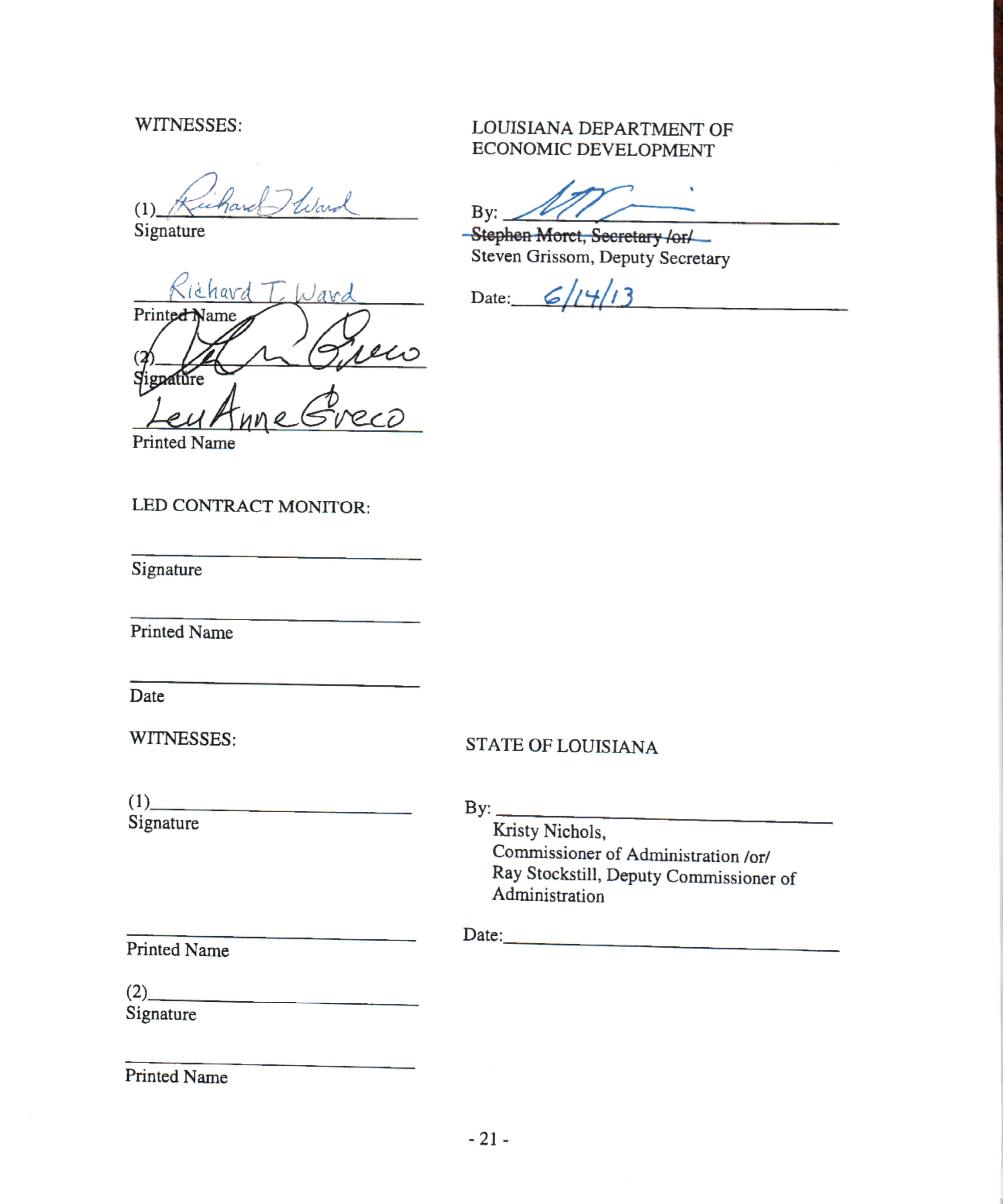
The Senate vote was on April 24, 2013, and the House approval followed on May 22. Gov. Bobby Jindal signed the bill on June 5 and the cooperative endeavor agreement was signed on June 14 by LED Deputy Secretary Steven Grissom—even though the bill did not become law until Aug. 1, 2013. PTDC3577

(CLICK ON IMAGE TO ENLARGE)

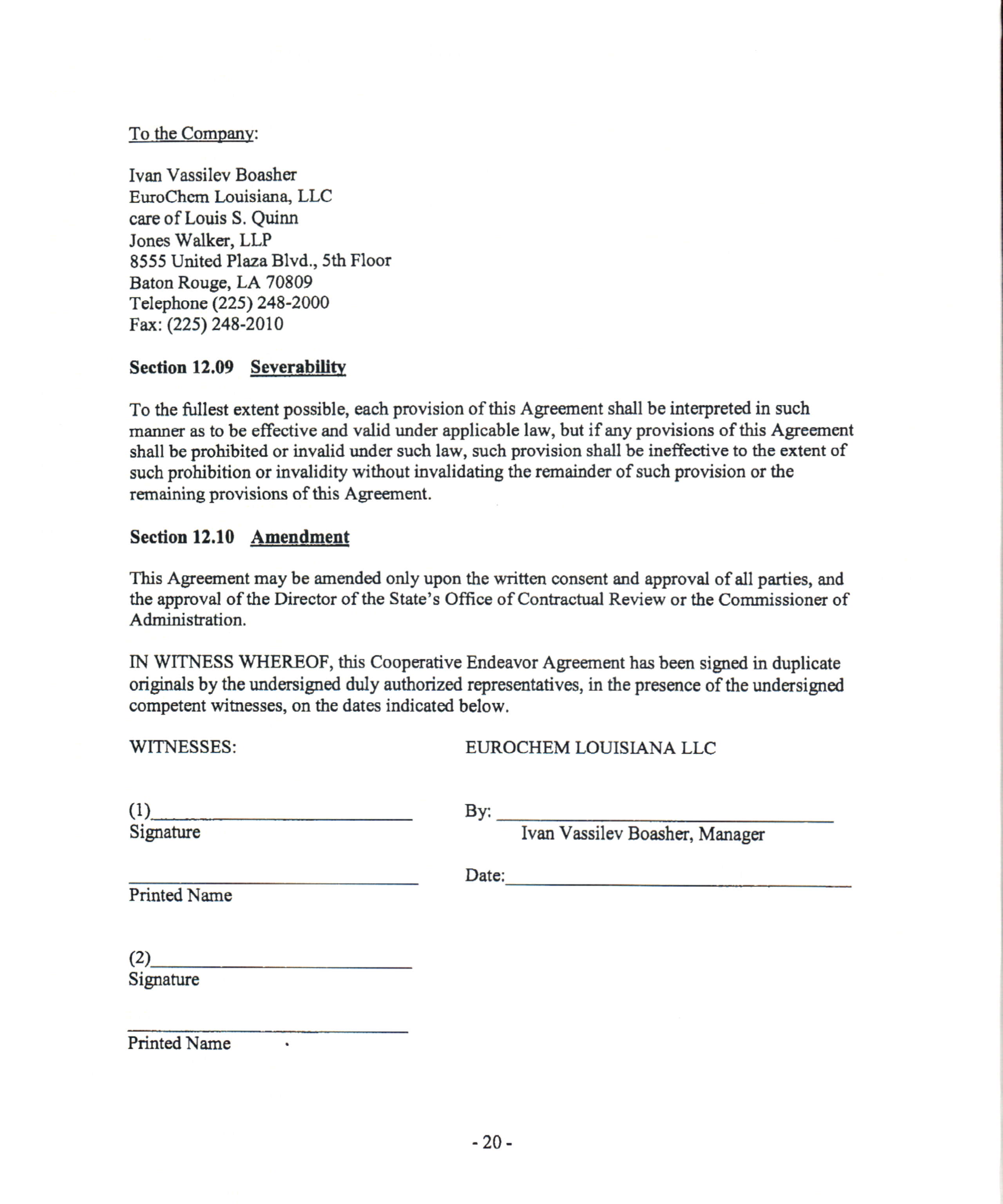
The name of the Eurochem representative on the state documents obtained from LED was Ivan Vassilev Boasher, identified only as “Manager.”PTDC3576

(CLICK ON IMAGE TO ENLARGE)

EuroChem, founded in 2001, is a Russian company owned jointly by Melnichenko (92.2 percent of shares) and CEO Dmitry Strezhnev, who owns the remaining 7.8 percent. It was Strezhnev, and not Melnichenko, who joined with Jindal in announcing plans for the $1.5 billion facility.

To secure the project, the state offered the company a competitive incentives package that includes a $6 million performance-based grant to offset the costs of site infrastructure improvements, the announcement said. In addition, EuroChem will receive the services of LED FastStart—the state’s workforce training program. “The company also is expected to utilize Louisiana’s Quality Jobs and Industrial Tax Exemption programs,” Jindal said in making the announcement on July 10, 2013.

“EuroChem is evaluating two final sites for its Louisiana plant,” he said. The Iberville Parish property had been on the market for more than two years through the Office of State Lands, and EuroChem deposited $12 million in an escrow account to buy the property. At the same time, EuroChem also secured an option to purchase a 900-acre, privately-owned tract in St. John the Baptist Parish. “Both Mississippi River sites are being evaluated for construction and logistics suitability, and the company will make a final site decision within the next year,” Jindal said. http://gov.louisiana.gov/index.cfm?md=newsroom&tmp=detail&articleID=4141&printer=1

Well, a year has come and gone and the option on the St. John property, identified by sources as the Goldmine Plantation in the Mississippi River’s east bank near the town of Edgard, which was for 330 days, has expired and was not renewed. No documents requesting permits have been filed with the parishes of St. John or Iberville, the town of St. Gabriel or the U.S. Army Corps of Engineers.

Meanwhile, during the 2014 legislative session—a year after approval of the sale of the Iberville Parish land to an unknown buyer for an undisclosed price—State Rep. John Bel Edwards apparently decided the deal was not a good one in light of the Ukraine crisis which erupted after approval of the cooperative endeavor agreement.

Edwards pushed through House Concurrent Resolution 209 (HCR 209) which requested that LED Secretary Stephen Moret “reevaluate and explore rescinding the cooperative endeavor agreement with the Russian-based company EuroChem.”

Of course the administration promptly ignored the resolution.

The 2,150 acre parcel in Iberville Parish is surrounded on three sides by the Mississippi River and the tract in turn surrounds the Carville Historic District that houses the National Hansen’s Disease Museum, the Gillis W. Long Military Center (Louisiana National Guard facility), and the U.S. Department of Labor’s Carville Job Corps Center. There are no exiting shipping terminals on the tract and the property is prone to flooding during times of high water.

One Iberville Parish official told our sources that he did not believe the project was going to move forward because of relations between the U.S. and Russia over the Ukraine crisis and because of current restrictions in Iberville on air emissions from existing plants which limits the amount of air emission credits available.

And it is those air emission, or carbon, credits that appear to be the key in the entire deal.

One person close to the St. John transaction, told our source that while the prospect of Eurochem’s building a plant in Louisiana is “still alive,” the purchase of the Iberville property “had to do with environmental credits.”

The credits, he said, were available from another company at the time they purchased the Iberville tract but are now gone. He refused to identify the company from whom credits were supposed to be available nor did he say what happened to those credits. “One was the deal (for construction) and one was about emission credits,” he said. “They purchased the Iberville land and continued to do business with us like it never happened.”

A spokesman for the Department of Environmental Quality explained that there are basically two geographic categories when considering air quality standards for permitting: attainment or nonattainment. When an area is considered to be in the nonattainment area, DEQ works with businesses to lower emissions to meet standards through “emissions credits.”

These “credits,” which are provided by the state, are gained by companies that make improvements to their current physical plants in order to reduce oxide and volatile organic compound (VOC) emissions. The credits can be bought and sold much like a commodity on the open market, he explained.

The credits also have to be acquired from companies within that particular designated geographic area that is considered in the nonattainment area.

Because Iberville Parish is within a nonattainment area, Eurochem would have to acquire the credits if planning to make an application for construction and would be required to demonstrate it had sufficient oxide and VOC credits to meet the application approval.

While no one is making any accusations, there is a flourishing international black market for emissions credits that has come under scrutiny by several investigative agencies, including Interpol, which calls carbon trading the “world’s fasting growing commodities market.” Guide to Carbon Trading Crime

http://www.interpol.int/en/News-and-media/News/2013/PR090/

Larry Lohmann, writing for New Scientist, says that the larger carbon markets are “poised on the edge of breakdown.” https://www.academia.edu/3152549/Regulation_as_Corruption_in_the_Carbon_Offset_Markets

Deloitte Forensic, Australia, calls carbon credit fraud “the white collar crime of the future.”

carbon_credit_fraud

Carbon credits also have become a favorite vehicle for money laundering schemes, according to investigative agencies. http://www.redd-monitor.org/2013/08/06/itv-series-fraud-squad-investigates-carbon-credit-criminals/

http://www.marymonson.co.uk/fraud-solicitors/carbon-credit-fraud/

There are too many unknowns about the Iberville Parish land sale, according to retired Gen. Russel Honoré, leader of the Louisiana Green Army coalition. “The state is broke and we’re making deals with foreign entities who are polluters in their own countries,” he said of the Iberville Parish land sale as well as a recent deal with a Chinese company that has had a poor environmental record.

“As much pollution problems and erosion problems as we have in this state, we don’t need to be bringing in these companies from other countries unless they have clean safety and environmental records,” Honoré said.

Still another unanswered question concerns that buy-back clause in the cooperative endeavor agreement between Eurochem and LED. The side of the ledger favoring EuroChem is the $6 million grant the state gave EuroChem, along with all the other tax incentives it is receiving—should the plant be built. But on the plus side for Louisiana is the clause that says if the fertilizer plant is not built, the state has the option of buying the land back at a reduced price or approving the buyer for re-sale.


Read Full Post »

U.S. Rep. Steve Scalise’s claim that he did not know who he was talking to when he spoke to that meeting of the Workshop on Civil Rights hosted by the European-American Unity and Rights Conference (EURO) back in May of 2002 is coming unraveled like a cheap suit.

And so too, are the cover stories concocted by participants of that meeting who are trying to pull Scalise’s fat out of the fire.

And those accounts, with their unsavory associations and bizarre twists, constitute some of the most sordid stories imaginable, complete with bombing plots, pornography, escort services, mailing lists and dozens of politicians who subsequently went into scramble mode.

Mark Twain once said, “If you tell the truth, you don’t have to remember anything” and because of conflicting memories of those involved, the coverups appear to be spinning out of control.

Thanks to stellar investigative reporting by blogger Lamar White, Scalise’s position as House Majority Whip could go the same way as that of former Sen. Trent Lott (R-MS) who resigned his post as Senate Majority Leader following his association with a similar white supremacy group, the Council of Conservative Citizens (CCC). Lott resigned from the Senate five years later and now works, along with former U.S. Sen. John Breaux (D-LA) in the powerful Washington lobbying firm Squire Patton Boggs.

CCC and EURO have cross-pollinated over the years to the point where it’s difficult to distinguish one from the other with certain individuals having been—and remaining—members of both organizations.

One of those with just such dual membership is Kenny Knight of Prairieville.

Knight has publicly taken credit for issuing the invitation to Scalise to speak to the Jefferson Heights Civic Association at the Landmark Hotel in Metairie 12 years ago, but not, he said, to EURO, which was scheduled to meet in the same room later that day.

There are several problems with that story.

One, Scalise himself has made no such claim, choosing instead to plead ignorance that he was addressing a white supremacy group in 2002 while he was a member of the Louisiana House of Representatives. He makes no mention of any such civic association. http://www.businessreport.com/article/scalise-defending-amid-rising-scandal-regarding-2002-speech-white-supremacist-event

But claiming ignorance is a pretty weak defense given his comment years ago to New Orleans Times-Picayune reporter Stephanie Grace that he was “like David Duke without the baggage.” http://www.theneworleansadvocate.com/news/state/11213737-123/stephanie-grace-scalises-pitch-to

Duke, of course, was—and is—President of EURO and also addressed the Landmark gathering via teleconference hookup from Europe.

The second inconvenient snag in the failure to communicate (with apologies to the late Strother Martin of Cool Hand Luke) occurred when Knight told the Times-Picayune that he was not a member of EURO http://www.nola.com/politics/index.ssf/2014/12/david_duke_adviser_kenny_knigh.html

Barbara Noble, whom the Times-Picayune  said “was dating Knight” at the time of Scalise’s address (the implication being they might no longer be dating), backed up his claim. “Neither of us were members of EURO,” she said.

But while technically, Knight may not have a member of EURO, a quick check of the Louisiana Secretary of State’s corporate records reveals that he was not only a member of the organization’s predecessor, the National Organization for European American Rights (NO FEAR), he was the organization’s treasurer. (Duke changed the name to EURO after being sued for trademark infringement by No Fear, Inc.)

And what would be Noble’s motivation in having his back if she is a former girlfriend?

A further check of the Secretary of State’s web page also reveals that she and Knight both were officers of or affiliated with five separate corporate entities, three of which are still in good standing with the Secretary of State’s office.

All-American Health & Life Insurance of Metairie is not in good standing for failure to file its annual report with the Secretary of State, records show but both were listed as officers. Knight was the firm’s president she was vice president.

Southeast Solar Distributors likewise is listed as inactive by the Secretary of State. She was the company’s president and Knight its vice president when it was active, records show.

While she is not listed as an officer of T-Mart, Inc. of Prairieville, a telephone call to the business by LouisianaVoice reached her voice mail. Other active businesses in which the two are involved include Axcess Medical Clinic, Inc., of Prairieville (Knight is Director and she is Secretary) and Louisiana Men’s Clinic, Inc. of Mandeville (both are directors).

Louisiana Men’s Clinic is a facility that specializes in the treatment of erectile dysfunction http://louisianamensclinic.com/ while Axcess Medical Clinic appears to be an office complex for physicians owned by the pair.

Two months following Scalise’s address to EURO, Knight was on the Mississippi Gulf Coast representing CCC in its celebration after the Gulfport City Council voted to keep flying the confederate flag.

KENNY KNIGHT

(That’s Kenny Knight in the middle with the white shirt, brown shorts and white beard.)

Accompanying Knight at that rally was Vincent Breeding, one-time resident of Duke’s home and keeper of the EURO flame as its president while Duke served a federal prison term for fraud and tax evasion.

VINCE BREEDING

(Vincent Breeding is on the right wearing the slacks and tie. Kenny Knight is at the far left. And as one reader pointed out, these aren’t Ole Miss frat boys waving the Rebel flag.)

But Breeding, it turns out, had a much darker side. In addition to espousing the virtues of white supremacy, Christian beliefs and conservative values, he hosted an internet website which, in addition to offering graphic pornography, also provided an escort service that catered to all tastes, including black women. That would seem rather difficult to square with the EURO philosophy.

But then Duke himself once published a sexual self-help book for women entitled Finders Keepers under the pseudonym Dorothy Vanderbilt.

In 2003, Breeding was ousted from his leadership role in EURO and was succeeded by Knight but four years later, on Aug. 2, 2007, both Knight and Breeding, along with Barbara Noble, would participate in ribbon-cutting ceremonies for the Ascension Parish Chamber of Commerce.

Breeding, in addition to his porn web page and escort service and his previous employment at a Tampa strip club, once shared an apartment with one Todd Vanbiber who authorities thwarted in his plot to place 14 bombs along two major highways, I-4, the major access route to Walt Disney World, and U.S. 441. The bombings were planned for April 19, 1997, the second anniversary of the Oklahoma City bombing.

Another Duke associate, Don Black, was once shot while attempting to steal the mailing list of the National States’ Rights Party. The man who shot him was Jerry Ray, brother of James Earl Ray. Ironically, Black not only survived the gunshot, but later worked closely with Duke through his web page Stormfront and along the way, married Duke’s ex-wife.

Mailing lists, it turns out, constitute the life blood of organizations such as EURO, CCC, and the KKK. It is those mailing lists that allow the leaders of the organizations to solicit funds from those of like minds and it was just such a list that supported Duke’s lavish lifestyle that finally caught up with him.

And it was that same list that was sold to then-gubernatorial candidate Mike Foster in 1995 for $150,000. Foster failed to report the purchase as a campaign expenditure and would become the first Louisiana governor to be fined for violating the state’s code of ethics for elected officials.

But Foster was not the first by any stretch—nor the last—to be linked to such white supremacy groups. Louisiana Congressman John Rarick and Georgia Gov. Lester Maddox both were members of the old White Citizens Council, forerunner to the CCC.

Former Mississippi Supreme Court Chief Justice Kay Cobb addressed CCC on two occasions and Trent Lott five times, once telling its members that they stood “for the right principles and the right philosophy,” only to later claim he had “no idea” what the organization stood for (we’re beginning to detect a trend here). As nice saves go, Senator, not so much.

Lott also spoke at the 100th birthday celebration of Sen. Strom Thurmond of South Carolina, proclaiming that if the rest of the country had followed Mississippi’s lead in voting for the segregationist “Dixiecrat” when he ran for president in 1943, “we wouldn’t have had all these problems over all these years…” When Lott later apologized for his remarks, the CCC labeled him as “little more than a political prostitute.”

Former Mississippi Gov. Haley Barbour was elected largely on the strength of support from CCC and his photo even appeared with CCC officers on the organization’s website and former Georgia Congressman Bob Barr delivered the keynote speech at the CCC national convention in June of 1998.

Byron De La Beckwith, the man who in 1963 murdered civil rights activist Medgar Evers, was a CCC member as was Charles Sharpe. While serving as South Carolina’s Commissioner of Agriculture, Sharpe was arrested for accepting $20,000 in bribes to protect an illegal cockfighting ring.

And then there is Tony Perkins who, like Lott and Judge Cobb, addressed the Louisiana CCC. His appearance was on May 19, 2001 (almost exactly a year before Scalise’s appearance), when he was serving as a Republican state representative from Baton Rouge. Perkins currently serves as President of the Family Research Council in Washington, D.C.

These are only the more prominent public officials who have affiliated themselves with these groups. There are others. http://www.splcenter.org/get-informed/intelligence-report/browse-all-issues/2004/fall/communing-with-the-council

So we have the CCC, EURO, and the KKK, which are pretty much synonymous with their interchangeable memberships, rubbing shoulders with right-wing, family-values politicians who run for cover the moment the glare of public scrutiny is shone upon them. The only thing missing from the picture are the 30 pieces of silver.

All of which must, by necessity, raise this burning question: Is the price of political fraudulence worth the wear and tear on an elected official’s integrity?

Read Full Post »

Some things never change when it comes to doing business with the State of Louisiana.

Several business owners have, over the past couple of years, told LouisianaVoice they would never bid on a state contract because, they said, the bid process and contracts are rigged, or at least weighted, heavily in favor of pre-selected vendors.

Now, three separate sources have come forward to offer specifics that support that claim as it regards a request for proposals (RFP) for renewal of an existing $75 million contract.

One of our very first stories under the LouisianaVoice banner was the manner in which Gov. Bobby Jindal went about privatizing his very first state agency, the Office of Risk Management (ORM), throwing nearly 100 employees out of work in the process.

Now we learn the story of F.A. Richard & Associates (FARA), the Mandeville company the state initially paid $68 million to take over as third party administrator (TPA) of ORM has taken yet another interesting twist.

Well, make that two interesting twists—including a third violation of the original contract between the Division of Administration (DOA) and FARA and now it seems there may be a strong case made for bid manipulation on the part of the state.

The reason we said the state initially paid $68 million is because eight months after that 2011 takeover, FARA was back asking—and getting—an amendment to its contract which boosted the contract amount by exactly 10 percent, or $6.8 million, bringing the total cost to just a tad under $75 million. An obscure state regulation allowed a one-time amendment to contracts for up to (drum roll, please)…10 percent.

Then, less than a month after the contract was amended by that $6.8 million, FARA sold its state contract to Avizent, an Ohio company, which kept the contract for about four months before it sold out to York Risk Services Group of Parsippany, New Jersey.

Last month, it was announced that Onex Corp., a Toronto-based private equity firm, had finalized a deal to acquire York for $1.325 billion.

In each case, the name FARA was retained “for branding purposes,” according to one former FARA employee, but there was no getting around the fact that the state’s contract was—and is—being shifted from one company to another until the latest deal that placed in the possession of a foreign corporation.

The original contract with FARA stipulates that the contract may not be sold, transferred or re-assigned without “prior written authority” from DOA.

LouisianaVoice, of course, made the appropriate public records request for that “prior written authority” right after it was sold the first time—to Avizent. After the usual delays in responding, DOA finally sent us an email which said no such document existed.

So, now we a contract the very specific terms of which have openly violated not once, not twice, but three times and the state has remained silent on this point.

Jindal, in case you need a reminder, is the same Louisiana governor who only last Friday criticized President Obama of “flaunting the law” in his executive action granting amnesty to illegal immigrants.

But as bad as the contract shuffling might be, ongoing efforts to rig the bidding process for a renewal of the five-year contract in FARA’s favor would appear to be far more serious.

Three separate sources—one employed by DOA and the other two former employees of first ORM and, after ORM was privatized, FARA, said that FARA had been requested to assist in drafting a new RFP in such a way as to guarantee that FARA would retain the contract.

Both former FARA employees, interviewed separately, said a staff meeting of FARA employees was held in Lafayette last April and again in May. On both occasions, they said, FARA management assured them that the company had been asked to assist ORM in drafting the RFP and that FARA was certain to win renewal of the contract, which expires next July 1.

“We were all told to update our resumés so they could be used in beefing up FARA’s proposal,” said one of the former employees.

If true, that would constitute bid rigging in almost any law book and should prompt an immediate investigation. This would be an ideal opportunity for someone to awaken East Baton Rouge District Attorney Hillar Moore to see if he is up to performing his duties.

Wasn’t that, after all, the basis for the investigation of Bruce Greenstein and the $189 million contract to his former employer, CNSI? That was the investigation that led to his nine-count indictment for perjury.

Having said that, if there are any other business owners who have had unpleasant experiences in bidding on state contracts, or who feel they have been shut out of the process through favoritism we would love to hear from you. Our email address is: louisianavoice@yahoo.com or louisianavoice@cox.net

Read Full Post »

« Newer Posts - Older Posts »