Feeds:
Posts
Comments

Archive for the ‘Fraud’ Category

By MIKE STAGG (Independent filmmaker, citizen activist, political strategist – Special to LouisianaVoice)

For the past seven years, as Louisiana has lurched from one fiscal crisis to another, the State of Louisiana has paid the oil and gas industry $2.4 Billion in severance tax exemptions. Despite that massive transfer of public wealth into private hands, the oil and gas industry used its influence inside the Department of Natural Resources and the Jindal administration, to limit—and for three years shut down—audits that would have revealed whether the industry’s severance taxes and royalty payments to the state were accurate.

These facts have been hiding in plain sight, contained in five performance audits of the Department of Natural Resources and the Louisiana Department of Revenue conducted by the Legislative Auditor since 2010. Two of those audits focused on royalty collections from oil and gas produced on state-owned lands and water bottoms. Another focused on severance tax collections; yet another dealt with mineral leases handled by the State Mineral and Energy board, while the fifth audit examined how the Office of Conservation has handled the orphaned and abandoned well cleanup program.

The cozy relationship between DNR and the oil and gas industry is explicit in the department’s regulation of the industry. That coziness, when extended to state finances, has proven disastrous for the Louisiana treasury and its residents. DNR is responsible for collecting oil and gas royalties, which account for roughly seven percent of state General Fund dollars, or approximately $800 million per year.

For a three-year period, between July 2010 and July 2013, DNR had jurisdiction to determine the accuracy of severance taxes and royalty payments.

And DNR let industry have its way.

Audits on royalty revenue dropped. Audits on severance tax revenue all but stopped, even as the state’s financial condition continued to worsen. In short, when it came to providing rigorous oversight to ensure that the royalty and severance tax payments were accurate, DNR’s Office of Mineral Resources deferred to the oil and gas industry while programs that serve the citizens of Louisiana were cut, primarily in healthcare and higher education, the unprotected portions of the state General Fund.

DNR’s relationship with the oil and gas industry is a blatant example of regulatory capture. Regulatory Capture is a form of political corruption that occurs when an agency, created to act in the public interest, advances instead the special concerns of the industry it is charged to regulate.

Severance taxes are the constitutional expression of our, as Louisiana citizens, shared claim on our state’s vast mineral wealth. Exempting severance taxes negates the public claim on that mineral wealth and undermines our ability to invest in ourselves as a state.

Severance tax exemptions are direct payments from the state to the oil and gas producers after the companies have submitted their exemption certificates. Royalties are the property owners’ share of the proceeds from the sale of oil and gas produced from wells on their land. For purposes of this story, royalties are the state’s share of the revenue from oil and gas produced on state-owned lands and water bottoms after severance taxes have been paid.

Since the mid-1980s, Louisiana Department of Revenue has published an annual report on tax exemptions called “The Tax Exemption Budget.” In that document, the department identifies each tax exemption and quantifies the cost of each exemption to the state.

It makes clear that tax exemptions are in fact a spending of state funds — here’s how the LDR explains it in every report: “Tax exemptions are tax dollars that are not collected and result in a loss of state tax revenues available for appropriation. In this sense, the fiscal effect of tax exemptions is the same as a direct fund expenditure.”

Between 2008 and 2014, according to the Tax Exemption Budget, the State of Louisiana paid oil and gas companies more than $2.4 Billion in severance tax exemptions. Those checks went out at the exact same time that our legislature cut funding for programs like aid to families of children with disabilities, behavioral health programs, home health care, and programs that assisted victims of domestic violence. During that same period, state funding for higher education was also cut by more than $700 million as the tuition and fees paid by those attending technical colleges, community colleges, and state universities were jacked up to cover the difference.

The first performance audit on royalty collections was released in July 2010. Royaltieshttps://app.lla.state.la.us/PublicReports.nsf/B6B5DE331E9D48818625776E005CFDA5/$FILE/00018070.pdf The Legislative Auditor found that DNR’s Office of Mineral Resources took a lackadaisical approach to verifying the accuracy of royalty payments from the 1,888 active mineral leases on state-owned lands and water bottoms.

The Legislative Auditor noted that severance taxes and royalties are connected, that both are dependent on the amount of oil and gas produced, as well as the price of the resource.

Desk audits compared the volume of oil and gas sold to the volume of oil and gas produced, which ensures that royalty payments are properly calculated. These audits also help ensure that production wells on state lands are submitting properly calculated royalty payments.

The Legislative Auditor found that the Office of Mineral Resources (OMR) had not conducted a single such audit in a decade. Despite the Auditor’s recommendation that it resume these audits, OMR waited another three years before getting around to doing so.

The Legislative Auditor also found that OMR did not compare royalty reports against severance tax reports filed with the state Department of Revenue, nor did it compare royalty reports to production reports submitted elsewhere in DNR.

In its response to the Legislative Auditor’s Royalty performance audit findings, on June 24, 2010, DNR announced that “As part of the Streamlining Commission’s recommendations, OMR will take over LDRs severance tax field audit program and the two audits will be integrated beginning July 1, 2010.”

In September of 2013, the Legislative Auditor released a follow-up performance audit on royalty collections. https://app.lla.state.la.us/PublicReports.nsf/DB918AD8E33411F286257B490074B82A/$FILE/00031C97.pdf

The auditors were dismayed to find that the revenue produced by OMR’s audits had fallen below the levels reported in 2010.

The Auditor also found that that the State Mineral and Energy Board had waived 45% of the $12.8 million in penalties that were assessed against companies by OMR for late payment of royalties.

Neither the Office of Mineral Resources nor the State Mineral and Energy Board seemed at all concerned about the fiscal impact their indifference to generating revenue had on the programs that Louisiana residents depend on. Their primary concern was with not inconveniencing their friends in the oil and gas industry.

The Legislative Auditor conducted an audit on severance tax collection procedures in the

Louisiana Department of Revenue in 2013 but, because severance tax audit functions had been transferred to the DNR in 2010, auditors had to return to the Office of Mineral Resources close on the heels of the second royalty collections audit. https://app.lla.state.la.us/PublicReports.nsf/AC044A6D3709B90C86257BE30065348B/$FILE/000351F7.pdf

In this audit, the Legislative Auditor found that oil and gas industry complaints about the LDR’s use of GenTax software (which identified possible nonpayers of severance taxes) led first, to LDR shutting off the software, and second, audit power being transferred to DNR.

The scale of the oil and gas production not audited as a result of that shift was staggering. DNR’s field audits ignored oil and gas production on private lands — which comprises 98.1% of all oil and gas leases in Louisiana — for a three-year period.

Revenue from severance tax audits fell 99.8% from the levels produced by the Department of Revenue once responsibility was transferred to the Office of Mineral Resources. The actual dollar amount fell from $26 Million in 2010 to $40,729 in Fiscal Year 2012.

For the three-year period that DNR’s Office of Mineral Resources had responsibility for severance tax audits, the industry essentially operated under an honor system.

Prior history shows why this was a problem. In the late 1990s, the Mike Foster administration filed lawsuits against more than 20 oil and gas companies claiming they had shortchanged the state by as much as $100 million on severance tax payments. Now, for three years as recurring revenue shortfalls continued, the Office of Mineral Resources ignored that history.

During this time, the Haynesville Trend emerged as the most productive shale gas field in the country.

Even though the severance tax exemption on horizontal drilling meant that the state was denied severance tax revenue for much of that play, companies still managed to game the exemption system at taxpayer expense.

Under the rules for severance tax exemptions, the state pays back the taxes already paid once it receives the exemption certificate from the company — plus “Judicial Interest” which in the period covered by the audit averaged about 4.5%.

That is, the state had to dip into non-exempt severance tax payments in order to cover the interest costs on those certificates that the companies chose to sit on for several months.

The Audit found that over the course of four fiscal years running from 2009 through 2012, the Department of Revenue issued 13,818 severance tax refund checks totaling $360,190,583. An extra $23,859,012 in interest was tacked on to that. https://app.lla.state.la.us/PublicReports.nsf/CF6244B77E3A958686257C30005E80B1/$FILE/000368DA.pdf

In addition, the Auditor found that the Department of Revenue overpaid severance tax exemption refunds by $12.9 million between July 2010 and May 2012.

The decline in audit revenue, the interest paid to companies on the gaming of the severance tax exemption process, the overpayment of severance tax exemption refunds, the decision by the State Mineral and Energy Board to waive 45% of fines for late payment of royalties combined to benefit the industry at taxpayer expense to the tune of $68 million.

These gifts to the oil and gas industry were made at a time when the industry was already receiving $2.4 Billion in tax exemptions and at a time when every dollar the state did not collect translated into a cut to programs that Louisiana residents depended on.

The Auditor also pointed out that hiring additional auditors within DNR and LDR would produce a great return on the state’s investment. Each auditor costs a department between $50,000 and $60,000 per year, but they bring in an average of $1.3 million per year. LDR said it had requested additional auditors in its budgets but they were never approved by the Jindal administration.

Oil and gas companies control all of the information used in the severance tax and royalty payment process. The industry has used this power to its advantage and to the state’s detriment.

Vigilant auditing can close that information gap.

The Office of Mineral Resources has shown little interest in that kind of work. DNR’s abdication of its oversight role on royalty revenue has had an outsized impact on Louisiana because of the role that revenue plays in state finances. When added to the three-year period when DNR failed to perform severance tax audits, the agency has likely cost the state hundreds of millions of dollars over the past seven years.

That is corruption.

Not all of this went unnoticed. In the 2014 legislative session, Sen. Rick Gallot (D-Ruston) and Rep. Joe Harrison (R-Gray) introduced concurrent resolutions to order LDR, DNR and the Legislative Auditor to agree upon a means to conduct a thorough audit of oil and gas production, severance taxes and royalty payments. Gallot’s resolution passed the Senate by a vote of 35-0. https://app.lla.state.la.us/PublicReports.nsf/D6A0EBE279B83B9F86257CE700506EAD/$FILE/000010BC.pdf

But by the time the resolution reached the House floor in early June, the oil and gas industry and the Jindal administration recognized the threat the audit posed, so they joined forces to kill it. SCR 142

The resolution had to be killed to keep the secret.

In the midst of a prolonged and deepening fiscal crisis, the Jindal administration and the industry did not want legislators and the public to question whether the severance taxes and royalties paid to the state were accurately calculated.

The Department of Natural Resources betrayed the trust of the people of this state. It failed its fiduciary responsibility twice; first, as collector of royalty payments, and again during the time it served as chief auditor of severance tax collections. It has repeatedly put the needs of the industry above the needs of the people of this state.

For the oil and gas industry, $2.4 Billion in severance tax exemption payments were not enough. Its greed is so great that, in a time of fiscal constraints on state government, it went out of its way to cheat the state out of still more money. It used its power and influence in the Department of Natural Resources and its ties to the Jindal administration to do so.

By these acts, the oil and gas industry has shown itself to be unworthy of the trust we have placed in it.

For Looting Louisiana in our time of fiscal need, the oil and gas industry must be stripped of its severance tax exemptions. Under the Louisiana Constitution, we are entitled to the full benefits of this state’s mineral wealth.

Read Full Post »

By Robert Burns (Special to LouisianaVoice)

Two months ago, Louisiana Voice reported on Livingston Parish DA Scott Perrilloux’s determination to prosecute Corey delaHoussaye.  Perrilloux, working with the State Inspector General’s Office (IG), has charged delaHoussaye, an FBI informant responsible for FEMA denying $59 million to contractors for Livingston Parish’s hurricane Gustav cleanup due to rampant fraud, with falsifying public records.  Specifically, Perrilloux and the IG allege delaHoussaye submitted paperwork for some time periods for which he claimed to be working but which the IG asserts he was at times golfing, visiting his doctor, working out, and tending to other personal matters.

Perrilloux failed to procure an indictment of delaHoussaye in December of 2013, but he nevertheless proceeded forward with a bill of information.  Meanwhile, delaHoussaye filed federal and state civil suits against the parish as a result of incoming Parish President Layton Ricks stopping payment on a $379,000 check to delaHoussaye for his final invoice.

The civil matter ended Friday when delaHoussaye agreed to accept $325,000 as payment for his final invoice and to dismiss both his federal and state civil actions against the parish.

For now, the state criminal trial continues even though Judge Brenda Ricks ruled on February 23, 2015 that insufficient evidence exists to proceed with a trial.  Mere minutes after Ricks’ ruling, Perrilloux angrily stated to reporters that he would appeal Ricks’ ruling, and he added, “Just because they wear a black robe doesn’t mean they know everything.”  True to his word, Perrilloux recently filed an appeal with the First Circuit Court of Appeal seeking to overturn Ricks’ ruling and proceed with the criminal trial.

On Monday, April 20, 2015, delaHoussaye’s attorney, John McLindon, argued before Judge Ricks a motion to suppress and motion to quash the evidence gathered by the IG on multiple fronts.  Judge Ricks’ ruling, expected sometime this week, may go a long way on clarifying just what authority and powers the IG has.

First, McLindon asserts that the IG is entitled to access the records only of a “covered agency.”  Thus, IG access is limited to only executive branches of state government, of which Livingston Parish, with whom delaHoussaye executed his contract, clearly is not.  In an obvious admission that Livingston Parish is not a covered agency, Greg Murphy, Assistant District Attorney, placed Ben Plaia, an attorney for the Governor’s Office of Homeland Security and Emergency Preparedness (GOHSEP), on the witness stand.  Murphy utilized Plaia’s testimony to buttress Murphy’s argument that, because GOHSEP controls access to federal emergency funding and because those funds flow through it to the parish, delaHoussaye’s records were fair game by virtue of GOHSEP’s standing as a covered agency.  Essentially, Murphy argued that, by virtue of funds flowing through GOHSEP, its own presumed covered agency status is imputed unto Livingston Parish.

McLindon attacked that assertion during cross examination by asking Plaia a series of questions.  When asked if GOHSEP, delaHoussaye, or C-Del (delaHoussaye’s company) were covered agencies, Plaia responded, “I don’t know.”  Obviously, if GOHSEP isn’t a covered agency, nothing can be imputed, and Plaia would not testify that GOSHEP is a covered agency.    When asked if delaHoussaye or C-Del were contractors of a covered agency, Plaia again responded, “I don’t know.”  Similarly, when asked if delaHoussaye or C-Del were subcontractors, grantees, or sub-grantees of a covered agency, Plaia again responded, “I don’t know.”  When asked if GOHSEP had any contractors or subcontractors, Plaia indicated that it did not.  When asked if it would be proper for GOHSEP to pay delaHoussaye or C-Del directly if invoices seeking payment were submitted directly to GOHSEP, Plaia responded, “No.  In fact, I believe it would be improper for us to do so.”

Based on Plaia’s testimony, not only was there no foundation to establish that GOHSEP could impute any covered status unto Livingston Parish, but there was no foundation for establishing that GOHSEP is even a covered agency with anything to impute.  Nevertheless, taking no chances, McLindon continued to attack the IG’s powers and authority even under the assumption that somehow covered status were deemed to exist and be imputable to Livingston Parish.

In doing so, McLindon is not the first attorney to fire a shot across the bow at the IG’s investigative powers and techniques.  In December of 2013, during the trial of Murphy Painter, former Commissioner of the Alcohol and Tobacco Commission (ATC), both Mike Fawer and Al Robert, Jr., Painter’s defense attorneys, sharply criticized the IG in terms of overreach regarding search warrants and sloppy investigative techniques.  Robert asserted to Federal Judge James Brady that the IG’s execution of the search warrant entailing Painter was both sloppy and that the agency acted well beyond the authority the judge granted.  In perhaps the most stunning quote of the entire trial, Robert, outside the presence of the jury, stated to Judge Brady, “Your Honor, this is not the FBI!  This is the OIG!  These people do not know what they’re doing!”

Similarly, when Fawer had IG investigator Shane Evans on the witness stand, he asked him to confirm his notes documenting that ATC officer Brant Thompson indicated Painter was “out of control, manic-depressive, and selectively enforcing alcohol statutes.” Evans confirmed that Thompson made those statements to him.  Fawer then asked Evans what investigative procedures he used to substantiate Thompson’s allegations against Painter.  Evans stated that he’d performed no investigative procedures at all and instead that he “merely wrote down what Thompson said.”  Fawer then inquired, “And based on your notations, my client (Painter) was summoned to the Governor’s Office later that evening, and he was fired by the Governor, wasn’t he?”  Evans responded that it was his understanding that Painter had resigned, to which Fawer responded, “Resigned, fired, whatever the case.  The bottom line is that very evening my client was out of a job all based on a few notes you wrote down with no attempt whatsoever to substantiate what you wrote, correct?”  Evans, who has left the IG and now serves as an investigator for the EBRP Coroner’s Office, didn’t challenge Fawer’s assertion.

McLindon takes Fawer and Robert’s assertions a step further and indicates his firm belief that the IG has no search warrant authority at all.  He argues that the Louisiana Legislature specifically granted the IG subpoena power but was silent on search warrant authority.  He said that fact, combined with the fact that, for criminal matters, “statutes are to be given a narrow interpretation and any ambiguity resolved in favor of the accused,” (the Doctrine of Lenity) means that the IG has no search warrant authority.  McLindon said that, prior to this case, nobody has ever challenged the IG on its search warrant authority, but he is formally doing so in this case and seeks for Ricks to make a formal ruling on whether they have such authority.  Murphy countered that Ricks must believe the IG has the authority to execute search warrants since she signed one dated June 21, 2011.  He then provided a copy to Judge Ricks, to which she responded, “You went way back to find that one, didn’t you?”

Next, even if covered status is somehow deemed to exist for Livingston Parish and search warrant authority is deemed by the court to be vested unto the IG, McLindon next argued that the IG failed to conform to the statutory requirement regarding an added step for subpoenas sought by the IG.  Specifically, McLindon argued the statute says that the judge shall issue a written decision within 72 hours of the application for the subpoena.  McLindon indicated that the IG and prosecutor have taken the position that the Motion for the Search Warrant is the decision, but McLindon counters that the motion is merely the application.  Furthermore, he stressed heavily that the Legislature could have granted unfettered subpoena power to the IG in the same manner as that which exists for the Attorney General, but it intentionally meant to provide an added layer of review in the case of the IG.  McLindon argued that the IG has been wrong to merely ignore that added layer as it has historically done.  Again, McLindon argued nobody has challenged the IG on this requirement, but he’s doing so in this case.

McLindon concluded his arguments by indicating that failure to suppress the evidence obtained by the IG for the reasons he argues “gives agencies carte blanche to engage in fishing expeditions into the private, sensitive information of citizens.”

In yet another added challenge to IG authority on obtaining its evidence, McLindon cited a case, State v. Skinner, in which the Louisiana Supreme Court made clear the need for a warrant, and not a mere subpoena, to obtain an individual’s medical records.  McLindon thus seeks for delaHoussaye’s medical records indicating he was visiting a physician during a timeframe that the IG alleges he reported working to also be suppressed.  He seeks such suppression based upon the IG obtaining the records via subpoena rather than a warrant.

Readers may read McLindon’s full post-trial memo outlining his arguments.

Louisiana Voice has interviewed several attorneys about the wisdom of the Louisiana Legislature granting the IG law enforcement authority even with the provision of no arrest powers, silence on search warrant authority, and an added hurdle for subpoenas which McLindon asserts has historically been simply ignored by the IG.  The consensus among the attorneys with whom Louisiana Voice has interviewed on the subject is that the Legislature made a mistake and that the IG is often abusing its power and, in at least some instances, acting in a reckless manner.  Perhaps Judge Ricks’ ruling later this week will provide guidance as to whether she may be inclined to agree and, more specifically, to concur with arguments McLindon has advanced in this case.

Read Full Post »

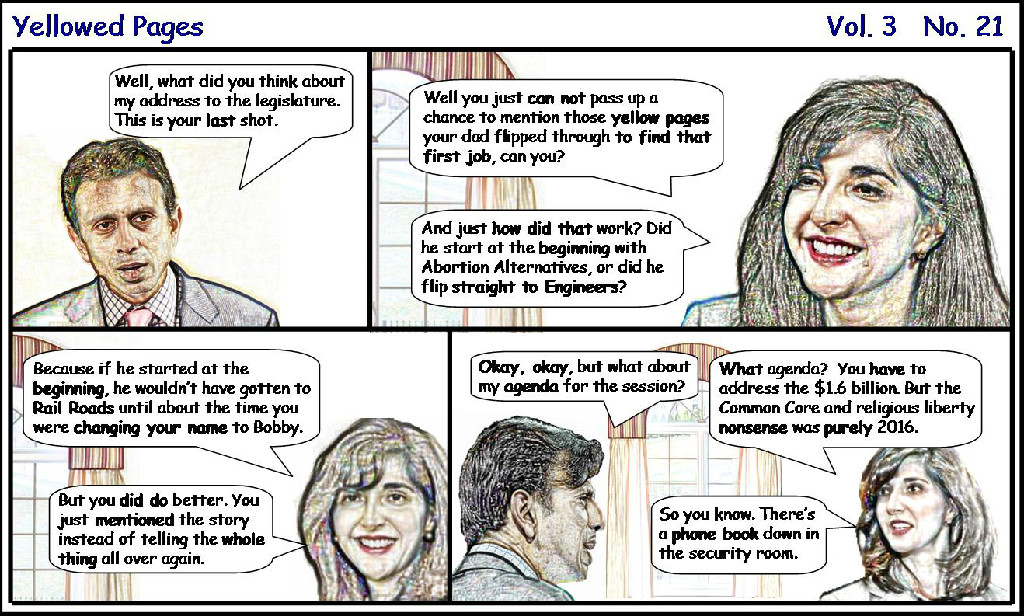
JINDAL STATE OF THE STATE ADDRESS(FROM OUR ANONYMOUS CARTOONIST: CLICK ON IMAGE TO ENLARGE)

If there was any lingering doubt that Bobby Jindal has been committing payroll fraud, that doubt was erased in last Monday’s State of the State address to legislators at the opening of the 2015 legislative which, thankfully, will be his last such address.

Fraud is defined as:

  • The wrongful or criminal deception intended to result in financial or personal gain;
  • Deceit, trickery, or breach of confidence perpetrated for profit or to gain some unfair or dishonest advantage;
  • A person or thing intended to deceive others, typically by unjustifiably claiming or being credited with accomplishments or qualities.

Payroll fraud is further defined as the unauthorized altering of payroll or benefits systems in order for an employee to gain funds which are not due. The person making financial gain could be the employee or could be an associate who is using the employee to commit the fraud while taking the funds for himself.

There are generally three types of payroll fraud but for our purposes we are interested in only one:

  • Ghost employees—A person, fictional or real, who is being paid for work he does not perform. In order for the fraud to work the ghost employee must be added to the payroll register. If the individual is paid a monthly salary this is easier for the fraudster, as once this has been set up there is little or no paperwork required. In order for the fraud to work, the ghost employee must be added elected to the payroll register. Once this has been set up, there is little or no paperwork required.

Under that definition, Jindal could certainly be considered a ghost employee. One person even suggested that it was not really Jindal speaking to legislators, that Jindal was actually in Iowa and they were being addressed by a hologram.

We maintain that Jindal is committing payroll fraud by vacating the state so often and leaving the details of running the state to appointed subordinates as inexperienced and naïve as he. The point here is this: No one on his staff was elected; he was. And he has not been at the helm of the ship of state and by absenting himself so frequently and so consistently as he gins up his presidential candidacy, he is committing payroll fraud, theft, and malfeasance. Others, like former Desoto Parish School Superintendent and Board of Elementary and Secondary Education member Walter Lee have been indicted and been prosecuted for payroll fraud.

Before we really get into his speech to legislators, JINDAL ADDRESS TO LEGISLATURE we simply must call attention to the feeble effort at humor he (or someone) injected into the third line of his speech:

“Well, here we are…at the moment that some of you have been waiting for a long time—my last state of the state speech.”

After an apparently appropriate pause, he continued: “No, that was not supposed to be an applause line…and I do appreciate your restraint.”

Seriously? You actually wrote that line in your speech? If you have to write that in, if you are incapable of ad-libbing that simple line, then we now understand that idiotic response to President Obama’s State of the Union Address in 2009.

Before getting to the real meat of his legislative agenda for this year (if you can call it that), he touched ever-so-lightly on a few other points he generously referred to as his administration’s accomplishments. Our responses to each point are drawn directly from statistics provided by 24/7 Wall Street, a service that provides a steady stream of statistical data on business and government:

  • “We cleaned up our ethics laws so that now what you know is more important than who you know.” (A quick look at the appointment of Troy Hebert as director of the Office of Alcohol and Tobacco Control after the baseless firing of Murphy Painter could quickly debunk that bogus claim. So could several appointments to the LSU Board of Supervisors and the equally egregious firing of key personnel like Tommy Teague who did their jobs well but made the fatal mistake of crossing Mr. Egomaniac.)
  • “We reformed our education system…” (Louisiana is the fifth-worst educated state and we are the third-worst state for children who struggle to read);
  • “We reformed our health care system…” (Really? Is that why the privatization of our state hospitals remain in turmoil? That same reform ultimately forced the closure of Baton Rouge General Mid-City’s emergency room because of the overload brought on by the closure of Earl K. Long Hospital? Can we thank your “reform” for the fact that Louisiana still has the nation’s third-lowest life expectancy rate or that we enjoy the nation’s third-most unhealthy rating, that we are fifth-highest in cardiovascular deaths or that we have the highest obesity rate in the nation?);
  • “…Our economy is booming.” (Seriously? Louisiana is rated as the worst state for business in the U.S.; we rank sixth-highest among states where the middle class is dying; we remain the eighth-poorest state in the nation with a poverty rate that is third-highest, and we’re saddled with the fourth-worst income disparity in the nation and we’re rated the 10th-worst state in which to be unemployed.);
  • “We have balanced our budget every year…and have received eight credit upgrades.” (This one of those claims so preposterous one doesn’t know how to respond, but we’ll give it our best. Jindal has repeatedly patched budget holes by skimming funds from other agencies, like more than $400 million from the Office of Group Benefits reserve fund, from the sale of the tobacco settlement, from ripping funds for the developmentally disadvantaged (to fund a race track tied a political donor—what was that line again about “what you know, not who you know”?), by cutting health care and higher education, by selling state property, and now he’s trying to cover the current $1.6 billion budget hole by selling the State Lottery. As for those credit upgrades, we can only point to the February action by Moody’s and Standard & Poor’s bond rating agencies to move the state’s credit outlook from stable to negative—and to threaten the more severe action of a downgrade.);
  • “The end result is a stronger, more prosperous Louisiana for our children. I measure Louisiana’s prosperity not by the prosperity of our government, but by the prosperity of our people.” (So, why are the fifth-most dangerous state in the nation? The 10th-most miserable state? Why do we have the eighth-worst quality of life? And the 11th-worst run state in the nation? And why have you never once addressed in your seven-plus years in office our ranking as the number-one state in the nation for gun violence or our ranking as first in the world for our prison incarceration rate?)
  • “We don’t live by Washington’s rules of kicking our debts down the road.” (For the love of God…);
  • “We have laid out a budget proposal that seeks to protect higher education, health care and other important government functions.” (And that’s why higher education and health care have been cut each of your years in office and why more cuts are anticipated that could conceivably shut down some of our universities. You really call cuts of up to 80 percent “protecting” higher education?);
  • “We have a system of corporate welfare in this state.” (Wow. After more than seven years of giving away the store to the tune of billions of dollars in corporate tax breaks, you finally come the realization that perhaps your generosity to the Wal-Marts, chicken processing plants and movie production companies may have been a bit much—that those policies may have actually hurt the state? What brought about this sudden epiphany? Bob Mann, in his Something Like the Truth blog, was all over that when he called attention to Jindal’s latest comment in the face of his claim a couple of years ago that we were “crushing businesses” with oppressive taxes. We’ll let him take this one.) http://bobmannblog.com/2015/04/17/bobby-jindal-is-now-against-corporate-welfare/
  • “We have identified over $500 million of corporate welfare spending that we think should be cut…” (Why the hell did it take you seven years?)

After all was said and done, after his hit-and-run sideswipes at all his purported “accomplishments,” Jindal devoted the bulk of his address to only two issues: Common Core and religious liberty. Of the latter issue, he said, “I absolutely intend to fight for passage of this legislation.”

Jindal was referring to Bossier City Republican State Rep. Mike Johnson’s HB 707 which would waste an enormous amount of time and energy—time that could be better spent on far more pressing matters, like a $1.6 billion deficit—on preventing the state from taking “any adverse action” against a person or business on the basis of a “moral conviction about marriage.”

Despite claims by Jindal and Johnson to the contrary, the bill is nothing more than a clone of the Indiana law that constitutes a not-so-subtle attack on gays or anyone else with whom any businessman deems a threat to his or her definition of marriage.

So, after eight addresses to the legislature, Jindal has yet to address any of the issues like inadequate health care, violence, poverty, pay disparity or equal pay for women, increasing the minimum wage, poor business climate (his rosy claims notwithstanding), our highway system (we didn’t mention that, but we are the seventh-worst state in which to drive, with the 15th-highest auto fatality rate), or our having the highest incarceration rate in the world.

Instead, the thrust of his address is aimed at Common Core—he called it federal control even though Common Core was devised by the nation’s governors and not the federal government—and something called the “Marriage and Conscience Act.”

And he expects those two issues, along with something he calls “American Exceptionalism,” to thrust him into the White House as leader of the free world.

And, of course, attacking national Democrats like Obama and just today, Hillary Clinton, on her claim of having immigrant grandparents. Jindal, of course, wants exclusive rights to that claim and says so with his oft-repeated platitude: My parents came to this country over 40 years ago with nothing but the belief that America is the land of freedom and opportunity. They were right. The sad truth is that the Left no longer believes in American Exceptionalism.”

Well, to tell the truth, if Bobby Jindal is the example—the standard-bearer, if you will—for what is considered “American Exceptionalism,” then frankly, we don’t believe in it either.

Read Full Post »

By Robert Burns (Special to LouisianaVoice)

LouisianaVoice readers may recall a December 15, 2014 post outlining state defense attorneys desperately fighting to block a deposition of Stephen Russo,  Secretary of the State Department of Health and Hospitals (DHH), to be conducted by Lewis Unglesby, lead plaintiff attorney in the Client Network Services Inc. (CNSI) civil lawsuit against the state.  CNSI alleges that Gov. Jindal’s office, in “consultation” with AG Caldwell’s Office, unjustly cancelled its contract to provide Medicaid processing services to DHH after news of a federal grand jury having convened to consider potential improprieties in the awarding of the contract broke.  The federal grand jury probe went nowhere, but Caldwell nevertheless continued a probe with a state grand jury.  Ultimately, that state grand jury indicted former DHH Secretary Bruce Greenstein for nine counts of alleged perjury entailing testimony to that grand jury or statements made at his senate confirmation hearing.

At that December hearing, Judge Kelley ruled that Russo could be deposed and that any attorney-client privilege had clearly been waived.  The AG’s Office filed an immediate appeal writ with the First Circuit (notwithstanding the fact Judge Kelley stated, “There’s nothing to appeal because this matter is clear,”).  The First Circuit upheld Judge Kelley’s ruling and denied the appeal.  During that December hearing, Unglesby stated AG Caldwell’s Office had “quite likely acted illegally” in publicly releasing Greenstein’s grand jury testimony.  A hearing to quash that testimony transpired in Greenstein’s criminal trial on March 20, 2015.

At that hearing, Greenstein criminal defense attorney, John McLindon, argued for protection of the grand jury “body” not only for the Greenstein case but for all future criminal trials.  He stated that denying his motion to quash the grand jury testimony would send a horrible signal that grand jury secrecy was a “sham” in Louisiana.  He also stated that AG Caldwell’s Office essentially engaged in an ex-parte maneuver in that the AG’s motion to file the grand jury transcript into the public record was “buried” at the end of the order.  McLindon also argued that David Caldwell had been deceptive in describing the motion in court on the day it was presented as a “routine procedure” to enable McLindon to obtain a copy of the testimony, which McLindon indicated he was entitled to anyway.  Judge Daniel ruled that the AG’s office acted properly in filing the transcript into the public record, but McLindon indicated he may likely appeal Judge Daniel’s ruling.

Louisiana Voice has now reviewed extensive court filings in the civil case in which CNSI attorneys lodge even more allegations of serious wrongdoing on the part of Caldwell’s Office.  Those allegations entail the testimony of CNSI whistleblower Stephen Smith.

Smith is the CNSI employee who sent an anonymous email to Jeffrey Branch with the Center for Medicare/Medicaid Services (CMS) under the alias of “Kunego.”  The email was sent sometime after a meeting which Smith had with Norm Nichols, President of Molina Medicaid Services, and the company which has managed Louisiana’s Medicaid processing for decades and which filed a protest after CNSI won the contract.  Smith testified that Nichols indicated that, although Molina lost the protest, “there were still things in the process that were questionable.”    Smith has moved on to Orlando, Florida where he serves as Vice President for Sellers Dorsey, LLC, which is a health policy consulting company.

On May 1, 2014, CNSI attorneys conducted a video deposition of Smith in Orlando.  During the deposition, Unglesby presented Smith with a copy of what the AG had supplied as the “Kunego report.”  That report, which was filed under seal soon after CNSI’s lawsuit was initiated, contained notations of AG investigator Scott Bailey’s interview of Smith (but identified as “Kunego”) on May 10th and May 11th of 2012.  Unglesby then asked Smith to take a pen and underline those portions of the interview notes for which he wished to claim were his words and recollections of the interview and to refrain from underlining those items for which he did not wish to assess as having originated from him.  As readers can readily tell from reading the 7-page report, Smith was only willing to claim responsibility for between 50-60% of it as evidenced by what is underlined.  Nevertheless, the report contains some rather intriguing allegations, not the least of which is contained on page five.  On that page, the report states:  “Bobby Jindal has what Kunego calls an India to India ancestor driven background and network of connections that brought CNSI and Jindal together.”

The deposition continued for an extended period, so the parties agreed to recess and reconvene on a later date, which turned out to be July 8, 2014.  Upon reconvening the deposition, Unglesby made an inquiry of Smith regarding whether he’d had any communication with anyone from the AG’s Office.  Smith responded that Scott Bailey, the AG investigator who had interviewed him for the Kunego report, had telephoned him twice and had flown to Orlando to meet with him on June 28, 2014.  Smith indicated that Bailey stated that he needed to clarify the timeframe of the meeting with Nichols and also to inform him that the AG’s office had provided CNSI attorneys with the “wrong version” of the Kunego report.  Smith testified that Bailey informed him that, on May 1, 2014, he’d been provided with the “unedited” Kunego report when he should have been provided with the “edited” report, which is the report the AG’s Office intended to supply to CNSI attorneys.

Smith then explained that the unedited report, which CNSI attorneys provided at the May 1, 2014 deposition, was what had confused him so much because it had statements in the report which he knew he hadn’t made and therefore caused confusion as to how such statements were in a report of an interview of him.  When Unglesby pressed Smith on whether he asked Bailey how such allegations, including that of Jindal’s “India to India ancestor driven background” and that being responsible for bringing CNSI and Jindal together, got in his interview report, Smith indicated that he did not press Bailey for any explanation.

CNSI attorneys, upon learning of these phone conversations between Bailey and Smith, the in-person meeting between the two on June 28, 2014, and the fact that two reports of Smith’s interview responses even exist, prompted strong accusations of witness tampering on the part of AG Caldwell’s Office.  CNSI attorney Michael McKay of the law firm Stone Pigman, in a Motion to Conduct Discovery Regarding Certain Activities of the AG’s Investigator, accuses AG investigator Scott Bailey of “outrageous witness tampering,” and seeks to depose Bailey about his conduct and actions and also have the AG surrender documents, including the “edited” Kunego report, which were shared between Bailey and Smith, along with documents and dates of correspondence between Smith and Nichols.

CNSI attorneys allege that the AG’s Office filed the “unedited” version of the “Kunego report” under seal with the full knowledge that it contained material not attributable to Smith as a means to “influence the public” and to justify a six-month stay being sought by the AG’s Office for all proceedings.  Although the motion to stay was denied (and the First Circuit upheld the denial on June 7, 2013), the AG’s Office filed a motion to limit discovery and a motion for Judge Kelley to recuse himself on the basis Unglesby had previously represented him.  Judge Caldwell denied the recusal motion on July 1, 2013; however, Judge Kelley granted a motion to stay all proceedings on July 30, 2013.  CNSI attorneys asserted that Kelley’s decision was based largely on the “unedited” Kunego report which they contended the AG’s Office knew full well contained material not supplied by Smith and for which the foundation is unknown.  CNSI attorneys also expressed frustration that, as of the date of their filing, August 22, 2014, they still had not been provided with the “edited” Kunego report.

The hearing on CNSI’s motion to depose Bailey was argued before Judge Kelley on October 7, 2014, and he granted the motion.  At a bare minimum, CNSI attorneys have already exposed a high level of ineptitude on the part of AG Caldwell’s Office in that it provided the wrong “version” of the Kunego report given how critical that report is to both the civil and criminal trials.  It is mind boggling that a document that critical wouldn’t be triple checked as being the one the AG’s Office wanted to ensure CNSI attorneys received.  The mere fact they would later have to admit to Smith that “we gave the CNSI attorneys the wrong version” speaks volumes as to the AG Office’s ineptitude.  Of course, as CNSI attorneys argued in their support memorandum, it begs the question as to why two versions of the report even exist at all.

It remains to be seen how successful CNSI’s attorneys may be in exploiting their allegation of witness tampering by the AG’s Office.  Obviously, their ultimate goal is to have Smith’s testimony at trial declared inadmissible based on inconsistency and the actions of AG Caldwell’s Office.  If they succeed, a huge defense to CNSI’s alleged wrongful contract termination may go by the wayside and expose Louisiana taxpayers to a substantial monetary award.  Further, if Smith’s testimony is ruled inadmissible, a spillover benefit to Greenstein’s criminal trial may also arise.

When combined with the recent scathing WWL investigative report on AG Caldwell, one can only question if the biggest beneficiary of all of the extensive focus of the ineptitude and controversies of Gov. Jindal has been AG Caldwell himself.  It certainly appears that for an extended period, he was able to fly below radar on his office’s ineptitude and potential serious wrongdoing.  Perhaps recent revelations of his actions may provide an excellent source of campaign fodder for the October election for Louisiana’s next attorney general.

Read Full Post »


There’s nothing left to be said other than to say Bobby Jindal is bat guano crazy.

The Louisiana Office of Group Benefits (OGB) was cruising along in 2011, providing virtually complaint-free quick turnarounds on medical claims for state employees, retirees and their dependents.

But then Bobby Jindal saw a way to undercut premiums in his privatization scheme which allowed the state to be obligated for less in its share of matching premiums so that Jindal could rake in some extra cash to cover his backside, aka budget deficit.

The result, as just about everyone who follows this sham of an administration knows, was that the $500 million reserve fund was all but wiped out.

Bobby Jindal, after having first jerked $40 million in funding for state colleges and universities, reversed himself again by taking $30 million from a federal hurricane recovery fund.

Bobby Jindal has shrunk the state’s rainy day fund from $730 million when he took office to $460 million and a $450 million fund to subsidize companies for investing in the state has evaporated as is the $800 million balance in the Medicaid Trust Fund for the Elderly.

And after giving away billions of dollars in tax breaks, incentives, rebates and exemptions for business and industry in an effort to spur economic development, we learned today (March 18) that Louisiana’s unemployment rate was third highest in the nation. http://www.politico.com/magazine/story/2015/02/bobby-jindal-campaigning-114948_Page2.html#.VQoeJ005Ccw

The one constant in all this is the Louisiana State Lottery, which since a 2004 Constitutional amendment has dedicated proceeds to the Minimum Foundation Formula (MFP) for public education.

Since the lottery’s approval by voters in 1990 and its implementation in 1991, the lottery, which is mandated to transfer 35 percent of proceeds to the state treasury, has contributed $2.8 billion to the state.

In 2014, sales were $450 million and $161 million of that was transferred to the state.

Also, 2014 marked the 13th consecutive year that the lottery has transferred more than $100 million to the state.

Why do we tell you all this?

Well, only because the administration of Bobby Jindal is currently entertaining the notion of selling bonds that guarantee future State Lottery profits in order to raise some $467.7 million in one-time money to help plug a $1.6 billion hole in the state budget.

Wait. What? Sell the State Lottery?

Yup.

State Treasurer John Kennedy tells LouisianaVoice that the administration is “seriously considering” two separate proposals to take over the lottery and to pay the state one time money.

The two proposals were from Wall Street banking firms Goldman Sachs and Citigroup. While Citigroup did not specify an amount, Goldman Sachs said, “Based on lottery revenue growth of at least 1.5 percent annually, the state could raise approximately $428 million and preserve a minimum contribution to the MFP of $160.2 million.” Goldman Sachs Presentation – March 2015

Citigroup Presentation – March 2015

With 13 consecutive years of receipts of more than $100 million and total receipts of $2.8 billion since 1992, $428 million in quick cash appears to be a terrible deal for the state—not that Bobby Jindal gives—or ever gave—a flying fig about this state.

Let’s first take a look back at the history of lotteries in Louisiana.

In 1868, the Louisiana Lottery Co. was authorized and granted a 25-year charter after a carpetbagger criminal syndicate from New York bribed the Legislature into approving the lottery and establishing the syndicate as the sole lottery provider.

Because it was an interstate venture, 90 percent of the syndicate’s revenue came from outside Louisiana. Because it was so profitable, when efforts were made to repeal the charger, bribes to legislators ensured the effort’s failure.

Ten years after it was approved, Louisiana had the only legal lottery remaining in the company. When Congress passed a prohibition against operating lotteries across state lines, the Louisiana Lottery was finally abolished in 1895. When it was disbanded, reports of ill-gotten gains and bribery surfaced. http://www.library.ca.gov/crb/97/03/chapt2.html

But even more worrisome are the histories of the two Wall Street banking firms who submitted proposals for taking over the Louisiana Lottery.

And even though Kennedy said Commissioner of Administration Kristy Nichols has said the lottery won’t be sold, the mere fact that two proposals for just that scenario have been simultaneously submitted by Goldman Sachs and Citigroup cannot be considered as coincidence. Both investment banking firms pointed that similar actions have been taken by Oregon, Florida, Arizona and West Virginia.

And what about the integrity and professional ethics of the two companies?

That’s a fair question, so let’s look at the records.

Goldman Sachs:

Citigroup:

So now the administration suddenly receives “unsolicited” proposals for the sale of the Louisiana State Lottery from two Wall Street banking firms with checkered backgrounds. (But admittedly, it would be difficult to find a Wall Street bank—or banker—these days that is not under a similar cloud.)

A Division of Administration (DOA) source said Bobby Jindal feels that, unlike his desire to sell the remainder of the tobacco settlement in yet another desperate effort to raise one-time revenue, he would not need legislative approval to sell the State Lottery. “We feel legislative approval would be required, but the governor apparently feels otherwise,” Kennedy said.

The State Treasurer added that he felt if Bobby Jindal does intend to sell the State Lottery, “he will wait until after the legislative session has adjourned and then direct the Lottery Corporation to take the action.”

The nine lottery corporation members are appointed to staggered terms by the governor. Kennedy serves as an ex-officio member. Three members, Christopher Carver ($2,000), Heather Doss ($1,000), and Lawrence Katz, combined to contribute $8,000 to various Jindal campaigns since 2003.


Read Full Post »

« Newer Posts - Older Posts »

