Feeds:
Posts
Comments

Archive for the ‘Fraud’ Category

A professional acquaintance told us several months ago that if David Vitter is elected governor, “I guarantee you he will go down in scandal in his first term.”

It may not take that long.

Vitter has used his Senate franking privilege to stick his sanctimonious foot in his mouth all the way up to his knee. Or, as my grandfather was fond of saying, he let his alligator mouth overload his jay bird backside.

On Friday (October 23, 2015), it was also learned that a man employed by a Dallas private investigation firm that has been paid more than $135,000 in 2015 by Vitter’s campaign was arrested after attempting to record a conversation between two Jefferson Parish politicians. The firm, J.W. Bearden & Associates, also has offices in New Orleans. http://theadvocate.com/news/police/13785472-32/man-arrested-after-trying-to

Robert Frenzel, 30, of Texas, was apparently video recording a conversation between Jefferson Parish Sheriff Newell Normand and State Sen. Danny Martiny during a regular breakfast meeting convened by Normand at the Royal Blend café in Old Metairie.

When confronted by Normand, Frenzel bolted from the restaurant. He was eventually found hiding behind an air-conditioning unit and booked on one count of criminal mischief but Normand said there also was probable cause to arrest him for interception of communications.

Vitter’s campaign office did not respond to repeated requests by Lamar White, publisher of the CenLamar web blog, for comment on Frenzel’s arrest. White’s phone calls and text messages to Vitter campaign spokesman Luke Bolar were not answered.

Normand, a longtime political enemy of Vitter, said he was unable to say for certain that he was a target of Frenzel’s surveillance, “but I’m going to find out.” He said he was confident in suggesting that Vitter was behind the surveillance. “Everybody does opposition research,” he told the Baton Rouge Advocate, “but quite frankly, I’m not the opposition.”

Normand said that investigators discovered a printout on blogger Jason Brad Berry. Over the past week, Berry has published a series of interviews on his blog www.theamerican zombie.com with former prostitutes who claim to have had sexual relations with Vitter, including one, Wendy Ellis, who says Vitter fathered a child with her in 2000.

While it’s commonplace for U.S. senators and representatives to use their free mailing perk (franking) to bolster their campaigns for re-election, it’s a bit tacky to do so in an effort to promote yourself to voters in a campaign for, say….governor.

And yet, that’s precisely what he has done. Apparently, it’s not enough to hit up state lobbyists in a blatant quid pro quo (kwid ˌprō ˈkwō/ noun: a favor or advantage granted or expected in return for something) solicitation of $5,000 contributions.

Also on Friday, one day before the gubernatorial primary election, we received a one-page, three-paragraph letter from Vitter on his U.S. Senate letterhead “to keep you informed on my work in the U.S. Senate to reduce wasteful spending in Washington.” VITTER FRANKING LETTER

(CLICK ON IMAGE TO ENLARGE)

After launching into a one-paragraph attack on President Obama for the $18 trillion national debt, Vitter launched into an invective against the Supplemental Nutrition Assistance Program (SNAP), aka food stamps.

“Nearly one in five people in America receive some amount of benefits from the program,” he wrote. “As it has expanded, fraud has also spread.”

Well yes, as any program involving the exchange of anything valuable expands, fraud expansion goes with it. That’s no great revelation. But let’s take a closer look. (We would emulate Bobby Jindal by prefacing this with his usual, “Two things,” but there are more than two points to be made here.)

  • Louisiana accounted for $1.3 billion of the total of $70 billion in U.S. food stamp redemptions in Fiscal Year 2014, which was 1.85 percent of the national total.
  • Louisiana had only 26 of the 2,226 sanctions imposed nationally in FY-2014, just 1.2 percent of the total sanctions.
  • In 2014 more than $84 million in food stamp benefits were spent at military commissaries. Vitter purports to support the military but many members of our armed forces live at or below the poverty level. The USDA estimates that up to 22,000 active-duty members of the military used food stamps in 2012. http://www.marketplace.org/topics/wealth-poverty/military-families-turn-food-stamps
  • More than 90 percent of entitlement benefits went to the elderly, the disabled or to working households. The breakdown is 53 percent to those 65 and older, 20 percent to the non-elderly disabled and 18 percent to non-elderly, non-disabled working households. SNAP STATISTICS

SNAP SNAPSHOT

Vitter says in his letter than he has authored bills to require work requirements to be enforced. He apparently is oblivious or uncaring about the fact that some food stamp recipients are forced to work two and three minimum wage jobs just to survive. Yet Vitter is adamantly opposed to increasing the minimum wage.

Vitter apparently subscribes to the belief that life begins at conception and ends at birth as evidenced by his opposition to both choice for women and assistance for babies born into poverty. Here are a few more points:

legalized-tax-fraud

Vitter appears to be quite concerned about entitlement benefits, particularly food stamps, going to the citizens of the third poorest state in the nation and not sufficiently concerned about the outlay of billions of state dollars in benefits to corporations that provide few, if any, new jobs. That’s not conducive to running a successful campaign for governor—unless he is trying to appeal to a certain segment of the population, say the so-called 1 percent, which wants to deny food stamps, health benefits, and higher wages to the least of us.

That doesn’t sound like someone who wants to be governor for all the people of the state.

But then Vitter has always been all about Vitter—and a couple of special ladies he would prefer not to discuss in debates or any other forum.

Take the case of Derek Myers, the former television reporter who was fired after three weeks on the job after Myers asked Vitter if he still patronized prostitutes and added: “Senator Vitter, don’t you think the people deserve answers?”

Myers, an investigative reporter for WVLA in Baton Rouge confronted Vitter in a parking lot immediately after he qualified to run for governor last month.

Vitter’s office denied that it contacted the TV station about pulling Vitter’s ads from the station following the confrontation. Vitter spokesman Luke Bolar claimed he’d heard that Myers pushed a Vitter campaign staffer in an effort to reach Vitter.

Myers, however, said video of the incident existed that shows that he never assaulted any campaign staffer but that WVLA forbade him from making the video public.

For Vitter, the hits just keep coming.

Lamar White and CenLamar also re-posted a new story on Friday originally broken by Jason Brad Berry in which he revealed that three other witnesses have come forward to implicate Vitter as a client of prostitutes in New Orleans during the 1990s. http://cenlamar.com/2015/10/23/there-is-definitely-a-house-in-new-orleans-three-more-allege-vitters-involvement-with-nola-prostitutes/

This comes on the heels of a story published a week ago by Berry’s American Zombie news blog which published interviews with a former prostitute who says Vitter fathered a child by her in 2000.

Three years ago, a brief tweet exchange took place between Vitters twitter account and a 20-year-old college student from the New Orleans Westbank. The tweet to “LuvMy_Kisses” was quickly deleted but not before it was archived. The woman, identified as Daysha Scott, was asked to explain why Vitter was contacting her. She tweeted back, “I know something you don’t know.” http://gawker.com/5937761/why-was-philandering-senator-david-vitter-tweeting-to-this-young-lady-last-night

All in all, David Vitter, who entered the 2015 race for governor as the odds-on favorite, could now find himself suddenly on shaky ground if not for Saturday’s primary then certainly for the Nov. 21 General Election. Democrat State Rep. John Bel Edwards was generally conceded to be a shoo-in for a runoff slot by virtue of his being the only Democrat in the race while Vitter is opposed by two other Republicans, Lt. Gov. Jay Dardenne and Public Service Commissioner Scott Angelle.

In recent days, Angelle has pulled even with Vitter, according to some political polls.

The latest incident with the private investigator could be a devastating blow to the one-time front-runner and more details are almost certain to emerge in the coming days and weeks.

Read Full Post »

Two separate directives, one from State Police Internal Affairs and the other from the Louisiana State Troopers Association (LSTA), have been sent to state troopers from State Police Troop D in Lake Charles relative to a multi-pronged investigation of reports of a series of irregularities in the troop.

A two-page memorandum from the Louisiana State Troopers Association (LSTA) was sent to Troop D state troopers in Lake Charles informing them that “eight or so” Troop D members have received letters indicating they are the targets of an Internal Affairs administrative investigation.

While the investigation was classified as administrative, it was made clear that the probe could become a criminal investigation.

The main thrust of the investigation appears to be related to time reported in driving to and from Baton Rouge to participate in firearms transition training. In that matter, some troopers reportedly charged more time than others for the same trip to qualify for firing of new weapons earlier this year. LouisianaVoice requested time sheets for those officers but state police attorneys denied our request because the matter was part of an official investigation—an investigation that was not initiated until we made our public records request.

Earlier, a single page communication from State Police Internal Affairs (IA) warning Troop D members to cooperate with the investigation either as witnesses or as targets.

LouisianaVoice was provided a copy of both letters, but is complying with requests that neither be reproduced here for fear that State Police investigators have some method of tracing the source of the leak because of special coloring or encoding on each copy sent out.

LouisianaVoice has learned that troopers in Troop D have been warned not to talk to anyone about the investigation, including LouisianaVoice. “They have put out a directive to intimidate the guys at Troop D so they won’t talk to you,” one source informed us on Saturday.

While neither memo mention LouisianaVoice by name, troopers were warned in the IA memorandum that all aspects of the probe are considered confidential and are to be discussed with no one.

The IA letter said, “As a Louisiana State Trooper, you are hereby advised of your rights related to an administrative investigation…

This administrative investigation is of potential violations of LSP and/or DPS policies and procedures including, but not limited to, irregularities regarding accrual of time, overtime, LACE details, escorts and other details, involving employees currently or formerly assigned to Troop D.

LACE, or Local Area Compensated Enforcement, is a program which is run by some district attorneys in the state to pay for traffic enforcement, including DWIs. District attorneys are willing to pay overtime to have state troopers monitor local traffic when there is insufficient local law enforcement. It became part of state law enforcement in the 1980s after state police suffered from a lack of state funding in an effort to put more troops on the roads when the state could not.

LACE was run sporadically in southwest Louisiana since its inception but has been a full time program only since 2008.

“…Your responsibility in this investigation is to cooperate fully with the investigation and to keep the substance of the investigation and the fact thereof confidential as outlined below.

  • Internal Affairs investigators or designated Administrative Investigators shall receive the full cooperation of any employee of the Department of Public Safety and Corrections, Public Safety Services, during the course of an administrative investigation. Employees shall obey any lawful order or directive given by the investigator during the investigation.
  • Ongoing administrative investigations are considered confidential and as such, officers shall not violate that confidentiality. Those in violation are subject to disciplinary action.
  • You are hereby ordered to refrain from destroying anything which might constitute evidence relevant to this investigation, including, but not limited to, department documents, electronic documents, electronic data, email communications, text message communications, communications on your MDT (mobile data terminals), radio logs, timesheets, and mobile video recordings.

The second, two-page communique from LSTA also said that “virtually other members of Troop D received letters notifying them that they are potential witnesses to one or more ongoing investigations.”

The LSTA memorandum was written in the first person and while the author is not identified, it appears to have originated from LSTA administrative offices.

Besides the time charged for firearms qualifying in Baton Rouge last spring, it specified six areas as possible subjects of investigation, including five previously cited by LouisianaVoice in its recent series of stories about Troop D. Those include:

  • Overtime/decline overtime;
  • Gift cards/ticket quotas;
  • Escort payments;
  • Payroll abuse;
  • Time off for DWI arrest;
  • LACE.

Of the six, only the LACE program was not reported on previously by LouisianaVoice, although allegations of irregularities in the program have recently come to our attention.

LouisianaVoice made public records requests for documents pertaining to overtime charged by certain troopers, excessive escort payments that were allegedly charged by a Troop D trooper, for radio logs and time sheets of yet another trooper, all of which were denied by LSP attorneys because the records were part of “ongoing investigations.”

And while no requests were made for public records involving gift cards, ticket quotas, or time off given troopers for DWI arrests, LouisianaVoice did publish a story about the practices in an earlier post. https://louisianavoice.com/2015/09/11/gift-cards-for-tickets-payroll-chicanery-quotas-short-shifts-the-norm-in-troop-d-troopers-express-dismay-at-problems/

Among other things, the LSTA memorandum said:

  • Troopers have a right to counsel and a right to consult with their LSTA representative provided the representative is not involved in the same investigation;
  • Eight or so Troop D members have received Target Letters indicating they are the subject of an investigation;
  • Virtually all members of Troop D have received letters notifying them that they are potential witnesses to one or more ongoing investigations;
  • Other troopers could become targets as the various investigations progress;
  • The stated purposed of the investigation relates to the “accrual and/or reporting” of time concerning the 2015 firearm transition training;
  • Other potential areas of investigation are ongoing, although few specifics were provided to LSTA;
  • All members of Troop D are required to cooperate fully in all investigations;
  • Some aspects of the ongoing investigations could have criminal ramifications but so far, the investigation is only an “administrative investigation.”
  • The confidentiality warning troopers received separately does not include troopers’ conferring with legal counsel;
  • Those cited as the subject of an IA interrogation and those who may be witnesses in an IA interview were cautioned to tell the truth;
  • Anyone interviewed is entitled to a copy of the interview upon request;
  • Likewise, those who are targets of the investigation are entitled to a copy of any written complaint leading to an interrogation upon request;
  • Anyone interviewed or interrogated is obligated to answer question but not obligated to engage in lengthy discussions, i.e. “tell us what you know. IA can ask a question. You should answer the question as directly and concisely as possible (and) then wait for the next question. Do not engage in a friendly conversation.”
  • Interview subjects were instructed to answer “I don’t know” to questions they do not know the answer to. “Do not speculate. Do not estimate. Do not just talk—answer the question directly and shut up while waiting for the next question.”
  • Interview subjects were told the most important thing they can do “is listen to the question carefully, answer the question as directly and concisely as possible and wait for the next question.”
  • Finally, they were told, “Remember, you have a right to counsel and a representative if you feel it necessary.”

The LSTA memorandum’s author said, “If I have learned anything over the last 7-8 years under the Edmonson administration, it is that the Colonel reacts badly if he believes a trooper lies or tries to obstruct an investigation.”

LouisianaVoice currently has additional public records requests pending that involve state troopers in other parts of the state.

Read Full Post »

The badge of the Louisiana State Police has been tarnished and the rank and file—the road troopers, especially those in Troop D—don’t like it.

From reports of gift cards to troopers for making ticket quotas to an unwritten policy of giving time off for DWI arrests to padding of fees for escorting oversized loads, the picture emerging from Troop D presents a negative reflection on the entire Department of Public Safety.

And those troopers who are trying to uphold the integrity of the LSP motto of “Courtesy, Loyalty, Service” believe that is an unfair representation. They have privately expressed their collective dismay—particularly at a time when it appears that open season has been declared on law enforcement officials by seemingly anyone with a grudge.

LouisianaVoice has learned from sources within the Department of Public Safety that Trooper Ronald Picou of Beauregard Parish has been suspected of committing payroll chicanery for years. His fellow troopers say Picou gets his recommended number of citations (read quota) within the first couple of hours after coming on duty and then abandons his patrol duties for the remainder of the shift.

LouisianaVoice has learned that Picou habitually works the first two or three hours of his 12-hour night shift or four-to-six hours of his 12-hour shift when working days. All activities during a shift are logged on the State Police radio but there were some shifts that Picou supposedly worked which showed zero radio activity.

Other Troop D troopers questioned whether Picou is writing the tickets he did write because the driver deserved a citation or so that the trooper can take off early but still get paid. Picou is assigned to patrol Beauregard Parish.

When troopers took it upon themselves to determine where Picou was spending his shift, the answer came almost too easily, they said. His patrol vehicle was parked at his home while taxpayers’ investment in protection was being ignored. Some troopers said that Picou even bragged about sleeping at home.

Why would a trooper need to spend so much time at home? It might be because he has been too busy running a construction company during the day.

Louisiana Secretary of State corporate records show that Ronald Picou runs TRP Construction at 1870 Granberry Road in Deridder in Beauregard Parish. That also is the address of his residence.

Our sources indicate that Picou would work only a couple of hours of his night shift and then go home to rest so he could work at his construction job the following day.

TRP’s corporate papers were filed with the Secretary of State on April 23 of this year. Prior to that, he was active in Bois Clair, LLC, a right-of-way construction company whose previous address was also 1870 Granberry Board. Bois Clair is no longer affiliated with Picou and now has a Leesville address, effective April 23, the same date his current company was registered with the Secretary of State.

His co-workers at Troop D say they are fed up that he is not available to back up other troopers or other law enforcement agencies by choosing instead to pursue private business interests during his off hours and resting during his shift hours.

State Police Investigation of the Payroll Abuse

So how could a law enforcement officer go silent for up to 12 hours at a time without attracting the attention of supervision? It seems reasonable to think a supervisor, not hearing from a road trooper, would check on the officer to make sure he was safe. There is no legitimate explanation for this other than to speculate that the supervisor was aware and allowed it to happen.

Picou’s activities, or lack thereof, were reported to State Police Internal Affairs more than three years ago through an anonymous letter after troopers audited the radio logs confirming the reports. It was not reported directly for fear of retaliation (a wise decision in retrospect). Internal Affairs passed the investigation on to the Troop D commander Capt. Harlan Chris Guillory.

The investigation, instead of attempting to halt payroll abuse, however, was instead focused on discovering those involved with reporting the conduct. It seems to be an apparent pattern with the State Police to go after the messenger as evidenced by the 80-page report in our previous post which sought to discredit—and demote—officers who initiated a prescription monitoring program on Guillory. Guillory, Picou’s supervisor (Lt. Jim Jacobsen), and Picou were reported to be close friends.

Picou was placed on Jacobsen’s shift every year—something rarely, if ever, done. State police sources say shifts rotate each year and it is uncommon for a trooper to stay with the same lieutenant. Jacobsen subsequently retired but since his retirement, Picou has been on Lt. Paul Brady’s shift who is also said to be good friends with Jacobsen and has reportedly allowed the practice to continue.

The conduct was reported to state police at least three times. LSP finally appears to be taking the allegations seriously in response to LouisianaVoice’s public records request for Picou’s radio logs for the past six months. We intended to confirm the allegations with the documents but were denied because they are reportedly a part of an investigation. This despite LSP’s having been notified of this years ago. Nothing was done until we began asking questions.

When LouisianaVoice again made a public records request on Monday of this week (Sept. 6) for the State Police investigation file on Picou, we received the following response from LSP Attorney Supervisor Michele Giroir:

“…in response to your below public records request, I have been advised that the information that you seek is related to an ongoing administrative investigation.  Therefore, the records are not subject to release to you at this time pursuant to R.S. 40:2532 and Article 1 Section 5 of the Louisiana Constitution of 1974.”

Bear in mind that Picou was first reported three years ago and those were the investigative records we were seeking. So three years have gone by with no action on the complaints but now the file is suddenly part of an “ongoing administrative investigation.”

We have but one question: Why has it taken three years to conduct the investigation, an investigation which conveniently places the records beyond the reach of the public?

The annual estimated payroll abuse based on current salary at the average rate of radio silence based on 180 shifts per year is more $30,000 per year, according to figures provided LouisianaVoice. If the allegations are confirmed, this one trooper is responsible to the taxpayers of over $100,000, sources tell us.

The citizens of Beauregard Parish and Louisiana deserve better. The procedure of getting citations as quickly as possible and taking the rest of the shift off has begun to spread, officers said. Other troopers and new hires are being trained on how to do this. It does not stop there.

Brady Days, Drunk Driving Arrest for Paid Time Off

Brady days are an unwritten policy of time off for arresting a drunk driver. The practice got its name from the person who came up with the idea: Lt. Paul Brady. His idea was approved by Guillory.

Once a trooper arrests a drunk driver, he is allowed to take off for the remainder of the shift in violation of quota and payroll fraud laws. This in turn has led to claims that some motorists get arrested who are not impaired. Our sources tell us that supervisors order troopers to charge people who are not impaired (below the legal limit of blood alcohol content).

The supervisor demands the trooper offer a urine test and if it came back without drugs, it will not matter because by then, the trooper has received credit for the arrest even though the DA will simply drop the charges. Again, this raises an important question: Are motorists getting arrested because they made the mistake of driving drunk or because the trooper has the incentive of getting to go home early, with pay?

Prizes

There is a popular joke in law enforcement. Whenever a motorist accuses an officer of issuing a citation because the officer needs to meet his quota, officers jokingly respond that if he gives one more (ticket) he gets a toaster. Well in the case of Troop D, some troopers really are being awarded with gift cards monthly for getting enough arrests or citations. One source said the gift cards generally are awarded in denominations of $50.

Suspected Bribery

One report said a trooper was caught taking extra money for an oversized load escort. The extra payment appeared to be in exchange for the trooper to violate the restrictions of the state issued permit. The company tried to pay another trooper to do the same thing resulting in the discovery of a suspected bribe. The company made the mistake of filing a complaint against the second trooper who refused to take the extra payment. The original trooper had to give the money back. There was no investigation according to LSP Internal Affairs and therefore no information was available for a public records request.

They are not all bad

This information was brought forward by troopers who do not condone these actions. They tried reporting it through proper channels. Private citizens also reported Picou to troopers and asked that the information be passed on to supervisors. “They are embarrassed by these actions,” one trooper said. “Releasing this to LouisianaVoice was a last resort.”

Because of the unspoken policy of going after the whistleblowers, troopers who talked to us understandably found it necessary to conceal their identities.

Troopers now earn nearly $100,000 per year. Sergeants and above are well above six figures. The widespread payroll abuse is overt. New troopers are being trained that this is okay and it is becoming ingrained in the culture at Troop D. We can only hope this is not the case in other troops throughout the state.

LouisianaVoice stands behind and supports law enforcement at all levels. Without dedicated police officers, society would be reduced to anarchy. No one wants that. There has to be order and there must be laws and rules to live by. But these rules must be evenly applied both to the enforcers and to those on whom the rules are enforced.

When there is a double standard, we all suffer the consequences.

Administration’s attacking those who report abuse is not the answer and certainly not conducive to high morale.

Read Full Post »

Even as grieving friends, relatives and fellow state troopers were gathering to say goodbye to slain Troop D State Trooper Steven Vincent in Lake Charles last weekend, a State Police Internal Affairs investigation was well underway into alleged payroll irregularities on the part of Troop D Commander Capt. Chris Guillory.

One report received by LouisianaVoice indicates that Guillory reassigned a supervisor to administrative duties after he and his subordinates declined to participate in what they felt was payroll fraud stemming from travel to Baton Rouge for new firearms qualification.

Meanwhile, a potential confrontation between Guillory and the man who filed a complaint against him was averted when a sheriff’s deputy escorted Dwight Gerst from a visitation for Vincent at the Rosa Hart Theater at the Lake Charles Civic Center on Friday, Aug. 28.

Gerst, who was friends with and who was trained by Vincent, attended the wake but said he was cursed by Guillory while he was standing in line and a sheriff’s deputy subsequently escorted him from the visitation. “I was there to honor and pay my respects to a friend,” Gerst said.

LouisianaVoice published a story on Aug. 17 about Guillory’s refusal to accept a formal complaint about threats Gerst said Trooper Jimmy Rogers made against him. Gerst then took his complaint to State Police headquarters in Baton Rouge but it was never followed up by Baton Rouge, he said.

But now, Internal Affairs is conducting what appears to be a full-blown investigation into a number of allegations involving Guillory, including but not limited to the payroll irregularities and prescription drug abuse.

One of the payroll issue stems from a trip Troop D troopers made to Baton Rouge earlier this year to qualify with new weapons issued the troopers. LouisianaVoice has learned that troopers were instructed to charge extra hours for the round trip and time spent qualifying.

Guillory is said to have reassigned one supervisor to administrative duties after he and his subordinates declined to participate in padding their time sheets.

LouisianaVoice in late July made a public records request of State Police for an opportunity to review all time sheets for the pay period that Troop D personnel traveled to Baton Rouge to fire the newly issued weapons.

On Aug. 18, State Police Attorney Supervisor Michele Giroir notified us by letter that the time sheets, along with numerous other requested public records had become the subject of an ongoing investigation being conducted by Louisiana State Police. “Therefore, these records are not subject to release at this time,” Giroir wrote.

It appears the request by LouisianaVoice for the records sparked the investigations into the suspected payroll irregularities. Reporting sources indicated they had not wanted to take information to LouisianaVoice but did so after reporting the problems internally only to see the investigation focus more on discovering the source of the reporting than in identifying and stopping misconduct.

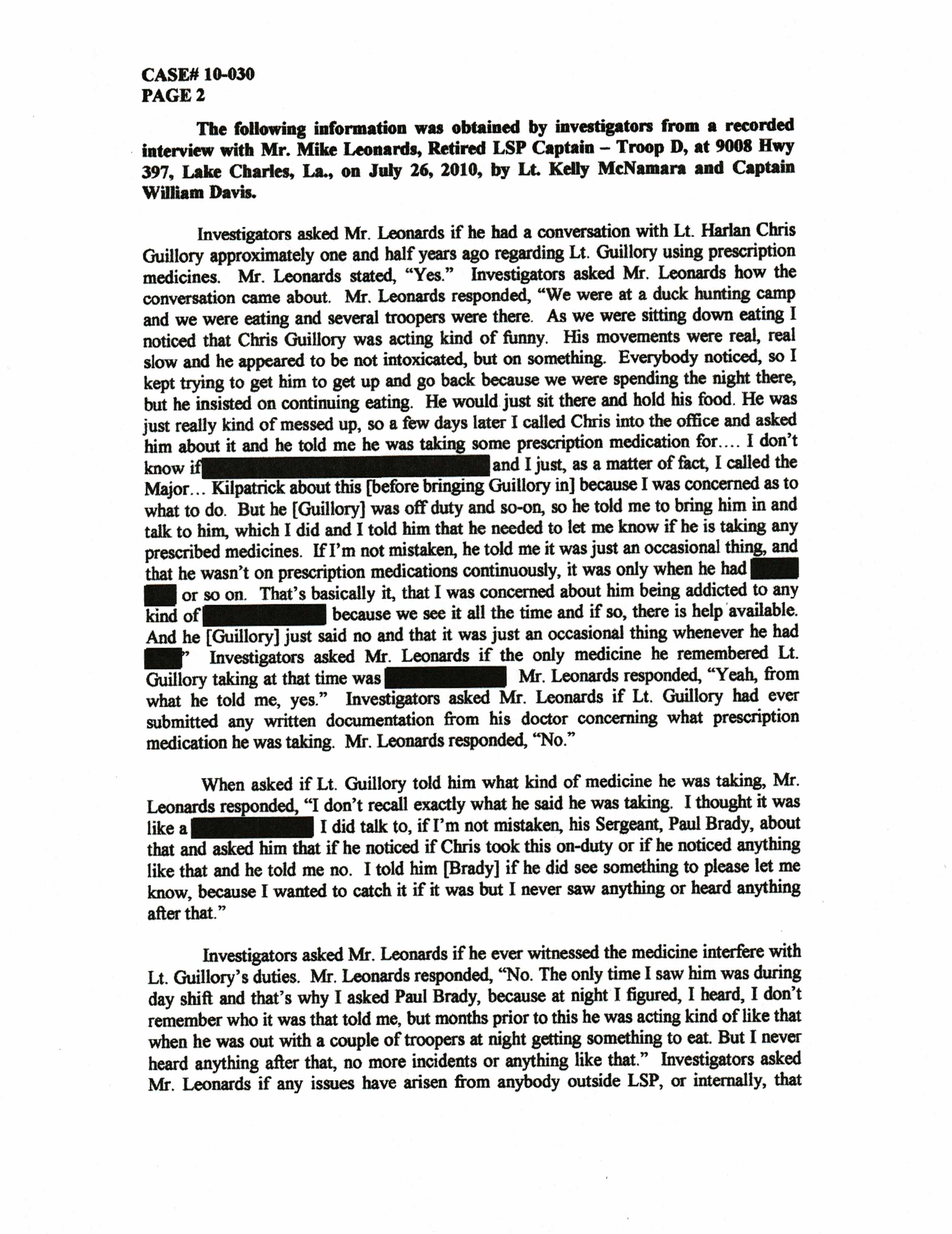
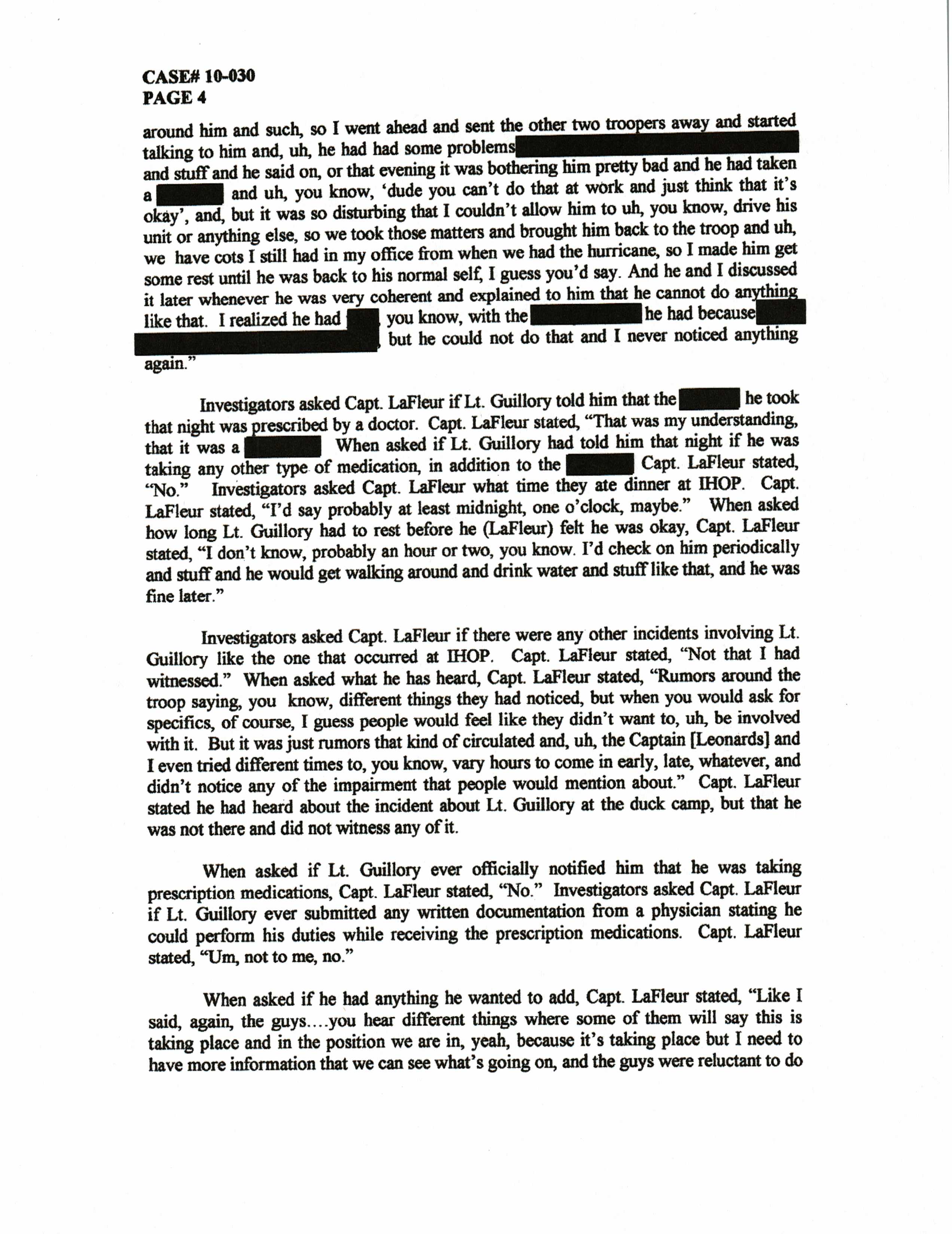
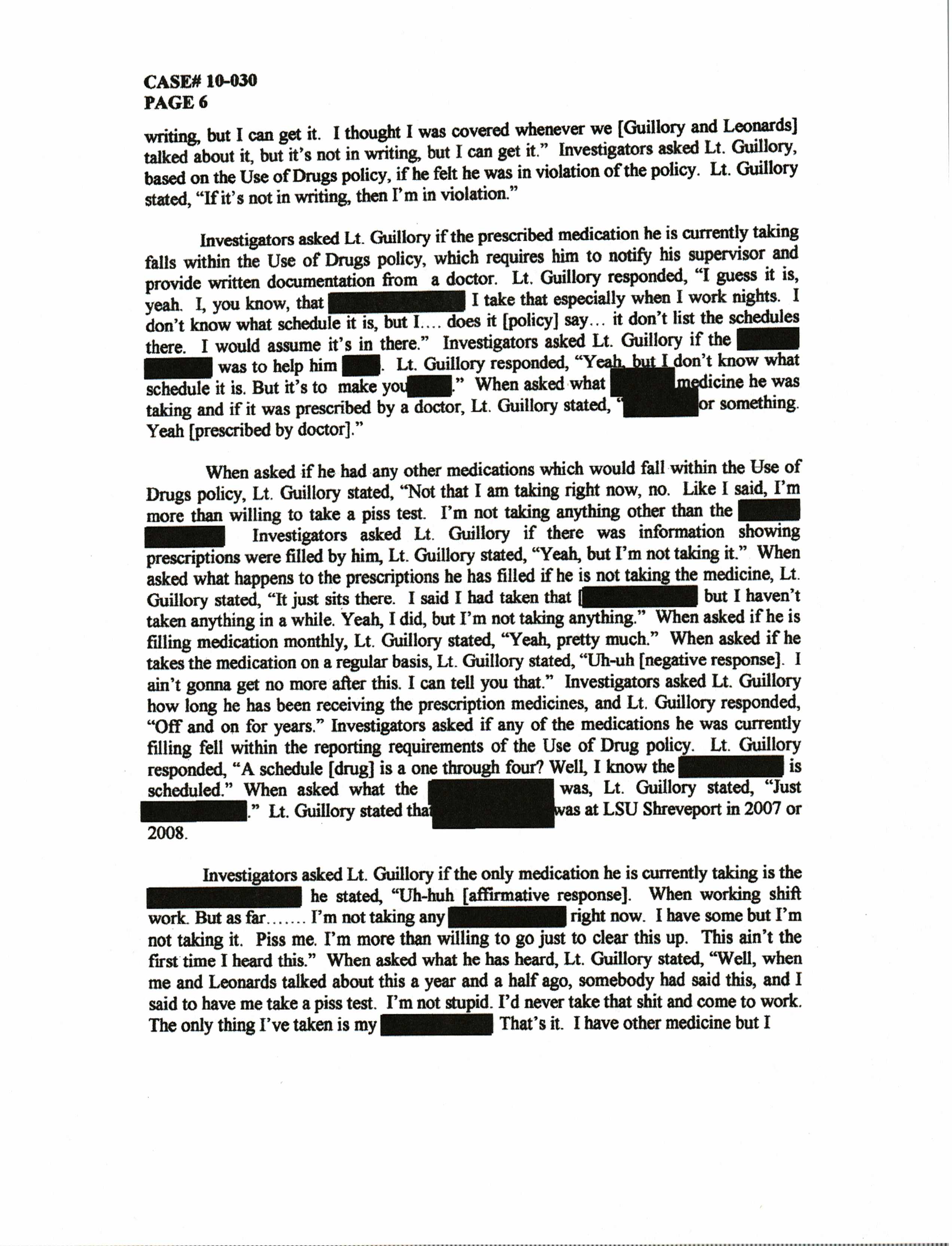
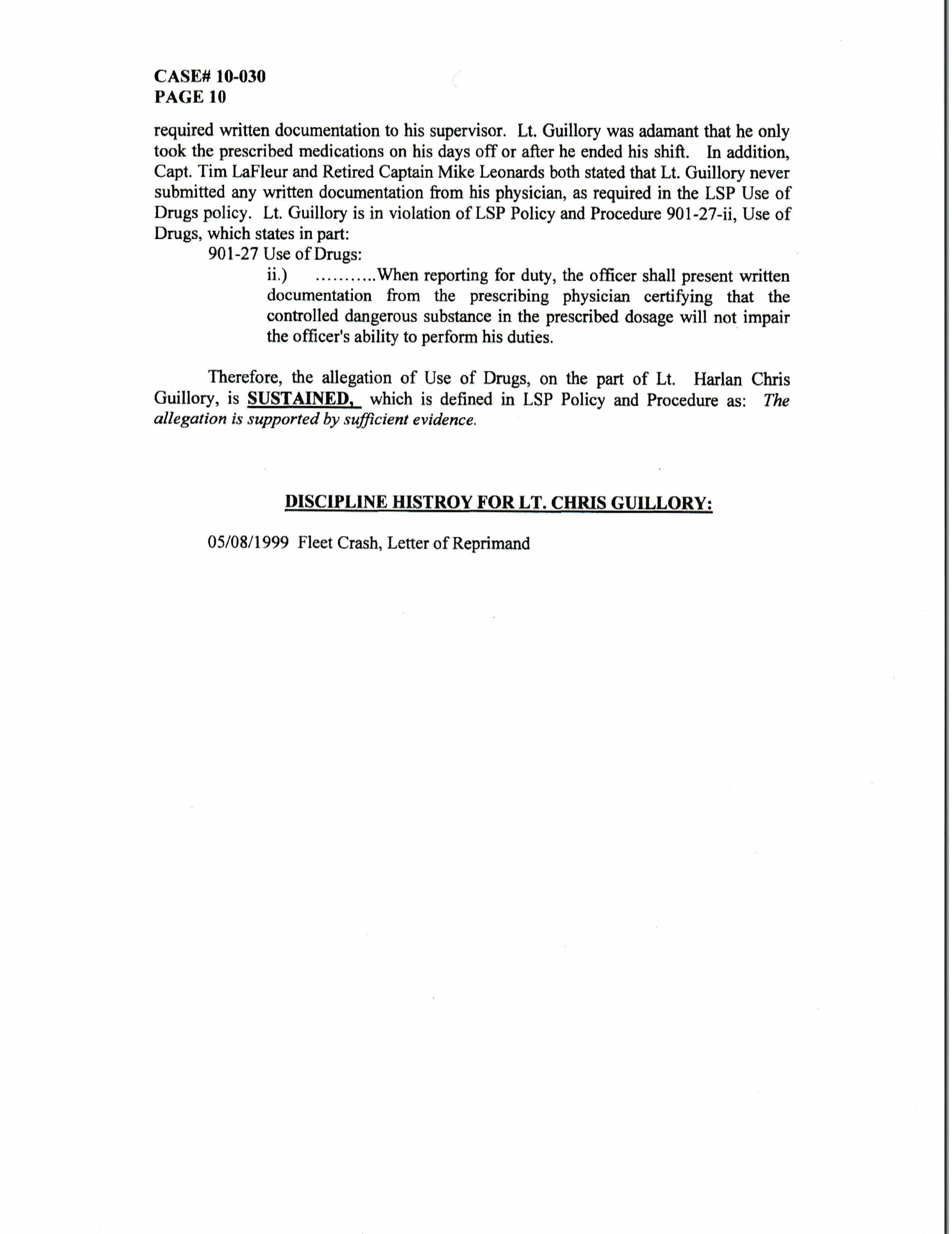
Giroir did, however, release a 10-page investigative report of an investigation of the possible abuse of prescription drugs by Guillory. “…Guillory may have taken, or is currently taking, a prescribed controlled dangerous substance, which is required to be reported as per LSP Policy and Procedure…,” the report said.

The report alluded to instances of Guillory’s being observed driving erratically in his patrol vehicle. One state police official reported that Guillory was at a restaurant and had to be driven back to Troop D to sleep on a cot until returning to normal. Guillory denied to investigators that he slept on the cot. It was also reported he experienced difficulty manipulating utensils at a restaurant while eating in a restaurant with other troopers.

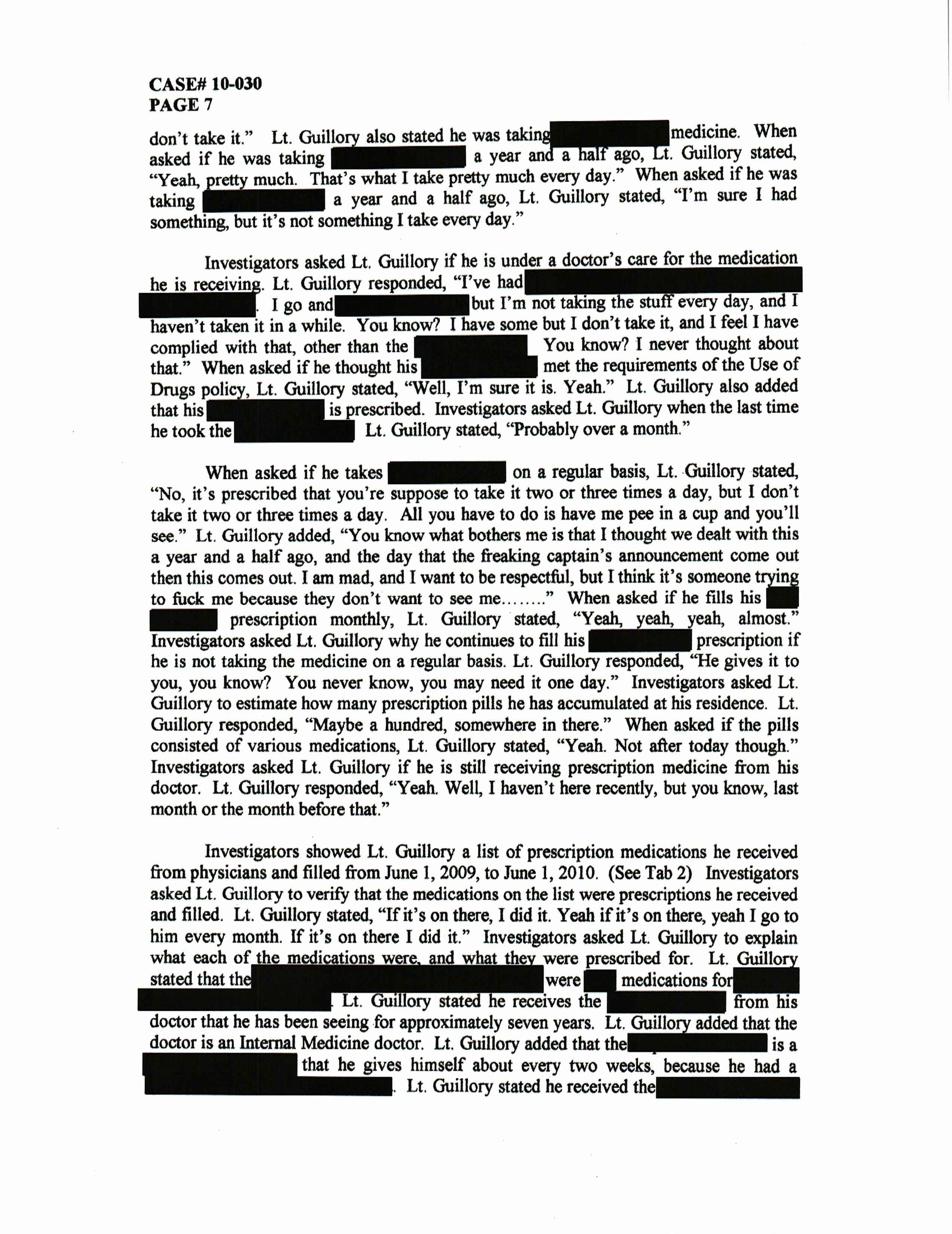
The 10-page investigative report was heavily redacted, but it was evident that Guillory first told investigators he was in compliance with LSP drug use policy but later admitted he was not. He told investigators he was obtaining prescriptions from three different doctors and that he had accumulated “maybe a hundred” pills at his home. He admitted to investigators that he occasionally doubled up on his dosage but that it was not an everyday thing.

The type pills prescribed to Guillory was redacted, but LouisianaVoice has learned that they were believed to be OxyContin which is normally prescribed for only 15 days because of addiction risks and is intended for use by terminal cancer patients and chronic pain sufferers.

State police investigators described the drugs as a “the cocktail.” According to law enforcement experts, the cocktail is a combination of pain killers, muscle relaxers, and anti-depressants.

Guillory reported that he flushed the medications after being interviewed by Internal Affairs. Shortly after the investigation was concluded, he was reprimanded for violating the State Police drug use policy. He was promoted to the rank of captain and became commander of Troop D subsequent to the investigation but later received a letter of reprimand for violation of prescription medication notification regulations from State Police Superintendent Mike Edmonson.

Here is the 10-page redacted report, along with the letter informing the Region II Command Inspector of the investigation, followed at the very bottom by a link to Edmonson’s letter of reprimand to Guillory—after he was promoted to captain. (CLICK ON EACH IMAGE TO ENLARGE):

IMAG1108

IMAG1110IMAG1111IMAG1113IMAG1114IMAG1115IMAG1116IMAG1117IMAG1118IMAG1119

Here is the GUILLORY REPRIMAND letter of Sept. 28, 2010.

Read Full Post »

The Louisiana Auctioneers Licensing Board doesn’t like former board member Robert Burns. Neither does the board’s attorney, convicted felon Larry Bankston.

That’s understandable. They haven’t like him since he uncovered payroll fraud and other irregularities and was bounced off the board by Bobby Jindal, whose idea of accountability is to hold whistleblowers fully accountable. When he was shown the door, Burns began video recording board meetings. During one meeting he even captured the board’s attorney saying Jindal’s office had advised the board not to worry about a legislative auditor’s report critical of illegal payments and illegal pay raises to part time executive assistant Sandy Edmonds.

Burns can be much like a canker sore when he puts his mind to it—irritating, always there, and impossible to ignore. But there’s nothing in the state public meeting statutes that says spectators—or media—must be liked. In fact, when the media (and Burns, through his newly-launched Web blog, is a member of the media whether that fits the board’s definition or not) become too cozy with public officials, then they no longer serve their purpose as the public watchdog.

Today (Aug. 31), we received a disturbing email from Burns. The Louisiana Auctioneer Licensing Board is considering turning off and removing his video recorder if he leaves it unmanned to go to the restroom or leaves the room for any other reason. “Frequently I am the only one in attendance” at board meetings, Burns wrote. True, the Auctioneer Licensing Board flies pretty much under the radar and attracts little to no media attention other than from Burns.

“If I need to go to the restroom or something,” he continued, “I leave the video camera running while on its unipod.” (I still don’t know why he doesn’t invest in a tripod which, unlike a unipod, is free-standing, but that’s another story.)

The AGENDA released for Tuesday’s (Sept. 1) meeting contains item number 8, which says:

  • Revision of Board Meeting Rules- In the event that the public videos or records the proceedings, such equipment must be manned at all times. Any equipment left unattended will be removed and turned off.

Now I am no attorney, though Mr. Bankston is, or at least he has been since he got the Louisiana Supreme Court to reinstate his licenses after his release from prison.

In 1994, then-State Sen. Bankston (D-Baton Rouge), chairman of the Senate Judiciary Committee (appropriately enough), met in his law office with one Fred Goodson, owner of a video poker truck stop in Slidell. There followed a discussion of a plan to manipulate the legislative process so as to protect the interest of video poker companies.

And what did Bankston get as quid pro quo? Well, it seems he owned a beachfront condominium in Gulf Shores, Alabama, so Goodson agreed to pay Bankston $1,555 per month for the “non-use” lease of the condo—a bribe, as it were.

Indicted on October of 1996, he was convicted on two counts of racketeering the following year and sentenced to a 41-month sentence in federal prison and ordered to pay a $20,000 fine.

He was released on Nov. 6, 2000, and served the remainder of his term in a half-way house in Baton Rouge. He was disbarred on March 9, 2002, retroactive to Nov. 19, 1997, but on Feb. 5, 2004, with only one dissenting vote, the Supreme Court’s disciplinary committee recommended that he be re-admitted to the bar.

So today, he provides legal advice to the Auctioneer Licensing Board—a board that winks and looks the other way at payroll fraud on behalf of one of its part time employees.

“If the proposed rule passes,” Burns wrote, “the board apparently believes it has the right to ‘remove and turn off’ any video recording equipment left running. I see nothing in the statute that requires any equipment to be manned, nor do I see where they have any authority to tamper with my video equipment, much less ‘remove it.’

“This is just another effort by a public body hell-bent on deterring public transparency,” he said, adding that he was going to go on the assumption that Attorney General Buddy Caldwell “has been perfectly willing to aid and abet” in the proposed action.

Duly indignant over this flagrant violation of state law, I fired off my own email to the board which first cited the applicable state law on public meetings:

  • The law grants the public the right to attend and record the deliberations of public bodies including city and parish governing bodies; school boards; levee boards; port commissions; boards of public utilities; planning, zoning and airport commissions; other state, local or special district boards, commissions or authorities with policy making, advisory or administrative functions; and committees or subcommittees of those bodies. Judicial proceedings are exempted.

After providing that remedial lesson on the law, I wrote:

I am given to understand this item is to discuss a new rule which would allow the board to turn off Mr. Burns’ video recorder should he have to leave the meeting for a few minutes for any reason. I have a problem with this and I am personally prepared to take you to court over both.

First of all, you have no right to tamper with his video equipment. It is perfectly within the law for him to record the meetings as per the section on public meetings laws highlighted above. Whether he happens to be in the room at the time or not is irrelevant. It is his equipment, not yours, and he has every right under law to record any open meeting.

Moreover, if you follow through on this action, I will pay the costs of Mr. Burns’ filing a lawsuit holding the board chairperson and its legal counsel personally liable for all applicable fines and legal costs. Mr. Burns will not only file suit for damages under the open meetings laws but for harassment and intimidation, as well.

There’s another twist in this sordid soap opera. Item 2 on the agenda calls for a discussion of Burns. He recently lost a public records lawsuit against the board, not because he was wrong in his contention, but because, in the presiding judge’s words, the office of Attorney General Buddy Caldwell gave the board bad advice.

Be that as it may, the agenda said that the discussion of Burns may require an executive session.

Not so!

The only reason for an executive, or closed session is to discuss ongoing negotiations, pending litigation or personnel matters. In the case of Burns, he is not an employee of the board, so any claim of discussing personnel would be invalid as would any claim of ongoing negotiations. As for pending litigation, it is no longer pending. The ruling has been made and the case is over, so all excuses for executive session are out the window. So, if there is to be a discussion of Burns, he has every right under law to insist that all such discussion be done in open session for all (including video cameras) to see and hear. If the board does otherwise, it will be yet another claim in future litigation.

In fact, the board is now skating dangerously close to civil rights violations, which would throw any lawsuit into federal court.


Read Full Post »

« Newer Posts - Older Posts »