Feeds:
Posts
Comments

Archive for the ‘Fraud’ Category

LouisianaVoice has received unconfirmed word that State Trooper Ronald Picou has been placed on leave pending termination following a months-long investigation of Louisiana State Police (LSP) Troop D in Lake Charles. The investigation was prompted by LouisianaVoice revelations that Picou would often leave work after only a couple of hours on shift to go home and sleep so that he would be able to work at the construction company he owned.

Our sources from within Troop D have reported that Picou’s patrol unit is parked at the troop and all of his equipment has been turned in. Those same sources say he is on leave. It is common practice to place a terminated trooper on leave until his or her effective termination date.

Those sources also say he will appeal his termination.

Left undetermined is whether or not he will face prosecution for knowingly accepting payment for time not worked.

LouisianaVoice first broke the story on September 11 in which we reported the awarding of gift cards to troopers for making ticket quotas and an unwritten policy of giving time off for DWI arrests. https://louisianavoice.com/2015/09/11/gift-cards-for-tickets-payroll-chicanery-quotas-short-shifts-the-norm-in-troop-d-troopers-express-dismay-at-problems/

In that story, we wrote that Picou “habitually works the first two or three hours of his 12-hour night shift (or four-to-six hours of his 12-hour day shift) and then go on radio silence for the remainder of his shift.

Radio records obtained by LouisianaVoice from independent sources after LSP denied our request for the logs, saying they, along with other requested records had become the subject of an ongoing investigation and therefore “are not subject to release at this time.” The records given LouisianaVoice indicated frequent extended periods of time during which there was no radio traffic at all from Picou.

Of course, LSP brass launched its initial investigation into discovering the identity of the whistleblower(s) before finally turning attention to the allegations themselves.

Louisiana Secretary of State corporate records show that Picou, of Beauregard Parish, operates TRP Construction in Deridder. When his fellow troopers took it upon themselves to determine where Picou was spending his shift, they invariably found his patrol vehicle parked at his home while taxpayers’ investment in protection was being ignored. Some even said Picou bragged about sleeping at home.

Picou was placed on Lt. Jim Jacobsen’s shift every year. It is rare, if ever, for a trooper to remain with the same lieutenant. Following Jacobsen’s retirement, Picou was placed on Lt. Paul Brady’s shift. Both Jacobsen and Brady, along with Troop D Commander Capt. Chris Guillory, are said to be close friends.

Jacobsen even sent a letter to LouisianaVoice in November that he said cleared Picou of any wrongdoing. https://louisianavoice.com/2015/11/12/explanation-of-retired-state-trooper-beauregard-parish-sheriff-candidate-jim-jacobson-is-less-than-illuminating/

There were several problems with that letter, however.

First, the letter was dated August 1, 2013, long before our story was published.

Second, the letter itself said that the investigation was carried out by Troop D rather than LSP internal affairs investigators.

In that letter, the allegations of Neglect of Duty, Unsatisfactory Performance, Secondary Employment Obligations and Performance of Duty were all determined to be “unfounded.”

The letter was signed by “Captain Chris Guillory, Troop D, Louisiana State Police.”

Guillory has experienced his own problems. Besides being given a letter of reprimand on November 13 for allowing a State Trooper to continue work after being placed on suspension, he was given an earlier reprimand for abusing prescription narcotics while on duty—and was subsequently promoted from lieutenant to captain and was named commander of Troop D.

So the observation must be made that the poop doesn’t always flow downhill. Those charged with supervisory duties are accountable for the transgressions of those who answer to them. When behavior that casts a dark shadow across the entire organization and which puts everyone in an unfavorable light  is allowed to continue unabated, perhaps even encouraged, that’s when the sewer begins to back up.

Read Full Post »

© 2016

A joint investigation by LouisianaVoice and Fox8 News has revealed that a federal investigation has been launched into allegations that former Louisiana Office of Alcohol and Tobacco Control director Troy Hebert used his position to extort sex from a woman who experienced problems with ATC over a liquor license for her New Orleans restaurant.

New Orleans businessman Amer Bader, who initially told LouisianaVoice he had been visited by the FBI, told a former ATC agent he exchanged text messages with Hebert. In those texts, he accused Hebert of extorting sexual favors from a woman friend of Bader’s who was experiencing problems in licensing her restaurant with ATC. He later said it was not he who was visited by federal agents, but his friend who runs the Star Steak House on Decatur Street.

The restaurant, according to the former agent, was delinquent in paying its taxes and its license expired on May 31, 2015. Following an appearance at ATC in Baton Rouge, Hebert allegedly contacted her and offered to help, according to the source who voluntarily came forward. The two began meeting for dinner, the anonymous source told LouisianaVoice via email on Dec. 18. She said Hebert eventually took the woman to an apartment he keeps above the Copper Monkey Grill at 725 Conti St. in New Orleans where they engaged in sex.

She said the woman, whom she identified as Sarah Palmer, took photos of the interior of the apartment on her cell phone and that she also saved text messages from Hebert despite his admonition to delete the photos and texts. Those photos and text messages were eventually turned over to the FBI, the source said.

Hebert, in response to Bader’s text messages, reportedly claimed that he did not seduce the woman but that she seduced him.

LouisianaVoice reached Hebert by phone late Tuesday and asked for a statement. Hebert requested that we put any questions in writing and email them to him, so we did:

  • Did you in fact offer to help (Sarah Palmer) with her licensing?
  • Did you offer to help her financially with paying for her children’s school?
  • Did you issue temporary permits so she could continue to sell alcohol?
  • Does the director of ATC have authority to issue temporary permits in cases of delinquent sales tax remittances?
  • Did you dismiss the case against her? If so, why?
  • Did you have sex with Sarah Palmer?
  • Did you exchange emails with Amer Bader regarding your relationship with Sarah Palmer?
  • Who provided legal representation for restaurant and bar owners before the ATC when you were director?

Hebert offered this written statement by email:

“Like Paul Harvey use to say, this is ‘the rest of the story.’

“Star Steak House in the French Quarter was facing suspension/revocation of their alcohol permit because Ms. Palmer’s Middle Eastern manager, who is a convicted felon, was breaking the law and pocketing thousands of state sales tax dollars from the business.

“At the ATC hearing, Ms. Palmer stated that she was committed to keeping her business open legally and her 20-plus employees working. She was advised that she would have to remove her manager from any and all dealings with the business and work out a payment plan with the Department of Revenue (LDR) to pay all taxes owed the state.

“She was granted a temporary permit to give her and LDR time to work out a payment plan in which they did. It is customary to grant several 35-day temporary permits rather than permanent ones to ensure that all details have been worked out. Ms. Palmer was asked on several occasions to finalize the proper paper work to resolve this issue completely, which she did not. At that point and time, no more permits were issued and ATC learned the business had actually closed. Because you cannot collect from a business that no longer exists, the charges were dropped.

“At no point and time did I or ATC do anything illegal or unethical and the records and policy clearly reflect that. It is standard procedure to try and allow a business to remain open, if possible, in order for the state to collect the taxes owed as well as save innocent people’s jobs. ‘You can’t get blood out of a turnip.’ To try and suggest otherwise is simply a ploy to discredit me and a great agency for doing our job dealing with those who don’t do theirs.

“During the course of this time, Ms. Palmer’s manager, whom I suggested that she fire, began threatening me. Due to the numerous other threats and the torching of my car, I reached out to the FBI for help and protection of my family and I (sic).

“Your sources that say the FBI is investigating me must have their wires crossed. Why would the FBI investigate me for doing my job and was threatened for doing so? Common sense says that if there is an investigation, it is about the people who threatened my life and family for fighting for the good law-abiding taxpayers of our state.

“I love my wife and children with all my heart and would never do anything to jeopardize that or put them in harm’s way.

“As a respected public servant for 25 years and now a private citizen, any malice, defamation, suggestions or slander from your reporting against my character that will cause irreparable harm to me personally, professionally or politically will be dealt with in the court of law. I do not mean to come across disrespectful, but sometimes you cannot put the toothpaste back in the tube.”

He also included a copy of a Nov. 19, 2015, letter to U.S. Attorney General Loretta Lynch in which he claimed he and his family had been threatened. In his letter, he said FBI offices in New Orleans and Baton Rouge had declined to assist him.

Hebert also forwarded an email from Palmer to him dated Oct. 13, 2015 which said, “I am proposing the following terms in order to satisfy my tax issues with the state.

  • 10 percent down on the balance that I currently owe;
  • Remaining money owed would be paid over a course of 12 months as long as I stay current on the money due each and every month.”

That email, however, was not part of the file on the restaurant obtained from ATC by LouisianaVoice, an indication it was a private communication between Palmer and Hebert and outside official channels.

In a separate email to WVUE-TV, he also said, “Is it your station’s policy to report such damaging allegations against someone’s reputation from only a source and not an actual confirmation from the FBI?”

The FBI, of course, neither confirms nor denies the existence of criminal investigations.

LouisianaVoice obtained public records from ATC which show that Hebert issued a “Commissioner’s Findings and Order” on Sept. 9 in which he suspended the woman’s license upon finding there was “sufficient evidence to support a finding that the permittee (Louisiana Oyster House, dba as Star Steak and Lobster at 237 Decatur Street) did violate the provisions” of:

  • LA. R.S. 26:75/26:295 (proper permit not held, first offense) and
  • LA R.S. 26:91B/16:287B (failure to pay state sales tax, first offense). HEARING NOTE PAGE 1

HEARING NOTE PAGE 2

(CLICK ON IMAGES TO ENLARGE)

The confidential source, who has requested anonymity, said the day following the hearing attended by Palmer, she received a call from Hebert “offering to help her get her license back.”

In a Dec. 18 email to LouisianaVoice, the source said, “He wanted to meet her for a drink to discuss it. She met with him and he told her he would reinstate her license if she would go out with him. She agreed and went to dinner with him at a local restaurant. He was accompanied by two of his bodyguards (ATC agents) who remained outside the restaurant while he dined with her. He even took her to his French Quarter apartment on top of the Copper Monkey Bar on Conti St. He revoked the suspension of her license the next day, and did not make her pay the fine. He continued to go out with her and have sex with her,” she wrote. copper monkey3

She said that Palmer “has evidence of her relations with him consisting of pictures and text messages. She has kept quiet until now for fear that he will retaliate against her business.”

The following day, Dec. 19, she sent another email in which she reiterated her claim that Palmer possessed photos of Hebert’s apartment on her cell phone. “He has also sent her numerous text messages from his state-issued cell phone telling her how much he wants to see her. Two weeks ago, he called her and said be sure to erase the text messages but she didn’t because she did not trust him. He even told her that he was going to help her with some money for her kids’ schools. She also has not had to pay the fines. He keeps pushing them back. She believes they will disappear before the new commissioner takes office.”

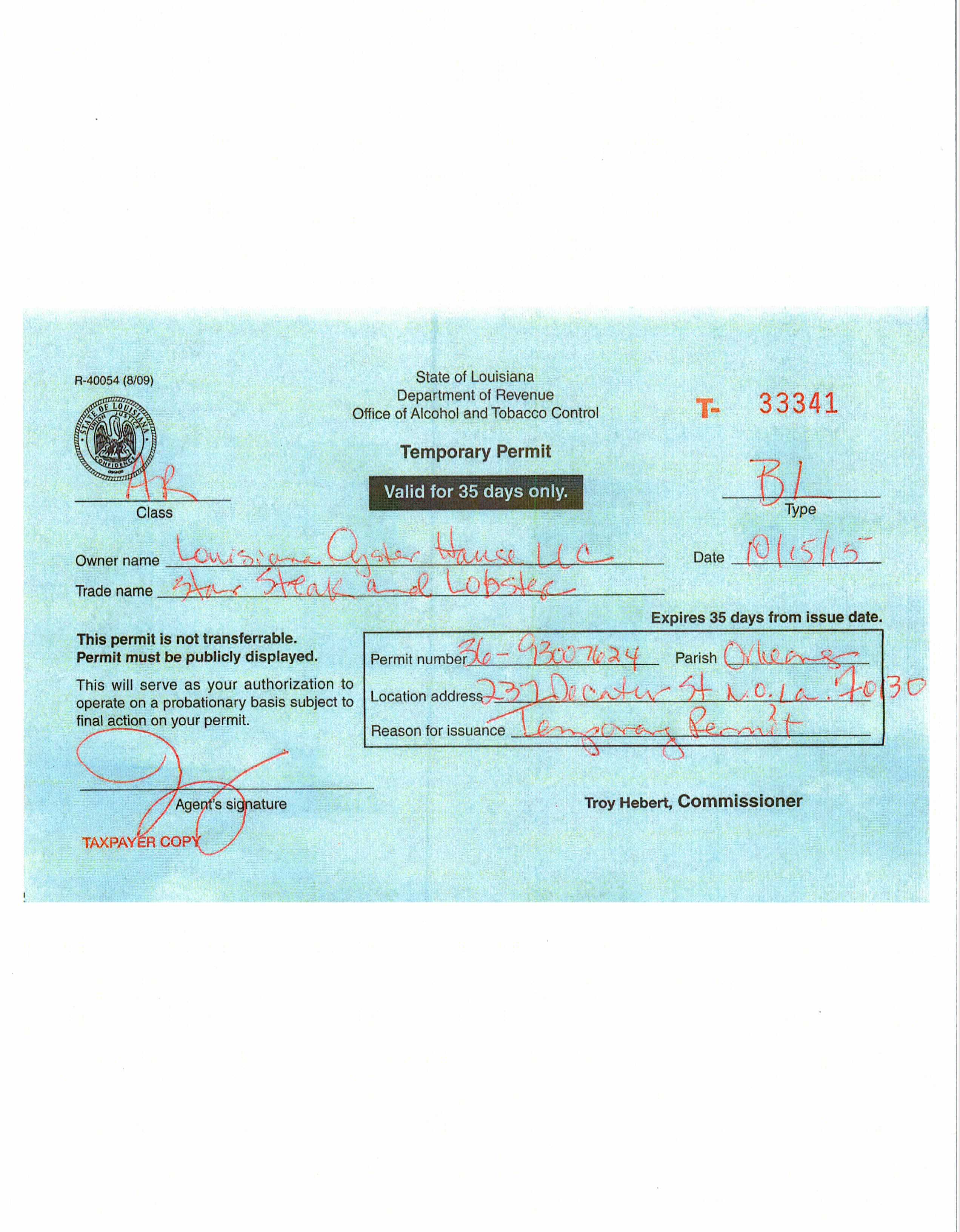
A temporary permit was in fact issued on Sept. 11, according to records obtained from ATC offices in Baton Rouge. Subsequent temporary permits were issued on Oct. 15 and Nov. 20. Each permit was marked “Valid for 35 days only.” SEPT. TEMPORARY PERMIT

OCT. TEMPORARY PERMITNOV. TEMPORARY PERMIT

And while each of the temporary permits bore the name and title of ATC Commissioner Hebert, the person who signed each of them was Judy Pontin, executive management officer for ATC’s New Orleans office.

Pontin is the sister of Chris Young, a New Orleans attorney who represents bar and restaurant owners before ATC and who is a lobbyist for the Beer Industry League of Louisiana. Another brother is John Young, former Jefferson Parish President and unsuccessful candidate for lieutenant governor in last fall’s statewide election. Pontin was hired by Hebert on Nov. 4, 2013 at a salary of $71,000. JUDY PONTIN

JUDY PONTIN

On Jan. 6, just four days before he left office, Hebert issued a second “Commissioner’s Findings and Order” on the restaurant but this time he wrote, “After reviewing the evidence and all relevant testimony, the Commissioner finds the following:

“There is not sufficient evidence (emphasis ours) to support the finding that the permittee did violate the provisions of:

  • LA R.S. 26:75 & 26:275—Proper Permit not held;
  • LA. R.S. 2691B & 26:287B—Failure to Pay Sales Tax. DISMISSAL LETTER PAGE 1DISMISSAL LETTER PAGE 2

“It is hereby ordered that this matter be dismissed,” he wrote as one of, if not the final act in his capacity as ATC commissioner.

There followed on last Wednesday (Jan. 20), a flurry of several quick emails pertaining to the application process for renewal of the restaurant’s license, a development that does not square with Hebert’s claim that the restaurant had closed. The first, at 9:52 a.m., was a forward from ATC attorney Linda Pham to fellow attorney Jacqueline Wilson of an earlier (8:18 a.m.) message from a Lorie Hebert and given “high importance,” which said, “I received a phone message from an atty. David Corkern about this mandatory case set for today at 2:30 p.m.” The reference was to the license for Star Restaurant and Corkern was the attorney for manager Sarah Palmer.

At 9:31 a.m., Pontin forwarded a pdf attachment to Wilson and at 10:04 a.m., Pontin sent an email to Palmer saying, “Please see attached the 2015 renewal application we discussed as per or (sic) phone conversation. If you have any further questions please do not hesitate to call. That was likely the same attachment that Pontin had sent to Wilson at 10:04 a.m.

The anonymous source, who has sent 11 separate emails to date, said she had seen text messages from Hebert to Palmer and “there are witnesses who followed their dinners.”

Seven of her emails were sent between Dec. 18 and Dec. 27. Then her messages went dark before suddenly resuming on Saturday (Jan 23). “I have stayed clear because FBI is now actively involved,” she said on Saturday by way of explaining why her communications ceased for nearly a month. “They have made contact with Palmer and have seized photos, emails and text messages,” she said.

“The FBI now has evidence but is expanding (its) investigation further,” she said. “The investigation (is) going in this direction: Hebert makes trouble for a business. Then his number-one assistant Judy (Pontin), maiden name Young, sister to (attorney) Chris Young, sends word to (the) targeted business to hire Chris Young and pay big fees to get them off Hebert’s radar. Once Young is hired (and the) fee paid, problem disappears. Once (the) deal is done, Chris Young calls his sister Judy in Hebert’s office and the coverup begins.”

Asked how she knew Palmer, she said simply, “She is a girlfriend of mine.”

Tomorrow: LouisianaVoice examines political contributions by New Orleans strip clubs which were passed over in ATC’s “Operation Trick or Treat” sweep of the French Quarter in October.


Read Full Post »

“The petty thief is imprisoned but the big thief becomes a feudal lord.”

Zhuangzi


There it was, splashed across the Metro page of Tuesday’s Baton Rouge Advocate:

“OMV audit: More than $200,000 stolen”

The entire matter is heavily weighed down by irony but you’d never know it from reading the story.

It seems that a new audit of the Department of Public Safety and Corrections (DPS) has revealed that two employees of the Louisiana Office of Motor Vehicles (OMV) misappropriated more than $211,000 before being arrested.

The two, Heather Prather of Baker in East Baton Rouge Parish and Angelle Temple of Marksville in Avoyelles Parish were actually arrested in early 2015—nearly a year ago—and fired for felony theft, injuring public records and malfeasance in office.


“Steal a little and they throw you in jail. Steal a lot and then they make you king.”

Bob Dylan


“Upon investigation, OMV management determined that the OMV employees had diverted public funds for personal use and violated state laws,” according to the Legislative Auditor’s Office.

Apparently the two issued receipts to paying customers but then either altered, voided or simply did not post the transactions. There was no indication as to whether or not the two knew each other or if they conspired together or acted separately in misappropriating the funds.

And yes, $211,000 is a lot of money and nothing in this post should be interpreted as excusing the women’s actions.

But isn’t it odd that the media would give such prominence to this story while overlooking official misappropriation of public funds?

Take, for example, the lingering case of high ranking State Police official Jill Boudreaux and the unmet demand that she repay nearly $60,000 in money she received to which she was not entitled. That little matter is still unresolved after almost six years.

And then there is Bobby Jindal. He allowed the taxpayers of Louisiana to pick up the tab for the cost of more than $3 million for State Police security details. Those costs were incurred while he spent more than two-thirds of his final year in office campaigning out-of-state for the Republican presidential nomination. A reasonable person would assume his campaign would have paid for that protection since his travels had zero to do with his job as governor of Louisiana.

But few lately have accused Jindal of being reasonable. The cost of flights, taxis, auto rentals, lodging, laundry and meals cost Louisiana taxpayers more than $640,000 in addition to the salaries of state troopers assigned to his out-of-state security detail. None of that has been refunded by Jindal’s campaign.


“He who uses the office he owes to the voters wrongfully

and against them is a thief”

Jose Marti

Boudreaux, Undersecretary for DPS, which has management oversight responsibility for OMV, first said the office would consider a policy of no longer accepting cash as a safeguard against theft by employees.

Later, however, she and the Auditor’s Office agreed that OMV only needs a better system of controls over accepting cash. State Police public information officer Doug Cain said the goal of OMV was to continue to provide convenience to the customer while at the same time, assuring “due diligence to have accountability on the process.”

Due diligence appears to have been lacking in efforts to have Boudreaux repay the $59,000 she was paid as part of an early retirement incentive offered nearly six years ago.

In April of 2010, the Jindal administration, in an offer to implement across the board savings, made a one-time incentive package offer to various state agencies as a means to encourage state employees to take early retirement.

Handled properly, it appeared at the time—and still does appear—to have been an economical and compassionate way to nudge employees who wanted out but who could not afford to retire, into making the decision to walk away, thus reducing the number of state employees which in turn translated to long-term savings in salaries and benefits paid by the state.

On April 23 of that year, DPS Deputy Undersecretary Jill Boudreaux sent an email to all personnel informing them that the Department of Civil Service and the Louisiana State Police Commission had approved the retirement incentive as a “Layoff Avoidance Plan.”

In legal-speak, under the incentive eligible applicants would receive a payment of 50 percent of the savings realized by DPS for one year from the effective date of the employee’s retirement.

In simpler language, the incentive was simply 50 percent of the employee’s annual salary. If an employee making $50,000 per year, for example, was approved for the incentive, he or she would walk away with $25,000 in up-front payments, plus his or her regular retirement and the agency would save one-half of her salary from the date of retirement to the end of the fiscal year. The higher the salary, the higher the potential savings.

The program, offered to the first 20 DPS employees to sign up via an internet link on a specific date, was designed to save the state many times that amount over the long haul. If, for example, 20 employees, each making $50,000 a year, took advantage of the incentive, DPS theoretically would realize a savings of $1 million per year thereafter following the initial retirement year.

That formula, repeated in multiple agencies, could produce a savings of several million—not that much in terms of a $25 billion state budget, but a savings nonetheless.

The policy did come with one major caveat from the Department of Civil Service, however. Agencies were cautioned not to circumvent the program through the state’s obscure retire-rehire policy whereby several administrative personnel, the most notable being former Secretary of Higher Education Sally Clausen, have “retired,” only to be “rehired” a day or so later in order to reap a monetary windfall.

“We strongly recommend that agencies exercise caution in re-hiring an employee who has received a retirement incentive payment within the same budget unit until it can be clearly demonstrated that the projected savings have been realized,” the Civil Service communique said.


“A man with a briefcase can steal millions more than any man with a gun.”

Don Henley


Basically, to realize a savings under the early retirement incentive payout, an agency would have been required to wait at least a year before rehiring an employee who had retired under the program.

Boudreaux, by what many in DPS feel was more than mere happenstance, managed to be the first person to sign up on the date the internet link opened up for applications.

In Boudreaux’s case, her incentive payment was based on an annual salary of about $92,000 so her incentive payment was around $46,000. In addition, she was also entitled to payment of up to 300 hours of unused annual leave which came to another $13,000 or so for a total of about $59,000 in walk-around money.

Her retirement date was April 28 but the day before, on April 27, she double encumbered herself into the classified (Civil Service) Deputy Undersecretary position because another employee was promoted into her old position on April 26.

A double incumbency is when an employee is appointed to a position that is already occupied by an incumbent, in this case, Boudreaux’s successor. Double incumbencies are mostly used for smooth succession planning initiatives when the incumbent of a position (Boudreaux, in this case) is planning to retire, according to the Louisiana Department of Civil Service.

http://www.civilservice.louisiana.gov/files/HRHandbook/JobAid/5-Double%20Incumbency.pdf

Here’s the kicker: agencies are not required to report double incumbencies to the Civil Service Department if the separation or retirement will last for fewer than 30 days. And because State Civil Service is not required to fund double incumbencies, everything is conveniently kept in-house and away from public scrutiny.

On April 30, under the little-known retire-rehire policy, Boudreaux was rehired two days after her “retirement,” but this time at the higher paying position of Undersecretary, an unclassified, or appointive position.

What’s more, though she “retired” as Deputy Undersecretary on April 28, her “retirement” was inexplicably calculated based on the higher Undersecretary position’s salary, a position she did not assume until April 30—two days after her “retirement,” sources inside DPS told LouisianaVoice.

Following her maneuver, then-Commissioner of Administration Angelé Davis apparently saw through the ruse and reportedly ordered Boudreaux to repay her incentive payment as well as the payment for her 300 hours of annual leave, according to those same DPS sources.

It was about this time, however, that Davis left Gov. Bobby Jindal’s administration to take a position in the private sector. Paul Rainwater was named to succeed Davis on June 24, 2010, and the matter of Boudreaux’s payment quickly slipped through the cracks and was never repaid.

Granted, $59,000 is not a lot in the over scheme of things—especially with the state facing a budgetary shortfall of nearly $2 billion. But as the late Sen. Everette Dirksen said, “A million here and a million there and pretty soon you’re taking about real money.”

Well, no matter the amount, it’s real money.

Perhaps when Jay Dardenne takes over as the incoming Commissioner of Administration, he may wish to take another look at the manner in which Boudreaux took $59,000 in extra cash and then defied the directive by Davis to repay the money.

Read Full Post »

Nearly two years ago, LouisianaVoice broke a story about a Mangham contractor’s claims that the Louisiana Department of Transportation and Development (DOTD) had bankrupted his company when it denied payments for his work. https://louisianavoice.com/2014/04/09/contractor-claims-in-lawsuit-that-dotd-official-attempted-shake-down-for-cash-equipment-during-monroe-work/

The reasons payment were denied? Because, contractor Jeff Mercer said, he resisted shake-down efforts by a DOTD inspector who demanded cash and equipment from him.

On Friday, after eight years of legal battles, Mercer won a unanimous $20 million judgment from a 12-person jury in 4th Judicial District Court in Monroe.

Work for which Mercer says he was not paid included:

  • Two projects on I-49 in Caddo Parish ($1.6 million);
  • A Morehouse Parish bridge project ($7.1 million);
  • Louisville Avenue in Monroe ($79,463);
  • Well Road in West Monroe ($50,568);
  • Airline Drive in Bossier City ($57,818);
  • Brasher Road in LaSalle Parish ($70,139).

While the Monroe News-Star gave substantial coverage to the court decision, LouisianaVoice was the first media outlet to give Mercer the time of day back in April of 2014 when we first learned of his troubles with DOTD. Monroe television station KTVE did a brief interview with Mercer following our initial story, but that was it—until yesterday’s decision. http://www.thenewsstar.com/story/news/local/2015/12/04/contractor-wins-20m-suit-against-dotd/76813444/

In our 2014 story, Mercer said that three of his employees filed sworn affidavits with the court in which all four say DOTD inspector Willis Jenkins demanded that Mercer either “put some green” in his hand or that Mercer place a new electric generator “under his carport” the following day.

One employee, John Sanderson, said he was approached by Jenkins who informed him that he “could make things difficult” on Mercer. “He indicated that this burden would not necessarily be on the Louisville Avenue project but on future jobs awarded to Jeff Mercer, LLC,” Sanderson said. “I replied, ‘You didn’t mean to say that,’” whereupon, Sanderson said, Jenkins repeated his threat. “During that conversation, I heard Willis tell Jeff that he ‘wanted green,’” Sanderson said.

Incredibly, Jenkins admitted making the comment but said it was a joke. Despite getting complaints about the shakedown attempt, DOTD never investigated the allegations. (Note to Jenkins: don’t joke like that in airports.)

Another Mercer employee, Bennett Trip, said in a signed statement that he heard Jenkins tell Mercer he “wanted some green.” He said he also heard Jenkins tell another Mercer employee that Jenkins, pointing to a generator in Tripp’s truck, said he “wanted one of those under his carport.”

Following complaints by Mercer, Jenkins was subsequently removed from the Louisville Avenue project by DOTD Engineer Marshall Hill who said it was not the first time he’d heard such claims about Jenkins. But Tripp said the shakedown continued when another state official told Mercer employees, “Y’all had my buddy removed and we’re going to make the rest of the job a living hell.”

Mercer claimed in his lawsuit there was collusion among DOTD officials to “make the jobs as costly and difficult as possible” for him. He told LouisianaVoice in April of 2014 that after receiving verbal instructions on the way in which one project was to be done, it was subsequently approved but later, DOTD officials, including defendant John Eason, advised that the work was not acceptable.

He said that DOTD officials provided false information to federal investigators; that he was forced to perform extra work outside the contract specifications; that a prime contractor, T.J. Lambrecht was told if he continued to do business with Mercer, closer inspections of his jobs would result, and that job specifications were routinely changed which in turn made his work more difficult.

Doughty said DOTD officials in Baton Rouge threatened his client with federal prosecution when he asked for payments for work he’d done. An FBI investigation initiated by DOTD was subsequently dropped.

Mercer eventually was forced to shutter the doors on his construction firm which had employed 20 to 40 people.

DOTD interoffice emails obtained by LouisianaVoice seem to support Mercer’s claim that he was targeted by DOTD personnel and denied payment on the basis that the agency was within its rights to “just say no.”

One email from DOTD official Barry Lacy which was copied to three other DOTD officials and which stemmed from a dispute over what amount had been paid for a job, made a veiled threat to turn Mercer’s request for payment “to the U.S. Department of Transportation’s Office of Inspector General.”

Still another suggested that payment should be made on a project “but never paid to Mercer.”

“I did everything they told me to do,” Mercer told LouisianaVoice. “But because I refused to allow one DOTD employee to shake me down, they put me out of business. They took reprisals and they ostracized me and broke me but now I’m fighting back.”

Both Mercer and his Rayville attorney David Doughty indicated they had reported the events to the governor’s office but no one in the Jindal administration, which has spent eight years touting its ethics record, offered to intervene or even investigate his allegations.

Not only did the jury hold DOTD liable for damages, but it also held four individual DOTD employees—Willis Jenkins, Michael Murphy, Eason and Barry Lacy—personally liable.

That, of course raises the obvious question of will there now—finally—be a criminal investigation of the four individuals? After all, the jury’s verdict centered on Mercer’s claims of extortion, bribery and plain old shakedowns in the purest sense of old-time Louisiana politics.

Granted, civil and criminal trials are vastly different. In a civil trial, a verdict can be reached on the lower standard of a “preponderance of the evidence” while criminal charges must be proven “beyond a reasonable doubt.”

In a civil suit, the plaintiff must only prove that there was a greater than 50 percent chance, based on all reasonable evidence, that the defendant committed the action that caused damages. In criminal matters, however, there is a higher standard. The prosecutor must prove that the accused committed the crime beyond a reasonable doubt.

But even with required higher standard of proof, the fact that a civil jury was unanimous in its decision should be sufficient to prompt at least a criminal investigation by the Ouachita Parish District Attorney’s office. Because federal funds were involved in the construction projects, and because Mercer was a contractor under the federal Disability Business Enterprise (DBE), a federal grand jury probe should ensue. “Who protects the DBE from the DOTD?” Doughty asked. “The people who are supposed to guard DBE companies are within DOTD itself (and) he didn’t get any help from them.”

Additionally, offenses committed under the funds from the American Recovery and Reinvestment Act (ARRA) of 2009 carry even stiffer penalties. ARRA funds were used on the I-49 projects.

The civil award puts the Louisiana Attorney General’s Office in an awkward position. The AG’s office defended the state’s interests in Mercer’s lawsuit and now that the jury has cited public corruption in its award, the office now finds itself in the unenviable position of being required to investigate public corruption in a case it had just defended in civil court. http://www.ag.state.la.us/Article.aspx?articleID=6&catID=8

“It’s been a long fight,” Mercer told the News-Star. To LouisianaVoice, he exulted, “We waxed their butts.”

He still has two more suits for more than $10 million in contractual losses pending in Baton Rouge district court.

Doughty told the News-Star that people “are tired of corruption and tired of reading about this type of thing” and that the jury “was sending a message.”

DOTD is expected to appeal the jury verdict to the Second Circuit Court of Appeal and if the state court decision is upheld, most likely the state will apply for writs with the Louisiana Supreme Court. If the decision is upheld in the higher courts, the State Legislature would then have to appropriate the payment.

All that means it could be years before Mercer sees a dime but judicial interest continues to run from the date the lawsuit was filed and the state ultimately could be forced to pay as much as an additional 50 percent.

Read Full Post »

Former Lake Charles Police Department Deputy Chief Thomas Bell has been terminated from LCPD and is under indictment for malfeasance in office. Local media has reported he is suspected of allowing his secretary Janine Blaney to get paid for hours she did not work. Janine Blaney has been charged with public payroll fraud for claiming 45 hours of regular time and 54 hours of overtime she allegedly did not work.

http://www.kplctv.com/story/30350422/fired-lcpd-employee-claimed-fictitious-overtime

This case has many similarities to allegations at Troop D except for one main difference. The amounts suspected by LSP are much greater. Sources have alleged Picou was allowed to work a small portion of his shift but get paid for the entire shift of 12 hours for the better part of a decade far outweighing the allegations against Blaney. Louisiana Voice submitted public records requests for numerous documents to determine if the allegations were accurate in August. The public records request apparently served as the motivation to initiate the largest known internal affairs investigation/inquisition in the history of the Louisiana State Police.

When LouisianaVoice made a second public records request (Sept. 6) for the State Police investigation file on Picou, we received the following response from LSP Attorney Supervisor Michele Giroir:

“…in response to your below public records request, I have been advised that the information that you seek is related to an ongoing administrative investigation.  Therefore, the records are not subject to release to you at this time pursuant to R.S. 40:2532 and Article 1 Section 5 of the Louisiana Constitution of 1974.”

Some of the records requested were from three years ago. The investigation files on Trooper Ronald Picou from three years ago are now under investigation suggesting there are serious concerns those charged with stopping the reported allegations of payroll fraud failed to take action and allowed it to continue. Troop D Commander Captain Chris Guillory’s investigation into Picou’s conduct was reportedly only focused on finding the whistle blowers.

Trooper Picou was supervised by retired Lieutenant Jim Jacobsen who is now running for sheriff of Beauregard Parish. Picou remained on Jacobsen’s shift every year which troopers say is far outside the norm. Troopers normally rotate shifts every year. After Jacobsen’s retirement, Picou was allowed to remain on the same shift as LT Paul Brady, also of Beauregard Parish, who reportedly allowed Picou to continue his activities even over the objections of other supervisors. After the latest investigation started, Picou was removed from the supervision of LT Brady.

JACOBSON

The photo above is reportedly from the retirement party for Jacobsen held at Picou’s home. From left to right, Captain Chris Guillory, LT Paul Brady, Trooper Ronald Picou, and Retired LT Jim Jacobsen. The two in dark shirts are unidentified and their faces have been blocked out.

Deputy Chief Bell is facing criminal charges for allegedly allowing an employee to claim a total of 99 hours. We have to be clear that Bell is not suspected of getting paid for hours he did not work. He is charged for allegedly allowing it to happen as a supervisor. Our records request for radio logs was an effort to confirm the allegations Jacobsen, Brady, and Guillory allowed Picou to commit payroll fraud. Louisiana Voice has spoken with state police officials who confirm the radio logs do support the allegations.

The troopers involved in the investigation have been issued gag orders and have not spoken to us. Through sources not under gag order, we have learned the internal affairs section at LSP is conducting a thorough investigation into the allegations against Picou and others. We will continue to monitor this situation and will continue to issue relevant requests for records until the truth is exposed.

Ironically, Jacobson is attacking the incumbent Beauregard Parish sheriff for mishandling taxpayer money and for intimidation of deputies. He also claims that all the troopers named in previous LouisianaVoice posts have been cleared and that the investigations are over. Not true. One state trooper in Troop D, Jimmy Rogers, recently resigned following a series of LouisianaVoice posts about allegations of harassment and domestic abuse by Rogers and the apparent reluctance of LSP to thoroughly investigate those claims.

As for Jacobson’s claim that “all the troopers” named in our reports have been cleared, we can only say that LSP officials have indicated to us that investigations are ongoing and that further disciplinary measures are under consideration.

It does appear, however, that LSP will not address these allegations before the election on November 21. Beauregard Parish voters have the right to know Jacobsen’s involvement before going to the polls. Jacobsen is not under a gag order, so here is our offer:

LouisianaVoice will publish any response Jacobsen offers explaining these allegations. Our email address is: louisianavoice@cox.net

We eagerly await that response.

PICOU LETTER


Read Full Post »

« Newer Posts - Older Posts »