Feeds:
Posts
Comments

Archive for the ‘Fraud’ Category

Even as the so-called mainstream media (and we’re not really certain what qualifies as “mainstream” anymore) shifts into its sympathetic mode for Superintendent of State Police Mike Edmonson, there are lots of loose ends still lying around that LouisianaVoice will continue to report.

As we wrote in Wednesday’s post, the controversy swirling around Louisiana State Police (LSP) headquarters in Independence Boulevard was never just about a trip to San Diego.

It’s about the overall atmosphere permeating the agency and trooper morale which is said to be at an all-time low. That’s because in spite of generous pay raises bestowed upon troopers, the rank and file feel the administration has put its own interests ahead of those of the agency and its personnel.

The parties, inconsistent discipline dictated by whether or not a trooper is a member of the elite clique, distinguished troopers passed over for promotions in favor of lesser qualified candidates, trips, many trips, taken by LSP management and not all strictly for business; and we have received reports of free trips, which would be in violation of regulations set forth by the State Ethics Board.

GENERAL PROHIBITIONS (R.S. 42:1111 – 1121)

  1. 1115 – Elected officials and public employees are prohibited from soliciting or accepting a gift from the following persons: persons who have or are seeking to obtain a contractual or other business or financial relationship with the public servant’s agency; or persons who are seeking, for compensation, to influence the passage or defeat of legislation by the public servant’s agency. Public employees, not elected officials, are also prohibited from soliciting or accepting a 4 gift from the following persons: persons who conduct operations or activities regulated by the public employee’s agency; or persons who have substantial economic interests which may be substantially affected by the performance or non-performance of the public employee’s official duties.

There are events and conditions not yet reported but which will be. And they are scattered throughout the organization, from LSP to the Louisiana State Troopers Association (LSTA), and the Louisiana State Police Commission (LSPC). Especially LSPC, which is charged with overseeing State Police in the same manner as the Civil Service Commission oversees the rights of state civil service employees. That one commission, chaired by a State Trooper, has purged its membership if all but one member who is not easily identified as an Edmonson supporter and has morphed into something of a secretive club now rumored to be carrying on extra-curricular activities far outside the scope of its mission.

And one other facet of operations at LSP largely overlooked up to now is the issue of overtime hours. While troopers charged with carrying out investigations of criminal activity are finding it next to impossible to get overtime approved from their superiors and are forced to conduct investigations on their own time, others are finding it much easier to pad their paychecks.

Take Master Trooper Thurman D. Miller, for example.

Miller, who serves as President of the CENTRAL STATE TROOPERS COALITION, which is affiliated with the National Black State Troopers Coalition, is called the “One Man Overtime Machine” by his fellow troopers, though probably not to his face.

It’s a title well-earned.

From last June 20, 2016, through March 12 of this year, Miller has reported working 1,066 hours of overtime. Of that amount, he was paid time-and-a-half for 951 hours with the balance of 115 hours taken as compensatory, or K-time, meaning he gets paid leave for a like number of hours worked.

That works out to nearly 60 hours of combined overtime and K-time for every two-week pay period since last June—75 percent of a regular two-week, 80-hour pay period.

Miller, who makes $72,600 in regular salary, earned $50,400 in straight time during that period and nearly matched that amount in overtime earnings of another $45,900. Plus, he accumulated almost three weeks extra paid vacation.

So, not quite having worked 70 percent of a year since last June, he already has been paid 131 percent of his base yearly salary.

But the real kicker is found in his daily time sheets.

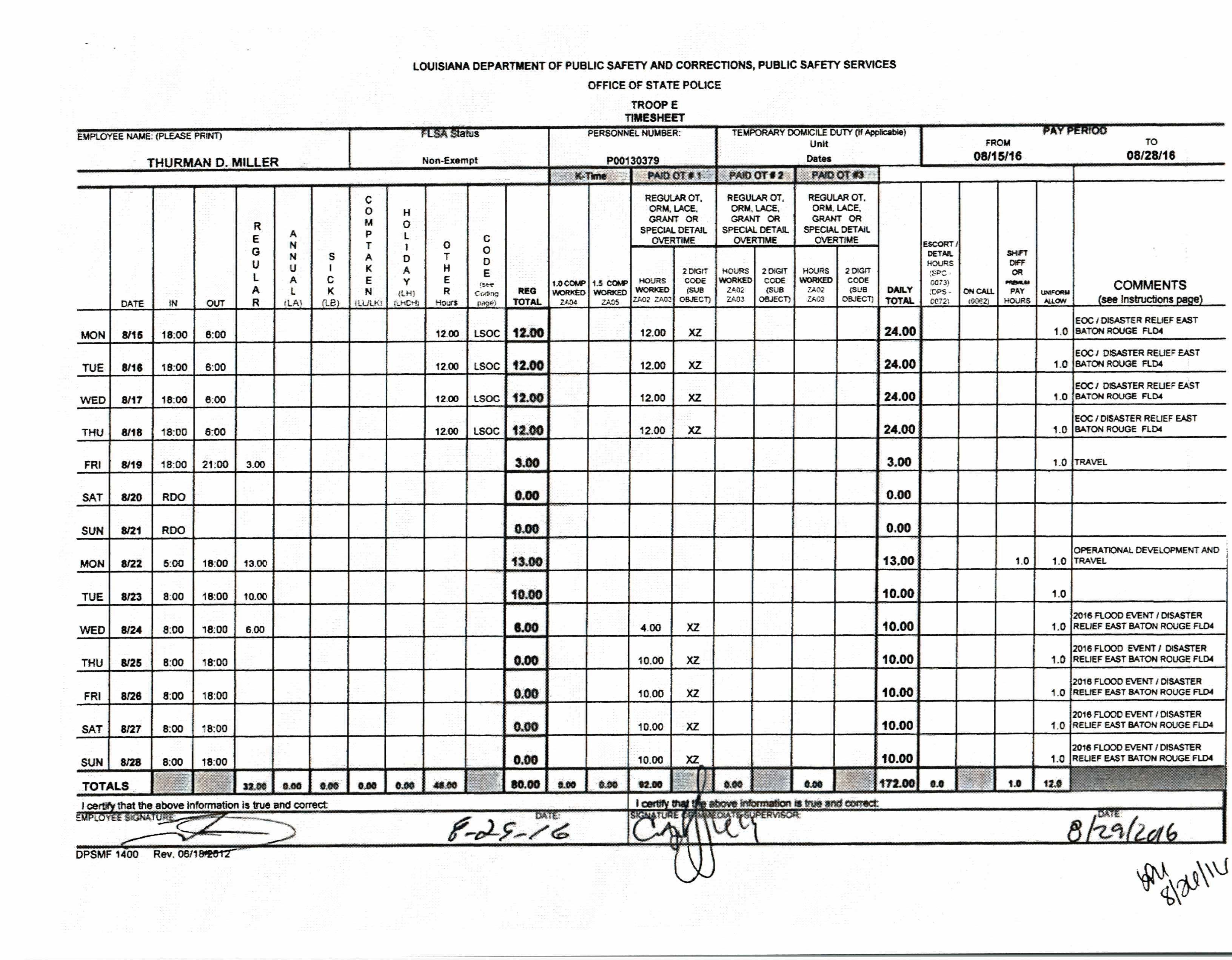
For example, during one stretch last August when his time sheet shows that he was assigned to disaster relief while working the South Louisiana floods, he logged 24-hour days for four consecutive days.

But that’s nothing. The month before, working extra security in the wake of the Alton Sterling shooting in Baton Rouge, iron-man Miller logged 24-hour shifts for nine consecutive days.

State Police Public Information Officer Maj. Doug Cain said there are provisions for allowing troopers to be called in on emergency duty and not allowed to go home. “They sleep 20 or 30 minutes and go back on duty,” he said.

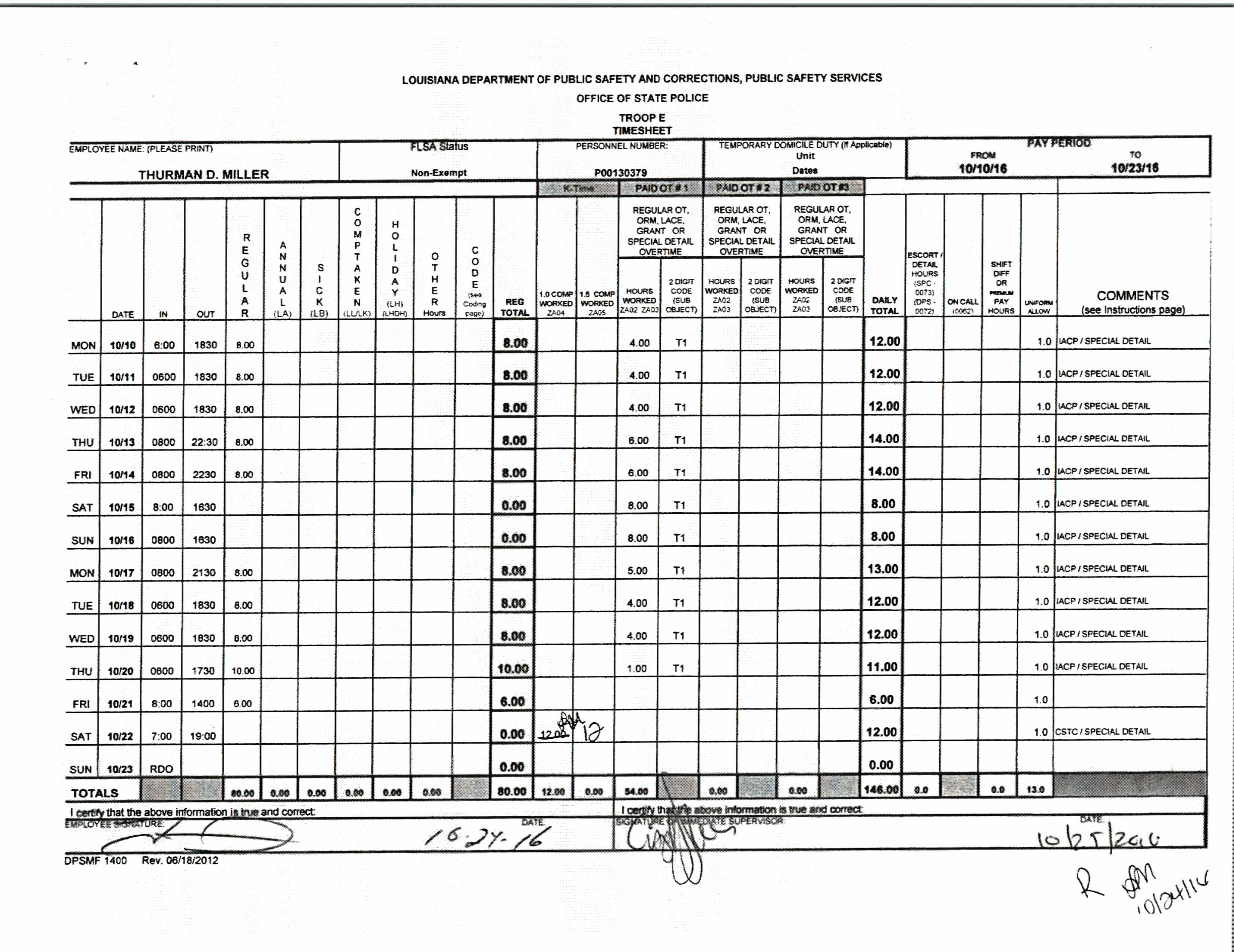
And on that infamous drive to San Diego in October, Miller initially reported two consecutive 24-hour shifts on Oct. 11 and 12 followed by a 22-hour shift on the 13th, but was forced to trim 12 hours off each of the 24-hour claims of Oct. 11 and 12 and to eliminate altogether the 14-hours overtime claimed for Oct. 13 in a revised timesheet. It was not immediately known if he was paid for the excessive hours and required to repay the state or not.

Here are a few samples of Miller’s timesheets (Click on images to enlarge):

Cain said that during the flood, state offices were closed and Miller and other officers were compensated for hours state offices were closed and for hours actually worked.

The LSP Policy Manual specifically addresses the issue of excessive overtime:

Officers/Civilians shall not work more than a total of 16 cumulative hours without having a rest period of 8 consecutive hours off-duty. An 8 hour rest period shall be required following 16 cumulative work hours before returning to regular duty or an overtime assignment. Exceptions to the 16 hour rule require the approval of the Troop/Section Commander or designee. Cumulative hours are defined as any combination of regular work hours and/or overtime/details.

Commanders and supervisors are urged to exercise caution and sound judgment when considering whether to allow an officer/civilian to work more than 16 cumulative hours.

Troop/Section Commanders, Region Commanders and Unit Supervisors are responsible for effectively managing work schedules to minimize overtime.

 Reasonable justification shall mean that the work could not be performed by other on-duty personnel or that time constraints require that the work be immediately performed.

 If overtime is necessary, every effort to minimize the total accumulation shall be made by all supervisory personnel.

Miller, it should be pointed out, works in Operations and not Investigations. And while he’s racking up all that overtime, there are troopers spread across the state who need overtime to complete ongoing investigations but cannot get approval for it.

They do their investigations on their own time which somehow makes the whole picture seem a little out of kilter.

Yet another symptom of a much large problem that is plaguing LSP.

Read Full Post »

It’s such a truism that it’s almost a cliché: if you don’t like the news, shoot the messenger.

That is precisely the scenario that is unfolding as this is being written, according to three separate reports received today by LouisianaVoice.

  • The first is an unsubstantiated (to this point, at least) report that LouisianaVoice is about to be named a defendant in a defamation/libel suit by certain employees of the Louisiana Department of Public Safety and Corrections.

That would be the Louisiana State Police (LSP), since those are virtually the only DPS personnel I’ve written about.

And if they want to play that game, I’m more than ready because any litigation on their part will open them up for discovery of every questionable, unethical or illegal act they have ever committed during their entire careers. If they don’t have a little dirty laundry they don’t want exposed, then bring it on.

Anyone can sue and whenever feathers are ruffled, the potential for litigation is a given, but it does not come without risks on the part of the plaintiffs. They will be propounded with more interrogatories and requests for documents than they ever thought possible.

But the other two actions, in my opinion, are far more ominous.

  • A terse email from one person says simply, “Rest assured, he (State Police Superintendent Mike Edmonson) has already begun trying to destroy you. He is frantically trying to learn who emailed you.”
  • That’s a normal reaction by someone backed into a corner but for the third message received today by telephone. The caller said simply, “LSP has IT (Information Technology section) being paid overtime in efforts to determine who is communicating with LouisianaVoice and who is the ‘Trooper Underground.’”

If Edmonson is indeed finished at LSP as several sources have indicated, then there are two possible explanations about the timing of these efforts. One is they were initiated prior to the serving of those 18 subpoenas and while he was still trying to hang on to his job by discrediting his critics—and most likely cleaning house of those he deemed to be malcontents.

The second possible explanation is that as he exits, he fully intends to pull others down with him. And if the right (for Edmonson) person is appointed to succeed him, it will be a seamless transition and the witch hunt will continue unabated and heads will roll with collateral damage hopefully extending to the pesky media, i.e. bloggers.

And just to clear the air a little, LouisianaVoice is a Web blog which covers the entire spectrum of Louisiana politics and Trooper Underground is a Facebook blog that concentrates on matters of concern exclusively to Louisiana State Troopers and retired troopers. We are separate entities.

The ones behind this effort should know that if this is true, and they’re doing this without a valid search warrant, there well could be serious legal (read civil and criminal) repercussions for their actions.

Be that as it may, the efforts to out whistleblowers and to discredit those who report waste, favoritism, fraud, and other nefarious activities within the agency charged with protecting the state’s citizens presents a chilling prospect not just for LouisianaVoice or the Trooper Underground, but for all of us.

This is reminiscent of Terrebonne Parish Sheriff Jerry Larpenter’s raid on the home of a Houma blogger because the blogger, a city policeman, dared to criticize Larpenter. More puzzling even than the sheriff’s efforts to silence a critic fully protected under the First Amendment was the fact that a sitting judge actually signed the search warrant. Thankfully, it was quickly ruled unconstitutional by an appeal court.

It’s also reminiscent of a number of other tyrants, dictators, despots and demagogues down through history. Names like Joe McCarthy and Richard Nixon come immediately to mind. There are others who ruled entire countries and waged wars while silencing critics. You know who they are.

These are the acts of desperate people who will go to any end to exact revenge on those who, unable to improve things from within, go outside the agency for help. Whether or you agree with them, were it not for the Baton Rouge Advocate (see its recent outstanding series on the Louisiana State Penitentiary at Angola), New Orleans TV reporter Lee Zurik, retired TV reporter Ken Booth, Lamar White’s CenLamar, Bob Mann’s Something Like the Truth, Robert Burns’ Sound Off Louisiana and yes, LouisianaVoice, to whom could these people turn?

The Attorney General? He’s too busy running for governor. The East Baton Rouge Parish District Attorney? We don’t know where the hell he is. The Louisiana Office of Inspector General? (Insert chortles, yuks and guffaws here).

So, let them come after us. We’re ready. If we go down, we go down swinging.

Lawsuits can be filed in both directions.

Read Full Post »

1399909

Bloomberg News Service on March 1 published a STORY that said global megabanks have paid $321 billion in fines for such non-banking-like practices as money laundering, market manipulation and even terrorist financing since the market crash of 2008.

And while $321 billion may sound impressive, Bloomberg failed to mention that because of those same banks, President George W. Bush had little choice but to sign the Emergency Economic Stabilization Act of 2008 that pumped more than twice that amount, $700 billion of taxpayer bailout funds, into the failed banks that precipitated the Great Recession of 2008.

Most financial advisers would describe that as a negative return on investment.

Adding insult to injury, $1.6 billion of that $700 billion was used to award multi-million dollar bonuses to CEOs of the very firms that got us into the mess to begin with. http://www.cbsnews.com/news/16b-of-bank-bailout-went-to-execs/

Bloomberg also failed to mention that those fines had little effect on those who perpetuated the crimes but did have a significant impact on stockholders and retirees, those, in other words, who had nothing to do with the massive fraud carried out on such a grand scale.

In fact, in 2010, former Countrywide Financial CEO Angelo Mozilo was fined $22.5 million and ordered to pay another $45 million in restitution as his penalty for reaping a profit of $141.7 million from stock sale, according to Mary Kreiner Ramirez and Steven A. Ramirez, authors of The Case for the Corporate Death Penalty (New York University Press, 2017). So, despite the penalties, he walked away with a net gain $74.2 million, or a 52 percent return, sending a clear signal his peers that “crime does in fact pay,” the authors wrote.

There are also two questions Bloomberg neglected to address:

  1. What the total cost of the runaway greed and reckless actions of firms like AIG, Lehman Brothers, Merrill Lynch, Goldman Sachs, Citigroup, Countrywide, and J.P. Morgan to stockholders, retirees and American taxpayers in general?
  2. How many top tier officers at these firms who condoned, encouraged and/or actively participated in the illegal practices went to jail?

The answer to the first question is an eye-popping $15 trillion, according to Ramirez and Ramirez.

The answer to the second question is just as unbelievable: ONE.

In fact, as of Jan. 28, that last date that STATISTICS were updated by the Bureau of Prisons, there were exactly 555 people serving federal jail sentences for banking, insurance, embezzlement and counterfeiting. That comes to .3 percent (three-tenths of one percent) of the total federal prison population.

By contrast, there were 82,109 in federal prison for non-violent drug offenses (46.4 percent of the total), and 14,853 imprisoned on immigration charges (8.4 percent).

At this point it might be fair to ask just who did the most lasting damage to the nation’s economy?

It would also be fair to question why, if only one Wall Street banker went to jail, how is that there are 555 imprisoned for banking- and insurance-related offenses? The answer to that is those offenders, situated on Main Street instead of Wall Street, lacked the political clout in Washington that the leaders of the megabanks enjoyed.

Is that an over-simplification of the circumstances? Probably, but it’s interesting to compare the actions of different White House administrations in handling financial crises.

President Obama’s first Attorney General, Eric Holder, in his “too big to fail” proclamation, said, “I am concerned that the size of some of these institutions becomes so large that it does become difficult for us to prosecute them when we are hit with indications…it (prosecution) will have a negative impact on the economy.”

Obama, for his part, said, “One of the biggest problems about the…financial crisis and the whole subprime lending fiasco is that a lot of that stuff wasn’t necessarily illegal, it was just immoral or inappropriate or reckless.”

Wasn’t necessarily illegal? Both statements stretch credulity to its breaking point and are in themselves, disgraceful because federal laws were clearly broken knowingly and willfully.

It wasn’t always that way. For example, in the wake of the savings and loan crisis of the 1980s and 1990s, more than 1,100 bankers were indicted and 839 were convicted.

Enron, the seventh-largest company in the U.S. at the turn of the century, is another example of how the feds went after those who played fast and loose with the rules. President George H.W. Bush called on Enron CEO Kenneth Lay to run the World Economic Summit in Houston in 1990 and in 1992, Lay co-chaired the reelection campaign of Bush the First.

Enron and its affiliates also contributed more than $888,000 to the Republican National Committee in 2000, the year that George W. Bush was elected President and another $1.3 million to the Republican Party. Lay and his wife personally contributed $238,000 to George W. Bush campaigns and inauguration celebrations and raised another $100,000 from friends. To the younger Bush, Lay was known as “Kenny boy.”

Still, Enron and its top executives were not immune from prosecution by Bush the Second.

Despite the access to the highest levels of government enjoyed by Enron and Lay, he and Jeff Skilling, his successor as Enron CEO, were indicted by the Department of Justice in 2004 and though the two combined to spend some $60 million on their defense, Lay was convicted on all counts and Skilling on 19 of 28 counts of securities fraud.

George W. Bush’s Attorney General John Ashcroft recused himself from the Enron investigation because Enron and Lay both were major financial supporters in Ashcroft’s Missouri unsuccessful Senate re-election campaign. His chief of staff, David Ayers, also took himself out of the investigation of Enron. That was as it should have been.

Enron’s accounting firm, Arthur Andersen, was convicted of shredding Enron documents and both Enron and Arthur Andersen soon ceased to exist.

The same fate befell CenTrust Savings Bank, Drexel Burnham Lambert investment bank, and WorldCom—all because of flagrant violations of federal securities laws and each was prosecuted by the administrations of the two Bushes. WorldCom, in fact, was the largest bankruptcy in history when it went under in 2002.

Evidently, those firms were not considered too big to fail.

By contrast, Obama’s Attorney General Holder and Lanny Breuer, chief of the Department of Justice (DOJ) Criminal Division, did not remove themselves from DOJ’s investigation of the investment banks that brought on the Great Recession of 2008. This despite the fact that both men had worked for the same law firm of Covington & Burling which included among its clients such eminent Wall Street banking firms as Bank of America (Countrywide’s successor), Citigroup, and JP Morgan Chase.

In fact, at the time Holder was tapped as attorney general, he was co-chairing Covington & Burling’s white-collar defense unit. Good training in case you’re ever called on to investigate your former bosses.

Breuer returned to Covington & Burling in 2013 followed by his boss Holder in July 2015, giving Holder at least a reason for his strained, if not borderline unprincipled logic for not pursuing criminal indictments against the megabanks.

Following Holder’s departure, Deputy Attorney General Sally Quillian Yates (Remember her? She’s the one President Trump fired after she refused to enforce his illegal immigration order) issued a DOJ memo (turns out she was pretty good at memos that cut right to the chase) on Sept. 9, 2015, that reversed Holder and Breuer’s DOJ policy toward pursuing individual accountability, both criminally and civilly, for corporate wrongdoing. The memorandum said the policy change was to maximize DOJ’s “ability to deter misconduct and to hold those who engage in it accountable.”

The comparison between the approaches of two Bushes and Obama to bankers’ disdain for securities laws to the detriment of the entire country represents a stark role reversal for the perceived political philosophies of the Republican and Democratic administrations.

And now, President Trump has expressed his determination to roll back the Dodd-Frank bill passed after the 2008 recession for the express purpose of preventing a recurrence of the runaway greed that nearly wrecked the world economy.

In fact, he wants to remove all regulation of Wall Street banks, quite possibly the most dangerous single cartel in American society.

Read Full Post »

Anyone who thought retired State Police Lieutenant Leon “Bucky” Millet would eventually get tired of calling out State Police Superintendent Mike Edmonson, the Louisiana State Troopers Association (LSTA) or the Louisiana State Police Commission (LSPC) just doesn’t know Bucky Millet—or wife Vivian, for that matter.

Both have been fixtures at LSPC’s monthly meetings for more than a year now, driving in all the way from Lake Arthur, and at times have been a real pain in the posteriors for the commission. Millet has warned commissioners on more than one occasions that continuing to allow Edmonson to stack the commission with his lap dogs will eventually come to no good. Looking back, his repeated warnings have suddenly gone from the predictions of a disgruntled retiree to the prophetic words of someone with unerringly keen insight—and foresight.

Millet, fed up with the direction being taken by the organization he once served so proudly, has now fired off formal complaints to Gov. John Bel Edwards, Attorney General Jeff Landry, Inspector General Stephen Street, State Police Lt. Col. Murphy of the Louisiana Department of Public Safety’s (DPS) Bureau of Investigations, and East Baton Rouge Parish District Attorney Hillar Moore.

In his separate letter to each of the five, he called for an investigation of possible malfeasance and payroll fraud on the part of four State Troopers who took an unmarked State Police vehicle to California last October.

While LSPC Chairman State Trooper T.J. Doss and other commissioners have chosen to ignore his monthly warnings and have been generally dismissive of his questions the way a busy parent would dismiss a child’s questions, the LSPC now finds itself in the uncomfortable position of observing from the sidelines as a formal investigation gets underway of the very agency it is supposed to have been overseeing.

That investigation by auditors from the Division of Administration (DOA) was ordered by Gov. John Bel Edwards after it was learned that Edmonson had 15 of his subordinates (including the four who drove the vehicle assigned to Deputy Superintendent Charles Dupuy) to San Diego to witness Edmonson receiving an award for which a former State Trooper of the Year was originally nominated. LSP headquarters, meanwhile, is using an earlier 2015 unsuccessful nomination of Edmonson for the award as justification for stiffing Maj. Carl Saizan’s nomination.

It’s not as if the LSTA hasn’t tried to silence the affable Millet. After Millet and three other retirees challenged the association’s laundering more than $45,000 in illegal campaign contributions through its executive director’s personal checking account, LSTA took quick action. After it became evident that they weren’t going away, the association, without explanation or comment, simply revoked their memberships.

LSTA is supposed to be an association of active and retired state troopers established to work to benefit troopers, retirees and their families and to work for better conditions for troopers. But it’s evident those benefits extend only to those who keep their mouths shut. Apparently, there is some hidden clause in its bylaws that prohibits dissention among the ranks.

Again, if that move was intended to silence Millet, it only backfired by making him even more vocal and more determined than ever to ask questions and to challenge decisions. He has proven himself to be a nettlesome irritation over the pathetic, so-called “investigation” of the LSTA members who authorized the contributions, as well as the association’s endorsement of Edwards—its first-ever political endorsement.

Natchitoches attorney, former legislator and political ally of Edwards Taylor Townsend was hired by the LSPC under a $75,000 contract to conduct the pseudo-investigation after commission legal counsel Lenore Feeney said she could not conduct such an investigation. Neither, apparently, could Townsend, even though that didn’t prevent him from accepting payments under his contract. The final product of his investigation was not a written report as one might reasonably expect, but simply an oral recommendation that “no action be taken.” Not exactly the most bang for the buck.

Like the San Diego trip’s $72,000 costs in travel, lodging, meals and salary, Townsend’s contract stands as another $75,000 frittered away with nothing, repeat, nothing to show for it.

Doss and his allies on the commission must have thought they’d dodged a bullet despite fellow commissioner Lloyd Grafton’s observation that the entire affair looked a lot like “money laundering” to him. He should know. Grafton, a former federal DEA agent who was instrumental in thwarting a coup d’état in the Caribbean island nation of Dominica, is no stranger to sniffing out money laundering. He eventually resigned from the commission in disgust over what he called a “lack of integrity.”

Millet, tired of constantly having to bicker with Doss and other commission members, has now taken the next logical step, spurred on by that San Diego episode, in filing his complaint.

While he is asking for an investigation of the four who drove, it is critical to remember they took a vehicle permanently assigned to Edmonson’s second-in-command—pretty clear evidence that they didn’t act on their own volition but were instructed to drive some 2,000 miles in order to help bolster Edmonson’s ego. That raises the question of who ordered the four to pile into that Expedition and head west?

Accordingly, no investigation should be held without including Edmonson (who had to have ordered them to drive the vehicle) and Dupuy, whose vehicle was used—obviously with his permission.

But Millet is more concerned about the overtime charged by each of the four, including 12 hours each for seven days of travel. Two legs of their trip, from the Grand Canyon to Las Vegas, and from Las Vegas to San Diego were trips of about 250 miles or so that should have taken about four hours each but for which each man charged 12 hours. That’s 96 total hours—32 hours at overtime rates—to travel about 500 miles.

While it’s probably a waste of time to ask Street to conduct an investigation given the effectiveness displayed by his office over the past several years, any investigation undertaken by Paul would be even more fruitless; he’s being asked to investigate the actions of Edmonson, his boss. That ain’t happening.

But if Landry launches his own investigation, the results should be fascinating when compared to that of the governor’s office, given the acrimonious relationship between the two offices and given Landry’s obvious desire to run against Edwards in 2019.

But all of those will pale in comparison to the ticklish position T.J. Doss will find himself in if Millet does the expected and requests another investigation—by the LSPC.

We have speculated on this site several times in the recent past as to what Doss, a state trooper who owes his position as commission chairman to Edmonson (not to mention his job), will do if called upon to investigate his boss.

As the late C.B. Forgotston would say if he were still with us: You can’t make this stuff up.

Read Full Post »

In what may turn out to be one of her last official acts, Louisiana State Police (LSP) Executive Officer Rhonda Fogleman, has issued official notice of the transfer, albeit illegal, of Major Derrell Williams from head of Internal Affairs to Technical Support Services “on authority of Colonel Mike Edmonson.”

Additionally, LouisianaVoice has received information from a person who claims to have witnessed Edmonson and family members taking food and beverages from the State Police cafeteria for their personal use.

Edmonson initially said Williams was being transferred to road patrol as punishment for the side trip to Las Vegas and the Grand Canyon during a drive to San Diego last October.

The move would hardly be considered a demotion—or punishment, for that matter. But it would impossible for Edmonson to actually discipline Williams since there has been no due process for him or any of the other three who rode in the unmarked State Police vehicle assigned to Deputy Superintendent Lt. Col. Charles Dupuy to San Diego.

At the same time, LouisianaVoice has learned that Fogleman, who Edmonson earlier threw under the bus along with the four who drove to California in October, has made inquiry into possible retirement.

Edmonson, shown copies of expense reports for Williams that contained his signature, tantamount to approval of the expenses, laid the blame for that approval on Fogleman. He claimed that she used his signature stamp to approve the expenses, which included hotel invoices from hotels in Vegas and the Grand Canyon.

Fogleman has been employed at LSP for 32 years and currently earns $72,800 per year, Civil Service records show.

A terse comment received today from a Department of Public Safety employee who requested anonymity for obvious reasons said, “I have personally witnessed the illustrious Colonel back his state-owned SUV to the back of the cafeteria and load it up with food and drinks and unload at his residence.”

The comment went on to say, “If that wasn’t enough his kids were allowed to do the same. I witnessed it because I was assigned to HQ as my assigned shift.”

LouisianaVoice contacted Edmonson through Public Information Officer Maj. Doug Cain. He did not deny he had taken food and beverages from the cafeteria but did issue a one-sentence statement through Cain:

DPS cafeteria services are available for purchase by all DPS employees as well as the general public.”

He did not say whether or not he or members of his family actually purchased the commodities. Nor did it address the claim that he and his family members were taking bulk items from the cafeteria in vehicles.

The question of the legality of the reassignment of Williams is hinges on whether or not LSP followed established RULES for filling vacancies. Rule 8.2 says the technical support major must be advertised as a promotion for anyone interested in applying.

That section says, “When proposing to fill a vacancy by original appointment, the appointing authority (Edmonson) shall request the Director (of the Louisiana State Police Commission) to certify the names of persons eligible for appointment, furnishing such information about the vacancy as may be necessary for the Director to decide those persons eligible for appointment.”

Rule 8.4 (a) says, “The Director…shall certify to the appointing authority the names of the highest ranking eligibles from the appropriate list for the class of the vacant position.”

Paragraph (b) adds, “In specific instances, and pursuant to and in conformity with an order of the State Police Commission, a court, or other commission, or agency of competent jurisdiction, the Director may make, or permit the appointing authority to make, selective certification.”

The transfer of Williams and the assignment of Maj. Cathy Flinchum to head of Internal Affairs was Edmonson’s way of addressing the flak over the trip taken by him and 15 other LSP personnel, each of whom was paid for attending the International Association of Chiefs of Police (IACP) conference last October to see their boss receive an award from IACP.

To date, Edmonson has only addressed the travel and overtime of the four State Troopers who drove Dupuy’s vehicle to San Diego.

That apparently was insufficient to Gov. John Bel Edwards who has ordered an investigation by auditors from the Division of Administration.

LouisianaVoice, meanwhile, has requested copies of Training and Travel authorizations for each of those who went to San Diego as well as authorization documents for taking the state vehicle out-of-state. We have yet to receive those documents.

Read Full Post »

« Newer Posts - Older Posts »