Feeds:
Posts
Comments

Archive for the ‘Finances’ Category

I want to share something with you.

I have leveled criticism at Louisiana’s legislators and at both the former and current governor. Much, if not all that criticism I believed to be legitimate and well-earned. I was unmercifully hard on Bobby Jindal for the simple reason that not only did I believe him to be inept, but heartless as well when it came to consideration of the needs of the sick and elderly, of students and teachers, of minorities and the poor. In the end, I’m convinced I was not hard enough on him.

But today, I read two documents that have prompted me to take a little different approach, especially as it regards one certain legislator, a man I have never met, a man with whom I have never spoken but a man, nevertheless, who gives me hope, after today’s readings, that there may yet be those who have some sense of priority and compassion.

The man is State Sen. J.P. MORRELL and I fervently hope that my praise isn’t misguided or ill-conceived. Sometimes we are too eager to find a hero or at least someone to look up to. I hope this isn’t one of those times.

First, some background.

Earlier on Sunday, I came across a heart-rending online story of the struggles of an Oregon woman who, already waging a heroic fight against cancer, had the added burden, along with her husband, of having to battle the bureaucratic idiocy of the nation’s largest medical insurer, UnitedHealthcare.

The story was infuriating. Here, on one hand, was a woman, a mother of a four-year-old daughter, being told that only a liver transplant could save her life. On the other hand, there were the brain-dead bean-counters at UnitedHealthcare, all the way up to the company’s CEO, denying her one chance at life.

Morrell, it turns out, read the same story and also saw it on CNN. But instead of recapping, here’s what Morrell wrote, courtesy of Kreweoftruth, a New Orleans Internet blog:

This morning, Mother’s Day, I watched, then read, the heart wrenching tale of Erika Zak on CNN.

Erika is a 38-year-old mother and wife, who defeated stage 4 metastatic colon cancer but is dying.  Her liver, damaged by microwave ablation surgery, is failing and she is dying. So, she began the second fight of her life… with her insurance company.

Sitting with my wife and kids, enjoying breakfast today on Mother’s Day, this story deeply affected me. To be powerless in the face of callous CEOs making decisions regarding whether you live or die, it’s terrifying. 

Inevitably, I saw the obvious parallels between her plight and tens of thousands of Louisianans at the mercy of the Louisiana State Legislature and our budget crisis. As we contemplate passing ‘fake’ budgets as part of a ‘process’, we are playing games and, consequently, playing with people’s lives.

A $650+ million shortfall is less than two months away. As we squabble, 35,000+ nursing home recipients are being told that they are about to be evicted. With no clear and reasonable revenue agreement in place, we alternate between closing hospitals with medical schools, burdening families with crippling college debt, or cutting services to the Department of Children and Family Services.

As the Chairman of the Senate Revenue and Fiscal Affairs Committee, my role is to try to shepherd revenue raising measures through this process to avert this disaster. It’s an awesome, and terrifying, responsibility that weighs on me every single day.

Some of the issues being debated this session are tremendously important, such as criminal justice reform or public safety. Other bills are innocuous and warrant little to no debate, like renaming highways or changing the membership of security districts. However, there are some bills that are neither important nor insignificant.

House Bill 553, regarding the renewal of the Harrah’s gaming license is one such bill. The amount of time, energy and effort that has been expended by the proponents and opponents of this bill is staggering. The Senate has been barraged by the effort of over a dozen registered lobbyists each one of whom is trying to explain why this bill is a ‘good deal’ for the City of New Orleans and State of Louisiana. On the other hand, the opposition has its own horde of unregistered lobbyists to advocate for competing business interests. Both sides have expended an immense amount of time trying to shape opinions, news and narratives to get their own way.  

As someone inside this chaotic budget crisis, this Harrah’s deal is truly unworthy of our attention. Whether you believe the current deal is a good one or whether there is time to negotiate a better one, either position is immaterial.

With the looming crisis facing our state, and our city, the noise surrounding this deal is an unwarranted distraction. I do not want myself or my colleagues to be distracted. The citizens of Louisiana deserve much better than that. And, I’m going to use my position to insist they get it. Consideration of an early renewal of this license right now, is like trying to get a lower lease payment on your car while you home is under foreclosure. We need to get our home in order. 

Negotiations of this kind are about maximizing leverage and should never be negotiated until each party is on equal footing. The State of Louisiana is broke and can’t pay its bills, a circumstance that makes any extra money seem attractive. That’s not a good place to start a negotiation. 

Tomorrow, in Senate Judiciary B Committee, I will cast my vote to defer this bill for this legislative session. A future legislature will have ample time to reconsider this issue when the budget crisis has passed. 

I am putting my position on the record, before committee, because the legislature is trying to adjourn by Friday, May 18th. The purpose of the early adjournment is to spare taxpayers the additional cost of a special session. Bills of this nature, with tremendous forces on both sides vying for supremacy, will destroy a possibility of this happening. 

-JP Morrell

Louisiana State Senator, District 3

Morrell seems to be one responsible legislator, at least in this case, who can cut through the B.S. and get to the core of the issue facing the state.

And he understands and is disgusted by the fact that legislators can spend so much time on issues that do not address the fiscal problems facing the state and its citizens:

  • Issues like Payday loan companies’ attempt to raise interest rates to 167 percent (Morrell was absent for that vote, which passed the Senate by a 20-17 margin but which later failed to make it out of committee on the House side).
  • Issues like allowing anyone—anyone—with a concealed carry permit to enter public schools in Louisiana fully armed.
  • Issues like commending a former state legislator for his support of a ridiculous bill that was struck down by the Supreme Court. Really?
  • Issues like, as Morrell points out, renaming highways or changing memberships of security districts.

And Morrell is not shy in noting that in the furor over the Harrah’s gaming license, the legislature has been overrun by parasites with briefcases, aka lobbyists for both sides. Some of them, he said aren’t even registered lobbyists as required by law. All so Harrah’s can get an early renewal of its license. Early—while the attention to the looming fiscal cliff has been a little late in claiming the serious attention of people like Cameron Henry and Lance Harris and House Speaker Taylor Barras.

A decade of kicking the can down the road and it’s starting to show a few dents.

Morrell, at least, gets it.

One word.

Priorities.

Now, if he could just get the message across to his colleagues…
Read Full Post »

Editor’s note: The following (with added comment) is a guest column provided to LouisianaVoice by the Healthcare Alliance for Regulatory Board Reform (HARBR):

By Christian Wolff

Louisiana Senate Bill 286, dubbed the Physician’s Bill of Rights, fell into a “coma” before the Louisiana Legislature on last Wednesday but not before an outburst over the testimony of the bill’s author.

Sen John Milkovich (D-Shreveport) was in the middle of explaining the obvious conflict of interest on the Louisiana State Board of Medical Examiners when he was interrupted by New Orleans attorney Jack Stolier who twice shouted that Milkovich’s testimony was a “bald faced lie.” (Milkovich’s testimony and Stolier’s off-camera interruption can be heard beginning at the 7:15 MARK of this video of the House Health and Welfare Committee.)

Milkovich had just referenced an “affair” between Dr. Cecilia Mouton, then an investigator for the board of medical examiners, and Stolier, who represented physicians before the board in disciplinary matters.

But hey, the brief flareup was by far the most interesting—and probably the most intelligent—moment of this session sadly marked by legislative ineptitude, indecision, and concerted efforts to bow to the will of special interests st the expense of constituents and Louisiana (See the disgraceful Senate passage of the Payday Loan bill. How anyone can hold out one scintilla of hope for this bunch is beyond comprehension).

After Stolier was escorted from the committee room by Capitol security personnel, Milkovich read from a March 18, 2016, LouisianaVoice post which alluded to the relationship between the two. He also cited a letter from a board director which acknowledged a “personal relationship” between the two. Mouton, now Director of Operations for the board, and Stolier have since married but Milkovich called the romantic link between Mouton, who was prosecuting doctors, and Stolier, who was defending them, a blatant conflict of interest.

This, folks, is typical of the manner in which both the Board of Medical Examiners and the Louisiana State Board of Dentistry disregard due process and run roughshod over members of the medical profession who are charged and deemed guilty without even a nod at procedure. Guilty until proven innocent turns legal procedure on its head and is the very reason why some sort of checks and balances are desperately need to bring these rogue board under control.

But instead, the board, without objection, agreed that the bill be involuntarily deferred, meaning that for all practical purposes, it is dead for this session. (This, by the way, is the same Board of Medical Examiners that has defied a court order and continues to refuse to allow the legislative auditor to see its records so the auditor can do his job.)

Typically, the House does not entertain motions to override/hear bills that were involuntarily deferred in a committee.

This is the same legislature that is on the verge of approving (the Senate already has, by a 20-17 vote) an increase to 167 percent in interest rates payday loan predators can charge, along with doubling loan origination fees. Looks like the American Legislative Exchange Council (ALEC) has been busy this session—as it has in past years.

Advocates of SB 286 praised it on May 2 as an excellent piece of legislation. It was referred to it as “landmark” bill with implications for the due process reforms of healthcare licensing boards in every state in the nation.

Legislators’ indifference—not unlike their indifference to solving the state’s fiscal ills—could open the state up to litigation, leaving it to Attorney General Jeff Landry to try and defend the state, an interesting proposition in itself. Such potential litigation already has a precedent: a recent U.S. Supreme Court decision, North Carolina Board of Dental Examiners v Federal Trade Commission. In that decision, SCOTUS laid out conditions by which licensing and regulatory boards could and could not act as agents of their respective states.

In order to be considered a “state agency,” boards now need to show that they have a voting minority of “market place participants” in the profession being regulated. The other means by which a state regulatory or licensing board may come into compliance with the SCOTUS decision, and now, the Federal Trade Commission (FTC) mandate, is to have demonstrable and meaningful state oversight by an entity or entities which are not marketplace participants in the profession regulated by the board over which they are providing oversight.

The concern of SCOTUS and the FTC is that without meeting at least one of these two conditions, licensing and regulatory boards might act in their own interests rather than in the interest of the public. Moreover, SCOTUS and FTC, are concerned that beyond acting in the interest of their own professions over the interest of the public, boards may act in the interest of boards themselves over the fair and equal interest of given licensees or classes of licensees. This might be called “market capture via regulatory capture” and would be to the detriment of patients, the public, and licensees alike.

States whose regulatory boards do not comply with the conditions set forth in North Carolina Dental Board leave every member of every board including administrative staff and legal counsel legally exposed in their professional capacities and as individuals. Suits might be based in the violation of anti-trust laws, or on injury against persons (such as licensees) who were harmed without the benefit of due process of law.

Healthcare licensees in every state across the nation are being awakened to the injustices which have befallen physicians, and increasingly, other healthcare providers, since the passing of the short-sighted Healthcare Quality Improvement Act in 1986.

Louisiana is not alone by any stretch. It was foolish and immature for the Louisiana House Health and Welfare Committee to put SB 286 to rest in the way it did. When the Physicians’ Bill of Rights awakens from its “Involuntary Deferment” it may well be in a different state already positioned to make the proper move. The first state will set the landmark precedent and if the precedent does not affect national policy, it will be followed by every state in the nation.

Read Full Post »

Something happening here,

What it is ain’t exactly clear


The 1967 Buffalo Springfield Vietnam War protest song, For What It’s Worth could be applicable to just about any scenario in Louisiana politics but probably never more so than with HOUSE BILL 727 by State Rep. Major Thibaut (D-New Roads).

Thibaut, posing as a Democrat but appearing to be anything but, apparently wants to repeal the FIRST AMENDMENT which guarantees American citizens the right of peaceful assembly.

HB 727, which has 50 additional co-authors in the House and 14 in the Senate, would amend an existing statute in accordance with the dictates of the AMERICAN LEGISLATIVE EXCHANGE COUNCIL (ALEC), which long ago wormed its way into the Republican mindset as a means of advancing its agenda.

That agenda, of course, works hand-in-hand with that of corporate America—big oil, big banks, big pharma, charter schools, and private prisons, among others—to the overall detriment of those who ultimately foot the bill—the working stiffs of middle America who continue to convince themselves that their interests are compatible.

The bottom line is this: if the corporate giants are shelling out millions upon millions of dollars to lobby lawmakers and to finance their campaigns, you can bet they’re in bed together. And when they whisper sweet nothings in each other’s ear, they ain’t discussing how to make your life easier.

And that’s HB 727 and ALEC are all about. While the seemingly innocuous bill appears only to lay out penalties for trespassing onto “critical infrastructure,” and to include “pipelines” or “any site where the construction or improvement of any facility or structure…is occurring” to the definition of critical infrastructure, the wording of the bill includes subtle landmines designed to discourage otherwise legal protests.

For instance, while criminal trespass and criminal damage has long been considered a violation of the law, the bill adds this provision:

“Any person who commits the crime of criminal damage to a critical infrastructure wherein it is foreseeable that human life will be threatened or operations of a critical infrastructure will be disrupted as a result of such conduct shall be imprisoned at hard labor for not less than six years nor more than 20 years, fined not more than $25,000, or both.”

There’s a man with a gun over there

Telling me I got to beware

The key phrase here is “wherein it is foreseeable…”

This is a pretty subjective call on someone’s part. Just who decides what is “foreseeable”?

And then there is the conspiracy clause that’s added to the bill.

HB 727, which passed the HOUSE by an overwhelming 97-3 vote with five members absent, provides if “two or more” person conspire to violate the statute, each “shall be imprisoned with or without hard labor for not more than five years, fined not more than $10,000, or both.”

Just what would constitute a “conspiracy” in this case? Well, it could mean the simple discussion of possible trespass. Whatever it is, the word “foreseeable” is thrown into the mix again. So, a protest in the proximity of pipeline construction could conceivably be construed by an ambitious prosecutor as “conspiracy” and any discussion during such a protest could become a conspiracy.

Besides being yet another windfall for the private prisons, this bill is nothing more than a means to discourage protests over pipeline construction through sensitive areas such as the Bayou Bridge Pipeline, a joint venture of Energy Transfer Partners and Phillips 66 (keep those names in mind; they’ll come up again later).

It’s also an obvious effort to placate ALEC and the oil and gas industry that has held this state, its governors and legislators captive for a century. The political leaders of this state, from the governor on down, won’t go to the bathroom without permission from Mid-Continent Oil and Gas Association, which boasts on its WEB PAGE that it is “Louisiana’s longest-standing trade association” (read: lobbying arm of the petroleum industry).

There’s battle lines being drawn;

Nobody’s right if everybody’s wrong

What’s not difficult to believe is the motivation behind nearly half of the bill’s sponsors.

Of the 51 representatives and 14 senators who signed on as co-authors of the bill, 31 (23 representatives and eight senators) combined to rake in $62,500 in contributions from Transfer Partners and Phillips 66 since January 2011.

ENERGY TRANSFER PARTNERS CONTRIBUTIONS

PHILLIPS 66 CONTRIBUTIONS

Phillips also gave $3,500 to Senate President John Alario and Energy Transfer Partners chipped in another $4,000. Additionally, Energy Transfer Partners gave $4,000 to then-Sen. Robert Adley of Bossier Parish who was appointed by Gov. John Bel Edwards as Executive Director of the Louisiana Offshore Terminal Authority, $2,000 to then-Rep. Jim Fannin of Jonesboro who served as Chairman of the House Appropriations Committee at the time.

Energy Transfer Partners also contributed $5,000 to Edwards, who is on record as SUPPORTING the Bayou Bridge project, and Phillips 66 added another $5,500.

Thibaut was not one of those. But he did specialize in accepting campaign contributions from more than 40 political action committees—including several aligned with energy interests. In all, he pulled in $105,000 from PACs since 2008, campaign records show.

Those PACs included such diverse interests as dentists, bankers, payday loan companies, optometrists, insurance, student loans, pharmaceutical companies, sugar, realtors, and nursing homes, to name only a few.

EASTPAC, WESTPAC, NORTHPAC, and SOUTHPAC, four PACs run by the Louisiana Association of Business and Industry (LABI) combined to $13,750 to Thibaut, records show, while the Louisiana Manufacturers PAC gave $11,000.

With that money stacked against them, the Bayou Bridge pipeline opponents are fighting an uphill battle, especially with leaders like Edwards already having publicly endorsed the project.

The end game, of course, is to head off a repeat of STANDING ROCK, the largest Native American protest movement in modern history over the construction of a 1,170-mile Dakota Access pipeline, of which the BAYOU BRIDGE project through the Atchafalaya Basin is a part. Opponents of the 162-mile Bayou Bridge project—from St. James Parish to Calcasieu Parish—say would harm the area’s delicate ecosystem.

Standing Rock was an ugly scene, further illustrative of how this country has time after time ripped land, basic human rights and dignity from the country’s original inhabitants, inhabitants who weren’t even recognized as American citizens until 1924 even though more than 12,000 fought for this country in World War I.

Standing Rock apparently was such a national emergency that St. Charles Parish Sheriff Greg Champagne, at the time President of the National Sheriffs’ Association, found it necessary to visit Standing Rock in 2016 and to write a lengthy self-serving account in the association’s online PRESIDENT’S PODIUM of the carnage he witnessed at the hands of the protestors whom he described in less than glowing terms.

His article prompted a lengthy REBUTTAL by Cherri Foytlin, state Director of BOLD LOUISIANA in Rayne and Monique Verdin, a citizen of the UNITED HOUMA NATION, who also were at Standing Rock. It’s difficult to believe, after reading the two missives, that they were at the same place, witnessing the same events play out.

What a field day for the heat;

A thousand people in the street

Singing songs and carrying signs

Mostly saying, “hooray for our side.”

Read Full Post »

Legislators and leaders of the Louisiana Association of Business and Industry (LABI) would do well to pay attention to the rumblings of discontent that began in West Virginia and rolled westward into Kentucky and Oklahoma.

Those same rumblings, though faint and indistinct for now, are being picked up by those in tune with the times.

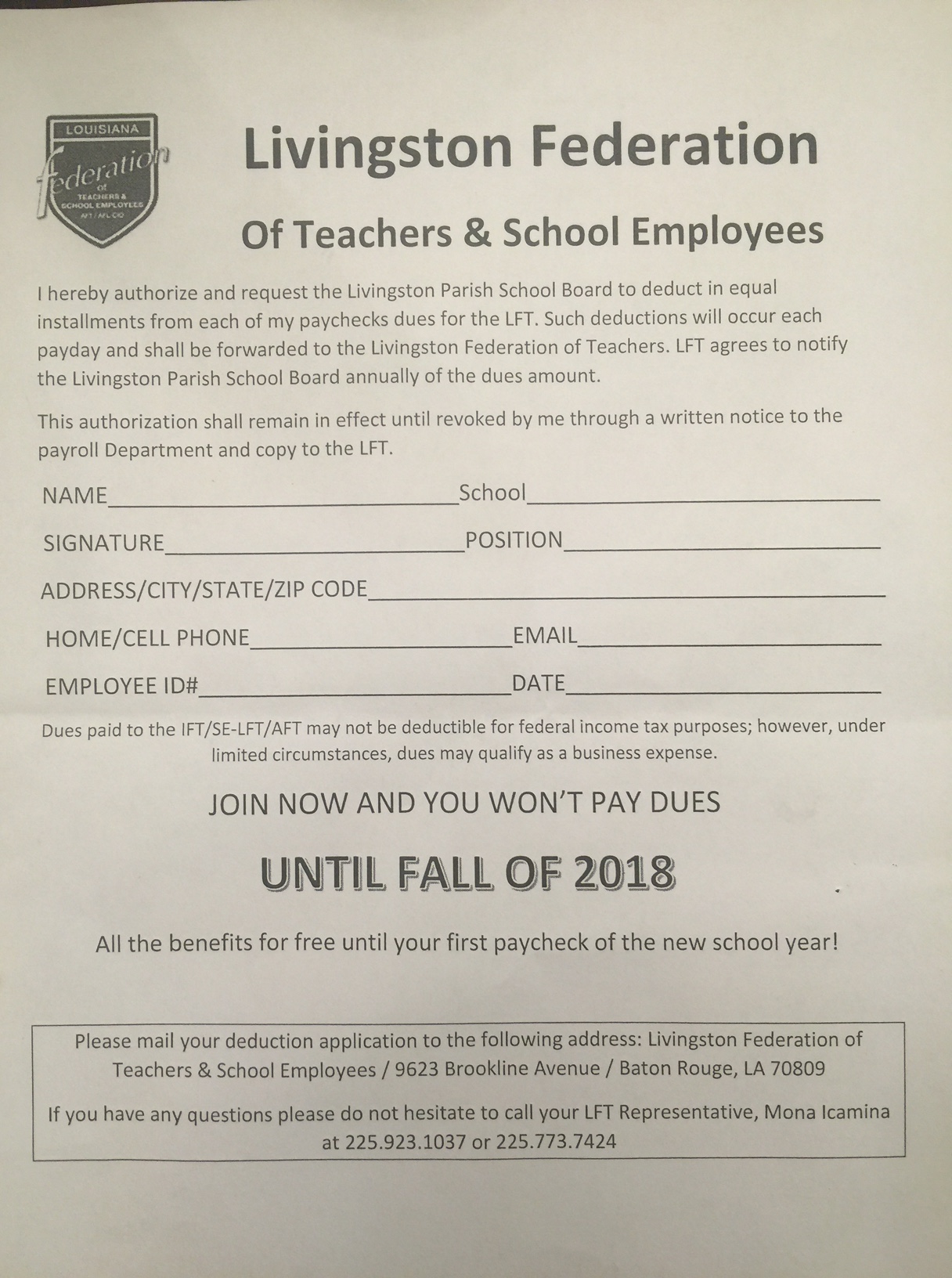
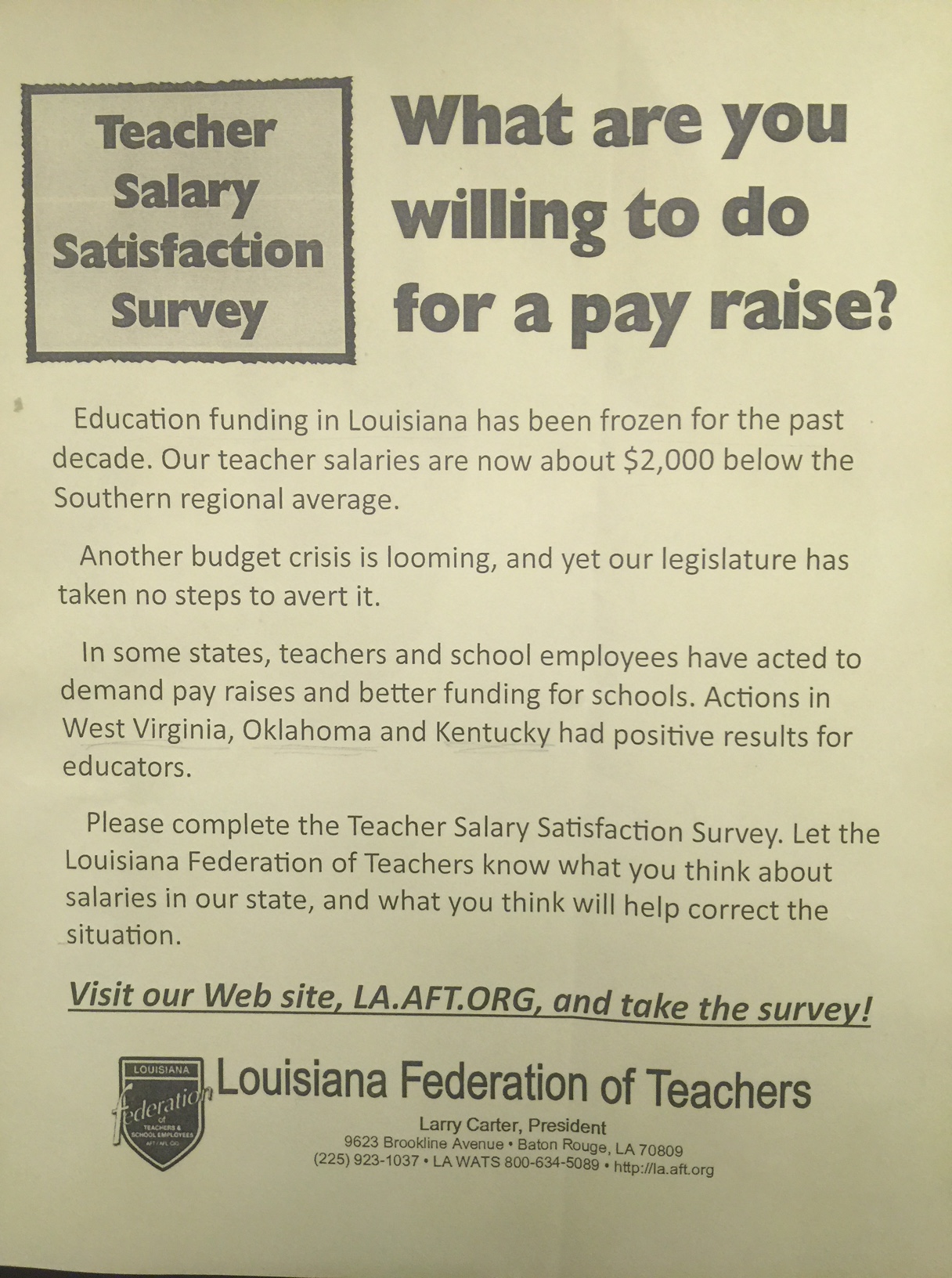
Louisiana’s public school teachers, a group to whom I owe so very much from a personal perspective and to whom I shall ever remain loyal, are quietly receiving copies of a “Teacher Salary Satisfaction Survey” being distributed by the Louisiana Federation of Teachers (LFT).

It could just as easily be called a “Teacher Salary Dissatisfaction Survey.

The flier opens with the question: “What are you willing to do for a pay raise?” and goes on to note that education funding in Louisiana “has been frozen for the past decade. Our teacher salaries are now about $2,000 below the Southern regional average.”

How can that possibly be? How could we have allowed ourselves to neglect the most dedicated, the most heroic among us for so very long?

We gave state police huge salary increases and while I don’t begrudge their pay increases, they certainly should not have come at the expense of teacher salaries.

Teachers should never have to bow down at the sacrificial altar of political servitude, yet that is precisely what has happened.

I can still remember that little presidential wannabe Bobby Jindal telling LABI that the only reason some teachers are still in the classroom was by virtue of their being able to breathe. That was just before Sandy Hook when a teacher stood between a gunman and a student and took a bullet that ended her breathing ability but which allowed a child to go on living.

I still remember teachers at Ruston High School taking an interest in the well-concealed abilities of a poverty-stricken, less-than-mediocre student and nurturing and cultivating those latent talents into eventual college material and a career in journalism. They didn’t have to do that; they could have let him slip through the cracks. But they didn’t. Thanks, Mrs. Garrett, Miss Lewis, Miss Hinton, Mr. Ryland, Coach Perkins, Mr. Peoples, Mr. Barnes. Thanks so very much. You never knew (or maybe you did) what your compassion meant to that kid.

“Another budget crisis is looming, and yet our legislature has taken no steps to avert it,” the flier says.

True. So true. The legislature has taken no steps because legislators, for the most part, are in bed with the special interests who are slowly bleeding this state to death with overly-generous tax breaks even as benefits are being ripped from our citizens. Benefits like health care, education, decent roads and bridges, flood control, the environment—benefits that we rely on our elected officials to provide.

Oh, but they haven’t forgotten the tax breaks for the Saints, the Pelicans, the Walmarts, the Exxons, the Dow Chemicals, pharmaceuticals, the movie industry, the utilities, the banks and payday loan companies, the nursing homes, the private prisons, the Koch brothers, the Grover Norquists, the American Legislative Exchange Council (ALEC), or chicken-plucking plants.

But teachers? Nope. They don’t need raises. Besides, we have virtual academies and charter schools, so who needs public education?

“In some states,” the flier reads, “teachers and school employees have acted to demand pay raises and better funding for schools. Actions in West Virginia, Oklahoma and Kentucky had positive results for educators.”

LABI, of course, would beg to differ. After all, LABI was created back in the 1970s for the express purpose of destroying labor unions in Louisiana through passage of the right to work law. I got that straight from the mouth of Ed Steimel, one of the moving forces for the creation of LABI, shortly before his death.

But let’s back up a minute and pause for reflection before you try to label me as some ranting liberal or even worse, a (gasp) communist.

Do you approve of:

  • Your annual two-week (or whatever the length of time) vacation?
  • How about the eight-hour work day?
  • The 40-hour work week?
  • Overtime?
  • Retirement?
  • Minimum wage?
  • Health benefits?
  • The abolition of sweat shops where children as young as seven or eight are required to work 12- or 14-hour days for pennies?
  • Workplace safety reforms that have drastically reduced injuries and deaths at work?
  • Sanitation laws that have cleaned up the meatpacking industry?

Well, gee, if you approve of all that, you must be a ranting liberal yourself. Or worse, a (nah, better not say it).

But just who do you think brought about those reforms? It certainly wasn’t management. Okay, the guvmint was largely responsible for the meatpacking industry reforms but for the rest, you can tip your hat to organized labor.

“Please complete the Teacher Salary Satisfaction Survey,” the flier reads. “Let the Louisiana Federation of Teachers know what you think about salaries in our state, and what you think will help correct the situation.”

The second page is an authorization form requesting the local school board (in this case, Livingston Parish) to deduct dues for the LFT.

Legislators and LABI are being taken to class here and they’d be wise to pay attention lest they get a failing grade.

Read Full Post »

Physicians Health Foundation (PHF), which for years has abetted the Louisiana Board of Medical Examiners in targeting vulnerable medical practitioners in a manner reminiscent of the tactics employed by the Louisiana State Board of Dentistry, now finds itself in the crosshairs of State Sen. John Milkovich (D-Shreveport).

Both boards have for years flown under the radar of governors, legislators and the media but more and more, attention is being given to their near-autonomous rule by intimidation and extortion.

PHF, also known as the Healthcare Professionals’ Foundation of Louisiana (HPFL), is located on Bluebonnet Boulevard in Baton Rouge and it currently is about halfway through a three-year, $1.35 million contract with the Board of Medical Examiners to run a “Statewide Operations of Physicians Health Program.”

And, since the Board of Dentistry has been mentioned, it might be worth noting that PHF also is just over a year into a three-year, $287,000 contract with that board to “develop, create and administer the Dental Health Professional Monitoring Program.”

By its own admission in a lawsuit to be discussed later in this post, it is not a treatment facility. So, just what does PHF (or HPFL) do to earn its money?

Well, for the Board of Medical Examiners, it appears to extract huge fees from medical professionals (which includes doctors, physician assistants, podiatrists, medical psychologists, dentists and dental hygienists) who are found to have addiction problems or who the board deems to have committed other transgressions.

And since its contract with the Board of Medical Examiners includes dentists, it is unclear why there is a need for a separate $287,000 contract with the Dentistry Board.

But like the Dental Board, the Board of Medical Examiners has set itself up as accuser, prosecutor, judge and jury in investigating complaints and handing down its decisions. Again, like the Dental Board, the Board of Medical Examiners even conducts its own hearings whenever a doctor appeals one of its decisions.

And the board remains a stellar undefeated record in 20 years of reviews of its decisions that are appealed.

Which probably is the reason Sen. Milkovich feels the need for his SB 286, which would establish a Physicians’ Bill of Rights designed to protect their rights whenever they are brought under the scrutiny of the board. More about that shortly.

In addition to its ability to suspend licenses of medical professionals, the board wields a big stick in its ability to coerce licensees into signing consent agreements to enter into rehab.

And those consent agreements often come with large price tags in the form of fees and penalties. Many state regulatory boards, the Board of Medical Examiners and the Dentistry Board included, receive their budgets not from legislative appropriations but from membership fees and financial penalties assessed against members accused and convicted of violations, some of which, though minor, still carry large fines.

Doctors and other medical practitioners apparently are referred to the rehab centers by PHF (or HPFL) whose spokesperson indicated to LouisianaVoice that it has a list of approved facilities in Louisiana, Mississippi and Alabama, among others.

PHF’s $1.35 million contract with the Medical Board runs from Aug. 1, 2016 through July 31, 2019.

One of those rehab centers is PALMETTO Addiction Recovery Center in Rayville.

That facility became involved in a lawsuit in 2009 after one of its staff members. Dr. Douglas Wayne Cook became sexually involved with one of the center’s patients. The husband of the victim sued Cook, who is no longer with Palmetto but who does continue to have a private practice in Richland Parish.


Milkovich’s bill, already reported out of committee favorably, is scheduled to be brought before the entire Senate on Monday.

“Under Louisiana’s current board system, physicians often face an uneven playing field, rigged proceedings, and a stacked deck,” Milkovich said. “Licensed, dedicated and highly qualified professionals may have their licenses threatened, suspended, or revoked, based on false accusations, anonymous complaints, and spurious charges. Doctors are often administratively charged by the board without even being informed of the identity of their accusers, the evidence against them, or even the substance of the accusations brought against them. This injustice is compounded by the heavy-handed and inequitable tactics employed by some Board staff.

“We understand that there must be a fair and sound disciplinary process for physicians, to protect the public. However, the goal of board proceedings for physicians should be impartiality, fairness, and integrity—not intimidation, falsification, and inequity.

“The aim of SB 286 is to level the playing field, un-stack the deck and render the Board’s adjudication of doctors more transparent. Everyone deserves Due Process. And that includes doctors.”

The bill, according to the BATON ROUGE ADVOCATE, would require stricter communication requirements during board investigations and would require that the board provide physicians under investigation written notice of complaints within 10 days or receipt. Moreover, the bill would require that the board reveal the identity of the complainant and would prohibit ex parte communications by board members prior to a hearing on the pending investigation.

One critic of the board, Dr. Greg Stephens said criminals and terrorists receive “more due process than we give doctors.” He and his former boss, Dr. John Gianforte, said they were coerced into consenting to voluntary license suspensions and mandated substance abuse treatment without either being allowed to give their side of the story.

They were suspended following claims that Stephens allowed unqualified staff members to write and sign prescriptions in his name while serving as medical director at a clinic in Shreveport when in fact, the prescription pad was stolen by two employees and Stephens’ name forged. Gianforte said the two employees were fired and one was later charged by law enforcement authorities.

Milkovich even cited a case where a New Orleans physician practicing at Tulane Medical Center committed suicide last November. His license was summarily suspended in June following an investigation but was reinstated in October. By then, however, the doctor had lost privileges, positions and future opportunities as a result of the investigation, the senator said.

In another case, the family of another doctor filed suit against PFL when the doctor, informed that he had had tested positive for drug use, committed suicide a few hours later. The doctor’s family was told by PFL that its programs and personnel had statutorily qualified immunity from legal liability regarding their activities and that they were further protected by a release and a hold-harmless agreement with the Physicians Health Program.

RAMEY V. DECAIRE

PHF was successful in getting the Louisiana Supreme Court to rule that it was exempt under the peremptory exception of no cause of action and the family’s lawsuit was dismissed. PHF, apparently not satisfied with merely winning, then went after the family for legal sanctions, claiming their suit was frivolous and without reasonable good faith. The trial court denied PHF’s motion and PHF appealed. The First Circuit Court of Appeal upheld the trial court and assessed costs against PHF.

Read Full Post »

« Newer Posts - Older Posts »