Feeds:
Posts
Comments

Archive for the ‘Finances’ Category


U.S. Sen. David Vitter could be setting himself up for a repeat of ethics complaints over a perceived use of his Senate franking privileges in his campaign for governor.

The congressional franking privilege, which originated in 1775, allows members of Congress to send official notices, brochures and updates to constituents back home under their signature without having to pay postage. Congress, through legislative appropriations, reimburses the U.S. Postal Service for franked mail it handles.

Vitter is not a candidate for re-election in the 2016 election but instead is running to succeed Bobby Jindal as governor against three other candidates. He is making full use of his franking privileges to announce town hall meetings across the state to address local issues. One such mail-out has caught the attention of LouisianaVoice.

Reform efforts over the past two decades have reduced overall franking expenditures from $113.4 million in fiscal year 1988 to $16.9 million in FY 2014 and even then, many of the mail-outs are simply tossed unread by recipients back home. Much of that reduction can be attributed to a shift to electronic communications rather than any real reform of the practice.

Franking has come under wide criticism by opponents of the privilege who say it:

  • Is financially wasteful;
  • Has become outdated with the introduction of other forms of communication, i.e. e-mail;
  • Is abused for private and political gain;
  • Gives unfair advantages to incumbents in congressional elections.

The last two could be cited as giving Vitter an unfair edge in this fall’s governor’s race. While he is not running for re-election, he is a candidate for governor and his Senate franking privileges could be looked upon as an unfair advantage over fellow Republicans—Public Service Commissioner Scott Angelle and Lt. Gov. Jay Dardenne—and Democrat State Rep. John Bel Edwards who are also running for governor.

Franking rules strictly prohibit incumbents from actually soliciting votes when the mail-outs are done on the taxpayer dime but they do not preclude addressing hot button issues like immigration, social security, veterans’ benefits, etc.

In 2009, Louisiana Democratic Party Chairman Chris Whittington filed an official ethics complaint against Vitter for his verbal attacks on U.S. Rep. Charlie Melancon, an eventual opponent in Vitter’s 2010 re-election campaign. Those attacks were made in local meetings pursuant to mass mail-outs by Vitter via the franking privilege.

Whittington said Vitter, by explicitly invoking the name of Melancon in his so-called town hall meetings, publicized in advance by franking mail-outs, crossed the line from official business (the supposed purpose of franking) to campaigning.

Though the words “vote for…” never appeared in any of Vitter’s mailings, reports from his town hall meetings across the state made it clear that he mentioned Melancon often. Vitter in turn charged that the Democrats were trying to “shut down the debate and suggest that it’s somehow out of bounds. Well, it’s not out of bounds because this is still America,” he said.

http://www.dailykos.com/story/2009/08/22/770585/-LA-Sen-Louisiana-Dems-File-Ethics-Complaint-Against-Sen-Vitter#

In Vitter’s most recent franking mail-out, he issued an invitation to one of his town hall meetings on Monday, June 1 in the chambers of the East Baton Rouge Council “to discuss possible solutions to relieve traffic congestion. We’ll also discuss efforts like working to pass a long-term highway reauthorization bill that would help to update our roads and bridges,” the announcement said. IMAG0721(CLICK ON IMAGE TO ENLARGE)
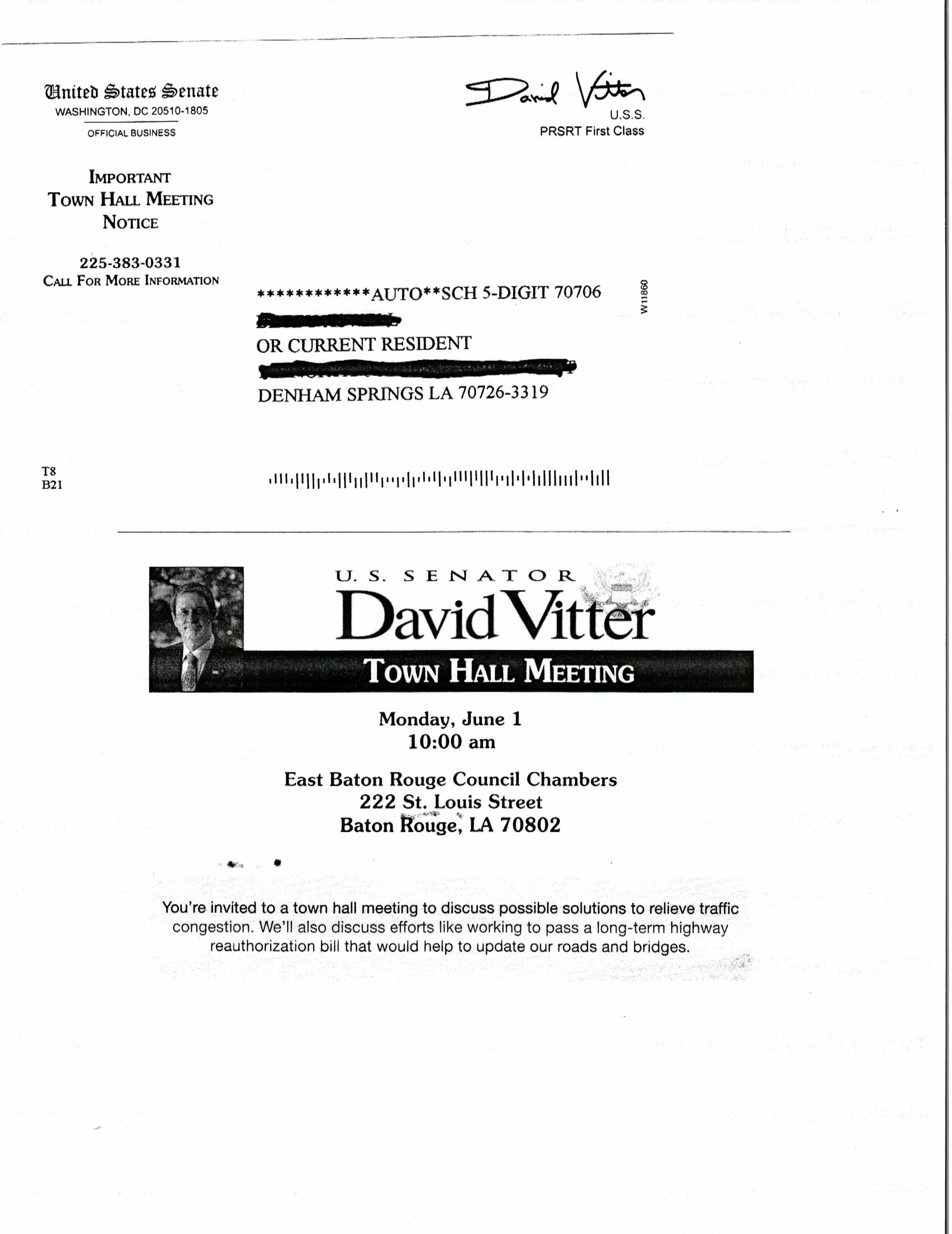
While strictly interpreted, such a discussion could easily be passed off as a federal concern with federal roads and highways crisscrossing East Baton Rouge Parish. That, along with the unquestioned problem of traffic congestion experienced by local motorists, could easily be construed by Vitter as a Senate-related issue.

We have no way of knowing at this point, but it would seem a safe bet that similar town hall meetings have been or will be announced by Vitter via franking in other parts of the state to discuss other pressing problems.

But coming as it does in the middle of what promises to be a heated election season in Louisiana, it would appear to give Vitter a decided—and unfair—advantage over his three opponents who do not have the luxury of free campaign mail-outs.

Nor would it be the first time Vitter has skated on the edge of campaign rules.

In January of 2014, Vitter was up against a state law that prohibited him from using his seven-figure campaign funds amassed as a federal office-holder for a state campaign.

No problem for a manipulators like Vitter and Charlie Spies, a Republican lawyer who was instrumental in launching Mitt Romney’s largest super PAC. In early 2013, Spies created the Fund for Louisiana’s Future and registered the super PAC both federally and in Louisiana in order “to support Sen. Vitter whether he ran for re-election to the Senate or for governor.”

Thus did Vitter become perhaps the first politician in the U.S. to be the largest single funder of his own super PAC.

A former general counsel for the Federal Election Commission said Vitter’s funding of his own super PAC, unprecedented to that point, raised the issue of the separation of super PACs and a candidate’s campaign “to a new level.”

Another observer, Paul Ryan, senior counsel for the Campaign Legal Center, said the existing Louisiana prohibition of the use of federal campaign funds in a state campaign was the only plausible reason for a candidate ceding control of his own campaign funds by transferring cash from his federal campaign to his gubernatorial campaign.

http://www.nationaljournal.com/politics/how-david-vitter-shattered-another-campaign-finance-rule-20140601

Stand by, folks. This election campaign promises to be a tad out of the ordinary, even by Louisiana’s unique standards.


Read Full Post »

State Treasurer John Kennedy on Tuesday told the House Appropriations Committee that the Division of Administration exerts extortion-like tactics against legislators and takes the approach that it should not be questioned about the manner in which it hands out state contracts and that the legislature should, in effect, keep its nose out of the administration’s business.

Kennedy was testifying on behalf of House Bill 30 by State Rep. Jerome Richard (I-Thibodaux) which provides for reporting, review and approval by the Joint Legislative Committee on the Budget (JLCB) of all contracts for professional, personal and consulting services totaling $40,000 or more per year which are funded exclusively with state general fund (SGF) or the Overcollections Fund. HB 30

HB 30 FISCAL NOTES

Kennedy, in a matter of only a few minutes’ testimony, attacked figures provided by three representatives of the Division of Administration (DOA) who objected to the bill because of what they termed additional delays that would be incurred in contract approval and because of claimed infringement upon the separation of powers between the legislative and administrative branches of government.

Here is the link to the committee hearing. While Kennedy spoke at length on the bill, the gist of his remarks about DOA begin at about one hour and 13 minutes into his testimony. You can move your cursor to that point and pick up his attacks on DOA. http://house.louisiana.gov/H_Video/VideoArchivePlayer.aspx?v=house/2015/may/0526_15_AP

That argument appeared to be a reach at best considering it is the legislature that appropriates funding for the contracts. It also appeared more of a smokescreen for the real objections: DOA’s, and by extension, Bobby Jindal’s wish that the administration be allowed to continue to operate behind closed doors and without any oversight, unanswerable to anyone.

DOA representatives tried to minimize the effect of the bill by downplaying the number and dollar amount of the contracts affected (which raises the obvious question of why the opposition to the bill if its impact would be so minimal). The administration said only 164 contracts totaling some $29 million would be affected by the bill.

Kennedy, however, was quick to jump on those figures. “The numbers the division provided you are inaccurate,” he said flatly. “The Legislative Auditor, who works for you,” he told committee members, “just released a report that says there are 14,000 consulting contracts, plus another 4600 ‘off the books.’

“The fiscal notes of 2014 by the Legislative Fiscal Office—not the Division (DOA)—said the number of contracts approved in 2013 by the Office of Contractual Review was 2,001—not 160—professional, personal and consulting service contracts with a total value of $3.1 billion,” he said. “I don’t know where DOA is getting its numbers.

“To sum up their objections,” he said, “it appears to me that DOA and more to the point, the bureaucracy, is smarter than you and knows how to spend taxpayer dollars better than you. That’s the bottom line. They don’t want you to know. This bill will not be overly burdensome to you. Thirty days before the JLCB hearing, you will get a list of contracts. If there are no questions, they fly through. If there are questions, you can ask.”

Kennedy tossed a grenade at DOA on the issue of separation of powers when he accused the administration of blackmailing legislators who might be reluctant to go along with its programs.

“Let’s talk about how the division’s advice on contracts has worked out,” he said. “The Division advised you to spend all the $800 million in the Medicaid Trust Fund for the Elderly. Now they have zero in that account. In fact, they pushed you to do that. Some of you were told if you didn’t do that, you’d lose your Capital Outlay projects. How’s that for separation of powers? How’d that work out for you?

“My colleagues from Division who just testified against the bill are the same ones who told you to take $400 million out of the (Office of Group Benefits) savings account set aside to pay retirees’ and state employees’ health claims. How’d that work out?”

Kennedy didn’t stop there. He came prepared with an entire laundry list of accusations against the administration.

“My colleagues from Division are the ones who told you, ‘Look, we need to privatize our health care delivery system,’ which I support in concept. They sat at this table and I heard them say we would only have to spend $600 million per year on our public-private partnership and (that it would be) a great deal ‘because right now we’re spending $900 million.’ I thought we’d be saving $300 million a year. Except we’re not spending $600 million; we’re spending $1.3 billion and we don’t have the slightest idea whether it’s (the partnerships) working. How’d that work out for you?

“I sat right here at this table and I heard my friends from Division say we need to do Bayou Health managed care. You now appropriate $2.8 billion a year for four health insurance companies to treat 900,000 of our people—not their people, our people,” he said. “There’s just one problem: when the Legislative Auditor goes to DHH (the Department of Health and Hospitals) to audit it (the program), they tell him no.”

Kennedy said that pursuant to orders from DOA, “the only way they can audit is if they take the numbers given him (Legislative Auditor Daryl Purpera) by the insurance companies.

“This is a good bill,” he said. “It’s not my bill. My preference is to tell Division to cut 10 percent on all contracts and if you can’t do it, you will be unemployed. But this bill allows you to see where the taxpayer money is being spent.

“I have more confidence in you than I do in the people who’re doing things right now,” he said.

Kennedy said he was somewhat reluctant to testify about the bill “but I’m not going to let this go—especially the part about separation of powers.

“You want to see a blatant example of separation of powers?” he asked rhetorically, returning to the issue of the administration’s heavy handedness. “How about if I have a bill but you don’t read it. You either vote for it or you lose your Capital Outlay projects. How’s that for separation of powers?”

That evoked memories from November of 2012 when Jindal removed two representatives from their committee assignments one day after they voted against the administration’s proposed contract between the Office of Group Benefits and Blue Cross/Blue Shield of Louisiana.

“Everything they (legislative committees) do is scripted,” said Rep. Joe Harrison (R-Gray), speaking to LouisianaVoice about his removal from the House Appropriations Committee. “I’ve seen the scripts. They hand out a list of questions we are allowed to ask and they tell us not to deviate from the list and not to ask questions that are not in the best interest of the administration.” https://louisianavoice.com/2012/11/02/notable-quotables-in-their-own-words-142/

Rep. John Schroder (R-Covington) asked Kennedy what his budget was to which Kennedy responded, “Less than last year and less that year than the year before and probably will be even less after this hearing. But you know what? I don’t care.

“There’s nothing you can say to get Division to support this bill,” he said. “They’re just not going to do it.

“You can’t find these contracts with a search party. But if you require them to come before you, you can get a feel for how money is being spent that people work hard for and you can provide a mechanism to shift some of that spending to higher priorities.

“Next year, you will spend $47 million on consulting contracts for coastal restoration. I’m not against coastal restoration; I’m all for it. But these consultants will not plant a blade of swamp grass. Don’t tell me they can’t do the job for 10 percent less. That $47 million is more than the entire state general fund appropriation for LSU-Shreveport, Southern University-Shreveport, McNeese and Nicholls State combined.

“Under the law, agencies are supposed to go before the Civil Service Board and show that the work being contracted cannot be done by state employees but that is perfunctory at best,” Kennedy said.

To the administration’s arguments of delays in contract approvals and infringements on the separation of powers, Rep. Brett Geymann (R-Lake Charles) dug in his heels. “This is not a bad thing,” he insisted. “We’re not going to go through every page of every contract unless someone calls it to our attention. It doesn’t matter if it’s 14,000 or 14 million contracts. The number is immaterial. If there’s an issue with a contract, we need to look at it.”

For once, the administration did not have its way with the legislature. The committee approved the bill unanimously and it will now move to the House floor for debate where Jindal’s forces are certain to lobby hard against its passage.

Should the bill ultimately pass both the House and Senate, Jindal will in all likelihood, veto the measure and at that point, we will learn how strong the legislature’s resolve really is.

But for Kennedy, the line has been drawn in the dust.

Read Full Post »

Our friend C.B. Forgotston, who follows the legislature relentlessly, alerted us to this little tidbit this morning that illustrates just how far the legislature is willing to go to absolve itself of any responsibility in the current fiscal mess in which the state currently finds itself.

Year after year, when stinging budget cuts are imposed on higher education and health care, the same cry goes up from the citizenry: “Why are only higher ed and health care subjected to repeated budget cuts? Why aren’t other agencies made to share the pain?”

And year after year, the same response from legislators: “Because under the State Constitution, those are the only areas that can be cut.

“Our hands are tied,” they wail in unison.

Not so, says Forgotston, who once was a staff attorney for the legislature.

Of the $30 Billion in the current state budget, $3.9 Billion or only 13 percent is constitutionally-protected, he says.

Of the dedicated funds:

  • $3.3 Billion (85 percent of the constitutionally-dedicated funds) funds public elementary and secondary education’s Minimum Foundation Program (“MFP”) which is approved by the leges.
  • $318 Million (9 percent) pays the annual debt service on state borrowing (bonds).
  • $115 Million (3 percent) pays the supplemental pay for municipal policemen, firemen and deputy sheriffs.

What’s not protected?

            Of the $30 Billion budget, Forgotston says 87 percent is not constitutionally-protected. That includes:

  • NGOs (non-governmental organizations) and other local pork barrel projects in the Operating and Capital Outlay budgets.

The constitutional scapegoat

            The constitution is a convenient scapegoat for the governor and the legislators’ lack of political courage to set priorities,” he said, “especially, since none of them appear to have ever read the document.”

No matter. On Monday, they had a chance to do something about it and they didn’t.

They punted.

And the vote wasn’t even close.

The Senate Finance Committee deferred, by an 8-2 vote, Senate Bill 196 by State Sen. Jean Paul Morrell (D-New Orleans) which would have placed a constitutional amendment before Louisiana voters that would have repealed the constitutionally-imposed dedications. SB 196 TEXT

The Legislative Fiscal Notes, which accompany any bill dealing with fiscal matters, says there would be “no anticipated direct material effect on governmental expenditures.”

The fiscal notes also said, “Due to the elimination of approximately 20 constitutional funds and the requirement that the revenue source of such funds now flow into the State General Fund (SGF), the SGF will have approximately a statutorily dedicated fund balance transfer of approximately $3.9 billion in FY 16 and annual SGF revenue flow of approximately $730 million per year.” SB 196 FISCAL NOTES

Morrell lectured committee members as he testified on behalf of his bill, saying, “We fixed higher ed but not health care. We have too many ‘not me’s’ coming before you to defend their programs.

“If you kill this bill,” he cautioned members, “you’re saying to your constituents not only that your hands are tied but that you like your hands to be tied.”

Which is precisely what they did on motion from Sen. Dan Claitor (R-Baton Rouge).

Before the vote on Claitor’s motion, Sen. Fred Mills (R-St. Martinville) offered a substitute motion to approve the bill, sending it to the Senate floor. Only Sen. Bodi White (R-Central) voted with Mills in favor of the bill. Those voting against approval were committee Chairman Jack Donahue (R-Mandeville), committee Vice-Chairman Norbert Chabert (R-Houma), members Bret Allain (R-Franklin), Sherri Smith Buffington (R-Shreveport), Claitor, Ronnie Johns (R-Lake Charles), Eric LaFleur (D-Ville Platte), Edwin Murray (D-New Orleans), and Greg Tarver (D-Shreveport).

As an unspoken acknowledgement of the committee’s concern over a possible veto by Bobby Jindal, a fretful White went so far as to suggest to Morrell that he might get a more favorable consideration of his bill if he waited until next year “when we have a new governor.”

So, bottom line, it appears that legislators remain unwilling to confront a lame duck, largely absentee governor despite his abysmal approval ratings by Louisiana voters.

Something is wrong with this herd mentality, folks.

This is not the time to wait for a “new governor.” This is the time for bold, decisive action that says to Jindal, “We damned well dare you to veto this or we’ll throw it back in your face with a veto session like this state—or any other state—has never seen. We will bring the attention of the national media down upon your delusional head.”

Instead, they choose to wait.

Again.

Read Full Post »

By the content of that comment from the writer calling himself Earthpapa, we figured we must have hit a nerve with our report about Troy Hebert’s “campaign” expenditures on hotels and LSU tickets after he left office.

But the fact is, an apology is in order. We said he spent $4,930 in campaign funds on LSU tickets after he left office.

On double checking our figures, we find the actual amount is $4,991.

But the lengthy comment by Earthpapa appeared to have Hebert’s footprints all over it and the strident tone of his missive indicated to us that we had scored a direct hit, or very close to it.

And while we’re not saying with any definitiveness that Hebert was the author of the comment, it was enough to send us diving back into his campaign report for other expenditures incurred after he left the Louisiana Senate in November of 2010 to become head of the Office of Alcohol and Tobacco Control (ATC).

(As an aside, the State Ethics Board has said that if campaign funds are not to be used for the purpose of campaigning or holding office, they are to be returned to the donors on a pro rata basis. Accordingly, if 100 donors give $1,000 each and $50,000 is left over and not to be used, then theoretically, the 100 donors would receive refunds of 50 percent of their contributions, or $500 each.)

But Hebert, apparently playing by his own rules, has continued to spend campaign funds at least through last December on such things as Christmas cards, advertising, postage, office supplies, stationery, flowers, food, newspaper advertising, subscriptions, gifts, clerical salaries for his New Iberia office and, of course, those LSU tickets—all expenditures not allowed under state campaign regulations.

Specifically, the Ethics Board says, “Funds must be expended for a use related to a political campaign or the holding of a public office.” (Emphasis by the Board.) But Hebert has not held office nor has he sought political office since becoming ATC director. shall not be used for any perso  may not be used for any personal use unrelated to holding of public office

In all, Hebert (aka Earthpapa?) has shelled out more than $36,300 in non-campaign-related expenditures since December of 2010, according to his own campaign finance records. TROY HEBERT CAMPAIGN EXPENDITURES POST-SENATE

A breakdown of expenditures, in addition to the $4,991 in LSU tickets, includes:

  • $3,539 on newspaper advertising;
  • $14,454 on souvenirs (logo hats and shirts) and office supplies;
  • $1,785 for postage, Christmas cards and newspaper, magazine and cable subscriptions;
  • $1,250 on ornaments, gifts and lunches;
  • $8,500 in political contributions to other candidates (which is allowable);
  • $4,500 in salaries to two clerical employees in a New Iberia office from December of 2012 (the month after he left office) through December of 2013, two years after he left office.

There was no explanation as to why the ATC director needed an office in New Iberia or why his campaign funds had to be used to pay office staff salaries.

In November and December of 2014, three years after leaving office, he spent $3,585 at Erin Oswalt Photography for Christmas cards and in December of 2010, he spent $492 with Oswalt on postcards, campaign expense reports reveal.

His campaign also purchased $1,028 in postage between December of 2010 and December of 2014—not counting the eyebrow-raising $676 in campaign funds spent in December of 2014 for Christmas card postage.

Again, it’s difficult to conceive why the director of a state agency would need to purchase more than $1,700 in postage stamps over a four-year period using campaign funds long after he left office in open violation of campaign regulations.

Perhaps Hebert Earthpapa will contact us and explain the use of campaign funds for non-campaign purposes.

Read Full Post »

Ask a typical Louisiana legislator about his compensation, and you’ll likely get the usual story that the part-time status assigned to lawmakers is a myth. You’re likely to hear all kinds of horror stories about how they have to travel to Baton Rouge, some from as far away as Shreveport, to tend to state business.

But for many legislators, there are conspicuous gaps in those tales of woe.

They will tell you those trips to the state capital are not limited to the legislative sessions (85 days in even-numbered years, 60 days in odd-numbered years), that they attend committee meetings year-round.

All that is true enough but when they do travel to Baton Rouge, they receive per diem that averages around $150 per day (the rate is tied to the federal reimbursement rate and fluctuates accordingly), plus mileage.

But as always when a politician is talking, it’s best to listen carefully to what he doesn’t say.

Bear in mind that they collect the $150 or so per diem for all 85 days in even years even though lawmakers rarely meet on Fridays and never on weekends or Memorial Day, meaning there are as many as 37 days in even years and 24 days in odd years on which they do not meet but are paid.

Still, they will tell you the $16,800 per year in salary is a pittance for the work they do. Never mind the $500 per month in vouchered expenses and $1,500 per month in unvouchered expense they receive, bring their total compensation to something a little north of $50,000 per year.

And granted, that’s not much when you consider the time they are required to take from their regular jobs.

But there’s a dirty little secret they don’t—and won’t—tell you.

And that is 27 of 39 current senators (69 percent) and 52 of 104 representatives (exactly half) access campaign contributions to elevate them to lifestyles the average person can only dream of.

You might think campaign funds would be used exclusively for campaign-related expenses but you would be wrong. Louisiana legislators (and many other office holders as well, including mayors, sheriffs and state officials) regularly spend campaign funds on such things as tickets to big-time athletic events, lavish meals, and extensive travel.

And then there’s the story of Sen. Sherri Buffington (R-Shreveport). In January of 2004, she was Sherri Smith Cheek and she and her then-husband, Jon Cheek, traveled to New Orleans to attend the NCAA national championship football game between LSU and Oklahoma but forgot his tickets.

No problem. Sherri Smith Cheek, a freshman senator, simply called State Police and arranged for a Pony Express-type relay by state troopers from Shreveport to New Orleans to deliver the six tickets. When word of the special deliver leaked out, she expressed her regret (don’t they always feel just awful—after they’re caught?) and said she would repay State Police $448.50, based on her computation of 12 hours of trooper pay. http://www.freerepublic.com/focus/f-news/1060246/posts

A check of her campaign expense records, however, revealed no such payment to State Police. That, however, does not preclude her having paid the money from personal funds.

But those same campaign expense records show that Sherri Smith Cheek Buffington (she has re-married) did spend $20,548 on LSU football tickets between 2009 and 2014.

In fact, 22 senators and 36 members of the House spent $577,839 on LSU tickets from 2003 to 2014, according to campaign expense records. The breakdown was 22 senators ($240,678) and 36 representatives ($337,161). LSU ATHLETICS

Buffington’s $20,548 was not the most spent on LSU tickets by a legislator, however. Not even close.

Nine others outspent her on tickets to Saturday nights in Tiger Stadium. They include the $30,170 by Sen. Gary Smith (D-Norco), ($28,745 by Sen. Norby Chabert (R-Houma), $25,414 by House Speaker Chuck Kleckley (R-Lake Charles), $23,984 by Rep. Joel Robideaux (R-Lafayette), $23,026 by Rep. Frank Hoffman (R-West Monroe), $21,924 by Sen. Jonathan Perry (R-Kaplan), $21,856 by Sen. Dale Erdey (R-Livingston), $21,680 by Rep. Patrick Connick (R-Marrero), and $20,942 by Senate President John Alario (R-Westwego).

Nor were tickets to athletic events limited to LSU.

Other expenditures will be explored in more depth in subsequent posts. To give you an idea of how legislators develop a sense of entitlement while denying increases in the minimum wage, voting down equal pay for women bills, rejecting Medicaid that would provide expanded healthcare to the state’s lower income citizens and generally falling all over each other in an effort to be front and center in sacrificing higher education and state hospitals at the altar of Bobby Jindal, here’s a teaser on other campaign fund expenditures:

  • Six senators and three House members combined to spend $46,417 on New Orleans Saints tickets since 2003; NEW ORLEANS SAINTS
  • Seven members of the Senate and two representatives combined to shell out $37,093 on tickets to New Orleans Hornets/Pelicans NBA basketball games over the same time span; NEW ORLEANS HORNETS  NEW ORLEANS PELICANS
  • Twenty-two members of the Legislature (11 each from the House and Senate) combined to use $35,494 in campaign funds for Sugar Bowl football and NCAA basketball tournament tickets; SUGAR BOWL  NCAA REGIONALS
  • Twenty-seven members (eight from the Senate and 19 from the House) paid out $61,606 for out-of-state travel (even though none of the members were seeking office outside Louisiana); TRAVEL
  • Members of the two chambers managed to spend some $380,000 on meals—much of that for campaign supporters and workers, which technically, would be campaign-related and permissible, but a sizable chunk of which appears to be for less noble purposes. RESTAURANTS  MEALS

The State Ethics Board has issued several opinions on campaign fund spending limitations over the years and some of those opinions have specifically addressed the expenditure of campaign funds for personal use. Those opinions, which would seem to prohibit use of funds for athletic events, etc., will be discussed in upcoming posts.

Read Full Post »

« Newer Posts - Older Posts »
