Feeds:
Posts
Comments

Archive for the ‘Finances’ Category

1399909

Bloomberg News Service on March 1 published a STORY that said global megabanks have paid $321 billion in fines for such non-banking-like practices as money laundering, market manipulation and even terrorist financing since the market crash of 2008.

And while $321 billion may sound impressive, Bloomberg failed to mention that because of those same banks, President George W. Bush had little choice but to sign the Emergency Economic Stabilization Act of 2008 that pumped more than twice that amount, $700 billion of taxpayer bailout funds, into the failed banks that precipitated the Great Recession of 2008.

Most financial advisers would describe that as a negative return on investment.

Adding insult to injury, $1.6 billion of that $700 billion was used to award multi-million dollar bonuses to CEOs of the very firms that got us into the mess to begin with. http://www.cbsnews.com/news/16b-of-bank-bailout-went-to-execs/

Bloomberg also failed to mention that those fines had little effect on those who perpetuated the crimes but did have a significant impact on stockholders and retirees, those, in other words, who had nothing to do with the massive fraud carried out on such a grand scale.

In fact, in 2010, former Countrywide Financial CEO Angelo Mozilo was fined $22.5 million and ordered to pay another $45 million in restitution as his penalty for reaping a profit of $141.7 million from stock sale, according to Mary Kreiner Ramirez and Steven A. Ramirez, authors of The Case for the Corporate Death Penalty (New York University Press, 2017). So, despite the penalties, he walked away with a net gain $74.2 million, or a 52 percent return, sending a clear signal his peers that “crime does in fact pay,” the authors wrote.

There are also two questions Bloomberg neglected to address:

  1. What the total cost of the runaway greed and reckless actions of firms like AIG, Lehman Brothers, Merrill Lynch, Goldman Sachs, Citigroup, Countrywide, and J.P. Morgan to stockholders, retirees and American taxpayers in general?
  2. How many top tier officers at these firms who condoned, encouraged and/or actively participated in the illegal practices went to jail?

The answer to the first question is an eye-popping $15 trillion, according to Ramirez and Ramirez.

The answer to the second question is just as unbelievable: ONE.

In fact, as of Jan. 28, that last date that STATISTICS were updated by the Bureau of Prisons, there were exactly 555 people serving federal jail sentences for banking, insurance, embezzlement and counterfeiting. That comes to .3 percent (three-tenths of one percent) of the total federal prison population.

By contrast, there were 82,109 in federal prison for non-violent drug offenses (46.4 percent of the total), and 14,853 imprisoned on immigration charges (8.4 percent).

At this point it might be fair to ask just who did the most lasting damage to the nation’s economy?

It would also be fair to question why, if only one Wall Street banker went to jail, how is that there are 555 imprisoned for banking- and insurance-related offenses? The answer to that is those offenders, situated on Main Street instead of Wall Street, lacked the political clout in Washington that the leaders of the megabanks enjoyed.

Is that an over-simplification of the circumstances? Probably, but it’s interesting to compare the actions of different White House administrations in handling financial crises.

President Obama’s first Attorney General, Eric Holder, in his “too big to fail” proclamation, said, “I am concerned that the size of some of these institutions becomes so large that it does become difficult for us to prosecute them when we are hit with indications…it (prosecution) will have a negative impact on the economy.”

Obama, for his part, said, “One of the biggest problems about the…financial crisis and the whole subprime lending fiasco is that a lot of that stuff wasn’t necessarily illegal, it was just immoral or inappropriate or reckless.”

Wasn’t necessarily illegal? Both statements stretch credulity to its breaking point and are in themselves, disgraceful because federal laws were clearly broken knowingly and willfully.

It wasn’t always that way. For example, in the wake of the savings and loan crisis of the 1980s and 1990s, more than 1,100 bankers were indicted and 839 were convicted.

Enron, the seventh-largest company in the U.S. at the turn of the century, is another example of how the feds went after those who played fast and loose with the rules. President George H.W. Bush called on Enron CEO Kenneth Lay to run the World Economic Summit in Houston in 1990 and in 1992, Lay co-chaired the reelection campaign of Bush the First.

Enron and its affiliates also contributed more than $888,000 to the Republican National Committee in 2000, the year that George W. Bush was elected President and another $1.3 million to the Republican Party. Lay and his wife personally contributed $238,000 to George W. Bush campaigns and inauguration celebrations and raised another $100,000 from friends. To the younger Bush, Lay was known as “Kenny boy.”

Still, Enron and its top executives were not immune from prosecution by Bush the Second.

Despite the access to the highest levels of government enjoyed by Enron and Lay, he and Jeff Skilling, his successor as Enron CEO, were indicted by the Department of Justice in 2004 and though the two combined to spend some $60 million on their defense, Lay was convicted on all counts and Skilling on 19 of 28 counts of securities fraud.

George W. Bush’s Attorney General John Ashcroft recused himself from the Enron investigation because Enron and Lay both were major financial supporters in Ashcroft’s Missouri unsuccessful Senate re-election campaign. His chief of staff, David Ayers, also took himself out of the investigation of Enron. That was as it should have been.

Enron’s accounting firm, Arthur Andersen, was convicted of shredding Enron documents and both Enron and Arthur Andersen soon ceased to exist.

The same fate befell CenTrust Savings Bank, Drexel Burnham Lambert investment bank, and WorldCom—all because of flagrant violations of federal securities laws and each was prosecuted by the administrations of the two Bushes. WorldCom, in fact, was the largest bankruptcy in history when it went under in 2002.

Evidently, those firms were not considered too big to fail.

By contrast, Obama’s Attorney General Holder and Lanny Breuer, chief of the Department of Justice (DOJ) Criminal Division, did not remove themselves from DOJ’s investigation of the investment banks that brought on the Great Recession of 2008. This despite the fact that both men had worked for the same law firm of Covington & Burling which included among its clients such eminent Wall Street banking firms as Bank of America (Countrywide’s successor), Citigroup, and JP Morgan Chase.

In fact, at the time Holder was tapped as attorney general, he was co-chairing Covington & Burling’s white-collar defense unit. Good training in case you’re ever called on to investigate your former bosses.

Breuer returned to Covington & Burling in 2013 followed by his boss Holder in July 2015, giving Holder at least a reason for his strained, if not borderline unprincipled logic for not pursuing criminal indictments against the megabanks.

Following Holder’s departure, Deputy Attorney General Sally Quillian Yates (Remember her? She’s the one President Trump fired after she refused to enforce his illegal immigration order) issued a DOJ memo (turns out she was pretty good at memos that cut right to the chase) on Sept. 9, 2015, that reversed Holder and Breuer’s DOJ policy toward pursuing individual accountability, both criminally and civilly, for corporate wrongdoing. The memorandum said the policy change was to maximize DOJ’s “ability to deter misconduct and to hold those who engage in it accountable.”

The comparison between the approaches of two Bushes and Obama to bankers’ disdain for securities laws to the detriment of the entire country represents a stark role reversal for the perceived political philosophies of the Republican and Democratic administrations.

And now, President Trump has expressed his determination to roll back the Dodd-Frank bill passed after the 2008 recession for the express purpose of preventing a recurrence of the runaway greed that nearly wrecked the world economy.

In fact, he wants to remove all regulation of Wall Street banks, quite possibly the most dangerous single cartel in American society.

Read Full Post »

 By Stephen Winham, Guest Columnist

“… Already long ago, from when we sold our vote to no man, the People have abdicated our duties; for the People who once upon a time handed out military command, high civil office, legions — everything, now restrains itself and anxiously hopes for just two things: bread and circuses”

Juvenal [circa 100 AD], Satire 10.77–81

“Bread and circuses” (or bread and games; from Latin: panem et circenses) is metonymic for a superficial means of appeasement. In the case of politics, the phrase is used to describe the generation of public approval, not through exemplary or excellent public service or public policy, but through diversion; distraction; or the mere satisfaction of the immediate, shallow requirements of a populace, as an offered “palliative“… The phrase also implies the erosion or ignorance of civic duty amongst the concerns of the commoner.

—Wikipedia


Have these words of a Roman poet, written 1900 years ago, ever been more relevant to our country and state?  And, this is hardly satire.  In Louisiana’s government, we still get the circuses (the just-ended special legislative session, for example), but they are not nearly so much fun as they were in the past. They also no longer provide the level of distraction our elected officials expect.  Our leaders still provide the bread, too, though too many are left with the heels – and we are not always sure even they are distributed equitably.

Just as our country is clearly divided, our state is becoming increasingly partisan. Confronted with precisely the same problems, the two sides view them as if they exist in alternate realities.  The factions do not seek to find common ground.  They might compromise, but that is hardly the same thing.

In the most recent session of the legislature a purported compromise on how to best patch the state’s budget for the remainder of this year resulted from an agreement by the administration to accept the effect of a very questionable House Concurrent Resolution that will, if we believe the proponents, be a great “reform” and will magically free up almost a hundred million dollars in state general fund for the fiscal year that begins July 1, 2017 – money, mind you, that was always there for the taking, just never captured.  Sound just a little suspicious?

How does this magic work and how does it differ from past gimmicks, you might well ask?  Well, unlike some of those, it really does free up general fund, but it also cuts other constitutional and statutorily dedicated funding, notably including the Transportation Trust Fund.  The Transportation Trust Fund has already been criticized for not being used more on roads and bridges desperately in need of repair – and now we are going to take another $15-$18 million of it to pay part of our General Obligation (not highway) Debt service?  And, lest we forget, TTF funds match Federal Highway funds so the potential impact is greater than the amount diverted. Is this your concept of “reform?”  It certainly is not mine.

The Bond Security and Redemption Fund ensures our general obligation debt service will always get paid first. It is the subject of HCR1 of the special session.  Money constantly (and somewhat theoretically) flows through it on the way to the general fund from which we have typically paid general debt service. I consider the fund a practical fiction because it would only have actual effect if somebody ever pressed the “stop” button and froze it to draw the necessary amount for debt service. However, its existence enhances our bond ratings. There is a legitimate concern that messing with it in any way can jeopardize our ratings, not because it places the payment of debt service in danger, but simply because we have started messing with it at all. The fact we have recently had to borrow short-term to meet current obligations is further evidence we should leave the BSRF alone. To the extent confidence in our fiscal status is eroded, and our ratings decline, we must pay more to service our debt.

House Speaker Barras, the author of the concurrent resolution that directs this miracle reform is a banker.  He certainly knows all these things.  Let’s put the best face possible on the resolution and assume he wanted its passage to ensure the special session did not close with absolutely no action toward addressing our long-range problems – which would have been the case in its absence.  This proposal had been made before and rejected by the administration for the reasons above and others – reasons I consider valid.

Could using the resolution as a bargaining chip have been a power play more than anything else?  Barras was not JBE’s pick for Speaker of the House.  The Republicans in the house are flexing their muscles in a faint attempt to emulate the partisanship of their national counterparts. Did they rally around the speaker to get in JBE’s face with this one?  Could this distraction have also been the center ring performance in this special session – a small act in a small session with bigger acts like those in past sessions to come when the Greatest Show on Earth returns to Baton Rouge in April?

Let’s face it.  Nobody has done anything that comes close to solving our overall budget problem.  Our roads and other infrastructure are crumbling, our state services are becoming increasingly mediocre and, in the case of some life-and-death situations, dangerously ineffective.  Worse, most everybody seems to be ignoring the fact that we face a $1.2 billion (gee, why does that number sound so familiar?) gap in Fiscal Year 2018-2019 when the temporary sales taxes used to bandage the budget the last time we hit the wall expire.

The latest of literally dozens of past blue ribbon groups tasked with providing options for fixing the state’s fiscal problems, the Task Force on Structural Changes in Budget and Tax Policy, issued its final report, to little fanfare, on January 27, 2017.  Some of the best minds in our state participated in this study and it provides solid recommendations based on current information.  Our leaders need only choose among them.  I commend its reading to you.  Why has this report not become part of the circus yet – Is it too dull to have entertainment value?  Do our leaders believe we cannot be convinced by (or even understand) facts?  Do they believe illusion, misdirection and confusion are always better and that we are easily fooled?

Commissioner of Administration Jay Dardenne was a key participant in the task force.  When the Fiscal Year 2017-2018 executive budget was presented, the governor and Commissioner Dardenne declined to say what they might ultimately suggest as the solution to our problem.  They also said, as they have in the past, this is not the budget they want to see implemented.  Well, if it isn’t, what is?

If the cuts presented in the governor’s proposed budget, most notably to TOPS, are not realistic – not something we can all live with – what cuts are?  We don’t know because, despite protestations to the contrary, we have not seen a truly honest budget in many years – one that says, “Okay, Louisiana, you don’t want to pay more taxes, here are the things we are going to permanently cut and we are going to stand behind them to the end.”  This is very different from: “Well, shucks, here’s some things that will balance the budget, but we don’t want to do them and neither do you, so what have you got to offer as an alternative?”

Representative John Schroder has taken the position the governor should present a realistic plan he is willing to stand behind to provide the legislature with a realistic starting point.  The governor seems to be saying no such plan exists.  So, if the governor doesn’t have a plan and neither does the legislature, where does that leave us?

Our governor has greater control over the budget than is the case in some other states.  Representative Schroder has a point, but the simple fact is the legislature, not the governor, holds the power of appropriation and many, including me, consider it to be its greatest power. The governor can recommend things all day long, but he cannot enact appropriations or taxes.

Speaking of taxes, why are so many of our citizens convinced they already pay too much in taxes for what they get from the government?  Look no further than LouisianaVoice, The ADVOCATE, nola.com, almost any television or radio station and what do you read, see, and hear?

Every day we are bombarded with tales of waste, corruption, theft, etc. in our state departments.  Are you going to tell me nothing can be done about this?  Am I to believe lightening would strike JBE and our other elected officials dead if they dared expect the people they appoint to run these programs as effectively and efficiently as possible and to demand accountability for their failures?  I’m not talking about the simple act of firing those who are doing a poor job.  That doesn’t accomplish anything if the replacement continues the practices of the predecessor. I am talking about expecting officials to have integrity and to know enough about the operations of their departments to stop these things from happening in the first place.

I honestly and truly believe people are willing to pay for things from which they see benefits and that they believe are providing maximum value – the marketplace proves this.  Every effort must be made to instill confidence in our government’s ability to manage our resources in the best way possible.  Sure, its goals are different – government exists to provide services, not make a profit, but that is no excuse for not performing to the highest standards possible.

I don’t know about you, but I am finding the circus less than entertaining and I can provide my own bread for the most part.  Others have given up on the circus, but need help from its owners.  It is past time those owners accept their responsibilities – and it is up to us to lean on them to do so every chance we get – beginning right now and continuing in earnest during the next legislative session.  Our leaders need to all look at what is happening to the real Ringling Brothers Circus and realize it could happen to them – and, much worse, to us.


Read Full Post »

It’s a classic political maneuver whenever a public figure is in trouble: get out in front of the story and release it yourself to make yourself either the good guy or a sympathetic figure—whichever the situation dictates.

Take Superintendent of State Police Mike Edmonson, for example.

First, he yanks a national award intended for a former Trooper of the Year and gets himself nominated instead, which by most standards, is a really shoddy way to treat a subordinate.

The he invites 15 of his best friends, also LSP subordinates, with him to San Diego to watch him bask in the moment—at the International Association of Chiefs of Police (IACP) 123rd Annual Conference and Exposition held on October 15-18, 2016.

And he dispatches four of those to drive to California in an unmarked State Police SUV permanently assigned to his second in command, Charles Dupuy.

But when he realizes that LouisianaVoice, which has been working on this story for a couple of months now, and New Orleans TV investigative reporter Lee Zurik are planning to release a fairly critical story Monday night about his little escapade, he decides to beat them to the punch by going PUBLIC with his version of events.

But in doing so, this so-called “leader” callously tosses the four who drove the state vehicle under the bus while professing none too convincingly to be “embarrassed” by the whole affair. I mean, it’s a little difficult to be embarrassed when one of the four’s expenses for the trip was approved by Dupuy.

So much for the Loyalty part of that “Courtesy, Loyalty, Service” motto of the Louisiana State Police. If you’re going to give permission (as Edmonson did) for four men to drive to California and they take a state vehicle permanently assigned to your second in command, and that same second in command (Dupuy) signs off on the expenses of the senior member of the four (Williams), then it necessarily means that the top brass of Louisiana State Police (Edmonson, Dupuy, et al) were complicit and Edmonson can hardly discipline the four without coming down on Dupuy as well.
charles-dupuy

Sour grapes? You bet. No one likes being scooped on a story in which so much time and effort has been devoted. And this is not to be taken as criticism of The Advocate. In their shoes, I would not have done things any differently. And it’s certainly obvious that reporter Jim Mustian he did more than a little digging on his own as evidenced by his interview with a spokesman for the Metropolitan Crime Commission in New Orleans. We don’t begrudge participation of other media in a story such as this. Indeed, we welcome it. News is the exclusive domain of no one.

But it’s also just as evident that Edmonson had his PR machine cranked up full tilt in a desperate act of damage control.

He allowed those four State Troopers to make the trip in a State Police vehicle, a Ford Expedition—because, he said, it represented a savings to State Police. That was less than two months before he testified before members of the House Committee on Appropriations on December 6, 2016, that his department was in dire need of 658 additional VEHICLES (Scroll to the 7:40 point in the proceedings).

And he did it all on the state dime.

717,200 state dimes, to be precise, or as close as we can come, given the information provided by LSP was incomplete. That comes to at least $71,720 in taxpayer funds as the LSP assemblage partied even as the state barreled headlong toward yet another budgetary shortfall.

Gov. John Bel Edwards only last week issued a call for a 10-day SPECIAL SESSION of the legislature in an attempt to address a projected $304 million budget hole. That session began Monday at 6:30 p.m. and is scheduled to end by midnight, Feb. 22.

It’s not as though Edmonson needed validation badly enough to yank the honor from one of his subordinates. He has, after all, won other major awards:

  • FBI Washington DC, Top 25 Police Administrators Award, 2009
  • Sheriff Buford Pusser National Law Enforcement Officer of the Year Award, 2013
  • Human Trafficking, Faces of Hope Award, 2013
  • Inner City Entrepreneur (ICE) Institute—Top Cop Award, 2013
  • American Association of Motor Vehicle Administrators Martha Irwin Award for Lifetime Achievement in Highway Safety, 2014
  • New Orleans Convention and Visitors Bureau, Captain Katz Lifetime Award for Outstanding Achievement in Public Safety, 2015.

Edmonson’s expenses were paid by IACP as the organization’s “honored guest,” according to LSP Maj. Doug Cain, and the travel and lodging expenses of Lafargue, who submitted expense claims only for $366 in meals (though he did turn in a time sheet so he could be paid for attending the event), were apparently picked up by the Louisiana State Troopers Association (LSTA) as best we can determine.

Cain said the reason so many personnel made the trip was because there were two other national conferences being held simultaneously: the Association of State Criminal Investigative Agencies (ASCIA), and the National Safety Council Annual Conference. Edmonson said the conference is an annual event and was included in the LSP budget.

But that didn’t prevent everyone involved from taking time to party hardy. This happy hour group photo was snapped at a San Diego watering hole.

san-diego-happy-hour

That’s Mike Edmonson right up front, on the left. Third from left is his wife and standing behind him on the third row in the yellow shirt is his brother, State Police Maj. Paul Edmonson. When LouisianaVoice requested a list of those who traveled to San Diego, Paul Edmonson’s name was conveniently omitted from the list. Yet, here he is.

The entire affair more closely resembled a frat party than a professional function, given the side trip to Vegas and the barroom fellowship.

Here is the announcement of Edmonson’s award from the Louisiana State Police Facebook page:

Following a nomination process that included numerous highway and public safety leaders from across the country, Louisiana State Police Superintendent Colonel Mike Edmonson was awarded the “J. Stannard Baker Award for Highway Safety.” Colonel Edmonson was honored with the prestigious award during the International Association of Chiefs of Police (IACP) Annual Conference which was held from October 15-18, 2016 in San Diego, CA. The IACP Annual Conference has a reputation for providing quality education on pressing law enforcement topics, and at this year’s conference Colonel Edmonson served on a panel of law enforcement leaders from across the nation to discuss topics such as community and training.

At each year’s IACP Annual Conference, the J. Stannard Baker award is presented to recognize law enforcement officers and others who have made outstanding lifetime contributions to highway safety. The award is sponsored by the IACP, the National Highway Traffic Safety Administration (NHTSA), and the Northwestern University’s Center for Public Safety. For an individual to receive this award, they must be nominated by a law enforcement agency or other traffic safety group or official. They must also be a full time law enforcement officer of a state, county, metropolitan, or municipal agency or be an individual who has made a significant lifetime contribution to highway safety.

The IACP is a professional association for law enforcement worldwide. The IACP actively supports law enforcement through advocacy, outreach, and education. By establishing partnerships across the public safety spectrum, the IACP provides members with resources and support in all aspects of law enforcement policy and operations. The organization helps members to perform their jobs safely and effectively, while also educating the public on the role of law enforcement to help build sustainable community relations.

The glowing news release, however, does not tell the complete story.

Sources close to the story have told LouisianaVoice that New Orleans State Police Maj. Carl Saizan, a 33-year State Police veteran and former Louisiana State Trooper of the Year, was originally nominated for the award but that the nomination had to pass through Edmonson for his stamp of approval. Instead, Saizan’s nomination was mysteriously scratched in favor of….Edmonson. Department of Transportation and Development (DOTD) Secretary Dr. Shawn Wilson ultimately signed off on Edmonson’s nomination.

Repeated efforts to contact Saizan for a comment were unsuccessful but LouisianaVoice was told he was not a happy camper about Edmonson’s snub. In fact, he may well have voiced his displeasure to Edmonson because he has since been removed as Region One Patrol Commander over Troop A (Baton Rouge), Troop B (New Orleans) and Troop L (Mandeville) and placed over only Troop N, which is exclusively New Orleans.

Edmonson, for his part, denied any knowledge of Saizan’s nomination. “I don’t know anything about anyone else being nominated,” he said in a telephone interview on February 13. “This was a lifetime achievement award based on my 37 years with State Police, mainly my last nine years as Superintendent,” he said.

Maj. Doug Cain, LSP Public Information Officer, told LouisianaVoice that he submitted Edmonson’s name for nomination for the award in “early May” of 2016 but a chain of emails received by LouisianaVoice indicates that saizan’s nomination was in the works as early as April 7. That timeline coincides with the story we received that upon receiving communication that Saizan was being nominated, Edmonson, or someone on his behalf—and certainly with his blessing—decided that he and not Saizan should be the nominee.

Here is Cain’s email:

From: Doug Cain
Sent: Saturday, February 18, 2017 9:28 PM
To: Tom Aswell
Subject: Re: QUESTION

I submitted app early May.  Don’t know exact date off the top of my head.

For those who may not recall, remember in June of 2014, State Sen. Neil Riser (R-Columbia) tried to sneak an amendment onto a bill literally during the closing minutes of the regular legislative session that would have pumped up Edmonson’s retirement benefits by about $55,000 per year. In case you don’t remember, Edmonson feigned ignorance of that maneuver as well, saying he had no knowledge of any such attempt only to later admit differently that he gave the go-ahead to the attempt in the full knowledge he had chosen to lock in his retirement years earlier and that that decision was supposed to be “irrevocable.”

So someone acts on Edmonson’s behalf to benefit him and he then attempts to distance himself from the action by claiming ignorance.

Does anyone see a pattern here?

LouisianaVoice received corroboration of the Saizan story from six independent sources, all from law enforcement veterans—three active and three of whom are retired.

The 15 “guests,” along with their salaries, who traveled to California to witness the presentation at the three-day International Association of Chiefs of Police convention in San Diego on October 16-18 were:

  • Derrell Williams, of Internal Affairs, $132,800 per year;
  • Col. Jason Starnes, recently promoted into the newly-created $150,750 per year unclassified position of Chief Administrative Officer (CAO) to assist the Undersecretary in the administration of all programs and sections within the Office of Management and Finance. The job description states Chief Administrative Officer shall exercise the duties and responsibilities of the Office of Management and Finance in the absence of the Undersecretary at the direction of the Deputy Secretary. Perk – he receives Free housing at the State Police Headquarters compound (dorm) because he is separated;
  • Special Assistant Superintendent Charles Dupuy, Edmonson’s $161,300 per year alter-ego;
  • Paul Edmonson, Command Inspector of Special Investigations Section ($136,800). He is Mike Edmonson’s brother and was not included in the list provided by LSP of those making the trip but somehow showed up in a group photo of the contingent in a San Diego bar;
  • John W. Alario, son of Senate President John A. Alario, Jr., who pulls down $115,000 per year as Executive Director of the Louisiana Liquefied Petroleum Gas Commission;
  • Layne Barnum, Command Inspector, Criminal Investigations Division ($132,800);
  • Greg Graphia, Operational Development Section consists of the Planning, Public Affairs, and Research Units. The Section functions as staff for Mike Edmonson ($124,100);
  • Special Deputy Superintendent over Bureau of Investigations Murphy Paul ($150,750). The Bureau of Investigation is responsible for the investigation of criminal activity, intelligence gathering, and case and technical support in the State of Louisiana.
  • Chavez Cammon, Criminal Investigations Unit, New Orleans ($96,900);
  • Stephen Lafargue, Secretary-Treasurer of the Louisiana State Troopers’ Association (LSTA) and Bureau of Investigations for Troop D in Lake Charles ($112,300);
  • Rodney Hyatt, HQ President of the Louisiana State Troopers’ Association (LSTA) and Lt. of Operational Development Section ($99,800);
  • Master Trooper Thurman Miller, President of the Central States Troopers Coalition of Louisiana ($72,600);
  • Trooper Alexandr Nezgodinsky, Insurance Fraud Section, Baton Rouge ($50,900);
  • Charles McNeal, Investigative Support Section (ISS) LA-SAFE Director ($124,100);
  • Brandon Blackburn, an $18,700-per-year unclassified student/intern who is the son of the late Frank Blackburn who served as legal counsel to the Department of Public Safety (DPS). The younger Blackburn, along with his mother, Cindy Kreider Blackburn, and Mike Edmonson’s wife, Suzanne, paid their own expenses, records show.

With Edmonson, Dupuy and Starnes all in San Diego, it’s a good thing no major emergencies like floods, shootings or petro-chemical plant explosions occurred during their absence. But it nevertheless raises questions as to the wisdom of having the top three LSP administrators out of state at the same time. Cain, however, defended the decision, saying, Command and control is maintained 24/7.”

Yeah, like Bobby Jindal continued to run the state while campaigning for President in Iowa.

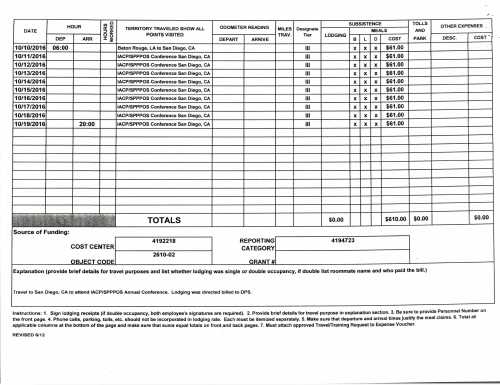
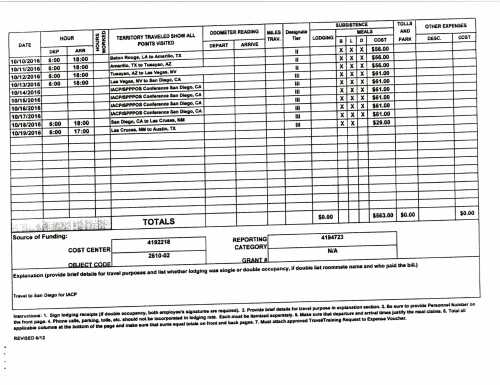
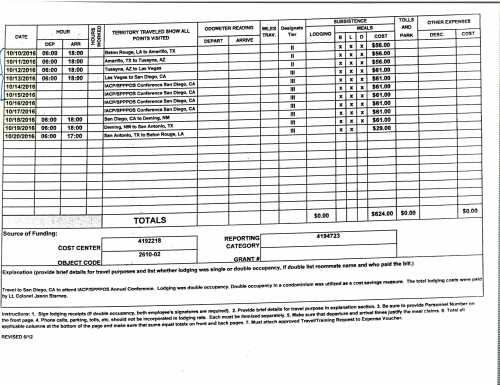
The decision to have LSP pay the salaries of such a large group of attendees, as well as travel, lodging, meal and conference registration expenses via state LaCarte credit cards, seems questionable enough. But the justification of having four troopers—Derrell Williams, Rodney Hyatt, Thurman Miller and Alexandr Nezgodinsky—drive a state vehicle from Baton Rouge to San Diego (with an overnight stopover in an expensive Las Vegas casino hotel)—was the most puzzling.

Miller is a member of the Retirement Board and President of the Central States Troopers Coalition of Louisiana, Inc. 

Traveling via Interstates 10 and 8 from Baton Rouge, the four would have had to go northwest from Phoenix about 250 miles for an overnight stay in Vegas and from there, 260 miles southwest to San Diego. The straight-line distance between Phoenix and San Diego via I-8, on the other hand, is 350 miles. That means the 510-mile detour taken by the four was about 160 miles longer than necessary.

The four logged seven days for the round trip—four days driving to California and three days on the return trip—plus the four days at the conference itself.

Not only did fuel for the trip cost $610.98, but the four troopers combined to log 249 total hours during the trip (12 hours per day each for three of the men except for the final day, when 11 hours were claimed by the same three) on their time sheets. Each man was paid for 56 regular hours (224 hours total) for the seven days on the road and for 27 hours each (81 total hours) in overtime pay for the trip. Each also was paid for attending the four-day conference, according to time sheets submitted by the troopers.

Maj. Derrell Williams was the only one of the four to claim no overtime for the 11 days that included the trip and the conference. That’s because those with the rank of captain or above cannot earn overtime pay. They can, however, earn straight compensatory time. His salary and expenses still came to $5,730.

Cain was asked for the justification for taking the vehicle and his email response was: More cost effective to transport 4 individuals and also provide local transportation in San Diego for departmental personnel.”

Edmonson likewise said by the time the cost of flying to San Diego and renting a car was tabulated, it was more economical to have the men drive.

But when their travel time (regular and overtime hours), meals and hotel bills were totaled, the cost of driving the vehicle came to more than $21,000, which does not appear to fit the “cost effective” justification given by Cain or Edmonson. In fact, each of the four could have flown first class for less than that. Edmonson said he would re-calculate the cost of driving the vehicle to California.

On Friday, he heaved the four men under the bus when he announced that they would be required to repay overtime claimed as well as hotel expenses for their overnight stay in Las Vegas. He said Maj. Catherine Flinchum who formerly worked in Internal Affairs, the section Williams now heads up, would conduct an investigation of the trip by the four men.

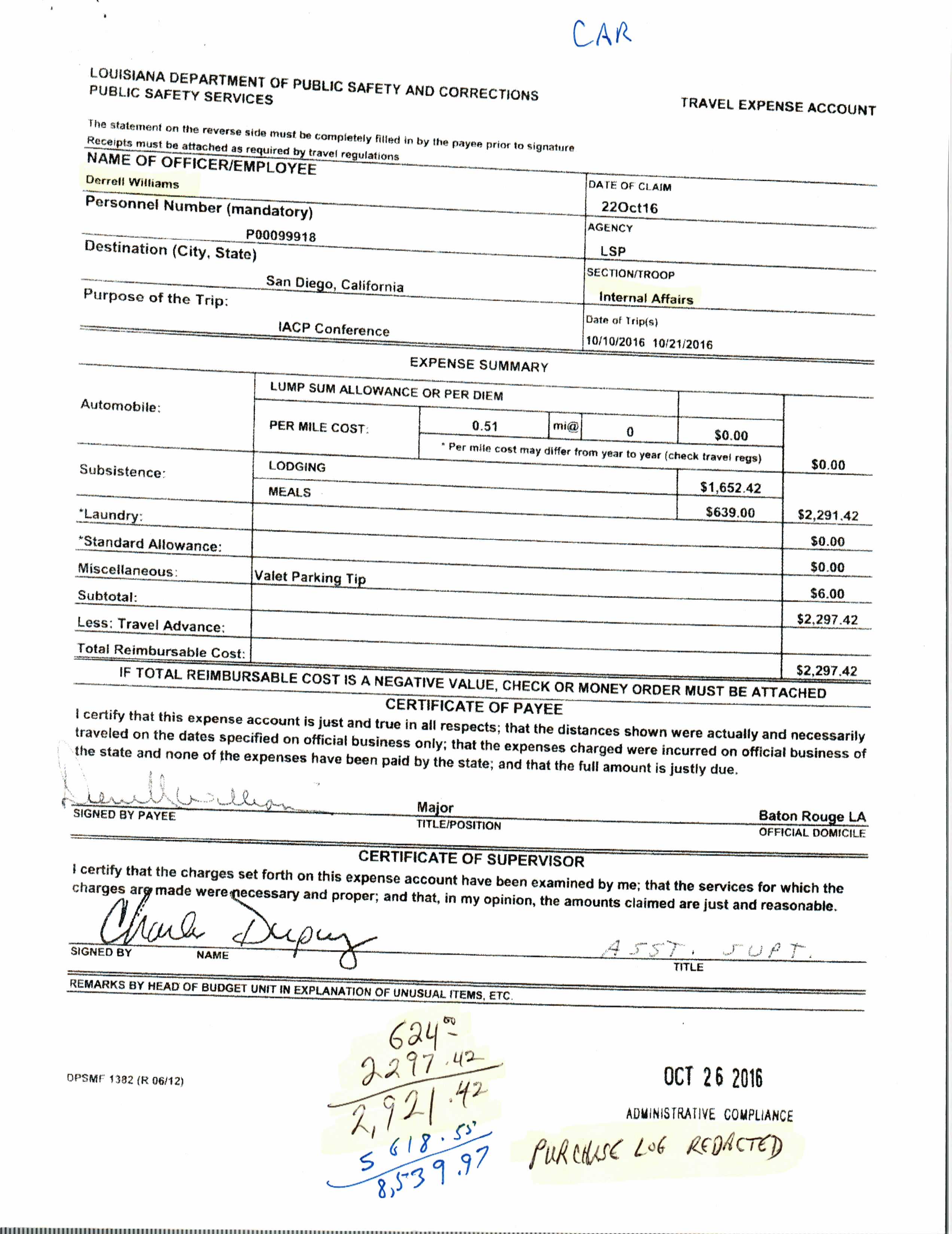
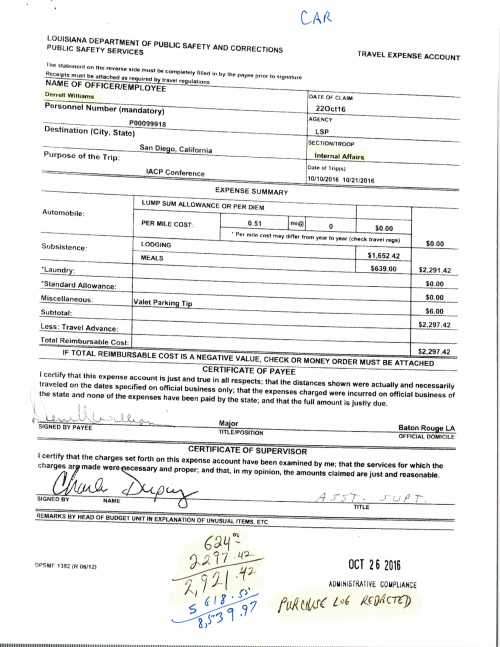
Interestingly, Williams’s supervisor who signed off on his $2,297.42 expense report was Lt. Col. Charles Dupuy, to whom the vehicle they drove is permanently assigned. That leaves unanswered the question of whether Edmonson’s investigation would extend to his second in command for approving the use of his vehicle and for approving the expenditures.

The bottom line here is that Edmonson knew of and approved taking the vehicle to San Diego and knew of the Las Vegas trip. His signature may not be on the approval for the expenses, but his fingerprints are all over this entire sordid affair. He owns it and no amount of public contrition can change that.

As for others who made the trip by auto, Capt. Gregory Graphia, who also was in San Diego, signed off on time sheets (including the overtime logged) of both Rodney Hyatt and Thurman Miller while Hyatt signed off on Alexandr Nezgodinsky’s time sheet even though he is not Nezgodinsky’s supervisor. A tight little incestuous circle of responsibility, to be sure.

Nezgodinsky, by the way, presents an interesting question in his own right. It seems he has been a State Trooper only since May 2014. So how did a trooper with so little seniority rate a free trip to San Diego? The answer to that may lie in the fact that he was a San Diego city police officer as late as 2012. Perhaps the Louisiana crowd needed a tour guide to the tourist hot spots.

As far as Cain’s somewhat questionable explanation of “local transportation for departmental personnel” goes, Enterprise, which has a contract with the state for discounted rates, still rents cars in San Diego.

One law enforcement official offered a third possible reason for taking the vehicle. “Any way you can check to see if booze for their private parties was transported out there?” he asked.

Cain denied that the Expedition transported anything other than the four troopers.

The total breakdown of costs to the state was almost evenly split between salaries and expenses, records show. Altogether, the salaries for all attendees came to nearly $34,800 and expenses for travel, lodging, registration and meals were $36,233, plus whatever unreported expenses were incurred by Paul Edmonson, according to incomplete records provided by LSP as a result of LouisianaVoice’s public records requests.

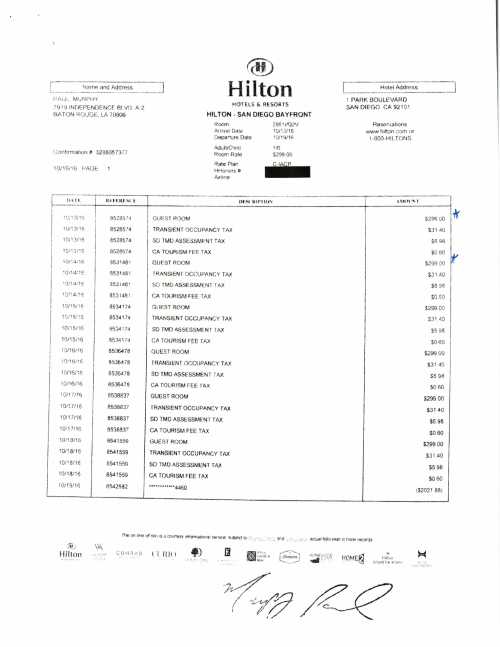
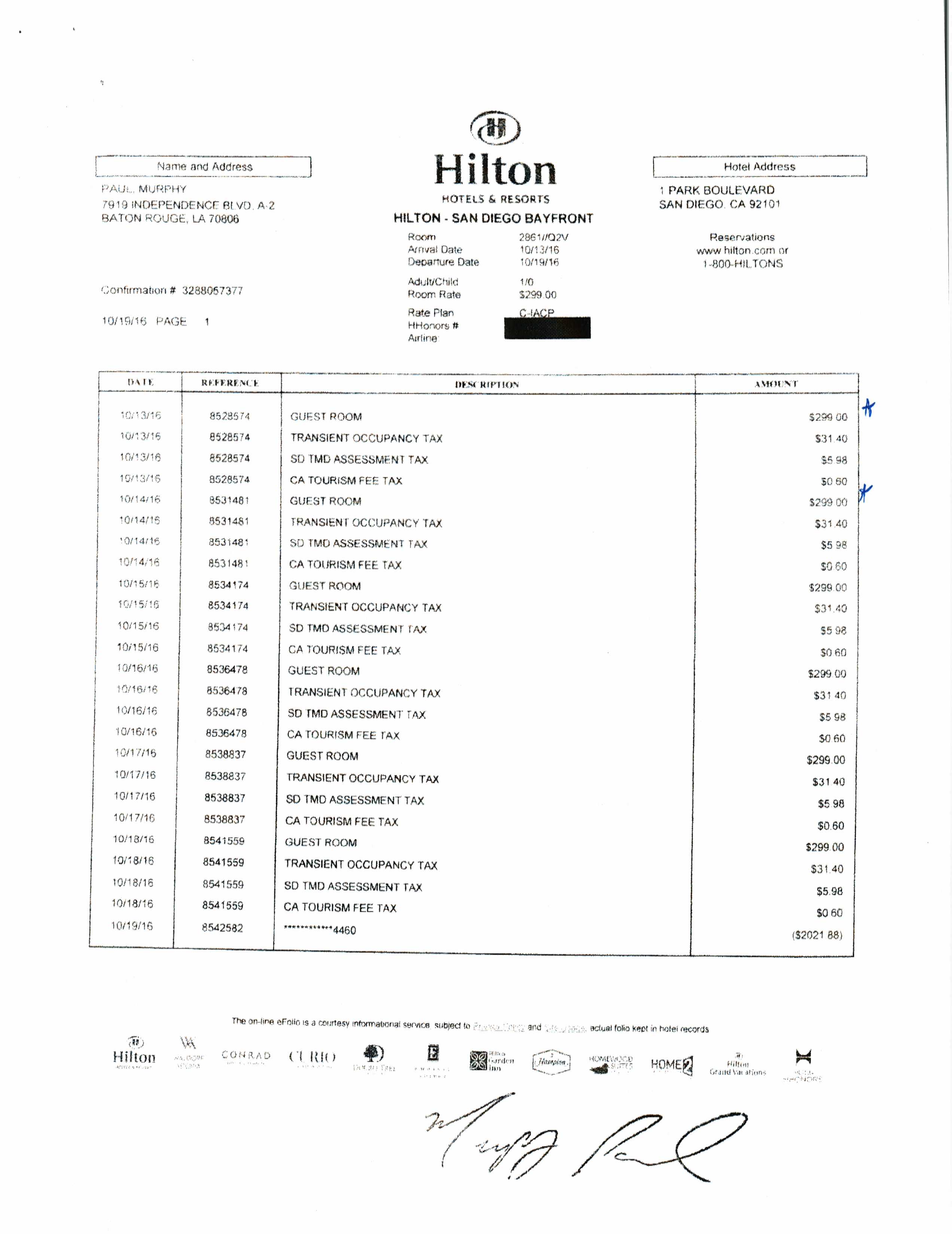
Among those costs were hotel bills far exceeding the maximum allowed by state travel guidelines. While several hotel bills were submitted for as much as $299 per night, state guidelines set a maximum limit of $126 per night for several listed cities, including San Diego.

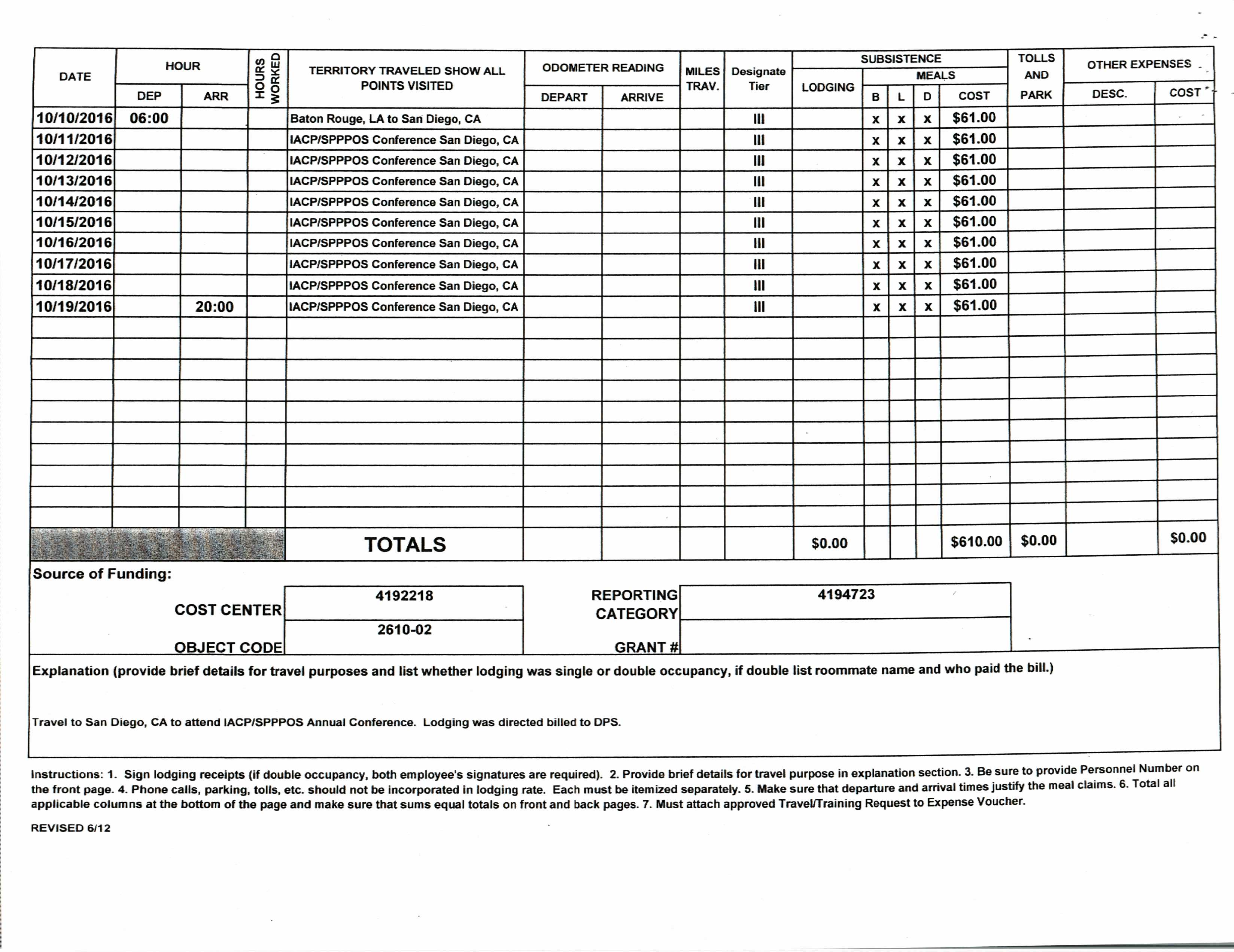
Likewise, the $68-per-day limit for meals ($13 for breakfast, $19 for lunch and $36 for dinner) was routinely exceeded, sometimes just for breakfast. Three examples included meal expense statements of $60 and $72 for breakfast, $68 and $102 for lunch and $96, $120 and $193 for dinner.
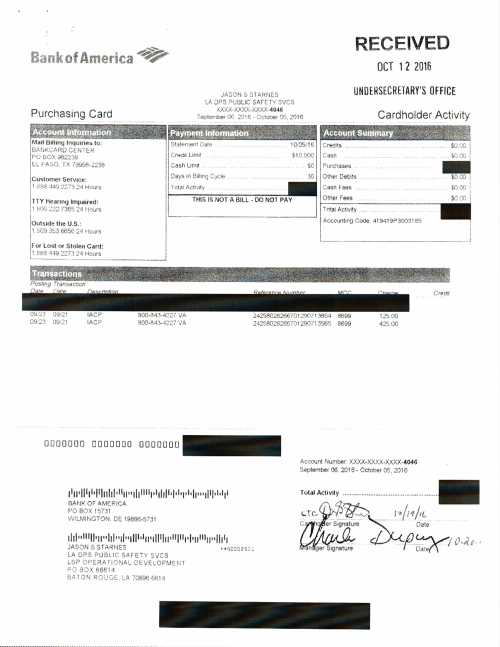
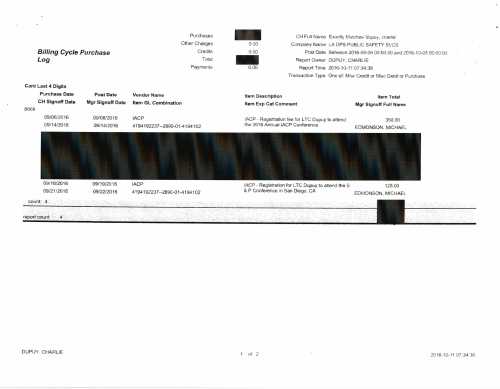
redacted-starnes-invoice

redacted-edmonson-invoice

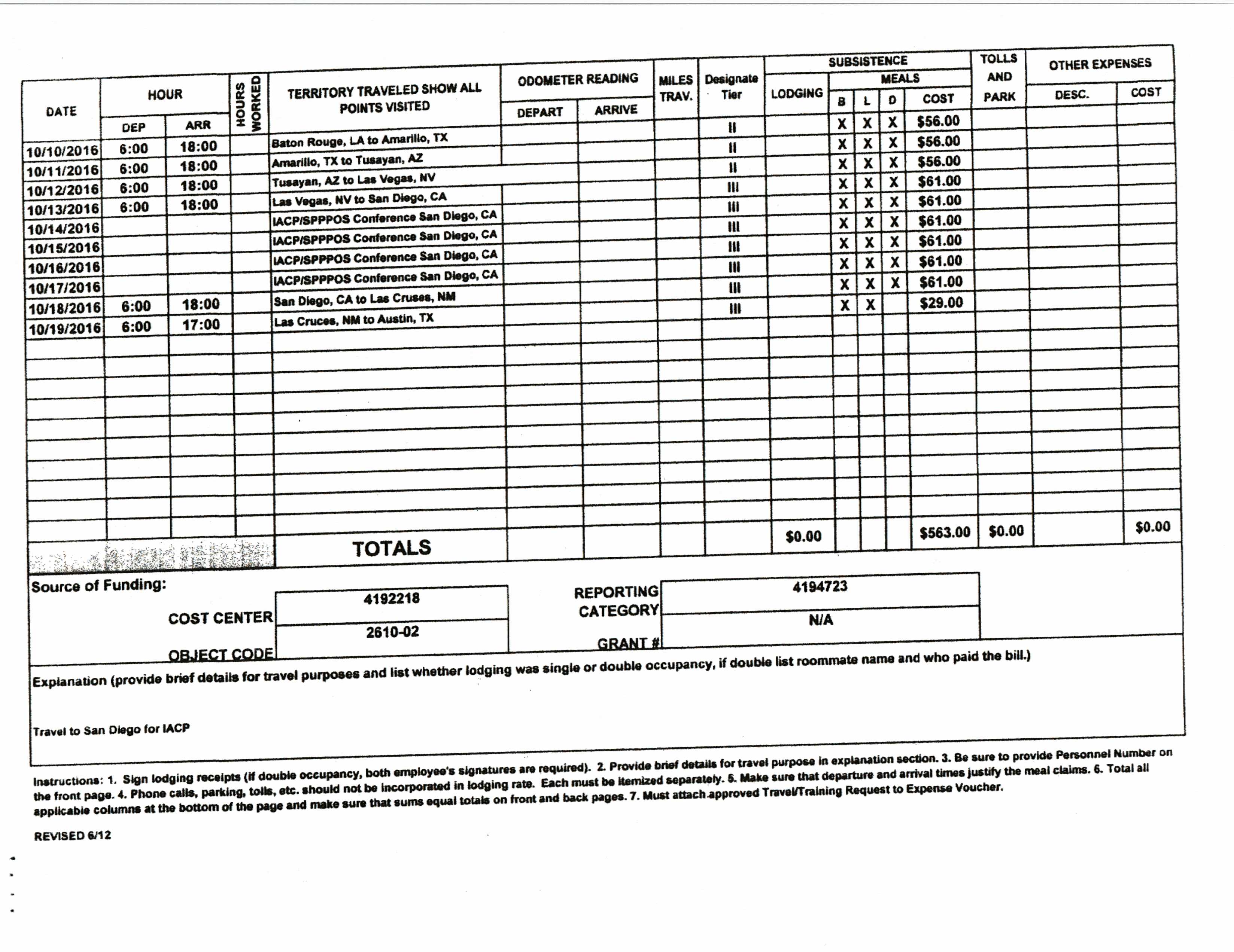
nezgodinsky-original-expenses

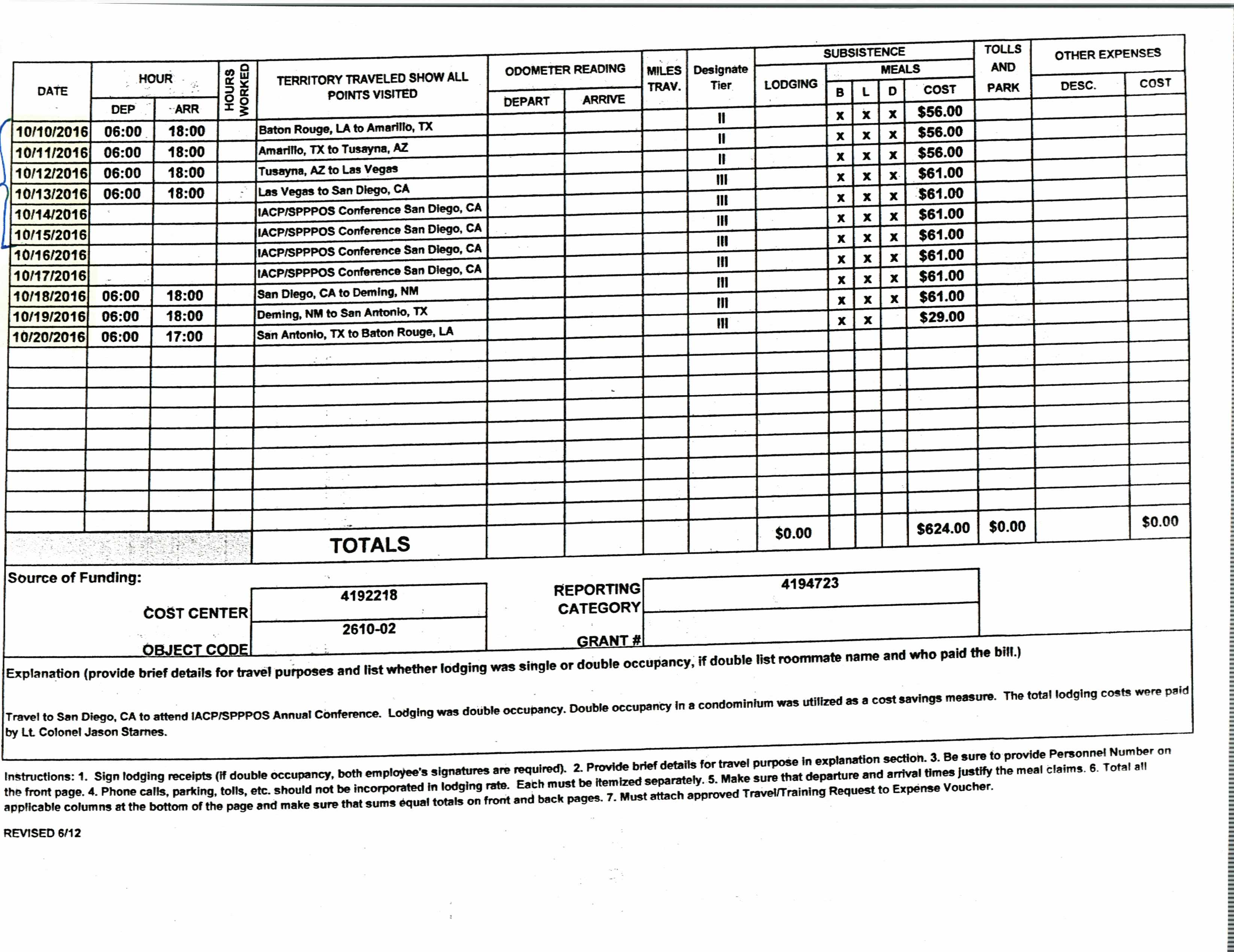
nezgodinsky-amended-expenses

hotel-bill

hyatt-expenses

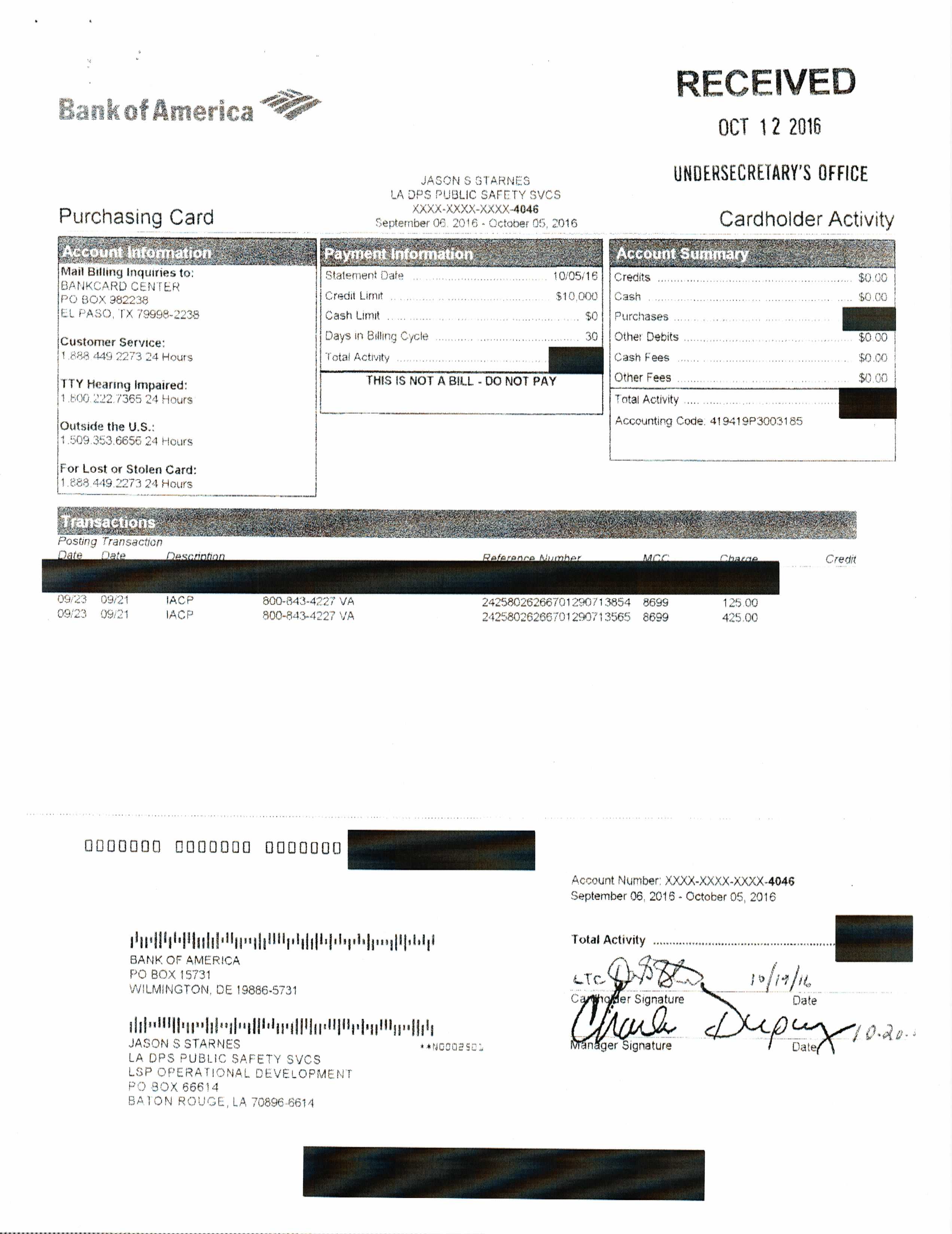
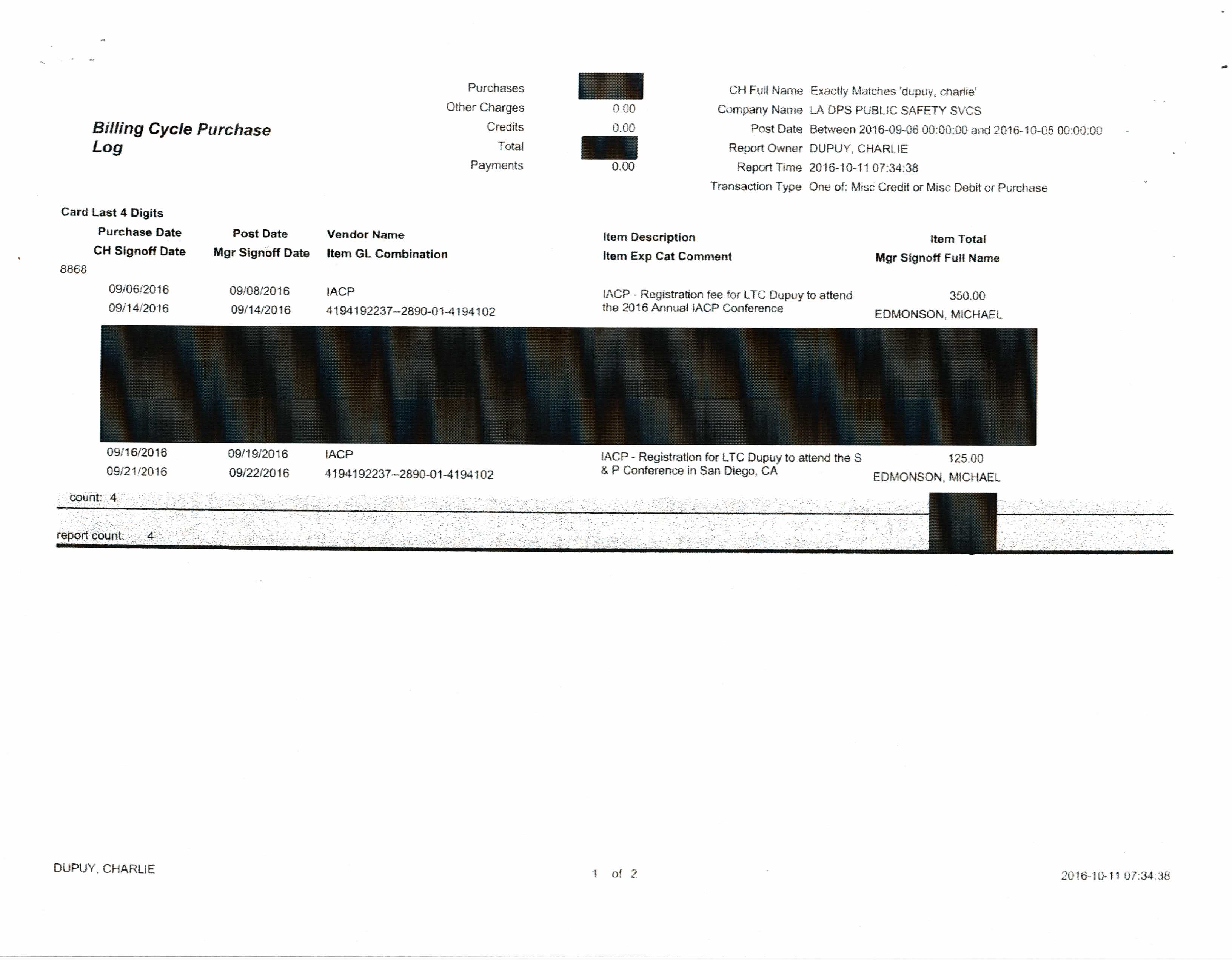
Note the redaction of costs on several of the documents provided by LSP and the overtime hours charged.

The trip could prove embarrassing for the governor who recently posted on his office’s web page his PLAN to “stabilize the FY17 budget deficit of $304 million.”

Included in that plan:

  • No money in the FY17 budget for inflation or merit pay for state employees (so many years now that we’ve actually lost count but a good guess would be seven or eight years—but State Troopers have fared a little better, getting two recent raises that gave some officers increases as much as 50 percent. Those raises, by the way, did not apply to officers of the Department of Public Safety.);
  • No funds for flood related expenses.

Proposed cuts to specific programs included:

  • Louisiana Commission on Law Enforcement—$251,674. The costs of the San Diego trip represented 28.5 percent of the cuts to this one program.
  • Louisiana Emergency Response Network Board—$27,625 (the San Diego trip cost two-and-one-half times this amount).
  • Office of State Police, Operational Support Program—$7.38 million;
  • Office of State Fire Marshal, Fire Prevention Program—$900,503;
  • Office of Juvenile Justice—$4.46 million;

Granted, $71,720 doesn’t represent a lot in the overall scheme of things when talking about a $304 million total deficit. Certainly not in any defense of Edmonson, but what if this is not an anomaly? What if this kind of fiscal irresponsibility is typical throughout state government?

If you have wastes of $71,720 here and $71,720 there, and $71,720 somewhere else, to paraphrase the late U.S. Senator from Illinois, Everett Dirksen, pretty soon you’re talking about real money.

And remember, that $71,720 doesn’t include airfare, lodging and meals for Paul Edmonson since LSP failed to include him on the list of individuals who traveled to San Diego. Moreover, LSP initially provided expense records that redacted purchase amounts charged to the state LaCarte cards but later, pursuant to LouisianaVoice’s follow-up request, provided copies that were not redacted. But there were still no itemized receipts provided that showed what those purchases were.

Asked for the total cost of the trip, Cain responded, “I don’t have this figure; you have all the relevant documents.”

Well, given the deletion of Paul Edmonson from the guest list, not quite all.

Given the timing of this, the incredible waste of state resources, and the fact that the state continues to grapple with budgetary shortfalls, perhaps the time has finally come for Gov. Edwards to take somebody to the woodshed for a lesson in discretion.

Because, Governor, we’re all “embarrassed” by Edmonson’s repeated lapses in judgment.

Read Full Post »

I was one of the lucky ones in the August floods.

Sort of. Everything, after all, is relative.

Yes, we lost our home and one vehicle and my wife lost her employment for four months while the place where she worked rebuilt.

But as I said, we were lucky. The car was insured and we have three daughters, all within 10 miles, who did not flood. One of those is a single mom with a spacious, four-bedroom home, so we had a soft place in which to land. And that’s where we’ve been since August 13.

Now, finally, we’re purchasing furniture and appliances and the contractors are back to restoring our home. The sheetrock is up.

img_0400

img_0397

img_0395

All it took was a low-interest SBA loan (nothing from FEMA, thank you very much).

So now I’m 73 and retired on a fixed income with a spanking new $120,000 mortgage. But on the bright side, I’ll be only 103 when my home is paid for a second time.

Which brings me to the point of all this.

LouisianaVoice did not hold its usual October fund-raiser because we did that right after the flood and I didn’t feel right to request help again so quickly.

But now, LouisianaVoice needs your help.

Badly.

I now have financial obligations I didn’t have before and as I plow deeper into the operations of state government, commissions, boards, and campaign contributions, I’m finding more and more to report.

And it ain’t cheap. I have fuel costs for my 2009 truck, costs of copies of records when I am unable to scan them and now a new mortgage on top of everything else.

We need your financial help.

Please help us keep the stories coming by clicking on the yellow “DONATE” button to the upper right of this post and pay by credit card.

Or you can send your contributions to:

Capital News Service/LouisianaVoice

P.O. Box 922

Denham Springs, LA 70727


Any help you can provide is appreciated more than you could ever know.


Thank you.


Tom Aswell

Read Full Post »

When I took issue with the moronic drivel contained in that pro-Trump email that popped up on my inbox recently, my post generated an unusually large number of comments. And while the majority were supportive, as expected, many others took me to task for daring to criticize anything about President Orange Hair. Some even took my criticism of Trump as an admission of support for Hillary. It wasn’t.

But being the glutton for punishment that is in my DNA, I’m back for more. So all you Trump supporters out there, get ready to pour it on because what I’m about to say is backed up by fact instead of the emotional, unsubstantiated rhetoric typical of the conversation I overheard earlier today (Feb. 7) as I waited to pick up a to-go order for dinner.

The two men were watching a national newscast (most likely Fox) when a story came on about criticism leveled at Trump by Sen. John McCain. The older of the two said to the other, “What’s that guy’s name? The war prisoner. He needs to keep his mouth shut. He’s not for America.”

Whoa. A man who fought for his country, was captured and spent five years as a prisoner of war. Not for America. What the hell is that man using for a patriotism barometer?

But he wasn’t through. “Trump’s right to keep them foreigners out. They don’t belong here. They just want something for nothing but nobody owes them a thing.”

Here’s a news flash for you, Mr. America: A 2012 study revealed that immigrants were behind more than 75 percent of new PATENTS from top 10 patent-producing American universities.

Perhaps we owe them something, seeing as how their patents became the property of the universities for whom they worked.

As I listened (Yeah, I was eavesdropping but their loud voices made it easy for me), the man continued to lament the costs of welfare which (as I’m certain he doesn’t know—or care) pale in comparison to the corporate welfare via tax breaks, offshore bank accounts, and the export of jobs overseas to countries where workers are paid a couple of dollars per day, if that. What if Congress went after the corporate welfare fraud? Oh, I don’t know, maybe the nation’s infrastructure might be repaired. Hungry kids might be fed. The federal deficit could be addressed in realistic terms. But for the real “welfare queens,” consider THIS.

One of the comments on my post about the shallow email defended Trump by saying he’s doing what he said he’d do and that I would lose my credibility when the wall between the U.S. and Mexico is built. Well, don’t be surprised of Canada builds a wall first. They don’t like the guy, either. Yes, he’s doing what he said he’d do, and that’s what scares the hell out of me.

And what can we say about Steve Bannon, Kellyanne Conway and Sean Spicer other than “Never forget BOWLING GREEN”?

As if the foregoing aren’t bad enough, consider this:

Trump (and nearly everyone else on the planet) heaped criticism on Hillary Clinton over the Benghazi debacle. So what does Trump do nine days after taking office? He approved a RAID on Yemen without sufficient intelligence, ground support or adequate backup operations. The result was the death of a Navy Seal, an eight-year-old American girl, and 30 other civilians.

Remember how Trump attacked Hillary for her Wall Street connections and promised in his inauguration speech that the voice of the American people would be heard? Let’s review.

Since his election, he has loaded his administration with Goldman Sachs ALUMNI. Do you seriously, for one nano-second believe that Goldman Sachs (or Trump) has the least bit of consideration for your problems, your concerns?

If you still think Golden Hair is your golden boy, then take a look at what he’s done in his first few days in office:

He is vowing to scrap the reforms put in place by the DODD-FRANK BILL that attempted to rein in reckless Wall Street hedge funds, junk bonds and the like that destroyed the country’s housing market and plunged the U.S. into the Great Recession. You can now look forward to an economic collapse of even greater proportions because Trump has thrown red meat to the Wall Street carnivores.

Bernie Madoff was correct when he said he was guilty of running the biggest Ponzi scheme within the biggest Ponzi scheme of all—Wall Street. It crashed before and it will crater again under a weight of runaway greed. Book it. It will happen.

He has promised to gut the Clean Air Act, the Clean Water Act, to cut pollution limits for power plants, and oil and gas, and to eliminate a rule that limited bribery and corruption in oil operations—all aimed at reducing federal regulations. http://www.thefiscaltimes.com/2017/02/03/Trump-s-Rollback-Clean-Air-and-Water-Rules-Could-Raise-Health-Care-Costs

Getting the government out of our lives has a wonderful ring to it if:

  • You’ve never had to work at a job that doesn’t have sick leave and paid vacations;
  • You’ve never had a job that did not pay overtime after 40 hours per week;
  • You’ve never had a job that did not offer health benefits;
  • You’ve never had a job that required you to work six days per week;
  • You’ve never been a child forced to work in a sweat shop 50 hours per week;
  • You’ve never had a job where workers were routinely injured, maimed or killed on the job with no worker’s compensation insurance or other means of recovery;
  • You’ve never had to worry about such things as the electrical wiring in your home;
  • You’ve never had to call a cop or a fireman for assistance;
  • You’ve never had to worry about the quality of food you purchased.

In other words, getting government out of our lives is great in theory provided you’ve never had to worry about the concerns above, conditions that actually prevailed before government regulations were passed that changed all those things for the better. And those were just a few examples of how government has gotten into our lives—for the better.

Yes, the regulations can be a hindrance to those who would put profits ahead of the welfare of their employees. And let’s face it, these corporations simply are not going to regulate themselves. They’ve already shown that when they furtively dump toxins into our rivers and lakes. They’ve already shown that when Volkswagen deliberately tries to game the system. They’re shown that when insurance companies like Allstate and State Farm screwed over homeowners following Katrina and the floods of last August—and insurance companies have regulators but they’re politicians whose campaigns are supported by…..insurance companies.

Trump has already shown that he meant it when he made those campaign promises to roll back regulations. And the people heard and still they voted against their own best interests.

That, of course, raises a very important question: Will your life be better after he has made good on all those promises? Don’t count on it.

That question will be lost in all the misdirection of childish arguments over the size of the inauguration crowd, terrorist attacks that did or did not occur that were are were not covered by the media, or criticism over Saturday Night Live skits (criticism that has most assuredly been a YUGE ratings boost for SNL).

Read Full Post »

« Newer Posts - Older Posts »