Feeds:
Posts
Comments

Archive for the ‘Finances’ Category

Gov. John Bel Edwards and the Louisiana Legislature could probably learn a thing or two about building budgetary surpluses from the St. Landry Parish Fire Protection District No. 2—except at least one St. Landry Parish citizens thinks the surplus may be the result of smoke and mirrors and a little voodoo tax millage assessment.

On the other hand, the State Ethics Board appears to be taking its cue from the Attorney General’s office in stonewalling tactics.

The district had a bank balance of more than three times its annual budget at the end of 2016, according to a state AUDIT of the its books. The audit showed nearly $8.4 million in the bank as of Dec. 31, 2016, after expenses of $2.6 million.

And a formal complaint made to the Louisiana State Board of Ethics last May against the district and its secretary-treasurer has produced only a letter of acknowledgement but no results after nine months.

Despite annual revenues of nearly $3.7 million for both 2015 and 2016, the district’s board seemingly felt it could not afford to hire a qualified employee to apply generally accepted accounting principles in recording the districts financial transactions or preparing its financial statements, the audit indicated.

“A material weakness is a deficiency, or combination of deficiencies, in internal control such that there is a reasonable possibility that a material misstatement of the entity’s financial statements will not be prevented, or detected and corrected on a timely basis,” the audit said. “we identified certain deficiencies in internal control that we consider to be material weaknesses.”

Nor did the board seem to feel it was in a position to hire additional firefighters in order to cut back on more expensive overtime pay. Board members paid themselves nearly $16,600 in 2016 and paid out $1.2 million in salaries. An additional $329,677 was paid in overtime (listed as “extra shifts and call out time”).

Auditors recommended that the board examine the following options and implement policies and procedures in order to reduce excessive payroll expenditures:

  • Establish set annual/monthly salaries for management-level positions in order to eliminate overtime paid;
  • Hire additional firefighters in order to decrease overtime pay;
  • Better utilize volunteer firefighters in an effort to minimize costs.

While Edwards and the legislature might be scratching their heads if they knew of the district’s fiscal wizardry, a closer look at a curious tax millage might clear things up.

It seems that district voters may have once approved a 17.5 mill property tax but the district somehow managed to collect two identical millages of 17.5 mills each until January 2018, when one of the assessments expired.

St. Landry Parish resident and local taxpayer Charles Jagneaux, who filed the complaint with the state ethics board, which has been basically toothless since it was gutted by Bobby Jindal in one of his first acts as governor in 2008, has a theory about that dual tax millage.

“My understanding is that the second millage was passed by calling it a renewal when in fact, it was a second identical millage,” he said. “The board attempted to put the expiring millage on the ballot (for a renewal) this year but the parish council would not let them since there was a multi-million-dollar surplus.”

The ethics complaint was filed against Johnny Ardoin, secretary-treasurer of the district’s board. Ardoin, it turns out, is also a member of the Port Barre TOWN COUNCIL, which would appear to be a case of dual office-holding, illegal under Louisiana law.

As a point of clarification from a reader who is in a position to know, dual office holding falls under (drum roll, please…) the attorney general’s office, not the ethics board so the ethics board would not address that matter,

A second, more serious ethics violation, however, seems to arise from Ardoin’s membership on the fire district board.

The Port Barre Town Council appoints two members of the fire district’s board of commissioners.

That would seem to constitute a built-in conflict of interest for Ardoin. Given his position as a member of the town council, he is in the unique position to appoint himself to the fire district’s board of commissioners.

That ethics complaint, like most complaints to the state ethics board these days, is in all likelihood, a dead-end street, particularly as it regards dual office-holding. But even in cases when ethics fines are assessed, which is seldom, they often are ignored and never collected, thanks again to Bobby Jindal and his ethics reform agenda.

Read Full Post »

By Stephen Winham, guest columnist

Caveat:  I worked closely with Buddy Roemer as state budget director.  I have only the barest of acquaintances with John Bel Edwards. For this reason, I must question how fair my comparison of the two can be.  I admit I am disappointed in John Bel Edwards’ performance as governor to date and have admired Roemer’s efforts even more with the passage of time.

As he assumed office as governor of Louisiana thirty years ago, Buddy Roemer faced a huge budget gap left by his predecessor. The solution was difficult and was complicated by a recalcitrant legislature.  The gap was closed, and a surplus generated within the first year of Roemer’s administration.  In addition, comprehensive budget reforms were enacted to limit the probability of a recurrence of such a gap.

A similar scenario confronted John Bel Edwards 28 years later, yet two years into his administration he has made no real progress on the budget front in terms of balance or reforms.  Roemer and Edwards are very different people and the opposition to their administrations have different roots.

Roemer was, and continues to be a true reformer.  He had little regard, until it was too late, for his gubernatorial re-election chances.  Edwards seems to have been running for re-election from the first day of his administration.  Roemer attempted to buck the system.  Edwards tries to work within it.  They were both elected as Democrats.

Roemer and JBE were improbable victors in their races for governor.  Roemer came from last in the polls to the top (albeit by only 3 points) going into the 1987 primary election.  He won the general election with only 33% of the vote.  His closest competitor was fellow Democrat and three-term governor, Edwin Washington Edwards.  EWE conceded the race rather than face Roemer in a run-off – and denied him an electoral mandate.

JBE was considered a dark horse candidate from the beginning. The only major Democrat in his gubernatorial race, John Bel Edwards finished first in the primary election with 39.9% of the vote. He was expected to lose to his Republican opponent, U. S. Senator David Vitter, in the general election. Despite Vitter’s 23% showing in the primary election, and his personal problems, he was considered a sure winner in the run-off.  To the surprise of most political analysts, JBE won with 56.1% of the vote.

Roemer and JBE were each elected because people were looking for something dramatically different.   Roemer promised to “slay the dragon” and end corruption and special interest control over government.  JBE vowed to bring common sense, fiscal responsibility, and compassion for ordinary people to the office.  Roemer was strident, JBE is calm.

Governors are not dictators.  There is little they can do without action by the legislature and consent, when needed, of the judiciary.  Despite his lack of an electoral mandate, Roemer was able to quickly get a lot of good legislation enacted, mainly because the need was abundantly and undeniably clear – and he was a convenient scapegoat if things went wrong later.   A strong contingent of legislators were loyal to Edwin Edwards and bitter that he was not still governor.  While they went along with the emergency measures Roemer proposed to address the fiscal emergency and reforms including the creation of an official revenue forecast by a new Revenue Estimating Conference, opposition intensified over time.

Historically, Louisiana’s governors were powerful enough to anoint legislative leaders – an obvious plus for enacting an agenda.  The most powerful of those leaders are the house speaker and senate president. The senate is, by its size and nature, a more powerful and cohesive body than the house.  In the middle of Roemer’s term, the senate dealt him a severe blow by replacing his chosen president and returning EWE’s powerful senate president, Sammy Nunez, to that office – an office he continued to hold until he left the legislature in 1996.

Roemer proposed several progressive tax increases that failed in the legislature and the electorate, including a decrease in the sacrosanct homestead exemption.  It is no small irony that he eventually agreed with EWE’s earlier push to legalize gambling and supported an even broader entry into that sector –  the lottery, riverboat casinos, and video poker.

Roemer steadily lost political power as his term went on.  Despite pushing for and achieving hundreds of millions in teacher pay raises, he was vilified because he also pushed a teacher accountability program roundly criticized as unfair by teachers. His environmental reforms angered oil and gas, chemical, and other industries.  He was increasingly perceived as arrogant and hard to work with.

Anxious for EWE’s return, his supporters became even harsher in their opposition to Roemer’s administration.  In 1990, on the grounds it violated federal law, he vetoed a bill passed by the legislature that banned abortion even in cases of rape and incest.  The legislature overrode his veto (a very rare event in Louisiana).  The law was struck down by a U. S. District Court in 1991 for the very reason Roemer had vetoed it, but it didn’t matter politically.

In 1991, Roemer switched parties.  While the national Republican Party sent in big guns to help him get re-elected, emphasizing his scandal-free administration and his budgetary, campaign finance and environmental reforms, he never had the support of the state Republican Party, very many legislators, or the special interests he had disdained.  Quite the contrary. The state party endorsed another candidate and legislators and special interests actively attacked Roemer. It didn’t help that Roemer did not really focus on the campaign but rather continued his zeal for reform to the end. He finished 3rd in the primary and endorsed EWE in the runoff with David Duke – an embarrassing race.  He ran again in 1995 as a conservative Republican but ran 4th in the primary.

His high school’s class valedictorian, like Roemer, and a West Point graduate, versus Roemer’s Harvard education, John Bel Edwards was a conventional, but conservative Democrat.  He is the son of a southeast Louisiana sheriff, Roemer the son of a northwest Louisiana plantation owner. Like Roemer, his biggest obstacle has been the legislature, but for somewhat different reasons.

Louisiana now has a strong Republican Party that believes we should have a Republican governor.  Partisanship was not a big issue when Roemer was governor, but it certainly is now and has gotten more so since JBE became governor in 2016.  Although he had a solid record as a Democratic state representative, what seems to matter most is that he is a Democrat.  Not only do Republicans now control both houses of the legislature, but all statewide elected officials except the governor are now Republicans.  Regaining the governor’s office is a number one priority of the party and since John Bel Edwards has been running for re-election from day one he presents an easy target.

The state house of representatives openly rejected JBE’s choice for speaker.  Rather than elect one of his harshest critics (Cameron Henry who withdrew from consideration), they chose a compromise candidate, the low-key Taylor Barras – who had not even been mentioned as a contender before he was elected.  Not since Huey Long’s administration had the state house elected a speaker not endorsed by the governor, though as noted above, the state senate did unseat Roemer’s chosen president.

Nobody doubted we had a severe fiscal problem when Roemer was elected, but many would argue that we simply spend too much money today – end of story.  JBE’s Republican opposition relishes reports of waste and abuse in the media and remains unconvinced he has done enough to address them.  The governor has not specifically answered the charge he does not do enough to hold his appointees accountable for fiscal irresponsibility unless the media is relentless in reporting it.  This has not helped his case for more revenue.

JBE has proposed both revenue measures and cuts.  However, his proposals are often open to widespread criticism.  When he recommends cuts, they are dramatic and are not presented in such a way that the legislature or public believes they are the only, or the best, ways to cut the budget.  They do not seem to explicitly address the waste and abuse people read about on LouisianaVoice, in the newspapers, and see reported on television.

On the revenue side, JBE did not initially focus on proposals by the task force specifically created to present options for dealing with the “fiscal Cliff.”  That cliff has been forestalled by two years of temporary taxes. The centerpiece of JBE’s revenue proposal last year was the previously unheard of and dead on arrival Commercial Activity Tax.  The CAT constituted over 60 percent of his original package and was so watered down by the time it was actually introduced, it lost what little value it had and was quickly withdrawn.

Another year has passed, and the governor has proposed revenues more in line with what the task force recommended.  The cuts he has recommended are devastating.  His critics in the legislature don’t really like anything he puts forth and as the next election gets closer the criticism is sure to get harsher.

The governor has asked the legislature to present and enact its own proposals if it doesn’t like his.  The legislature has responded by recommending an accountability system and little else.  The proposed system seems to have been presented as a distraction from the need for immediate, concrete, and sustainable solutions.

Let’s face it.  There is nothing new under the sun.  Our fiscal status and options have been studied dozens of times over dozens of years.   The governor can recommend things all day every day, but only the legislature has the power to enact measures to authorize them.  Whether the governor has made truly responsible proposals or not, it is ultimately the legislature’s responsibility to act.  They can blame the governor ad infinitum, but the final responsibility is theirs and the excuse they don’t know enough to come up with solutions is a patently empty claim.

Roemer was able to get a lot done through the legislature in his first year when he had his best chance to do so.  JBE’s chances of significant accomplishments will apparently continue to diminish with time.  Even with the help of the most powerful and long-serving member of the legislature, Senate President John Alario, he has been unable to succeed.  A bloc of opposition in the house stymies him repeatedly.

I am of the considered opinion that we could all save a lot of time, grief, and money by simply agreeing, right now, to make permanent the temporary sales taxes currently in effect, cut as necessary for the difference, and hope for a better, more responsible future under new leadership.  A fool’s hope, perhaps, but at least everybody would be able to make plans for more than a year or two into the future – individuals and businesses.

LABI and other business interests are hypercritical of JBE and, of course, any business taxation.  In the absence of sustainable solutions how can they possibly expect vigorous business expansion and prosperity?  Future taxes are unpredictable, regardless of temporary incentives. How can they, or we, have hope our mediocre infrastructure, educational system, and other public services will not continue to decline?

Trying to ruffle as few feathers as possible in hope of re-election has not worked for JBE.  Ruffling as many feathers as possible may not have worked over time for Roemer, but we are still profiting from major accomplishments in his first few years.  He wasn’t a good politician and maybe that’s why he never got the credit he deserved.

Whether JBE is a good politician remains to be seen.


Read Full Post »

Corruption.

As the March 12 opening day of the critical 2018 regular session approaches, and with the looming possibility of the call of a special session to address fiscal Armageddon, it’s an important word for Louisiana citizens to remember.

Corruption.

In a state where administrators, legislators, and judges all seem to be in it for personal enrichment, it’s a word that has become synonymous with political office—from small town mayors, city councils and police chiefs to the highest levels of state government.

Corruption.

Like a cancer, corruption metastasizes until it adversely affects every aspect of our lives: education, economics, environment, health, and not least, trust in our elected officials.

Michael Johnston and Oguzhan Dincer, both former fellows at Harvard Law School’s Edmond J. Safra Center for Ethics, recently collaborated to conduct their fourth Corruption in America Survey, an undertaking first initiated in 2014 and repeated annually.

Since 2016, the survey has been hosted by the newly-founded Institute for Corruption Studies, an independent research institute within the Illinois State University’s Department of Economics.

More than 1,000 news reporters/journalists covering state politics and issues related to corruption across 50 states participated in the survey. Reporters from every state except North Dakota and New Hampshire participated.

Click HERE to read the complete results.

To no one’s surprise, Louisiana ranks among the worst states in terms of executive, judicial, and legislative sleaze—in both legal and illegal corruption.

What, exactly, it meant by legal and illegal corruption? After all, corruption is corruption, is it not?

Well, yes and no. Illegal corruption was defined by Dincer and Johnston as “the private gains in the form of cash or gifts by a government official in exchange for providing specific benefits to private individuals or groups.”

How Gauche. Everyone knows that in Louisiana the preferred method is legal corruption, which the two researchers defined as “the political gains in the form of campaign contributions or endorsements by a government official, in exchange for providing specific benefits to private individuals or groups, be it by explicit or implicit understanding.”

For evidence of that, one need look no further than the LouisianaVoice STORY of Aug. 28, 2016, to see how Bobby Jindal, Attorney General Jeff Landry, and a gaggle of legislators fell all over themselves in protecting the big oil and gas companies from their responsibilities to clean up after themselves. Here is a more detailed look at .

Who better to serve as director of the Louisiana Offshore Terminal Authority than former State Sen. Robert Adley of Bossier Parish, the top recipient of OIL AND GAS CAMPAIGN CONTRIBUTIONS?

And Bobby Jindal handed out appointments to the most influential boards and commissions to his biggest campaign contributors like candy on a Halloween night and even upgraded a major highway in South Louisiana to benefit a company run by another large contributor.

Dincer and Johnston said that official legal corruption is moderately to very common in both the executive and legislative branches of government in a “significant” number of states, “including the usual suspects such as Mississippi, New Jersey, and New York,” but that “Alabama, Kentucky, and Louisiana are perceived to be the most corrupt states” in the executive, legislative, and judicial branches.

Illegal Corruption

Only 13 states were found to have moderately common to very common illegal corruption in their executive branches. Louisiana was one of those 13.

Only four states had illegal judicial corruption deemed to be moderately common (Alabama and Louisiana) or very common (Arkansas and Kentucky). Dincer and Johnston wrote that even a finding of only slightly common in illegal judicial corruption “is still worrying since it is the judicial branch of the government that is expected to try government officials charged with corruption.”

“State legislators are perceived to be more corrupt than the members of the executive branches in a number of states,” the researchers said.

To illustrate that, the survey found just six states with legislative illegal corruption that was very common (Alabama, Arkansas, Kentucky, and Louisiana) or extremely common (Oklahoma and Pennsylvania).

Legislators were found by LouisianaVoice to have leased luxury vehicles for family members, purchased season tickets to college and professional athletic sports teams, hired family members as campaign staff, paid personal income taxes and state ethics fines—all with campaign funds and all of which were illegal.

One legislator even profited by conveniently investing in Microsoft just as his committee was pushing through approval of one of the company’s software programs at the same time other states were taking similar action. The simultaneous approvals gave Microsoft stock a significant boost.

Legal Corruption

“Legal corruption is perceived to be more common than illegal corruption in all branches of government,” the report said, with Louisiana, Alabama, and Wisconsin scoring highest in legal corruption “in all branches of government.”

Those same three states, along with Arkansas, topped the list in legal corruption in the judicial branch where legal sleaze “is perceived to be ‘very common,’” it said, noting that in all four states, judges are elected as opposed to states where judges are chosen on merit and in which judicial corruption is not as common.

“…We expect our courts to rise above the day-to-day pressures and expectations of politics,” the report said. “That they apparently do not raises serious questions about the ways judges are elected in many states, how their campaigns are financed, and whether conflicts of interest arise as those who contribute to judicial campaigns are allowed to appear before those same judges as cases are tried.”

Louisiana, Alabama, and Wisconsin were joined by Arizona, Florida, Maryland, Missouri, New Mexico, North Carolina, Oklahoma, Texas, Hawaii, Illinois, Kentucky, Oregon, Georgia, New Jersey, and New York as states where legal executive corruption was found to be either “very common” or “extremely common.”

Legal legislative corruption was found to be “extremely common” in 12 states: Louisiana, Alabama, Georgia, Indiana, Maryland, Missouri, New Jersey, New York, Oklahoma, Oregon, South Carolina, and Texas.

Aggregate Corruption

Across the board, in terms of legal and illegal corruption in all three branches of government, few states do it better than Louisiana, results of the survey reveal, with the state ranking in the upper tier of corruption in all six listings.

That finding prompted the authors of the report to say that corruption in state government “is not just a matter of contemporary personalities and events, but is rather a result of deeper and more lasting characteristics and influences.

Nowhere, it would seem, is that truer than in Louisiana. Following is just a partial list of Louisiana public officials who have come face-to-face with corruption charges of varying degrees:


Louisiana Executive Corruption

Sherman Bernard: The first Louisiana Insurance Commissioners to be convicted, he served 41 months for extortion and conspiracy.

Doug Green: The second State Insurance Commissioner to go to jail, he was convicted on three counts of money laundering, 27 counts of mail fraud, and was sentenced to 25 years in prison.

Jim Brown: The third consecutive Louisiana Insurance Commissioner served six months for lying to the FBI.

Richard Leche: Louisiana Governor sentenced to 10 years in prison for accepting kickbacks on the purchase of 233 state trucks.

Edwin Edwards: Louisiana Governor sentenced to 10 years in prison after his conviction of extortion in connection with the awarding of state riverboat casino licenses.

Charles Roemer: Commissioner of Administration under Gov. Edwin Edwards, was convicted on one count of conspiracy to violate federal racketeering laws, violating the statute and engaging in wire and mail fraud as a result of the FBI’s Brilab operation which also resulted in the conviction of New Orleans mob boss Carlos Marcello. Roemer served 15 months in federal prison.

Jack Gremillion: Louisiana Attorney General of whom it was once said by Gov. Earl K. Long, “If you want to hide something from Jack Gremillion, put it in a law book,” was sentenced to three years in prison for lying to a federal grand jury about his interest in a failed loan and thrift company.

Gil Dozier: Louisiana Agriculture Commissioner, initially sentenced to 10 years in prison for extortion and racketeering but had eight years added after presiding federal judge learned Dozier had attempted to tamper with a juror and to hire a hit man for an unidentified target.

George D’Artois: Shreveport Public Safety Commissioner was implicated in the 1976 murder of Shreveport advertising executive Jim Leslie but he died in surgery before he could be tried.

Cyrus “Bobby” Tardo: former Sheriff of Lafourche Parish sentenced to 29 years, five months after pleading guilty in 1989 to solicitation for murder, conspiracy, possessing an unregistered destructive device and using an explosive to damage a sheriff’s car. His victim? His successor and the man who defeated him for reelection as sheriff, Duffy Breaux.

Duffy Breaux: Lafourche Parish Sheriff sentenced to four years, nine months in prison for conspiracy, mail fraud, obstruction of justice in 1995.

Eugene Holland: The first of three consecutive St. Helena Parish sheriffs to be convicted of a federal crime, sentenced to 16 months in prison for the theft of public funds to cover his utility bills and to pay for renovations to his house and barn. Pleaded guilty in 1996.

Chaney Philips: The second of three consecutive St. Helena Parish sheriffs to serve prison time after his conviction on nine counts of conspiracy, mail fraud, engaging in illegal monetary transactions, theft involving a federally-funded program, money laundering, and perjury—all related to his time not as sheriff but as parish assessor before being elected sheriff. Sentenced to seven years.

Ronald “Gun” Ficklin: Third consecutive St. Helena Parish sheriff to be convicted of federal criminal charges. Sentenced to five years, three months for trafficking cars with altered vehicle identification numbers, altering VINs, mail fraud, helping convicted felon possess a fun. Pleaded guilty in 2007.

Jiff Hingle: Plaquemines Parish Sheriff pleaded guilty in 2011 to conspiracy to commit mail fraud and bribery, sentenced to 46 months in prison.

Bodie Little: Winn Parish Sheriff convicted in 2012 of drug trafficking, sentenced to 13 years, four months in prison.

Royce Toney: Ouachita Parish Sheriff, pleaded guilty in 2012 to hacking a deputy’s email and phone records and then trying to cover up his snooping. Sentenced to four years’ probation.

Walter Reed: St. Tammany Parish District Attorney (22nd JDC) sentenced to four years in prison in April 2017 for conspiracy, wire fraud, mail fraud, money laundering, making false statements on tax returns. Sentence on hold during appeals process.

Harry Morel, Jr.: St. Charles Parish District Attorney (29th JDC) pleaded guilty in April 2016 to obstruction of justice in FBI inquiry into whether he used his position to solicit sex from women seeking official help. Sentenced to three years in prison.

Aaron Broussard: Former Jefferson Parish President pleaded guilty in 2012 to conspiring to accept bribes from a parish contractor. Sentenced to 46 months in prison. While parish officials other than district attorneys and sheriffs are not generally listed here, Broussard is because of his high national profile following Hurricane Katrina.

Ray Nagin: New Orleans Mayor convicted in 2014, sentenced to 10 years in prison for bribery, wire fraud, money laundering, conspiracy, tax evasion for illegal dealings with city vendors. As with the case of Broussard above, mayors not normally included in this list because of the sheer volume. But because of his high profile following Katrina and as mayor of state’s largest city, it was decided to include him.


Louisiana Legislative Corruption

Larry Bankston: Former chairman of the Senate Judiciary B. Committee that handled gambling legislation was convicted in 1997 on two counts of interstate communications in the aid of racketeering involving alleged bribes from a Slidell video poker truck stop owner. Sentenced to 41 months in prison. Re-admitted to Louisiana State Bar by State Supreme Court. Currently suing State Attorney General for the cancellation of his contract to represent a state agency.

Gaston Gerald: State Senator convicted in 1979 of extorting $25,000 from a contractor. Sentenced to five years in prison. Re-elected while in prison and put a prison acquaintance on Senate payroll as an aide before he was expelled from the Senate in 1981.

Sebastian “Buster” Guzzardo: State Representative among more than 20 persons, including the leader of the New Orleans Marcello crime family and three reputed New York mobsters, convicted in the Worldwide Gaming investigation. Conviction was for conducting an illegal gambling business and for aiding a mob-controlled video poker company. Sentenced in 1996 to three months in prison.

Girod Jackson, III: State Representative who pleaded guilty in 2013 to tax evasion and tax fraud in connection with his business dealings with the Jefferson Parish Housing Authority. Sentenced to three months in prison, nine months of home detention despite recommendations of 12 to 18 months imprisonment.

William Jefferson: 18-year veteran of U.S. House of Representatives convinced in 2009 on 11 of 16 felony counts for taking bribes in connection with a Nigeria business deal. Seven of the 11 counts on which he was convicted were overturned on appeal. Sentenced to five years, five months after appeals. In 2006, following Hurricane Katrina, Jefferson interrupted rescue operations by using a Louisiana National Guard detachment to recover personal effects from his home. (His sister, Orleans Parish Assessor, also sentenced to 15 months in prison after admitting to funneling $1 million in public funds to her family’s bogus charities.)

Charles Jones: State Senator from Monroe, convicted in 2010 of filing false tax returns and for tax evasion, sentenced to 27 months in federal prison and ordered to pay more than $300,000 in restitution. Was re-admitted to Louisiana State Bar on Monday (Jan. 29, 2017).

Harry “Soup” Kember: State Representative was sentenced to five years in prison after his 1986 conviction of mail fraud for pocketing part of a $150,000 state grant he secured for a constituent’s company.

Derrick Shepherd: State Senator sentenced to three years in prison in 2010 after admitting that he laundered money for a corrupt bond broker, netting $65,000 for the scheme.

Rick Tonry: Served only four months as a U.S. Representative from the 1st Congressional District after pleading guilty in 1977 to receiving illegal campaign contributions, promising favors in return for contributions and for buying votes in the 1976 Democratic primary.


Louisiana Judicial Corruption

Ronald Bodenhimer: The 24th Judicial District Judge was among four judges to be caught up in the FBI Wrinkled Robe investigation of Jefferson Parish Courthouse corruption and one of two to receive jail time. He was sentenced to 46 months in prison after pleading guilty in 2003 to planting drugs on a critic of his New Orleans East marina, for bond splitting, and for attempting to fix a child custody case on behalf of Popeyes Chicken Founder Al Copeland.

Wayne Cresap: The 34th JDC Judge for St. Bernard Parish was sentenced to five years in prison after pleading guilty in 2009 to accepting more than $70,000 in bribes and for letting inmates out of jail without paying their bonds.

Alan Green: Another of the four Judges of the 24th JDC in Jefferson Parish. Sentenced to 51 months in prison after his 2005 conviction of a $10,000 mail fraud scheme to take bribes from a bail bonds company.

William Roe: The 25th JDC Judge for Plaquemines Parish was sentenced in 2010 to three months in prison for unauthorized use of movables for pocketing more than $6,000 in reimbursements for legal seminars that he attended as judge. The money should have been deposited in a public account instead.

Thomas Porteous, Jr.: Only the eighth federal judge to be removed from office by impeachment in the Republic’s history, he was convicted in 2010 by the U.S. Senate on four articles charging him with receiving cash and favors from lawyers who had dealings in his court, used a false name to elude creditors, and deliberately misled Senators during his confirmation hearings. As if to underscore the gravity of the charges, all 96 senators present voted guilty on the first article which addressed charges during his time as a state court judge and his failure to recuse himself from matters involving a former law partner with whom he was accused of granting favors for cash.

There are scores of other examples, including city and parish elected officials, local police chiefs, and even a legislator who resigned rather than be expelled for spousal abuse. And former Louisiana State Penitentiary at Angola Warden Burl Cain retired in 2016 under an ethics cloud even though he was official cleared of ethics charges. His son, Nate Cain and Nate’s former wife, Tonia, were indicted in August 2017 on 18 federal fraud charges over purchases he was said to have made with state credit cards during his tenure as warden of Avoyelles Correctional Center in Cottonport.

Additionally, LouisianaVoice over the past three years documented numerous instances of abuse of power and outright corruption from troop commanders all the way up to the upper command of Louisiana State Police.

There were dozens more not listed and sadly, there will continue to be corruption in all three branches of state government so long as the people of this state continue to look away and ignore the widespread malfeasance and outright skullduggery.

And by ignoring the problem, we are necessarily condoning it.

Read Full Post »
Under the Latin term Respondeat Superior (Let the master answer), an individual would not be held personally liable in a civil proceeding if (a) he (or she) was acting within the scope and duties of his employment or if the action was taken on advice of counsel.

An example of that would be if a state employee withheld records from a reporter on advice of the agency’s attorney but it was subsequently determined in court that the records were actually public and should have been made available upon request. It would be the agency, not the employee, who would be liable in such a case.

A newspaper reporter would be protected from libel damages if he had written something he believed to be factual and it was vetted by editors and published only to be found to be inaccurate and damaging to the subject’s reputation or career. In that case, the newspaper or TV station (or, more accurately, the medium’s liability insurance policy) would pay.

So, it is more than a little curious that Louisiana Department of Health (LDH) paid to defend Attorney Supervisor Weldon Hill—and paid the settlement—in Bethany Gauthreaux’s sexual harassment lawsuit against Hill, a STORY first reported by LouisianaVoice earlier this month.

And why, when the news media requested names of cases involving sexual harassment, was this case omitted. Nowhere in the Baton Rouge Advocate STORY is the Gauthreaux case listed. Was this an honest mistake—or was it by design?

Not only did LDH pay the $40,000 settlement, but the agency also paid more than $76,300 in legal fees to the Baton Rouge law firm of Keogh Cox and Wilson ($69,828), the Louisiana Attorney General’s office ($1,258), Court Reporters of Louisiana ($2,183), Walgreen’s ($27), the East Baton Rouge Clerk of Court ($2,611), North Oaks Medical Center ($250), and for photocopies ($186).

And how did that particular law firm wind up with the contract to defend Hill and LDH? The very fact that the LDH Deputy General Counsel, under whom Gauthreaux worked, was Kim Sullivan should have disqualified the firm.

Attorney Chad Sullivan is Kim Sullivan’s husband and he works for Keogh Cox and Wilson, a fact that the firm should have disclosed. By virtue of supervising plaintiff Gauthreaux, Kim Sullivan was a potential co-defendant—and witness—in a case defended by her husband’s law firm. (Click HERE and move your cursor to the first photo on the third row—the first one with a beard. That’s Chad Sullivan.)

Including the $40,000 settlement, the TOTAL COST to LDH was just north of $116,300 to defend an employee who, it would seem certain, was not acting within the scope and duties of his employment. And it would appear he was certainly not acting on advice of legal counsel (though he is himself an attorney) when he was said to have asked highly personal questions about breast feeding her newborn infant, pressed his body against hers as she monitored her computer screen, and placed his hand on hers atop the computer mouse.

And moving her and two other women from their eighth-floor offices to the fifth floor—Gauthreaux to a converted supply room with no phone—would seem something of a gray area insofar as the Respondeat Superior doctrine would apply as would the statement attributed to Hill that he felt women “have nothing to say,” and his timing women employees’ bathroom breaks.

So, now the state is out more than $116,000 because of the actions of Hill, his supervisor, LDH Executive Counsel Stephen Russo, General Counsel Kimberly Humble, and others up the food chain—and because of the inaction of LDH’s Human Resources Office, which should have taken appropriate steps as soon as it was aware of the harassment, but curiously did not.

And just where was LDH Secretary Dr. Rebekah Gee while all this was going on? After all, someone anonymously (for obvious reasons, given the climate at LDH) placed a copy of Gauthreaux’s lawsuit on the windshield of Dr. Gee’s vehicle.

To get those answers, LouisianaVoice emailed Dr. Gee on Jan. 19, posing three simple questions:

  • What action do you plan to take regarding the sexual harassment lawsuit settlement against your legal department, specifically, Mr. Weldon Hill?
  • Why did Mr. Hill’s supervisor(s) and/or DHH HR not initiate some kind of remedial or disciplinary action?
  • Why did you not take some type of remedial or disciplinary action when you first found a copy of the Ms. Gauthreaux’s lawsuit on your vehicle windshield?

Dr. Gee never responded even though LouisianaVoice received a return receipt indicating that she did open that email.

So, a follow-up email was sent to Dr. Gee on Jan. 23:

Dr. Gee, I don’t mean to pester you, but I would remind you that to ignore my questions below would not serve your or LDH’s best interests. It almost seems as if you are trying to conceal information. Many a public servant has learned the hard way that eluding questions and refusing to face issues head-on usually backfires in the end. This litigation was a serious matter that deserves your serious attention. I will not bother to ask you again but should you choose to continue to ignore this issue, I will have no choice but to so state in my follow-up articles.

The same three questions were attached to the bottom of that email and a return receipt indicated she opened that email as well.

But she still has yet to respond.

Meanwhile, Hill and Russo continue at their jobs which pay them $100,000 and $138,500, respectively, while Gauthreaux was forced to quit her $42,500-per-year attorney position. And the word is that Hill is planning to quietly retire.

Not only should Dr. Gee answer the three questions LouisianaVoice put to her, but these as well:

  • Why did the state pay Hill’s attorney fees and the settlement without demanding some payment from him?
  • Why was he not summarily fired once the details of his actions were known?
  • Why was Russo and LDH’s HR Department not held accountable?
  • And finally, just what is the purpose of the mandated sexual harassment classes for state employees if those in supervisory positions are going to simply look the other way and not themselves be held accountable?

We’re waiting.

Read Full Post »

The late comedian Andy Griffith began his classic bit entitled What it was, was Football with this line:

“It was back last October, I believe it was…”

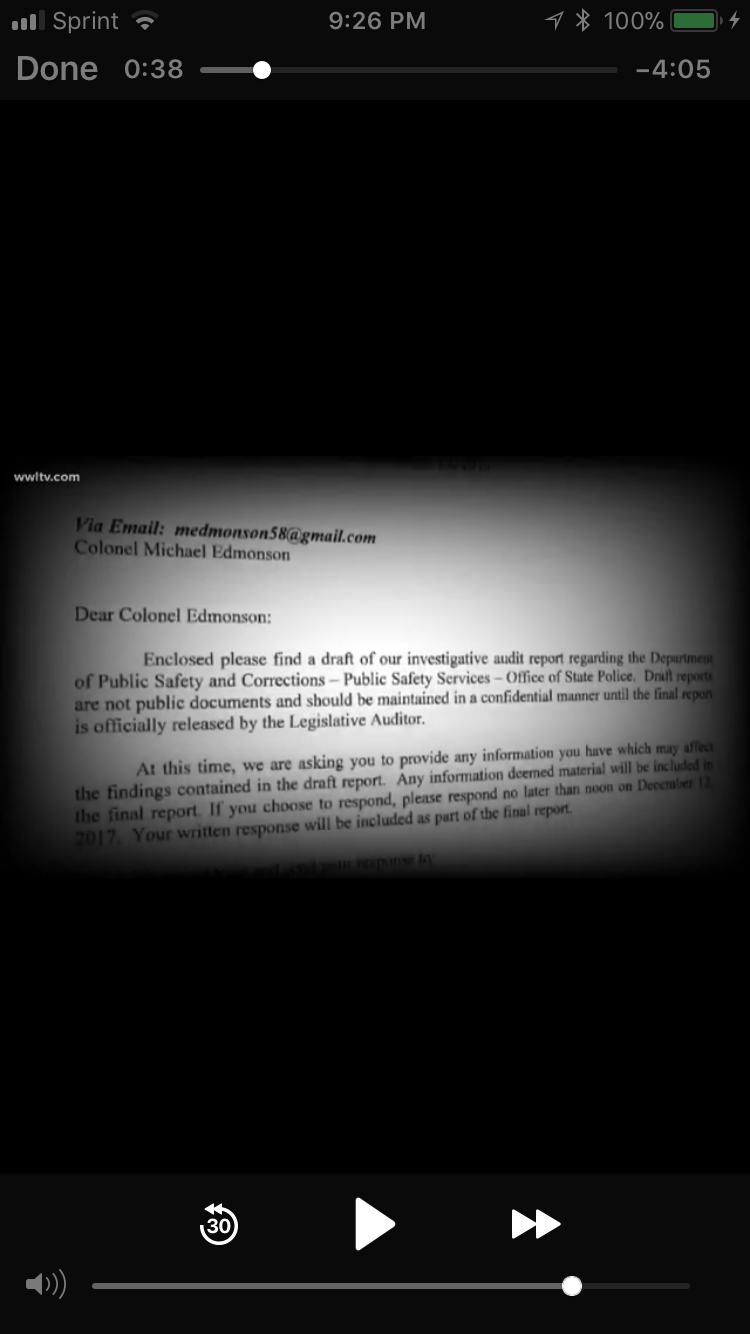
Well, it was back last December—Dec. 5, 2017, to be precise—that I speculated in my LouisianaVoice POST about the “premature” release of that Louisiana State Police (LSP) audit so critical of former LSP Superintendent Mike Edmonson that ol’ Mike most probably leaked that “premature” audit copy himself in order to set up a claim that his defense, in case of ensuring criminal charges, had been tainted.

Back on Dec. 5, I wrote: “A premature release of the audit before Edmonson had a chance to respond could conceivably prejudice the case against Edmonson. Accordingly, Edmonson (or more likely someone acting anonymously on his behalf) slipped a copy of the audit to The Advocate/WWL.”

The ploy may have worked had it not been for WWL-TV posting the auditor’s cover letter to Edmonson. That pretty much put the ball in Edmonson’s court in terms of identifying the leaker. That’s because there were only two copies of the audit draft. One went to LSP and one to Edmonson. Only the one that went to Edmonson contained the auditor’s cover letter. And when WWL abruptly removed the video from its web page when I called attention to it, that pretty much confirmed my theory.

Well, wouldn’t you know Mikey done went and done zackly I said he’d do.

Thanks in no small part to the resourcefulness of Baton Rouge Advocate reporter Jim Mustian, we now know that Mike won’t be submitting his response to the audit. That response, was initially due back on Jan. 15 and I did a post about his missing the deadline. Even then, it was pretty much a certainty there would be no response from Edmonson. It’s difficult, after all, to defend the indefensible.

But now he’s made it official through his legal counsel, Harry Rosenberg. Mustian had a STORY today that quoted Rosenberg as telling state auditors that his client was finding it impossible to “engage in a meaningful preliminary conference” with the auditor’s office “due to the premature release of the ‘draft’ audit.” SEE ROSENBERG LETTER AT END OF AUDIT

Now, folks, I’m not blessed with the ability to see into the future but this wasn’t a hard call to make. WWL’s posting of that cover letter—and its sudden disappearance from the station’s online story—along with Mike’s early protestations made his strategy oh, so very easy to decipher.

And, oh yes, that FBI INVESTIGATION also announced by Mustian on Tuesday is the latest wrinkle in the ongoing probe of his role as Louisiana’s top cop. The feds are interviewing LSP helicopter pilots and looking at flight logs. They’re making a list and checking it twice and Mike has to be feeling the heat.

So, with the news of the FBI investigation and Mike’s declining to provide his response to the audit can mean only one thing: Rosenberg, no stranger to criminal matters given his experience as a former U.S. attorney for Louisiana’s Eastern District from 1990-1993, has undoubtedly admonished his client to sit down and shut up.

That’s what lawyers do. They tell clients to zip it because they’re the smartest people in the room and they think everyone should listen to them. Except in this case, he’s probably right—if you believe the hokum that Rosenberg dropped into his letter to Legislative Auditor Daryl Purpera. Edmonson, according to Rosenberg, was nothing less than a saint who was a “consistent calming presence” during hurricanes, shootings, and floods” and that San Diego motor trip by four troopers was all their fault and none of Edmonson’s. In short, we should probably lay rose petals in his path.

There is one unanswered question about Rosenberg’s letter to the auditor, however.

He copied one other person with the letter: State Sen. Mike WALSWORTH of West Monroe.

Walsworth is a member of the Senate & Governmental Affairs Committee, but he’s not chairman or vice-chair and he’s not from Edmonson’s senatorial district, so why would he do that?

It’s enough to make one wonder if Walsworth’s name might be on those LSP flight logs and copying him with the letter was a way of giving him a heads-up. Just sayin’.

State Sen. NEIL RISER must be fuming that he didn’t get a copy of the Rosenberg letter.

In retrospect, maybe it’s unfortunate that Riser’s attempt to bump Edmonson’s retirement up by about $100,000 per year was unsuccessful. He may need the money to pay his attorney.

Read Full Post »

« Newer Posts - Older Posts »


