Feeds:
Posts
Comments

Archive for the ‘Ethics’ Category

Something happening here,

What it is ain’t exactly clear


The 1967 Buffalo Springfield Vietnam War protest song, For What It’s Worth could be applicable to just about any scenario in Louisiana politics but probably never more so than with HOUSE BILL 727 by State Rep. Major Thibaut (D-New Roads).

Thibaut, posing as a Democrat but appearing to be anything but, apparently wants to repeal the FIRST AMENDMENT which guarantees American citizens the right of peaceful assembly.

HB 727, which has 50 additional co-authors in the House and 14 in the Senate, would amend an existing statute in accordance with the dictates of the AMERICAN LEGISLATIVE EXCHANGE COUNCIL (ALEC), which long ago wormed its way into the Republican mindset as a means of advancing its agenda.

That agenda, of course, works hand-in-hand with that of corporate America—big oil, big banks, big pharma, charter schools, and private prisons, among others—to the overall detriment of those who ultimately foot the bill—the working stiffs of middle America who continue to convince themselves that their interests are compatible.

The bottom line is this: if the corporate giants are shelling out millions upon millions of dollars to lobby lawmakers and to finance their campaigns, you can bet they’re in bed together. And when they whisper sweet nothings in each other’s ear, they ain’t discussing how to make your life easier.

And that’s HB 727 and ALEC are all about. While the seemingly innocuous bill appears only to lay out penalties for trespassing onto “critical infrastructure,” and to include “pipelines” or “any site where the construction or improvement of any facility or structure…is occurring” to the definition of critical infrastructure, the wording of the bill includes subtle landmines designed to discourage otherwise legal protests.

For instance, while criminal trespass and criminal damage has long been considered a violation of the law, the bill adds this provision:

“Any person who commits the crime of criminal damage to a critical infrastructure wherein it is foreseeable that human life will be threatened or operations of a critical infrastructure will be disrupted as a result of such conduct shall be imprisoned at hard labor for not less than six years nor more than 20 years, fined not more than $25,000, or both.”

There’s a man with a gun over there

Telling me I got to beware

The key phrase here is “wherein it is foreseeable…”

This is a pretty subjective call on someone’s part. Just who decides what is “foreseeable”?

And then there is the conspiracy clause that’s added to the bill.

HB 727, which passed the HOUSE by an overwhelming 97-3 vote with five members absent, provides if “two or more” person conspire to violate the statute, each “shall be imprisoned with or without hard labor for not more than five years, fined not more than $10,000, or both.”

Just what would constitute a “conspiracy” in this case? Well, it could mean the simple discussion of possible trespass. Whatever it is, the word “foreseeable” is thrown into the mix again. So, a protest in the proximity of pipeline construction could conceivably be construed by an ambitious prosecutor as “conspiracy” and any discussion during such a protest could become a conspiracy.

Besides being yet another windfall for the private prisons, this bill is nothing more than a means to discourage protests over pipeline construction through sensitive areas such as the Bayou Bridge Pipeline, a joint venture of Energy Transfer Partners and Phillips 66 (keep those names in mind; they’ll come up again later).

It’s also an obvious effort to placate ALEC and the oil and gas industry that has held this state, its governors and legislators captive for a century. The political leaders of this state, from the governor on down, won’t go to the bathroom without permission from Mid-Continent Oil and Gas Association, which boasts on its WEB PAGE that it is “Louisiana’s longest-standing trade association” (read: lobbying arm of the petroleum industry).

There’s battle lines being drawn;

Nobody’s right if everybody’s wrong

What’s not difficult to believe is the motivation behind nearly half of the bill’s sponsors.

Of the 51 representatives and 14 senators who signed on as co-authors of the bill, 31 (23 representatives and eight senators) combined to rake in $62,500 in contributions from Transfer Partners and Phillips 66 since January 2011.

ENERGY TRANSFER PARTNERS CONTRIBUTIONS

PHILLIPS 66 CONTRIBUTIONS

Phillips also gave $3,500 to Senate President John Alario and Energy Transfer Partners chipped in another $4,000. Additionally, Energy Transfer Partners gave $4,000 to then-Sen. Robert Adley of Bossier Parish who was appointed by Gov. John Bel Edwards as Executive Director of the Louisiana Offshore Terminal Authority, $2,000 to then-Rep. Jim Fannin of Jonesboro who served as Chairman of the House Appropriations Committee at the time.

Energy Transfer Partners also contributed $5,000 to Edwards, who is on record as SUPPORTING the Bayou Bridge project, and Phillips 66 added another $5,500.

Thibaut was not one of those. But he did specialize in accepting campaign contributions from more than 40 political action committees—including several aligned with energy interests. In all, he pulled in $105,000 from PACs since 2008, campaign records show.

Those PACs included such diverse interests as dentists, bankers, payday loan companies, optometrists, insurance, student loans, pharmaceutical companies, sugar, realtors, and nursing homes, to name only a few.

EASTPAC, WESTPAC, NORTHPAC, and SOUTHPAC, four PACs run by the Louisiana Association of Business and Industry (LABI) combined to $13,750 to Thibaut, records show, while the Louisiana Manufacturers PAC gave $11,000.

With that money stacked against them, the Bayou Bridge pipeline opponents are fighting an uphill battle, especially with leaders like Edwards already having publicly endorsed the project.

The end game, of course, is to head off a repeat of STANDING ROCK, the largest Native American protest movement in modern history over the construction of a 1,170-mile Dakota Access pipeline, of which the BAYOU BRIDGE project through the Atchafalaya Basin is a part. Opponents of the 162-mile Bayou Bridge project—from St. James Parish to Calcasieu Parish—say would harm the area’s delicate ecosystem.

Standing Rock was an ugly scene, further illustrative of how this country has time after time ripped land, basic human rights and dignity from the country’s original inhabitants, inhabitants who weren’t even recognized as American citizens until 1924 even though more than 12,000 fought for this country in World War I.

Standing Rock apparently was such a national emergency that St. Charles Parish Sheriff Greg Champagne, at the time President of the National Sheriffs’ Association, found it necessary to visit Standing Rock in 2016 and to write a lengthy self-serving account in the association’s online PRESIDENT’S PODIUM of the carnage he witnessed at the hands of the protestors whom he described in less than glowing terms.

His article prompted a lengthy REBUTTAL by Cherri Foytlin, state Director of BOLD LOUISIANA in Rayne and Monique Verdin, a citizen of the UNITED HOUMA NATION, who also were at Standing Rock. It’s difficult to believe, after reading the two missives, that they were at the same place, witnessing the same events play out.

What a field day for the heat;

A thousand people in the street

Singing songs and carrying signs

Mostly saying, “hooray for our side.”
Read Full Post »

JIM BROWN, Louisiana’s erstwhile legislator, secretary of state, gubernatorial candidate, state insurance commissioner and self-described victim of an over-zealous FBI HATCHET JOB, today has a radio talk show and publishes an Internet blog as well as dabbling in the BOOK-PUBLISHING business.

On May 6, Brown will turn 78 but as a former track star at the University of North Carolina (he was the first athlete recruited by the legendary Dean Smith), he has certainly shown no signs of slowing down.

But this isn’t about Jim Brown per se. It’s about a post by Brown that reminded me just how unfair American justice can be and how badly the FBI can screw up.

Even FBI directors and agents who screw up and are eventually promoted to director of the FBI.

Agents like James Comey and former Director Robert Mueller.

In the interest of full disclosure and as an open admission that I am not an “objective news reporter” by any stretch, I want to say it pains me greatly to write anything that puts Donald Trump, whom I detest with every fiber in my being, in a favorable light—even by comparison. I will add that I purchased Comey’s book and actually started reading it. But I put it down after a few pages of self-serving fluff about what a great kid he was growing up, how he was bullied, and how he rose above it all. It just seemed to be a little too me, me, me.

I know I will receive critical comments, and though I am no fan of Hillary Clinton, I remain firmly convinced that the accident of Donald Trump (elected with a substantial minority of popular votes) is the worst tragedy to befall this nation since the Civil War. By comparison, LBJ was a benevolent father figure, Nixon a saint, George W. Bush a towering intellect, and Bill Clinton a paragon of marital fidelity.

But here’s the thing, as Brown reminds us in his POST: Comey, abetted by his boss, then-FBI Director Mueller, literally ruined the life of an LSU professor a mere 16 years ago.

It all actually started in 2001. Mueller had been appointed FBI Director in July of that year by W. In a matter of days after the 9/11 attacks on the World Trade Center and the Pentagon, the first of several envelopes containing deadly anthrax were sent to NBC News, the New York Post and the publisher of The Sun and The National Enquirer tabloids. In October, two more such envelopes were received at the Senate offices of Tom Daschle and Patrick Leahy. In all, 17 persons fell ill and five died from anthrax inhalation.

It didn’t take long for fingers to start pointing (incorrectly) to an obscure medical doctor named Steven Hatfill who once had worked at the Army’s elite Medical Research Institute of Infectious Diseases (USAMRIID), which, coincidentally, had stocks of anthrax, according to a lengthy 2010 article in THE ATLANTIC, entitled simply, “The Wrong Man.”

Hatfill immediately became the central figure in a media circus and the FBI was happy to oblige the need to find a scapegoat for the anthrax letters. He was working at Science Applications International Corp. (SAIC), a large defense contractor, from 1999 to 2002, where he was involved in developing a brochure for emergency personnel on ways in which to handle anthrax hoax letters.

He wasn’t surprised, then, when the FBI wanted to interview him for what he thought was the agency’s pursuit of foreign terrorists. He assumed that the FBI was routinely interviewing all scientists who had worked at USAMRIID.

It didn’t seem to matter to the FBI that anthrax is a bacterium and Hatfill was a virologist who never handled anthrax.

Investigators raided Hatfill’s girlfriend’s townhouse, telling her, “Your boyfriend killed five people.” He was fired from SAIC with the official explanation being that he had failed to maintain a necessary security clearance (a disqualification that would eliminate about half of Trump’s White House staff).

And here’s where the local angle comes in. He thought he’d landed on his feet when LSU hired him as the associate director of its new program designed to train firefighters and other emergency personnel to respond to terrorist acts and natural disasters. The pay ($150,000) was to be the same as he’d made at SAIC.

But Justice Department officials, in their desperation to nail Hatfill, told LSU to “cease and desist” from using him on any federally-funded program. Accordingly, he was fired before his first day on the job. Then other prospective jobs fell through. Like the anthrax he was suspected of sending, he became toxic. One job fell through his fingers like so much sand when he emerged from a meeting with prospective employers only to find FBI agents videotaping them.

For two years, his friends were interrogated, his phone was tapped, surveillance cameras recorded his every move. (Comey recently said in his ABC-TV interview with George Stephanopoulos that if an FBI agent can’t put his investigation together in 18 months, he should be fired.)

The FBI brought in two bloodhounds from California whose handlers insisted the dogs could sniff the scent of the killer on the anthrax letters—never mind that sniffing the letters would have been lethal to the animals. When Hatfill petted the dogs, their handlers said the dogs responded “favorably,” proof that Hatfill was the killer.

If the FBI had shown even a fraction of investigative professionalism in the dog handlers’ backgrounds as they had in Hatfill’s, they might well have sent the handlers—and their dogs—packing. Defendants in California who had been convicted on the basis of the dogs’ behavior were later exonerated. In one case, a judge called the dog handlers “as biased as any witness that this court has ever seen.”

But Mueller was infatuated with the dog evidence, however, personally assuring Attorney General John Ashcroft that they had their man. Comey, asked if Hatfill might be another Richard Jewell (the Atlanta security guard wrongly accused of the Olympics bombing), was just as adamant, saying he was “absolutely certain” there was no mistake.

Well, as we all know by now, Hatfill was innocent.

Mueller and Comey’s certainty that he was the anthrax killer eventually cost the Justice Department nearly $6 million in a LEGAL SETTLEMENT. Refusing to attend the press conference announcing the resolution of the case, Mueller was less than contrite about ruining an innocent man’s life. Responding later to reporters’ questions, he said, “I do not apologize for any aspect of the investigation. He added that it would be erroneous “to say there were mistakes.”

But, Mr. Mueller…there were mistakes. There was incompetence. There was recklessness. Most of all, there was a total lack of concern for an innocent man’s life—all for the benefit of advancing the careers of ambitious men too caught up in their own careers to think of the impact their actions might have on another’s livelihood.

As much as I loathe Trump and all he stands for, I fervently hope that Mueller—and by extension, Comey—haven’t traveled down that same path in the investigation of Russian interference in the 2016 election.

And last of all, but certainly not least, thanks to Jim Brown for reminding us of a dark chapter in LSU’s history, a chapter in which there should be everlasting shame, one that ranks right alongside that of the sorry saga Ivor Von Heerden’s firing over his criticism of the U.S. Army Corps of Engineers following Hurricane Katrina (it turned out his criticisms were dead-on)—neither of which should ever be forgotten.

Read Full Post »

If you are unfortunate enough to become the victim of a crime, you wouldn’t want to compound your problems by having it occur in Iberia Parish.

The Iberia Parish Sheriff’s Office, it seems, has problems keeping up with its investigative records.

What’s more, there seems to be a problem maintaining a consistent explanation as to why a record is no longer available.

But then, the Iberia Parish Sheriff’s Office is not exactly the model you want to hold up as a model of efficiency, forthrightness, or competence.

Take the 2006 murder of Jamon Rogers, for example.

Ricardo Irvin entered a GUILTY PLEA in 2009 to the killing, that much is known.

But when a freelance writer recently made a routine request for the file on the investigation of the killing he was told:

  • The sheriff’s office’s computer was hacked last August and the records are no longer accessible;
  • If you want the record, you’ll have to get a subpoena.

Well, of course that raised the obvious question of how would a subpoena help if the records were hacked and are “no longer accessible”?

Somehow, those two explanations just don’t reconcile.

It’s similar to the old joke about the lawyer’s answer to a lawsuit that his dog bit a man walking past his office:

  • My dog doesn’t bite;
  • I keep my dog inside a fence;
  • I don’t own a dog.

But that’s nothing new for the Iberia Parish Sheriff’s Office.

After all, in March 2014, Victor White III was stopped by Iberia Parish deputies who said they found marijuana and cocaine on his person. He was placed in a deputy’s patrol car, his hands cuffed behind his back. But while cuff, deputies said, he somehow managed (a) to get a gun and (b) to commit suicide by shooting himself…in the chest.

Lloyd Grafton of Ruston, an expert retained by the White family, said the entry wound was more to the right side than frontal area and that the bullet exited from White’s left side. “There is no way he could have shot himself the way they (officials) described it, with his hands cuffed behind his back,” Grafton said.

Grafton isn’t your typical hired gun retained by attorneys to say whatever supports their case. He is a veteran of twenty-one years as a special agent for the Justice Department’s U.S. Bureau of Narcotics and Dangerous Drugs and with the U.S. Treasury as a special agent for the Bureau of Alcohol, Tobacco and Firearms. He has what is commonly known as street creds.

Last month, Iberia Parish Sheriff Louis Ackal quietly settled a federal lawsuit brought by White’s family. As has become a trend in civil lawsuits, terms of the settlement were sealed and White’s family was prohibited by a confidentiality clause from disclosing the settlement amount.

Word is, the settlement was paid from sheriff’s department funds and not by an insurance carrier because Ackal’s liability policy was cancelled because of either unaffordable premiums because of repeated violations of basic rights or because no insurance company wants anything to do with providing coverage for the department.

But then again, maybe the department’s policy was simply lost in that massive computer “hacking” last August.

Pursuant to the puzzling response to the freelance writer, LouisianaVoice made an identical request for the investigation records under terms of the Public Records Act of Louisiana (R.S. 44:1 et seq.).

The response this time came from someone named Steve Elledge, general counsel for the sheriff’s office:

“According to the records custodian at the Bureau of Investigations, that investigation case file cannot be located,” read the terse email from Elledge on Wednesday. “Therefore, we are unable to comply with your public records request.”

We couldn’t resist being a bit flippant over what looks from our vantage point as a deliberate effort to avoid compliance with state law:

“You’ve ‘lost’ the file on a murder investigation? Really? Your office yesterday informed another person making the same request that (a) the sheriff’s office records were ‘hacked’ and therefore unavailable and (b) if he wanted the record he would have to get a subpoena. My question is how would a subpoena help if the records were hacked and unavailable?

“When did this ‘hacking’ occur and why was nothing ever publicized about it? There were no news stories about the records being hacked.

“Convenient, to say the least. I wonder if a court order might make them reappear?”

There has been no further correspondence between LouisianaVoice and the sheriff’s office.

Read Full Post »

First and foremost, there is nothing in the job description requirements that says the Secretary of the Louisiana Department of Health (LDH) must—or should—be a physician.

Nor does the state receive any benefit from the secretary’s maintaining a medical license or credentials and board certifications.

So, why should the head of the state’s largest department devote so much time, effort, and manpower on attempts to secure her professional credentials outside her state job?

Dr. Rebekah Gee was appointed Secretary of LDH by Gov. John Bel Edwards in January 2016 as he came to office. Prior to that, she was employed by the LSU HEALTH SCIENCES CENTER (LSUHSC) in New Orleans where she served as an obstetrician/gynecologist and as assistant professor of health policy and management.

So, it stands to reason that any attempt by LDH Secretary Dr. Rebekah Gee to pursue negotiations with LSU to retain her medical license, credentials, and board certifications through continued part-time employment as a physician at LSUHSC would be done on her own behalf and at her personal legal expenses.

Certainly, rank-and-file state employees must adhere to strict guidelines regarding the use of state computers, email addresses and telephone numbers—not to mention the taboo of calling on state attorneys to do private legal work on state time and state equipment.

Instead, following her appointment as secretary, she apparently directed the department’s legal counsel to pursue negotiations with LSU on her behalf on state time and using his state email address and signing off on his email correspondence with LSU as the executive counsel for the department.

Included in the email thread were negotiations on Dr. Gee’s behalf for her to retain her tenure at LSU (pretty difficult, considering her status was reduced to unpaid volunteer) and for LSU to pony up the premiums to keep her medical malpractice insurance from lapsing—a pretty generous financial windfall in its own right.

And all that doesn’t even address the apparent conflict of interest in her performing work for an agency overseen by—and which receives funding from—the department which she now heads.

As they say, rank does have its privileges and the series of emails back and forth between executive counsel Stephen Russo and LSU officials appears pretty rank.

Gee’s APPOINTMENT was announced on Jan. 5, 2016, and before she could even get settled into her office, the email campaign by Russo had begun in earnest.

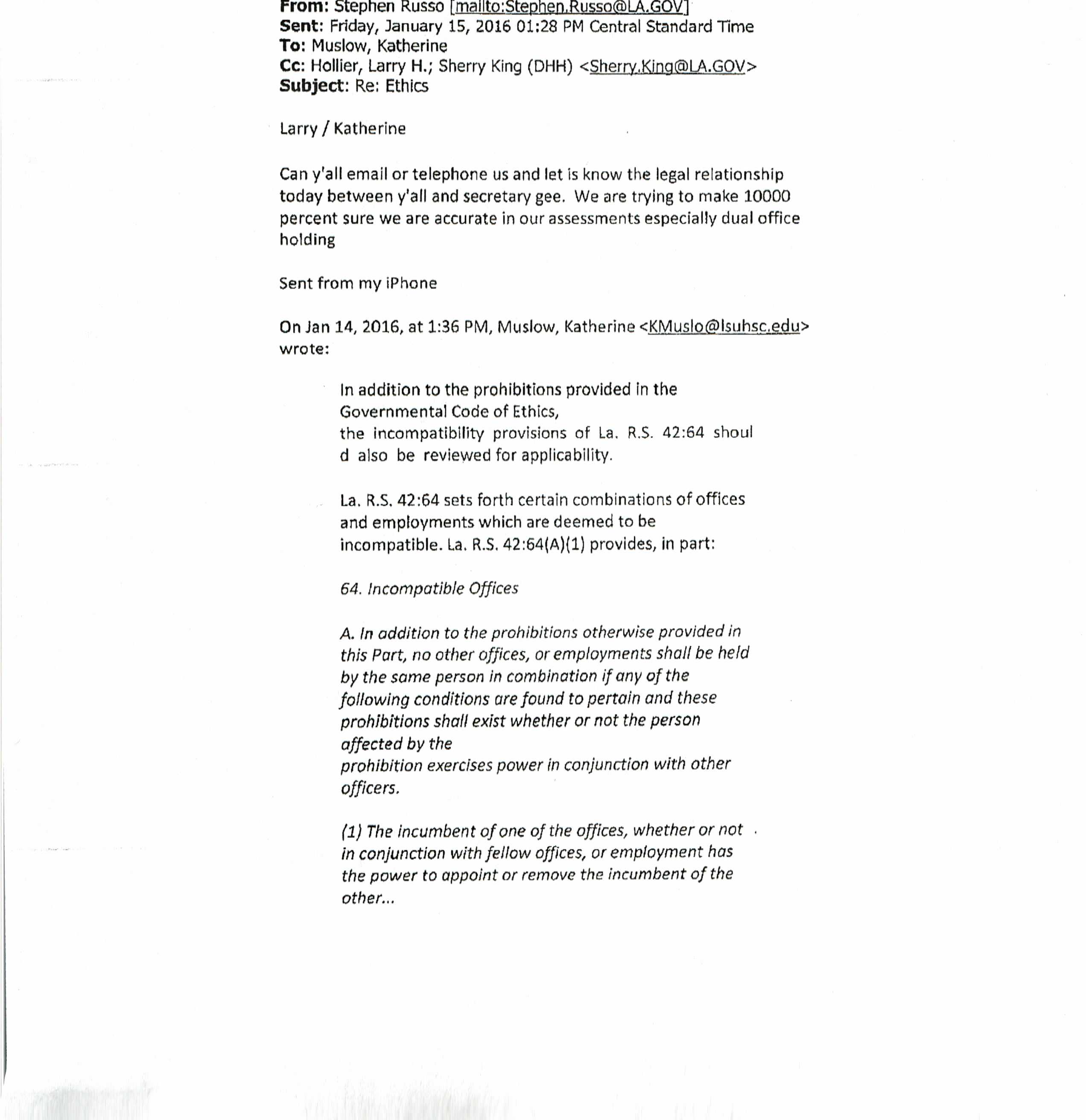
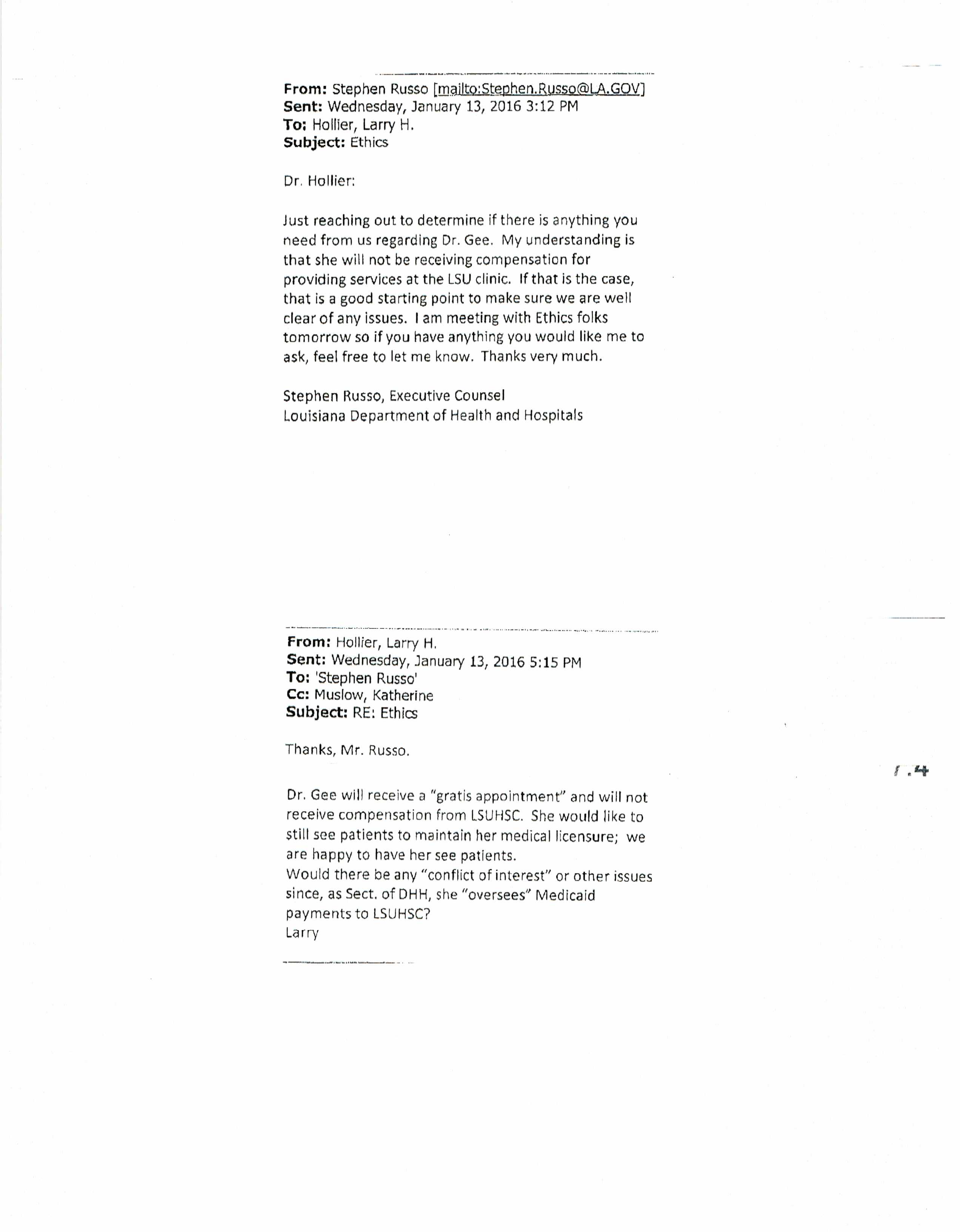
At 3:12 p.m. on Jan 13, Russo emailed LSUHSC Chancellor Dr. Larry Hollier to ask “if there is anything you need from us regarding Dr. Gee. My understanding is that she will not be receiving compensation for providing services at the LSU clinic. If that is the case, that is a good starting point to make sure we are well clear of any issues…”

At 5:15 p.m. that same day, Hollier responded: “Dr. Gee will receive a ‘gratis appointment’ and will not receive compensation from LSUHSC. She would like to still see patients to maintain her medical licensure; we are happy to have her see patients. Would there be any ‘conflict of interest’ or other issues since, as Sect. of DHH (since renamed LDH), she ‘oversees’ Medicaid payments to LSUHSC?”

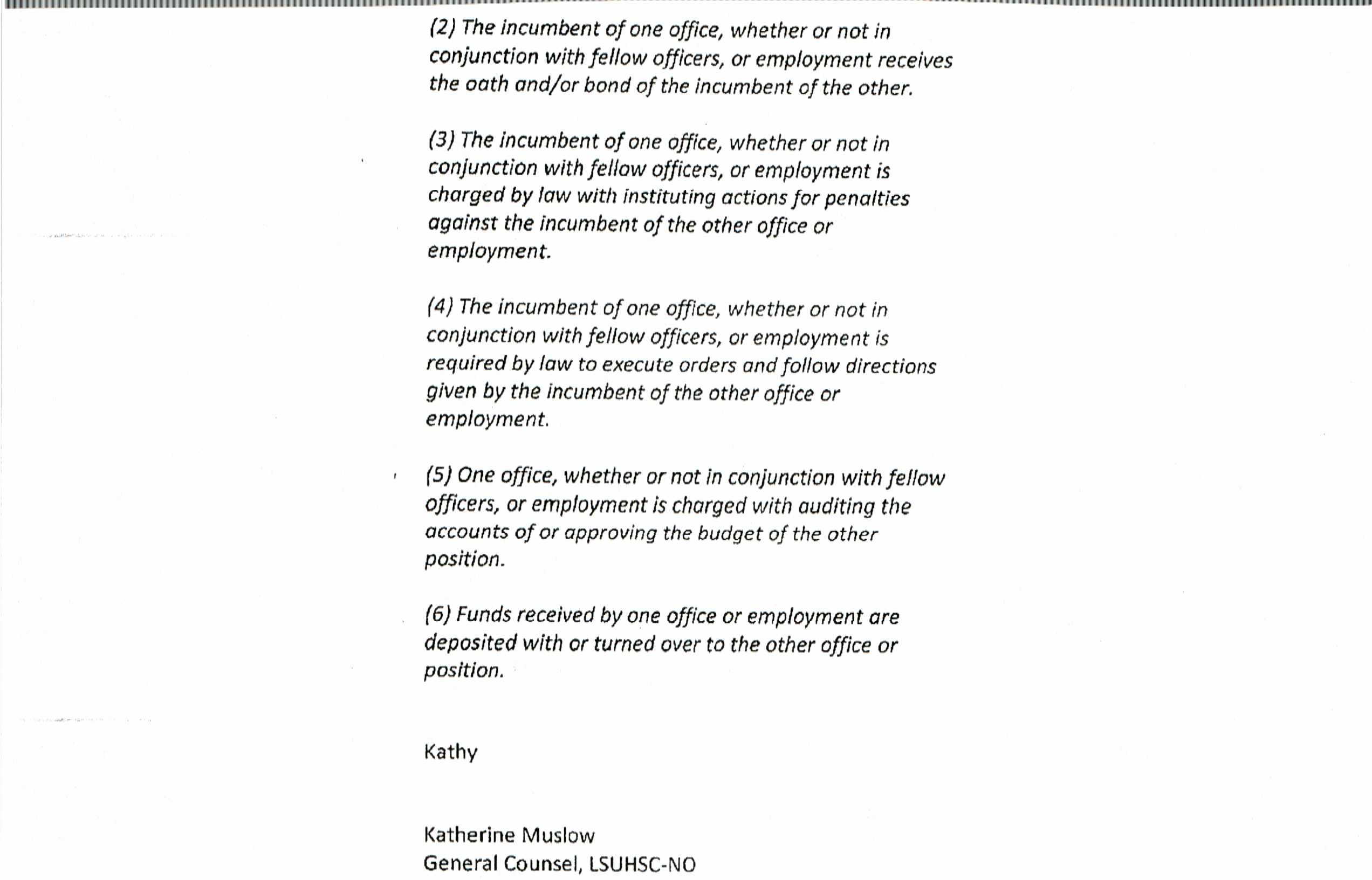
The following day, Jan. 14, LSUHSC General Counsel Katherine Muslow emailed Russo at 1:36 p.m. to say, “In addition to the prohibitions provided in the Governmental Code of Ethics, the incompatibility provisions of (state statutes) should also be reviewed for applicability.”

She then went on to list six “incompatibility provisions” which she seemed to feel would prohibit Dr. Gee from working even as a volunteer for an agency partially funded by the department that she headed.

On Jan. 15, Russo, still on the state clock at 1:28 p.m. and still on a state computer, wrote LSUHSC General Counsel Katherine Muslow and others from his state email account to ask that “y’all email or telephone us and let is (sic) know the legal relationship today between y’all and secretary gee (sic).”

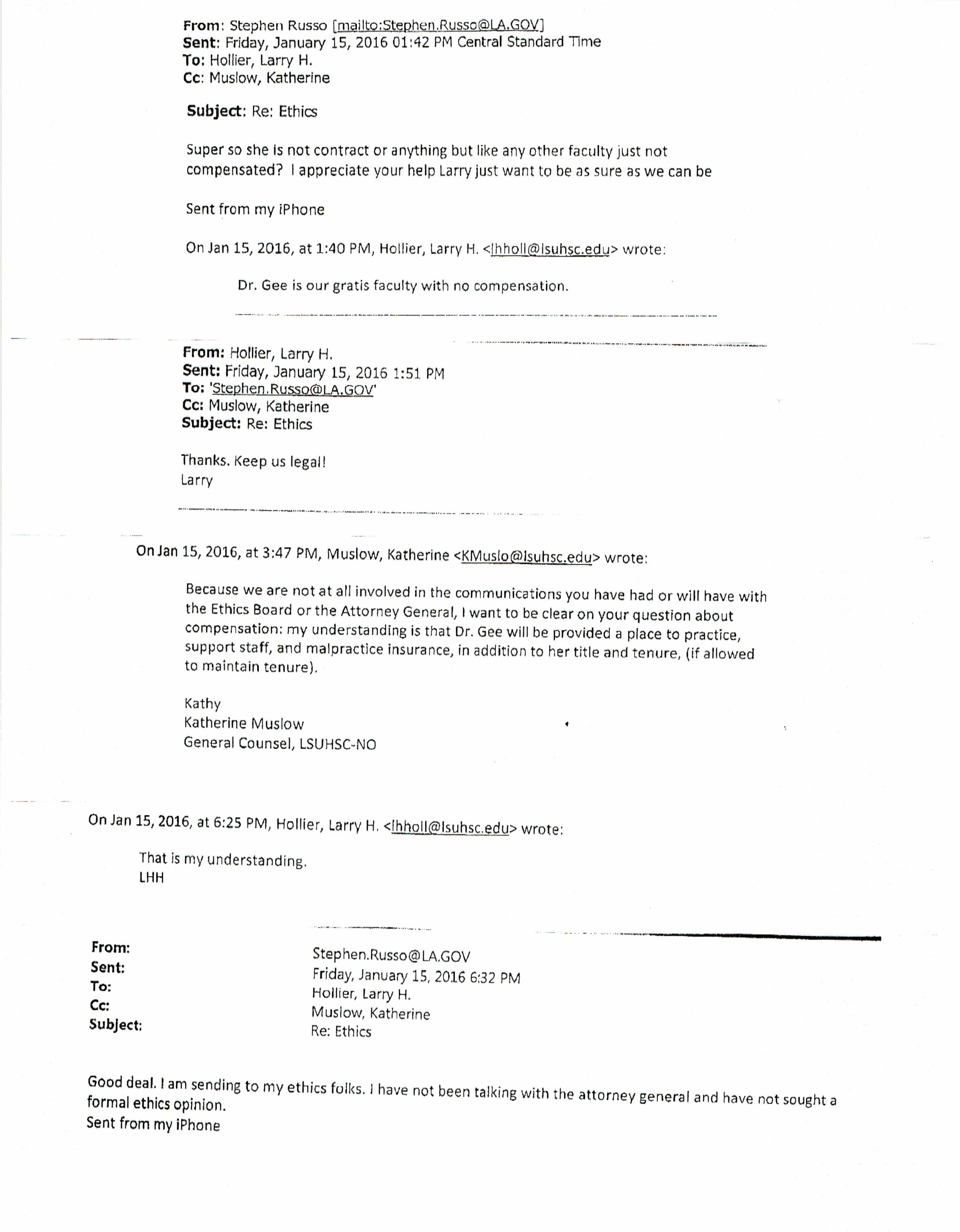
At 1:40 p.m., Dr. Hollier emailed Russo to reiterate that Dr. Gee “is our gratis faculty with no compensation.”

Two minutes later, Russo, apparently having not fully digested the content of Muslow’s list of reasons why Dr. Gee could not work for LSU (and too excited to bother with punctuation), responded to Hollier: “Super so she is not contract or anything but like any other faculty just not compensated?”

He finally got around to responding to Muslow at 6:32 p.m. that day: “Good deal. I am sending to my ethics folks. I have not been talking with the attorney general and have not sought a formal ethics opinion.”

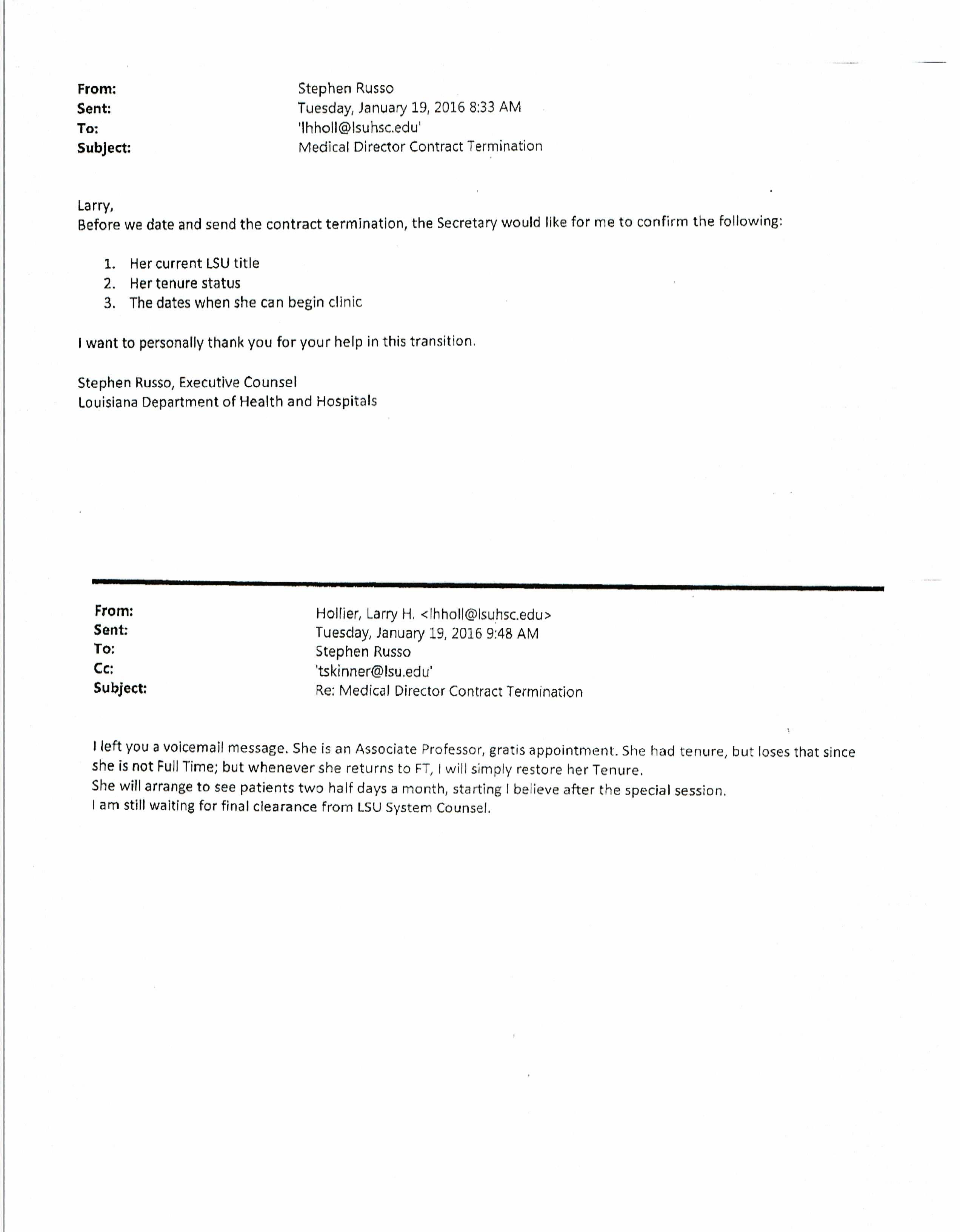
On Jan. 19, Russo was back at it early, emailing Hollier at 8:33 a.m. to discuss the termination of the contract between LDH and LSUHSC for the Medicaid Medical DIRECTOR position, the position Dr. Gee had held at LSUHSC. “Before we date and send the contract termination,” he wrote, “the Secretary (Dr. Gee) would like for me to confirm the following:

  1. Her current LSU title;
  2. Her tenure status;
  3. The dates when she can begin clinic.”

At 9:48 a.m., Hollier responded: “She is an Associate Professor, gratis appointment. She had tenure but loses that since she is not Full Time; but whenever she returns to FT (full time), I will simply restore her Tenure. She will arrange to see patients two half-days a month, starting I believe after the special session. I am waiting for final clearance from LSU System Counsel.”

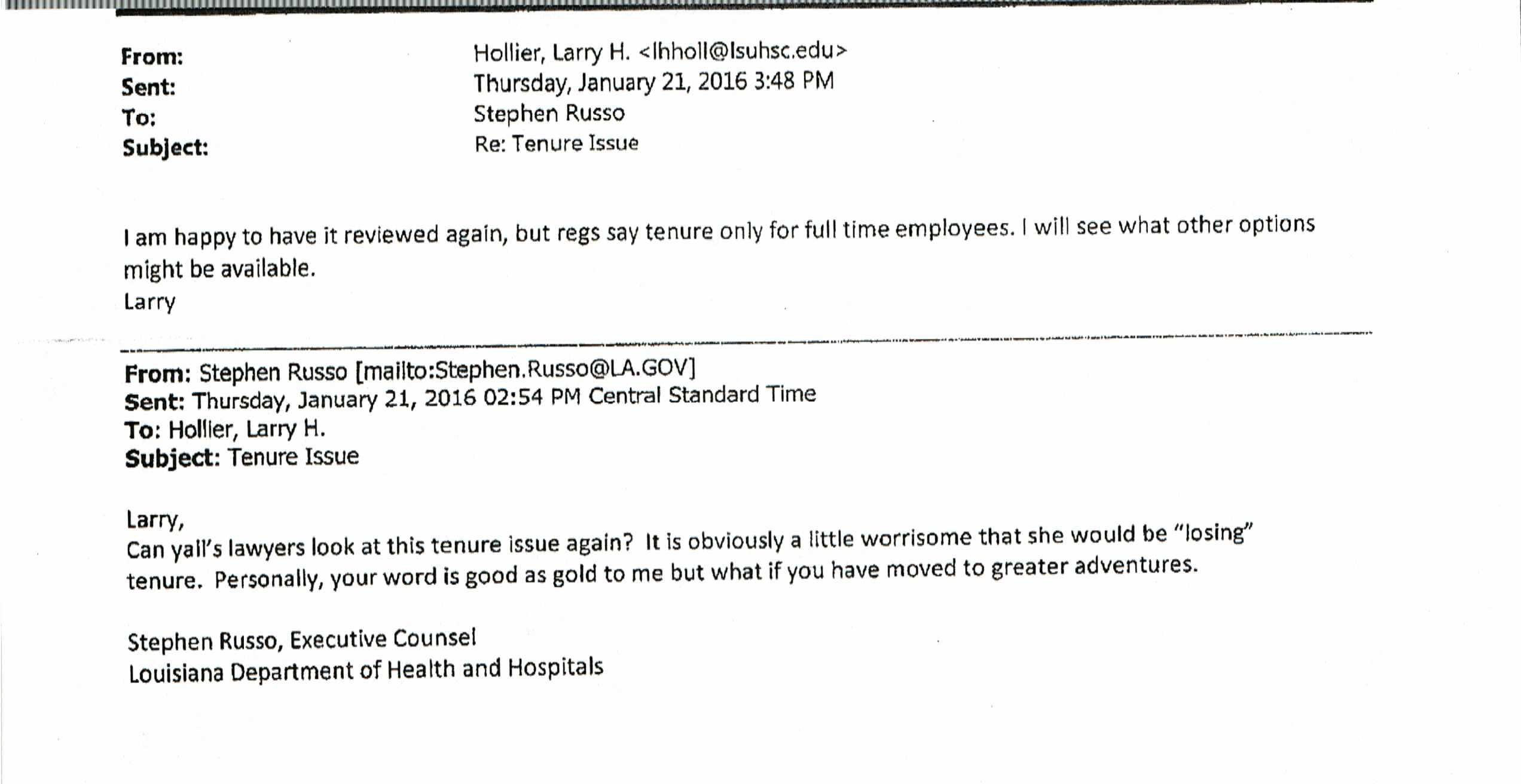
The news about Gee’s loss of tenure must’ve thrown Dr. Gee and by extension, Russo, into a tizzy. On Jan 21 at 2:54 p.m., Russo emailed Hollier: “Can yall’s (sic) lawyers look at this tenure issue again? It is obviously a little worrisome that she would be ‘losing’ tenure. Personally, your word is good as gold to me but what if you have moved to greater adventures.”

“I am happy to have it reviewed again,” answered Hollier at 3:48 p.m., “but regs say tenure only for full time employees. I will see what other options might be available.”

So, bottom line, what we have here is the secretary of a state department:

  • Working for an agency over which her department has jurisdiction;
  • Attempting to retain tenure from her old job even though state regulations clearly say an employee must be full time to earn or keep tenure;
  • Attempting to have the state pay for her medical malpractice insurance;
  • Instructing a subordinate (legal counsel Stephen Russo) perform private legal work on state time and on state equipment on behalf of her efforts to retain private part time employment.

As the late C.B. Forgotston would say, you can’t make this stuff up.

Read Full Post »

With a flurry of (count ‘em) 37 bills dealing with gambling gaming, there is probably none more interesting to the folks in Tangipahoa Parish than identical bills introduced in the Senate (SB-417) and House (HB-438) that would facilitate the move of a Bossier Parish casino to property along the Tangipahoa River.

Brent Stephens is owner of the current license for Diamond Jacks in Bossier City. He and his company, Peninsula Pacific, acquired the license for Diamond Jacks in June 2016 after Legends, the previous owner, was released from bankruptcy the previous year. Stephens operates at least two other gaming properties in Louisiana—the Amelia Belle in Amelia in St. Mary Parish following Hurricane Katrina, and Evangeline Downs in Opelousas in St. Landry Parish.

His first choice for relocating Diamond Jacks was Lake Pontchartrain in St. Tammany Parish but he encountered a couple of insurmountable snags: he couldn’t get political support and he couldn’t find any landowners willing to sell.

He then turned his attention to Tangipahoa Parish and was initially looking at sites around Manchac adjacent to I-55 but abandoned that idea for reasons known only to him.

He then settled on an area south and west of Hammond along I-12.

And though the governor has made a point of staying out of all the gaming legislation (with the exception of two: a non-gaming-related proposal involving Harrah’s Casino in New Orleans and one to permit gaming on land within 1200 feet of an authorized berthing site, both of which he supports, he has said he would sign the Tangipahoa Parish bill if it made it to his desk.

And that is one great big IF—as in, not likely.

Despite strong support from Parish President Robby Miller, the parish council, and 48 percent and a large contingent still undecided among Tangipahoa Parish voters, there remains two chances—slim and none—that the Tangipahoa River will become a Mecca for casino gamblers.

That’s because of the formation of a rather unique alliance against the proposal: Tangipahoa Parish churches and video poker.

Whoever coined the phrase that politics makes strange bedfellows was dead right. There can be no stranger bedfellows than fire-and-brimstone-breathing protestant ministers and video poker operators.

And while ministers can exert considerable influence, video poker operators are every bit as powerful, if not more so. That’s because while casino operators are prohibited from making political contributions, there are no such restrictions on the video poker industry.

Video poker interests are well-represented on both sides of the legislative aisles, meaning they spread a lot of campaign money around and enjoy substantial influence at the capitol.

Throw in State Rep. Sherman Mack and you have some formidable opposition.

  • Mack, from the Livingston Parish town of Albany, just happens to be Chairman of the House Criminal Justice Committee.
  • Mack is casting a lustful eye at the district attorney’s office for the 21st Judicial District which includes the parishes of Livingston, St. Helena and….Tangipahoa.
  • That office is currently occupied by four-term DA Scott Perrilloux who is considered vulnerable.
  • Mack does not want to be labeled as a “pro-gaming” legislator should he decide to challenge Perrilloux.

HB-438 was introduced by Rep. Stephen Pugh (R-Ponchatoula) and SB-438 by Sen. Bodi White (R-Central). Only White’s bill has made it out of committee (on March 20) and it now awaits debate on the Senate floor. Should it pass the full Senate, it will then be sent to Sherman’s committee where in all likelihood, it will die an ugly death.

And therein lies the real political story.

The bill does two things:

  • It authorizes the Tangipahoa River as a designated waterway on which gaming may be conducted, and
  • It calls for a parish-wide referendum.

But in case it passes the full Senate, makes it out of Mack’s Criminal Justice Committee, and gains approval by the full House, then and only then does the proposal move onto the State Gaming Board which would have to approve the move.

Because the Tangipahoa is barely large enough to entertain tubers and the occasional Bateau boat, it ain’t about to accommodate a full-blown floating casino. The alternative would be a “free-standing” casino and the odds of that getting approved are pretty long.

Just another example of the interesting political issues that color Tangipahoa Parish.


Read Full Post »

« Newer Posts - Older Posts »