Feeds:
Posts
Comments

Archive for the ‘Ethics’ Category

This should be the mother of all embarrassments for the legislature…but it won’t be.

I received a couple of emails over the past few weeks that, though sent independently of each other, combine to illustrate in crystallized form the ineptitude of the Louisiana Legislature.

Whether this ineptitude is by design or is simply the unfortunate consequences of an uninformed citizenry’s having elected a bunch of dunderheads remains a matter of conjecture.

But regardless, ineptness is ineptness and everyone loses. Barney Fife perhaps said it best in an episode of The Andy Griffith Show when, speaking to Andy, he said of a character played by Don Rickles, “He’s not ept, he’s not ept, he’s just not ept.”

But I digress.

The emails.

In the first one, I was blind-copied on a message sent to 15 senators, all members of the Senate Finance Committee:

  • Eric LaFleur (D-Ville Platte), chairman;
  • Brett Allain (R-Franklin);
  • Conrad Appel (R-Metairie);
  • Regina Barrow (D-Baton Rouge);
  • Wesley Bishop (D-New Orleans);
  • Jack Donahue (R-Mandeville);
  • Jim Fannin (R-Jonesboro);
  • Sharon Hewitt (R-Slidell);
  • Ronnie Johns (R-Lake Charles);
  • Greg Tarver (D-Shreveport);
  • Bodi White (R-Central);
  • Norby Chabert (R-Houma);
  • Blade Morrish (R-Jennings);
  • Francis Thompson (D-Delhi);
  • Mike Walsworth (R-West Monroe)

(Chabert, Morrish, Thompson and Walsworth are all interim members.)

The email dealt with the writer’s concerns over the Louisiana Department of Education’s Minimum Foundation Program, the formula employed for funding public education in Louisiana (not that they would be likely to read anything that didn’t have a campaign check attached),

I have withheld the identity of the author of the email because he/she obviously is an LDOE insider with sensitive knowledge of the situation. Here is that email:

To: lafleure@legis.la.gov, allainb@legis.la.gov, appelc@legis.la.gov, barrowr@legis.la.gov, bishopw@legis.la.gov, donahuej@legis.la.gov, fanninj@legis.la.gov, hewitts@legis.la.gov, johnsr@legis.la.gov, tarverg@legis.la.gov, whitem@legis.la.gov, chabertn@legis.la.gov, morrishd@legis.la.gov, thompsof@legis.la.gov, walsworthm@legis.la.gov
Date: April 28, 2018 at 4:16 PM
Subject: MFP Program at Department of Education

Greetings,

On Monday morning, the Senate Finance Committee will approve SCR48 by Sen. Morrish.  This resolution deals with the MFP (Minimum Foundation Program) formula for the 2018-2019 fiscal year. As the Department of Education and representatives of the Board of Elementary and Secondary Education will argue that these funds are necessary to help Louisiana’s struggling schools, one must question the MFP in the current fiscal year. 

The department has been in complete chaos these past few weeks when it discovered a serious flaw in the MFP formula. Every child in the state was shortchanged in State General Fund dollars since the fiscal year began in July 2017. Interestingly, some districts got more MFP dollars than (they) should have. The department currently has a $17 million State General Fund surplus because of the flawed formula. Now, instead of quickly correcting the formula and distributing the funds to the school districts, they (Deputy Superintendent Elizabeth Scioneaux and MFP Director Katherine Granier) are attempting to “spin” the mistake and make no mention about it because they are afraid of an audit of the MFP program. Basically, the department will lie and cover up the mistake, the local school districts will lose out on the funding that they are entitled, and the excess State General Fund will be used for onetime expenses in fiscal year 2018-2019.

Who is monitoring the Department of Education? Anyone? Are they not accountable? 

I would be interested in what they have to say about the $17 million surplus. I am quite certain that the local school boards would be surprised to know this, too. They are unsure how the formula is derived and they just depend on the Education department to get it right.

I would hazard a guess that this individual never received a response from a single member of the Senate Finance Committee. LouisianaVoice also would be interested in knowing if anyone at LDOE is accountable or if anyone in the Legislature is paying the least bit of attention.

That curiosity is piqued not only by the email above but by one received on Sunday. Again, I am keep the identity of the second writer confidential as well. Here is that email:

To anyone who thinks that the legislature is doing ANY real work:

Consider the Minimum Foundation Program (MFP). This $3.7 BILLION appropriation is the second largest item in the state budget (the largest is Medicaid). These dollars go to local school districts to fund operations. It’s kind of a big deal and surely elected members have some questions or at least want to know a little about this gigantic item, right? WRONG!  The MFP for FY19 exists as SCR 48. This resolution sailed through the Senate with only a couple of perfunctory questions. Not to be outdone, when it arrived at the House Education Committee, it got worse. Chairman Nancy Landry (one of the worst of the Tea-Partiers) called up the resolution before anyone from LDOE even arrived at the meeting, said it wasn’t necessary for the Department to be there, moved favorable, and just like that, $3.7 BILLION moved on. Not a single question, not a single comment, no public testimony (no one was present), no Department testimony. And THAT is YOUR legislature at work. Meanwhile, the House Floor spent HOURS on an asinine bill by Rep. Amedee (possibly the least intelligent member of the body) to mandate a certain amount of time per day as “recess” for grades K-8. One would think this is purely the purview of BESE and the local school boards, but No. Incidentally, Amedee is one of those Tea-Partiers who abhor any sort of government regulation EXCEPT WHEN IT IS SOMETHING THEY WANT. Then, it’s okay! To its credit, the House voted her bill down. But the fact that hours were spent on such stupidity, and not one minute was spent on the MFP, tells you everything you need to know about YOUR legislature. These are the jackasses that WE elected!! So, who should really shoulder the blame? The elected jackasses or “We, the People” who put them there? 

In addition to the contents of those two emails, consider this:

The Louisiana Department of Education has 37 unclassified employees (appointive) who draw $100,000 or more per year in salary, including Elizabeth Scioneaux, who is paid $133,000 per year whose job it apparently is, according to the first writer, to spend multi-million-dollar mistakes in order to conceal them from legislative or state auditor oversight.

LDOE also has nine people identified by the somewhat ambiguous job title of “Fellow” knocking down between $88,000 and $110,000 per year. Those are mixed in with the “consultants,” “directors,” “advisers,” “specialists,” “assistants,” “researchers,” “managers,” “liaison officers,” and something called “paraeducators.”

In all, LDOE has a whopping 170 UNCLASSIFIED EMPLOYEES, topped of course, by State Superintendent John White’s $275,000 per year. This information was obtained as part of a public records request submitted by LouisianaVoice.

We even found our old friend David “Lefty” Lefkowith, who pulls down $100,000 per year as a “director,” whatever that is. Our first encounter with Lefty was back in 2012 when we discovered he was commuting to and from his California home to perform his duties with LDOE. A little closer examination revealed he was part of a CARTEL that included then-candidate for Florida governor Jeb Bush, the now-defunct Enron Corp., and a spin-off company named Azurix in a failed effort to privatize and store potable water to later sell to the highest bidder through a process called aquifer storage and recovery (ASR). At least LDOE did drop Lefty’s 2012 salary of $145,000 per year to its current level. But then, we’re told that he no longer commutes, either; he works from home in California. Nice.

Others include:

  • Laura Hawkins—Recovery School District administrator (RSD): $110,000;
  • Elizabeth Marcell—RSD administrator: $115,000;
  • Dana Peterson—RSD administrator: $148,500;
  • Jules Burk—superintendent: $120,000;
  • Meredith Jordan—education coordinator: $112,200;
  • Ralph Thibodeaux—superintendent: $115,000;
  • Allen Walls—education coordinator: $112,200;
  • Ronald Bordelon—RSD administrator: $150,000;
  • Andrea Cambria—RSD administrator: $100,000;
  • Tiffany Delcour—assistant superintendent: $120,000;
  • Gabriela Fighetti—assistant superintendent: $135,000;
  • Lona Hankins—director: $140,000;
  • Jessica Baghian, assistant superintendent: $129,800;
  • Erin Bendily—assistant superintendent: $140,000;
  • Kenneth Bradford—assistant superintendent: $129,800;
  • Jennifer Conway—assistant superintendent: $129,800;
  • Bridget Devlin—chief operating officer: $110,000;
  • Hannah Dietsch—assistant superintendent: $130,000;
  • Lisa French—manager: $104,500;
  • Joan Hunt—executive counsel: $129,800;
  • Rebecca Kockler—assistant superintendent: $129,800;
  • Rebecca Lamury—director: $100,000;
  • Diana Molpus—educational director: $103,000;
  • Kunjan Narechania—assistant superintendent: $159,500;
  • Catherine Pozniak—assistant superintendent: $140,000;
  • Jan Sibley—fellow: $100,000;
  • Jill Slack—director: $126,500;
  • Melissa Stilley—liaison officer: $135,000;
  • Dana Talley—liaison officer: $130,000;
  • Francis Touchet—liaison officer: $130,000;
  • Alicia Witkowski—fellow: $110,000;
  • Jamie Woing—fellow: $110,000;
  • Jacob Johnson—executive director: $100,600;
  • Shan Davis—director: $135,200.

And there was Vicky Thomas, listed as a “confidential assistant,” making a cool $91,800 per year.

Yet, with all those high-powered appointees with the important-sounding titles, a $17 million error in the crucial MFP was apparently allowed to slip through the cracks and no one in the legislature across the street could think of a single question to ask—because they were too busy considering recess, concealed carry in schools, granting payday loan companies interest rates of 167 percent, renaming highways, and…well, you know: important matters.

Read Full Post »

I want to share something with you.

I have leveled criticism at Louisiana’s legislators and at both the former and current governor. Much, if not all that criticism I believed to be legitimate and well-earned. I was unmercifully hard on Bobby Jindal for the simple reason that not only did I believe him to be inept, but heartless as well when it came to consideration of the needs of the sick and elderly, of students and teachers, of minorities and the poor. In the end, I’m convinced I was not hard enough on him.

But today, I read two documents that have prompted me to take a little different approach, especially as it regards one certain legislator, a man I have never met, a man with whom I have never spoken but a man, nevertheless, who gives me hope, after today’s readings, that there may yet be those who have some sense of priority and compassion.

The man is State Sen. J.P. MORRELL and I fervently hope that my praise isn’t misguided or ill-conceived. Sometimes we are too eager to find a hero or at least someone to look up to. I hope this isn’t one of those times.

First, some background.

Earlier on Sunday, I came across a heart-rending online story of the struggles of an Oregon woman who, already waging a heroic fight against cancer, had the added burden, along with her husband, of having to battle the bureaucratic idiocy of the nation’s largest medical insurer, UnitedHealthcare.

The story was infuriating. Here, on one hand, was a woman, a mother of a four-year-old daughter, being told that only a liver transplant could save her life. On the other hand, there were the brain-dead bean-counters at UnitedHealthcare, all the way up to the company’s CEO, denying her one chance at life.

Morrell, it turns out, read the same story and also saw it on CNN. But instead of recapping, here’s what Morrell wrote, courtesy of Kreweoftruth, a New Orleans Internet blog:

This morning, Mother’s Day, I watched, then read, the heart wrenching tale of Erika Zak on CNN.

Erika is a 38-year-old mother and wife, who defeated stage 4 metastatic colon cancer but is dying.  Her liver, damaged by microwave ablation surgery, is failing and she is dying. So, she began the second fight of her life… with her insurance company.

Sitting with my wife and kids, enjoying breakfast today on Mother’s Day, this story deeply affected me. To be powerless in the face of callous CEOs making decisions regarding whether you live or die, it’s terrifying. 

Inevitably, I saw the obvious parallels between her plight and tens of thousands of Louisianans at the mercy of the Louisiana State Legislature and our budget crisis. As we contemplate passing ‘fake’ budgets as part of a ‘process’, we are playing games and, consequently, playing with people’s lives.

A $650+ million shortfall is less than two months away. As we squabble, 35,000+ nursing home recipients are being told that they are about to be evicted. With no clear and reasonable revenue agreement in place, we alternate between closing hospitals with medical schools, burdening families with crippling college debt, or cutting services to the Department of Children and Family Services.

As the Chairman of the Senate Revenue and Fiscal Affairs Committee, my role is to try to shepherd revenue raising measures through this process to avert this disaster. It’s an awesome, and terrifying, responsibility that weighs on me every single day.

Some of the issues being debated this session are tremendously important, such as criminal justice reform or public safety. Other bills are innocuous and warrant little to no debate, like renaming highways or changing the membership of security districts. However, there are some bills that are neither important nor insignificant.

House Bill 553, regarding the renewal of the Harrah’s gaming license is one such bill. The amount of time, energy and effort that has been expended by the proponents and opponents of this bill is staggering. The Senate has been barraged by the effort of over a dozen registered lobbyists each one of whom is trying to explain why this bill is a ‘good deal’ for the City of New Orleans and State of Louisiana. On the other hand, the opposition has its own horde of unregistered lobbyists to advocate for competing business interests. Both sides have expended an immense amount of time trying to shape opinions, news and narratives to get their own way.  

As someone inside this chaotic budget crisis, this Harrah’s deal is truly unworthy of our attention. Whether you believe the current deal is a good one or whether there is time to negotiate a better one, either position is immaterial.

With the looming crisis facing our state, and our city, the noise surrounding this deal is an unwarranted distraction. I do not want myself or my colleagues to be distracted. The citizens of Louisiana deserve much better than that. And, I’m going to use my position to insist they get it. Consideration of an early renewal of this license right now, is like trying to get a lower lease payment on your car while you home is under foreclosure. We need to get our home in order. 

Negotiations of this kind are about maximizing leverage and should never be negotiated until each party is on equal footing. The State of Louisiana is broke and can’t pay its bills, a circumstance that makes any extra money seem attractive. That’s not a good place to start a negotiation. 

Tomorrow, in Senate Judiciary B Committee, I will cast my vote to defer this bill for this legislative session. A future legislature will have ample time to reconsider this issue when the budget crisis has passed. 

I am putting my position on the record, before committee, because the legislature is trying to adjourn by Friday, May 18th. The purpose of the early adjournment is to spare taxpayers the additional cost of a special session. Bills of this nature, with tremendous forces on both sides vying for supremacy, will destroy a possibility of this happening. 

-JP Morrell

Louisiana State Senator, District 3

Morrell seems to be one responsible legislator, at least in this case, who can cut through the B.S. and get to the core of the issue facing the state.

And he understands and is disgusted by the fact that legislators can spend so much time on issues that do not address the fiscal problems facing the state and its citizens:

  • Issues like Payday loan companies’ attempt to raise interest rates to 167 percent (Morrell was absent for that vote, which passed the Senate by a 20-17 margin but which later failed to make it out of committee on the House side).
  • Issues like allowing anyone—anyone—with a concealed carry permit to enter public schools in Louisiana fully armed.
  • Issues like commending a former state legislator for his support of a ridiculous bill that was struck down by the Supreme Court. Really?
  • Issues like, as Morrell points out, renaming highways or changing memberships of security districts.

And Morrell is not shy in noting that in the furor over the Harrah’s gaming license, the legislature has been overrun by parasites with briefcases, aka lobbyists for both sides. Some of them, he said aren’t even registered lobbyists as required by law. All so Harrah’s can get an early renewal of its license. Early—while the attention to the looming fiscal cliff has been a little late in claiming the serious attention of people like Cameron Henry and Lance Harris and House Speaker Taylor Barras.

A decade of kicking the can down the road and it’s starting to show a few dents.

Morrell, at least, gets it.

One word.

Priorities.

Now, if he could just get the message across to his colleagues…

Read Full Post »

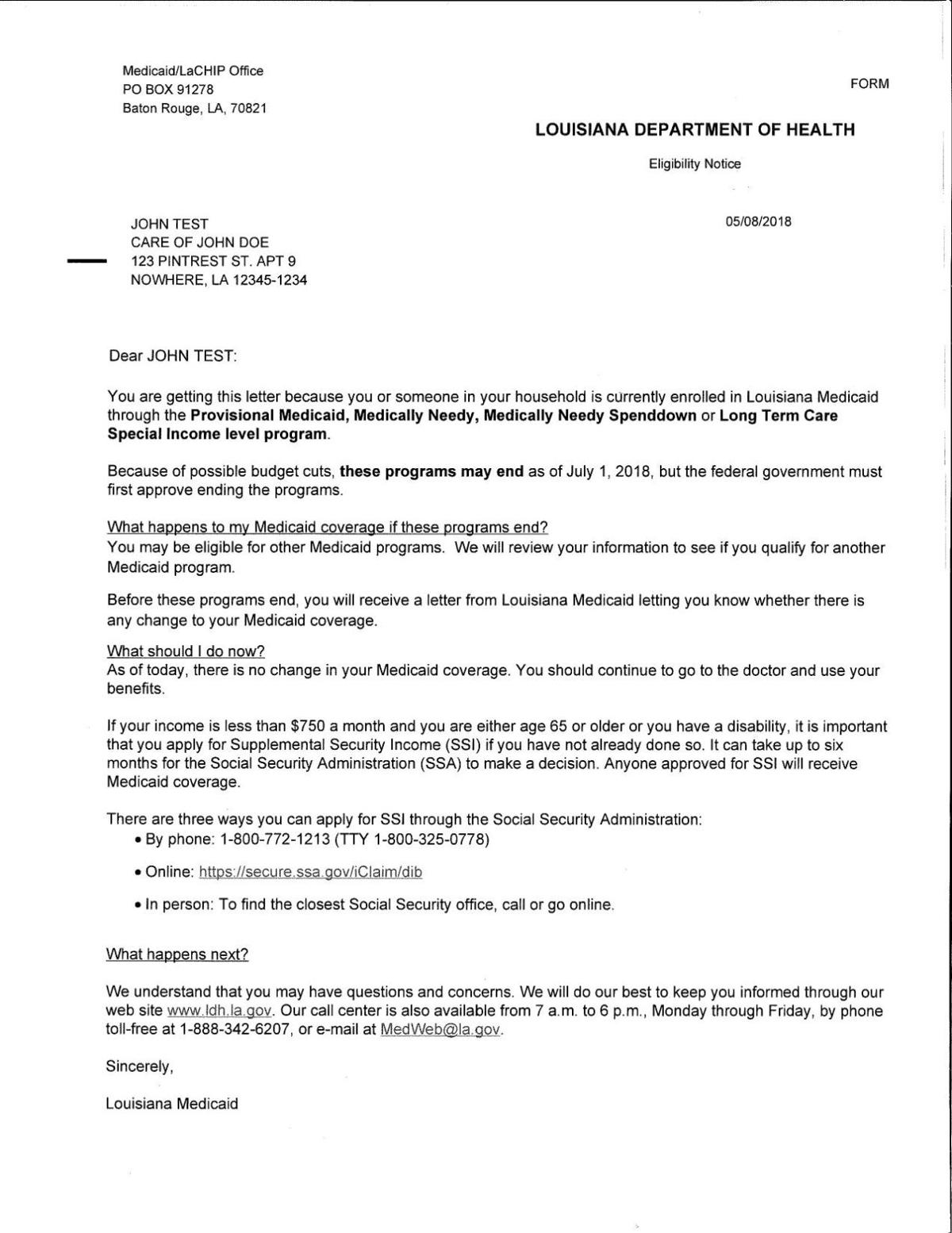
If you like political posturing, puffery, bombast, and breast-beating, then the reaction to that LETTER being sent out to 37,000 nursing home patients in Louisiana is tailor-made for political junkies like you.

The letter, sent out by the Louisiana Department of Health, got the desired reaction. CBS Evening News featured the story prominently in its Wednesday newscast, complete with a brief interview with Jim Tucker of Terrytown, operator of about a dozen nursing homes.

It’s interesting that Tucker was sought out for camera face time. He was Bobby Jindal’s Speaker of the House who abetted Jindal for eight years in gutting the state budget of services for the elderly and mentally ill. And now the roll him out in front of the cameras to cry wolf.

The Edwards administration tried to assure us, through Commissioner of Administration Jay Dardenne and LDH Secretary Dr. Rebekah Gee, that this is not Chicken Little, that the sky really will fall if budget cuts are not restored by July 1, the date that the state is projected to fall over the metaphorical fiscal cliff when $650 million in tax revenue falls off the books.

Typically, the reaction by Republicans in the legislature, the same ones who have steadfastly refused to face fiscal reality since the beginning of the Jindal accident in 2008, was to scream foul to anyone who would listen—and there were plenty who did.

Dr. Gee, of course, did her part, even tearing up as she explained to the TV cameras that hearts “are breaking over the need to do this. We can’t provide services with no money to pay for them.”

Dardenne added his bit, saying, “This letter is scary, but it’s not a tactic. This is the reality that we are facing.”

But House Appropriations Committee Chairman Cameron Henry (R-Metairie) gave the best performance. With a lock of hair hanging down over his forehead a-la the late Bobby Kennedy, he bleated, “This is premature at best, reckless at worst,” adding that the letter was designed “to scare the elderly of this state, and that is an embarrassment.” No, Cameron, you’re an embarrassment.

Ditto for Rep. Lance Harris (R-Alexandria), chairman of the House Republican Delegation, who called the letter an “unnecessary political scare tactic done to intimidate and frighten the most vulnerable people into believing they will be kicked out onto the streets if the governor doesn’t get everything he wants in the form of revenue.”

And Cameron Henry should understand that the legislature as a body is no less an embarrassment to those of us who have been forced to observe its collective ineptitude on a daily basis for 10 years now. To quote my grandfather, they couldn’t find a fart in a paper bag.

Lost in all the rhetoric is the hard fact that the administration might not have found it necessary to send out the letter—regardless whether it’s a scare tactic or reality—had the legislature made any effort to face up to its responsibility to the 4.5 million citizens of this state.

But here’s the real reality—and just remember where you read it:

Not a single nursing home patient is going to be evicted. Not one.

Want to know why?

Money.

And I don’t mean money to be appropriated by the legislature to properly fund state government, nursing homes included.

I’m talking about campaign money.

Lots of it. Tons of it.

Since 2014, individual nursing homes, nursing home owners, and nursing home political action committees have contributed more than $750,000 to Louisiana politicians, primarily legislators. Here is just a partial list of NURSING HOME CONTRIBUTIONS

And that’s just over the past four years.

More than $50,000 was contributed the campaign of Edwards.

Henry, the one who called out the administration for its “scare tactics,” received more than $10,000 since 2014.

Senate President John Alario also received more than $12,000 over the same time span.

Louisiana Public Service Commission member Foster Campbell said on the Jim Engster show on Louisiana Public Radio earlier this week that since he first ran for the legislature more than 40 years ago, the cost of seeking political office has become cost prohibitive. Foster said when he first ran for the State Senate in 1975, he borrowed $7,500 to finance his campaign. “Now, it costs hundreds of thousands of dollars” and the average person who wants to serve cannot afford to do so, he said.

I’ve always wondered why corporations and the wealthy who seem so concerned about “good government” don’t use their money to help others rather than lavish it on politicians. The money they throw at politicians and lobbyists could be put to such more productive use—but they don’t try because they don’t really care about good government. And every now and then, I can’t help wondering why that is.

But I don’t wonder about it long. The answer is obvious: power and influence.

And that’s a sorry commentary on our political system, from the local level all the way to the very top of the political pyramid.

And it’s for that reason that not a single nursing home resident will be evicted. By some miracle, repeated every year, it seems, extra money will be “found” to do what is politically expedient.

Because the money has already been spread around by those who buy influence and legislators.

Remember where you read it.

Read Full Post »

Editor’s note: The following (with added comment) is a guest column provided to LouisianaVoice by the Healthcare Alliance for Regulatory Board Reform (HARBR):

By Christian Wolff

Louisiana Senate Bill 286, dubbed the Physician’s Bill of Rights, fell into a “coma” before the Louisiana Legislature on last Wednesday but not before an outburst over the testimony of the bill’s author.

Sen John Milkovich (D-Shreveport) was in the middle of explaining the obvious conflict of interest on the Louisiana State Board of Medical Examiners when he was interrupted by New Orleans attorney Jack Stolier who twice shouted that Milkovich’s testimony was a “bald faced lie.” (Milkovich’s testimony and Stolier’s off-camera interruption can be heard beginning at the 7:15 MARK of this video of the House Health and Welfare Committee.)

Milkovich had just referenced an “affair” between Dr. Cecilia Mouton, then an investigator for the board of medical examiners, and Stolier, who represented physicians before the board in disciplinary matters.

But hey, the brief flareup was by far the most interesting—and probably the most intelligent—moment of this session sadly marked by legislative ineptitude, indecision, and concerted efforts to bow to the will of special interests st the expense of constituents and Louisiana (See the disgraceful Senate passage of the Payday Loan bill. How anyone can hold out one scintilla of hope for this bunch is beyond comprehension).

After Stolier was escorted from the committee room by Capitol security personnel, Milkovich read from a March 18, 2016, LouisianaVoice post which alluded to the relationship between the two. He also cited a letter from a board director which acknowledged a “personal relationship” between the two. Mouton, now Director of Operations for the board, and Stolier have since married but Milkovich called the romantic link between Mouton, who was prosecuting doctors, and Stolier, who was defending them, a blatant conflict of interest.

This, folks, is typical of the manner in which both the Board of Medical Examiners and the Louisiana State Board of Dentistry disregard due process and run roughshod over members of the medical profession who are charged and deemed guilty without even a nod at procedure. Guilty until proven innocent turns legal procedure on its head and is the very reason why some sort of checks and balances are desperately need to bring these rogue board under control.

But instead, the board, without objection, agreed that the bill be involuntarily deferred, meaning that for all practical purposes, it is dead for this session. (This, by the way, is the same Board of Medical Examiners that has defied a court order and continues to refuse to allow the legislative auditor to see its records so the auditor can do his job.)

Typically, the House does not entertain motions to override/hear bills that were involuntarily deferred in a committee.

This is the same legislature that is on the verge of approving (the Senate already has, by a 20-17 vote) an increase to 167 percent in interest rates payday loan predators can charge, along with doubling loan origination fees. Looks like the American Legislative Exchange Council (ALEC) has been busy this session—as it has in past years.

Advocates of SB 286 praised it on May 2 as an excellent piece of legislation. It was referred to it as “landmark” bill with implications for the due process reforms of healthcare licensing boards in every state in the nation.

Legislators’ indifference—not unlike their indifference to solving the state’s fiscal ills—could open the state up to litigation, leaving it to Attorney General Jeff Landry to try and defend the state, an interesting proposition in itself. Such potential litigation already has a precedent: a recent U.S. Supreme Court decision, North Carolina Board of Dental Examiners v Federal Trade Commission. In that decision, SCOTUS laid out conditions by which licensing and regulatory boards could and could not act as agents of their respective states.

In order to be considered a “state agency,” boards now need to show that they have a voting minority of “market place participants” in the profession being regulated. The other means by which a state regulatory or licensing board may come into compliance with the SCOTUS decision, and now, the Federal Trade Commission (FTC) mandate, is to have demonstrable and meaningful state oversight by an entity or entities which are not marketplace participants in the profession regulated by the board over which they are providing oversight.

The concern of SCOTUS and the FTC is that without meeting at least one of these two conditions, licensing and regulatory boards might act in their own interests rather than in the interest of the public. Moreover, SCOTUS and FTC, are concerned that beyond acting in the interest of their own professions over the interest of the public, boards may act in the interest of boards themselves over the fair and equal interest of given licensees or classes of licensees. This might be called “market capture via regulatory capture” and would be to the detriment of patients, the public, and licensees alike.

States whose regulatory boards do not comply with the conditions set forth in North Carolina Dental Board leave every member of every board including administrative staff and legal counsel legally exposed in their professional capacities and as individuals. Suits might be based in the violation of anti-trust laws, or on injury against persons (such as licensees) who were harmed without the benefit of due process of law.

Healthcare licensees in every state across the nation are being awakened to the injustices which have befallen physicians, and increasingly, other healthcare providers, since the passing of the short-sighted Healthcare Quality Improvement Act in 1986.

Louisiana is not alone by any stretch. It was foolish and immature for the Louisiana House Health and Welfare Committee to put SB 286 to rest in the way it did. When the Physicians’ Bill of Rights awakens from its “Involuntary Deferment” it may well be in a different state already positioned to make the proper move. The first state will set the landmark precedent and if the precedent does not affect national policy, it will be followed by every state in the nation.

Read Full Post »

If you would like a crystal-clear example of the disdain with which elected officials hold their constituency, those people whose interests they are elected to serve, you need look no further than SENATE BILL 365 by Sen. Rick Ward (R-Port Allen).

The bill, which gives Louisiana’s payday loan industry an opportunity to dig its spurs a little deeper into the very people who can lease afford it, was passed in the Senate on Monday by a 20-17 VOTE, with two members not voting.

Of the 20 who voted in favor of the bill, 13 have received campaign contributions totaling $43,250 (an average of $3,327 each) since 2011. Three of those, Daniel Martiny, R-Metairie ($9,500), Body White, R-Central ($9,000) and Gary Smith, D-Norco ($7,950), averaged $8,817 each.

Other recipients included:

  • Conrad Appel, R-Metairie: $4,000;
  • Wesley Bishop, D- New Orleans: $1500;
  • Norby Chabert, R-Houma: $2500;
  • Dale Erdy, R-Livingston: $1000
  • Ronnie Johns, R-Lake Charles: $3000;
  • Eric Lafleur, D-Ville Platte: $1500;
  • Beth Mizell, R-Franklinton: $500;
  • Barrow Peacock, R-Bossier City: $1500;
  • Ed Price, D-Gonzales: $1000;
  • Rick Ward, R-Port Allen: $2300.

Fourteen of the 17 senators who voted against the bill also received a combined total of $34,500, or an average of $2,464 each, campaign finance records show.

They included:

  • Senate President John Alario, R-Westwego: $7000;
  • Dan Claitor, R-Baton Rouge: $1000;
  • Page Cortez, R-Lafayette: $4500;
  • Jack Donahue, R-Mandeville: $500;
  • Jim Fannin, R-Jonesboro: $2000;
  • Gerald Long, R-Winnfield: $2500;
  • Dan Morrish, R-Jennings: $2500;
  • Jonathan Perry, R-Kaplan: $1500;
  • Neil Riser, R-Columbia: $2500;
  • John Smith, R-Leesville: $5000;
  • Leon Tarver, D-Shreveport: $1000;
  • Francis Thompson, D-Delhi: $1500;
  • Mike Walsworth, R-West Monroe: $2000.

Good on them for not cratering to the influence of campaign bucks but the overriding question remains: Why do candidates even accept money from these type sources when they know full well their motives?

The bill, if approved by the House and signed by Gov. Edwards who received $6,500 himself from payday loan contributors, would create the Louisiana Credit Access Loan Act, which would allow lenders to issue new payday loans from $500 to $875 for terms of three to 12 months. Present law limits loans to $350 for up to 60 days.

The bill also doubles the annual percentage rate on loans that can be made.

Proponents of the bill say that payday lenders provided a needed service to low-income borrowers who are unable to obtain traditional loans. But what they do not say is that such loans carry a $131 origination fee and 85 percent APR. Ward’s bill would increase the fees to $270 and the annual interest rate to 167 percent.

Jan Moller, director of the Louisiana Budget Project argues that Louisiana’s lower-income citizens upon whom payday loan companies prey, cannot afford triple-digit interest rates, adding that the bill is being pushed by more than a dozen “well-connected lobbyists” who he said are selling “a false narrative.” He said the bill is an example of “greed and arrogance at the highest level.”

The finest legislators money can buy, folks.

Read Full Post »

« Newer Posts - Older Posts »

