Feeds:
Posts
Comments

Archive for the ‘Ethics’ Category


U.S. Sen. David Vitter could be setting himself up for a repeat of ethics complaints over a perceived use of his Senate franking privileges in his campaign for governor.

The congressional franking privilege, which originated in 1775, allows members of Congress to send official notices, brochures and updates to constituents back home under their signature without having to pay postage. Congress, through legislative appropriations, reimburses the U.S. Postal Service for franked mail it handles.

Vitter is not a candidate for re-election in the 2016 election but instead is running to succeed Bobby Jindal as governor against three other candidates. He is making full use of his franking privileges to announce town hall meetings across the state to address local issues. One such mail-out has caught the attention of LouisianaVoice.

Reform efforts over the past two decades have reduced overall franking expenditures from $113.4 million in fiscal year 1988 to $16.9 million in FY 2014 and even then, many of the mail-outs are simply tossed unread by recipients back home. Much of that reduction can be attributed to a shift to electronic communications rather than any real reform of the practice.

Franking has come under wide criticism by opponents of the privilege who say it:

  • Is financially wasteful;
  • Has become outdated with the introduction of other forms of communication, i.e. e-mail;
  • Is abused for private and political gain;
  • Gives unfair advantages to incumbents in congressional elections.

The last two could be cited as giving Vitter an unfair edge in this fall’s governor’s race. While he is not running for re-election, he is a candidate for governor and his Senate franking privileges could be looked upon as an unfair advantage over fellow Republicans—Public Service Commissioner Scott Angelle and Lt. Gov. Jay Dardenne—and Democrat State Rep. John Bel Edwards who are also running for governor.

Franking rules strictly prohibit incumbents from actually soliciting votes when the mail-outs are done on the taxpayer dime but they do not preclude addressing hot button issues like immigration, social security, veterans’ benefits, etc.

In 2009, Louisiana Democratic Party Chairman Chris Whittington filed an official ethics complaint against Vitter for his verbal attacks on U.S. Rep. Charlie Melancon, an eventual opponent in Vitter’s 2010 re-election campaign. Those attacks were made in local meetings pursuant to mass mail-outs by Vitter via the franking privilege.

Whittington said Vitter, by explicitly invoking the name of Melancon in his so-called town hall meetings, publicized in advance by franking mail-outs, crossed the line from official business (the supposed purpose of franking) to campaigning.

Though the words “vote for…” never appeared in any of Vitter’s mailings, reports from his town hall meetings across the state made it clear that he mentioned Melancon often. Vitter in turn charged that the Democrats were trying to “shut down the debate and suggest that it’s somehow out of bounds. Well, it’s not out of bounds because this is still America,” he said.

http://www.dailykos.com/story/2009/08/22/770585/-LA-Sen-Louisiana-Dems-File-Ethics-Complaint-Against-Sen-Vitter#

In Vitter’s most recent franking mail-out, he issued an invitation to one of his town hall meetings on Monday, June 1 in the chambers of the East Baton Rouge Council “to discuss possible solutions to relieve traffic congestion. We’ll also discuss efforts like working to pass a long-term highway reauthorization bill that would help to update our roads and bridges,” the announcement said. IMAG0721(CLICK ON IMAGE TO ENLARGE)
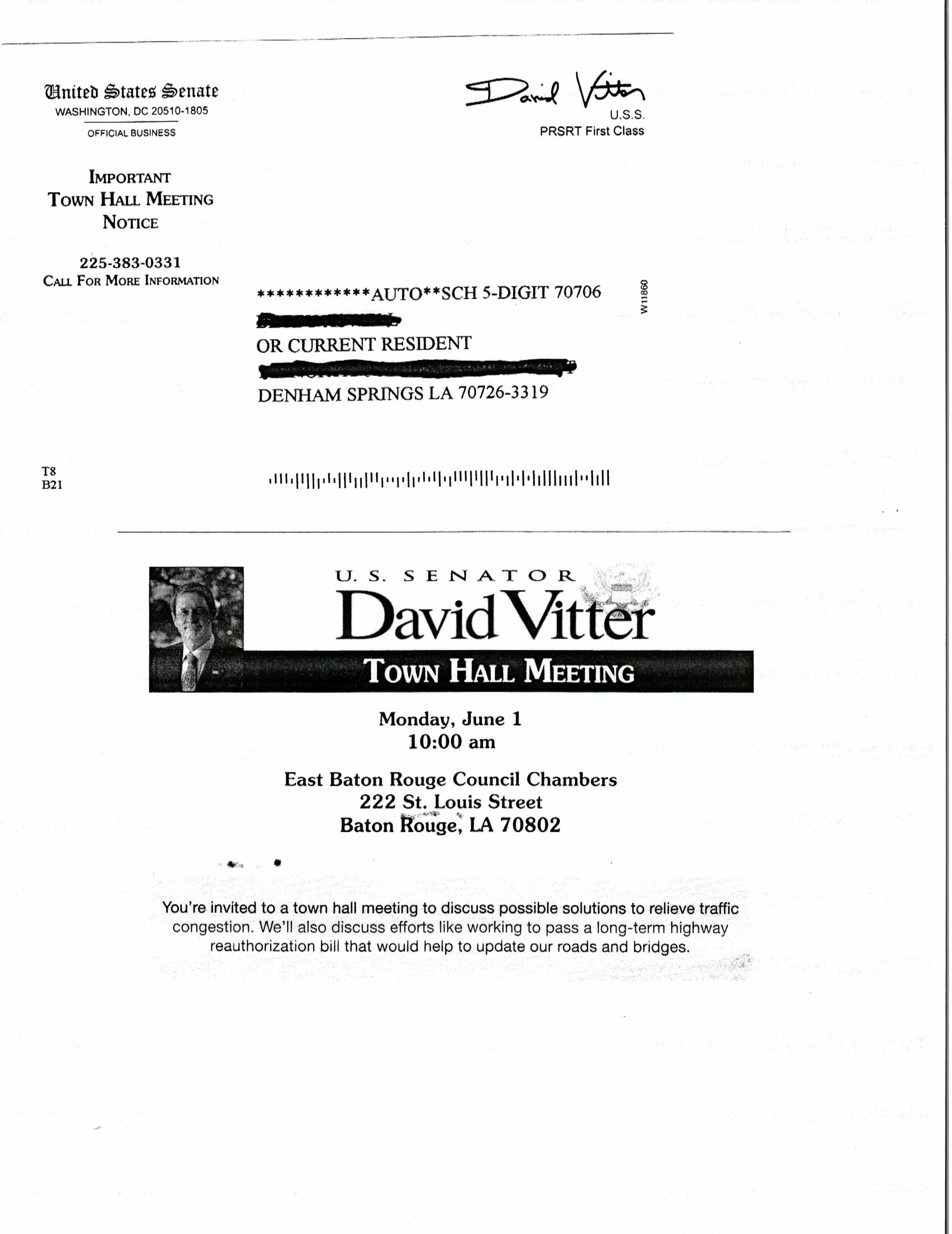
While strictly interpreted, such a discussion could easily be passed off as a federal concern with federal roads and highways crisscrossing East Baton Rouge Parish. That, along with the unquestioned problem of traffic congestion experienced by local motorists, could easily be construed by Vitter as a Senate-related issue.

We have no way of knowing at this point, but it would seem a safe bet that similar town hall meetings have been or will be announced by Vitter via franking in other parts of the state to discuss other pressing problems.

But coming as it does in the middle of what promises to be a heated election season in Louisiana, it would appear to give Vitter a decided—and unfair—advantage over his three opponents who do not have the luxury of free campaign mail-outs.

Nor would it be the first time Vitter has skated on the edge of campaign rules.

In January of 2014, Vitter was up against a state law that prohibited him from using his seven-figure campaign funds amassed as a federal office-holder for a state campaign.

No problem for a manipulators like Vitter and Charlie Spies, a Republican lawyer who was instrumental in launching Mitt Romney’s largest super PAC. In early 2013, Spies created the Fund for Louisiana’s Future and registered the super PAC both federally and in Louisiana in order “to support Sen. Vitter whether he ran for re-election to the Senate or for governor.”

Thus did Vitter become perhaps the first politician in the U.S. to be the largest single funder of his own super PAC.

A former general counsel for the Federal Election Commission said Vitter’s funding of his own super PAC, unprecedented to that point, raised the issue of the separation of super PACs and a candidate’s campaign “to a new level.”

Another observer, Paul Ryan, senior counsel for the Campaign Legal Center, said the existing Louisiana prohibition of the use of federal campaign funds in a state campaign was the only plausible reason for a candidate ceding control of his own campaign funds by transferring cash from his federal campaign to his gubernatorial campaign.

http://www.nationaljournal.com/politics/how-david-vitter-shattered-another-campaign-finance-rule-20140601

Stand by, folks. This election campaign promises to be a tad out of the ordinary, even by Louisiana’s unique standards.

Read Full Post »

That hateful, smugly, self-serving Executive Order 15-8 signed by Grovernor Jindal on Tuesday could ultimately blow up in his face, although his tenure as grovernor will be long over by the time the courts get around to ruling on his license to openly discriminate against gays.

In case you’ve been living in a cave these past few months, Jindal signed the executive order this week, in effect enacting the Louisiana Marriage and Conscience Act only hours after House Bill 707 by freshman Rep. Mike Johnson (R-Bossier City) was rejected in a 10-2 vote by the House Civil Law Committee.

Similar bills were passed by state legislatures in Indiana and Arkansas earlier this year.

Standing beside Jindal as he made the announcement of the executive order was Johnson but that ceremony could well be as close to a victory for the bill as the two tools of Gene Mills, Tony Perkins and Grover Norquist will get.

That’s because a challenge to a previous executive order, BJ 2012-16 (that would be the 16th executive order of year 2012) was upheld by the First Circuit Court of Appeal in Baton Rouge back in December and last month the Louisiana Supreme Court declined to hear the matter.

Janice Clark, 19th District Court Judge in Baton Rouge had approved the state’s motion to dismiss the case brought by the Louisiana Hospital Association (LHA) and the Louisiana State Medical Society against the Department of Insurance over Jindal’s executive order. The case will now be tried on its merits in state district court as a result of the higher court’s reversal.

Though far from over, observers will be watching the LHA closely case as it unfolds so as to gauge the effect it has on the governor’s powers to issue executive orders such as the one he handed down on Tuesday relative to the so-called marriage and conscience act which opponents see as little more than an effort to legally deny services by retail establishments, schools and medical facilities to gay couples.

The decision by the First Circuit, throwing the challenge to Jindal’s 2012 executive order back into state district court could impact his latest executive decision as well—long after a new governor has moved into the Capitol’s fourth floor. https://casetext.com/case/la-hosp-assn-la-state-med-socy-v-state

That 2012 order, creating Rule 26, suspended existing laws and granted far-reaching powers to Commissioner of Insurance Jim Donelon in the wake of Hurricane Isaac in August of 2012. The order’s justification was that Donelon could “be hindered in the proper performance of his duties and responsibilities…without the authority to suspend certain statutes in the Louisiana Insurance Code and the rules and regulations that implement the Louisiana Insurance Code including, but not limited to, cancellation, nonrenewal, reinstatement, premium payment and claim filings with regard to any and all types of insurance subject to the Louisiana Insurance Code.”

Accordingly, Jindal made the suspension of rules applicable to all insurance lines, including health maintenance organizations (HMOs), health and accident insurance, as well as property and casualty lines. Read the entire Rule 26 HERE.

LHA and the State Medical Society immediately filed their joint petition seeking preliminary and permanent injunctive and declaratory relief against the Department of Insurance, challenging the constitutionality of the rule.

Along with several other specific challenges, they claimed that the state statute does not grant the governor the authority to make “substantive, affirmative law.”

But it is the challenge to the governor’s authority to make “substantive, affirmative law” that should attract the attention of opponents of this week’s executive order.

It’s not likely that a ruling will be made on the 2012 executive order and the accompanying Rule 26 before Jindal leaves office and even it a ruling does come down, it’s likely to be appealed. But should a ruling adverse to his 2012 order, especially on the point of the governor’s ability to make law, result, it would obviously bolster the courage of opponents of the latest order creating the marriage and conscience act that specifically singles out gays on religious grounds but which could conceivably be expanded to other target groups.

No matter which direction the legal winds ultimately blow, the resulting publicity will be used by Jindal to continue to project himself onto the national stage, an invitation that has thus far eluded him.

If he wins, he will crow that justice has prevailed because his policy was on the same page with God. Should he lose, obviously, the judiciary will have come under left-wing, liberal influence.

Read Full Post »


b4ac09e9355fe66141a07e0ff68bc8e0_ebrf[1](CLICK ON IMAGE TO ENLARGE)

The metaphorical ink wasn’t even dry on the Baton Rouge Advocate web page story (yeah, we know, there’s no ink—or paper—on the internet) about Grovernor (as in Grover Norquist) Jindal’s decision to issue an executive order to do what the Legislature, in a rare flash of clarity, refused to do—approve House Bill 707 by State Rep. Mike Johnson (R-Bossier City)—when outraged comments from irate readers began appearing.

The House Civil Law Committee voted 10-2 to return Johnson’s silly yet dangerous Louisiana Marriage and Conscience Act bill to the calendar, a move that effectively kills the bill this session.

The grovernor immediately went on the attack by issuing his executive order to accomplish what legislators wisely would not—put in place the necessary protection for businesses to discriminate against gays. http://theadvocate.com/news/12415408-123/house-panel-effectively-kills-religious

“It’s not about discrimination,” Grovernor Jindal insisted. “It’s about protecting rights.” JINDAL EXECUTIVE ORDER

Whose rights? Certainly not those of gays and if the law is taken to more extreme measures, as some will almost certainly attempt to do, against blacks, against Islamics, against Jews, against Hispanics, perhaps even against Asians, including Indians.

This is about anything but protecting a business owner who has deep-seated religious beliefs from catering to same sex marriages. What if that business owner has equally deep-seated religious beliefs against Little League baseball players playing a Sunday afternoon makeup of an earlier rained-out game? Of if he is offended because Jews don’t observe their Sabbath (Saturday) on the same day of the week (Sunday) as Christians?

There have already been stories about how just about any one of us is condemned to hellfire and damnation by laws and dictates of the Old Testament. Robert Mann had a dandy that ran in the New Orleans Times-Picayune that illustrates the sheer idiocy of Johnson’s bill and those like it passed in Indiana and Arkansas. http://www.nola.com/opinions/index.ssf/2015/04/louisiana_religious_freedom_ga.html

And thorough as Mann’s story was, there was no mention of Leviticus 20:13: “If a man lies with a man as one lies with a woman, both of them have done what is detestable. They must be put to death.”

So there you have it: could Jindal’s real agenda be an executive order as the first step toward capital punishment for gays? It is in the Bible, after, and Jindal’s agenda is by his own admission, faith-driven. It’s only logical, to quote Star Trek‘s Mr. Spock.

As one Advocate reader so aptly observed, Jindal is the non-candidate running all over the country bitching about overreach in government but who apparently had no problem handing down his own edicts that control millions of people’s lives when it happens to be political expedient to him.

Another reader was quick to pounce on Jindal with his own words in an earlier attack on President Obama. He wrote, “Here is what Jindal had to say about President Obama’s Executive Order on Immigration: ‘If the President wants to make the case that the law should be changed, he should go make the case to Congress and our people. This is an arrogant, cynical political move by the President, and it’s why so many Americans no longer trust this President to solve the problems we face.’ Substitute the word ‘Governor’ for ‘President’ and what’s the difference?” he asked, perhaps not so rhetorically, of Jindal’s hypocrisy.

If Jindal’s latest actions, taken in context with the above statement, do not represent a double standard, then there never has been and never will be a double standard by any definition.

At the same time, it represents yet more legal fees for Jimmy Faircloth or whoever is called upon to defend the state when the lawsuits start flying and U.S. Supreme Court rulings come down.

A reader named Beatrice said that Jindal should begin waving one of those giant foam fingers people wear at athletic events, “except make it a middle finger, pointed at Louisiana.”

Our favorite, from Joe: “You’ve been bested, old man. Can you believe it? We have a genuine psychotic tyrant on the loose in the governor’s mansion.”

Finally, one reader attempted to steer the dialog back to the real issue. “The legislature just showed that you can’t be a bigot and get away with it here. There is finally hope for this state. Now maybe the legislature can get back to important things – like finding $1.6 Billion to et rid of next year’s deficit without destroying education and health care. You know—the thing that really matters in the day-to-day lives of Louisiana citizens.”

Not that any of those comments will matter to Jindal who with each passing day more and more frequently exhibits psychopathic patterns of behavior.

No, we’re not doctors, analysts, counselors or social workers, but some of the symptoms are right up front for all to see. Which of the below symptoms might apply to Jindal?

  • A disregard for laws and social mores;
  • A disregard for the rights of others;
  • A failure to feel remorse or guilt;
  • The inability to form emotional attachments or feel empathy with others (though they often can mimic emotions and fool those closest to them, even family members);
  • The ability to manipulate people and to easily gain others’ trust;
  • They generally are well-educated and able to hold steady jobs;
  • They are cool, calm and meticulous, planning out every detail in advance;
  • All the above.

Intelligent psychopaths make excellent white-collar criminals and con artists, thanks to their calm and charismatic natures. https://www.psychologytoday.com/blog/wicked-deeds/201401/how-tell-sociopath-psychopath

But none of those traits come close to describing Jindal, of course. Not this grovernor. No siree. Grovernor Jindal is sincere, understanding, compassionate, reverent and most of all, ambitious.

And there are delegates to woo in Iowa and those folks up there are God-fearing Christian who will take up his banner and follow him when they see what he’s done down there in Louisiana. Just you wait. He’s gonna bust through to 2, maybe even 3 percent in the presidential sweepstakes polls yet.

If you don’t believe it, just ask his core constituency—those Duck Dynasty people. They’re the ones who believe Jindal would be a great president, gays are abnormal human beings, and that blacks were happy picking cotton.

Seriously, though, the man is a total disgrace.

Read Full Post »

Additional checks by LouisianaVoice into the expenditure of campaign funds after leaving office has revealed that Troy Hebert, director of the Office of Alcohol and Tobacco Control was something of a piker in what appear to be his inappropriate expenditures of $39,000 in campaign contributions long after he left the Louisiana Senate in November of 2010.

Campaign reports examined by LouisianaVoice show that two former governors combined to spend more than $600,000 on what would appear to be such non-allowable expenditures as clerical salaries, club memberships, consulting fees, federal taxes, internet fees, office equipment, and something called “constituent relations” long after there were no longer any constituents. shall not be used for any perso

Three other former legislators who, like Hebert, now serve in other appointive capacities in state government were also checked at random and found to have combined for a little more than $22,000 in post-office-holding expenditures that appear to be for purposes specifically disallowed by the Louisiana Board of Ethics.

But former governors Kathleen Blanco and Mike Foster have made generous use of their leftover campaign bank accounts by paying hundreds of thousands of dollars for similarly disallowable purchases and expenditures.

Campaign expenditures for former governors Buddy Roemer and Edwin Edwards were not available on the State Ethics Board’s web page.

At the same time, we found one former legislator who has not spent a penny of his leftover campaign funds—for anything. Democrat Dudley “Butch” Gautreaux of Morgan City has spent none of his campaign funds—for any purpose—since leaving office in January of 2012. We sincerely hope there are others.

Foster, a Republican, accounted for more than $201,000 in apparent non-allowable expenditures from his campaign fund. He had the following expense items listed in his campaign expenditure report:

  • $3,000 for internet service;
  • $66,675 for clerical payroll;
  • $70,000 for copiers and other office equipment and maintenance contracts;
  • $9,400 in dues to the Camelot Club and City Club, both in Baton Rouge;
  • $4,300 in workers’ compensation insurance premiums for office staff;
  • $25,000 for bookkeeping services;
  • $9,800 in federal income tax payments on office staff;
  • $13,500 for “constituent services”;
  • $403 in payments to M.J. Foster Farms—an apparent reimbursement to himself for unknown expenditures.

In addition, Foster contributed to numerous causes, including $1,000 to a lamppost restoration drive in his hometown of Franklin and other charitable civic and church organizations and several political candidates. Only his contributions to political candidates and to the Louisiana Republican Party appeared to have been allowable under Ethics Board regulations.

Democrat Blanco easily eclipsed Foster with more than $400,000 in expenditures described in various Ethics Board opinions as not allowable for purposes “related to a political campaign or the holding of a public office.”

Some of her questionable expenditures included:

  • $188,000 for communication consulting;
  • $88,000 in clerical salaries;
  • $67,000 in donations to various causes;
  • $64,500 in tech support;

To be fair, however, there was brief speculation that Blanco would oppose Jindal in his re-election campaign of 2011 until health considerations took her out of that race. Any funds spent in exploration of a possible run would probably be looked upon favorably as campaign-related. Charitable contributions are allowed under certain conditions, such as in the cases of pro-rata refunds of unused contributions but otherwise such use of campaign funds for charitable donations is not allowed. We found an Ethics opinion that addresses that very issue: James David Cain

Like Foster, she also contributed generously to several political candidates as well as to the Louisiana Democratic Party, all allowable under Ethics Board regulations.

Former Sen. Anne Duplessis (D-New Orleans), now a member of the LSU Board of Supervisors ($13,440), former Rep. Kay Katz (R-Monroe), now a member of the Louisiana Tax Commission ($7,700), and former Rep. and former Sen. Noble Ellington (R-Winnsboro), now Chief Deputy Commissioner of Insurance ($1,300), each also had combined expenditures from their respective campaign funds totaling about $22,400 for purposes not allowed, according to Ethics Board regulations.

Small as those expenditures were when contrasted to Blanco, Foster or even Hebert, however, the samplings of more than $662,000 in questionable expenditures found by LouisianaVoice for only six former office holders—and the many examples of misuse of campaign funds by current officer holders—illustrates the critical lack of oversight of the manner in which office holders and former office holders alike live the good life off, what for many of them, is tax-free income most times in the tens of thousands of dollars but in some cases, six figures.

Campaign funds are contributed by donors, such as lobbyists, corporations, or other special interests who want something in return, like a favorable vote on a key issue. And because the politicians generally oblige, the donors couldn’t care less how campaign funds are spent. The funds are donated for the wrong reasons, so why should they care if they are spent for the wrong reasons?

That in a nutshell is what is wrong with our political system today. Far too much quid pro quo, a few winks, a couple of drinks over steak or lobster and donors look the other way as the recipient enjoys nice restaurants, club memberships, luxury car leases and tickets to college and pro athletic events and perhaps the occasional hooker.

Two things can occur to rein in this abuse:

The Louisiana Legislature, in a rare (and we do mean rare) moment of integrity and soul-searching, could enact binding laws governing who can contribute to campaigns (such as tracking the federal elections laws prohibiting corporate contributions), limiting PAC funds and spelling out in detail how campaign funds may and may not be spent.

But don’t look for that to happen in this or any other lifetime. Like corporations and banks, politicians just aren’t going to self-regulate without including a gaggle of hidden loopholes in any legislation that might happen to address the issue. You can bet any legitimate attempt will either be killed outright or amended to death in committee.

The other—and this, sadly, is just as unlikely—the voters of Louisiana will, in unity, say “ENOUGH!” They will, like Peter Finch as Howard Beale in Network, scream out their windows, “I’m mad as hell and I’m not going to take it any more” and they will turn out of office any legislator who so much as buys the first ticket to a football game or dines at a fine restaurant or leases a luxury auto with campaign funds. And in equal unanimity, they will demand reimbursement of all funds wrongly spent by current and former office holders alike.

But a final word of caution: That would be in a perfect world so don’t hold your breath.


Read Full Post »

By the content of that comment from the writer calling himself Earthpapa, we figured we must have hit a nerve with our report about Troy Hebert’s “campaign” expenditures on hotels and LSU tickets after he left office.

But the fact is, an apology is in order. We said he spent $4,930 in campaign funds on LSU tickets after he left office.

On double checking our figures, we find the actual amount is $4,991.

But the lengthy comment by Earthpapa appeared to have Hebert’s footprints all over it and the strident tone of his missive indicated to us that we had scored a direct hit, or very close to it.

And while we’re not saying with any definitiveness that Hebert was the author of the comment, it was enough to send us diving back into his campaign report for other expenditures incurred after he left the Louisiana Senate in November of 2010 to become head of the Office of Alcohol and Tobacco Control (ATC).

(As an aside, the State Ethics Board has said that if campaign funds are not to be used for the purpose of campaigning or holding office, they are to be returned to the donors on a pro rata basis. Accordingly, if 100 donors give $1,000 each and $50,000 is left over and not to be used, then theoretically, the 100 donors would receive refunds of 50 percent of their contributions, or $500 each.)

But Hebert, apparently playing by his own rules, has continued to spend campaign funds at least through last December on such things as Christmas cards, advertising, postage, office supplies, stationery, flowers, food, newspaper advertising, subscriptions, gifts, clerical salaries for his New Iberia office and, of course, those LSU tickets—all expenditures not allowed under state campaign regulations.

Specifically, the Ethics Board says, “Funds must be expended for a use related to a political campaign or the holding of a public office.” (Emphasis by the Board.) But Hebert has not held office nor has he sought political office since becoming ATC director. shall not be used for any perso  may not be used for any personal use unrelated to holding of public office

In all, Hebert (aka Earthpapa?) has shelled out more than $36,300 in non-campaign-related expenditures since December of 2010, according to his own campaign finance records. TROY HEBERT CAMPAIGN EXPENDITURES POST-SENATE

A breakdown of expenditures, in addition to the $4,991 in LSU tickets, includes:

  • $3,539 on newspaper advertising;
  • $14,454 on souvenirs (logo hats and shirts) and office supplies;
  • $1,785 for postage, Christmas cards and newspaper, magazine and cable subscriptions;
  • $1,250 on ornaments, gifts and lunches;
  • $8,500 in political contributions to other candidates (which is allowable);
  • $4,500 in salaries to two clerical employees in a New Iberia office from December of 2012 (the month after he left office) through December of 2013, two years after he left office.

There was no explanation as to why the ATC director needed an office in New Iberia or why his campaign funds had to be used to pay office staff salaries.

In November and December of 2014, three years after leaving office, he spent $3,585 at Erin Oswalt Photography for Christmas cards and in December of 2010, he spent $492 with Oswalt on postcards, campaign expense reports reveal.

His campaign also purchased $1,028 in postage between December of 2010 and December of 2014—not counting the eyebrow-raising $676 in campaign funds spent in December of 2014 for Christmas card postage.

Again, it’s difficult to conceive why the director of a state agency would need to purchase more than $1,700 in postage stamps over a four-year period using campaign funds long after he left office in open violation of campaign regulations.

Perhaps Hebert Earthpapa will contact us and explain the use of campaign funds for non-campaign purposes.

Read Full Post »

« Newer Posts - Older Posts »


