Feeds:
Posts
Comments

Archive for the ‘Ethics’ Category


Louisiana Troop A State Police Lieutenant John Cannon remains on his $115,690 per year job despite having been reprimanded for numerous offenses including theft of satellite television signals, failure to file required Daily Activity Reports (DARs), unauthorized voiding of traffic tickets, failure to investigate a fleet crash, failure to deliver fatality packets to the families of traffic fatality victims, and twice having sex with a woman while on duty—with one of those times being in the rear seat of his patrol unit.

Legislators approved two double digit state police pay increases six months apart earlier this year even as more than 35,000 state civil service employees were learning that they again would not receive 4 percent pay increases. https://louisianavoice.com/2015/09/29/state-general-fund-has-yet-to-see-any-of-the-11-million-in-delinquent-fine-collections-to-pay-for-state-police-pay-raise/

http://theadvocate.com/news/13605105-128/no-pay-raises-for-most

Troop A includes the eight parishes of East and West Feliciana, Pointe Coupee, East and West Baton Rouge, Iberville, Livingston, Ascension and part of St. James. Cannon, a shift supervisor, has been a state trooper since 1990. He was promoted to sergeant in July of 2000 and to lieutenant in August of 2010.

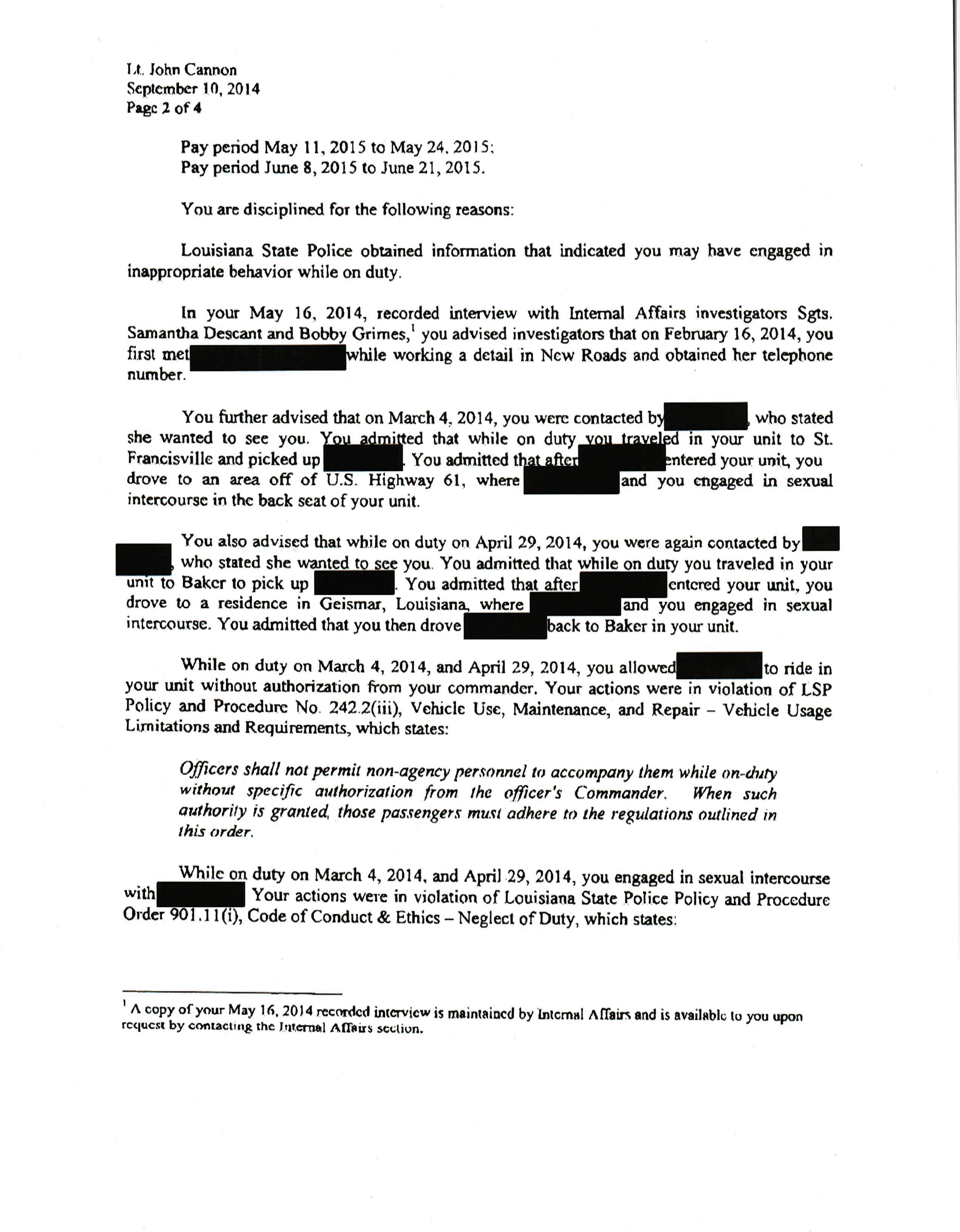
LouisianaVoice obtained the 38-page state police internal affairs investigative file on Cannon through a public records request. That file indicates Cannon was never demoted for his actions. His most severe punishment included a 36-hour suspension without pay and a $904.96 per pay period reduction in pay for nine two-week pay periods (the equivalent of a 240-hour suspension)—from Oct. 27, 2014 through June 21, 2015, that was handed down by letter of Sept. 10, 2014 from Lt. Col. Charles Dupuy.

The internal affairs investigation of claims that Cannon had sex with a woman on two occasions while on duty was launched on May 15, 2014, after West Feliciana Parish sheriff’s deputies reported they had a woman in custody for possession of Lortab and marijuana. The woman, whose name was redacted throughout the report, told deputies that she twice had exchanged sex for money with Cannon.

She repeated her story to state police detectives but failed a polygraph test on the question of her being paid for sex, the report said. Cannon subsequently admitted to detectives that he had sexual intercourse with the woman but denied he paid her for sex although he did admit that he twice gave her money. He said the money was given immediately before or after each sexual encounter but that on the first occasion the money was to pay her cell phone and the second time was to pay her rent and that he was only trying to help her and to establish a friendship.

While the woman was twice subjected to polygraph tests and failed on the key point of payment for sex, the state police report never indicated that a similar test was administered to Cannon even though that was the only aspect of the entire affair that would have actually been criminal in nature.

The two first met on Feb. 16, 2014 in, New Roads in Pointe Coupee Parish where Cannon was working a seat belt grant. The woman told investigators that the two had multiple conversations by phone before meeting behind the parish library in New Roads on Feb. 21 “sometime between 9 and 11 p.m.,” but that they did not engage in sex on that occasion. She said they subsequently “negotiated sex on the phone.”

Cannon later called her at her father’s home in St. Francisville where she was living and told her he “needed her,” she said. The woman told authorities that she told Cannon she was out of money and that he later picked her up in his marked state police unit near her father’s residence and “immediately gave her $120, which she claimed was for sex,” according to the report. Cannon later said the amount was closer to $60 and was not for sex but for her cell phone bill. The report by internal affairs put the date as March 4, 2014.

She told investigators that their first sexual encounter took place in a wooded area south of St. Francisville just off U.S. 61 and lasted “approximately two minutes.” Afterward, she said, Cannon realized his patrol car was stuck and that she smoked a marijuana joint while he checked to see how badly the car was stuck. Apparently realizing how it might look if he were caught with her in such a secluded area, especially given the fact that he was dating an employee of the West Feliciana Parish Sheriff’s Office at the time, he ordered her to walk to the main highway and catch a ride while he called for someone to pull him out.

She did catch a ride to her father’s house while Cannon called the sheriff’s department for help in removing his vehicle.

Almost two months later, on April 29, Cannon picked her up—in his state police unit while on duty and in full uniform—from an apartment in Baker where she was living with her boyfriend. Cannon drove to a home she told authorities she believed to be in Baton Rouge but which Cannon later admitted was a friend’s home in Prairieville in Ascension Parish. They again had sexual intercourse in a bedroom of the home, that time for a duration of about three minutes, she said. She told investigators she requested $150 afterward but Cannon gave her only $100. He admitted that he stopped at a Regions Bank ATM on Highland Road in Baton Rouge in order to withdraw some cash. He said the amount he gave her was closer to $60 to $80 but when advised that she claimed it was $100, he told investigators it “was possible he could have given her that amount,” the report said.

The report reiterated Cannon’s claim that while he gave her money, it was to pay her phone bill and to pay her rent but was never given in exchange for sex

While en route from Baker to Prairieville, she activated Cannon’s patrol unit’s siren which resulted in other motorists moving out of the way and that she videoed the interior of his unit with her cell phone. She said she also took a photo of the house to show her boyfriend. She said Cannon was aware of her videoing the inside of his patrol car but that he did not know about her taking a picture of the house.

His 36-hour suspension ran from Oct. 10, 2014 through Oct. 13, 2014, and he was allowed to return to work from Oct. 15 through Oct. 26.

That 224-hour time frame actually covers 18 pay periods because, according to the specified dates of his suspension, he was suspended only on every other pay period, thus allowing him to work during alternate pay periods.

The suspension also contained no prohibition to Cannon’s being able to work overtime in order to make up for the $904.96 reduction in pay for each pay period for which he was suspended. LouisianaVoice has submitted a follow-up public records request for documents related to all overtime worked by him from Oct. 27, 2014, and June 21, 2015.

Cannon has had a checkered record in his 25 years as a state trooper.

  • On April 12, 1995, he received a letter of reprimand for his involvement in a traffic accident in his state police car, a not uncommon occurrence for state police.
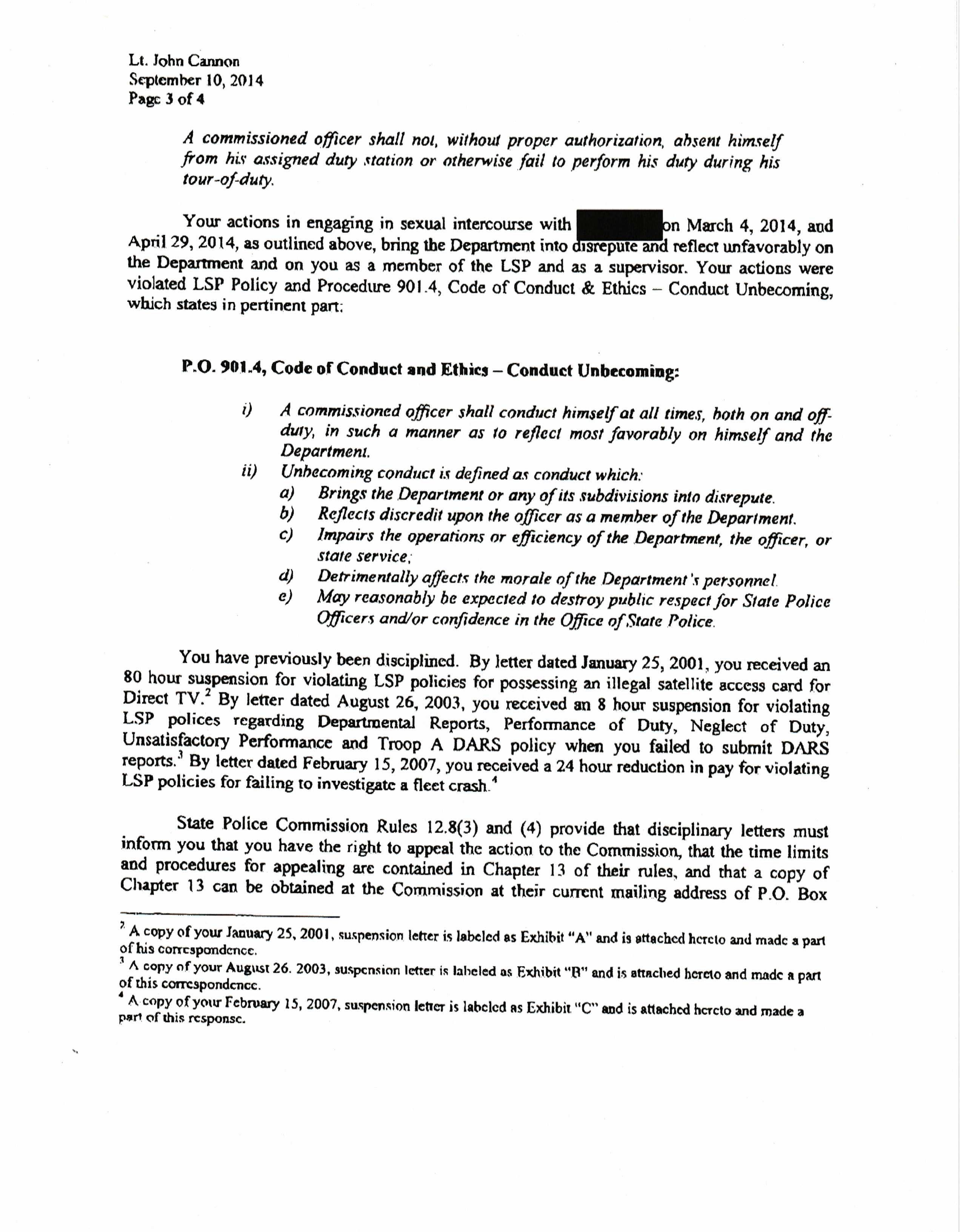
  • On Jan. 25, 2001, he was suspended for 80 hours after being found in possession of an illegal satellite access card for Direct TV.
  • On June 6, 2003, he received an eight-hour suspension for failure to submit his Daily Activity Reports (DARs).
  • On April 27, 2006, he received a reduction in pay equivalent to a 24-hour suspension for failure to investigate a fleet crash.

And even after Dupuy’s letter of Sept. 10, 2014, which imposed the 240-hour suspension for his sexual misconduct while on duty, he received a reprimand but no suspension on March 18 of this year for his failure to act upon six traffic citation void slips and for failure to follow state police procedure with nine other citations.

Additionally, a review revealed that Cannon had seven fatality reports that are provided by state police as a courtesy to families of the deceased which he had not delivered. The fatalities had occurred between the dates of March 24, 2014, and Oct. 1, 2014, but still had not been delivered to families of the deceased as of Dec. 4, 2014.

And while technically, Cannon claims he was not paying for sex, a case could be made that because he was on duty at the time of his trysts, he was being paid for sex.

All of which raises the obvious questions: Was he being protected from above and if so, who was protecting him?

Here is Lt. Col. Dupuy’s letter of Sept. 10, 2014, to Cannon (Click on image to enlarge):

IMAG1320IMAG1321IMAG1322IMAG1323

Read Full Post »

When LouisianaVoice attempted through a public records request to obtain an unredacted version of the disciplinary records of a trooper in State Police Troop D, our request was denied. Louisiana State Police Attorney Supervisor Michele Giroir explained that the individual’s rights to privacy outweighed the public’s right to know.

Specifically, her letter of Aug. 18 said:

  • The Department has reviewed your request. It remains the Department’s position that you are not entitled to review the redacted information. The individuals’ rights to privacy established by Article 1, Section 5 of the Louisiana Constitution of 1974, as amended, outweigh the public’s right to know the personal information in this matter….The substance of the matter is personal in nature and not related to (the trooper’s) duties as a state trooper. The information that you reviewed in the letter (in the redacted document we were provided) contains the substance of the conduct for which (the trooper) was disciplined as it related to his duties as state trooper. Providing further information would violate the involved parties’ rights to privacy.

Her decision left us disappointed but at the same time, we understand there are certain rights to privacy that must be upheld.

Apparently Troy Hebert did not get the memo. And now he is being sued for making just such private information public.

Moreover, it appears he may have violated an order from a Civil Service hearing referee not to discuss the matter with anyone, “including the media.”

Actually, his actions only provided cause for the filing of an amendment to a lawsuit already filed in Federal District Court in Baton Rouge over Hebert’s retaliation against former ATC agent Brette Tingle.

One day after Giroir’s letter, on Aug. 19, Hebert, Director of the Louisiana Office of Alcohol and Tobacco Control (ATC), issued a news release that was disseminated widely over television and print media in which Hebert leaked the contents of private cell phone text messages and emails.

Though Tingle’s communications on his state-issued cell phone contained sexually and racially-charged messages, the messages were to friends and family members, some of them African-American. Such messages are considered private under the Louisiana Constitution, as Giroir said in her letter. Moreover, LouisianaVoice learned in interviewing two African-American agents that some of the racial remarks were made to them but were said in jest. “I say some of the same things he said,” said one African-American agent, a female. “We joke back and forth with each other that way.”

Another African-American who worked with Tingle, Larry Hingle, said he understood the context in which Tingle’s messages were made and that he had no problem with him.

Tingle, in fact, contends that Hebert’s vendetta against him stems from his (Tingle’s) testimony on behalf of Charles Gilmore, one of three African-American ATC agents who filed Equal Employment Opportunity Commission (EEOC) complaints against Hebert. The three, Gilmore, Hingle, and Daimian T. McDowell subsequently filed suit against Hebert in Baton Rouge Federal District Court. https://louisianavoice.com/2014/07/14/forcing-grown-men-to-write-lines-overnight-transfers-other-bizarre-actions-by-troy-hebert-culminate-in-federal-lawsuit/

In his amended lawsuit, Tingle cites the same Article 1, Section 5 of the Louisiana Constitution which says, “Every person shall be secure in his person, property, communications, houses, papers, and effects against unreasonable searches, seizures, or invasions of privacy.” That pretty much tracks the Fourth Amendment which prohibits unreasonable search and seizure.

The search and seizure of the text messages in this case was (sic) unreasonable because, at the search’s inception, there was (sic) no reasonable grounds to believe that the search would reveal any employee misconduct and because Troy Hebert provoked this search in bad faith, in an arbitrary and maximally intrusive manner, and in retaliation for Brette Tingle’s exercise of protected activity,” Tingle says in his amended petition.

“The plaintiff (Tingle) never consented to Troy Hebert or anybody else searching his private text messages with his friends and family in an intrusive fishing expedition to search for any evidence that Troy Hebert could try to use to avoid the consequences of his overt race discrimination against African-American employees by discrediting Brette Tingle as a witness,” it said.

Moreover, the petition says, Hebert laid out false allegations of payroll fraud against Tingle in his news releases “even though an extensive investigation by the Louisiana Office of Inspector General (OIG) had found no probable cause for the payroll fraud accusation…”

(Both Hebert and the OIG’s Inspector General are appointed by the governor.)

Even more egregious, Tingle says, Hebert read Tingle’s communications aloud to 12 female ATC employees on Aug. 21.

“The extracts of these conversation, which were widely publicized by Troy Hebert, constitute defamation by innuendo and the embarrassing disclosure of personal and private facts,” the petition says. “This is particularly so since these alleged conversations have nothing whatsoever to do with Brette Tingle’s job performance and thus, Troy Hebert had no legitimate interest in publicly broadcasting these alleged private conversations.”

Hebert even hinted that Tingle may have been guilty of setting fire to Hebert’s state vehicle, Tingle said. “In an interview with a New Orleans news outlet, WVUE-TV, on Aug. 19, Troy Hebert…stated that if a person was (sic) to ‘connect the dots,’ it would be clear who vandalized the vehicle.

“While it is apparently true that Troy’s vehicle had been set on fire, Troy Hebert had no evidence that the plaintiff had committed this crime,” Tingle said. “Troy Hebert did know, or certainly should have known, that the temporal proximity of his statements and the termination of the plaintiff carried false and defamatory implications.”

The petition said the communications from his cellphone were “taken out of context and do not accurately reflect Brette Tingle’s attitudes toward persons of color.” He said he is “well-respected” by persons of color for his “fair-minded attitudes and conduct. Indeed, it is only because Brette Tingle took a firm and courageous stand against Troy Hebert’s race discrimination and retaliation against former fellow employees that Troy Hebert has gone to great lengths to destroy his (Tingle’s) career and reputation,” it said.

We at LouisianaVoice have followed Troy Hebert’s ham-handed manner of running his agency since he was named to replace Murphy Painter who was fired on bogus charges by the Jindal administration.

If there is anything that can be said of Hebert, it’s that he appears to be as inept and clueless as his boss. He has managed to run a once-fine investigative agency into the ground with his petty insistence on requiring agents rise and greet him with an enthusiastic “Good morning, Commissioner” upon his entering a room. We were dismayed to learn that he has forced agents, fully grown adults, to literally write lines. We were incredulous when he ordered Gilmore transferred from Baton Rouge to Shreveport literally overnight with no opportunity for him to make plans for such a move. And we were shocked to the point of disbelief upon learning that he had ordered a female agent to return to a New Orleans bar in full uniform—after she had purchased drugs while working as a plainclothes undercover agent in that same bar only days before.

We were puzzled when Jindal snatched him from the Legislature to serve as the top enforcement agent for ATC with no qualifications other than the fact that his wife is the Jindals’ children’s pediatrician.

But now, somehow we are unable to be shocked at anything this man does. Apparently no underhanded tactic is beneath him—even when it comes to violating the same State Constitution that the chief legal counsel for the Louisiana State Police was sufficiently cognizant to uphold in denying our access to personal records.

Hebert apparently has no problem violating a direct order from a Civil Service hearing referee who presided over an appeal of Tingle’s firing in July. The referee was quite specific in admonishing witnesses not to discuss the Tingle matter “with each other or anyone else, including the media.” That order was issued when Tingle’s hearing was continued by the referee who said a violation of her dictum “could result in disciplinary action, including dismissal” from their jobs. https://louisianavoice.com/2015/07/10/civil-service-hearing-for-fired-atc-agent-continued-to-sept-after-settlement-talks-break-down-troy-didnt-want-us-there/

In an otherwise competent, transparent and ethical administration, we would have expected Hebert to have been fired months ago. Under the Jindal administration, we harbor no such hope. In fact, Jindal did quite the opposite in naming Hebert his office’s legislative liaison.

Read Full Post »

Furtive plans by some agency heads to move certain unclassified employees into Civil Service classified positions before Bobby Jindal leaves office could be thwarted by Civil Service rules designed expressly to prevent such maneuvers.

LouisianaVoice received reports on Wednesday (Sept. 23) of plans to move some of Jindal’s appointees from unclassified to classified positions as a means of protecting them from potential termination by the new governor when he takes office on Jan. 11.

“Since the clock is ticking on the Jindal administration,” wrote one state employee, “his department heads are converting…unclassified folks into classified positions. Only trouble is, those positions don’t pay that well. [I] overheard a conversation by some HR (Human Resources) folks that they don’t know how to make the slip switch and include a $30,000 add-on to the classified position.”

But former Civil Service Director Shannon Templet, in one of her last actions before accepting the position of director of human resources for the Louisiana House of Representatives, may have put the kibosh on any such plans—or at least made any such attempt considerably more difficult.

General Circular 2015-033, issued to heads of state agencies and human resource directors on Sept. 1, addresses that very scenario although there still may be a small window of opportunity to circumvent a prohibition against converting appointees to unclassified positions. CIVIL SERVICE CIRCULAR 2015-033

The circular alluded to Civil Service Rule 22.2 which says all appointing authorities shall obtain the Civil Service Director’s approval before making a permanent appointment to any job at specified pay grades.

But the policy governing such appointments is applicable only between the date of any election for a statewide elected office (Oct. 24, 2015) through Inauguration Day (Jan. 11, 2016).

There appear to be no restrictions to such transfers between now and Oct. 24, which is nearly a full month away and some movement may have already occurred.

“Unless the director grants permission, vacancies covered under this rule cannot be filled on a permanent basis through a probationary or permanent appointment into a regular ongoing position,” the circular says. “This also applies to promotions and transfers into an agency while on permanent status.

“The process will be handled as follows:

  • Vacancies affected by this rule shall not be announced without obtaining prior approval of the director by means of a letter which includes justification explaining why the vacancy needs to be filled.
  • Agencies are to send letters requesting approval to fill to the Staffing Division.
  • Agencies will be notified via email of the director’s decision.
  • Verification of approval must be attached to the exam plan…for audit purposes.

Even if an appointive (non-classified) position should be converted to a classified one, the additional task of adjusting the position’s salary poses yet another problem—unless the appointee would agree to a major pay cut.

Because Civil Service classifications govern pay scales for every classified position in state government—as opposed to unclassified positions, which have no such restrictions—appointive posts generally pay much higher salaries than civil service jobs. Converting from unclassified to classified necessarily would dictate significant reductions in pay.

But even if that wrinkle could somehow be worked out, there is one more deterrent to such an underhanded tactic. Any transfer, lateral or otherwise, or new appointment generally carries with it a six-month (180 days) probationary period during which the employee may be terminated without cause.

As of today (Sept. 23), there are exactly 110 days until a new governor takes office.

Read Full Post »

Two separate directives, one from State Police Internal Affairs and the other from the Louisiana State Troopers Association (LSTA), have been sent to state troopers from State Police Troop D in Lake Charles relative to a multi-pronged investigation of reports of a series of irregularities in the troop.

A two-page memorandum from the Louisiana State Troopers Association (LSTA) was sent to Troop D state troopers in Lake Charles informing them that “eight or so” Troop D members have received letters indicating they are the targets of an Internal Affairs administrative investigation.

While the investigation was classified as administrative, it was made clear that the probe could become a criminal investigation.

The main thrust of the investigation appears to be related to time reported in driving to and from Baton Rouge to participate in firearms transition training. In that matter, some troopers reportedly charged more time than others for the same trip to qualify for firing of new weapons earlier this year. LouisianaVoice requested time sheets for those officers but state police attorneys denied our request because the matter was part of an official investigation—an investigation that was not initiated until we made our public records request.

Earlier, a single page communication from State Police Internal Affairs (IA) warning Troop D members to cooperate with the investigation either as witnesses or as targets.

LouisianaVoice was provided a copy of both letters, but is complying with requests that neither be reproduced here for fear that State Police investigators have some method of tracing the source of the leak because of special coloring or encoding on each copy sent out.

LouisianaVoice has learned that troopers in Troop D have been warned not to talk to anyone about the investigation, including LouisianaVoice. “They have put out a directive to intimidate the guys at Troop D so they won’t talk to you,” one source informed us on Saturday.

While neither memo mention LouisianaVoice by name, troopers were warned in the IA memorandum that all aspects of the probe are considered confidential and are to be discussed with no one.

The IA letter said, “As a Louisiana State Trooper, you are hereby advised of your rights related to an administrative investigation…

This administrative investigation is of potential violations of LSP and/or DPS policies and procedures including, but not limited to, irregularities regarding accrual of time, overtime, LACE details, escorts and other details, involving employees currently or formerly assigned to Troop D.

LACE, or Local Area Compensated Enforcement, is a program which is run by some district attorneys in the state to pay for traffic enforcement, including DWIs. District attorneys are willing to pay overtime to have state troopers monitor local traffic when there is insufficient local law enforcement. It became part of state law enforcement in the 1980s after state police suffered from a lack of state funding in an effort to put more troops on the roads when the state could not.

LACE was run sporadically in southwest Louisiana since its inception but has been a full time program only since 2008.

“…Your responsibility in this investigation is to cooperate fully with the investigation and to keep the substance of the investigation and the fact thereof confidential as outlined below.

  • Internal Affairs investigators or designated Administrative Investigators shall receive the full cooperation of any employee of the Department of Public Safety and Corrections, Public Safety Services, during the course of an administrative investigation. Employees shall obey any lawful order or directive given by the investigator during the investigation.
  • Ongoing administrative investigations are considered confidential and as such, officers shall not violate that confidentiality. Those in violation are subject to disciplinary action.
  • You are hereby ordered to refrain from destroying anything which might constitute evidence relevant to this investigation, including, but not limited to, department documents, electronic documents, electronic data, email communications, text message communications, communications on your MDT (mobile data terminals), radio logs, timesheets, and mobile video recordings.

The second, two-page communique from LSTA also said that “virtually other members of Troop D received letters notifying them that they are potential witnesses to one or more ongoing investigations.”

The LSTA memorandum was written in the first person and while the author is not identified, it appears to have originated from LSTA administrative offices.

Besides the time charged for firearms qualifying in Baton Rouge last spring, it specified six areas as possible subjects of investigation, including five previously cited by LouisianaVoice in its recent series of stories about Troop D. Those include:

  • Overtime/decline overtime;
  • Gift cards/ticket quotas;
  • Escort payments;
  • Payroll abuse;
  • Time off for DWI arrest;
  • LACE.

Of the six, only the LACE program was not reported on previously by LouisianaVoice, although allegations of irregularities in the program have recently come to our attention.

LouisianaVoice made public records requests for documents pertaining to overtime charged by certain troopers, excessive escort payments that were allegedly charged by a Troop D trooper, for radio logs and time sheets of yet another trooper, all of which were denied by LSP attorneys because the records were part of “ongoing investigations.”

And while no requests were made for public records involving gift cards, ticket quotas, or time off given troopers for DWI arrests, LouisianaVoice did publish a story about the practices in an earlier post. https://louisianavoice.com/2015/09/11/gift-cards-for-tickets-payroll-chicanery-quotas-short-shifts-the-norm-in-troop-d-troopers-express-dismay-at-problems/

Among other things, the LSTA memorandum said:

  • Troopers have a right to counsel and a right to consult with their LSTA representative provided the representative is not involved in the same investigation;
  • Eight or so Troop D members have received Target Letters indicating they are the subject of an investigation;
  • Virtually all members of Troop D have received letters notifying them that they are potential witnesses to one or more ongoing investigations;
  • Other troopers could become targets as the various investigations progress;
  • The stated purposed of the investigation relates to the “accrual and/or reporting” of time concerning the 2015 firearm transition training;
  • Other potential areas of investigation are ongoing, although few specifics were provided to LSTA;
  • All members of Troop D are required to cooperate fully in all investigations;
  • Some aspects of the ongoing investigations could have criminal ramifications but so far, the investigation is only an “administrative investigation.”
  • The confidentiality warning troopers received separately does not include troopers’ conferring with legal counsel;
  • Those cited as the subject of an IA interrogation and those who may be witnesses in an IA interview were cautioned to tell the truth;
  • Anyone interviewed is entitled to a copy of the interview upon request;
  • Likewise, those who are targets of the investigation are entitled to a copy of any written complaint leading to an interrogation upon request;
  • Anyone interviewed or interrogated is obligated to answer question but not obligated to engage in lengthy discussions, i.e. “tell us what you know. IA can ask a question. You should answer the question as directly and concisely as possible (and) then wait for the next question. Do not engage in a friendly conversation.”
  • Interview subjects were instructed to answer “I don’t know” to questions they do not know the answer to. “Do not speculate. Do not estimate. Do not just talk—answer the question directly and shut up while waiting for the next question.”
  • Interview subjects were told the most important thing they can do “is listen to the question carefully, answer the question as directly and concisely as possible and wait for the next question.”
  • Finally, they were told, “Remember, you have a right to counsel and a representative if you feel it necessary.”

The LSTA memorandum’s author said, “If I have learned anything over the last 7-8 years under the Edmonson administration, it is that the Colonel reacts badly if he believes a trooper lies or tries to obstruct an investigation.”

LouisianaVoice currently has additional public records requests pending that involve state troopers in other parts of the state.

Read Full Post »

The badge of the Louisiana State Police has been tarnished and the rank and file—the road troopers, especially those in Troop D—don’t like it.

From reports of gift cards to troopers for making ticket quotas to an unwritten policy of giving time off for DWI arrests to padding of fees for escorting oversized loads, the picture emerging from Troop D presents a negative reflection on the entire Department of Public Safety.

And those troopers who are trying to uphold the integrity of the LSP motto of “Courtesy, Loyalty, Service” believe that is an unfair representation. They have privately expressed their collective dismay—particularly at a time when it appears that open season has been declared on law enforcement officials by seemingly anyone with a grudge.

LouisianaVoice has learned from sources within the Department of Public Safety that Trooper Ronald Picou of Beauregard Parish has been suspected of committing payroll chicanery for years. His fellow troopers say Picou gets his recommended number of citations (read quota) within the first couple of hours after coming on duty and then abandons his patrol duties for the remainder of the shift.

LouisianaVoice has learned that Picou habitually works the first two or three hours of his 12-hour night shift or four-to-six hours of his 12-hour shift when working days. All activities during a shift are logged on the State Police radio but there were some shifts that Picou supposedly worked which showed zero radio activity.

Other Troop D troopers questioned whether Picou is writing the tickets he did write because the driver deserved a citation or so that the trooper can take off early but still get paid. Picou is assigned to patrol Beauregard Parish.

When troopers took it upon themselves to determine where Picou was spending his shift, the answer came almost too easily, they said. His patrol vehicle was parked at his home while taxpayers’ investment in protection was being ignored. Some troopers said that Picou even bragged about sleeping at home.

Why would a trooper need to spend so much time at home? It might be because he has been too busy running a construction company during the day.

Louisiana Secretary of State corporate records show that Ronald Picou runs TRP Construction at 1870 Granberry Road in Deridder in Beauregard Parish. That also is the address of his residence.

Our sources indicate that Picou would work only a couple of hours of his night shift and then go home to rest so he could work at his construction job the following day.

TRP’s corporate papers were filed with the Secretary of State on April 23 of this year. Prior to that, he was active in Bois Clair, LLC, a right-of-way construction company whose previous address was also 1870 Granberry Board. Bois Clair is no longer affiliated with Picou and now has a Leesville address, effective April 23, the same date his current company was registered with the Secretary of State.

His co-workers at Troop D say they are fed up that he is not available to back up other troopers or other law enforcement agencies by choosing instead to pursue private business interests during his off hours and resting during his shift hours.

State Police Investigation of the Payroll Abuse

So how could a law enforcement officer go silent for up to 12 hours at a time without attracting the attention of supervision? It seems reasonable to think a supervisor, not hearing from a road trooper, would check on the officer to make sure he was safe. There is no legitimate explanation for this other than to speculate that the supervisor was aware and allowed it to happen.

Picou’s activities, or lack thereof, were reported to State Police Internal Affairs more than three years ago through an anonymous letter after troopers audited the radio logs confirming the reports. It was not reported directly for fear of retaliation (a wise decision in retrospect). Internal Affairs passed the investigation on to the Troop D commander Capt. Harlan Chris Guillory.

The investigation, instead of attempting to halt payroll abuse, however, was instead focused on discovering those involved with reporting the conduct. It seems to be an apparent pattern with the State Police to go after the messenger as evidenced by the 80-page report in our previous post which sought to discredit—and demote—officers who initiated a prescription monitoring program on Guillory. Guillory, Picou’s supervisor (Lt. Jim Jacobsen), and Picou were reported to be close friends.

Picou was placed on Jacobsen’s shift every year—something rarely, if ever, done. State police sources say shifts rotate each year and it is uncommon for a trooper to stay with the same lieutenant. Jacobsen subsequently retired but since his retirement, Picou has been on Lt. Paul Brady’s shift who is also said to be good friends with Jacobsen and has reportedly allowed the practice to continue.

The conduct was reported to state police at least three times. LSP finally appears to be taking the allegations seriously in response to LouisianaVoice’s public records request for Picou’s radio logs for the past six months. We intended to confirm the allegations with the documents but were denied because they are reportedly a part of an investigation. This despite LSP’s having been notified of this years ago. Nothing was done until we began asking questions.

When LouisianaVoice again made a public records request on Monday of this week (Sept. 6) for the State Police investigation file on Picou, we received the following response from LSP Attorney Supervisor Michele Giroir:

“…in response to your below public records request, I have been advised that the information that you seek is related to an ongoing administrative investigation.  Therefore, the records are not subject to release to you at this time pursuant to R.S. 40:2532 and Article 1 Section 5 of the Louisiana Constitution of 1974.”

Bear in mind that Picou was first reported three years ago and those were the investigative records we were seeking. So three years have gone by with no action on the complaints but now the file is suddenly part of an “ongoing administrative investigation.”

We have but one question: Why has it taken three years to conduct the investigation, an investigation which conveniently places the records beyond the reach of the public?

The annual estimated payroll abuse based on current salary at the average rate of radio silence based on 180 shifts per year is more $30,000 per year, according to figures provided LouisianaVoice. If the allegations are confirmed, this one trooper is responsible to the taxpayers of over $100,000, sources tell us.

The citizens of Beauregard Parish and Louisiana deserve better. The procedure of getting citations as quickly as possible and taking the rest of the shift off has begun to spread, officers said. Other troopers and new hires are being trained on how to do this. It does not stop there.

Brady Days, Drunk Driving Arrest for Paid Time Off

Brady days are an unwritten policy of time off for arresting a drunk driver. The practice got its name from the person who came up with the idea: Lt. Paul Brady. His idea was approved by Guillory.

Once a trooper arrests a drunk driver, he is allowed to take off for the remainder of the shift in violation of quota and payroll fraud laws. This in turn has led to claims that some motorists get arrested who are not impaired. Our sources tell us that supervisors order troopers to charge people who are not impaired (below the legal limit of blood alcohol content).

The supervisor demands the trooper offer a urine test and if it came back without drugs, it will not matter because by then, the trooper has received credit for the arrest even though the DA will simply drop the charges. Again, this raises an important question: Are motorists getting arrested because they made the mistake of driving drunk or because the trooper has the incentive of getting to go home early, with pay?

Prizes

There is a popular joke in law enforcement. Whenever a motorist accuses an officer of issuing a citation because the officer needs to meet his quota, officers jokingly respond that if he gives one more (ticket) he gets a toaster. Well in the case of Troop D, some troopers really are being awarded with gift cards monthly for getting enough arrests or citations. One source said the gift cards generally are awarded in denominations of $50.

Suspected Bribery

One report said a trooper was caught taking extra money for an oversized load escort. The extra payment appeared to be in exchange for the trooper to violate the restrictions of the state issued permit. The company tried to pay another trooper to do the same thing resulting in the discovery of a suspected bribe. The company made the mistake of filing a complaint against the second trooper who refused to take the extra payment. The original trooper had to give the money back. There was no investigation according to LSP Internal Affairs and therefore no information was available for a public records request.

They are not all bad

This information was brought forward by troopers who do not condone these actions. They tried reporting it through proper channels. Private citizens also reported Picou to troopers and asked that the information be passed on to supervisors. “They are embarrassed by these actions,” one trooper said. “Releasing this to LouisianaVoice was a last resort.”

Because of the unspoken policy of going after the whistleblowers, troopers who talked to us understandably found it necessary to conceal their identities.

Troopers now earn nearly $100,000 per year. Sergeants and above are well above six figures. The widespread payroll abuse is overt. New troopers are being trained that this is okay and it is becoming ingrained in the culture at Troop D. We can only hope this is not the case in other troops throughout the state.

LouisianaVoice stands behind and supports law enforcement at all levels. Without dedicated police officers, society would be reduced to anarchy. No one wants that. There has to be order and there must be laws and rules to live by. But these rules must be evenly applied both to the enforcers and to those on whom the rules are enforced.

When there is a double standard, we all suffer the consequences.

Administration’s attacking those who report abuse is not the answer and certainly not conducive to high morale.

Read Full Post »

« Newer Posts - Older Posts »