Feeds:
Posts
Comments

Archive for the ‘Education’ Category

LouisianaVoice has obtained a letter from a New Orleans law firm demanding payment of almost $7.9 million owed by the Recovery School District (RSD) of New Orleans to an Illinois company contracted to provide transportation to RSD students.

The letter confirms earlier reports by LouisianaVoice that RSD was in arrears by nearly $6.6 million in payments to Durham School Services.

At the same time, LouisianaVoice also received a copy of a July 13 letter from Durham notifying about 170 bus drivers and monitors that their jobs were being terminated, effective Aug. 6 as a result of failure of RSD and the Louisiana Department of Education (DOE) to remit contractual payments to Durham.

The letter from Jones Walker Law Firm, dated June 27, was addressed to DOE Superintendent John White and RSD Superintendent Patrick Dobard. In addition, copies were also mailed to each member of the Board of Elementary and Secondary Education.RSD – Durham Letter

“On Feb. 24, 2012, Durham advised DOE and RSD of their breach of the agreements for failing to timely pay for invoiced transportation services,” the letter said. “At that time, the past due amount was $4,494,291.44. Since then, not only have DOE and RSD failed to remedy this breach, but the past due balance has significantly increased.”

The total past due amount quoted in that letter was $6,568,694.81.

“Durham has attempted to engage in good faith discussions with representatives from RSD regarding this matter, but so far a satisfactory resolution has not been reached,” attorney Michael DePetrillo said in the letter. “Durham has also tried to meet with representatives from DOE, who have not yet committed to meeting with Durham on these issues.

“It is my understanding that DOE and RSD have proposed in writing to pay $3.5 million to Durham by July 6 with the remaining balance owed for the 2011-2012 school year paid to Durham by Dec. 31, 2012. Durham, however has not been provided with any assurance regarding these payments nor an indication as to the confirmed source of funding for these payments.”

DePetrillo also cited the outstanding balance of nearly $217,000 due from the defunct Sojourner Truth Academy. “Durham was forced to file a lawsuit and recently obtained a judgment for $216,835.42,” he said. “The problem Durham now faces, in light of Sojourner Truth Academy’s closure, is whether Durham will be able to collect for this debt.”

He said two other invoices not yet billed—for $1,200,594.30 and $108,288.40 bring the total owed by RSD and DOE to $7,877,577.51.

White has said that a payment agreement has been reached with Durham but that has not prevented the loss of 170 jobs.

Part of the loss could stem from the drop in enrollment at RSD schools by nearly 2,000 students.

The letter from Durham to drivers and monitors, however, would seem to indicate that the delinquent payments are largely to blame and that, contrary to White’s claims, no formal agreement for a payment schedule has been reached.
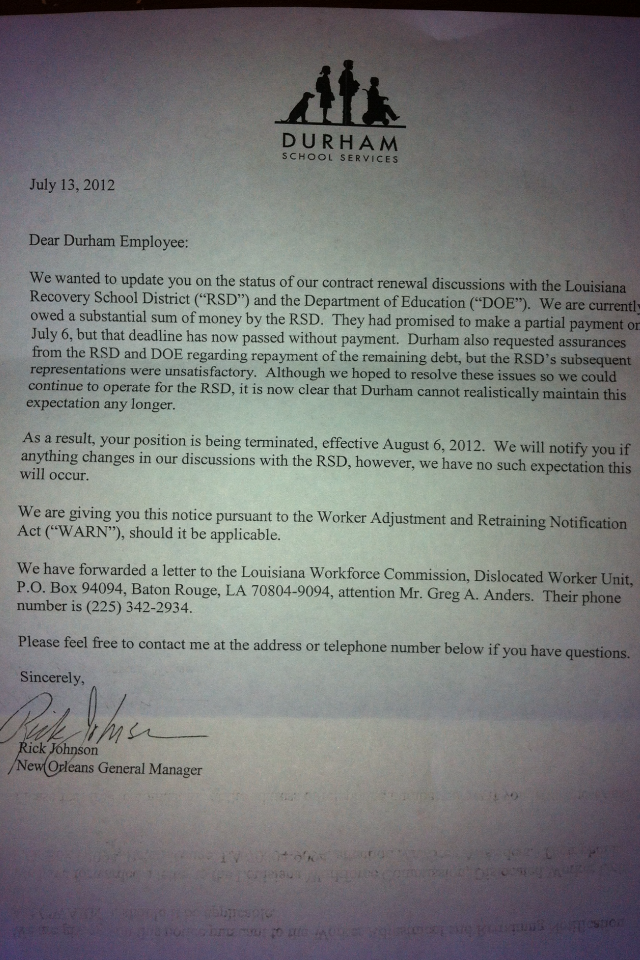
“We wanted to update you on the status of our contract renewal discussions with the Louisiana Recovery School District and the Department of Education,” it said. “We are currently owed a substantial sum of money by the RSD. They had promised to make a partial payment on July 6, but that deadline has now passed without payment.

“Durham also requested assurances from the RSD and DOE regarding repayment of the remaining debt, but the RSD’s subsequent representations were unsatisfactory. Although we hoped to resolve these issues so we could continue to operate for the RSD, it is now clear that Durham cannot realistically maintain this expectation any longer.

“As a result, your position is being terminated, effective August 6, 2012. We will notify you if anything changes in our discussions with the RSD; however, we have no such expectation this will occur.”

Could this be yet another attempt by White to “fill the room with air” as a means of deflecting attention from the real problems?

Stay tuned.

Read Full Post »

“Because the facilities master plan was in a period of decision-making, and thus not finalized, FEMA delayed payments.”

–State Superintendent of Education John White, explaining how the Recovery School District (RSD) in New Orleans ran up a debt of $7.8 million to a private contractor, $6.6 million of which was delinquent, for the transportation of RSD students in post-Katrina New Orleans. White did not explain why the facilities master plan remained in a period of “decision-making” six years after Hurricane Katrina.

Read Full Post »

The Recovery School District (RSD) is in denial about a demand letter from a transportation contractor demanding payment of $7.8 million, including $6.6 million now considered delinquent.

A member of the Board of Elementary and Secondary Education, however, claims to have a copy of the letter.

The contractor, Durham School Services of Warrenville, Illinois, isn’t talking.

State Superintendent of Education John White, who was the RSD superintendent during much of the time for which Durham says it has not been paid, says it’s not his fault and that payment was supposed to come from FEMA funds. White further said that a payment agreement has been reached.

Meanwhile, those most affected, about 140 school bus drivers and 30 monitors employed by Durham are about to be laid off.

But part of the layoff could be attributed to the fact that RSD has nearly 2,000 fewer students to be transported—which raises the question: where did they go?

A New Orleans television station recently aired a story that showed RSD’s $10.5 million contract with Durham School Services is costing the district up to three times as much per student for transportation of RSD students as in some other parts of the country.

Considering all the money wasted on FEMA trailers, blue tarps and cleanup costs following Katrina’s destruction of New Orleans, could the transportation contract be yet another example of the cavalier manner in which federal dollars have been sucked into a black hole of corruption with few of the benefits actually going to the victims of the storm?

Durham retained the services of the politically-connect Jones Walker Law Firm of New Orleans and Jones Walker attorney Michael DePetrillo in February sent a letter of demand to the Louisiana Department of Education (DOE) and RSD for payment of $7.8 million, of which $6,568,694 was said to be past due. The last payment made to the company was on September 20, 2011, and the past due amount is now said to be $6.6 million.

DePetrillo did not return a call to his office.

Nor has Durham returned phone calls even though one spokesman for its New Orleans office promised that someone from its corporate office would “call right back.”

RSD public information officer Kizzy Payton has denied that the district is in possession of any such February letter from Durham or Jones Walker.

Former RSD Superintendent Paul Vallas said he inherited a “terrible” bus transportation system when he was hired in 2007 and he promptly hired Durham which, in the 2008-09 school year bused 7,500 children. For the school year just completed, only 5,700 children were transported by Durham, placing the cost at $1,800 per student.

The Hinds County (Jackson) Mississippi School District contracts with Durham to bus 4,000 students at a cost of $3.6 million, or $900 per student—half of what the RSD-NO pays, or is contracted to pay. Indianapolis also contracts with Durham, as does Memphis. In Indianapolis Durham transports 28,000 under a $15 million contract ($535 per student) and in Memphis, it buses 35,000 students at a contract price of $18 million ($514 per student).

So this means in Memphis, Durham is being paid 58.3 percent more to transport more than six times as many students as it does for the RSD.

Put another way, the company is being paid 65.7 percent less to transport 29.8 percent fewer students in Hinds County.

In addition to its $10.5 million contract with Durham, RSD-NO also has a $500,000-a-year contract with Transpar Group of Memphis to design bus routes and to provide oversight.

Transpar, a Missouri company, worked with Vallas when he was chief of schools in Chicago and questions arose then about inflated contracts with the company.

Transpar, in addition to receiving $500,000 a year to draw up bus routes and to provide oversight, also is housed in the RSD New Orleans offices.

School officials in Memphis, Indianapolis and Hinds County, Mississippi, said oversight and route planning is either handled in-house or worked out with Durham and that the additional services of a company like Transpar are not needed.

The controversy over the money Durham says it is owed by RSD raises an even bigger question about the state’s Minimum Foundation Program (MFP) funding for the Recovery School District.

Transportation costs are factored into the MFP appropriation for each school district, meaning the state appropriated funds to be used for the transportation of students in the RSD.

Capitol News Service has submitted public records requests to DOE in an attempt to ascertain what happened to the funds appropriated to RSD for transportation and why those funds were not used to pay the Durham contract.

White, in an email to CNS on Monday said, “You would have to ask Durham directly whether there have been layoffs and to what any layoffs are attributable. Durham has not informed the RSD of the state of any such action.”

Then, addressing the transportation costs, White said, “FEMA covers transportation costs for transporting students being served in modular campuses, such as is the case for many schools in post-Katrina New Orleans.

“Because the facilities master plan was in a period of decision-making, and thus not finalized, FEMA delayed payments.

“They have since re-started payment and the RSD and Durham have arrived at a payment agreement.”

He did not explain why the facilities master plan was still in a period of “decision-making” six years after Katrina hit New Orleans.

Read Full Post »

“It’s like we’re trying to fly an airplane while we’re building it.”

–Board of Elementary and Secondary Education member Lottie Beebe (R-Breaux Bridge), often at odds with Gov. Bobby Jindal and State Superintendent of Education John White on issues involving public education, on hearing that English Language and math teacher training for the Common Core Standards (adopted by 48 states) by local school boards has been re-scheduled for a second time because parishes did not receive expected training from the Department of Education. The local training, originally scheduled for June, was re-set for July and now has been postponed once again.

Read Full Post »

Remember last year’s incredible fiasco precipitated by Gov. Piyush Jindal when he spurned that $80.6 million Broadband Technology Opportunities Program (BTOP) grant to provide high speed broadband internet to rural areas of Louisiana?

Well, it’s back—perhaps to bite him in the gluteus maximus.

State Superintendent of Education John White has released a report that shows Louisiana public school students and teachers are lacking the technology to enter the digital age.

The Louisiana Technology Footprint report discusses technology guidelines that provide a snapshot of the current state of digital readiness of school districts and campuses in the state.

Louisiana Believes, the highly-touted plan by the department includes, among other goals, one for all schools to be digital-ready by 2014-2015.

The report provides districts with an initial footprint picture of network, bandwidth and device requirements need to fully implement online assessments by the 2014-2015 school year and full digital readiness thereafter.

“Data and technology specifications…indicate school campuses in Louisiana have 197,898 devices available for online testing but only 67,038 (33.9 percent) met new device standards,” the report says.

Only five districts—Ascension, City of Bogalusa, Red River, St. James and FirstLine Schools of New Orleans—meet the minimum device readiness requirements and only two—Ascension and St. James—meet both device and network readiness guidelines for online testing, it said.

It was last Oct. 26 that the National Oceanic and Atmospheric Administration Division (NOAA) issued its final termination letter for the grant after repeated efforts to get the state to comply with its request for additional information.

The project, which LouisianaVoice learned was opposed by the American Legislative Exchange Council (ALEC), would have created 900 miles of cable over 21 rural parishes in Louisiana and would have supported several Louisiana universities with expanded optical fiber networking capacity.

That could have complimented the Board of Regents’ $20 million Louisiana Optical Network Initiative (LONI) project, designed to extend high-speed networking capabilities in the state.

But Jindal, whose wife’s charitable foundation received considerable funding from AT&T, apparently preferred that the project be carried out by private companies—such as…oh, say AT&T, for example.

The governor refused to re-apply for the grant because what he termed a “heavy-handed approach from the federal government that would have undermined and taken over private business.”

U.S. Sen. Mary Landrieu call Jindal’s stated reason “hogwash.” She said the grant would not have interfered with private enterprise and in fact, would have granted money for private companies to lay the cable. “We weren’t trying to create a government broadband system,” she said.

Almost a year before the final rejection of the grant, ALEC, at its annual meeting in San Diego in August of 2010, passed a resolution opposing initiatives targeted at providing universally accessible broadband service because of “the unnecessary, burdensome and economically harmful regulation of broadband internet service companies, including the providers of the infrastructure that supports and enables internet services…”

Looks like someone forgot to tell White about Jindal’s opposition to expanded availability to that evil internet.

In fact, White, in his report, encourages school districts to join a statewide consortium that will aid in consolidated purchasing and contracts as well as providing technology services and support.

Wonder who’ll get the contract to form that consortium?

Read Full Post »

« Newer Posts - Older Posts »

