Feeds:
Posts
Comments

Archive for the ‘Education’ Category

You have to love Rolfe McCollister, Jr. The man has done the following:

  • Was an unsuccessful candidate for mayor-president of Baton Rouge;
  • Contributed $17,000 to the campaign of Bobby Jindal in 2003, 2006, and 2008;
  • Served as treasurer for Jindal’s 2007 gubernatorial campaign;
  • Served as chairman of Jindal’s transition team following Jindal’s 2007 election;
  • Served as a director of Jindal’s first fundraising organization Believe in Louisiana;
  • Currently serves as treasurer of Jindal’s super PAC Believe Again;
  • Been appointed by Jindal as a member of the LSU Board of Supervisors.

Moreover, McCollister’s Louisiana Business, Inc. partner, Julio Melara has:

  • Contributed $7,500 to Jindal’s campaigns in 2007, 2010, and 2011 (his wife also contributed $1,000 in 2007);
  • Been appointed to the Louisiana Stadium and Exposition District (Superdome Board).

At the same time, McCollister, apparently with a straight face, attempts to pass himself off as an objective news executive as Publisher of the Baton Rouge Business Report, even publishing a story by his staff today (Monday, April 27) on the long-running court battle by real news organizations to obtain the names of 35 candidates for the LSU presidency. https://www.businessreport.com/business/along-alexander-lsu-board-considered-candidates-texas-alabama-east-carolina-presidential-search-2012

Before the finger-pointing begins, let’s set the record straight. While McCollister carries the water for Jindal on such issues as protecting what should obviously be public records, firing an LSU president (thus, making the new hire necessary) and giving away LSU hospitals to a foundation run by a fellow LSU board member, he also purports to be an objective chronicler of political news.

We at LouisianaVoice, on the other hand, make no pretense at objectivity. We are opinionated and we freely express those opinions—and invite readers to do the same, both pro and con. We spent a quarter-century working for the so-called objective publications. But a political blog is very much like an op-ed opinion piece. McCollister should be familiar with those; he’s certainly seen enough of them from Jindal in the New York Times, Washington Post, and Wall Street Journal.

Louisiana Business, Inc., led by McCollister and Melara, is the parent company of the Business Report, so both men are in the news business but nevertheless have continued to curry favor from the man they apparently believe will one day occupy the big house at 1600 Pennsylvania Ave. in Washington, D.C.

What is so particularly galling about Monday’s story about the release of the documents by the LSU board attorney is that a reader unfamiliar with the story would have no way of knowing that the publisher was complicit not in attempting to shine the light of transparency on a secretive board, but in participating in the board’s harboring of the information. Nowhere was a single word devoted to revealing that the piece’s publisher was a party to attempting to hide information from the public—an effort, by the way, that cost the state tens of thousands, if not hundreds of thousands, of dollars in legal costs and fines.

As if that were not enough, McCollister, in his ever-diligent vigil to defend the public’s right to know, turned his guns on an LSU faculty member who was bold enough to criticize the LSU board in print over its efforts to keep its business away from the public’s prying eyes.

On April 1, McCollister, in a column titled The Two Hats of Bob, attacked LSU journalism professor Bob Mann who also writes a political blog called Something Like the Truth, which is also published in the New Orleans Times-Picayune. “Man is one to take full advantage of free speech and faculty tenure as he pontificates in his columns on all that’s evil,” McCollister sniffed. https://www.businessreport.com/politics/rolfe-mccollister-survey-reveals-contradictions-confusion

He was writing about Mann’s blog and the accompanying column that ran in the Times-Picayune in which Mann said the LSU Board was more loyal to Jindal than to the students at LSU and that the entire board needed to resign or be fired. In that column, Mann quoted from another McCollister essay in which McCollister “chided those in the news media who ‘sound like Chicken Little. Let me predict here and now, the world will not end for Louisiana or higher education during the upcoming session. Solutions will be found.’ What those magic solutions are, McCollister does not say,” Mann wrote.

“I asked a former seasoned journalist about the ethics of a faculty member who has a second job as a journalist and (who) writes about his university,” the publisher continued in that April 1 column. “He said, ‘Every good journalist knows that you cannot ethically cover the institution that pays your salary and the people who supervise the work you do for that salary.”

Oh, really? And just who was that “former seasoned journalist”? And was he a former journalist or just formerly seasoned?

As for ethically covering “the institution that pays your salary” (or in this case, appointed you and your business partner to two of the more prestigious boards in state government), doesn’t McCollister provide Jindal glowing press coverage at every opportunity? (Of course, whether that can accurately be called real “coverage” is still open to debate. There’s another word for it in the reporting business. It’s called fluff.)

“The ethical equation doesn’t change if a reporter vilifies those people (for whom he works),” McCollister continued. “Who is to say the reporter’s self-interest isn’t involved. When journalists don’t recognize this fundamental aspect of journalism, everything they write, on any topic, lacks credibility.”

Wait. We’re confused. Is McCollister still talking about Mann—or about himself? It’s really impossible to tell, considering all the self-interest and conflicts of interests involved in everything McCollister writes about Jindal.

But let’s review. McCollister, it seems, was also a member of the LSU Board back in 1992 when the state was in the throes of another financial crisis and cutting budgets. At that time, McCollister, indignant over the cuts to LSU, called for the arrest of the governor.

The governor? Edwin Edwards. http://www.nola.com/opinions/baton-rouge/index.ssf/2015/03/higher_education_budget_cuts_l.html

Mann responded to McCollister, of course. Anyone would. But rather than delve into their “he said, she said” exchange, let’s look at what others are saying.

The Hayride blog, which is somewhere off to the right of Rush Limbaugh, trumpeted its headline: “Bob Mann goes after Rolfe McCollister, but doesn’t have the numbers on his side.”

http://thehayride.com/2015/03/bob-mann-goes-after-rolfe-mccollister-but-doesnt-have-the-numbers-on-his-side/

Repeating the Chicken Little quote by McCollister, it added a quote by him which it accused Mann of omitting: “Business is strong in Louisiana and getting even better. I hear from many company CEOs who had a record year and look to grow and expand in 2015.”

(Perhaps that’s why Louisiana continues to rank third in the nation in our poverty rate and why Louisiana’s colleges and universities are looking seriously at declaring financial exigency.)

We’ll get back to The Hayride momentarily.

Red Shtick, a Baton Rouge publication that specializes in parody, took its turn at lampooning McCollister for his obvious double standard. http://theredshtick.com/2015/04/03/jindal-crony-who-pens-pro-jindal-editorials-accuses-professor-of-unethical-journalism/

Likewise, the Independent of Lafayette, one of the state’s better political publications, noted with some irony that McCollister found it necessary to reach out “to an anonymous source” to obtain an opinion about journalistic ethics—after all, “hasn’t he run a newspaper for more than 25 years?” the Independent asked somewhat rhetorically, adding, “I’m sure that untenured, junior faculty at LSU will take note that one of the governor’s best friends, who serves on the LSU Board, has this opinion of academic freedom. http://theind.com/article-20612-rolfe-mccollister-faculty-who-criticize-lsu-in-print-are-unethical.html

“Did McCollister threaten my LSU job? The Independent quoted Mann as asking. “Not really. He just finds some gutless anonymous source to call me unethical for criticizing a group of public officials.”

As promised, we now return to The Hayride and one of its regular columnists who seems to fit comfortably in Jindal’s back pocket and who slings darts and arrows at anyone who dares criticize his governor.

We’re talking, of course, about one Jeff Sadow who works as…(ahem), ah…well, as a full time political science professor at LSU-Shreveport. Correction. Make that associate professor. And one who has (gasp!) a political blog.

Rather than go into a lot of Sadow’s qualifications to speak his opinion in a blog as opposed to those who would censure Mann, we’ll let yet another blogger lay it out for us.

https://lahigheredconfessions.wordpress.com/2015/04/02/biting-the-hand-that-pays-you/

But at the end of the day (to borrow a phrase from Bobby Jindal), we still believe in tolerance and we will defend with our last breath the First Amendment rights of McCollister, Sadow, and Mann. They have every right to voice their opinions, though two of those three do not appear to agree.

To sum it all up, it appears we have an LSU Board member who is a Jindal operative in every sense of the word and who just happens to own a news publication. But that board member/journalist steadfastly refuses to advocate for openness on the board (as would just about any member of the Fourth Estate), who votes to fire an LSU president only because the governor wants him to, who votes in favor of giving away teaching hospitals to a fellow board member, and who calls for the censuring of free speech by a journalism professor and newspaper columnist. And, coincidentally, we have an associate professor who does the same thing as Mann, but who gets a free pass because his opinions happen to dovetail nicely with those of  McCollister, Jindal, et al.

Okay, as long as we understand the ground rules.

But, Chicken Little, it appears the sky really is falling. And as for those solutions McCollister promised “will be found,” they now appear more distant than ever.

And meanwhile, he calls Bob Mann unethical.
Read Full Post »

Editor’s note: Normally, we do not make a practice of publishing letters from readers as a guest column. But in this case, we make an exception because we were struck by the manner in which this writer expressed his concern for our state. With only minor editing for punctuation, syntax, etc., we offer here an essay written by a retired state employee now living in Pointe Coupee Parish.

By Kerry Phillips (Special to LouisianaVoice)

After reading this article:  https://louisianavoice.com/2015/04/24/it-wasnt-the-best-week-for-louisiana-as-state-hit-with-triple-whammy-at-least-no-1-lsu-beat-no-2-tex-am-in-baseball/,  and this article: http://bobmannblog.com/2015/04/24/for-jindal-if-the-choice-is-tax-hikes-vs-closing-lsu-its-bye-bye-lsu/, and after watching The Ed Show on April 24 on MSNBC regarding Jindal’s religious freedom bill and how he is truly now a national joke…..and finally, after reading Bobby Jindal’s op-ed in The New York Times, and not hearing anything about any of this in the news with the exception of a small article in The Advocate on the OGB fiasco, I have to say that as much as we love this great state of Louisiana, the heritage, the diversity, the culture, the beauty this state has to offer with many aspects, we will be moving AWAY from this state as soon as we possibly can.

We are at the bottom of every list possible nationwide, and thank God this info is getting out nationwide. We are a laughing stock. And I am sad. Sad for my state. Sad for the people, the young, elderly, poor, government workers, fire fighters, teachers. Should I go on?

I was born here.  I was born in Baton Rouge and attended fantastic schools there. I went to college in this state. I worked for over 30 years as a state employee. I was so proud when I first got my voter’s registration card and I have voted in every election. I retired, thinking my state would honor the commitments they made to me throughout my career.

Sadly, it seems I was fooled.

To know that our legislators are basically bought and paid for by lobbyists and special interests groups who truly have no interest in our state that we call paradise is sad. We have always been known nationwide as a “banana republic.” Now I see why.

No one should say that our citizens move away from this state because of a lack of jobs. They now move away because of this cruel joke that has been perpetrated on us by a handful of people within the last decade. None of these people even care about this state, our education, our colleges, our government workers, our healthcare, etc. What we’re seeing is robbery and pilfering by people who only care about one agenda. And that agenda has nothing to do with the welfare of the citizens of Louisiana. Nor does it have anything to do with our hospitals, our children’s education, or the workers of this state.

So when you turn on the local news and see people with arms folded, waiting and complaining about long lines at their Motor Vehicle offices, thank yourselves. When there is no hospital emergency system available for your loved ones, thank yourselves. When LSU does not exist anymore, God forbid, thank yourselves. When you fail to register your outrage when a contract giving away our state hospitals—with 50 blank pages—only to have the deal rejected by the federal government, thank yourselves.

My family and I plan to move to a more progressive state—to a state where citizens actually live in the current year/century and do not want to take us back to 1915, a state where people want to move forward in a way that benefits all citizens, not just the few. And no, it’s not because of my legislator, who has worked to improve the economy and to help state employees where I live. It’s because I am now becoming ashamed of our state and most of our legislators who helped get us in our current predicament.

I lived in Baton Rouge until we moved to the Central/Greenwell Springs area where I lived for more than 27 years. For the past 15 years, we have lived in Pointe Coupee Parish. And while I’d absolutely hate to leave this state (and it’s an extremely hard choice for me), I do think we’ve made our decision. Our state appears to be done, over with….unless…..our legislators decided to truly quit being Jindal’s lapdog. They need to quit being afraid to buck his system because his system has ruined and bankrupted our state. They need to stop allowing him to be a dictator in this state. He is not our God.

And when religious leaders—from north Louisiana, no less—oppose his religious freedom bill, we welcome their voices. We do not live with the Old Testament laws because with Jesus, a new testament was founded. Do we really want to go back? Are we going to go against what Jesus preached? I’m not. Are we going to allow Jindal’s religious freedom bill to become the hot topic offered only to deflect attention from the real issues, the disasters of his creation: the financial issues we now face that are the direct result of his ineptness?  Come on.

I pray so very hard that all of our legislators, men and women, will grow some courage and principles and do what is right for the whole of this state. I’m not stupid, though. I know legislators get benefits that no average citizen—or state employee—can get.  But, isn’t it time for them to sit back and ask themselves, “Do I really want to sell my soul for some Saints tickets or concert tickets or a fantastic meal at some expensive restaurant? Do I want to sell my soul? Or do I want to do what the citizens of this state want?”  “Do I want to do what Jesus would do?”

Heavy, thought-provoking questions to ask, I know. But, I know what I would do.

This is going to be one of the most historic legislative sessions in this state’s history. It is going to make or break our state. And I am afraid the state is going to break. And the poor, the sick, the elderly will be the ones to suffer.

Of course, there is nothing wrong with people prospering and living a great life. What’s wrong is people prospering and living a great life on the backs of other people.

And so I have this one simple plea for our legislators: For once, do what is right for the whole of the state.  I pray in earnest for that. My friends and I pray hard that the right things will be done. I would love to live here and pass on the culture and treasures this state has to offer to my grandchildren. But, if things continue on as they have for the last decade, we will have to choose differently.


Read Full Post »

Bobby Jindal has promised to find money to address the funding crisis facing Louisiana’s public colleges and universities but besides the obvious dire financial straits in which the state currently finds itself, two important obstacles must be overcome by our absentee governor: the American Legislative Exchange Council (ALEC) and Grover Norquist.

The odds of appeasing just one in efforts to raise needed funding for higher education will be difficult enough, given Jindal’s allegiance to the two. Obtaining the blessings of both while simultaneously distracted by the siren’s call of the Republican presidential nomination will be virtually impossible.

Higher education, already hit with repeated cuts by the Jindal administration, is facing additional cuts of up to $600 million, or 82 percent of its current budget, according to news coming out of the House Appropriations Committee earlier this month. http://www.nola.com/politics/index.ssf/2015/04/louisianas_higher_education_bu.html

Such a fiscal scenario could result in the closure of some schools and across the board discontinuation of programs.

Moody’s, the bond-rating service, has warned that Louisiana higher education cannot absorb any further cuts. http://www.treasury.state.la.us/Lists/SiteArticlesByCat/DispForm_Single.aspx?List=c023d63e%2Dac65%2D439d%2Daf97%2Dda71d8688dff&ID=884

Louisiana has already cut per student spending by 42 percent since fiscal year 2008 (compared to the national average of 6 percent), fourth highest in the nation behind Arizona, New Hampshire and Oregon. The actual cut in dollars, $4,715 per student, is second only to the $4,775 per student cut by New Mexico. To help offset those cuts, Louisiana colleges and universities have bumped tuition by 38 percent, 10th highest in the nation but still a shade less than half the 78.4 percent increase for Arizona students. http://www.cbpp.org/research/recent-deep-state-higher-education-cuts-may-harm-students-and-the-economy-for-years-to-come?fa=view&id=3927

But that’s all part of the game plan for ALEC, the “model legislation” alliance of state legislators heavily funded by the Koch brothers which has as its overall objective the privatization of nearly all public services now taken for granted: prisons, pension plans, medical insurance, and education, to name but a few. http://www.cbpp.org/research/alec-tax-and-budget-proposals-would-slash-public-services-and-jeopardize-economic-growth?fa=view&id=3901

Jindal has already incorporated some of ALEC’s privatization proposals, namely state employee medical insurance and elementary and secondary education. He met with less success in attempts to initiate prison privatization and state retirement reform.

ALEC also proposes abolishing state income taxes, another proposal floated and then quickly abandoned by Jindal but pushed successfully by Kansas Gov. Brownback. http://www.washingtonpost.com/blogs/wonkblog/wp/2015/04/21/vwelfap/

And then there is Norquist, the anti-tax Republican operative who founded Americans for Tax Reform and who somehow survived the Jack Abramoff scandal and thrived. http://en.wikipedia.org/wiki/Jack_Abramoff_Indian_lobbying_scandal

What strange hold does he have over Jindal?

The pledge.

Jindal, as did a couple dozen Louisiana legislators, signed onto Norquist’s “no-tax” pledge—a promise not to raise taxes under any circumstances. The pledge even prompted Jindal to veto a 4-cent cigarette tax renewal in 2011 because in his twisted logic, it was somehow a new tax. The legislature had to adopt a last-minute constitutional amendment to make the tax permanent.

Undeterred, Jindal, through communications director Mike Reed, has said he would support a cigarette tax increase this year only if it is offset with a tax cut elsewhere. This despite estimates that a higher tax would not only generate needed income for the state, but would, by encouraging smokes to quit and teens to not start smoking, create long-term health care savings for the state. His veto also flew in the face of a 1997 article that Jindal authored while secretary of the Louisiana Department of Health and Hospitals in which he said, “Society must recover those costs which could have been avoided had the individual not chosen the risky behavior only to prevent others from having to bear the costs.” http://theadvocate.com/news/11930951-123/lawmaker-proposes-154-state-cigarette

Not to be confused with the “no-go” zones of Jindal’s vivid imagination, the “no-tax” pledge apparently is a good thing for Republicans and tea partiers and is considered sacrosanct to those who have taken the oath even if it locks politicians into the impossible situation of trying to resolve a $1.6 billion budgetary crisis while not increasing revenue.

Jindal routinely runs proposed legislation by Norquist for his blessings, according to Jindal spokesperson Reed who admitted as much. http://www.nola.com/opinions/index.ssf/2015/03/in_jindals_world_tax_is_a_tax.html

Even U.S. Sen. David Vitter signed the pledge but has assured voters it won’t be binding on him as governor—a dubious promise that would make him unique among signers. After all, a pledge is a pledge and when one signs it, so what difference would it make which office he holds?

So, how does all this figure into the budget crisis for higher education in Louisiana?

In a word, privatization. Or, taking the “state” out of “state universities.”

While neither Jindal nor any legislator has dared breathe the word privatization as it regards the state’s colleges and universities, at least one Jindal appointee, Board of Regents Chairman Roy Martin of Alexandria, has broached the subject, speaking he said, strictly as an individual. http://theadvocate.com/news/11716059-123/regents-look-at-privatizing-public

The slashing of higher education budgets appears to be a pattern as governors attempt to wean colleges and universities from dependence on state funding, transitioning their status from state-supported to state-assisted to state-located. http://www.usnews.com/news/articles/2015/02/27/scott-walker-bobby-jindal-aim-to-slash-higher-ed-funding

Privatization of state colleges and universities would, of course, push tuition rates even higher, making a college education cost prohibitive for many. But that dovetails nicely with the ALEC agenda as income disparity continues to widen with ever more generous tax laws that benefit the super-rich while placing growing burdens on lower-income taxpayers. By winnowing out those who can least afford college, privatization necessarily enhances the selection process to serve the elite and at the same time, opens up additional revenue opportunities for those in position to take advantage of privatized services such as book stores, printing, food services, and general maintenance. http://gse.buffalo.edu/FAS/Johnston/privatization.html

There is already a backlog of nearly $2 billion in maintenance projects on state college and university campuses just waiting for some lucky entrepreneur with the right connections.

http://theadvocate.com/home/5997316-125/backlog-of-maintenance

States like Louisiana, by such actions as simply increasing our cigarette tax (third lowest in the nation) and being less generous with corporate tax breaks and initiatives, could have reduced the size of the spending cuts or avoided them altogether. Sadly, that was not done and those looking at someone to blame cannot point the finger only at Jindal; legislators have been complicit from the beginning and must shoulder the responsibility for the present mess.

As a result, state colleges and universities have already cut staff and eliminated entire programs to such a degree that Louisiana’s high school seniors already are considering options out of state and other states are obliging. https://lahigheredconfessions.wordpress.com/

Should the legislature adopt any measures to raise revenue for higher education, such measures likely would be vetoed by Jindal if he gets the message from Norquist to do so.

If that occurs, his palpable disregard for the welfare of this state as evidenced by his growing absence will be dwarfed by the affront of taking his cue of governance from a Washington, D.C. lobbyist as opposed to listening to his constituents who want real solutions and not political grandstanding.

But that certainly would be nothing new for Bobby Jindal.

Read Full Post »

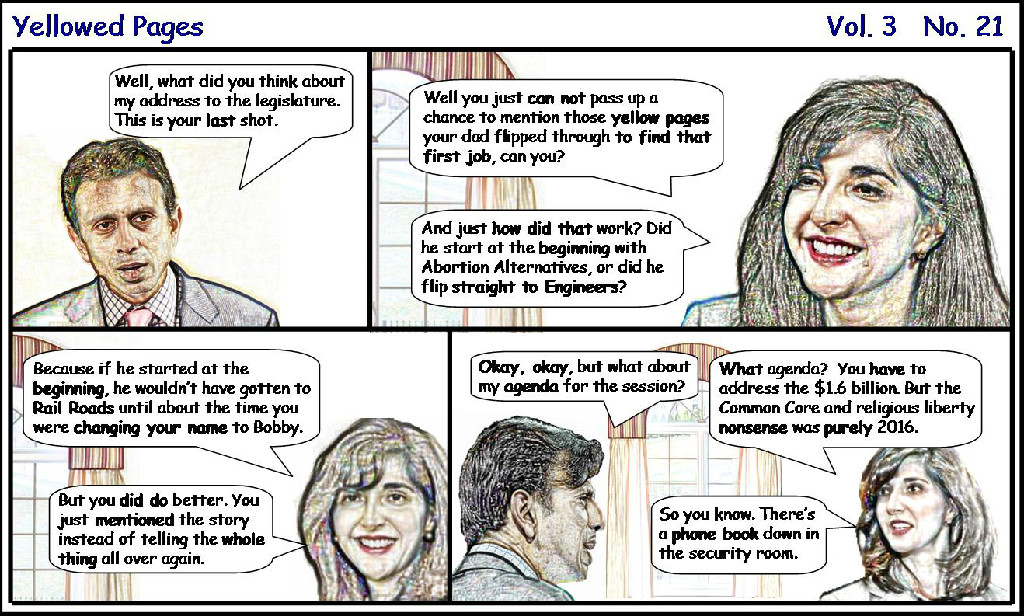
JINDAL STATE OF THE STATE ADDRESS(FROM OUR ANONYMOUS CARTOONIST: CLICK ON IMAGE TO ENLARGE)

If there was any lingering doubt that Bobby Jindal has been committing payroll fraud, that doubt was erased in last Monday’s State of the State address to legislators at the opening of the 2015 legislative which, thankfully, will be his last such address.

Fraud is defined as:

  • The wrongful or criminal deception intended to result in financial or personal gain;
  • Deceit, trickery, or breach of confidence perpetrated for profit or to gain some unfair or dishonest advantage;
  • A person or thing intended to deceive others, typically by unjustifiably claiming or being credited with accomplishments or qualities.

Payroll fraud is further defined as the unauthorized altering of payroll or benefits systems in order for an employee to gain funds which are not due. The person making financial gain could be the employee or could be an associate who is using the employee to commit the fraud while taking the funds for himself.

There are generally three types of payroll fraud but for our purposes we are interested in only one:

  • Ghost employees—A person, fictional or real, who is being paid for work he does not perform. In order for the fraud to work the ghost employee must be added to the payroll register. If the individual is paid a monthly salary this is easier for the fraudster, as once this has been set up there is little or no paperwork required. In order for the fraud to work, the ghost employee must be added elected to the payroll register. Once this has been set up, there is little or no paperwork required.

Under that definition, Jindal could certainly be considered a ghost employee. One person even suggested that it was not really Jindal speaking to legislators, that Jindal was actually in Iowa and they were being addressed by a hologram.

We maintain that Jindal is committing payroll fraud by vacating the state so often and leaving the details of running the state to appointed subordinates as inexperienced and naïve as he. The point here is this: No one on his staff was elected; he was. And he has not been at the helm of the ship of state and by absenting himself so frequently and so consistently as he gins up his presidential candidacy, he is committing payroll fraud, theft, and malfeasance. Others, like former Desoto Parish School Superintendent and Board of Elementary and Secondary Education member Walter Lee have been indicted and been prosecuted for payroll fraud.

Before we really get into his speech to legislators, JINDAL ADDRESS TO LEGISLATURE we simply must call attention to the feeble effort at humor he (or someone) injected into the third line of his speech:

“Well, here we are…at the moment that some of you have been waiting for a long time—my last state of the state speech.”

After an apparently appropriate pause, he continued: “No, that was not supposed to be an applause line…and I do appreciate your restraint.”

Seriously? You actually wrote that line in your speech? If you have to write that in, if you are incapable of ad-libbing that simple line, then we now understand that idiotic response to President Obama’s State of the Union Address in 2009.

Before getting to the real meat of his legislative agenda for this year (if you can call it that), he touched ever-so-lightly on a few other points he generously referred to as his administration’s accomplishments. Our responses to each point are drawn directly from statistics provided by 24/7 Wall Street, a service that provides a steady stream of statistical data on business and government:

  • “We cleaned up our ethics laws so that now what you know is more important than who you know.” (A quick look at the appointment of Troy Hebert as director of the Office of Alcohol and Tobacco Control after the baseless firing of Murphy Painter could quickly debunk that bogus claim. So could several appointments to the LSU Board of Supervisors and the equally egregious firing of key personnel like Tommy Teague who did their jobs well but made the fatal mistake of crossing Mr. Egomaniac.)
  • “We reformed our education system…” (Louisiana is the fifth-worst educated state and we are the third-worst state for children who struggle to read);
  • “We reformed our health care system…” (Really? Is that why the privatization of our state hospitals remain in turmoil? That same reform ultimately forced the closure of Baton Rouge General Mid-City’s emergency room because of the overload brought on by the closure of Earl K. Long Hospital? Can we thank your “reform” for the fact that Louisiana still has the nation’s third-lowest life expectancy rate or that we enjoy the nation’s third-most unhealthy rating, that we are fifth-highest in cardiovascular deaths or that we have the highest obesity rate in the nation?);
  • “…Our economy is booming.” (Seriously? Louisiana is rated as the worst state for business in the U.S.; we rank sixth-highest among states where the middle class is dying; we remain the eighth-poorest state in the nation with a poverty rate that is third-highest, and we’re saddled with the fourth-worst income disparity in the nation and we’re rated the 10th-worst state in which to be unemployed.);
  • “We have balanced our budget every year…and have received eight credit upgrades.” (This one of those claims so preposterous one doesn’t know how to respond, but we’ll give it our best. Jindal has repeatedly patched budget holes by skimming funds from other agencies, like more than $400 million from the Office of Group Benefits reserve fund, from the sale of the tobacco settlement, from ripping funds for the developmentally disadvantaged (to fund a race track tied a political donor—what was that line again about “what you know, not who you know”?), by cutting health care and higher education, by selling state property, and now he’s trying to cover the current $1.6 billion budget hole by selling the State Lottery. As for those credit upgrades, we can only point to the February action by Moody’s and Standard & Poor’s bond rating agencies to move the state’s credit outlook from stable to negative—and to threaten the more severe action of a downgrade.);
  • “The end result is a stronger, more prosperous Louisiana for our children. I measure Louisiana’s prosperity not by the prosperity of our government, but by the prosperity of our people.” (So, why are the fifth-most dangerous state in the nation? The 10th-most miserable state? Why do we have the eighth-worst quality of life? And the 11th-worst run state in the nation? And why have you never once addressed in your seven-plus years in office our ranking as the number-one state in the nation for gun violence or our ranking as first in the world for our prison incarceration rate?)
  • “We don’t live by Washington’s rules of kicking our debts down the road.” (For the love of God…);
  • “We have laid out a budget proposal that seeks to protect higher education, health care and other important government functions.” (And that’s why higher education and health care have been cut each of your years in office and why more cuts are anticipated that could conceivably shut down some of our universities. You really call cuts of up to 80 percent “protecting” higher education?);
  • “We have a system of corporate welfare in this state.” (Wow. After more than seven years of giving away the store to the tune of billions of dollars in corporate tax breaks, you finally come the realization that perhaps your generosity to the Wal-Marts, chicken processing plants and movie production companies may have been a bit much—that those policies may have actually hurt the state? What brought about this sudden epiphany? Bob Mann, in his Something Like the Truth blog, was all over that when he called attention to Jindal’s latest comment in the face of his claim a couple of years ago that we were “crushing businesses” with oppressive taxes. We’ll let him take this one.) http://bobmannblog.com/2015/04/17/bobby-jindal-is-now-against-corporate-welfare/
  • “We have identified over $500 million of corporate welfare spending that we think should be cut…” (Why the hell did it take you seven years?)

After all was said and done, after his hit-and-run sideswipes at all his purported “accomplishments,” Jindal devoted the bulk of his address to only two issues: Common Core and religious liberty. Of the latter issue, he said, “I absolutely intend to fight for passage of this legislation.”

Jindal was referring to Bossier City Republican State Rep. Mike Johnson’s HB 707 which would waste an enormous amount of time and energy—time that could be better spent on far more pressing matters, like a $1.6 billion deficit—on preventing the state from taking “any adverse action” against a person or business on the basis of a “moral conviction about marriage.”

Despite claims by Jindal and Johnson to the contrary, the bill is nothing more than a clone of the Indiana law that constitutes a not-so-subtle attack on gays or anyone else with whom any businessman deems a threat to his or her definition of marriage.

So, after eight addresses to the legislature, Jindal has yet to address any of the issues like inadequate health care, violence, poverty, pay disparity or equal pay for women, increasing the minimum wage, poor business climate (his rosy claims notwithstanding), our highway system (we didn’t mention that, but we are the seventh-worst state in which to drive, with the 15th-highest auto fatality rate), or our having the highest incarceration rate in the world.

Instead, the thrust of his address is aimed at Common Core—he called it federal control even though Common Core was devised by the nation’s governors and not the federal government—and something called the “Marriage and Conscience Act.”

And he expects those two issues, along with something he calls “American Exceptionalism,” to thrust him into the White House as leader of the free world.

And, of course, attacking national Democrats like Obama and just today, Hillary Clinton, on her claim of having immigrant grandparents. Jindal, of course, wants exclusive rights to that claim and says so with his oft-repeated platitude: My parents came to this country over 40 years ago with nothing but the belief that America is the land of freedom and opportunity. They were right. The sad truth is that the Left no longer believes in American Exceptionalism.”

Well, to tell the truth, if Bobby Jindal is the example—the standard-bearer, if you will—for what is considered “American Exceptionalism,” then frankly, we don’t believe in it either.

Read Full Post »

U.S. Sen. David Vitter and Public Service Commissioner Scott Angelle could well be running for governor of Texas instead of Louisiana, if campaign contributions through March 31 are any indication.

That’s because between the two, there have been 69 contributions from donors in the Lone Star State totaling more than half a million dollars, according to campaign finance reports on file with the Louisiana Board of Ethics.

In fact, it might even appear to some that there is a disproportionate amount of out-of-state money that has already been invested in the four major candidates for governor—and the Oct. 24 primary election is still six months away.

Besides the 317 out-of-state contributors who have combined to pour $900,000 into the four campaigns, 954 special interests (corporations, political action committees, etc.) have funneled more than $3 million of the total $6.1 million contributed to the campaigns of Republicans Vitter, Angelle, Lt. Gov. Jay Dardenne and Democratic State Rep. John Bel Edwards, records show.

With nearly half the total contributions coming from special interests—the numbers do not include donations made by individuals and family members affiliated with corporations—it is evident that the decision of choosing political leaders has been taken away from the citizenry in favor of moneyed power brokers.

Elections now go to the candidate who has the most money to spend on the slickest image building and most damaging character assassination of the opposition—all with little or no attention given to real issues or genuine political ideology. It’s as if every candidate has adopted the sales adage that says you don’t sell the hamburger, you sell the sizzle. To create that sizzle, politicians have shamelessly sold their souls to people like the Koch brothers, financier George Soros, Amway founder Richard DeVos, Las Vegas casino magnates Sheldon Adelson and Steve Wynn.

Voters would probably be wise to examine the issues more carefully, question candidates on their positions and reject the big money the way the old 1960s-era print advertisement for the Volkswagen Beetle which shows two men campaigning from convertible vehicles, one photo has a candidate standing in the rear seat of a luxury vehicle (it appears to be a Cadillac) trailed by a marching band, and the other from the back seat of an economy Beetle with a lone bass drummer behind him—with the caption “Which man would you vote for?”

1de860b7f87d9e7b14f5e5a00dbb9b49[1]

Indeed, Louisiana, which man would you vote for? It would behoove us to take long looks at the candidates and what they stand for and not vote for the one who can best saturate TV ads with photos of him and his beaming family as he prattles on about how much he loves corporate donors and PACs this state.

Julia O’Donoghue, writing for the New Orleans Times-Picayune, noted that each of the four leading candidates for governor said he will not be signing the “no-tax” pledge of Grover Norquist of Americans for Tax Reform. http://www.nola.com/politics/index.ssf/2015/03/post_584.html

“As Louisiana’s next governor, I’ll make fiscal decisions that are best for Louisiana, not based on what a Washington group dictates,” says Vitter, the top money-raiser of the four. http://www.nola.com/politics/index.ssf/2015/03/grover_norquists_no_tax_increa.html

But though Vitter says he would not sign the pledge as governor, he already has, as U.S. Senator.

That’s why it is so crucial to watch what the candidates do and not what they say. As you watch the polished TV ads in the coming months remember that old expression “What you do speaks so loud that I cannot hear what you are saying.”

That’s especially true of Vitter and Angelle. One has somehow survived not one, but two, extra-marital scandals, either one of which would have destroyed the political careers of other men, and the other is nothing more than Third Term Jindal—an appointee of and anointed by the man who single-handedly wrecked higher education, the Office of Group Benefits, the state’s hospital system, the state’s infrastructure and the state’s economy while on his way (he somehow still believes) to the White House.

LouisianaVoice received a most interesting web post about so-called “dark money” in political campaigns. The post, entitled Be Afraid of the Dark: How Dark Money affects elections, is the creation of Accounting-Degree.org and though dated, provides a thorough explanation of how $200 million in dark money—money not covered by federal disclosure rules intended to inform the public of who is paying to influence its vote—was expected to be spent in the 2014 Congressional elections last fall. http://www.accounting-degree.org/dark-money/

It goes into a detailed explanation of:

  • The 1976 U.S. Supreme Court Decision Buckley v. Valeo, which allowed unlimited campaign expenditures by individuals;
  • The Citizens United v. Federal Elections Commission decision by the Supreme Court allowing unlimited outside campaign expenditures by corporations and labor unions;
  • The 2010 Speechnow v. FEC Appeals Court decision allowing unlimited contributins to political action committees by individuals;
  • Super PACs, the political action committees that accept and spend unlimited contributions from individuals, corporations and unions (donors publicly disclosed);
  • 501(c)(4) Committees, the nonprofit campaign committees regulated by the IRS, not elections officials. Though not political in their primary function, they may accept and spend unlimited contributions from individuals, corporations and unions and may then funnel money to super PACs (donors not publicly disclosed).

With an estimated $5 billion poured into last fall’s federal election campaigns, one has to wonder why the contributors, those who love power and love using it, would not be satisfied with using that money for the greater good—feeding the poor, paying teachers more, building infrastructure, health care, etc., rather than using it for the more sinister purpose of buying candidates and elections.

With that in mind, let’s take a closer look at the campaign contributions from Jan. 1, 2014 through March 31, 2015 for the four leading gubernatorial candidates:

DAVID VITTER (Rep.): VITTER CONTRIBUTIONS

  • Total contributions: 1,158 totaling $3.7 million (Ave. contribution: $3,195);
  • Total contributions of $5,000 maximum: 592 at $2.96 million (Ave. contribution: $5,000);
  • Total special interest (corporations, PACs, etc.) at $5,000 maximum: 328 at $1.64 million (Ave. contribution: $5,000);
  • Total special interest contributions of all amounts: 532 at $2 million (more than half his total contributions of all amounts from all sources) (Ave. contribution: $3,759);
  • Total out-of-state contributions: 186 at $490,835 (Ave. contribution: $2,639) (including Texas: 54 for $201,500; Virginia: 19 for $38,500; Washington, D.C.: 12 for $27,000).

SCOTT ANGELLE (Rep.): ANGELLE CONTRIBUTIONS

  • Total contributions: 430 at $1.5 million (Ave. contribution: $3,486);
  • Total contributions of $5,000 maximum: 230 for $1,150,000 (Ave. contribution: $5,000);
  • Total special interest contributions of $5,000 maximum: 130 at $650,000 (Ave. contribution: $5,000);
  • Total special interest contributions, all amounts: 213 for $800,500 (Ave. contribution: $3,758);
  • Total out-of-state contributions: 84 for $339,000 (Ave. contribution: $4,036) (including Texas: 74 at $316,000, an average contribution of $4,270).

JAY DARDENNE (Rep.): JAY DARDENNE CONTRIBUTIONS

  • Total contributions: 409 at $597,000 (Ave. contribution: $1,460);
  • Total contributions at $5,000 maximum: 46 at $230,000 (Ave. contribution: $5,000);
  • Total special interest contributions of $5,000 maximum: 16 at $80,000 (Ave contribution: $5,000);
  • Total special interest contributions, all amounts: 115 at $111,825 (Ave contribution: $972);
  • Total out-of-state contributions: 24 for $36,350 (Ave. contribution: 1,515) (Texas: 13 for $20,320 for an average contribution of $1,563).

JOHN BEL EDWARDS (Dem.): JOHN BEL EDWARDS CONTRIBUTIONS

  • Total contributions: 198 at $299,700 (Ave. contribution: $1,514);
  • Total contributions of $5,000 maximum: 15 at $75,000 (Ave. contribution: $5,000);
  • Total special interest contributions of $5,000 maximum: 5 at $25,000 (Ave. contribution $5,000);
  • Total special interest contributions, all amounts: 94 at $94,250 (Ave. contribution: $1,003);
  • Total out-of-state contributions: 23 at $24,200 (Ave. contribution: $1,052).

QUICK SUMMARY:

  • Out-of-state contributions: Vitter with 186 for $490,835, compared to 131 for $399,550 for the other three candidates combined;
  • Special interest contributions: Vitter with 532 for $2 million, compared to 422 for $1,006,375 for the other three candidates combined;
  • Special interest contributions of $5,000 maximum: Vitter with 328 for $1.64 million, compared to 151 for $755,000 for Angelle, Dardenne and Edwards combined;
  • Contributions of the $5,000 maximum: 592 for $2.96 million while the remaining three candidates combined for 291 contributions totaling $1,455,000.

Finally, it might be worth mentioning that in 2011 Bobby Jindal raised a whopping $12 million for his re-election campaign.

And you see what that bought us.


Read Full Post »

« Newer Posts - Older Posts »


