Feeds:
Posts
Comments

Archive for the ‘Economy’ Category

If, as most observers believe, Gov. Bobby Jindal has designs on seeking the Republican presidential nomination for 2016 he first must demonstrate that he is an administrator capable of running his own state and for him to do that, there are several clichés frequently employed by our parents and grandparents that might apply:

Get on the stick, shake a leg, get the lead out, make haste, get it in gear, quit burning daylight, get your act together, s**t or get off the pot…well, you get the idea.

Jindal has had the better part of seven years to turn this state around economically, culturally and educationally or to at least make strides to that end in order to demonstrate his leadership abilities.

To say he has failed would be kind. The truth is, his administration, with only 14 months left, is an abject failure, those glowing surveys about the state’s business climate touted by his head cheerleader and Baton Rouge Business Report publisher Rolfe McCollister, Jr., notwithstanding. (McCollister, Jindal’s former campaign treasurer whom Jindal appointed to the LSU Board of Supervisors, would not appear to be the most objective member of the fourth estate to report on the administration’s accomplishments.)

The current outstanding weeklong analytical series by the Baton Rouge Advocate entitled Giving Away Louisiana, on the other hand, provides ample evidence of massive—and ill-advised—tax breaks given business and industry that have done little to light a fire under the state’s moribund economy.

http://blogs.theadvocate.com/specialreports/2014/11/26/giving-away-louisiana/

Congratulations on superb coverage of such a complex topic by Advocate staffers Jeff Adelson, Rebekah Allen, Mark Ballard, Gordon Russell, Richard Thompson, Edie White, John Ballance, Patrick Dennis, Bill Feig, Walt Handelsman, Jay Martin, Heather McClelland, John McCusker, Paul Sandau, and Travis Spradling.

Two glaring examples of poor fiscal policies cited by the Advocate include:

  • The foolishly generous film and TV tax breaks have succeeded in luring production companies to Louisiana, but at what costs? True, Twelve Years a Slave was a huge success, winning three Oscars and a Golden Globe Award, among others. On the other hand, there is that $200 million bomb Green Lantern. For that cinematic disaster, the state gave away $35 million in subsidies but recovered only $8 million of that amount. The Advocate pointed out that the state poured more money into that forgettable film than it appropriated for the University of New Orleans. How’s that for setting your priorities? And every time a Duck Dynasty episode airs, the state has to pony up about $300,000 in similar taxpayer-financed breaks. http://blogs.theadvocate.com/specialreports/2014/12/02/giving-away-louisiana-film-tax-incentives/
  • And then there is that vaguely-defined policy called Enterprise Zone, a tax incentive program ostensibly created to attract business and industry to depressed areas as a means of spurring employment, stimulating the economy and improving living conditions of low-income residents. The only thing wrong with this $69 million per year boondoggle is that it’s not working. Instead, the Enterprise Zone tax credits are being used to underwrite construction of projects like a couple of Walmart stores in St. Tammany Parish, one of the more affluent areas of the state, and for expensive shops in an upscale Baton Rouge retail complex—even as low-income areas of the state continue to deteriorate. http://blogs.theadvocate.com/specialreports/2014/12/01/giving-away-louisiana-2/

The dismal performance of those two programs are precisely why 24/7 Wall Street, a financial news and opinion company which publishes more than 30 articles per day, released a report on Thursday (Dec. 4) which pegs Louisiana as being the 11th worst-run state in America. http://247wallst.com/special-report/2014/12/03/the-best-and-worst-run-states-in-america-a-survey-of-all-50-3/

“Selecting appropriate criteria to compare the 50 states is difficult,” the story says, “because there is so much variation among the states. Some depend disproportionately on one industry while others’ economies are more balanced.

Some of the best-run states benefit from a wealth of natural resources. North Dakota, Wyoming, Alaska, and Texas, according to the survey, are among the top 10 best-run states, and in all four, the mining industry—which includes fossil fuel extraction—is a major contributor to state GDP, the report says.

“While each state is different, states at both ends of the list share certain characteristics,” the report says. For example, people living in the worst-run states were likely to have lower standards of living. Violent crime rates and the percentage of those living in poverty were typically higher in these states, while the percentage of those with at least a high school diploma was lower than the national rate.

The worst-run states also tended to have weaker fiscal management and poor credit ratings from Moody’s Investors Service and Standard & Poor’s (S&P). Illinois, the worst-run state in America, received lower ratings than any other state from both agencies while most of the 10 best-run states had perfect ratings from both agencies, it said.

Louisiana, in ranking 40th in the nation, managed to fare better than New Jersey, which ranked 43rd, or eighth worst, something Jindal might use against Gov. Christ Christie if it comes down to a race between those two for the GOP nomination.

Following Illinois in 24/7 Wall Street’s list of worst-run state in the U.S. were New Mexico, Mississippi, Rhode Island, Kentucky, Arizona, Georgia, New Jersey, Missouri, Alabama and Louisiana.

In breaking down its statistical information, the survey showed that Louisiana’s $3,333 debt per capita was right at the mid-point at 24th lowest and the unemployment rate was 15th lowest in the nation at 6.2 percent, those favorable factors were offset by the state’s median household income of $44,164, eighth lowest, and a poverty rate of 19.8 percent that was third highest.

Louisiana had “one of the lowest median household incomes in the nation,” at just $44,164, the report said “and 10.7 percent of all households reported an income of less than $10,000, a higher rate than in any state except for Mississippi. Largely due to these low incomes, the poverty rate in Louisiana was nearly 20 percent (19.8 percent) and 17.2 percent of households used food stamps last year, both among the highest rates in the nation. The state’s GDP grew by 1.3 percent last year, less than the U.S. overall. This was largely due to a decline in output from the mining industry, which accounted for 8 percent of Louisiana’s output, versus 2.3 percent across the country. Louisiana’s ranking was bolstered by its high exports, which equaled $13,693 per capita in 2013, the most in the nation. Last year, products made from petroleum and coal accounted for more than 40 percent of the state’s exports.”

And all this time, Jindal has been telling us that Louisiana’s economic growth during his administration has surpassed other southern states and that of the nation as a whole. See this August release by Jindal. Scroll down to the paragraph beginning “Louisiana’s Economic Growth” at this link: http://www.bobbyjindal.com/blog.html/

Read Full Post »

Our October fund raiser enters its final five days and we still need assistance to help us offset the cost of pursuing legal action against an administration that prefers to conduct its business behind closed doors and out of sight of the people to whom they are supposed to answer.

We also are launching an ambitious project that will involve considerable time and expense. If Gov. Bobby Jindal does seek higher office as it becomes more and more apparent that he will, the people of America need to know the real story of what he has done to our state and its people. Voters in the other 49 states need to know not Jindal’s version of his accomplishments as governor, but the truth about:

  • What has occurred with CNSI and Bruce Greenstein;
  • How Jindal squandered the Office of Group Benefits $500 million reserve fund;
  • The lies the administration told us two years ago about how state employee benefits would not be affected by privatization;
  • The lies about how Buck Consultants advised the administration to cut health care premiums when the company’s July report said just the opposite;
  • How Jindal attempted unsuccessfully to gut state employee retirement benefits;
  • How Jindal attempted to sneak a significant retirement benefit into law for the Superintendent of State Police;
  • How Jindal appointees throughout state government have abused the power entrusted to them;
  • How Jindal has attempted a giveaway plan for state hospitals that has yet to be approved by the federal Center for Medicare & Medicaid Services (CMS);
  • How regulations have been skirted so that Jindal could reward supporters with favorable purchases and contracts;
  • How Jindal fired employees and demoted legislators for the simple transgression of disagreeing with him;
  • How Jindal has refused Medicaid expansion that has cost hundreds of thousands of Louisiana’s poor the opportunity to obtain medical care;
  • How Jindal has gutted appropriations to higher education in Louisiana, forcing tuition increases detrimental to students;
  • How Jindal has attempted to systematically destroy public education in Louisiana;
  • How Jindal has refused federal grants that could have gone far in developing internet services for rural areas and high speed rail service between Baton Rouge and New Orleans;
  • How Jindal has rewarded major contributors with appointments to key boards and commissions;
  • How Jindal attempted to use the court system to persecute an agency head who refused to knuckle under to illegal demands from the governor’s office;
  • How Jindal has manipulated the state budget each year he has been in office in a desperate effort to smooth over deficit after deficit;
  • And most of all, how Jindal literally abandoned the state while still governor so that he could pursue his quixotic dream of becoming president.

To this end, LouisianaVoice Editor Tom Aswell will be spending the next several months researching and writing a book chronicling the Jindal administration. Should Jindal become a presidential contender or even if he is selected as another candidate’s vice presidential running mate, such a book could have a national impact and even affect the outcome of the 2016 presidential election.

This project is going to take time and involve considerable expense as we compile our research and prepare the book for publication in time for the 2016 election.

To accomplish this, we need your help.

If you are not seeing the “Donate” button, it may be because you are receiving our posts via email subscription. To contribute by credit card, please click on this link to go to our actual web page and look for the yellow Donate button: https://louisianavoice.com/

If you prefer not to conduct an internet transaction, you may mail a check to:

Capital News Service/LouisianaVoice

P.O. Box 922

Denham Springs, Louisiana 70727-0922

Read Full Post »

In reading Destiny’s Anvil, a novel about Louisiana politics by New Orleans writer Steven Wells Hicks, one sentence near the end of the story was so profound that it jumped off the page at us:

  • The responsibility for building and maintaining our way of open and honest government belongs in the hands of those who elect our leaders and not the leaders themselves.

The very simplicity of that one sentence, so succinct and straightforward a summation of what our government should aspire to, should be the credo which dictates the acceptance of every campaign contribution, every promise made and every action carried out by every elected official in America.

Sadly, it does not. And most certainly, it does not in Louisiana, especially where generous donors to the campaigns of Gov. Bobby Jindal (R-Iowa, R-New Hampshire, R-Florida, R-Anywhere by Louisiana) are concerned.

LouisianaVoice has learned that one major donor and its principals not only benefitted from several contracts worth more than $240 million, but also appear to have been given preferable treatment in the purchase of a state building at a bargain price at the expense of taxpayers.

The electorate of this state has capitulated in that responsibility, choosing instead to acquiesce to backroom deals fueled by campaign contributions and to actions concealed in secrecy and carried out for political expedience or personal gain instead of for the common good of the citizenry.

Remember last month when we wrote that Timmy Teepell in 2010 issued a directive to Tommy Teague, then the CEO of the Office of Group Benefits that a request for proposals (RFP) be crafted in such a way as to favor a specific vendor and that then-Commissioner of Administration Angéle Davis resigned shortly thereafter?

At the time, Teepell was Jindal’s Chief of Staff. The RFP was for vendors to provide health care coverage to state workers primarily in northeast Louisiana. Vantage Health Plan of Monroe subsequently landed the 26 month, $70 million contract, effective July 1, 2010. Six months later, on Jan. 1, 2011, a second one-year contract of $14 million awarded to Vantage to provide a Medicare Advantage plan for eligible OGB retirees and on Sept. 1, 2012, Vantage received yet another four-month $10 million contract under an emergency rule to provide an HMO plan to OGB members.

Since Jindal took office in January of 2008, Vantage has been awarded six contracts totaling nearly $242 million.

In addition to the claim of the 2010 directive to Teague to “write a tightly-written” RFP, LouisianaVoice has learned the Jindal administration may have deliberately circumvented the usual procedure for selling state property in order that Vantage could purchase a six-story state office building in Monroe last year.

By legislative fiat, the administration was within its legal rights to sell the State Office Building in Monroe to a chosen buyer without going through the bid process but it may have done so at a cost to state taxpayers.

Senate Bill 216 of 2013 by Sens. Mike Walsworth (R-West Monroe), Rick Gallot (D-Ruston), Neil Riser (R-Columbia) and Francis Thompson (D-Delhi) passed overwhelming in both the House and Senate and was signed into law by Jindal as Act 127, clearing the way for the sale of the former Virginia Hotel at 122 St. John Street.

By law, if a legislative act is passed, the state can legally bypass the public bid process but there are several indications that the administration may well have gone out of its way to accommodate Vantage and its President, Dr. Patrick Gary Jones through the Louisiana Department of Economic Development (LED).

The cooperative endeavor agreement between Vantage and the state was executed by Vantage Executive Vice President Mike Breard and LED Undersecretary Anne Villa on Aug. 28, 2013.

Vantage paid the state $881,000 for the six-story, 100,750-square-foot building and an adjoining 39,260-square-foot lot and one-story office building. The cost breakdown was $655,000 for the hotel and $226,000 for the adjoining property.

The Virginia Hotel was constructed in 1925 at a cost of $1.6 million and underwent extensive renovations in 1969 and again in 1984, according to documents provided LouisianaVoice by DED.

But LouisianaVoice has learned that there was at least one other potential buyer interested in the Virginia Hotel/State Office Building and indeed, documents obtained from LED contained no fewer than three references to fears by Vantage officers that if the building were put up for public auction, the bids might make the costs prohibitive to Vantage.

Melody Olson and husband Kim purchased the nearby Penn Hotel for $341,000 and poured $2 million into converting it into condominiums.

The late Shady Wall, a colorful state representative from Ouachita Parish, lived in the Penn’s penthouse. (Wall once wedged a pencil between a stack of books and the “yes” button at his House desk and went home for the day, officially casting “yes” votes on every matter that came up in the chamber after his departure.) The Olsons now reside in that same penthouse.

Melody Olson told LouisianaVoice that she and her husband wanted to purchase the Virginia and convert it into a boutique hotel but were never given the opportunity.

“It was sold through the Department of Economic Development and never was offered for public bid,” she said. “We never got the chance to make an offer.”

One internal LED memorandum said that Vantage Health Plan (VHP) “approached LED to help arrange the sale in order to avoid typical State surplus real property requirements of public bidding. VHP fears that public bidding would allow a developer utilizing various incentive programs to pay an above market price that VHP would find hard to match.” (Emphasis added.) IMAG0379

(CLICK ON IMAGE TO ENLARGE)

Another document appears to be an internal memorandum that provides an overview of a 2012 meeting about the sale. It indicates that LED Secretary Stephen Moret, Sen. Walsworth, LED Legislative and Congressional Liaison Mandi Mitchell and LED Director of Contract Performance Shawn Welcome were in attendance on behalf of the state and Dr. Jones and his son-in-law Michael Echols, Director of Business Development, representing Vantage.

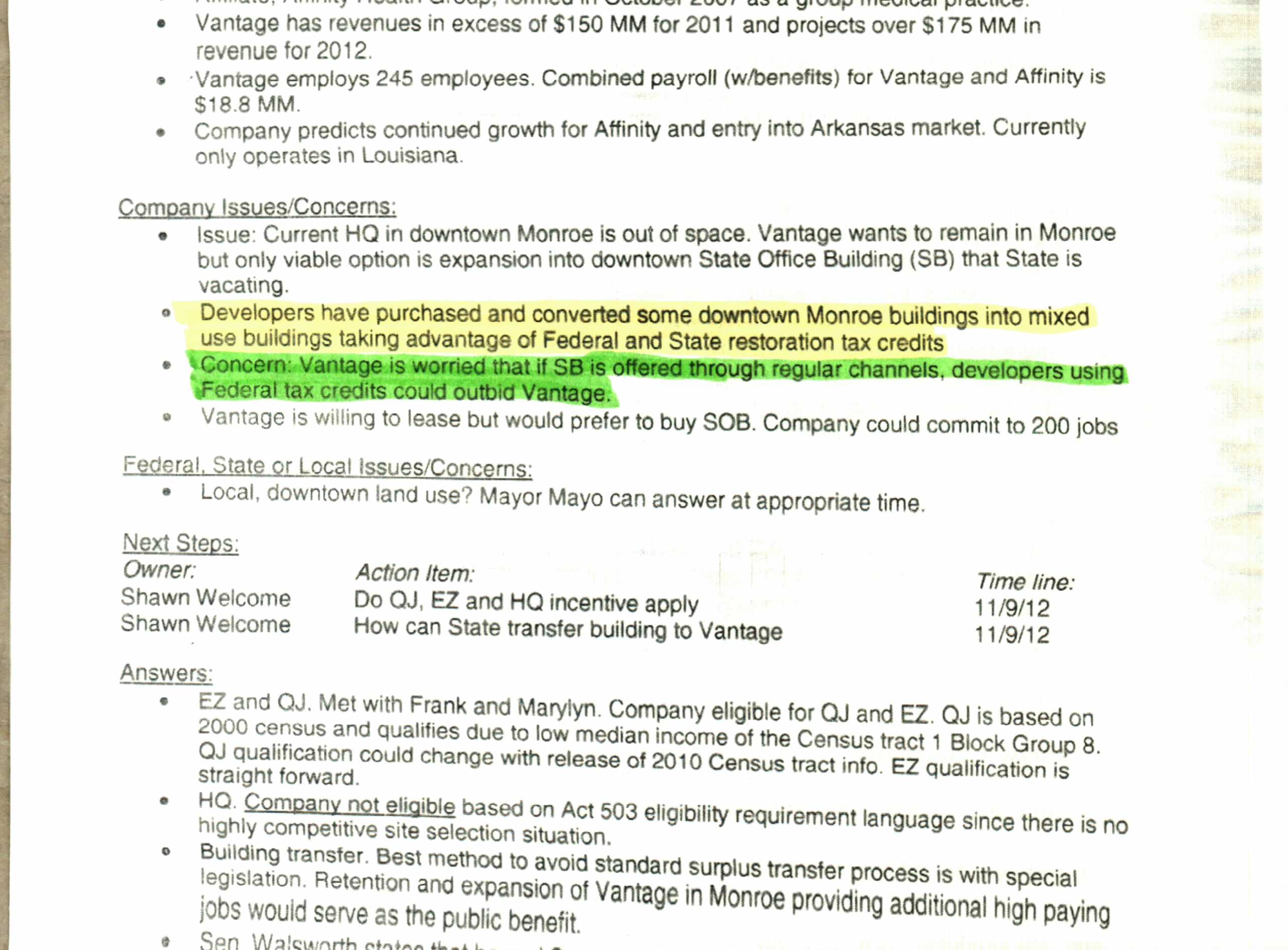
Under a heading entitled Company Issues/Concerns there were these two notations:

  • “Developers have purchased and converted some downtown Monroe buildings into mixed use buildings (by) taking advantage of federal and state restoration tax credits.”
  • “Concern: Vantage is worried that if SB (state building) is offered through regular channels, developers using federal tax credits could outbid Vantage.” IMAG0377

(CLICK ON IMAGE TO ENLARGE)

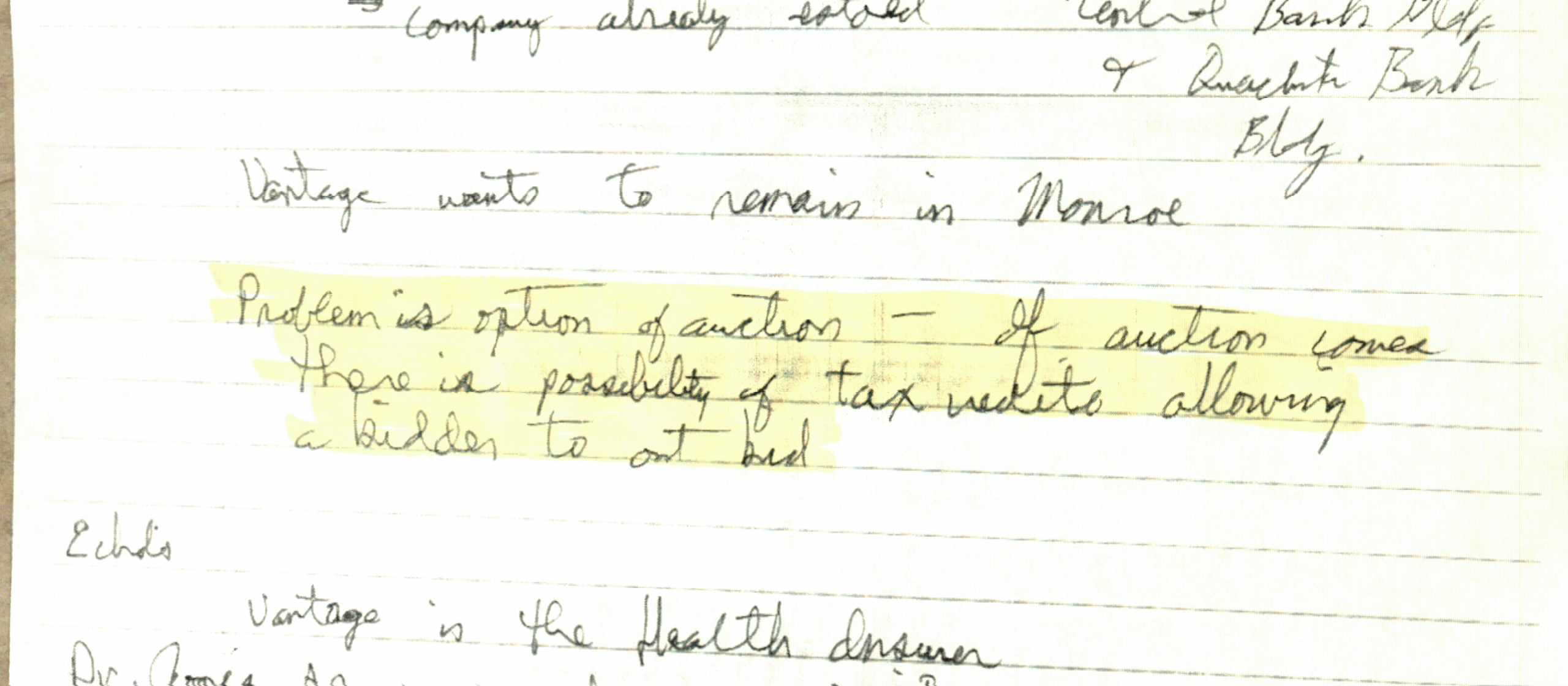
Finally, there was a handwritten note which described another meeting on Nov. 1, 2012. Besides the notation that “Sen. Riser supports,” there was this:

  • “Problem is option of auction—if auction comes there is possibility of tax credits allowing a bidder to out-bid.”

IMAG0378

(CLICK ON IMAGE TO ENLARGE)

Finally, there was a hand-scrawled notation at the bottom of a typewritten page containing employment estimates by Vantage through 2024 which directed that an “approach” be written “specific to Vantage.”

And while Vantage repeatedly cited concerns about other potential buyers obtaining state and federal incentives which they might use to thwart their purchase plans for the building, Vantage was not shy about seeking incentives from the state for its own benefit.

Documents obtained from LED show no fewer than 20 applications or notices of applications for various state incentive programs, including Enterprise Zone, Quality Jobs Program and property tax exemptions for renovations to existing offices in Monroe or expansion into new offices in Shreveport, Mangham, West Monroe, New Orleans and even into Arkansas.

Nor were Vantage and its corporate principals shy about flashing cash for political campaign contributions.

Campaign finance records show that Vantage its affiliate, Affinity Health Group, their corporate officers and family members combined to contribute more than $100,000 to various political campaigns, including $22,000 to Jindal and $11,000 to three of the four Senators who authored the bill authorizing the sale of the Virginia Hotel to Vantage: Thompson ($5,400), Walsworth ($4,500), and Riser ($1,000.

Read Full Post »

Peter Schroeder, a writer for The Hill, has drunk the Kool-Aid.

The Hill is a subsidiary of News Communications, Inc. that covers the U.S. Congress with an emphasis on business, lobbying and political campaigns and is one of the first web pages accessed each day by those wishing to stay abreast of events in the nation’s capital.

But Sunday’s story by Schroeder has to leave readers in Louisiana scratching their heads and wondering about his credentials or his sanity—or both.

His story, The New and Improved Jindal, touts the prospects of Gov. Bobby Jindal (R-Iowa, R-New Hampshire, R-Anywhere but Louisiana) as a legitimate challenger for the 2016 Republican presidential nomination. http://thehill.com/homenews/campaign/219759-the-new-and-improved-bobby-jindal

Perhaps unwittingly, however, the headline to his story may have provided an insight to what’s in store for the Boy Blunder.

By invoking the term “new and improved,” we immediately are left with the idea that he is being packaged and sold like so much washing powder or toothpaste—or perhaps more appropriately, toilet paper.

To bolster his evaluation of Jindal as a real comer, Schroeder relied on people like Tony Perkins, founder of the Louisiana Family Forum, former legislator, failed U.S. Senate candidate and president of the Family Research Council and Jindal’s former chief of staff, current political adviser Timmy Teepell and Baton Rouge political pollster Bernie Pinsonat.

The fact that Jindal and Perkins are in lock step on family values issues does not exactly make Perkins an impartial observer and Teepell certainly has much to gain if he and his consulting company, OnMessage, can ride Jindal’s coattails into the White House (or as Sarah Palin would say, 1400 Pennsylvania Avenue).

Schroeder also hangs his analysis on a single speech by Jindal last week when he cracked a couple of jokes that actually got chuckles from his conservative audience at the Values Voters Summit in Washington. “Jindal showed a dynamic style as he paced across the state,” he wrote.

What!!? Really? You’re staking your writing career on that thin bit of evidence?

Well, not exactly. There is this from Teepell:

“Most people’s impression of his speaking skills go back to his State of the Union response (of 2009), which was just a terrible speech.

“You’re having to do it (speaking) all the time, and on a number of different issues every single day, and so he just gets better and better.”

So, there you have it. By Teepell’s own admission, Jindal is making these speeches “every single day,” which leaves damned little time for him to devote his attention to the mundane duties of governor—a job to which he was re-elected by 67 percent of 20 percent of the state’s voters, a veritable mandate.

If he’s such a rising star, perhaps Schroeder can explain to us how Jindal managed to finish behind “nobody” in a recent straw poll. Maybe he can tell us why he remains a bottom feeder in the polls, along with Palin who can’t seem to get the address of the White House right.

Jindal’s supporters argue that his low numbers can be attributed to the fact that voters in the heartland don’t know him, not because they don’t like him.

News flash: we know him in Louisiana and his numbers have never been lower here and it’s precisely because we do know him.

Louisiana pollster Bernie Pinsonat said Jindal simply needs an issue that will give him national exposure.

We have several such issues:

  • He was for Common Core before he decided it would be politically expedient to oppose it.
  • He regularly hopped all over north Louisiana handing out stimulus money at Protestant churches and “awarding” military veterans’ pins during his first term but has not visited a single church of any stripe nor has he delivered any military pins since his re-election where only 20 percent of registered voters even bothered to vote.
  • He has bankrupted the state with tax giveaways to corporations while attempting to rip state employees’ pensions from them with a patently unconstitutional legislative bill.
  • He is now attempting to do the same thing with state worker health benefits while at the same time depleting the fund balance of the Office of Group Benefits.
  • He has handed out hundreds of millions of dollars in questionable state contracts to consultants and favored firms.
  • His hand-picked Secretary of Health and Hospitals has been indicted on nine counts of perjury in connection with one of those contracts.
  • He has given away the state hospital system to private entities though the move has yet to be approved by the Center for Medicare and Medicaid Services (CMS).
  • He has repeatedly cut the budgets of higher education in Louisiana.
  • He has consistently promoted school vouchers and charter schools at the expense of low-income students who are left in the underfunded public schools.
  • He attempted to give the State Police Superintendent a $55,000 a year retirement raise while ignoring rank and file state police and state employees.
  • He has broken his promise not to use one-time money for recurring expenses—not once, but six times.
  • He has enveloped the governor’s office in secrecy.
  • He has cloaked himself in a mantle of self-righteousness that is betrayed by his callous lack of concern for the people of Louisiana.

“People are going to have plenty of time to get a better impression of Gov. Jindal,” Teepell said. “That (2009) speech won’t be the only thing they remember about him.”

The business of remaking or re-packaging of the new and improved Jindal reminds of the wisdom of Mark Twain who said, “If you tell the truth, you don’t have to remember anything.”

As far as we’re concerned, Jindal is going to have plenty to try to remember in his quest for the brass ring that is the GOP nomination.

Or, as we prefer to think, if you’re genuine—if you’re the real deal—there’s really no need for a makeover.

And if ever a person needed a makeover, it’s Jindal.

Read Full Post »

“Like all of the governor’s self-created crises, the solution always seems to be to ask more of the people of our state: more money, more patience, more suspended disbelief.”

—State Rep. John Bel Edwards, commenting on the failure of Gov. Jindal’s promise of a $20 million a year savings with the privatization of the Office of Group Benefits.

Read Full Post »

« Newer Posts - Older Posts »