Because of our limited staff (one, plus a few occasional contributors), we often fall behind in our efforts to keep up with the news of our misbehaving public officials. We try to keep up, but these guys are pretty slick and very resourceful in finding new ways to siphon off funds, whether they be state funds or contributions from campaign supporters.
So, today, we will highlight a couple of politicos who are very tight: Bobby Jindal and his director of the Office of Alcohol and Tobacco Control (ATC), Troy Hebert (whose wife just happens to be the Jindal children’s pediatrician, we’re told).
We have an update on the status of Frederick Tombar III, who, like Hebert was appointed to a high-level position in the Jindal administration only to harass himself out of a job.
Tombar, it seems, has landed on his feet after leaving his $260,000 a year job as director of the Louisiana Housing Corporation because of some sexually explicit emails he sent to two female employees—one, a contract employee and the other an actual employee of the agency.
Both women attempted to put off Tombar’s advances because of fear of losing their jobs but eventually each filed complaints and Tombar left before he could be interviewed during an investigation by Ron Jackson, Human Resources Director for the Division of Administration.
Not to worry. We’re told by sources that Tombar, of New Orleans, had a soft landing at Cornerstone Government Affairs consulting company where he will work alongside two former state Commissioners of Administration, Mark Drennan and Paul Rainwater. http://www.cgagroup.com/index.html
http://www.cgagroup.com/team/RainwaterPaul.html
http://www.cgagroup.com/team/mark_drennen.html
Efforts to reach both Drennan and Rainwater for comment were unsuccessful.
It’s not known what Tombar’s salary at Cornerstone will be, but we are willing to bet it doesn’t approach the quarter-million a year he was making as a Jindal appointee.
That other appointee mentioned earlier, Troy Hebert, of whom much has been written here, little of it good, recently sent a bill to former ATC agent Howard Caviness of West Monroe who now serves as Grambling State University chief of police. Well, actually, the bill was not from Hebert, but from the agency under which he serves, the Department of Revenue (LDR).
The invoice, for all of $123.59 is for an alleged overpayment to Caviness in Dec. of 2012, according to the letter dated April 29 which is stamped “2nd notice.” Supposedly, the $123.59, when collected, will go to help patch over Jindal’s $1.6 billion budget deficit. 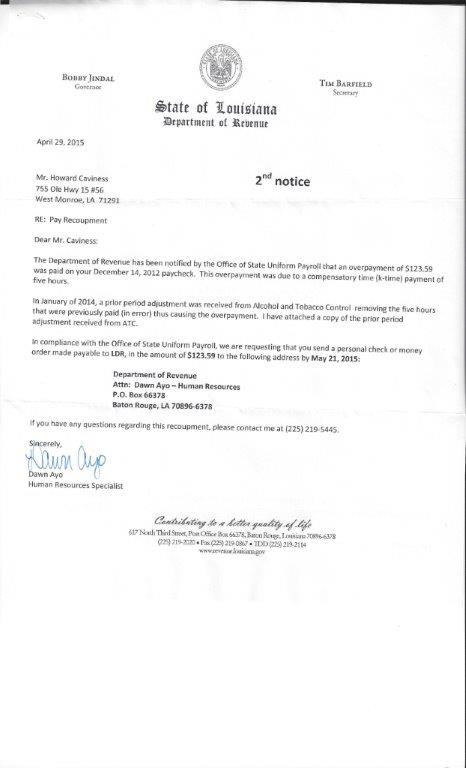
Attached to the letter is a time sheet for the two-week time period of Nov. 26—Dec. 9, 2012, with no explanation other than a hand-scrawled, “will leave a balance owed.” 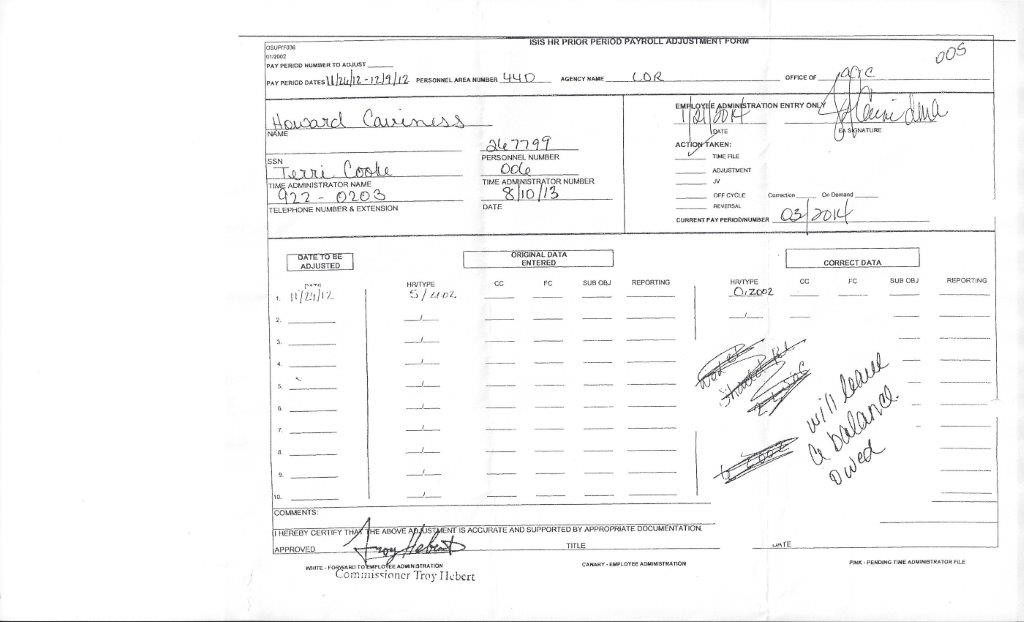
(CLICK ON IMAGES TO ENLARGE)
Caviness, contacted by LouisianaVoice, feels the action is in retaliation for his having testified on behalf of another former agent, Brett Tingle, who Hebert fired while Tingle was recovering from a heart attack.
Reprisals against a state employee by officials in the Jindal administration? Surely not!
But that would fit the modus operandi of Hebert and would give credence to a third former agent who revealed she was ordered to conduct an investigation of LouisianaVoice publisher Tom Aswell (that would be me). That former agent admitted that she did indeed follow through on the investigation but found me “rather boring.” We’ll take boring any day.
But we did our own nosing around and found that Hebert played pretty fast and loose with campaign donors’ money while he was still a state senator—and even after he left office to take over operations at ATC after Jindal did a number on former ATC Director Murphy Painter.
At the top of the list, as with the case of so many office holders, was his $12,165 expenditure for the purchase of what seems to be the most sought-after perk of all state politicians: LSU football tickets—$4,930 of that well after he left the House of Representatives in 2010 to become head of ATC. It’s somewhat difficult to see how whose expenditures, especially the $4,930 spent after he left office, could be justified as being “related to the holding of public office,” as state campaign expense laws clearly dictate. related to a campaign personal use cannot use campaign funds for personal use
But, as they say in those cheesy TV commercials, “Wait! There’s more!”
Our boy Troy also shelled out the following amounts for other seeming unrelated purposes:
- Nov. 11, 2014: All State Sugar Bowl tickets, $590 (again, quite a stretch in tying this to holding public office); SUGAR BOWL
- April 22, 2009: Sullivan’s Restaurant, Baton Rouge, $2,323.10 for a fundraiser; RESTAURANTS
- April 1, 2010: Delta Airlines, $691.80 (no explanation of any destination, but his House district was pretty small and probably didn’t require air travel to get around Iberia Parish; TRAVEL
- April 1, 2010: Hilton Hotel, Washington, D.C., $1,505.70. Ah! There’s his destination for that Delta flight. But what was he running for in Washington? HOTELS
- May 10, 2011: Monteleone Hotel, New Orleans, $500. About those two hotel bills: state regulations limit hotel rooms to a mere $120 per night. Perhaps someone should sent Hebert a bill for the difference. Oh, wait. The rooms were paid out of campaign funds, not the state treasury. So that makes it okay, we guess. travelguide
Still, $15,452 in campaign expenditures which somehow just don’t pass the smell test for legitimate campaign expenditures, especially $5,520 of which was spent after he left office.
And then there’s Jindal.
Since 2009, a year after he first took office, he has racked up an eye-popping expenditure of $169,597 in hotel room costs alone. TRAVEL
Even more revealing, all but $30,000 of that ($139,660) has been since his re-election in October of 2011, evidence that he has spent precious little time in Louisiana performing the “job he always wanted,” and the job to which he was elected.
Jindal also spent more than $185,000 in campaign money since 2003 on air travel, his campaign expense records show. Because his travel expenses were about equally divided between pre- and post-re-election in 2011, it would indicate that much of his lodging was provided by organizations to whom he was speaking.
By running as an “undeclared” candidate for the Republican presidential nomination, he was able to make free use of campaign funds he reaped while running for and serving as governor. That would explain why he is so cagey about his non-candidacy candidacy: the rules change and federal regulations kick in once he is a declared candidate. His self-serving claim to be “praying for guidance” over his decision has little or nothing to do with it; it’s all about the way he can spend the money.
 button to the right of the page or by mailing your check to:




 Louisiana Voice