Feeds:
Posts
Comments

Archive for the ‘DHH’ Category

Our friend C.B. Forgotston, who follows the legislature relentlessly, alerted us to this little tidbit this morning that illustrates just how far the legislature is willing to go to absolve itself of any responsibility in the current fiscal mess in which the state currently finds itself.

Year after year, when stinging budget cuts are imposed on higher education and health care, the same cry goes up from the citizenry: “Why are only higher ed and health care subjected to repeated budget cuts? Why aren’t other agencies made to share the pain?”

And year after year, the same response from legislators: “Because under the State Constitution, those are the only areas that can be cut.

“Our hands are tied,” they wail in unison.

Not so, says Forgotston, who once was a staff attorney for the legislature.

Of the $30 Billion in the current state budget, $3.9 Billion or only 13 percent is constitutionally-protected, he says.

Of the dedicated funds:

  • $3.3 Billion (85 percent of the constitutionally-dedicated funds) funds public elementary and secondary education’s Minimum Foundation Program (“MFP”) which is approved by the leges.
  • $318 Million (9 percent) pays the annual debt service on state borrowing (bonds).
  • $115 Million (3 percent) pays the supplemental pay for municipal policemen, firemen and deputy sheriffs.

What’s not protected?

            Of the $30 Billion budget, Forgotston says 87 percent is not constitutionally-protected. That includes:

  • NGOs (non-governmental organizations) and other local pork barrel projects in the Operating and Capital Outlay budgets.

The constitutional scapegoat

            The constitution is a convenient scapegoat for the governor and the legislators’ lack of political courage to set priorities,” he said, “especially, since none of them appear to have ever read the document.”

No matter. On Monday, they had a chance to do something about it and they didn’t.

They punted.

And the vote wasn’t even close.

The Senate Finance Committee deferred, by an 8-2 vote, Senate Bill 196 by State Sen. Jean Paul Morrell (D-New Orleans) which would have placed a constitutional amendment before Louisiana voters that would have repealed the constitutionally-imposed dedications. SB 196 TEXT

The Legislative Fiscal Notes, which accompany any bill dealing with fiscal matters, says there would be “no anticipated direct material effect on governmental expenditures.”

The fiscal notes also said, “Due to the elimination of approximately 20 constitutional funds and the requirement that the revenue source of such funds now flow into the State General Fund (SGF), the SGF will have approximately a statutorily dedicated fund balance transfer of approximately $3.9 billion in FY 16 and annual SGF revenue flow of approximately $730 million per year.” SB 196 FISCAL NOTES

Morrell lectured committee members as he testified on behalf of his bill, saying, “We fixed higher ed but not health care. We have too many ‘not me’s’ coming before you to defend their programs.

“If you kill this bill,” he cautioned members, “you’re saying to your constituents not only that your hands are tied but that you like your hands to be tied.”

Which is precisely what they did on motion from Sen. Dan Claitor (R-Baton Rouge).

Before the vote on Claitor’s motion, Sen. Fred Mills (R-St. Martinville) offered a substitute motion to approve the bill, sending it to the Senate floor. Only Sen. Bodi White (R-Central) voted with Mills in favor of the bill. Those voting against approval were committee Chairman Jack Donahue (R-Mandeville), committee Vice-Chairman Norbert Chabert (R-Houma), members Bret Allain (R-Franklin), Sherri Smith Buffington (R-Shreveport), Claitor, Ronnie Johns (R-Lake Charles), Eric LaFleur (D-Ville Platte), Edwin Murray (D-New Orleans), and Greg Tarver (D-Shreveport).

As an unspoken acknowledgement of the committee’s concern over a possible veto by Bobby Jindal, a fretful White went so far as to suggest to Morrell that he might get a more favorable consideration of his bill if he waited until next year “when we have a new governor.”

So, bottom line, it appears that legislators remain unwilling to confront a lame duck, largely absentee governor despite his abysmal approval ratings by Louisiana voters.

Something is wrong with this herd mentality, folks.

This is not the time to wait for a “new governor.” This is the time for bold, decisive action that says to Jindal, “We damned well dare you to veto this or we’ll throw it back in your face with a veto session like this state—or any other state—has never seen. We will bring the attention of the national media down upon your delusional head.”

Instead, they choose to wait.

Again.
Read Full Post »

Thank goodness for late-inning rallies Thursday and Friday nights by LSU’s No. 1-ranked baseball team to beat No. 2 Texas A&M 4-3  and 9-6, respectively. Otherwise, the news just keeps getting worse for Louisiana.

That’s right; we had to flip all the way back to the sports section to find anything good to write.

That’s because even as the legislature grapples with that $1.6 billion budgetary shortfall, things were becoming unraveled elsewhere as the administration was hit this week not with a double- but a triple-whammy that could end up costing the state hundreds of millions of dollars and could conceivably end up costing another LSU president his job.

We will try to take the events in chronological order.

On Tuesday, the administration received word from the Center for Medicare & Medicaid Services that CMS AGAIN REJECTS the administration’s Cooperative Endeavor Agreements (CEAs) in connection with the controversial state hospital privatization plan pushed by Bobby Jindal “because the state has not met its burden of documenting the allowability of its claims for Federal Financial Participation (FFP).”

The decision apparently will cost the state $190 million, according to a letter to State Medicaid Director Ruth Kennedy from Acting CMS Director Nikki Wachino.

On the heels of that letter, Commissioner of Administration Kristy Nichols received notification from Attorney General Buddy Caldwell on Thursday that the state had been OVERPAID BY $17 MILLION in tobacco settlement money and would have to repay that amount to the tobacco companies who then will redistribute it to states that were underpaid.

And on Friday, State Treasurer John Kennedy announced that national investors had pulled out of a large portion of a major bond deal for LSU after concerns were raised on Wall Street by LSU President F. King Alexander who announced on Thursday that he was preparing paperwork for the state’s flagship university to file for financial exigency, or academic bankruptcy. http://www.nola.com/politics/index.ssf/2015/04/lsu_academic_bankruptcy.html

Kennedy, in a Friday news release, said his office was “trying to sort out the facts,” but essentially, a $114 million bond issue that was in the works appeared to fall flat when investors pulled out on about $80 million in commitments. The bond sale was to have funded a Family Housing Complex, residence halls and a Student Health Center and also would have saved interest on existing debt. http://campaign.r20.constantcontact.com/render?ca=e9da20fd-7c07-4e6d-9d75-82afa4fb05a9&c=cdce75a0-62fb-11e3-959d-d4ae52a459cd&ch=ce38f740-62fb-11e3-95d9-d4ae52a459cd

A BloombergBusiness report said that while investors who bought the $114 million of debt sold by LSU they were not told the school was considering filing for exigency. http://www.bloomberg.com/news/articles/2015-04-23/louisiana-state-bond-buyers-greeted-by-insolvency-plan-next-day

A declaration of exigency by LSU and other colleges and universities across the state would open the way for the schools to fire tenured professors. http://www.bloomberg.com/politics/articles/2015-04-23/louisiana-state-to-draft-insolvency-plan-as-jindal-plans-cuts

One state official confided in LouisianaVoice that Alexander, in his attempts to underscore the severity of the financial crisis in Louisiana higher education, currently facing still more deep budgetary cuts, may have overplayed his hand in making a “premature” announcement of such magnitude.

Meanwhile, word leaked out of a Board of Regents committee meeting Friday afternoon that as many as one-half to 75 percent of Louisiana colleges and universities may be unable to meet payroll by June unless some solution is found quickly to the fiscal crisis that has spread a mood of imminent doom across state campuses. That source said he does not believe a solution will be found until the last week of the session—if then.

With a vengeful governor like Bobby Jindal, anything perceived by him to place him in a bad light is met with severe repercussions, namely teaguing, and Alexander’s pronouncements have certainly reflected poorly on the administration.

For new readers who may not be familiar with the term, teaguing refers to Jindal’s firing of Melody Teague because of her testimony before the state government streamlining committee and the similar firing of her husband, Tommy Teague, only six months later from his job as Director of the Office of Group Benefits (OGB) when he failed to go along with the ill-fated privatization of that agency. Dozens of other state employees and legislators have been either fired or demoted from committee assignments by Jindal for lesser sins. LouisianaVoice learned today that Melody Teague, who was suffering from ALS, died in March. http://www.legacy.com/obituaries/theadvocate/obituary.aspx?pid=174404543

For his part, Jindal, after more than seven years in office, has finally admitted there is a problem with “corporate welfare” in Louisiana, i.e. corporations that do not pay any taxes to the state.

One classic example cited by Steve Spires of the Louisiana Budget Project was Wal-Mart, which is a Delaware-based corporation. Spires, speaking at a State of (Dis)Repair conference in Hammond on Thursday, noted that Louisiana Wal-Mart stores are leased by local entities who pay exorbitant rent to the corporate parent in Delaware, a state with no state income tax, thus avoiding income tax in Louisiana while reaping the benefits of other incentives such as Enterprise Zone designation and 10-year property tax exemptions.

Jindal has only in the past couple of weeks so much as acknowledged the state has a problem with its generous tax breaks for corporations which cost the state billions of dollars per year.

Thus, as the budget crisis grows progressively worse with each passing year, Jindal has resorted to more and more sleight of hand in patching over budget holes with one-money.

Caldwell, in his letter to Nichols and Kennedy, said a number of states had been underpaid in tobacco fund settlement money by the tobacco companies because of accounting errors, and that a corresponding number, including Louisiana, had been overpaid.

Louisiana, he said, was overpaid by about $17 million which will have to be repaid so the money can be redistributed to the proper states.

The CMS rejection has been a problem for the administration since the privatization deals with several private hospitals were signed, though DHH Secretary Kathy Kleibert has attempted to see the world through rose-colored glasses, always expressing optimism that the state’s plan would be approved.

Not so.

In her three-page letter to Ruth Kennedy, Wachino said, “After careful consideration, CMS cannot accept the arguments advanced by the State in its Request for Reconsideration. While CMS recognizes the State’s efforts at corrective action, such measures do not address the State’s noncompliance for the period in question (Jan. 1, 2013 through May 23, 2014). For the reasons stated above, as well as in CMS’s Dec. 23, 2014, disallowance letter, the…disallowance is affirmed.”

All in all, the state has seen better weeks.

Go LSU! We need a sweep badly!

Read Full Post »

One might think the Jindal administration and the Office of Group Benefits (OGB) might have learned something from the Bruce Greenstein fiasco over at the Department of Health and Hospitals (DHH).

Greenstein, you will remember, was the DHH secretary when that $280 million contract was awarded by his agency to his former employer, CNSI.

That scenario could be repeated at OGB.

Even though Greenstein insisted he had established a “firewall” between himself and CNSI, it was subsequently revealed that Greenstein had hundreds of email and text message exchanges with his old bosses during the contract selection process.

That eventually led to Greenstein’s forced resignation and criminal indictment and a civil suit by CNSI the entire messy episodes are slowly making their way through the Baton Rouge District Court system.

Which brings us to OGB and its $35 million-a-year contract with Blue Cross/Blue Shield of Louisiana (BCBS) to administer OGB’s Preferred Provider Organization—a task that apparently proved somewhat daunting to BCBS during the first year of its contract, costing the contractor more than $3.1 million in performance penalties.

One of five contracts with the state totaling $1.2 billion, that three-year contract will end on Jan. 1, and OGB is currently accepting proposals for a new three-year contract.

OGB issued its request for proposals (RFP) on March 13, giving an April 20 deadline for proposals but that deadline was extended to April 30 in an addendum issued on Wednesday (April 22). OGB RFP

LouisianaVoice, however, has learned that OGB Administrator Elise Cazes has been put in charge of the evaluation committee which will make recommendations on awarding a winner of the new contract.

The problem? Cazes was appointed Group Benefits Administrator on June 23, 2014.

Cazes was previously employed by BCBS of Louisiana, raising the possibility of a conflict of interests. https://louisianavoice.com/2014/07/26/ogb-laying-of-24-more-blow-softened-when-ceo-assures-affected-employees-losing-their-jobs-not-like-losing-a-child/

She earns $106,000 per year in her current position.

Not only does she head up the evaluation committee, but she also was given the responsibility of naming other members of the committee. To date, the name of only one other evaluation committee member, OGB Interim Deputy Director Bill Guerra, has been revealed.

At the same time, LouisianaVoice has learned that BCBS in 2013 was fined more than $3.1 million for performance deficiencies in connection with its contract with OGB. BLUE CROSS PENALTIES

BCBS was paid slightly more than $32.2 million to administer the PPO plan for calendar year 2013, the first year of its current contract.

Under terms of its contract with OGB, BCBS could be fined up to $9.7 million for failure to meet a variety of standards. Those include:

  • General Standards (10 percent of total medical administrative fees): $3.52 million;
  • Data Submission Standards: $10,000 per day, or a maximum of $20,000;
  • Mental Health & Substance Abuse (MH&SA) Standards (17.5 percent of total medical administrative fees): $6.2 million.

The actual penalties imposed for 2013, according to OGB’s own report, and the breakdown included:

  • Average speed to answer phones (39 seconds against an industry standard of less than three seconds): $352,325;
  • Claims Accuracy: $352,325
  • Membership Identification Cards Timeliness: $352,325;
  • Data Submission Timeliness: $20,000 (the maximum amount allowed);
  • MH&SA Appeals: $528,487;
  • MH&SA Ambulatory Follow-Up: $528,487;
  • MH&SA Medical Integration: $528,487;
  • MH&SA Member Satisfaction Survey Score: $528,487

TOTAL: $3.19 million.

In explaining the deficiency report, OGB noted that the contract between BCBS and OGB “contains 26 performance goals (called service level agreements, or SLAs) related to customer service and claims processing. During 2013 Blue Cross experienced challenges in meeting a handful of these goals.”

The report indicated that “all issues” had been resolved and that OGB and BCBS were “fully prepared for excellent performance during the 2014 calendar year.”

But LouisianaVoice recently received the following email from a retiree which would seem to indicate otherwise:

“Here’s a laugh; Look at the insurance health cards my wife and I received thus far:

  • Received 3/6/15:  deductible—$300
  • Received 03/09/15: insured deductible—$600
  • Received (date unknown): insured deductible—$600
  • Received 03/20/15: insured deductible—$1800
  • Received 03/20/15: spouse deductible—$600
  • Received 03/27/15: spouse deductible—$600
  • Received 03/27/15: insured deductible—$1800
  • Received 04/04/15: insured deductible—$600. 

“Do I get to pick our deductible from these cards?  You can tell that BCBSLA and OGB are on top of this matter, right? I plan to make a personal visit to the OGB office probably next week and show them this trash and find out what our deductible(s) really are. Do you think they know? I will ask while I am (at the OGB office) for the real executive director at OGB (to) please stand up.

“Our online monthly premium is a different figure from the letter received in the mail today from OGB. I am ready for someone to figure out what’s going on, and do something logically and correctly.  Health insurance is a serious matter for people and they are playing with us. Everything needs to be corrected and cleaned up for all state employees (retirees and actives).

“OGB use to be correct on these technical matters and they had in the past straightened out BCBSLA for me several times on what was to be paid, etc. Now OGB has gone crazy too! I guess it’s from all the new executives at the top.” 


Read Full Post »

JINDAL STATE OF THE STATE ADDRESS(FROM OUR ANONYMOUS CARTOONIST: CLICK ON IMAGE TO ENLARGE)

If there was any lingering doubt that Bobby Jindal has been committing payroll fraud, that doubt was erased in last Monday’s State of the State address to legislators at the opening of the 2015 legislative which, thankfully, will be his last such address.

Fraud is defined as:

  • The wrongful or criminal deception intended to result in financial or personal gain;
  • Deceit, trickery, or breach of confidence perpetrated for profit or to gain some unfair or dishonest advantage;
  • A person or thing intended to deceive others, typically by unjustifiably claiming or being credited with accomplishments or qualities.

Payroll fraud is further defined as the unauthorized altering of payroll or benefits systems in order for an employee to gain funds which are not due. The person making financial gain could be the employee or could be an associate who is using the employee to commit the fraud while taking the funds for himself.

There are generally three types of payroll fraud but for our purposes we are interested in only one:

  • Ghost employees—A person, fictional or real, who is being paid for work he does not perform. In order for the fraud to work the ghost employee must be added to the payroll register. If the individual is paid a monthly salary this is easier for the fraudster, as once this has been set up there is little or no paperwork required. In order for the fraud to work, the ghost employee must be added elected to the payroll register. Once this has been set up, there is little or no paperwork required.

Under that definition, Jindal could certainly be considered a ghost employee. One person even suggested that it was not really Jindal speaking to legislators, that Jindal was actually in Iowa and they were being addressed by a hologram.

We maintain that Jindal is committing payroll fraud by vacating the state so often and leaving the details of running the state to appointed subordinates as inexperienced and naïve as he. The point here is this: No one on his staff was elected; he was. And he has not been at the helm of the ship of state and by absenting himself so frequently and so consistently as he gins up his presidential candidacy, he is committing payroll fraud, theft, and malfeasance. Others, like former Desoto Parish School Superintendent and Board of Elementary and Secondary Education member Walter Lee have been indicted and been prosecuted for payroll fraud.

Before we really get into his speech to legislators, JINDAL ADDRESS TO LEGISLATURE we simply must call attention to the feeble effort at humor he (or someone) injected into the third line of his speech:

“Well, here we are…at the moment that some of you have been waiting for a long time—my last state of the state speech.”

After an apparently appropriate pause, he continued: “No, that was not supposed to be an applause line…and I do appreciate your restraint.”

Seriously? You actually wrote that line in your speech? If you have to write that in, if you are incapable of ad-libbing that simple line, then we now understand that idiotic response to President Obama’s State of the Union Address in 2009.

Before getting to the real meat of his legislative agenda for this year (if you can call it that), he touched ever-so-lightly on a few other points he generously referred to as his administration’s accomplishments. Our responses to each point are drawn directly from statistics provided by 24/7 Wall Street, a service that provides a steady stream of statistical data on business and government:

  • “We cleaned up our ethics laws so that now what you know is more important than who you know.” (A quick look at the appointment of Troy Hebert as director of the Office of Alcohol and Tobacco Control after the baseless firing of Murphy Painter could quickly debunk that bogus claim. So could several appointments to the LSU Board of Supervisors and the equally egregious firing of key personnel like Tommy Teague who did their jobs well but made the fatal mistake of crossing Mr. Egomaniac.)
  • “We reformed our education system…” (Louisiana is the fifth-worst educated state and we are the third-worst state for children who struggle to read);
  • “We reformed our health care system…” (Really? Is that why the privatization of our state hospitals remain in turmoil? That same reform ultimately forced the closure of Baton Rouge General Mid-City’s emergency room because of the overload brought on by the closure of Earl K. Long Hospital? Can we thank your “reform” for the fact that Louisiana still has the nation’s third-lowest life expectancy rate or that we enjoy the nation’s third-most unhealthy rating, that we are fifth-highest in cardiovascular deaths or that we have the highest obesity rate in the nation?);
  • “…Our economy is booming.” (Seriously? Louisiana is rated as the worst state for business in the U.S.; we rank sixth-highest among states where the middle class is dying; we remain the eighth-poorest state in the nation with a poverty rate that is third-highest, and we’re saddled with the fourth-worst income disparity in the nation and we’re rated the 10th-worst state in which to be unemployed.);
  • “We have balanced our budget every year…and have received eight credit upgrades.” (This one of those claims so preposterous one doesn’t know how to respond, but we’ll give it our best. Jindal has repeatedly patched budget holes by skimming funds from other agencies, like more than $400 million from the Office of Group Benefits reserve fund, from the sale of the tobacco settlement, from ripping funds for the developmentally disadvantaged (to fund a race track tied a political donor—what was that line again about “what you know, not who you know”?), by cutting health care and higher education, by selling state property, and now he’s trying to cover the current $1.6 billion budget hole by selling the State Lottery. As for those credit upgrades, we can only point to the February action by Moody’s and Standard & Poor’s bond rating agencies to move the state’s credit outlook from stable to negative—and to threaten the more severe action of a downgrade.);
  • “The end result is a stronger, more prosperous Louisiana for our children. I measure Louisiana’s prosperity not by the prosperity of our government, but by the prosperity of our people.” (So, why are the fifth-most dangerous state in the nation? The 10th-most miserable state? Why do we have the eighth-worst quality of life? And the 11th-worst run state in the nation? And why have you never once addressed in your seven-plus years in office our ranking as the number-one state in the nation for gun violence or our ranking as first in the world for our prison incarceration rate?)
  • “We don’t live by Washington’s rules of kicking our debts down the road.” (For the love of God…);
  • “We have laid out a budget proposal that seeks to protect higher education, health care and other important government functions.” (And that’s why higher education and health care have been cut each of your years in office and why more cuts are anticipated that could conceivably shut down some of our universities. You really call cuts of up to 80 percent “protecting” higher education?);
  • “We have a system of corporate welfare in this state.” (Wow. After more than seven years of giving away the store to the tune of billions of dollars in corporate tax breaks, you finally come the realization that perhaps your generosity to the Wal-Marts, chicken processing plants and movie production companies may have been a bit much—that those policies may have actually hurt the state? What brought about this sudden epiphany? Bob Mann, in his Something Like the Truth blog, was all over that when he called attention to Jindal’s latest comment in the face of his claim a couple of years ago that we were “crushing businesses” with oppressive taxes. We’ll let him take this one.) http://bobmannblog.com/2015/04/17/bobby-jindal-is-now-against-corporate-welfare/
  • “We have identified over $500 million of corporate welfare spending that we think should be cut…” (Why the hell did it take you seven years?)

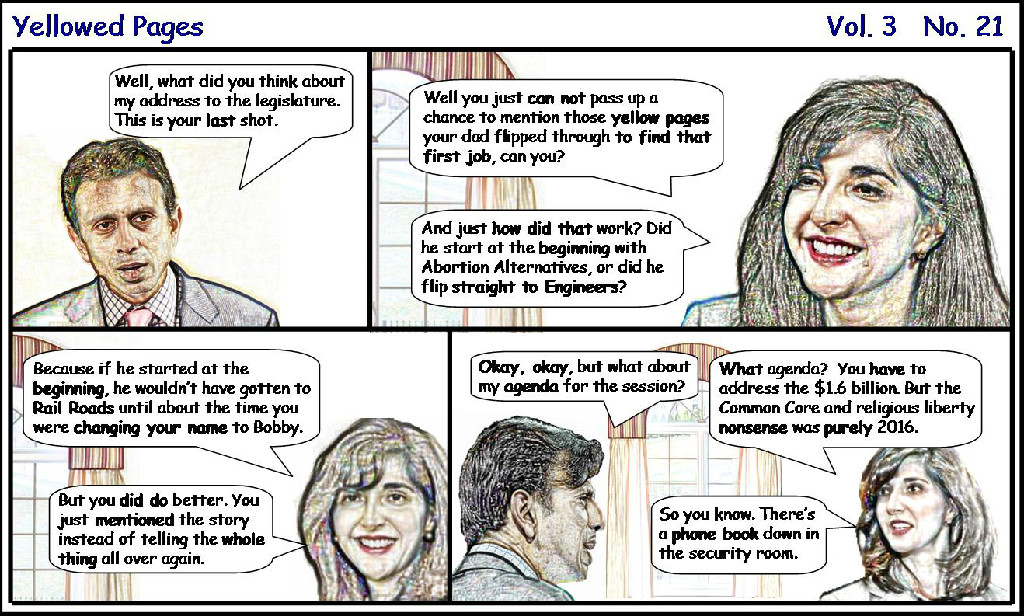
After all was said and done, after his hit-and-run sideswipes at all his purported “accomplishments,” Jindal devoted the bulk of his address to only two issues: Common Core and religious liberty. Of the latter issue, he said, “I absolutely intend to fight for passage of this legislation.”

Jindal was referring to Bossier City Republican State Rep. Mike Johnson’s HB 707 which would waste an enormous amount of time and energy—time that could be better spent on far more pressing matters, like a $1.6 billion deficit—on preventing the state from taking “any adverse action” against a person or business on the basis of a “moral conviction about marriage.”

Despite claims by Jindal and Johnson to the contrary, the bill is nothing more than a clone of the Indiana law that constitutes a not-so-subtle attack on gays or anyone else with whom any businessman deems a threat to his or her definition of marriage.

So, after eight addresses to the legislature, Jindal has yet to address any of the issues like inadequate health care, violence, poverty, pay disparity or equal pay for women, increasing the minimum wage, poor business climate (his rosy claims notwithstanding), our highway system (we didn’t mention that, but we are the seventh-worst state in which to drive, with the 15th-highest auto fatality rate), or our having the highest incarceration rate in the world.

Instead, the thrust of his address is aimed at Common Core—he called it federal control even though Common Core was devised by the nation’s governors and not the federal government—and something called the “Marriage and Conscience Act.”

And he expects those two issues, along with something he calls “American Exceptionalism,” to thrust him into the White House as leader of the free world.

And, of course, attacking national Democrats like Obama and just today, Hillary Clinton, on her claim of having immigrant grandparents. Jindal, of course, wants exclusive rights to that claim and says so with his oft-repeated platitude: My parents came to this country over 40 years ago with nothing but the belief that America is the land of freedom and opportunity. They were right. The sad truth is that the Left no longer believes in American Exceptionalism.”

Well, to tell the truth, if Bobby Jindal is the example—the standard-bearer, if you will—for what is considered “American Exceptionalism,” then frankly, we don’t believe in it either.

Read Full Post »

Dr. Randall M. Wilk operates a medical practice in Gretna dedicated to the surgical treatment of diseases in the head and neck. http://www.drrandallwilk.com/#

Approximately 25 percent of his patients are cancer sufferers. Licensed to practice medicine in the state of Louisiana (License No. MD022962), Wilk earned his medical degree from the LSU School of Medicine in New Orleans. He did his general surgery training at the Ochsner Medical Institutions and did his head and neck surgery training in Portland, Oregon.

He also has a Ph.D. in anatomy from LSU and a DDS from the Baylor College of Dentistry and has a certificate in oral surgery.

But even though he does not operate a dental facility, that DDS degree has cost him more than $100,000 in legal fees because of the heavy-handed tactics of the Louisiana State Board of Dentistry which carried its badgering of Wilk all the way to the floors of the Louisiana House and Senate.

“Since graduating from dental school 25 years ago I have never filled a tooth, made a denture, made a crown, cleaned teeth, restored a tooth, or anything that one would consider a dental practice,” Wilk says, adding that he went “from graduating dental school in 1987 to starting graduate school” that same year.

Wilk noted that the dental board, in its 2009 financial statement, reported a loss to the Department of Health and Hospitals (DHH) of more than $60,000 and that the only plan put forth for managing that loss was “higher revenue from the collection of fines.”

Within weeks of that report, Wilk said, “I received a letter from the board sating that they had received a complaint on me from a Camp Morrison.”

Morrison, a private investigator, has worked for the board for numerous years under a series of contracts totaling more than $1 million. Moreover, even though he is an independent contractor, he is given free office space in the board’s suite at the high-rent One Canal Place office building in New Orleans.

Dating back to 1997, Morrison was issued nine consecutive contracts totaling more than $1.8 million. Most of his contracts were for two-year durations. His first, from March 1, 1997 to Feb. 28, 2000, was for $45,000. But from Sept. 1, 2000, through Aug. 31, 2002, his contract more than trebled, to $150,000 and increased again to $200,000 with his next contract which ran from Sept. 1, 2002 through Aug. 31, 2004.

Beginning on Sept. 1, 2004, he was awarded four consecutive two-year contracts of $240,000 each. Those four contracts combined to run through Aug. 31, 2012.

For whatever reason, on Sept. 1, 2012, the board cut his contract back to nine months and $110,000 but when that pact expired on June 30, 2013, he was issued a new contract, this one for three years, from July 1, 2013 through June 30, 2016, for $340,000.

Wilk said he was told that Morrison had reported to the board “that they had no record of me having an anesthesia permit from the dental board in 2007, that they had no record of me having a certificate in oral surgery, and that I was suspended from the Medicaid and Medicare programs.

“All of those are false statements,” he said, but the board refused to produce a copy of Morrison’s report. “I believe that filing a false report is a crime.”

Wilk said a meeting was scheduled and at that meeting two board members said they wanted him to sign a consent decree and to pay the board $5,000.

When Wilk said he had no intention of signing anything without first having his attorney examine the document, they left the room for a short time and returned with an adding machine “and told me that if I did not sign the document right then and there, that they could levy fines of over $100,000.”

He said the two handed him the adding machine tape “and placed the consent decree in front of me. For those familiar with the Godfather movies, the only thing missing was Luca Brassi with a pistol to my head.” He said a board member said it appeared that he (Wilk) felt his medical degree was more important than his dental degree.

“This was a pure and simple shakedown,” Wilk said.

He said it’s not unusual for medical specialists to obtain a dental degree prior to going to medical school and residency. “In the state of Louisiana, dozens of doctors are in this position. At least half-a-dozen are otolaryngologists, several are plastic surgeons, general surgeons, head and neck surgeons, orthopedic surgeons, gastroenterologists, anesthesiologists, even psychiatrists.

“Having a dental degree does not make your medical practice a dental practice,” he said.

Apparently the dental board and its investigator, Camp Morrison, disagree. Here are minutes of a 2011 dental board meeting at which Wilk’s case is discussed. DENTAL BOARD MINUTES MAY 20, 2011 (bottom of page 14)

Moreover, the DENTAL BOARD BULLETIN also mentions disciplinary action against Wilk (Item no. 14 in the left column near the bottom of page 3).

Wilk obtained legal counsel but the barrage from the dental board continued “for almost two years,” he said. “They subpoenaed me five times, requested copies of my patient records for several years and required my staff to go over 12,000 records. The final documents sent to them weighed several hundred pounds.

“Despite my being represented by counsel, Mr. Morrison continued to serve me subpoenas, to appear in my office waiting room, the operating room at Ochsner Hospital and at my home,” all the while passing out his cards to people and saying he was the investigator for the board of dentistry.”

Eventually, the board relented somewhat by notifying Wilk’s attorneys that if he paid the board $10,000 the matter would “go away.” Wilk said he feels that such tactics are tantamount to corruption or shakedowns. Again, he refused to pay.

Louisiana Revised Statute 37:793 (H) (2) says:

  • A personal permit is not required when the dentist uses the services of (1) a trained medical doctor, (2) doctor of osteopathy trained in conscious sedation with parenteral drugs, (3) certified registered nurse anesthetist, (4) a dentist who has successfully completed a program consistent with Part II of the American Dental Association Guidelines on Teaching the Comprehensive Control of Pain and Anxiety in Dentistry, or (5) a qualified oral and maxillofacial surgeon provided that the doctor or certified registered nurse anesthetist remains on the premises of the dental facility until any patient given parenteral drugs is sufficiently recovered.

When Wilk’s pointed out that the statute “specifically exempts me from what they are fining me for, their lawyer stated that he will have to ‘get that law changed.’” Wilk said. He said the board, which in 2010 reported an operating loss of $104,000, “held its own trial and fined me and held me for the board’s legal costs, totaling about $100,000.” They are their own judge, jury, and executioners,” he said. DENTISTRY BOARD 2009 FINANCIAL STATEMENT

The board subsequently prevailed on then-State Rep. Herbert Dixon to introduce legislation giving the dental board the necessary leverage to pursue claims against medical practitioners like Wilk who were not practicing dentists.

Wilk was scheduled to testify in committee against Dixon’s bill, HB 172, at 10 a.m. on May 15, 2012 but upon arriving, learned that the bill had been moved up to first on the calendar and had already been discussed and passed by the committee. It subsequently passed unanimously in both the House and Senate, yet more evidence that legislators often pass bills without really knowing what they contain or the implications of the language.

Wilk said that State Sen. David Heitmeier (D-New Orleans) had a discussion with Peyton Burkhalter, who had by then succeeded Barry Ogden as executive director of the board, and that Burkhalter had assured Heitmeier that the board had decided to drop the charges against Wilk. “He said that Mr. Morrison’s Gestapo tactics would end,” Wilk said.

State Sen. Fred Mills (R-Breaux Bridge) told LouisianaVoice on Thursday that he and former House Speaker Jim Tucker (R-Terrytown) had experienced clashes with the board in the past. “They’ve got some problems with that board,” he said, “and I believe the answer in the end will be the establishment of oversight over them,” he said. “We’ve had to threaten them with legislative action, including replacing the entire board, in order to back them down in the past.”

Wilk said he feels there is outright corruption on the board and that its shakedowns of dentists and non-dentists alike constitutes extortion. “Knowing that no violation of any statute occurred but demanding payment under threat of costly litigation is unethical conduct,” he said.

“I believe that their changing the law was intended to persecute me but also puts many other practitioners at risk. The implications…are far-reaching and as such constitute a restraint of trade. The precedent set by this bill (HB 172) (allows) other boards to reach beyond their jurisdiction. This law does nothing to protect the public,” he said.

Read Full Post »

« Newer Posts - Older Posts »


