Feeds:
Posts
Comments

Archive for the ‘Crime’ Category

In the early morning hours of Jan. 22, 2012, Joseph Branch, with a blood alcohol content (BAC) of .307 percent (2½ higher than the .08 percent, the legal definition of intoxication in Louisiana) and driving at a high rate of speed, struck two bicyclists, killing Nathan Crowson and severely injuring his riding companion, Daniel Morris.

Branch, who had a previous DWI conviction in 2006 and was given a six-month suspended sentence, was convicted of vehicular homicide and first degree vehicular negligent injuring and sentenced to 7½ years in prison. http://theadvocate.com/news/11878236-123/baton-rouge-man-joseph-branch

That should be that, right?

Well, no. There remained the issue of whether or not The Bulldog, a bar where Branch had been drinking with two friends just before the accident, might be legally liable for continuing to serve Branch after it was evident that he was intoxicated.

Anytime there is an alcohol-related auto accident involving a fatality, the Louisiana Office of Alcohol and Tobacco Control (ATC) investigates whether or not the driver had been served alcohol after it was obvious he was intoxicated. Such customers are supposed to be eighty-sixed, or cut off from being served more alcohol.

So, how are investigations carried out?

Meticulously. Carefully. Thoroughly.

Think again.

The investigation, which would routinely require weeks upon weeks of interviews, document and video review and which normally produce written reports 30 to 40 pages in length, was unusually short in duration and produced a report of a single page.

One page that completely exonerated the bar of any violation. http://www.wbrc.com/story/16903763/bar-cleared-in-fatal-crash

Initially, two ATC agents, neither of whom now work for the agency, began the investigation by requesting a video of the night in question to determine if Branch displayed any obvious signs of intoxication. They also asked owners of The Bulldog, located on Perkins Road in Baton Rouge, for certain other documents and information, including copies of any and all receipts of alcoholic beverages purchased by Branch.

When the bar initially refused to cooperate, the agents who customarily investigate such cases, obtained a subpoena and served it on the bar.

Enter ATC Commissioner Troy Hebert.

This is the same Troy Hebert who allegedly once admonished an agent for not shooting an unarmed man. When an ATC agent attempted to question a man who appeared to be intoxicated in the Tigerland area near the LSU campus where a number of bars and clubs are located, the man dove at the agent’s feet in an attempt to take him down. He was quickly overpowered and handcuffed by agents who reported the incident to Hebert. They said Hebert asked, “Why didn’t you shoot him?”

It is also the same Troy Hebert who another Baton Rouge bar owner says set his establishment up for selling to underage customers.

In December, his bartender refused to sell alcohol to an underage patron working undercover in tandem with an ATC agent. When the bartender refused to sell alcohol to the underage customer, the female ATC agent purchased the drink and gave to the younger girl and then cited the bar for selling alcohol to underage patron.

“That server is taught that they are to remove the drink from the individual who is underage,” Hebert said.

“She slides the beer to the underage girl,” bar owner Andrew Bayard said. “She assumed possession and gives it to the underage girl. I don’t feel that is a fault of my employee.” http://www1.wbrz.com/news/bar-owner-at-odds-with-state-alcohol-agents-claims-his-employee-was-set-up

Hebert officially resigned as commissioner, effective Jan. 10, the day before the new governor, John Bel Edwards, took office. He since has announced he will seek the U.S. Senate seat being vacated by Sen. David Vitter who is not seeking re-election.

But we digress.

In an unprecedented move, Hebert, who had zero experience as an investigator, decided he would be the lead investigator of the Bulldog.

What possible motive would Hebert have in rushing through an investigation and issuing a press release on Feb. 9 absolving the bar of any responsibility? Why would he instruct the lead agent on the case to limit his report to one page?

Why would Hebert watch the video footage for only a few seconds before proclaiming he “saw nothing” there? Why not watch the entire video to see if Branch did, in fact, appear intoxicated?

Even more curious, why would Hebert instruct that same agent to return to The Bulldog and retrieve the subpoena the agent had served on the establishment for video and records, thus freeing the bar of any responsibility to turn over key records?

Is it possible that the answer to each of these questions can consist of two words?

Might those two words be Chris Young?

The New Orleans attorney represents scores of clubs and bars (and convenience stores) before the ATC and his sister, Judy Pontin, is the executive management officer for ATC’s New Orleans office, earning $71,000 per year.

John Young, the brother of Chris Young and Pontin, is the former president of Jefferson Parish and was an unsuccessful candidate for lieutenant governor in last fall’s statewide elections.

ATC insiders told LouisianaVoice that when an establishment wants to apply for an alcohol permit or whenever the business experiences problems with ATC, Pontin refers them to Chris Young for legal representation.

Chris Young was the legal counsel for The Bulldog prior to and throughout the ATC investigation.

Daniel Morris, who was severely injured in the accident, retained the representation of Lafayette attorney Patrick Daniel who issued his own subpoena to ATC for certain records to bolster his litigation against The Bulldog.

In February 2013, more than a year after the accident which left Morris disabled, Daniel sent a letter to ATC general Counsel Jessica Starns noting that ATC FAILED TO PROVIDE RECORDS TO MORRIS

“Your response is considered incomplete as it does not contain certain items referenced in the produced documents,” he said.

It was not immediately determined if the records were finally produced but it does raise the obvious question of why did ATC not comply with that subpoena in the first place, thus necessitating a follow up letter from the attorney?

Could those records have contained information that conflicted with ATC’s one-page report of Feb. 9, 2012, the report that supposedly cleared The Bulldog?

A lot of questions were left hanging out there and someone deserves some answers.

We’re guessing that would be the families of the two cyclists.

But we may never know those answers.

In June 2014, the First Circuit Court of Appeal upheld a Baton Rouge state district court in tossing Morris’s lawsuit on the basis that the responsibility for intoxication lies with the individual, not the establishment.

Thus was added insult to Morris’s considerable injuries.

Read Full Post »

© 2016

A joint investigation by LouisianaVoice and Fox8 News has revealed that a federal investigation has been launched into allegations that former Louisiana Office of Alcohol and Tobacco Control director Troy Hebert used his position to extort sex from a woman who experienced problems with ATC over a liquor license for her New Orleans restaurant.

New Orleans businessman Amer Bader, who initially told LouisianaVoice he had been visited by the FBI, told a former ATC agent he exchanged text messages with Hebert. In those texts, he accused Hebert of extorting sexual favors from a woman friend of Bader’s who was experiencing problems in licensing her restaurant with ATC. He later said it was not he who was visited by federal agents, but his friend who runs the Star Steak House on Decatur Street.

The restaurant, according to the former agent, was delinquent in paying its taxes and its license expired on May 31, 2015. Following an appearance at ATC in Baton Rouge, Hebert allegedly contacted her and offered to help, according to the source who voluntarily came forward. The two began meeting for dinner, the anonymous source told LouisianaVoice via email on Dec. 18. She said Hebert eventually took the woman to an apartment he keeps above the Copper Monkey Grill at 725 Conti St. in New Orleans where they engaged in sex.

She said the woman, whom she identified as Sarah Palmer, took photos of the interior of the apartment on her cell phone and that she also saved text messages from Hebert despite his admonition to delete the photos and texts. Those photos and text messages were eventually turned over to the FBI, the source said.

Hebert, in response to Bader’s text messages, reportedly claimed that he did not seduce the woman but that she seduced him.

LouisianaVoice reached Hebert by phone late Tuesday and asked for a statement. Hebert requested that we put any questions in writing and email them to him, so we did:

  • Did you in fact offer to help (Sarah Palmer) with her licensing?
  • Did you offer to help her financially with paying for her children’s school?
  • Did you issue temporary permits so she could continue to sell alcohol?
  • Does the director of ATC have authority to issue temporary permits in cases of delinquent sales tax remittances?
  • Did you dismiss the case against her? If so, why?
  • Did you have sex with Sarah Palmer?
  • Did you exchange emails with Amer Bader regarding your relationship with Sarah Palmer?
  • Who provided legal representation for restaurant and bar owners before the ATC when you were director?

Hebert offered this written statement by email:

“Like Paul Harvey use to say, this is ‘the rest of the story.’

“Star Steak House in the French Quarter was facing suspension/revocation of their alcohol permit because Ms. Palmer’s Middle Eastern manager, who is a convicted felon, was breaking the law and pocketing thousands of state sales tax dollars from the business.

“At the ATC hearing, Ms. Palmer stated that she was committed to keeping her business open legally and her 20-plus employees working. She was advised that she would have to remove her manager from any and all dealings with the business and work out a payment plan with the Department of Revenue (LDR) to pay all taxes owed the state.

“She was granted a temporary permit to give her and LDR time to work out a payment plan in which they did. It is customary to grant several 35-day temporary permits rather than permanent ones to ensure that all details have been worked out. Ms. Palmer was asked on several occasions to finalize the proper paper work to resolve this issue completely, which she did not. At that point and time, no more permits were issued and ATC learned the business had actually closed. Because you cannot collect from a business that no longer exists, the charges were dropped.

“At no point and time did I or ATC do anything illegal or unethical and the records and policy clearly reflect that. It is standard procedure to try and allow a business to remain open, if possible, in order for the state to collect the taxes owed as well as save innocent people’s jobs. ‘You can’t get blood out of a turnip.’ To try and suggest otherwise is simply a ploy to discredit me and a great agency for doing our job dealing with those who don’t do theirs.

“During the course of this time, Ms. Palmer’s manager, whom I suggested that she fire, began threatening me. Due to the numerous other threats and the torching of my car, I reached out to the FBI for help and protection of my family and I (sic).

“Your sources that say the FBI is investigating me must have their wires crossed. Why would the FBI investigate me for doing my job and was threatened for doing so? Common sense says that if there is an investigation, it is about the people who threatened my life and family for fighting for the good law-abiding taxpayers of our state.

“I love my wife and children with all my heart and would never do anything to jeopardize that or put them in harm’s way.

“As a respected public servant for 25 years and now a private citizen, any malice, defamation, suggestions or slander from your reporting against my character that will cause irreparable harm to me personally, professionally or politically will be dealt with in the court of law. I do not mean to come across disrespectful, but sometimes you cannot put the toothpaste back in the tube.”

He also included a copy of a Nov. 19, 2015, letter to U.S. Attorney General Loretta Lynch in which he claimed he and his family had been threatened. In his letter, he said FBI offices in New Orleans and Baton Rouge had declined to assist him.

Hebert also forwarded an email from Palmer to him dated Oct. 13, 2015 which said, “I am proposing the following terms in order to satisfy my tax issues with the state.

  • 10 percent down on the balance that I currently owe;
  • Remaining money owed would be paid over a course of 12 months as long as I stay current on the money due each and every month.”

That email, however, was not part of the file on the restaurant obtained from ATC by LouisianaVoice, an indication it was a private communication between Palmer and Hebert and outside official channels.

In a separate email to WVUE-TV, he also said, “Is it your station’s policy to report such damaging allegations against someone’s reputation from only a source and not an actual confirmation from the FBI?”

The FBI, of course, neither confirms nor denies the existence of criminal investigations.

LouisianaVoice obtained public records from ATC which show that Hebert issued a “Commissioner’s Findings and Order” on Sept. 9 in which he suspended the woman’s license upon finding there was “sufficient evidence to support a finding that the permittee (Louisiana Oyster House, dba as Star Steak and Lobster at 237 Decatur Street) did violate the provisions” of:

  • LA. R.S. 26:75/26:295 (proper permit not held, first offense) and
  • LA R.S. 26:91B/16:287B (failure to pay state sales tax, first offense). HEARING NOTE PAGE 1

HEARING NOTE PAGE 2

(CLICK ON IMAGES TO ENLARGE)

The confidential source, who has requested anonymity, said the day following the hearing attended by Palmer, she received a call from Hebert “offering to help her get her license back.”

In a Dec. 18 email to LouisianaVoice, the source said, “He wanted to meet her for a drink to discuss it. She met with him and he told her he would reinstate her license if she would go out with him. She agreed and went to dinner with him at a local restaurant. He was accompanied by two of his bodyguards (ATC agents) who remained outside the restaurant while he dined with her. He even took her to his French Quarter apartment on top of the Copper Monkey Bar on Conti St. He revoked the suspension of her license the next day, and did not make her pay the fine. He continued to go out with her and have sex with her,” she wrote. copper monkey3

She said that Palmer “has evidence of her relations with him consisting of pictures and text messages. She has kept quiet until now for fear that he will retaliate against her business.”

The following day, Dec. 19, she sent another email in which she reiterated her claim that Palmer possessed photos of Hebert’s apartment on her cell phone. “He has also sent her numerous text messages from his state-issued cell phone telling her how much he wants to see her. Two weeks ago, he called her and said be sure to erase the text messages but she didn’t because she did not trust him. He even told her that he was going to help her with some money for her kids’ schools. She also has not had to pay the fines. He keeps pushing them back. She believes they will disappear before the new commissioner takes office.”

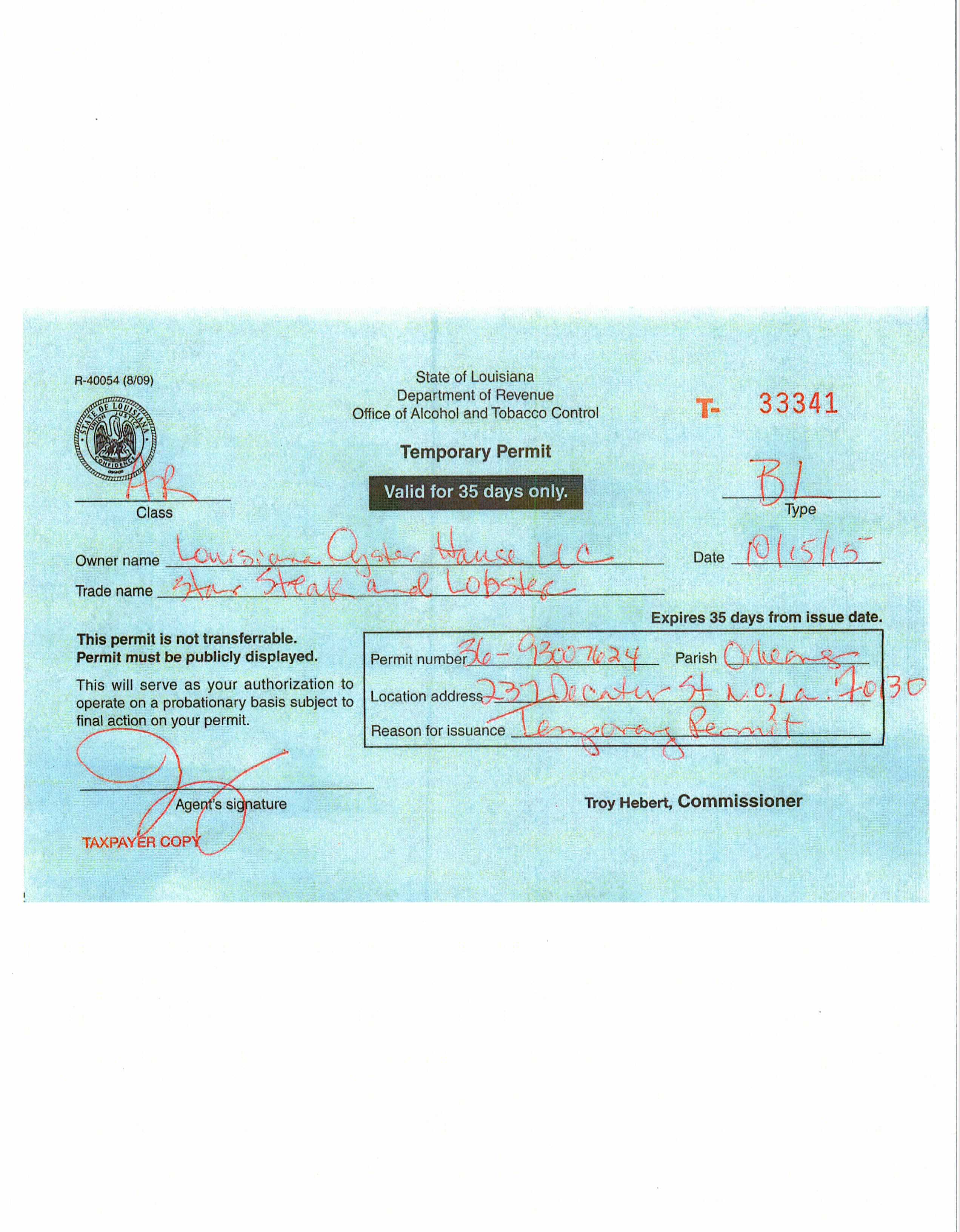
A temporary permit was in fact issued on Sept. 11, according to records obtained from ATC offices in Baton Rouge. Subsequent temporary permits were issued on Oct. 15 and Nov. 20. Each permit was marked “Valid for 35 days only.” SEPT. TEMPORARY PERMIT

OCT. TEMPORARY PERMITNOV. TEMPORARY PERMIT

And while each of the temporary permits bore the name and title of ATC Commissioner Hebert, the person who signed each of them was Judy Pontin, executive management officer for ATC’s New Orleans office.

Pontin is the sister of Chris Young, a New Orleans attorney who represents bar and restaurant owners before ATC and who is a lobbyist for the Beer Industry League of Louisiana. Another brother is John Young, former Jefferson Parish President and unsuccessful candidate for lieutenant governor in last fall’s statewide election. Pontin was hired by Hebert on Nov. 4, 2013 at a salary of $71,000. JUDY PONTIN

JUDY PONTIN

On Jan. 6, just four days before he left office, Hebert issued a second “Commissioner’s Findings and Order” on the restaurant but this time he wrote, “After reviewing the evidence and all relevant testimony, the Commissioner finds the following:

“There is not sufficient evidence (emphasis ours) to support the finding that the permittee did violate the provisions of:

  • LA R.S. 26:75 & 26:275—Proper Permit not held;
  • LA. R.S. 2691B & 26:287B—Failure to Pay Sales Tax. DISMISSAL LETTER PAGE 1DISMISSAL LETTER PAGE 2

“It is hereby ordered that this matter be dismissed,” he wrote as one of, if not the final act in his capacity as ATC commissioner.

There followed on last Wednesday (Jan. 20), a flurry of several quick emails pertaining to the application process for renewal of the restaurant’s license, a development that does not square with Hebert’s claim that the restaurant had closed. The first, at 9:52 a.m., was a forward from ATC attorney Linda Pham to fellow attorney Jacqueline Wilson of an earlier (8:18 a.m.) message from a Lorie Hebert and given “high importance,” which said, “I received a phone message from an atty. David Corkern about this mandatory case set for today at 2:30 p.m.” The reference was to the license for Star Restaurant and Corkern was the attorney for manager Sarah Palmer.

At 9:31 a.m., Pontin forwarded a pdf attachment to Wilson and at 10:04 a.m., Pontin sent an email to Palmer saying, “Please see attached the 2015 renewal application we discussed as per or (sic) phone conversation. If you have any further questions please do not hesitate to call. That was likely the same attachment that Pontin had sent to Wilson at 10:04 a.m.

The anonymous source, who has sent 11 separate emails to date, said she had seen text messages from Hebert to Palmer and “there are witnesses who followed their dinners.”

Seven of her emails were sent between Dec. 18 and Dec. 27. Then her messages went dark before suddenly resuming on Saturday (Jan 23). “I have stayed clear because FBI is now actively involved,” she said on Saturday by way of explaining why her communications ceased for nearly a month. “They have made contact with Palmer and have seized photos, emails and text messages,” she said.

“The FBI now has evidence but is expanding (its) investigation further,” she said. “The investigation (is) going in this direction: Hebert makes trouble for a business. Then his number-one assistant Judy (Pontin), maiden name Young, sister to (attorney) Chris Young, sends word to (the) targeted business to hire Chris Young and pay big fees to get them off Hebert’s radar. Once Young is hired (and the) fee paid, problem disappears. Once (the) deal is done, Chris Young calls his sister Judy in Hebert’s office and the coverup begins.”

Asked how she knew Palmer, she said simply, “She is a girlfriend of mine.”

Tomorrow: LouisianaVoice examines political contributions by New Orleans strip clubs which were passed over in ATC’s “Operation Trick or Treat” sweep of the French Quarter in October.


Read Full Post »

If you were to seek two cases that stand as glaring testimony to the way in which the Jindal administration employs a double standard in addressing legal and ethical issues, you need look no further than the cases involving Murphy Painter and Jeff Mercer.

Though the men never met and while one was a state employee and the other a private contractor, together, the two represent the composite poster child for victims of political favoritism and corruption. Both fell prey to unethical behavior and of the way political priorities have been set by the Jindal administration for the past eight years.

We have chronicled the manner in which Jindal and his henchmen made Painter a scapegoat by firing him from his post as director of the State Office of Alcohol and Tobacco Control (ATC). We have shown how, when he refused to knuckle under and bend the rules for the benefit of Anheuser-Busch distributor Southern Eagle, SMG (the Louisiana Superdome management company), the Louisiana Stadium and Exposition District (LSED) Board, and Tom Benson, Jindal not only fired Painter but even tried (unsuccessfully) to prosecute him in federal district court on bogus criminal charges of computer fraud.

Not only was Painter acquitted of all (there were 42 counts, none of which stuck) charges, but the state then was required to repay Painter’s legal costs of $474,000.

Another embarrassment for Jindal: ex-ATC commissioner Murphy Painter wins defamation suit against his accuser

LouisianaVoice was the first—and only—news service to suggest (correctly, it turned out) that Painter, instead of a criminal, was the victim of a political scheme intended to remove him from his position after he refused to approve an incomplete application by SMG for a permit to erect a large tent at Benson’s Champions Square adjacent to Benson Towers across from the Superdome. The tent was to house beer sales by Southern Eagle on Saints game days. https://louisianavoice.com/2013/02/06/emerging-claims-lawsuits-could-transform-murphy-painter-from-predator-to-all-too-familiar-victim-of-jindal-reprisals/

Jindal executive counsel Stephen Waguespack, now President of the Louisiana Association of Business and Industry (LABI), insisted—twice—that the permit be expedited, Painter asked that he put his concerns in writing but Waguespack responded that he was far too busy to reduce his demands to writing (which would’ve left a paper trail, don’t you see).

Instead, Painter was simply fired and SMG got its permit. Of course, it was mere coincidence that the Benson family, SMG, its law firm, Southern Eagle and members of the LSED Board had combined to dump more than $207,000 into Jindal’s campaigns between 2002 and 2012.

Quick as the Jindal crowd was to administer justice (read reprisals) in the Painter case, it was painfully slow in ferreting out reports of corruption in one of the largest agencies in the state—the Department of Transportation and Development—and even slower in addressing those reports with the proper corrective measures. The fact is, nothing was ever done about reports of attempted shakedowns of a DOTD contractor and the subsequent harassment of that same contractor that eventually put him out of business.

It turned out to be an expensive oversight on the state’s part.

On Friday, a 12-person jury returned a unanimous verdict in which it awarded Jeff Mercer of Mangham $20 million, plus eight years (and counting) of judicial interest for allowing DOTD supervisors to condone demands of cash and equipment from Mercer by a DOTD inspector (we call that extortion where I come from; the inspector allegedly threatened Mercer with inspection problems with his work). Moreover, Mercer was able to prove that DOTD deliberately withheld payments for work performed by Mercer as payback for his whistleblowing, first reported by LouisianaVoice in April of 2012. https://louisianavoice.com/2014/04/09/contractor-claims-in-lawsuit-that-dotd-official-attempted-shake-down-for-cash-equipment-during-monroe-work/

Story of attempted contractor shakedown broken 2 years ago by LouisianaVoice results in $20 million verdict against state

Mercer had even taken his complaint to the governor’s office, but nothing was ever done. No referral to the Inspector General’s office. The IG, by the way, works directly for and answers only to the governor and was prompt enough to bring charges against Painter three years ago.

So, the question must be asked: why was the governor’s office not front and center in taking appropriate action on reports of extortion, threats of federal prosecution against Mercer, and refusals to pay for work performed by him?

Why was the demand for compliance so urgent in the Painter case and the concern so lacking in the Mercer case?

To paraphrase Jindal: two words.

Campaign contributions.

Benson, SMG, and members of the LSED Board were major Jindal campaign contributors. Mercer was not.

Benson and his associates were friends of Jindal and as such, they possessed massive political power that the governor could not ignore—nor did he wish to.

Mercer was a small contractor from the small North Louisiana town of Mangham, situated about halfway between Winnsboro and Rayville—and smaller than each of those. He was not influential.

He was, they thought, an insignificant little nobody who could be ignored because he had neither the influence nor the political muscle to make himself heard over the rattle of dinner plates at the governor’s mansion or over the lofty, self-serving campaign rhetoric about Jindal’s gold standard of ethics.

The administration, it turns out, committed the worst tactical error possible in warfare and politics: it vastly underestimated the determination of a little man when he is truly pissed and it woefully underestimated the indignation and ire of a 12-person jury upon their hearing of the injustice heaped upon one of their own by an uncaring bureaucracy and of the unscrupulous actions of those within that same bureaucracy.

And boy, does it ever feel good when the underdog wins one!


Read Full Post »

Nearly two years ago, LouisianaVoice broke a story about a Mangham contractor’s claims that the Louisiana Department of Transportation and Development (DOTD) had bankrupted his company when it denied payments for his work. https://louisianavoice.com/2014/04/09/contractor-claims-in-lawsuit-that-dotd-official-attempted-shake-down-for-cash-equipment-during-monroe-work/

The reasons payment were denied? Because, contractor Jeff Mercer said, he resisted shake-down efforts by a DOTD inspector who demanded cash and equipment from him.

On Friday, after eight years of legal battles, Mercer won a unanimous $20 million judgment from a 12-person jury in 4th Judicial District Court in Monroe.

Work for which Mercer says he was not paid included:

  • Two projects on I-49 in Caddo Parish ($1.6 million);
  • A Morehouse Parish bridge project ($7.1 million);
  • Louisville Avenue in Monroe ($79,463);
  • Well Road in West Monroe ($50,568);
  • Airline Drive in Bossier City ($57,818);
  • Brasher Road in LaSalle Parish ($70,139).

While the Monroe News-Star gave substantial coverage to the court decision, LouisianaVoice was the first media outlet to give Mercer the time of day back in April of 2014 when we first learned of his troubles with DOTD. Monroe television station KTVE did a brief interview with Mercer following our initial story, but that was it—until yesterday’s decision. http://www.thenewsstar.com/story/news/local/2015/12/04/contractor-wins-20m-suit-against-dotd/76813444/

In our 2014 story, Mercer said that three of his employees filed sworn affidavits with the court in which all four say DOTD inspector Willis Jenkins demanded that Mercer either “put some green” in his hand or that Mercer place a new electric generator “under his carport” the following day.

One employee, John Sanderson, said he was approached by Jenkins who informed him that he “could make things difficult” on Mercer. “He indicated that this burden would not necessarily be on the Louisville Avenue project but on future jobs awarded to Jeff Mercer, LLC,” Sanderson said. “I replied, ‘You didn’t mean to say that,’” whereupon, Sanderson said, Jenkins repeated his threat. “During that conversation, I heard Willis tell Jeff that he ‘wanted green,’” Sanderson said.

Incredibly, Jenkins admitted making the comment but said it was a joke. Despite getting complaints about the shakedown attempt, DOTD never investigated the allegations. (Note to Jenkins: don’t joke like that in airports.)

Another Mercer employee, Bennett Trip, said in a signed statement that he heard Jenkins tell Mercer he “wanted some green.” He said he also heard Jenkins tell another Mercer employee that Jenkins, pointing to a generator in Tripp’s truck, said he “wanted one of those under his carport.”

Following complaints by Mercer, Jenkins was subsequently removed from the Louisville Avenue project by DOTD Engineer Marshall Hill who said it was not the first time he’d heard such claims about Jenkins. But Tripp said the shakedown continued when another state official told Mercer employees, “Y’all had my buddy removed and we’re going to make the rest of the job a living hell.”

Mercer claimed in his lawsuit there was collusion among DOTD officials to “make the jobs as costly and difficult as possible” for him. He told LouisianaVoice in April of 2014 that after receiving verbal instructions on the way in which one project was to be done, it was subsequently approved but later, DOTD officials, including defendant John Eason, advised that the work was not acceptable.

He said that DOTD officials provided false information to federal investigators; that he was forced to perform extra work outside the contract specifications; that a prime contractor, T.J. Lambrecht was told if he continued to do business with Mercer, closer inspections of his jobs would result, and that job specifications were routinely changed which in turn made his work more difficult.

Doughty said DOTD officials in Baton Rouge threatened his client with federal prosecution when he asked for payments for work he’d done. An FBI investigation initiated by DOTD was subsequently dropped.

Mercer eventually was forced to shutter the doors on his construction firm which had employed 20 to 40 people.

DOTD interoffice emails obtained by LouisianaVoice seem to support Mercer’s claim that he was targeted by DOTD personnel and denied payment on the basis that the agency was within its rights to “just say no.”

One email from DOTD official Barry Lacy which was copied to three other DOTD officials and which stemmed from a dispute over what amount had been paid for a job, made a veiled threat to turn Mercer’s request for payment “to the U.S. Department of Transportation’s Office of Inspector General.”

Still another suggested that payment should be made on a project “but never paid to Mercer.”

“I did everything they told me to do,” Mercer told LouisianaVoice. “But because I refused to allow one DOTD employee to shake me down, they put me out of business. They took reprisals and they ostracized me and broke me but now I’m fighting back.”

Both Mercer and his Rayville attorney David Doughty indicated they had reported the events to the governor’s office but no one in the Jindal administration, which has spent eight years touting its ethics record, offered to intervene or even investigate his allegations.

Not only did the jury hold DOTD liable for damages, but it also held four individual DOTD employees—Willis Jenkins, Michael Murphy, Eason and Barry Lacy—personally liable.

That, of course raises the obvious question of will there now—finally—be a criminal investigation of the four individuals? After all, the jury’s verdict centered on Mercer’s claims of extortion, bribery and plain old shakedowns in the purest sense of old-time Louisiana politics.

Granted, civil and criminal trials are vastly different. In a civil trial, a verdict can be reached on the lower standard of a “preponderance of the evidence” while criminal charges must be proven “beyond a reasonable doubt.”

In a civil suit, the plaintiff must only prove that there was a greater than 50 percent chance, based on all reasonable evidence, that the defendant committed the action that caused damages. In criminal matters, however, there is a higher standard. The prosecutor must prove that the accused committed the crime beyond a reasonable doubt.

But even with required higher standard of proof, the fact that a civil jury was unanimous in its decision should be sufficient to prompt at least a criminal investigation by the Ouachita Parish District Attorney’s office. Because federal funds were involved in the construction projects, and because Mercer was a contractor under the federal Disability Business Enterprise (DBE), a federal grand jury probe should ensue. “Who protects the DBE from the DOTD?” Doughty asked. “The people who are supposed to guard DBE companies are within DOTD itself (and) he didn’t get any help from them.”

Additionally, offenses committed under the funds from the American Recovery and Reinvestment Act (ARRA) of 2009 carry even stiffer penalties. ARRA funds were used on the I-49 projects.

The civil award puts the Louisiana Attorney General’s Office in an awkward position. The AG’s office defended the state’s interests in Mercer’s lawsuit and now that the jury has cited public corruption in its award, the office now finds itself in the unenviable position of being required to investigate public corruption in a case it had just defended in civil court. http://www.ag.state.la.us/Article.aspx?articleID=6&catID=8

“It’s been a long fight,” Mercer told the News-Star. To LouisianaVoice, he exulted, “We waxed their butts.”

He still has two more suits for more than $10 million in contractual losses pending in Baton Rouge district court.

Doughty told the News-Star that people “are tired of corruption and tired of reading about this type of thing” and that the jury “was sending a message.”

DOTD is expected to appeal the jury verdict to the Second Circuit Court of Appeal and if the state court decision is upheld, most likely the state will apply for writs with the Louisiana Supreme Court. If the decision is upheld in the higher courts, the State Legislature would then have to appropriate the payment.

All that means it could be years before Mercer sees a dime but judicial interest continues to run from the date the lawsuit was filed and the state ultimately could be forced to pay as much as an additional 50 percent.

Read Full Post »

A professor of Criminal Justice and retired Louisiana State Police Officer compares drug offenses with sex crimes in Louisiana in response to David Vitter’s vitriolic political ads suggesting that releasing non-violent drug offenders will harm public safety.

By Wayne “Steve” Thompson, PhD (Special to LouisianaVoice)

According to Louisiana Revised Statute 40:967, the state of Louisiana has a mandatory minimum sentence of five years for possession of 28 grams of cocaine or crack cocaine. According to Louisiana Revised Statute 14:34, the state of Louisiana does not have a mandatory minimum for aggravated battery which includes shooting or stabbing someone. Second degree rape has a mandatory minimum of two years (LRS 14:42.1). To sum it up, a man who threatens to kill a woman so she will not resist while he rapes her is required to do less time in jail than a person with a handful of cocaine or crack cocaine.

I have personally worked cases involving drug use and drug dealing resulting in decades if not centuries of incarceration. I have served numerous warrants on drug dealers while serving on the LSP SWAT team. I have assisted in the investigation of sex crimes cases. I found it frustrating the level of leniency towards sex offenders who received less punishment than drug offenders. Leniency for sex offenders is required to make sure there is room for the statutorily mandated sentences of non-violent drug offenders. My frustrations are shared by many in the criminal justice community.

Incarceration does not work

 Thirty-two percent of state felony convictions were for drug offenses in 2002 and more than 60 percent of those were sentenced to incarceration (Vanderwaal et al., 2006). There were 253,300 drug offenders in state prisons in 2005 (United States Department of Justice, 2008). The estimated cost of incarcerating these offenders is from $5 billion to $8 billion dollars per year. The average incarceration cost per offender is around $30,000 per year.

The drug war is an exercise of futility. Drug prices have gone down and the availability of drugs has increased (Caulkins & MacCoun, 2003). Long incarcerations result in higher recidivism or have zero effectiveness in reducing recidivism (Marinelli-Casey, et al., 2008; Caulkins & Reuter, 2006; Harvard Law Review, 1998; Vanderwaal et al., 2006). The user is still able to obtain drugs because there are plenty of people willing to stand in for a drug dealer when he or she is incarcerated. It is not the same for a violent offender. There is no line of violent offenders who want to step into the shoes of a sex offender, robber, or murderer. There are only victims. The incarceration of violent criminals can actually reduce the number of victimizations.

What does work?

According to Vanderwaal et al. (2006), drug treatment is more effective than incarceration in reducing drug use and reducing recidivism. Many states have realized this evidenced by numerous legislative acts which reduce mandatory minimum sentences and the establishment of over 1,600 drug courts by the end of 2004. The Back on Track (BOT) program in California is focused on first time low level drug dealers. They participate in extensive community service and meet positive goals such as school and employment requirements. If the participants successfully complete the program, they have their records sealed. Rivers (2009) reported the program has a recidivism rate of less than 10 percent and the cost is only $5,000 per participant. When this amount is compared to the reported prosecution expense of $10,000 and an annual incarceration rate of up to $50,000, it is a great success, a bargain for taxpayers.

Why does Louisiana lead the world in incarceration rates?

Research based treatment programs are a common sense alternative to incarceration that improves the ability to incarcerate violent offenders. An ad recently released in the Louisiana gubernatorial campaign condemned efforts to release up to 5,500 nonviolent drug offenders. That is 5,500 prison beds that can be used for violent offenders. The fiscal impact alone based on current incarceration costs is a savings of approximately $165 million every year. I am sure our schools could use that money.

The excessive punishments have been inspired by political popularity which also inhibits our ability to use common sense penalties and treatment. The public and law enforcement have shifted to the ideals that the drug problem is social, psychological, biological, and medical. The criminal justice system is ill equipped to deal with such problems.

Politicians are hesitant to change how we treat drug offenders for fear of appearing soft on crime resulting in damage to a political career. The fear is not created by the person who chooses innovation over ineffectiveness. The fear is created by opponents of the candidate by taking the methods out of context. I will attempt to place them in context.

Any effort to reduce the incarceration of nonviolent drug offenders through research proven treatment is a stance against violent criminals. Those who oppose such efforts are actually supporting keeping violent offenders in our midst. An attempt to create fear for political gain is described by Sheriff Tony Mancuso of Calcasieu Parish as “irresponsible” and “dangerous.”

Why do politicians think these ads work?

There is only one explanation, the perception of ignorance. The candidate must believe the voters at large have never dealt with a friend or family member who suffers from drug abuse and believe they should be treated versus incarcerated. We need representatives who will reduce our prison population with research proven best practices to make room for violent offenders. The people behind such political ads do not want violent offenders on the street and I would never make that claim. But, by putting such blatantly ignorant ads out, that is what they are facilitating.

References

Caulkins, J. P. & MacCoun, R. (2003). Limited rationality and the limits of supply reduction.       Journal of Drug Issues, 33(2), 433-464.

Caulkins, J. P. & Reuter, P. (2006). Reorienting U.S. drug policy. Issues in Science &        Technology, 23(1), 79-85.

Harvard Law Review. (1998). Alternatives to incarceration. Harvard Law Review, 111(7), 1863-  1991.

Louisiana Revised Statute 14:34. (1980). Aggravated Battery.

Louisiana Revised Statute 14:42.1. (2001). Forcible Rape.

Louisiana Revised Statute 40:967. (2007). Prohibited Acts-Schedule II, Penalties.

Marinelli-Casey, P., Gonzales, R., Hillhouse, M., Ang, A., Zweben, J., Cohen, J. Hora, P. F., &    Rawson, R. A., (2008). Drug court treatment for methamphetamine dependence:           Treatment response and posttreatment outcomes. Journal of Substance Abuse Treatment.      34(2), 242-248.

Rivers, J. L. (2009). Back on track: A problem-solving reentry court. Bureau of Justice Statistics    Office of Justice Programs. Retrieved on November 22, 2009 at             http://www.ojp.usdoj.gov/BJA/pdf/BackonTrackFS.pdf.

United States Department of Justice. (2008). Number of persons under jurisdiction of state           correctional authorities by most serious offense, 1980-2005. Retrieved November 24,    2009 at http://www.ojp.usdoj.gov/bjs/glance/tables/corrtyptab.htm.

Vanderwaal, C. J., Chriqui, J. F., Bishop, R. M., McBride, D. C., & Longshore, D. Y. (2006).       State drug policy reform movement: The use of ballot initiatives and legislation to       promote diversion to drug treatment. Journal of Drug Issues, 36(3), 619-648.

Editor’s note: In one of the two debates attended by Vitter prior to the Oct. 24 primary election, both he and State Rep. John Bel Edwards agreed that alternative programs needed to be implemented in order to alleviate prison overcrowding. That, of course, was before Vitter decided to ignore his own position to the issue and to paint Edwards as “soft on crime.”

Read Full Post »

« Newer Posts - Older Posts »