Feeds:
Posts
Comments

Archive for the ‘Courts’ Category

An important legal breakthrough for anyone in Ouachita and Morehouse parishes facing prosecution for drugs and/or weapons charges: your charges will be dismissed if you sweat.

So says no less an authority than 4th Judicial District Attorney Jerry L. Jones.

According to Jones, if you are a grave digger, a landscaper, bricklayer, carpenter, roofer, highway construction worker, or anyone involved in a myriad of occupations and endeavors that result in your exposure to sun and sweat, you are good to go with illegal weapons or the drug of your choice.

Hell, even if you’re a jogger, a tennis player, or an Alabama Crimson Tide football player, you get a free pass on drugs and weapons charges. Like fishing in the hot sun? Grilling out on July 4 is certain to get those sweat pores working overtime. But don’t worry. By the newly defined legal standards of the 4th JDC District Attorney’s office, sweat is like a Get Out of Jail Free card in the real-live game of Monopoly.

Did you break a sweat trying to chase the garbage collector down the street in your robe because you were a little late taking out the trash? Don’t worry about it. Both you and the garbage collector are good to go; you’re both outside, working up a sweat while Jones is in his air-conditioned office. Light up, wave that gun around, do a line. Together. Jones won’t prosecute. He said so himself.

This is the logic Jones himself expressed in dismissing charges against two Alabama football players who happen to call the Monroe area home.

All-Southeastern Conference offensive tackle Cam Robinson of West Monroe and reserve defensive back Laurence “Hootie” Jones of Monroe were arrested after a Monroe police officer smelled marijuana coming from their parked car in a closed public park. The officer spotted a handgun in Jones’ lap. A search of the car produced marijuana and a handgun that had been reported stolen in Baldwin County, Alabama.

Baldwin County is immediately east of Mobile County and includes the cities of Gulf Shores, Foley, Loxley and Orange Beach.

Prosecutor Neal Johnson of the DA’s office first said there was insufficient evidence in court documents to proceed with charges. Hence, there would be no grand jury and no bill of information from the DA’s office. http://sports.yahoo.com/news/somehow–bizarre-and-clumsy-handling-of-alabama-players-could-be-justice-001548496-ncaaf.html

Had Jones let it go at that, the decision not to prosecute probably would have received little attention. After all, who better to determine if there is enough evidence to proceed with a trial than prosecutors themselves?

But Jones, inflicted with a bad case of diarrhea of the mouth, just couldn’t shut up when shutting up would have been the prudent path to follow.

“I want to emphasize once again,” he told KNOE-TV in Monroe, “that the main reason I’m doing this is that I refuse to ruin the lives of two young men who have spent their adolescence and teenage years working and sweating while we were all in the air conditioning.” (Emphasis added). http://theadvocate.com/news/16165207-65/report-da-drops-drug-weapons-charges-against-alabama-football-players-louisiana-natives-cam-robinson

So there you have it. You work and sweat and Jones will look the other way. Hell, you might even be allowed to rob a bank except that’s a federal offense over which Jones has no authority. So, instead, go knock over a convenience store. Just make sure you’re sweating when you do so.

Unanswered (unasked, actually) was the obvious question: How many persons has Jones prosecuted on similar drugs and weapons charges who did not happen to be members of a big-time collegiate football program?

How many non-football-playing black kids from Monroe’s low-income, unemployed population are housed in the Ouachita Correctional Center for the sin of being caught with a single marijuana cigarette?

Well, an Internet post on the Ouachita Parish Sheriff’s Web page in August 2012 lists the results of the Ouachita Parish Task Force seizures:

  • 4 ounces of marijuana;
  • 13 marijuana cigarettes;
  • 60 one-eighth-ounce bags of marijuana;
  • Three quarter-ounce bags of marijuana;

Just last week, A West Monroe man (gasp) drove through a private parking lot to avoid a stop sign. He gave officers his consent to search his backpack and a vitamin bottle was found to contain “one to two grams” of marijuana and a marijuana smoking pipe. He was booked into the correctional center.

http://www.hannapub.com/ouachitacitizen/news/crime/wmpd-traffic-stop-leads-to-marijuana-arrest/article_ca8ba618-3758-11e6-a833-b784638b4c68.html

In 2014, Bernard Noble, 48, was sentenced to 13 years of hard labor for possession of the equivalent of two marijuana cigarettes. Neither Noble nor the West Monroe man played football and probably did not sweat until they were arrested. http://www.drugpolicy.org/news/2014/04/louisianan-given-13-year-prison-sentence-possession-two-marijuana-cigarettes

We stumbled across an online report that admittedly, is rather dated but interesting nonetheless. In 2007, there were 18,535 arrests for marijuana offenses in Louisiana. That represents an arrest rate of 432 per 100,000, which ranks Louisiana at number 5 in the nation.

http://www.drugscience.org/States/LA/LA.pdf

(We have to keep those private prisons occupied for their owners somehow.)

While we’re in no position to challenge Johnson’s contention of insufficient evidence, Jones’s justification for not prosecuting the two is certainly sufficient reason for demanding his resignation and disbarment. No one, not even an idiot like Jones, should be able to use sweat as a barometer for deciding whether or not to enforce the law with a blind eye to social status or celebrity.

In the case of Jones and the 4th JDC District Attorney’s office, justice isn’t blind; it’s stoned—stoned on the deranged notion that certain among us are above the law.


 

Read Full Post »

When it comes to financial shell games and political flim-flam, it seems that the two have a lot in common, oftentimes including the same personality mixes whose names keep cropping up. Sometimes those names can materialize like a deadly vapor in proceedings separated by a couple of decades. And somehow, those years and events mysteriously converge to affect the lives of thousands—or millions—of people.

It was in late 1990 that the late John Hays, the cantankerous publisher of the weekly Morning Paper in Ruston began writing stories that raised questions about Towers Financial Corp. and its chairman, one Steven Hoffenberg.

At first, his stories attracted little interest. On paper, as the sportswriters would say, it was a mismatch. Hays, described by NEW YORK TIMES in an April 1993 story as “a hard-drinking, chain-smoking, cowboy-booted newspaper publisher” was pitted against Hoffenberg, who briefly ran The New York Post, eventually taken over by Rupert Murdoch. Hoffenberg owned two jets, a yacht, limousines, mansions, and a Fifth Avenue office. Hays drove an old van well past its prime. It quickly shaped up as an epic battle between a small-town publisher operating on a shoestring and a sophisticated New Yorker who had, it seemed, more money than God.

But investors were getting nervous in the late 1980s and early 1990s. Some of them called Hays who had a penchant for taking on phony investment schemes. Hays, as was his wont, began making calls that piqued the interest of Securities and Exchange Commission investigators as well as state regulators. He had worked with these same regulators in other scams, so he had the credentials necessary to make them sit up and pay attention whenever he called.

Hays even managed to attract the attention of major newspapers like the WASHINGTON POST

Hoffenberg had all the right political connections. He was a business ally of former Texas Gov. John Connally and with a former co-chairman of the Republican National Committee. Other friends in high places included Victoria Reggie, daughter of powerful Crowley Judge Edmund Reggie and the future wife of Sen. Edward Kennedy, New York City Mayor Mario Cuomo, and Mickey Kantor, President Bill Clinton’s trade representative. Heavy hitters, one and all.

Some of his connections, however, tended to hang back in the murky shadows of a darker side of society. https://porkinspolicyreview.com/tag/steven-hoffenberg/

http://gawker.com/501354/exposed-the-leon-black-jeffrey-epstein-connection

http://www.mediaite.com/online/vanity-fair-editor-reportedly-removed-underage-girls-allegations-about-jeffrey-epstein-from-2003-story/

When a Shreveport brokerage firm started peddling high-yielding notes for Towers in 1990, Hays said he immediately wondered “if some fellow up in New York has such a good deal, what would inspire him to come down here to northern Louisiana and make the local people rich?”

He started making calls and writing stories—stories that obviously did not sit well with Hoffenberg.

If Hays was suspicious of Hoffenberg, the feeling was more than mutual. “He’s not a credible person,” Hoffenberg said of Hays. “He runs a newspaper that is full of lies. I have never heard from anybody that John Hays was somebody we should take seriously. I mean, he gives his newspaper away; he throws it on people’s driveways.” Twenty-five years later, one could close his eyes and almost hear Donald Trump talking about another candidate or some reporter covering his campaign.

(Oh, just as a heads-up, keep that Trump comparison in mind. He’ll come up later in this story.)

Hoffenberg was correct in that last statement. Hays did indeed toss about 25,000 free copies a week in the driveways of Lincoln, Union, Bienville, and Jackson parishes.

But Hays also became a national clearinghouse for information between state regulatory agencies. He was credited by Arkansas authorities as providing information to them that allowed them to keep Hoffenberg and Towers Financial Corp. out of that state.

But not all states. Hays began making calls to regulators and learned that Towers was selling notes in states where it had failed to meet registration requirements. Enter the feds. More stories followed.

So, who won the war of words?

Well, Hoffenberg eventually entered a guilty plea to running a $475 million Ponzi scheme, the largest on record until Bernie Madoff dwarfed Hoffenberg’s financial chicanery. In 1997, Hoffenberg was sentenced to 20 years in federal prison for defrauding thousands of investors. http://www.nytimes.com/1997/03/08/business/hoffenberg-gets-20-year-sentence-in-fraud-case.html

His nemesis who he said “runs a newspaper that is full of lies” and a man he said he never heard “from anybody that John Hays was somebody we should take seriously,” was nominated for the Pulitzer Prize.

Someone once said never start a fight with someone who buys ink by the barrel and newsprint by the boxcar. Apparently Hoffenberg wasn’t listening.

The Hoffenberg/Towers Investment saga was the subject of a lengthy abstract by Gene Murray, Ph.D., assistant professor in the Department of Mass Communication at Grambling State University. http://list.msu.edu/cgi-bin/wa?A3=ind9710a&L=AEJMC&E=7BIT&P=1328897&B=–&T=TEXT%2FPLAIN;%20charset=US-ASCII

But let’s fast forward to 2016. John Hays has been dead for a year now, the Morning Paper stopped publication several months before his death when his cancer weakened him to the point he could no longer peddle his ads or chase down a good story.

Hoffenberg couldn’t get out of jail in 1996 because, he said, he was so broke he couldn’t post the $100,000 bail. http://www.nydailynews.com/archives/money/sec-hoffenberg-pay-stay-jail-article-1.730715

Twenty years later, however, he is back in the money—and he wanted everyone to know it. It’s almost enough to make you wonder if he may have had a few dollars stashed safely offshore all that time.

The man who couldn’t make $100,000 bail a couple of decades ago has recently pledged $50 million to his super PAC set up to coordinate a marketing campaign in support of Donald Trump. http://www.washingtonexaminer.com/ponzi-schemer-steven-hoffenberg-pledges-50-million-to-help-trump/article/2593931

Hoffenberg, who professes to be a born-again Christian (funny how prison can do that; just ask Chuck Colson), is also in the business of marketing something called the Christ Credit Card to more than 700,000 registered Christian churches through Towers Financial.

http://whaminc.us/investor-questions-wham-answers

In addition to pledging $50 million of his own money to his super PAC, he also says he intends for his PAC to raise more than $1 billion in support of Trump. http://www.politico.com/story/2016/06/convicted-ponzi-schemer-ill-conduct-50-million-marketing-campaign-for-trump-224350

http://www.washingtonexaminer.com/trump-super-pac-predicts-raising-1-billion/article/2592210

So much for Trump’s claim that he is financing his own campaign—or for Hoffenberg’s earlier claims of poverty.

The announcement by Hoffenberg was the first time he has explained why he founded the Get Our Jobs Back, Inc. PAC back in April. He is listed as treasurer and custodian of records by the Federal Election Commission. http://docquery.fec.gov/cgi-bin/forms/C00616078/1070515/

Could this be déjà vu all over again? Can you imagine someone like Hoffenberg having the ear of a President Trump?

We have only a few random observations to make about this latest development, this unholy alliance between two high-rolling carnival hucksters of dubious trustworthiness:

  • Watch closely how he raises that much campaign cash.
  • Does his credit card scheme figure in the mix?
  • Old habits sometimes can be hard to break.
  • Where is John Hays when we really need him?

Read Full Post »

By Robert Burns

After Louisiana’s FYE books were closed on June 30, 2013, the Jindal administration touted the fact that 2,340 hospital employees had been laid off during that fiscal year. Nevertheless, one hospital, the Huey P. Long Hospital in Pineville, was proving particularly vexing for Jindal’s administration.

With much fanfare, Jindal’s folks called a news conference to announce that the hospital’s operations would be transferred to England Airpark with an estimated $30 million required to renovate the facility which was closed in the early 1990s. The money was said to come from $5 million pledged by the England facility and the remainder from state-issued capital outlay bonds issued during FYE ’13.

Despite all of the hoopla associated with the announcement of the transfer, the proposal ended up fizzling out, and Jindal’s administration had to conjure up a “Plan B.”

That turned out to be another iteration of the public/private partnerships for which the Jindal administration essentially could have qualified for a patent on crafting such arrangements. In this instance, the public/private partnership would entail Rapides Regional Medical Center and Christus St. Frances Cabrini Hospital taking over much of the workload of Huey P. Long.

Of course, the whole proposal had the

gnawing obstacle that it needed approval from those darn folks at the Legislature, and that’s where things got interesting.

To accomplish the goal, Senator Gerald Long obediently introduced

Senate Concurrent Resolution (SCR) 48 in the regular session of the 2014 Legislative Session. On March 31, 2014, the Senate Committee posted an agenda for its meeting of April 2, 2014; however, that agenda was devoid of any reference to SCR-48.

On April 1, 2014 at 4:07 p.m., a revised agenda was posted in which SCR

-48 was posted and itemized to include a notation entailing its subject matter: “creating a new model of health care delivery in the Alexandria and Pineville area.” Amendments were added to SCR-48, and it ultimately passed both the House (66-28) and Senate (26-11).

Baton Rouge attorney Arthur Smith, III,

filed litigation on behalf of affected employees of the hospital and others alleging violations of Senate Rules of Order 13.73 and 13.75.

Also alleged was a violation of Louisiana’s Open Meetings Laws

, and relief was sought to have SCR-48 declared null and void (a relief available under Louisiana’s Open Meetings laws) based on that violation and also an assertion that SCR-48 was unconstitutional. A preliminary injunction was also sought to block the closure of the hospital with the ultimate goal of obtaining a permanent injunction.

The trial court granted the preliminary injunction, but it simultaneously suspended enforcement of the

preliminary injunction upon the defendants (the Louisiana Senate, LSU, and the State of Louisiana) perfecting an appeal.

It was initially believed that the Louisiana Supreme Court (LSC) would decide the matter because of the issue raised of the constitutionality of SCR

-48. However, the Supreme Court quickly refused to hear the matter in stating that it was “not properly before this Court.” The Supremes (no, not the singing Supremes) elaborated by ruling that it could consider only matters which had been declared unconstitutional in a court of law.

Since the trial court’s reasons for judgment only made reference to the

potential unconstitutionality of SCR-48 without making a definitive declaration that it was unconstitutional, the Supreme Court denied writs.

Meanwhile, the hospital was closed, and Smith took his case to the First Circuit Court of Appeal. That appeal was dismissed based

upon the fact there was no active injunction to prevent the hospital from being closed. That was the case because, expecting (wrongly) the Supreme Court to rule on the matter, Judge Robert Downing suspended the preliminary injunction. With no injunction in place to prevent the closure, the hospital was padlocked.

The First Circuit issued its decision on September 15, 2015. That ruling notwithstanding, the

declaratory judgment aspect of the lawsuit could proceed forward, and that led to a hearing in 19th JDC Judge Don Johnson’s courtroom on Monday, June 13, 2016.

During that hearing, much of what has been elaborated above was rehashed, but then co-counsel for the day’s proceedings, Chris Roy, Sr., of Alexandria, took center stage and converted what had been basically a snooze fest into a fireworks display.

Prior to Roy beginning testimony, Judge Johnson interjected a few points of his own into the arguments. First, Johnson indicated that, while he was a student at Southern University, he experienced a significant health issue and went to Baton Rouge’s local charity hospital

, Earl K. Long, and he said, “I sure was glad it was there to treat me.”

Earl K. Long was also shut down by the Jindal administration and subsequently demolished. Emergency room treatment of indigent patients was initially taken over by Baton Rouge General Midtown. But Baton Rouge General closed its emergency room more than a year ago. That forced low-income charity patients in the northern part of East Baton Rouge Parish to travel a much further distance to Our Lady of the Lake Medical Center in South Baton Rouge for treatment. That point was not lost on attorneys for the defendants who claimed that care would continue to be provided for the underprivileged, but such care would simply now take place under the new public/private venture.

Roy said that the closure of the

Huey Long Charity Hospital caused an enormous level of anxiety among the community’s population and also with the employees of the hospital. Johnson acknowledged that fact and said, “I’m aware of that fact. They didn’t like it at all.” Roy stressed that “125 employees lost their jobs and $11 million in wages were lost as a result of this episode.”

Roy focused most of his arguments on the fact that, contrary to defense attorney claims, the whole issue

of SCR-48 is not now “moot.” He emphasized that ordinary citizens are provided with only one mechanism for making their sentiments known about proposed legislation and that is through “showing up and testifying at committees and subcommittees of the Legislature.”

Roy then rhetorically asked how they were supposed to do that w

hen the Senate would engage in such a “flat-out violation” of posting an addition to the agenda at 4:07 p.m. the day before a hearing when the clearly-established deadline was 1 p.m. for such an addition. Roy then stressed his age, and even poked fun at the relative youth of one of his opposing counselors (who appeared to be in his late 20s at most), in indicating that he, Roy, was one of the participants in the formation of the present Louisiana Constitution.

Roy said, “One of our main objectives was to try and make everything as transparent as possible because there had been a prior governor, whom I won’t reference by name (a thinly veiled reference to Huey Long), who sought to keep the public from knowing

anything that was transpiring.” The irony of the subject matter of the suit being the closing of a hospital named for him seemed not to be lost on anybody in the room.

“Your Honor,” Roy continued, “the Senate basically said ‘to hell with the Constitution. We are the Senate of the State of Louisiana, and we decide what we will do and won’t do.’” Roy then emphasized that opposing counsel could not simply argue that the whole matter was “moot,” and assert a defense along the lines of “we won’t do it again.” Roy then emphasized that Louisiana Senate President John Alario is a good man with integrity and a close personal friend of his, but he then asserted that what Alario allowed to transpire in this instance was just “wrong.”

The State sought the granting of a Motion for Summary Judgment (MSJ) to dismiss the case, and the plaintiffs sought the granting of an MSJ declaring SCR-48 to be null and void. In the battle of the MSJs, Johnson ruled in favor of the plaintiffs: “SCR-48 of the 2014 Regular Session is declared to be Null and Void. The Plaintiff’s may seek attorney fees, costs, and expenses through post-hearing motion. The Joint Motion for Summary Judgment filed by defendants is denied.”

Now all that remains to be seen is whether the state will have to pay salaries and benefits retroactive to the hospital’s closing date to those 125 employees (the amount given was $11 million saved by closing the facility) or if there will be yet another appeal of a 19th JDC judge’s ruling to the First Circuit.

The smart money is on an appeal.

Read Full Post »

By Robert Burns

With all parties acknowledging the need for an affirmation of her ruling Monday (June 13, 2016) by the First Circuit Court of Appeal, 19th JDC Judge Janice Clark denied multiple exceptions filed by the Louisiana State Office of Group Benefits (OGB) in response to a lawsuit filed by six retired state employees.

The lawsuit alleges that OGB, which provides health insurance coverage to nearly a quarter of a million state workers, teachers, retirees, and dependents, didn’t follow proper approval procedures calling for prior notice and public comment on significant changes to their health insurance coverage.

Winston DeCuir, Sr., who claimed in oral arguments before Judge Clark that the lawsuit was “moot,” explained that in June 2014, significant changes began to come under consideration for OGB benefits.

When an uproar began that the contemplated changes had not followed proper procedures, former Louisiana Attorney General James D. “Buddy” Caldwell’s Office issued a ruling on September 23, 2014 that, in fact, the rule-making process had been circumvented.

Pursuant to Caldwell’s ruling, DeCuir said, OGB sought an “emergency rule” to take effect because of the urgency of the situation. When Judge Clark inquired, “What triggered the need for the emergency rule?” DeCuir responded that the rapidly-shrinking balance in the reserve fund prompted OGB actuaries to say something had to be done as soon as possible.

DeCuir indicated that genuine concerns existed that, if the rate of decline wasn’t slowed, the system could literally deplete its reserve balance and be left with no funds with which to pay claims. He neglected to say the reserve fund was drawn down from its one-time high of $500 million by the reckless fiscal policies of the Bobby Jindal administration.

DeCuir explained that because of the looming impact the rule change would have on those covered by OGB benefits, on November 23, 2014, OGB issued the emergency rule but also provided simultaneous guidance entailing the additional costs to those covered.

He indicated that some costs would continue to be reimbursed until September 30, 2014 rather than August 1, 2014 as was originally planned.  He also emphasized that full implementation of the changes would not transpire until March 1, 2015 rather than January 1, 2015.

DeCuir noted that the final rule entailing full implementation was implemented on February 20, 2015 to replace the emergency rule. He said that with the required 180-day timeframe for going through normal procedures for rule changes, together with another 180 days to actually implement the changes, OGB’s reserves would have run a very serious risk of being fully depleted before the effects of the changes could take hold.

DeCuir said a public hearing was held on the changes but was “very, very poorly attended.”  He added, “In fact, I don’t know if any of Art’s (Smith, counsel for plaintiffs) clients were even present for the hearing.” Arthur Smith, III, dismissed the hearing as a “sham” designed to accomplish nothing but “window dressing with everything already done.”

Smith then focused his arguments on Jindal’s administration having “drained” OGB’s reserve balances. That statement prompted a sharp retort by DeCuir who said, “That statement simply is not accurate. There was not one dime transferred out of OGB’s reserves to the general fund. What transpired is that premiums charged to members declined. That, in turn, resulted in a decline in the State of Louisiana’s match in that it covers 75 percent of the cost of the coverage.  That is what caused the reserves to decline.”

Judge Clark then asked for reiteration of the fact that no funds were swept from OGB’s reserves to the general fund. Both DeCuir and Michael Adams, another defense attorney representing OGB, were emphatic in stating no such sweeps transpired.

What actually occurred was this: the administration lowered premiums so that its own 75 percent match would be reduced and the money saved from that maneuver was then used to cover some of the recurring budgetary shortfalls experienced by Jindal and a sadly incompetent but compliant Legislature for eight straight years. The decline in premiums, Mr. DeCuir, was not caused by fewer covered employees but by the clumsy shell game perpetrated by Jindal and Co. That statement, Mr. DeCuir, is accurate.

DeCuir indicated to Judge Clark that the plaintiffs may not be happy if they get what they’re ultimately seeking with their lawsuit. He explained that it’s conceivable that plaintiffs could end up owing OGB significant premium dollars if the plaintiffs do in fact ultimately prevail.

In making her ruling, Judge Clark stated: “The Court is of the opinion that plaintiffs have stated a valid cause of action within the four corners of the document.  It’s time for this matter to be presented to the First Circuit, which I understand is now returning from Sandestin, so that these plaintiffs can know whether they can move forward with their claim or have it drained.”

Adams then inquired about the prospect for him to assert Exceptions for Prematurity and Subject Matter Jurisdiction. Clark said that the Exception of Prematurity was too “intertwined” with DeCuir’s exception and therefore denied that exception as part of the day’s proceedings.  When DeCuir inquired if he could reassert the Exception of Subject Matter Jurisdiction, Clark indicated he could “have another bite at the apple, but it needs to be quick.”

Smith wrapped up the proceedings by inquiring about a Motion to Compel he’d previously filed, but Clark said, “Surely that matter can be resolved between the parties.” Adams then indicated that Smith had modified his discovery requests to make it far more narrow and that he believed that a mere meeting between him and Smith ought to be able to negate the need for any hearing on a Motion to Compel.

Adams said after the day’s hearing that he would appeal Clark’s ruling to the First Circuit Court of Appeal.

Judge Clark said if the whole matter proceeds to trial, “It will be a challenge to keep the jurors awake when all those actuaries start testifying.”

Read Full Post »

MAGNIFYING GLASS

By Ken Booth

Guest Columnist 

Under the provisions of Louisiana 44:1 et seq. (The Public Records Law), should any local or state government official raise questions as to whether requested records are public, the agency’s custodian of public documents is required to notify in writing the person making the request of the custodian’s determination and the reasons, including the legal basis. Said notice shall be made within three days of the request exclusive of Saturdays, Sundays, and legal holidays (emphasis added).

The law is pretty plain. It doesn’t say “may be made,” “might be made” or “should be made” within three days. The word used was shall.

MIKE EDMONSON PHOTO

But with the introduction of the new administration, elected and appointed officials in Louisiana seem to have decided they are exempt from provisions of the state law…one of them, the head of the State Police, of all people, even having “manufactured…own loophole for denying public records requests,” as reported by Louisiana Voice. https://louisianavoice.com/2016/06/01/lsp-stakes-out-claim-that-investigations-records-are-exempt-from-public-records-law-if-no-disciplinary-action-is-taken/

Are they perhaps taking their cues from federal officials?  Within the past week, for instance, the State Department told a federal court that processing a demand for documents relating to Hillary Clinton and her aides would take as long as 75 years and would stretch “generations.”

Besides Obama, of course, Nixon, both Bushes and Bill Clinton have regularly invoked executive privilege as a means of protecting documents from public scrutiny.

What brings this to mind are a series of demands for public records recently involving three areas of significant public interest but which have either gone unacknowledged or denied or even fought with lawsuits against the public seeking the records.  That’s a mean stretch even by Louisiana’s political and corruption standards.

When the weekly Ouachita Citizen sought to follow-up on a state audit that pointed to possible payroll fraud involving a law clerk for the 4th Judicial District Court, the court’s judges balked and denied the paper’s request for disciplinary action taken against court clerk Allyson Campbell over her alleged falsification of time sheets and other public documents.

When the newspaper filed a complaint with the District Attorney, the court filed a lawsuit against the newspaper which from a financial standpoint would effectively throttle further attempts to litigate the issue.

The paper has multiple public requests in at the office of state Attorney-General Jeff Landry which have for weeks gone unanswered.

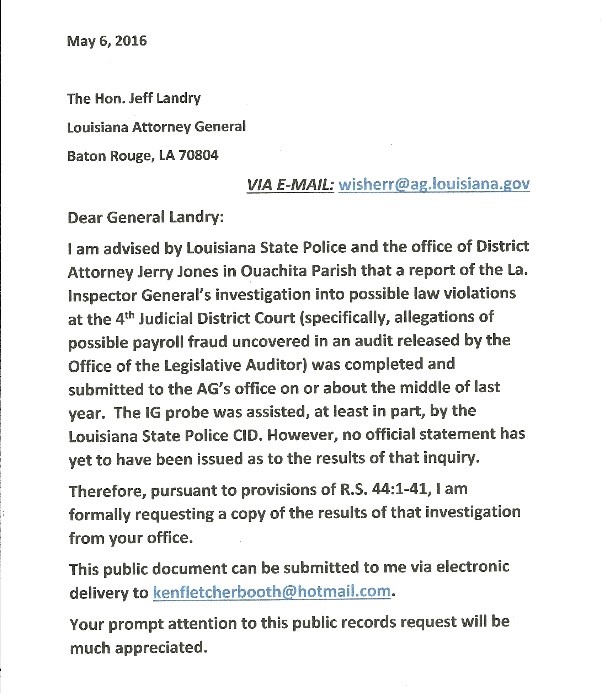
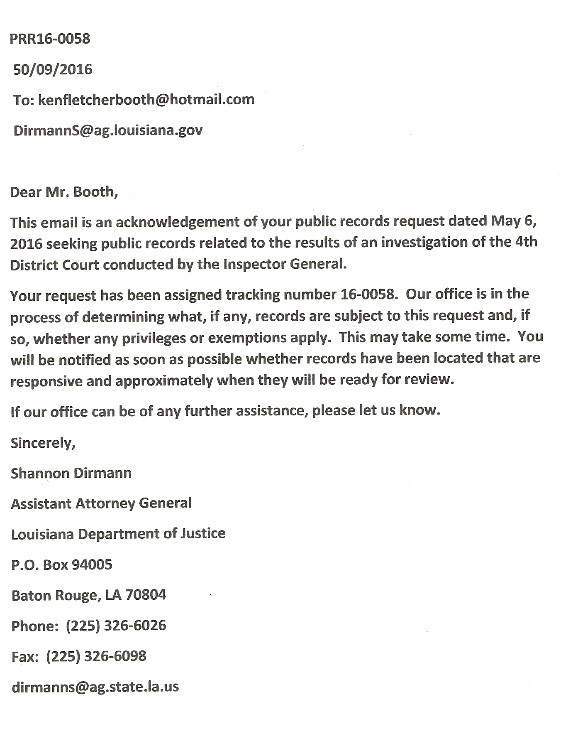
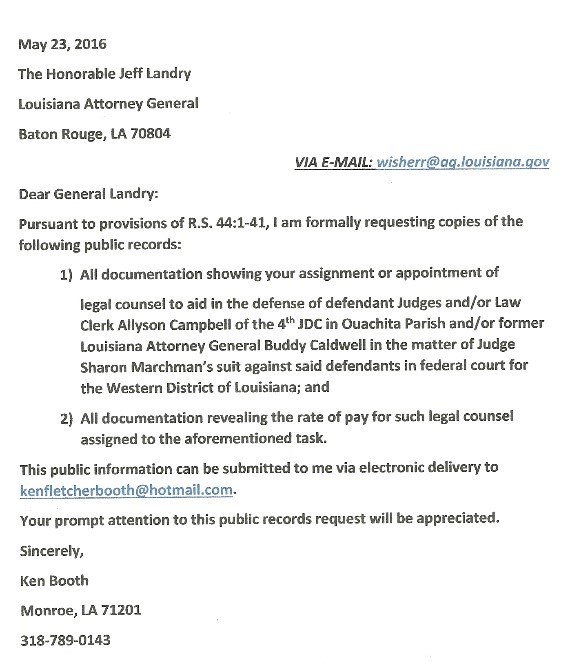
Similarly, a couple of my own requests (shown here) to the new “transparency-minded” and “aggressive” Republican Attorney-General remain without result except for one letter which said it “may take some time.”

In a June 7th E-mail to Landry’s office, I wrote: “I would very much appreciate either the documents requested sixteen days ago or an opinion from that office on why they cannot be produced. Please know this is a public records request that will not go away silently.”

Landry’s press secretary Ruth Wisher has made sure that reporters know that her boss doesn’t always return her texts. Well, that certainly makes everything hunky-dory.

BOOTH REQUEST

AG RESPONSE TO BOOTH

BOOTH FOLLOW UP REQUEST
           Known records requests to the AG’s office also demand access to a state police report on its investigation into the allegations of possible payroll fraud and destruction or concealment of court documents. A report on the findings from a companion investigation by the Inspector General’s office was released back on April 15th. The state police report is known to be in the hands of the Attorney General.

All of this is at odds with the very public Landry who has been throwing his weight around the capitol lately pushing for control of his agency’s own finances, making national headlines while trying unsuccessfully to crack down on illegal aliens, and squaring off (at least publicly) with the Gov. John Bel Edwards as if he hopes to succeed him some day.

But Landry and the 4th Judicial District Court in Ouachita Parish are not the only ones playing keep-away with public records.

LouisianaVoice has been repeatedly stymied by the Louisiana State Police with respect to sought after records.

In fact, as a recent LouisianaVoice post notes, Edmonson has manufactured his own loophole for denying public records requests after tiring, he suggests, of the public learning of “far too many instances of misconduct at LSP followed by a mindset of circling the wagons.”

Several high-profile cases of alleged improper State Trooper conduct have been determined to have been free of wrong doing and are therefore exempt  from public records laws if no diciplinary action is taken. That’s staking out a rather questionable claim by the Supertindent.

Curiously, however, his agency did release records showing payroll fraud had occurred at Troop D headquartered in Lake Charles when the lieutenant there was accused of having instructed the men under his command to pad their time sheets to reflect work that had not been performed.

Ironically, that’s the same charge investigated by the same LSP against the law clerk in Ouachita Parish, the report of which has been hidden from public scrutiny even amid growing speculation nothing will come of the charges against her or the Judges who approved her bogus time sheets. It should be noted that the Troop D lieutenant was found to have engaged in “no wrong doing” and access to any investigation findings with respect to him has been denied. However, a trooper he supervised and who figured in the padded time sheets was fired.

The Superintendent of the Louisiana State Police is appointed by the Governor with consent of the State Senate. Edmonson had—and continues to have—the support of Gov. Edwards.

Edwards is also credited with preserving through his influence, at least indirectly, the job of another Jindal administration hold-over department head, Education Superintendent John White. While White actually is appointed by the Board of Elementary and Secondary Education over which the governor has little control since most board members are elected, his stated support of White certainly didn’t hurt.

JOHN WHITE PHOTO

White, a 2012 BESE appointee, has been under considerable public fire over his steadfast defense of the Common Core program.

White has filed a lawsuit against two individuals seeking public records in five different requests from the Department of Education, presumably to block their access to dirty laundry in that agency as might be said of the lawsuit by the Judges in Monroe against The Ouachita Citizen.

Even considering Louisiana’s notorius reputation for politial scandals, suing private citizens or even the news media by government agencies has plunged the state’s standards to a new low.

As has been pointed out elsewhere the use of unlimited financial and legal resources—all paid for by the taxpayers—to block citizens with limited financial means is a dangerous threat to the very notion of checks and balances that are supposed to protect the public from abuse.

For those elected Louisiana officials to sit back and do nothing to put a stop to this unprecedented assault on the public’s right-to-know is pretty much tantamount to an endorsement of such actions.

And if the civilian public looks the other way when this kind of mess is exposed and doesn’t demand that it stop then expect the level of distrust to grow.


Read Full Post »

« Newer Posts - Older Posts »