Feeds:
Posts
Comments

Archive for the ‘Courts’ Category

In an effort to determine the consistency of enforcement of traffic laws, here are just a few stories LouisianaVoice pulled off the internet at random:

SYNOPSIS: Ponchatoula police arrested David Brunet, 33, of Folsom, on charges of negligent homicide after he struck and killed 29-year-old Justin Settoon of Ponchatoula on Aug. 29.

Police said Settoon had a green light and attempted to cross an intersection when he was struck by Brunet who they said ran a red light.

SYNOPSIS: State Police booked Denis Yasmir Amaya Rodriguez, 37, a Honduran immigrant, on three counts of negligent homicide and 41 counts of negligent injuring, reckless driving and driving without a license when a bus he was driving struck a parked fire truck in St. John the Baptist Parish.

He was transporting 31 passengers looking for work on flood recovery following the August 2016 floods that struck South Louisiana. State Police said he was in the country illegally.

SYNOPSIS: State Police booked Joshua Cole Stinson, 35, on charges of negligent homicide on July 12 after police said he ran a stop sign, striking and killing 81-year-old Curtis Simmons of Tylertown, Mississippi. Stinson was also booked for failure to stop at a stop sign and driving with an expired driver’s license.

SYNOPSIS: State Police booked Elmer Menendez, 32, of Utah on one count of negligent homicide, for not having a child restrained properly and for not wearing a seat belt after his 9-year-old son was killed in a collision with a second vehicle. Police said when Menendez lost control of his pickup truck, it spun along the road and crossed into oncoming traffic where it was struck by an SUV driven by Ron Adams, 46, of Baton Rouge.

SYNOPSIS: Ascension Parish authorities booked John D. Sanchez, 27, of St. Amant, for negligent homicide after his vehicle drifted into an adjacent lane on Interstate 10, striking a vehicle driven by Floyd Cox of Baton Rouge, killing him.

SYNOPSIS: Louisiana State Police arrested 19-year-old Christopher M. Lymous of St. Rose for negligent homicide in connection with a single car accident in which his 20-year-old passenger, Charles Green, Jr., also of St. Rose, was killed when he was ejected from the vehicle. State Police said Lymous was traveling 90 mph in a 55 mph speed zone prior to the January 2015 accident.

Police said Lymous swerved into the northbound lane of LA. 626 and lost control of his vehicle when he attempted to re-enter the southbound lane. The vehicle veered from the road, dropped into a ditch, hit multiple trees and flipped several times. Lymous voluntarily submitted to blood and breath tests for the purposes of determining impairment, both of which tested negative.

SYNOPSIS: Caddo Parish sheriff’s deputies arrested Carbin Logan, 42, of Deberry, Texas, when his SUV struck a horse and was in turn hit by an oncoming motorcycle, killing the cyclist, Vera Martin, 51, of Bethany, and critically injuring her husband, Gene Martin, 52.

Though authorities said Logan was driving drunk, he was not arrested for DUI but for vehicular negligent homicide and vehicular negligent injury.

SYNOPSIS: State Police in July of this year arrested both drivers involved in a fatal accident in St. John the Baptist Parish in December 2016 following a seven-month investigation. Arrested were Christian Moses, 18, of Gonzales, negligent homicide, and Tylas Bailey, 24, of Vacherie, vehicular homicide and driving under the influence.

The difference in negligent homicide and negligent vehicular homicide is negligent homicide means impairment was not a factor, police said.

Police said Moses made a left turn while traveling north on Airline Highway in Reserve into the path of Baily who was traveling south. Bailey’s vehicle struck Moses, killing Bailey’s passenger, Danielle Georgel of LaPlace.

SYNOPSIS: On orders of then-Louisiana Attorney General Charles Foti, head and neck surgeon Dr. Anna Pou, 50, and three of her nurses were arrested on four counts of second-degree murder after patients under Dr. Pou’s care died during Hurricane Katrina in 2005. Sanity prevailed, however, and Foti’s hysterical overreach was discounted as a grand jury refused to indict Dr. Pou and her nurses.

SYNOPSIS: St. Charles Parish sheriff’s deputies arrested Dallas Veillon, 57, of Luling, was convicted of negligent homicide when a St. Charles deputy sheriff was killed after the deputy struck Veillon’s vehicle in August 2013.

The deputy, Jeff Watson, was killed when Veillon pulled into Watson’s path. State Police, studying surveillance camera footage from a nearby store, determined that Watson, who was traveling an estimated 90 mph in a 35 mph zone, did not activate his lights and siren until .88 seconds prior to the crash.

Typically, Louisiana Attorney General Jeff Landry was quick to offer an opinion, albeit it inaccurate and uninformed, on the conviction of Veillon. “According to expert witnesses, Dallas Veillon had a blood alcohol level nearly twice the legal limit at the time of the crash…”

Veillon’s BAC was .10 percent, which is in excess of the .08 percent legal limit, but hardly twice the legal limit.

All of which brings us to our main point:

SYNOPSIS: Louisiana State Trooper Christopher Kelley of Troop E in Alexandria, driving to New Orleans Mardi Gras detail, was not on duty nor was he in an emergency situation. Accordingly, he did not have his lights or siren engaged.

Yet he was traveling on U.S. 190 in Pointe Coupee Parish at 111 mph—more than twice the posted speed limit—only seconds before striking Henry Baise, 64, killing him. Police said Baise pulled into Kelley’s path and that Kelley attempted to avoid the crash, slamming on his brakes which slowed his vehicle down to 79 mph at the point of impact—still 24 mph over the speed limit—speeds for which John Q. Public gets a speeding ticket, collision or no.

Prosecutor Tony Clayton said a grand jury reviewed a “brutally honest” State Police investigation before refusing to indict Kelley.

Anyone who knows anything about our system of justice knows that a prosecutor can manipulate and steer a grand jury in any direction he please. A skilled prosecutor can get a grand jury to indict a ham sandwich or to, say, just as an example, not indict a law enforcement officer for driving 111 mph and striking and killing an innocent driver who, unable to judge such high speed, pulls into his path—precisely the scenario that occurred in Kelley’s case.

All of which raises the obvious question is what did that “brutally honest” State Police investigation produce in the way of  disciplinary action against Kelley for driving at such an excessive speed?

The answer is a whopping suspension without pay for 14 weeks.

Fourteen weeks without pay for killing a man while driving like a maniac.

Nice.

It seems to us that Trooper Kelley would have a helluva lot of nerve to ever write another speeding citation the rest of his career in law enforcement.

It’s little wonder that there is growing disrespect for and suspicion of law enforcement in this country.

State Police stock

Read Full Post »

In the evolving efforts by public officials (mostly elected and appointed political toadies) to prevent you from having unfettered access to public records, three tactics have emerged:

  • CRAPP (Crazed Retaliation Against Public Participation).

This is the strategy employed by Sheriff Jerry Larpenter of Terrebonne Parish.

https://www.washingtonpost.com/news/volokh-conspiracy/wp/2016/08/30/louisiana-sheriff-jerry-larpenter-illegally-uses-criminal-libel-law-to-unmask-a-critic/?utm_term=.e2a1770cf5a0

When a local blogger posted critical stories about him and his political cronies, the good sheriff of Terror-Bonne got a friendly judge (who must’ve received his law degree from eBay) to sign off on a search warrant whereby Larpenter could conduct a raid on the blogger’s home.

All the offending blogger, who obviously was a dangerous criminal on a par with John Dillinger, Willie Sutton, and Bonnie and Clyde, had done was illustrate how the family tree of Terror-Bonne elected officials has no branches—that it’s all just one main trunk, sucking the life out of everything around it.

Deputies seized his laptops and about anything else they could lay their hands on in an attempt to discourage him from writing further disparaging comments about the fine public servants of Terror-Bonne, the First Amendment to the U.S. Constitution notwithstanding.

Of course, a federal judge quickly ruled the raid unconstitutional and gave Larpenter a stern lecture on Civics—not that it did any good.

And then there’s the second approach:

  • BLAPP (Blowhard’s Letter Against Public Participation).

With this method, a public body like, say, the Gravity Drainage District 8 of Calcasieu Parish, has an attorney, say Russell Stutes, Jr., to write a nasty letter to a citizen, say, Billy Broussard, who had performed extensive work for the drainage district for which he was not paid following Hurricane Rita, threatening Broussard with jail time if he persisted in making public records requests. https://louisianavoice.com/2016/12/05/hurricane-cleanup-contractor-threatened-by-attorney-over-requests-for-public-records-from-calcasieu-drainage-district/

Stutes wrote that all Calcasieu Parish employees “have been instructed not to respond to any additional requests or demands from you associated with the project,” neglecting for the moment that any citizen has a right to request any public record and that it is patently illegal for a public official, i.e., the custodian of the records, to ignore a legal request.

“Accordingly, the next time any Calcasieu Parish employee is contacted by you or any of your representatives with respect to the project, we will proceed with further civil actions and criminal charges,” Stutes continued. “A rule for contempt of court will be filed, and we will request injunctive relief from Judge (David) Ritchie. Given Judge Ritchie’s outrage at your frivolous claims last year, you and I both know the next time you are brought before him regarding the project, it will likely result in you serving time for deliberately disregarding his rulings.”

Stutes ended his asinine communiqué by writing, “Consider this your final warning, Mr. Broussard. The harassment of Calcasieu Parish employees must completely and immediately cease. Otherwise, we are prepared to follow through with all remedies allowed by law.”

I wrote then and I’ll say it again: What a crock.

  • SLAPP (Strategic Lawsuits Against Public Participation)

This is the preferred ploy being employed these days to shut down criticism—or inquiries—from the nosy citizenry.

The first two (CRAPP and BLAPP) are the acronyms created in the not-so-fertile mind of yours truly, although the events are very real as are SLAPP actions that are more and more often employed. The most recent cases involve two such lawsuits right here in Louisiana.

In the 3rd Judicial District (Ouachita and Morehouse parishes), judges, of all people, filed a lawsuit against a newspaper, The Ouachita Citizen, for seeking public records, even while admitting the records being sought were indeed public documents. https://lincolnparishnewsonline.wordpress.com/2015/05/19/judges-admit-dox-are-public-records-in-suit-against-newspaper/

More recently, Louisiana Superintendent of Education John White filed a SLAPP lawsuit against a citizen, James Finney, who was seeking information related to school enrollments and statistical calculations. http://www.huffingtonpost.com/mercedes-schneider/la-superintendent-john-wh_b_10216700.html

The Reporters Committee for Freedom of the Press, a nonprofit association dedicated to assisting journalists created in 1970, says SLAPPs “have become an all-to-common tool for intimidating and silencing critics of businesses, often for environmental and local land development issues.”

https://www.rcfp.org/browse-media-law-resources/digital-journalists-legal-guide/anti-slapp-laws-0

The California Anti-SLAPP Project (CASP), a law firm specializing in fighting SLAPPs and in protecting the First Amendment, says protected speech and expression on issues of public interest that may be targeted by SLAPPs include:

  • Posting a review on the internet;
  • Writing a letter to the editor
  • Circulating a petition;
  • Calling or writing a public official;
  • Reporting police misconduct;
  • Erecting a sign or displaying a banner on one’s own property;
  • Making comments to school officials;
  • Speaking a public meeting;
  • Filing a public interest lawsuit;
  • Testifying before Congress, the state legislature, or a city council.

SLAPPs are often brought by corporations, real estate developers, or government officials and entities against individuals or organizations who oppose them on public issues and typically claim defamation (libel or slander), malicious prosecution, abuse of power, conspiracy, and interference with prospective economic advantage. https://www.casp.net/sued-for-freedom-of-speech-california/what-is-a-first-amendment-slapp/

CASP says that while most SLAPPs are legally meritless, “they can effectively achieve their principal purpose (which is) to chill public debate on specific issues. Defending a SLAPP requires substantial money, time, and legal resources, and thus diverts the defendant’s attention away from the public issue. Equally important, however, a SLAPP also sends a message to others: you, too, can be sued if you speak up.”

In 1993, Florida Attorney General Robert A. Butterworth released a Survey and Report on SLAPPs in that state. Five years later, in urging the Florida Legislature to enact a strong anti-SLAPP statute, the Attorney General wrote: “The right to participate in the democratic process is a cherished part of our traditions and heritage. Unfortunately, the ability of many Floridians to speak out on issues that affect them is threatened by the growing use of a legal tactic called a Strategic Lawsuit Against Public Participation or SLAPP. A SLAPP lawsuit is filed against citizens in order to silence them. The theory is that a citizen who speaks out against a proposal and is sued for thousands of dollars for alleged interference, conspiracy, slander or libel will cease speaking out. And, as demonstrated in a report prepared by this office on SLAPPs in 1993, the tactic is successful. Even though the SLAPP filers rarely prevailed in court in their lawsuits, they achieved the desired aim—they shut down the opposition.” http://news.caloosahatchee.org/docs/SLAPP_2.pdf

Fortunately, there are options for those who are victimized by SLAPP lawsuits.

The Public Participation Project and the Media Law Resource Center grade each state on the basis of existing or absence of anti-SLAPP laws.

Whereas only five states (Texas, California, Oregon, Nevada and Oklahoma) and the District of Columbia have what are considered as excellent anti-SLAPP state laws with grades of “A,” Louisiana is one of seven states (Georgia, Vermont, Rhode Island, Indiana, Illinois, and Kansas are the others) which have what are considered to be good anti-SLAPP laws on the books. These seven states were given a grade of “B.”

Sixteen states, Idaho, Montana, Wyoming, North and South Dakota, Wisconsin, Iowa, Michigan, Kentucky, Mississippi, Alabama, North and South Carolina, Ohio, New Hampshire, and New Jersey, have no such laws and are rated “F.”

A key feature of anti-SLAPP statutes is immunity from civil liability for citizens or organizations participating in the processes of government, including:

  • Any written or oral statement made before a legislative, executive, or judicial body or in any other official proceeding authorized by law;
  • Any written or oral statement made in connection with an issue under consideration or review by a legislative, executive, or judicial body or in any other official proceeding authorized by law;
  • Any written or oral statement made in a place open to the public or in a public forum in connection with an issue of public interest; and
  • Any other conduct in furtherance of the exercise of the constitutional right of petition or the constitutional right of free speech in connection with a public issue.

When a citizen or organization is sued for protected activities, anti-SLAPP statutes provide for expedited hearing of a special motion to dismiss the SLAPP suit. The burden is placed on the plaintiff to prove that the defendants had no reasonable factual or legal grounds for exercising their constitutional rights and that there was actual injury suffered by the plaintiff as a result of the defendants’ actions. No action can be taken in furtherance of a SLAPP suit unless the plaintiff first demonstrates to the court that there is a “probability” of success. Attorneys’ fees and court costs are awarded to SLAPP defendants who win dismissal.

TOMORROW: A look at how one city council member’s questions produced not one, but four separate SLAPP lawsuits in a coordinated effort shut him up.

Read Full Post »

Ha·be·as cor·pus

[ˌhābēəs ˈkôrpəs]

NOUN

A writ requiring a person under arrest to be brought before a judge or into court, especially to secure the person’s release unless lawful grounds are shown for their detention.

Habeas corpus is the legal procedure that keeps the government from holding you indefinitely without showing cause. It’s been a pillar of Western law since the signing of the Magna Carta in England in 1215. The Founders of our nation believed habeas corpus was so essential to preserving liberty, justice, and democracy that they enshrined it in the very first article of the United States Constitution.


Ex·tor·tion

[ikˈstôrSH(ə)n]

NOUN

The practice of obtaining something, especially money, through force or threats.


RICO

[ˈrēkō]

ABBREVIATION

Racketeer Influenced and Corrupt Organizations Act.


Trudy White has been a judge in the 19th Judicial District of Louisiana since 2009. The district encompasses East Baton Rouge Parish. Before being elected a state district judge, she served for 10 years as a Baton Rouge city judge.

Cleve Dunn, Jr., served as Chairman of Judge Trudy White’s Campaign Committee, according to a campaign finance report filed on March 19, 2014 (scroll down to the second page of White’s campaign finance report by clicking HERE).

Cleve Dunn, Sr., who was paid $250 by Judge White’s campaign on Nov. 14, 2014, for marketing, is the operator of Rehabilitation Home Incarceration (RHI). RHI (see corporate filing record  HERE) has profited by its association with Judge White and is now a named defendant, along with Dunn and East Baton Rouge Parish Sheriff Sid Gautreaux, III, in a class action lawsuit filed in U.S. District Court for Louisiana’s Middle District.

REHAB PETITION

RHI is one of several private companies that offer pretrial supervision services for the court but is the only approved on Judge White’s website, the petition says. Judge White also assigns defendants a company called Street Crimes Alternatives for pretrial supervision, but, the petition says, that company is also run by Dunn.

A check by LouisianaVoice, however, revealed two other vendors for home incarceration on Judge White’s web page: Home Bound Monitoring Pretrial and Probation Services and Criminal Justice Service. There was no indication as to when those two were added to Judge White’s WEB PAGE.

Additionally, Judge White paid Frederick Hall and his wife, Gloria Hall, $250 each for campaign support activities on the same date as her campaign’s payment to Dunn. Hall is a former employee of RHI and, with his wife, now owns a bond company to which RHI routinely refers defendants, the lawsuit says.

Lead plaintiffs in the litigation, filed by the Southern Poverty Law Center, are Henry Ayo and Kaiasha White (no relation to Judge White).

Ayo was arrested for attempted theft of an air conditioning unit and Kaiasha White for simple and aggravated battery following an argument. Both appeared before Judge White on August 8, 2016.

“Since Judge White’s re-election … in 2014, she has assigned arrestees to supervision by RHI,” the lawsuit says. “White does so without conducting in open court an individualized determination of, or providing an opportunity for arrestees to be heard on, the need for, or the conditions of, RHI supervision.”

The lawsuit said that Judge White appears to make the RHI assignments before the defendants even appear in her court nor does she inquire of arrestees whether or not they can afford to pay bond or RHI’s initial or monthly fees. White, the petition says, usually sets the duration of RHI’s supervision at 90 days or for an indefinite time, “irrespective of the supervisee’s next court date.”

White does not typically impose specific supervision terms for RHI to enforce nor does she order a curfew, house arrest or payment of the initial or monthly fee as a condition of release from the parish prison. RHI takes it upon itself to set all those conditions in an arbitrary manner, the suit says.

RHI demands an initial fee of $525 and arrestees typically learn of this only when they or family members attempt to post bail or at their first meeting with RHI at the prison. Those who cannot immediately pay the initial RHI fee may wait in jail for days or weeks until they can pay despite their having already posted bail.

Through an agreement with RHI, the lawsuit says, East Baton Rouge Parish Sheriff Gautreaux and Parish Prison Warden Dennis Grimes “created and enforce a policy that the prison will not release arrestees from the prison until it receives permission from RHI—permission that comes only after RHI is satisfied with the initial payment made.”

Upon their release, they are required by RHI to sign a contract setting forth RHI’s future fees and conditions of supervision which require the arrestee to pay a monthly fee of $225 to their assigned RHI officer, or “monitor,” during their supervision term. The contract also sets a curfew for supervisees, restricting them from spending the night anywhere other than at their reported residential address.

“RHI monitors and Dunn himself threaten supervisees with re-arrest if they fail to make financial payments or comply with RHI’s costly supervision conditions—without affirmatively inquiring into their ability to pay,” the suit says. “Accordingly, supervisees pay (or attempt to pay) the fee out of fear of re-arrest and bond revocation by scraping together money from friends or family.”

Ayo was told his fees were in part to pay for an ankle monitor even though he was never provided one. When he and his wife were unable to make timely payments, RHI would assess him with late fees.

The federal RICO statute is invoked in the lawsuit because, it says, “Dunn has conducted the affairs of RHI through a pattern of racketeering to achieve the common purpose of unlawfully extorting money from plaintiffs Ayo and White and the proposed class. These racketeering acts are an integral part of RHI’s regular course of business.”

The petition says that Dunn “has committed multiple, related predicate acts of extortion by refusing to authorize the release of plaintiffs and the proposed class from the prison until they paid money towards the RHI initiation fee. Additionally, by unlawfully using the fear of arrest and jail by East Baton Rouge law enforcement or RHI officials, Dunn on numerous occasions extorted from plaintiffs and the proposed class a monthly supervision fee, along with fees for classes or other requirements imposed at the discretion of RHI employees.”

It said Dunn’s use of RHI to extort money from arrestees assigned by Judge White “constitutes a pattern of racketeering activity.”

The lawsuit listed a number of questions for the proposed class:

  • Whether RHI, independent of Judge White, sets terms for an arrestee’s release and the fees for its supervision services;
  • Whether Dunn, RHI, and Gautreaux, in his official capacity, have an agreement that individuals assigned to RHI by Judge White may not be released from the prison until they have paid RHI’s initial fee and RHI notifies the prison of such payment;
  • Whether RHI and Gautreaux, in his official capacity, enforce such agreement against the proposed class without determining whether individuals can afford to pay RHI’s initial fee;
  • Whether Gautreaux has a policy, practice, or custom of detaining arrestees until obtaining RHI’s permission to release them;
  • Whether RHI’s standard contract provides for an initial fee and monthly fees;
  • Whether RHI’s standard contract provides for arrest and jailing for failure to pay its fees;
  • Whether Dunn directs RHI employees to threaten to arrest and jail individuals who do not pay the monthly supervisory fees and other mandated fees to RHI
  • Whether Dunn’s operation of RHI through a pattern of racketeering activity, specifically, extorting money from (arrestees) by unlawfully detaining them in the prison until they pay RHI’s initial fee, then threatening them additional jailing if they fail to pay RHI monthly fees once released, violates the Louisiana and federal RICO acts;
  • Whether Gautreaux and RHI’s practice of detaining individuals because they could not pay RHI’s initial fee violates arrestees’ rights under the 14th Amendment to due process and equal protection;
  • Whether Gautreaux and RHI’s detention of arrestees after they posted bonds constituted an unreasonable seizure in violation of the 14th Amendment, and
  • Whether RHI lacks any legal authority or right to collect fees from arrestees.


Read Full Post »

It’s been more than 16 months and still there is no word as to the disposition of a Union Parish case involving a prisoner already awaiting sentencing for aggravated rape who, inexplicably, was not only allowed out of his cell, but also given admittance into an isolation cell where he raped a 17-year-old girl not once, but twice.

The Ruston Daily Leader first reported the story on May 3, 2016, but the rape had occurred earlier, on April 19. LouisianaVoice posted its first story on May 10. (See that story HERE.)

Demarcus Shavez Peyton of Homer, then 28, was being held in the Union Parish Detention Center pending his sentencing in Claiborne Parish after his conviction there of aggravated rape. Union Parish officials were informed by the Claiborne Parish Sheriff’s Office that Peyton was known as a serial rapist and that he had already been convicted of aggravated rape. He has since been sentenced to live imprisonment for the Claiborne Parish rape.

The Union Parish Detention Center is a public-run facility overseen by an operation committee comprised of District Attorney John Belton, Union Parish Sheriff Dusty Gates, the Union Parish Police Jury and the Farmerville Police Chief. Because no one individual has authority over the way in which the detention center is run, Gates was unable to adequately see to it that the girl, who had been placed in an isolation cell because she was under the influence of meth, was protected from Peyton.

Gates told LouisianaVoice on Wednesday (Aug. 30) that it was his understanding that the guard on duty that night has been disciplined. “The guard wasn’t paying attention,” Gates said. “When the call button was pushed, he just opened the cell without paying attention.”

The operational structure of the detention center and Gates’s explanation also brought into sharp focus the problems inherent with private prisons which are little more than money trees for the local sheriffs or private operators who run them. LouisianaVoice addressed that problem in a follow-up post on May 31 (click HERE).

In that story, three questions were posed:

  • How was it that the girl was being held in proximity to a convicted aggravated rapist?
  • Who (and this is the most important question of all) was the Union Parish Detention Center staff member who allowed Peyton out of his cell and into the girl’s?
  • Who is responsible for operations of the detention center?

The third question has already been answered. We’re still awaiting answers to the first two as well as a few other questions we put to the Attorney General’s Office in the form of a formal public records request because the AG was asked (rightly) by Belton to take over investigation of the matter in consideration of the DA’s involvement in running the prison (in itself, a curious arrangement):

  • Where does the attorney general’s investigation stand at this point?
  • Has a trial of Demarcus Peyton been scheduled for this alleged rape? If so, what is the scheduled date of that trial?
  • What disciplinary action was—or is anticipated to be—taken against the guard?
  • For Demarcus Peyton to have committed this act, two cell doors would have had to have been opened: his and the cell to the victim. Why was Demarcus Peyton allowed to leave his cell and even more egregious, why was he admitted to the victim’s cell when he was already awaiting sentencing for aggravated rape?
  • Are any measures being recommended by the attorney general’s office relative to the future operation of the Union Parish Detention Center?

Our questions were forwarded to the Attorney General’s Office at 10:09 a.m. Wednesday. At 11:25 a.m., we got out answer from Press Secretary Ruth Wisher: “This matter is under investigation; therefore, I cannot comment on the specifics or answer questions at this time.”

Sixteen months and it’s still “under investigation.”

How long does it take to investigate a rape in a confined area like a jail cell?

Another seemingly unrelated but nonetheless important question that we could be justified in asking is: To what end are sheriffs seeking bigger detention centers to house more prisoners? The answer to that, of course, is power, purely and simply. If the sheriff can build detention centers to house more prisoners, it brings in additional state money (the state pays about $26 per day per prisoner housed). With that extra income, the sheriff can shore up his power with bigger and more impressive weaponry arsenals.

That theory was underscored just this week when President Trump announced plans to remove the restrictions on military gear for local police departments (click HERE). That announcement must have local sheriffs and police chiefs salivating over the prospects of having a Humvee or a mine resistant ambush protected vehicle.

There will be those who will be just itching for the slightest provocation so they can roll out their military weapons to put down the insurrection and to haul anyone who might object off to their locally-run jails so they can keep the beds full and the payments rolling in from the state. It’s a self-perpetuating ATM.

Meanwhile, someone forgot to check the cell door, leaving a teenage girl vulnerable.

And now, 16 months after the fact, it’s still “under investigation.”

Perhaps Attorney General Jeff Landry has more important matters on his plate than bringing such a trivial matter as a sexual assault on a teenage girl to a close after more than 16 months. After all, she was on meth and in jail.

And we have to protect decent, upstanding citizens first, right?

Read Full Post »

Terrebonne Parish Sheriff Jerry Larpenter does not tolerate criticism and he will go after those who dare to step over that line.

The raid on the Houma police officer’s home has been well documented (CLICK HERE) as was the ruling (CLICK HERE)  by the First Circuit Court of Appeal which said the raid was clearly unconstitutional.

Earlier this year, the officer and his wife filed a lawsuit in federal court against Larpenter and about half of Terrebonne Parish’s political power brokers. (SEE HERE).

But long before the fireworks between Larpenter and former deputy and Houma police officer Wayne Anderson, Larpenter went after his own brother and sister-in-law, proving that, in this case, at least, blood is not thicker than water. That dispute has been non-stop for at least 12 years now.

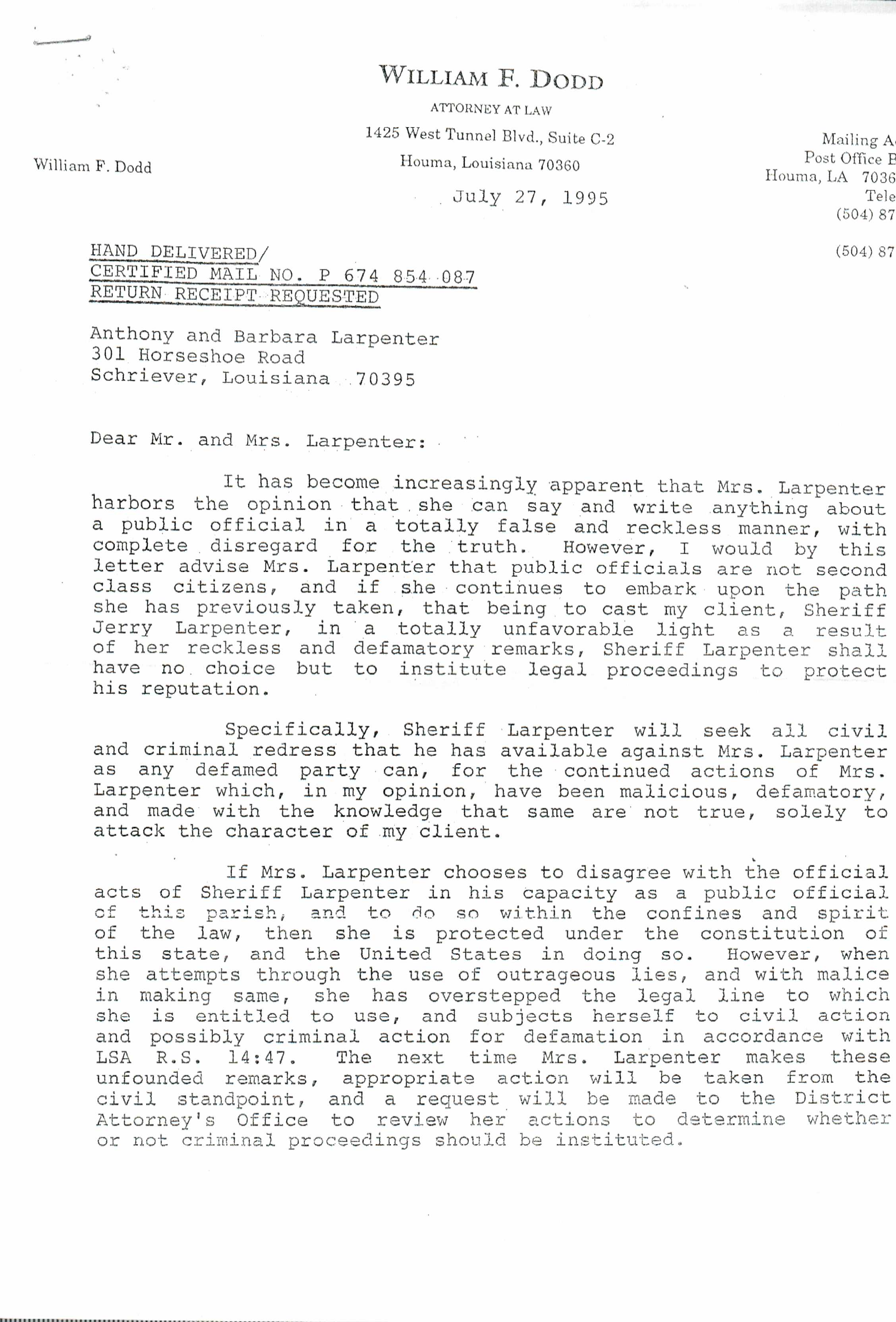
It was July 27, 1995, when Larpenter called upon his legal counsel, Houma attorney William F. Dodd (if that name seems familiar, it’s probably because his pappy, William J. Dodd, served as state auditor, lieutenant governor, and state superintendent of education and twice ran—and lost—for governor) to fire off a two-page threatening letter to brother Anthony Larpenter and his wife, Barbara.

There are those who are going to accuse LouisianaVoice of dredging up old news but the letter and the subpoenas that followed less than two months later represent a mindset in the Terrebonne Parish Sheriff’s Office, a pattern, if you will. Let’s face it, you have to have a pretty thin skin to call down the powers of your office on ordinary citizens whose most grievous offense was criticism of the manner in which you run that office.

The letter is the typical letter of legal intimidation, filled as it was with the usual attorney bluster, demands and threats but in the end, nothing but a loud, bullying, cheap tactic to stymie free speech.

“…I would by this letter advise Mrs. Larpenter that public officials are not second-class citizens, and if she continues to embark upon the path she has previously taken, that being to cast my client, Sheriff Jerry Larpenter, in a totally unfavorable light as a result of her reckless and defamatory remarks, Sheriff Larpenter shall have no choice but to institute legal proceedings to protect his reputation,” Dodd wrote.

“…The next time Mrs. Larpenter makes these unfounded remarks, appropriate action will be taken from the civil standpoint, and a request will be made to the district attorney’s office to review her actions to determine whether or not criminal proceedings should be instituted,” Dodd said.

There is an obscure state statute (R.S. 14:47)under which criminal charges may be brought against an individual for defamation. The maximum penalty under that statute is a fine of $500 or imprisonment of up to six months, or both.

Now I’m not an attorney, but I have to believe that criminal prosecution for defamation, libel or slander under this statute—unless, that is, you are making written or verbal physical threats against the well-being of someone—would be an extremely risky move for any politician. And Dodd’s letter makes no mention of any such threats, so it’s a little puzzling how he thinks he can morph disparaging remarks against an elected official into criminal action.

Once that precedent is set, television campaign ads will cease to exist since distorted attacks and outright lies are all they consist of and no one would ever be allowed to talk about an elected official again. That’s a slippery slope that can only lead to a totalitarian form of government.

Of course, Dodd’s letter also could have been nothing more than legal puffoonery, which is far more likely.

Less than two months later, on September 12, Larpenter, as a precursor to what the Andersons could expect 11 years later, had subpoenas served on his brother and sister-in-law. The subpoena demanded that they “produce the original taped conversation between deputy Gary Sanders and Deputy Jed Boquet on or about January 6, 1995.”


There was no indication as to what the conversation between the two deputies was about but it obviously was of considerable concern to Sheriff Larpenter.

Dodd ended his July letter on a really ugly and sinister note when he wrote, “I would point out that in the event a civil action is filed, and Sheriff Larpenter is successful, this being a community property state, and assuming that Mrs. Larpenter has no separate property agreement, any judgment that might be obtained in favor of Sheriff Larpenter, could be entered against this total community property owned by both of you.”

Translation: Mr. Larpenter, you’re the man of the house; you need to shut your wife up.

Well, Sheriff, those days are long gone. Forever. You’re still living back in the 1940s and ‘50s if you think this still plays. Women have a loud voice today and they do not have to ask permission to speak. Edith Bunker doesn’t exist anymore.

But you and Mr. Dodd would be wise to listen.

Read Full Post »

« Newer Posts - Older Posts »


