Feeds:
Posts
Comments

Archive for the ‘Corruption’ Category


Because of our limited staff (one, plus a few occasional contributors), we often fall behind in our efforts to keep up with the news of our misbehaving public officials. We try to keep up, but these guys are pretty slick and very resourceful in finding new ways to siphon off funds, whether they be state funds or contributions from campaign supporters.

So, today, we will highlight a couple of politicos who are very tight: Bobby Jindal and his director of the Office of Alcohol and Tobacco Control (ATC), Troy Hebert (whose wife just happens to be the Jindal children’s pediatrician, we’re told).

We have an update on the status of Frederick Tombar III, who, like Hebert was appointed to a high-level position in the Jindal administration only to harass himself out of a job.

Tombar, it seems, has landed on his feet after leaving his $260,000 a year job as director of the Louisiana Housing Corporation because of some sexually explicit emails he sent to two female employees—one, a contract employee and the other an actual employee of the agency.

Both women attempted to put off Tombar’s advances because of fear of losing their jobs but eventually each filed complaints and Tombar left before he could be interviewed during an investigation by Ron Jackson, Human Resources Director for the Division of Administration.

Not to worry. We’re told by sources that Tombar, of New Orleans, had a soft landing at Cornerstone Government Affairs consulting company where he will work alongside two former state Commissioners of Administration, Mark Drennan and Paul Rainwater. http://www.cgagroup.com/index.html

http://www.cgagroup.com/team/RainwaterPaul.html

http://www.cgagroup.com/team/mark_drennen.html

Efforts to reach both Drennan and Rainwater for comment were unsuccessful.

It’s not known what Tombar’s salary at Cornerstone will be, but we are willing to bet it doesn’t approach the quarter-million a year he was making as a Jindal appointee.

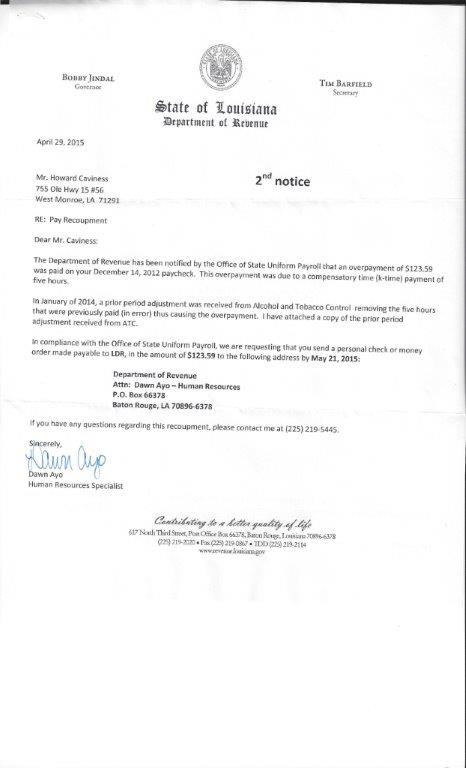
That other appointee mentioned earlier, Troy Hebert, of whom much has been written here, little of it good, recently sent a bill to former ATC agent Howard Caviness of West Monroe who now serves as Grambling State University chief of police. Well, actually, the bill was not from Hebert, but from the agency under which he serves, the Department of Revenue (LDR).

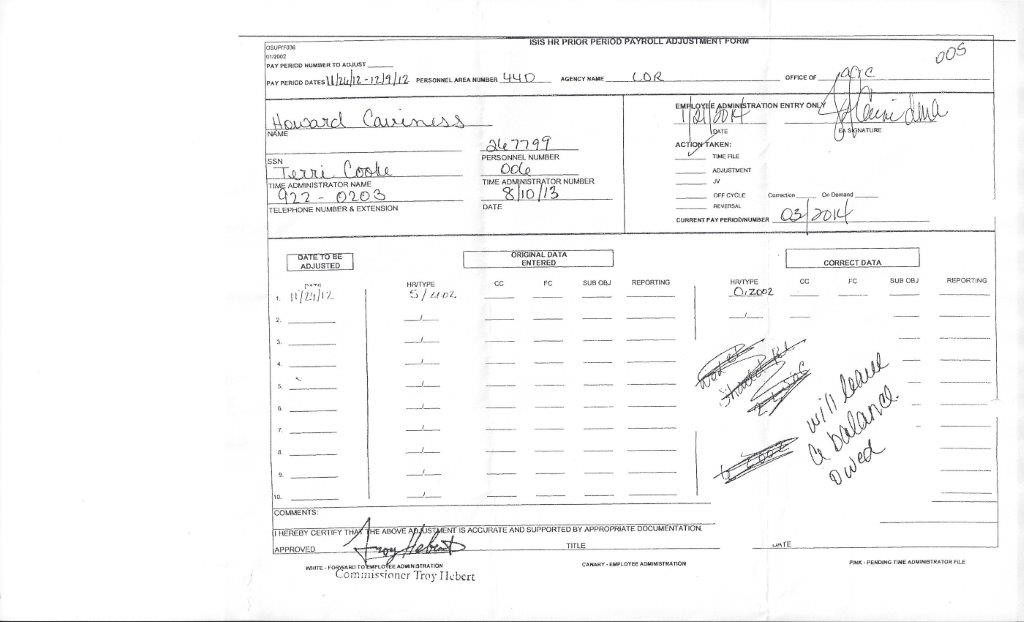
The invoice, for all of $123.59 is for an alleged overpayment to Caviness in Dec. of 2012, according to the letter dated April 29 which is stamped “2nd notice.” Supposedly, the $123.59, when collected, will go to help patch over Jindal’s $1.6 billion budget deficit. LDR letter

Attached to the letter is a time sheet for the two-week time period of Nov. 26—Dec. 9, 2012, with no explanation other than a hand-scrawled, “will leave a balance owed.” ATC timesheet

(CLICK ON IMAGES TO ENLARGE)

Caviness, contacted by LouisianaVoice, feels the action is in retaliation for his having testified on behalf of another former agent, Brett Tingle, who Hebert fired while Tingle was recovering from a heart attack.

Reprisals against a state employee by officials in the Jindal administration? Surely not!

But that would fit the modus operandi of Hebert and would give credence to a third former agent who revealed she was ordered to conduct an investigation of LouisianaVoice publisher Tom Aswell (that would be me). That former agent admitted that she did indeed follow through on the investigation but found me “rather boring.” We’ll take boring any day.

But we did our own nosing around and found that Hebert played pretty fast and loose with campaign donors’ money while he was still a state senator—and even after he left office to take over operations at ATC after Jindal did a number on former ATC Director Murphy Painter.

At the top of the list, as with the case of so many office holders, was his $12,165 expenditure for the purchase of what seems to be the most sought-after perk of all state politicians: LSU football tickets—$4,930 of that well after he left the House of Representatives in 2010 to become head of ATC. It’s somewhat difficult to see how whose expenditures, especially the $4,930 spent after he left office, could be justified as being “related to the holding of public office,” as state campaign expense laws clearly dictate. related to a campaign  personal use  cannot use campaign funds for personal use

But, as they say in those cheesy TV commercials, “Wait! There’s more!”

Our boy Troy also shelled out the following amounts for other seeming unrelated purposes:

  • Nov. 11, 2014: All State Sugar Bowl tickets, $590 (again, quite a stretch in tying this to holding public office); SUGAR BOWL
  • April 22, 2009: Sullivan’s Restaurant, Baton Rouge, $2,323.10 for a fundraiser; RESTAURANTS
  • April 1, 2010: Delta Airlines, $691.80 (no explanation of any destination, but his House district was pretty small and probably didn’t require air travel to get around Iberia Parish; TRAVEL
  • April 1, 2010: Hilton Hotel, Washington, D.C., $1,505.70. Ah! There’s his destination for that Delta flight. But what was he running for in Washington? HOTELS
  • May 10, 2011: Monteleone Hotel, New Orleans, $500. About those two hotel bills: state regulations limit hotel rooms to a mere $120 per night. Perhaps someone should sent Hebert a bill for the difference. Oh, wait. The rooms were paid out of campaign funds, not the state treasury. So that makes it okay, we guess.  travelguide

Still, $15,452 in campaign expenditures which somehow just don’t pass the smell test for legitimate campaign expenditures, especially $5,520 of which was spent after he left office.

And then there’s Jindal.

Since 2009, a year after he first took office, he has racked up an eye-popping expenditure of $169,597 in hotel room costs alone. TRAVEL

Even more revealing, all but $30,000 of that ($139,660) has been since his re-election in October of 2011, evidence that he has spent precious little time in Louisiana performing the “job he always wanted,” and the job to which he was elected.

Jindal also spent more than $185,000 in campaign money since 2003 on air travel, his campaign expense records show. Because his travel expenses were about equally divided between pre- and post-re-election in 2011, it would indicate that much of his lodging was provided by organizations to whom he was speaking.

By running as an “undeclared” candidate for the Republican presidential nomination, he was able to make free use of campaign funds he reaped while running for and serving as governor. That would explain why he is so cagey about his non-candidacy candidacy: the rules change and federal regulations kick in once he is a declared candidate. His self-serving claim to be “praying for guidance” over his decision has little or nothing to do with it; it’s all about the way he can spend the money.

Read Full Post »

By Robert Burns (Special to LouisianaVoice)

Forty years ago, actress Tippi Hedren offered a program for 20 Vietnamese women to learn the profession of being manicurists. The result was a complete revolution of the nail salon industry. The industry is now an $8 billion powerhouse which is dominated by Vietnamese operators. According to Nails, a publication devoted to the nail salon industry, 51 percent of nail salon operators nationwide are Vietnamese. Moreover, in Louisiana, despite the fact that Louisiana Cosmetology Board (LCB) Executive Director Steve Young said that the vast majority of nail salon operators are Vietnamese, his only explanation for why the LCB has no Vietnamese representation is that “it just has not reached that point.”

Vietnamese operators routinely undercut the competition’s price by 30-50 percent. They are recognized by Nails to have a stellar reputation for high-quality work, and they often support relatives in Vietnam. Numerous Vietnamese nail salon operators told Louisiana Voice that the LBC has targeted them for harassment and discriminatory inspections designed to drive them out of business. Their claims are detailed in a class action lawsuit filed by former U. S. Congressman Joseph Cao on February 6, 2014.

The suit alleges the LCB, its Executive Director, one of its attorneys, Celia Cangelosi (who is named personally as a defendant), and at least two of its inspectors, Sherrie Stockstill and Margaret Keller (also both named as defendants) have subjected the Vietnamese operators to being “harassed, intimidated, falsely imprisoned, and arbitrarily discriminated against.”

The lawsuit alleges that Thoa Thi Nguyen’s Exotic Nails was visited by LCB inspectors, including Stockstill, on Friday, July 19, 2013, at a time when the salon was “packed with patrons.” After several minutes of loitering and communicating facts of the salon’s operations, Stockstill shouted, “Everyone keep still.  Don’t move!” The suit alleges Stockstill and the other inspector, despite producing no identifications or search warrant, began opening drawers, sorting through files, and, for two hours, and demanded that Nguyen not leave the premises. Nguyen contends that LBC’s actions resulted in a loss of confidence among some of her patrons who witnessed the scene and that her business has suffered from the episode.

The lawsuit details several other similar incidents including operators being subjected to repeated “inspections” and forcing some operators to sell their businesses to escape the relentless attacks.  Meanwhile, the plaintiffs allege that non-Vietnamese operators are rarely, if ever, subjected to any inspection whatsoever. The lawsuit provides exhibits which show virtually all of the hearings for the LCB entail Vietnamese nail salon operators.

LCB meetings appear to be a vehicle for impeding competition and creating a self-generating source of revenue to provide fees for attorneys who serve under contract and to pay the board’s salaried staff. While the “inspectors” of the LBC earn average salaries of around $27,000, which perhaps explains their fundamental lack of knowledge or training regarding requirements to conduct searches, the LBC payroll approaches a staggering $1 million a year!  That doesn’t even include the $200,000 or so per year it generates for its two contract attorneys:  Cangelosi and Sherri Morris. Meanwhile, Vietnamese operators, who supply much of the funds through which they are harassed, are forced to literally beg the board for permission to work as evidenced by this applicant’s husband’s plea to the board after they moved from Texas and she sought a Louisiana license through reciprocity. Instead, the LCB proceeded to grill her on questions about her Vietnamese high school diploma and decide if the transcript translator should be “approved.”

Vietnamese citizens often immigrate to California and practice as manicurists before relocating to Louisiana, and one salon operator said he personally knows of 15 manicurists planning to relocate to Louisiana within weeks.

These operators were understandably concerned about the April agenda item on “California reciprocity.” At that meeting, Young sought to suspend California reciprocity based on its licensing authorities informing them they were “removing their seal from their documents.”  It was also claimed that it was difficult getting anyone on the phone from California.

Louisiana Voice contacted California licensing authorities, and we had no difficulty getting them on the phone. Moreover, we were told that Young’s statement was false and that they’d experienced a temporary machine failure but that a new color-printed seal was being incorporated into their documents. Accordingly, Louisiana Voice made a public records request for whatever documentation Young referenced in the previous video clip indicating California was removing its seal. What we got was this this email which confirmed what California licensing authorities said to us. It’s not clear whether the LBC is going to accept the new color seal, but what is clear is that Young came across as being determined to suspend California reciprocity and slow the expansion of Vietnamese nail salon operators in Louisiana. Though it’s not clear what an acceptable seal now is, Young and the LBC agreed to back off of reciprocity suspension and merely return as “rejected” any California documents with “no seal.”

Another common complaint among Vietnamese operators is that the LCB itself can’t decide what is legal and what isn’t. Inconsistency appears to rule the day. One operator indicated he was licensed by an LCB official only to be informed by a subsequent inspector that he failed to have proper equipment nor adequate space for conducting his operations. Another operator appeared to suffer a similar plight as evidenced by this video clip from the April 2015 LCB meeting during which one LBC attorney, Sherrie Morris, had to explain to another LBC attorney, Cangelosi, as to the fact that nails can’t be done in an esthetic salon. Cangelosi says “somebody” told them they could but she says it was “not someone from the Board.” Louisiana Voice has been told by several operators that it was LCB officials who told them they could operate. Cangelosi even admits, “Somebody licensed them.” In yet another instance at the same meeting, the LCB demonstrated that its inability to provide guidance to its licensees on acceptable “cheese graders.”

Still another nail salon operator said his salon was cited for violations and, when he informed the inspector that a beauty salon nearby operated in the same manner as he with the same equipment and space allocation, the investigator told him, “There are different rules for you guys.” When he complained to the investigator that he may challenge an administrative hearing on the issue, she said, “You may as well pay the $1,200 fine now.  If you challenge it, they’re just going to add $550 administrative costs and there is no way you can win!” When he inquired how that could be possible for his operation to be treated so differently than the nearby beauty salon, the investigator responded, “They can do whatever they want!”

Yet another complaint of Vietnamese operators is the haphazard manner in which Young is “notified” of violations. Many Vietnamese salon operators said inspectors were shifted to their districts to concentrate on them and that they make it a point of showing up on Saturdays to provide the maximum negative impact to their salon’s operations.

Young said that unlicensed salon operators have “no skill” and “aren’t educated.” Vietnamese manicurists and salon operators said his statement was as an insult and indicated Vietnamese families train relatives to perform the service with safety at the forefront.

Recently, President Obama proposed his FY ’16 budget containing $15 billion for states to explore abolishing many boards and commissions which restrict job opportunities. Louisiana Treasurer John Kennedy supports such action in Louisiana.

In an interview with Louisiana Voice, Young indicated the Federal discrimination lawsuit is “about over with,” a curious claim given that Federal Judge Brian Jackson has denied every state effort to toss the suit. In his rulings of March 20, Jackson denied the state’s motions to dismiss the complaint against inspector Stockstill both for racial discrimination and false imprisonment. Jackson dismissed the false imprisonment complaint against Keller but refused to dismiss the discrimination claim. The trial is estimated to commence on January 17, 2017 and last for seven days.

According to records available through LaTrac, the state has authorized spending of close to $300,000 so far in defending the racial discrimination lawsuit. Louisiana Voice made a public records request directly to the law firm providing the defense, Shows Cali. Readers may recall that Shows serves as Buddy Caldwell’s campaign treasurer for this fall’s attorney general race.  Further, in an investigative report by WWL in New Orleans, Shows was identified as a huge beneficiary of Caldwell’s propensity to award lucrative multi-million-dollar contracts to his close friends and associates.

Mississippi, also has considerable problems with its Cosmetology Board as evidenced by this rant by Mississippi State Representative Steven Holland in February of 2015. Unlike Louisiana, however, Mississippi requires all funds collected by boards and commissions to be placed in the state’s general fund and then individual boards and commissions must make application for funds for that year. Holland says the Mississippi Cosmetology Board’s funds need to be a “big goose egg.”

Read Full Post »


LouisianaVoice needs your support—moral and financial—now more than ever.

The trial on our lawsuit against the Division of Administration begins on Monday (May 4) as we try to hold the administration accountable on the production of public records so that we may keep you informed on events as they take place.

Unfortunately, this administration is trying to see to it—deliberately, we are convinced, that we are not able to provide vital information about the machinations of your state government in a timely manner.

We have already told you about the records request we submitted simultaneously with an identical request by the House Legislative Service Office. The legislature got its records—the same ones we requested—within 10 days; we didn’t get ours until three months later and then only after we filed our lawsuit.

The Division of Administration (DOA) is currently sitting on another request or ours. We again made simultaneously requests of DOA and an office under DOA. The office in question responded with the records within three days or our request. It’s been nearly two weeks and we’re still waiting for DOA to comply.

This is the battle we fight almost daily with the Jindal administration—and they have said in their response to our lawsuit that they do not deliberately delay complying with our requests, that they do not single us out for delay.

That simply does not square with what a former DOA employee told us: DOA routinely gets our requested records and simply stacks them in a corner for weeks at a time before notifying us that we may inspect them.

DOA has—and continues to—open defy us in violation of the state’s public records laws (R.S. 44:1 et seq.).

But even more absurd, in its response to our petition, DOA claims that I have not suffered monetary loss, so the court should not assess damages against the state. That is in direct contradiction to the statute which sets fines of $100 per day for non-compliance. Period. The statute makes no mention of any requirement that the one requesting the records suffer monetary loss as a prerequisite for the assessment of a fine.

Were it not for quick access to the legislature’s public records (which are readily available, with no delay tactics or word games) by LouisianaVoice, that $55,000-a-year retirement pay raise for State Police Col. Mike Edmonson would have gone through.

Were it not for acquisition of public records from the Department of Education (in another, successful lawsuit) by LouisianaVoice, private records of hundreds of thousands of Louisiana public school students would have been made available to Rupert Murdoch of Fox News.

This is what we do.

And it costs money and untold hours of dogged research.

To continue our legal fight, we need your help.

If we win on Monday, DOA is certain to appeal.

If DOA wins, we most certainly will appeal. They believe they can starve us out with legal costs but we won’t back down.

Either way, the costs are going to continue to climb from what we’ve already laid out in expenses.

Please click on the Donate Button with Credit Cards button (not here, but near the top right part of our web page) to donate by credit card.

If your receive e-mail notices to our posts, you will need to click on Read more of this post or pull up the full web site by clicking on https://louisianavoice.com/

If you prefer to mail checks or money orders, please make payable to:

Capitol News Service/LouisianaVoice

P.O. Box 922

Denham Springs, LA. 70727


Whichever way you choose to contribute, your help in our fight to make state government more transparent and accountable is both needed and appreciated.

Thank you.

Tom Aswell, editor

Read Full Post »

By MIKE STAGG (Independent filmmaker, citizen activist, political strategist – Special to LouisianaVoice)

For the past seven years, as Louisiana has lurched from one fiscal crisis to another, the State of Louisiana has paid the oil and gas industry $2.4 Billion in severance tax exemptions. Despite that massive transfer of public wealth into private hands, the oil and gas industry used its influence inside the Department of Natural Resources and the Jindal administration, to limit—and for three years shut down—audits that would have revealed whether the industry’s severance taxes and royalty payments to the state were accurate.

These facts have been hiding in plain sight, contained in five performance audits of the Department of Natural Resources and the Louisiana Department of Revenue conducted by the Legislative Auditor since 2010. Two of those audits focused on royalty collections from oil and gas produced on state-owned lands and water bottoms. Another focused on severance tax collections; yet another dealt with mineral leases handled by the State Mineral and Energy board, while the fifth audit examined how the Office of Conservation has handled the orphaned and abandoned well cleanup program.

The cozy relationship between DNR and the oil and gas industry is explicit in the department’s regulation of the industry. That coziness, when extended to state finances, has proven disastrous for the Louisiana treasury and its residents. DNR is responsible for collecting oil and gas royalties, which account for roughly seven percent of state General Fund dollars, or approximately $800 million per year.

For a three-year period, between July 2010 and July 2013, DNR had jurisdiction to determine the accuracy of severance taxes and royalty payments.

And DNR let industry have its way.

Audits on royalty revenue dropped. Audits on severance tax revenue all but stopped, even as the state’s financial condition continued to worsen. In short, when it came to providing rigorous oversight to ensure that the royalty and severance tax payments were accurate, DNR’s Office of Mineral Resources deferred to the oil and gas industry while programs that serve the citizens of Louisiana were cut, primarily in healthcare and higher education, the unprotected portions of the state General Fund.

DNR’s relationship with the oil and gas industry is a blatant example of regulatory capture. Regulatory Capture is a form of political corruption that occurs when an agency, created to act in the public interest, advances instead the special concerns of the industry it is charged to regulate.

Severance taxes are the constitutional expression of our, as Louisiana citizens, shared claim on our state’s vast mineral wealth. Exempting severance taxes negates the public claim on that mineral wealth and undermines our ability to invest in ourselves as a state.

Severance tax exemptions are direct payments from the state to the oil and gas producers after the companies have submitted their exemption certificates. Royalties are the property owners’ share of the proceeds from the sale of oil and gas produced from wells on their land. For purposes of this story, royalties are the state’s share of the revenue from oil and gas produced on state-owned lands and water bottoms after severance taxes have been paid.

Since the mid-1980s, Louisiana Department of Revenue has published an annual report on tax exemptions called “The Tax Exemption Budget.” In that document, the department identifies each tax exemption and quantifies the cost of each exemption to the state.

It makes clear that tax exemptions are in fact a spending of state funds — here’s how the LDR explains it in every report: “Tax exemptions are tax dollars that are not collected and result in a loss of state tax revenues available for appropriation. In this sense, the fiscal effect of tax exemptions is the same as a direct fund expenditure.”

Between 2008 and 2014, according to the Tax Exemption Budget, the State of Louisiana paid oil and gas companies more than $2.4 Billion in severance tax exemptions. Those checks went out at the exact same time that our legislature cut funding for programs like aid to families of children with disabilities, behavioral health programs, home health care, and programs that assisted victims of domestic violence. During that same period, state funding for higher education was also cut by more than $700 million as the tuition and fees paid by those attending technical colleges, community colleges, and state universities were jacked up to cover the difference.

The first performance audit on royalty collections was released in July 2010. Royaltieshttps://app.lla.state.la.us/PublicReports.nsf/B6B5DE331E9D48818625776E005CFDA5/$FILE/00018070.pdf The Legislative Auditor found that DNR’s Office of Mineral Resources took a lackadaisical approach to verifying the accuracy of royalty payments from the 1,888 active mineral leases on state-owned lands and water bottoms.

The Legislative Auditor noted that severance taxes and royalties are connected, that both are dependent on the amount of oil and gas produced, as well as the price of the resource.

Desk audits compared the volume of oil and gas sold to the volume of oil and gas produced, which ensures that royalty payments are properly calculated. These audits also help ensure that production wells on state lands are submitting properly calculated royalty payments.

The Legislative Auditor found that the Office of Mineral Resources (OMR) had not conducted a single such audit in a decade. Despite the Auditor’s recommendation that it resume these audits, OMR waited another three years before getting around to doing so.

The Legislative Auditor also found that OMR did not compare royalty reports against severance tax reports filed with the state Department of Revenue, nor did it compare royalty reports to production reports submitted elsewhere in DNR.

In its response to the Legislative Auditor’s Royalty performance audit findings, on June 24, 2010, DNR announced that “As part of the Streamlining Commission’s recommendations, OMR will take over LDRs severance tax field audit program and the two audits will be integrated beginning July 1, 2010.”

In September of 2013, the Legislative Auditor released a follow-up performance audit on royalty collections. https://app.lla.state.la.us/PublicReports.nsf/DB918AD8E33411F286257B490074B82A/$FILE/00031C97.pdf

The auditors were dismayed to find that the revenue produced by OMR’s audits had fallen below the levels reported in 2010.

The Auditor also found that that the State Mineral and Energy Board had waived 45% of the $12.8 million in penalties that were assessed against companies by OMR for late payment of royalties.

Neither the Office of Mineral Resources nor the State Mineral and Energy Board seemed at all concerned about the fiscal impact their indifference to generating revenue had on the programs that Louisiana residents depend on. Their primary concern was with not inconveniencing their friends in the oil and gas industry.

The Legislative Auditor conducted an audit on severance tax collection procedures in the

Louisiana Department of Revenue in 2013 but, because severance tax audit functions had been transferred to the DNR in 2010, auditors had to return to the Office of Mineral Resources close on the heels of the second royalty collections audit. https://app.lla.state.la.us/PublicReports.nsf/AC044A6D3709B90C86257BE30065348B/$FILE/000351F7.pdf

In this audit, the Legislative Auditor found that oil and gas industry complaints about the LDR’s use of GenTax software (which identified possible nonpayers of severance taxes) led first, to LDR shutting off the software, and second, audit power being transferred to DNR.

The scale of the oil and gas production not audited as a result of that shift was staggering. DNR’s field audits ignored oil and gas production on private lands — which comprises 98.1% of all oil and gas leases in Louisiana — for a three-year period.

Revenue from severance tax audits fell 99.8% from the levels produced by the Department of Revenue once responsibility was transferred to the Office of Mineral Resources. The actual dollar amount fell from $26 Million in 2010 to $40,729 in Fiscal Year 2012.

For the three-year period that DNR’s Office of Mineral Resources had responsibility for severance tax audits, the industry essentially operated under an honor system.

Prior history shows why this was a problem. In the late 1990s, the Mike Foster administration filed lawsuits against more than 20 oil and gas companies claiming they had shortchanged the state by as much as $100 million on severance tax payments. Now, for three years as recurring revenue shortfalls continued, the Office of Mineral Resources ignored that history.

During this time, the Haynesville Trend emerged as the most productive shale gas field in the country.

Even though the severance tax exemption on horizontal drilling meant that the state was denied severance tax revenue for much of that play, companies still managed to game the exemption system at taxpayer expense.

Under the rules for severance tax exemptions, the state pays back the taxes already paid once it receives the exemption certificate from the company — plus “Judicial Interest” which in the period covered by the audit averaged about 4.5%.

That is, the state had to dip into non-exempt severance tax payments in order to cover the interest costs on those certificates that the companies chose to sit on for several months.

The Audit found that over the course of four fiscal years running from 2009 through 2012, the Department of Revenue issued 13,818 severance tax refund checks totaling $360,190,583. An extra $23,859,012 in interest was tacked on to that. https://app.lla.state.la.us/PublicReports.nsf/CF6244B77E3A958686257C30005E80B1/$FILE/000368DA.pdf

In addition, the Auditor found that the Department of Revenue overpaid severance tax exemption refunds by $12.9 million between July 2010 and May 2012.

The decline in audit revenue, the interest paid to companies on the gaming of the severance tax exemption process, the overpayment of severance tax exemption refunds, the decision by the State Mineral and Energy Board to waive 45% of fines for late payment of royalties combined to benefit the industry at taxpayer expense to the tune of $68 million.

These gifts to the oil and gas industry were made at a time when the industry was already receiving $2.4 Billion in tax exemptions and at a time when every dollar the state did not collect translated into a cut to programs that Louisiana residents depended on.

The Auditor also pointed out that hiring additional auditors within DNR and LDR would produce a great return on the state’s investment. Each auditor costs a department between $50,000 and $60,000 per year, but they bring in an average of $1.3 million per year. LDR said it had requested additional auditors in its budgets but they were never approved by the Jindal administration.

Oil and gas companies control all of the information used in the severance tax and royalty payment process. The industry has used this power to its advantage and to the state’s detriment.

Vigilant auditing can close that information gap.

The Office of Mineral Resources has shown little interest in that kind of work. DNR’s abdication of its oversight role on royalty revenue has had an outsized impact on Louisiana because of the role that revenue plays in state finances. When added to the three-year period when DNR failed to perform severance tax audits, the agency has likely cost the state hundreds of millions of dollars over the past seven years.

That is corruption.

Not all of this went unnoticed. In the 2014 legislative session, Sen. Rick Gallot (D-Ruston) and Rep. Joe Harrison (R-Gray) introduced concurrent resolutions to order LDR, DNR and the Legislative Auditor to agree upon a means to conduct a thorough audit of oil and gas production, severance taxes and royalty payments. Gallot’s resolution passed the Senate by a vote of 35-0. https://app.lla.state.la.us/PublicReports.nsf/D6A0EBE279B83B9F86257CE700506EAD/$FILE/000010BC.pdf

But by the time the resolution reached the House floor in early June, the oil and gas industry and the Jindal administration recognized the threat the audit posed, so they joined forces to kill it. SCR 142

The resolution had to be killed to keep the secret.

In the midst of a prolonged and deepening fiscal crisis, the Jindal administration and the industry did not want legislators and the public to question whether the severance taxes and royalties paid to the state were accurately calculated.

The Department of Natural Resources betrayed the trust of the people of this state. It failed its fiduciary responsibility twice; first, as collector of royalty payments, and again during the time it served as chief auditor of severance tax collections. It has repeatedly put the needs of the industry above the needs of the people of this state.

For the oil and gas industry, $2.4 Billion in severance tax exemption payments were not enough. Its greed is so great that, in a time of fiscal constraints on state government, it went out of its way to cheat the state out of still more money. It used its power and influence in the Department of Natural Resources and its ties to the Jindal administration to do so.

By these acts, the oil and gas industry has shown itself to be unworthy of the trust we have placed in it.

For Looting Louisiana in our time of fiscal need, the oil and gas industry must be stripped of its severance tax exemptions. Under the Louisiana Constitution, we are entitled to the full benefits of this state’s mineral wealth.

Read Full Post »
Editor’s note: Normally, we do not make a practice of publishing letters from readers as a guest column. But in this case, we make an exception because we were struck by the manner in which this writer expressed his concern for our state. With only minor editing for punctuation, syntax, etc., we offer here an essay written by a retired state employee now living in Pointe Coupee Parish.

By Kerry Phillips (Special to LouisianaVoice)

After reading this article:  https://louisianavoice.com/2015/04/24/it-wasnt-the-best-week-for-louisiana-as-state-hit-with-triple-whammy-at-least-no-1-lsu-beat-no-2-tex-am-in-baseball/,  and this article: http://bobmannblog.com/2015/04/24/for-jindal-if-the-choice-is-tax-hikes-vs-closing-lsu-its-bye-bye-lsu/, and after watching The Ed Show on April 24 on MSNBC regarding Jindal’s religious freedom bill and how he is truly now a national joke…..and finally, after reading Bobby Jindal’s op-ed in The New York Times, and not hearing anything about any of this in the news with the exception of a small article in The Advocate on the OGB fiasco, I have to say that as much as we love this great state of Louisiana, the heritage, the diversity, the culture, the beauty this state has to offer with many aspects, we will be moving AWAY from this state as soon as we possibly can.

We are at the bottom of every list possible nationwide, and thank God this info is getting out nationwide. We are a laughing stock. And I am sad. Sad for my state. Sad for the people, the young, elderly, poor, government workers, fire fighters, teachers. Should I go on?

I was born here.  I was born in Baton Rouge and attended fantastic schools there. I went to college in this state. I worked for over 30 years as a state employee. I was so proud when I first got my voter’s registration card and I have voted in every election. I retired, thinking my state would honor the commitments they made to me throughout my career.

Sadly, it seems I was fooled.

To know that our legislators are basically bought and paid for by lobbyists and special interests groups who truly have no interest in our state that we call paradise is sad. We have always been known nationwide as a “banana republic.” Now I see why.

No one should say that our citizens move away from this state because of a lack of jobs. They now move away because of this cruel joke that has been perpetrated on us by a handful of people within the last decade. None of these people even care about this state, our education, our colleges, our government workers, our healthcare, etc. What we’re seeing is robbery and pilfering by people who only care about one agenda. And that agenda has nothing to do with the welfare of the citizens of Louisiana. Nor does it have anything to do with our hospitals, our children’s education, or the workers of this state.

So when you turn on the local news and see people with arms folded, waiting and complaining about long lines at their Motor Vehicle offices, thank yourselves. When there is no hospital emergency system available for your loved ones, thank yourselves. When LSU does not exist anymore, God forbid, thank yourselves. When you fail to register your outrage when a contract giving away our state hospitals—with 50 blank pages—only to have the deal rejected by the federal government, thank yourselves.

My family and I plan to move to a more progressive state—to a state where citizens actually live in the current year/century and do not want to take us back to 1915, a state where people want to move forward in a way that benefits all citizens, not just the few. And no, it’s not because of my legislator, who has worked to improve the economy and to help state employees where I live. It’s because I am now becoming ashamed of our state and most of our legislators who helped get us in our current predicament.

I lived in Baton Rouge until we moved to the Central/Greenwell Springs area where I lived for more than 27 years. For the past 15 years, we have lived in Pointe Coupee Parish. And while I’d absolutely hate to leave this state (and it’s an extremely hard choice for me), I do think we’ve made our decision. Our state appears to be done, over with….unless…..our legislators decided to truly quit being Jindal’s lapdog. They need to quit being afraid to buck his system because his system has ruined and bankrupted our state. They need to stop allowing him to be a dictator in this state. He is not our God.

And when religious leaders—from north Louisiana, no less—oppose his religious freedom bill, we welcome their voices. We do not live with the Old Testament laws because with Jesus, a new testament was founded. Do we really want to go back? Are we going to go against what Jesus preached? I’m not. Are we going to allow Jindal’s religious freedom bill to become the hot topic offered only to deflect attention from the real issues, the disasters of his creation: the financial issues we now face that are the direct result of his ineptness?  Come on.

I pray so very hard that all of our legislators, men and women, will grow some courage and principles and do what is right for the whole of this state. I’m not stupid, though. I know legislators get benefits that no average citizen—or state employee—can get.  But, isn’t it time for them to sit back and ask themselves, “Do I really want to sell my soul for some Saints tickets or concert tickets or a fantastic meal at some expensive restaurant? Do I want to sell my soul? Or do I want to do what the citizens of this state want?”  “Do I want to do what Jesus would do?”

Heavy, thought-provoking questions to ask, I know. But, I know what I would do.

This is going to be one of the most historic legislative sessions in this state’s history. It is going to make or break our state. And I am afraid the state is going to break. And the poor, the sick, the elderly will be the ones to suffer.

Of course, there is nothing wrong with people prospering and living a great life. What’s wrong is people prospering and living a great life on the backs of other people.

And so I have this one simple plea for our legislators: For once, do what is right for the whole of the state.  I pray in earnest for that. My friends and I pray hard that the right things will be done. I would love to live here and pass on the culture and treasures this state has to offer to my grandchildren. But, if things continue on as they have for the last decade, we will have to choose differently.


Read Full Post »

« Newer Posts - Older Posts »