Feeds:
Posts
Comments

Archive for the ‘Corruption’ Category

Even as grieving friends, relatives and fellow state troopers were gathering to say goodbye to slain Troop D State Trooper Steven Vincent in Lake Charles last weekend, a State Police Internal Affairs investigation was well underway into alleged payroll irregularities on the part of Troop D Commander Capt. Chris Guillory.

One report received by LouisianaVoice indicates that Guillory reassigned a supervisor to administrative duties after he and his subordinates declined to participate in what they felt was payroll fraud stemming from travel to Baton Rouge for new firearms qualification.

Meanwhile, a potential confrontation between Guillory and the man who filed a complaint against him was averted when a sheriff’s deputy escorted Dwight Gerst from a visitation for Vincent at the Rosa Hart Theater at the Lake Charles Civic Center on Friday, Aug. 28.

Gerst, who was friends with and who was trained by Vincent, attended the wake but said he was cursed by Guillory while he was standing in line and a sheriff’s deputy subsequently escorted him from the visitation. “I was there to honor and pay my respects to a friend,” Gerst said.

LouisianaVoice published a story on Aug. 17 about Guillory’s refusal to accept a formal complaint about threats Gerst said Trooper Jimmy Rogers made against him. Gerst then took his complaint to State Police headquarters in Baton Rouge but it was never followed up by Baton Rouge, he said.

But now, Internal Affairs is conducting what appears to be a full-blown investigation into a number of allegations involving Guillory, including but not limited to the payroll irregularities and prescription drug abuse.

One of the payroll issue stems from a trip Troop D troopers made to Baton Rouge earlier this year to qualify with new weapons issued the troopers. LouisianaVoice has learned that troopers were instructed to charge extra hours for the round trip and time spent qualifying.

Guillory is said to have reassigned one supervisor to administrative duties after he and his subordinates declined to participate in padding their time sheets.

LouisianaVoice in late July made a public records request of State Police for an opportunity to review all time sheets for the pay period that Troop D personnel traveled to Baton Rouge to fire the newly issued weapons.

On Aug. 18, State Police Attorney Supervisor Michele Giroir notified us by letter that the time sheets, along with numerous other requested public records had become the subject of an ongoing investigation being conducted by Louisiana State Police. “Therefore, these records are not subject to release at this time,” Giroir wrote.

It appears the request by LouisianaVoice for the records sparked the investigations into the suspected payroll irregularities. Reporting sources indicated they had not wanted to take information to LouisianaVoice but did so after reporting the problems internally only to see the investigation focus more on discovering the source of the reporting than in identifying and stopping misconduct.

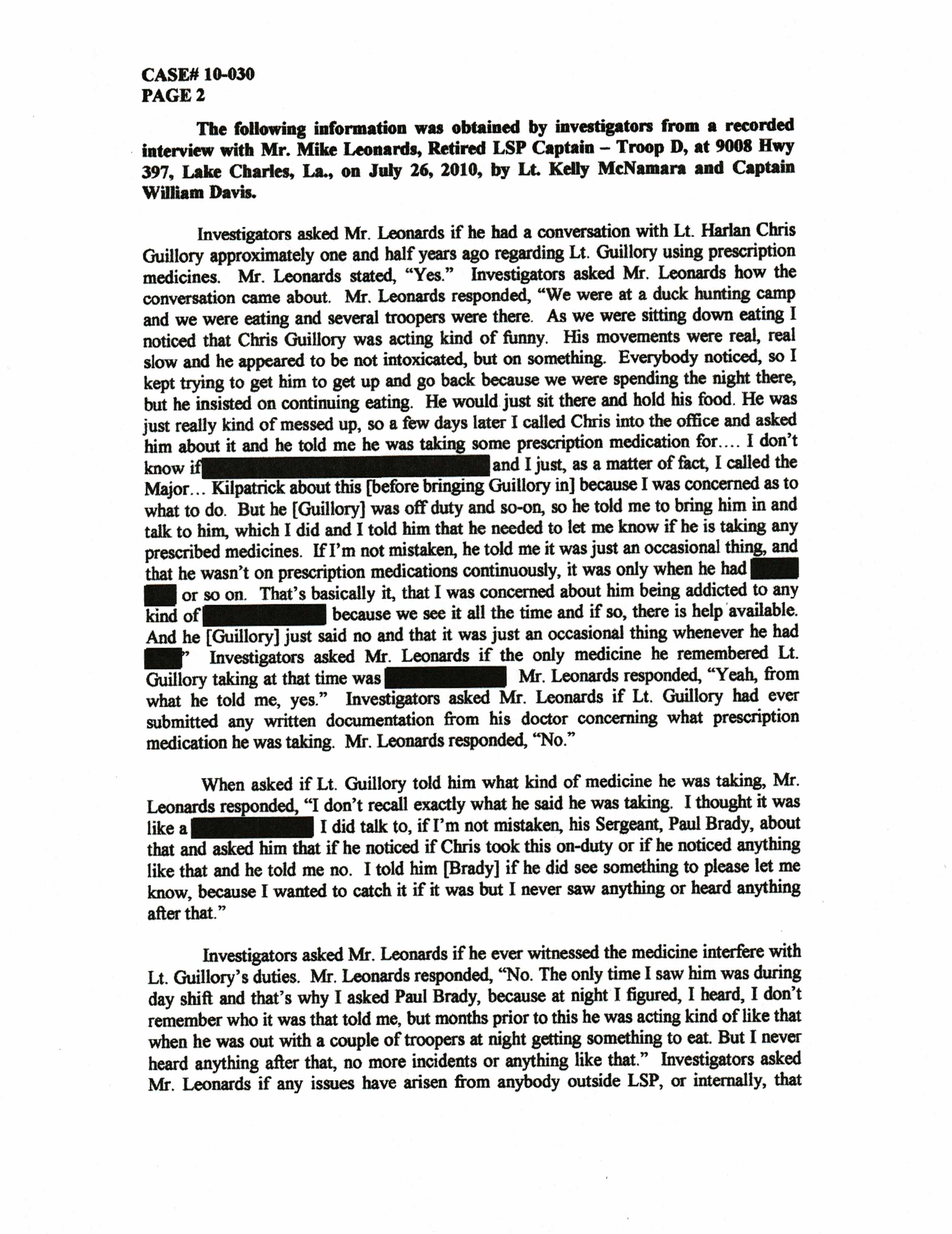
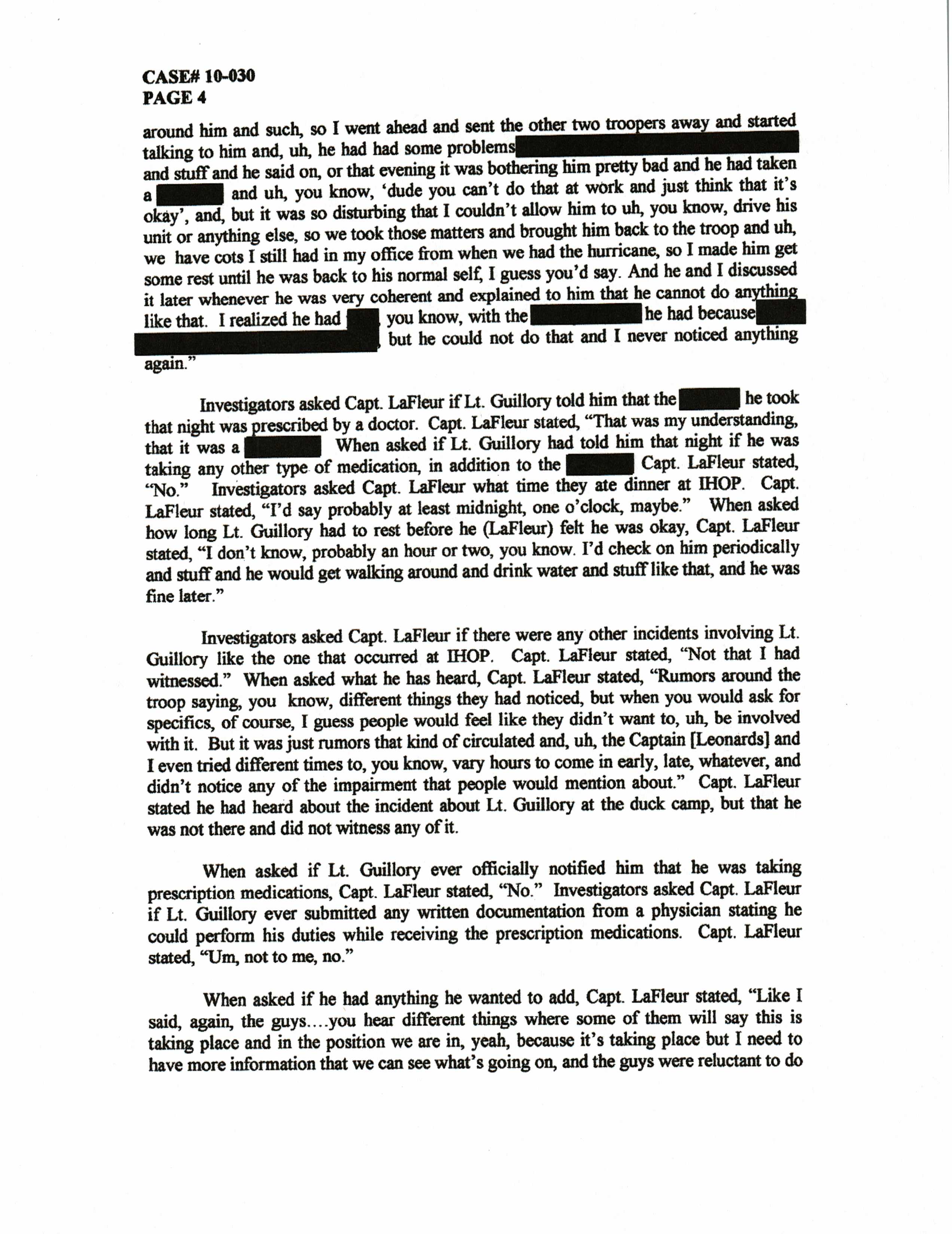
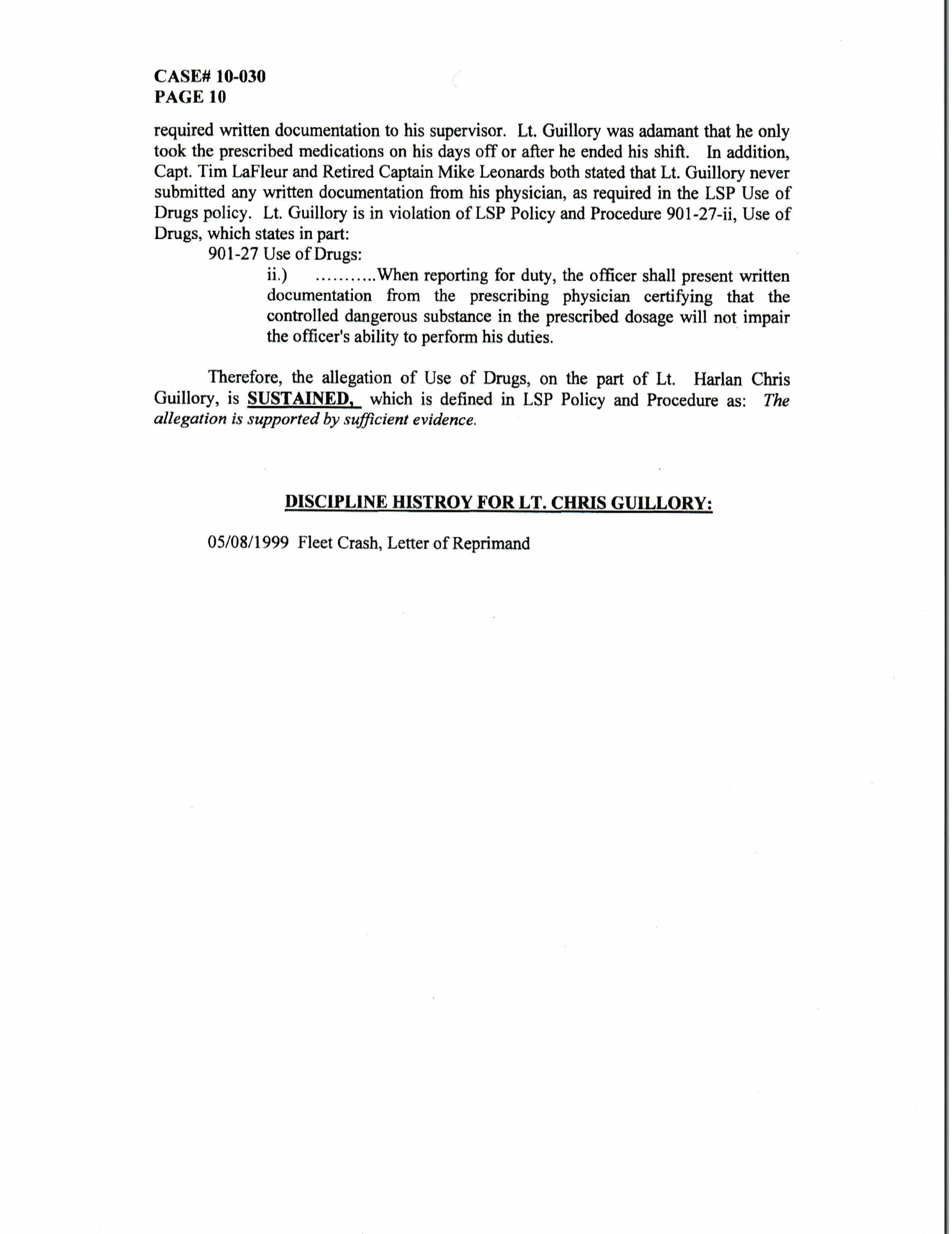
Giroir did, however, release a 10-page investigative report of an investigation of the possible abuse of prescription drugs by Guillory. “…Guillory may have taken, or is currently taking, a prescribed controlled dangerous substance, which is required to be reported as per LSP Policy and Procedure…,” the report said.

The report alluded to instances of Guillory’s being observed driving erratically in his patrol vehicle. One state police official reported that Guillory was at a restaurant and had to be driven back to Troop D to sleep on a cot until returning to normal. Guillory denied to investigators that he slept on the cot. It was also reported he experienced difficulty manipulating utensils at a restaurant while eating in a restaurant with other troopers.

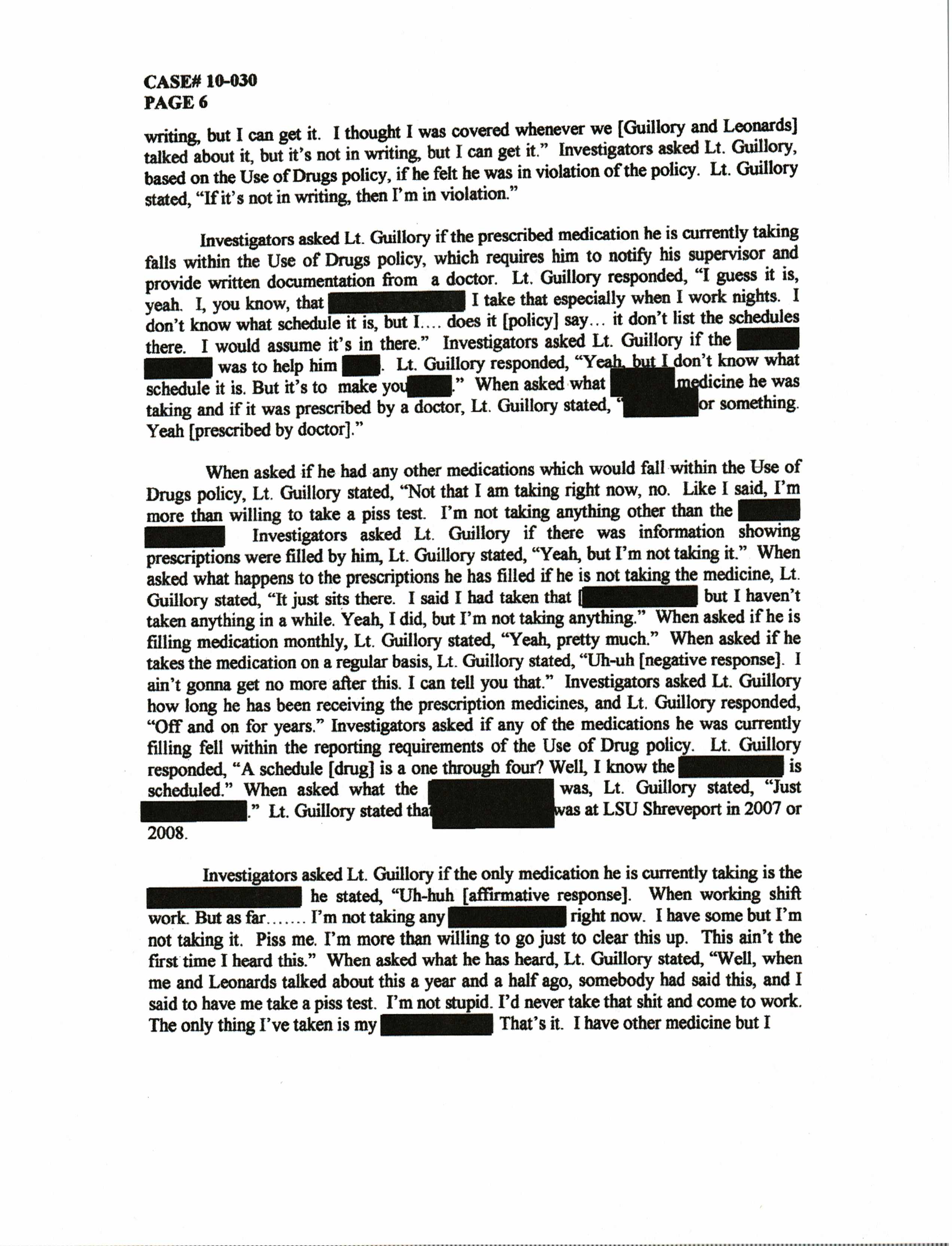
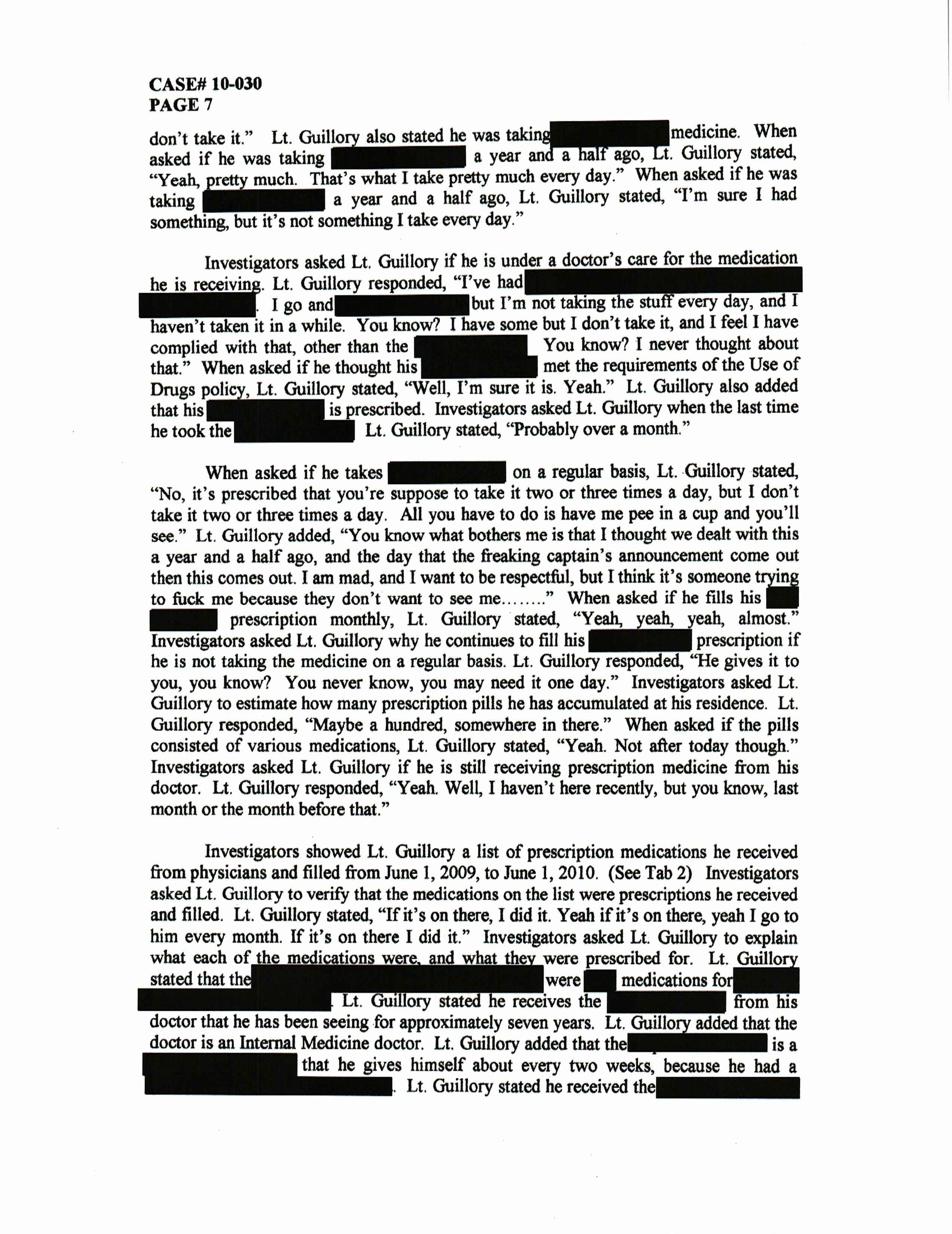
The 10-page investigative report was heavily redacted, but it was evident that Guillory first told investigators he was in compliance with LSP drug use policy but later admitted he was not. He told investigators he was obtaining prescriptions from three different doctors and that he had accumulated “maybe a hundred” pills at his home. He admitted to investigators that he occasionally doubled up on his dosage but that it was not an everyday thing.

The type pills prescribed to Guillory was redacted, but LouisianaVoice has learned that they were believed to be OxyContin which is normally prescribed for only 15 days because of addiction risks and is intended for use by terminal cancer patients and chronic pain sufferers.

State police investigators described the drugs as a “the cocktail.” According to law enforcement experts, the cocktail is a combination of pain killers, muscle relaxers, and anti-depressants.

Guillory reported that he flushed the medications after being interviewed by Internal Affairs. Shortly after the investigation was concluded, he was reprimanded for violating the State Police drug use policy. He was promoted to the rank of captain and became commander of Troop D subsequent to the investigation but later received a letter of reprimand for violation of prescription medication notification regulations from State Police Superintendent Mike Edmonson.

Here is the 10-page redacted report, along with the letter informing the Region II Command Inspector of the investigation, followed at the very bottom by a link to Edmonson’s letter of reprimand to Guillory—after he was promoted to captain. (CLICK ON EACH IMAGE TO ENLARGE):

IMAG1108

IMAG1110IMAG1111IMAG1113IMAG1114IMAG1115IMAG1116IMAG1117IMAG1118IMAG1119

Here is the GUILLORY REPRIMAND letter of Sept. 28, 2010.

Read Full Post »

While the candidates for governor try to turn our eyes away from the circus in Iowa long enough to make their case of why they should be chosen to clean up the Bobby Jindal mess, there is another statewide race that is quietly flying under the radar which deserves our attention.

If ever there was a case to be made for prohibiting campaign contributions from industries and individuals the candidates would be regulating once in office, it would have be with the races for Louisiana Insurance Commissioner, Public Service Commission, and Louisiana Attorney General. An examination of contributions to candidates for those offices stands as the poster child for campaign reform.

Matt Parker is trying to change that. The Monroe native owns and operates an auto body shop and it his experience with insurance companies through his business that has led him to defy all political odds and run against incumbent Insurance Commissioner Jim Donelon. http://mattparkerforlouisiana.com/

The single biggest black mark against Parker’s name is that he was an All-State football player at Neville High School in Monroe. Being an alumnus of district rival Ruston High (Magna Cum Barely, class of 1961), long a bridesmaid to the stellar football program of Neville, first under Bill Ruple and later Charles Brown, I find that to be a tough personal negative for Parker to overcome.

His entry into the cesspool of Louisiana politics stems from major problems independent body shops were having and continue to have with auto insurance companies. https://louisianavoice.com/2014/05/07/unlike-a-good-neighbor-state-farm-may-be-undermining-choice-of-auto-repair-shops-same-for-the-good-hands-folks/

Insurance claims departments were said to have had this nasty habit of steering claimants to shops of their own choosing, shops the complainants said that that while cheaper, were turning out inferior work and using sub-par after-market parts. This, said the shops being shut out, was endangering the lives of the motoring public.

The merits or qualifications of Parker are not up for discussion here. What is open for examination, however, is the list of campaign contributors for each of the two candidates. (A third candidate, Baton Rouge attorney Charlotte McDaniel McGehee, a Democrat, has just announced as a candidate but there are not campaign contributions records available for her as yet.)

Both Donelon and Parker are Republicans but you’d never know that from the campaign finance reports of the two candidates.

Donelon’s report is dominated by big money flowing into his campaign from insurance companies and individuals in the industry. No fewer than 75 such companies and individuals from out of state contributed nearly $130,000 to Donelon. That’s $50,000 more than all of Parker’s campaign contributions combined.

In all, Donelon has attracted about half-a-million dollars since January of 2014 while Parker has pulled in $76,800 total.

Sixteen Donelon contributors kicked in $5,000 each, exactly half of those from other states. Thirteen were from the insurance and banking industries.

One of those, Michael Karfunkel of New York City, is a co-founder, along with his brother, of AmTrust, described by the Southern Investigative Reporting Foundation (SIRF) as “a high-flying insurance company.” SIRF found that while Michael Karfunkel and brother George were active grant-makers to synagogues and institutions linked to Brooklyn’s Haredi Judaism community, they reaped huge benefits from using their foundations to maintain family control of AmTrust.

Several years of IRS Form 990s, the annual report for tax-exempt foundations, showed that the Karfunkel brothers funneled AmTrust stock into their foundations in violation of IRS rules governing “excess business holdings.”

Basically, a foundation’s “disqualified persons,” an IRS term for foundation managers, family members, directors and key donors, are limited to stock ownership of 20 percent . The Karfunkel insiders owned more than 59 percent of AmTrust’s shares.

Michael Karfunkel and AmTrust each contributed $5,000 to Donelon.

Other insurance companies, attorneys, bankers, and individual in the insurance industry who contributed the $5,000 maximum to Donelon included GMAC Insurance Management, LUBA, USAA, Anchor Insurance Managers, the Republic Group, Joseph Kavanagh of New York City, and Greenberg Traurig of Miami.

Here is the complete list of JIM DONELON CONTRIBUTIONS of $1,000 and more.

Parker, who says on his Web page that he will not accept any contributions from the insurance industry, has received only three individual contributions of $5,000. One of those from Daniel Parker, presumably a relative. Another is from the Louisiana Collision Industry, which has had its cause taken up by Attorney Buddy Caldwell and which had its fight with insurance companies featured on CNN’s Anderson Cooper 360.

Of his 83 contributors, 41 gave $1,000 or more. By contrast, 282 of Donelon’s contributors gave $1,000 or more. Here is the list of MATT PARKER CONTRIBUTIONS

We have long maintained that no elected regulator should be allowed to receive so much as one dollar from individuals or industries they regulate. While the official may be incorruptible and the epitome of virtue and integrity, the perception is, and always will be, that their decisions will always come down on the side of the contributor. That is one facet of campaign reform that should be—must be—addressed before we can ever say with a straight face that we live in a democracy where everyone gets the same consideration.

The best example of this is that of the billionaire brothers Farris and Dan Wilks who amassed their fortunes in the West Texas fracking boom. The brothers ponied up $15 million to Cruz’s Super PAC. Now let’s say Cruz somehow, God forbid, becomes President. Later, West Texas residents become concerned about health issues associated with fracking. Their drinking water suddenly becomes contaminated and undrinkable and their livestock suddenly become sick or start dying. Should they even bother appealing to a President Cruz’s humanitarian side for help?

We all know you can check that box “No.”

1de860b7f87d9e7b14f5e5a00dbb9b49[1]

Does anyone truly believe it was coincidence that State Farm’s increasing homeowners’ deductibles from $500 and $1,000 to 5 percent of the home’s value for named storms in 2014? (If you have a home valued at $150,000, for example, your deductible for damage from a named storm just went from $500 or $1,000 to $7,500. Donelon’s “Oh, well” response? “I wish it were not happening, but it is the world of hurricane deductibles that we live in.” http://www.nola.com/business/baton-rouge/index.ssf/2014/07/state_farms_5_hurricane_deduct.html

Does anyone believe it was coincidence that Allstate kept two separate sets of rates for home repair, depending on whether or not the claims coverage was paid by the National Flood Insurance Program (NFIP) or by Allstate? Following Hurricanes Katrina and Rita, Allstate deemed the cost of repairing Allstate-covered damage thusly: 76 cents per square foot for drywall, $23.48 per square yard for carpet, and 80 cents per square foot for painting. But when it came to administering claims under NFIP, claims that were paid by U.S. taxpayers, those same costs were estimated by Allstate as $3.31 per square foot for drywall, $28.43 per square yard for carpet and $1.15 per square foot for painting. (It should be pointed out here that Allstate received a fee for administering NFIP claims, but only if the claim was closed. Thus, it was to Allstate’s benefit to settle quickly—at the higher rates—since the money didn’t come out of Allstate’s pocket.

And does anyone think it coincidence that Allstate and State Farm, applying the tactic taught them by McKinsey and Company (the only private sector firm Bobby Jindal ever worked for) practiced the “delay, deny, defend” method of fighting claims of those who lost everything they owned in the hurricanes? Or that claims for homes where the only thing left was the slab on which the houses sat were denied because the homeowner was unable to prove the home had been destroyed by wind (covered) rather than rising water (not covered)? Or that Katrina blew shingles off roofs in Jackson, Mississippi, 180 miles north of New Orleans, but insurance companies denied similar claims in New Orleans because of a lack of proof that shingles weren’t damaged by rising water instead of wind? Allstate adjusters, worked under strict guidelines to protect the bottom line or risk losing their jobs. http://stlouis.legalexaminer.com/automobile-accidents/allstate-you-are-not-in-good-hands/

Does it seem strange to anyone that insurers were so easily able to pull these scams on premium-paying homeowners in Louisiana?

Or does it seem to be only politics as usual in a state where insurance companies and those affiliated with insurance, banking and defense attorney firms could virtually finance the political campaigns of an insurance commissioner who could be expected to grease the skids when the time came for the companies to employ these tactics against devastated homeowners desperate to settle—even for pennies on the dollar?

Parker or McGehee probably won’t win. The odds are stacked too heavily against them. If it even begins to look as if either one will make a dent in Donelon’s base, you can look for the attack dogs to take over the campaign ads.

But this state deserves better. Donelon might well be as honest as Abe, as righteous as Atticus Finch, as moral as Gandhi and as compassionate as Mother Teresa. I’m in no position to say otherwise.

But as long as the Commissioner of Insurance, Public Service Commission and the Attorney General campaign donations are dominated by regulated industries and individuals affiliated with those interests, the perception will always be there that the offices are bought, owned and run by special interests.

Read Full Post »

A former reserve law enforcement officer from southwest Louisiana has filed a formal complaint against a state trooper and his then-captain over an ongoing feud with State Trooper Jimmy Rogers that was the subject of an earlier LouisianaVoice story. https://louisianavoice.com/2015/08/12/the-stark-reality-of-jindal-administrations-double-standards-found-in-discipline-of-state-trooper-for-text-phone-threats/

The latest complaint marks the second time Rogers has become confrontational with individuals in Troop D and yet he has been assigned to work in the Troop D area school systems as a State Police School Resource Officer.

It is the third formal complaint that Dwight Gerst has attempted to file against Rogers and the second against Maj. Chris Guillory after Guillory refused to act on—or even accept—Gerst’s first complaint against Rogers last year. State Police Internal Affairs likewise never followed up on Gerst’s complaint that the state trooper stalked him at his home and at his child’s school in his state police vehicle.

Guillory refused to accept Gerst’s initial attempt at filing the complaint against Rogers, telling Gerst that he had “a problem” with Gerst and would not talk about his complaint until his “problem” was resolved. That “problem” was a festering dispute with Rogers that began in earnest when Gerst picked up two children from school and drove them home. Gerst says he had a reciprocal agreement with a neighbor whereby either parent could pick up the other’s child after school, but one of the children he picked up was Roger’s child.

Rogers, however, would seem to have problems of his own, judging from that heavily redacted nine-page disciplinary letter to him from State Police Commander Col. Mike Edmonson. In that Nov. 19, 2010, letter, Rogers was informed he would receive a 240-hour reduction in pay (a 10 percent reduction for 30 pay periods, which amounted to a $4,845.60 cut in pay) for repeated verbal threats of bodily harm and arrest directed to another man with whom he was feuding.

A court document filed by the mother of Rogers’s child and obtained by LouisianaVoice described Rogers as having “a lengthy history of abuse as well as (a) violent temperament.” The petition further said that Rogers had threatened to kill her and her family. The woman also requested that Rogers be entitled to supervised visitation of the child.

Despite the discipline meted out by Edmonson for the threats against the mother and her family, and despite Gerst’s attempt to file the complaint against him that was refused by Guillory, and never acted upon by State Police hierarchy, Rogers was nevertheless reassigned by Guillory this year as School Resource Officer to work in the Troop D area schools. SCHOOL RESOURCE OFFICER

Last August, Gerst picked up the neighbor’s nine-year-old child and Rogers’s five-year-old child who was left in the care of the older child. He said he took the children “straight home,” a distance of some 400 yards and then notified Rogers via text. Upon receiving the text, Rogers became infuriated. He subsequently pulled Gerst over at the school and demanded proof that he was authorized to pick up his own son and a niece and nephew. Gerst said Rogers was in uniform and was driving a state police vehicle in which two children were riding at the time.

When Guillory refused to accept Gerst’s formal complaint against Rogers, Gerst took his complaint up the chain of command, to State Police headquarters in Baton Rouge but that complaint was never addressed by Baton Rouge.

A state police spokesperson acknowledged on Monday (Aug. 17), however that Internal Affairs was investigating “some serious allegations” at Troop D Though he did not specify what the nature of those allegations were, they are probably related to Gerst’s latest complaint filed last week.

Following his complaint to State Police headquarters last year, Gerst was arrested and booked on $15,000 bail for two misdemeanor counts of contributing to the delinquency of a minor. Though the Calcasieu Parish Sheriff’s Office declined to make an arrest, it was made at the behest of the Calcasieu Parish District Attorney’s Office. Rogers and Guillory were said to have met with the district attorney representatives to push for the charges against Gerst.

After the prosecution presented its case at Gerst’s trial, the case was apparently so weak that the presiding judge issued a directed verdict of not guilty before Gerst’s attorneys even found it necessary to put on a defense. A directed verdict is an order given when the presiding judge finds that no reasonable jury could reach a decision to the contrary.

In his latest complaint, Gerst said he knew Rogers and the two communicated regularly. He said he picked up his neighbor’s nine-year-old daughter who was with Rogers’s five-year-old. “It was a hot day and I thought that someone was not able to pick the children up because children that young seem too young to walk home without supervision,” he said. “I had authorization from the parents to pick up the nine-year-old from school and they had the same permission for picking up my children. Jimmy was very angry and I told him it would not happen again.” He said after that incident, Rogers began stalking him. “He parked outside my home while off duty in his state police patrol vehicle and in uniform on several occasions.”

Later, he said he was in line to pick up his child at school and Rogers was behind him in his marked unit and in uniform. “He put the nine-year-old and his son in the patrol vehicle,” he said. “He then approached me (and) demanded I get out of my vehicle. He then questioned me about my authority to pick up my niece and nephew from school. The stop was made with two children in his state police vehicle. He left the children in the vehicle while he questioned me about whether I had authorization to be there,” Gerst said.

Gerst said he attempted to file a complaint at Troop D. “I met with Captain Guillory,” he said. “Lt. Cyprien was also present. Before I got the chance to tell Guillory that I wanted to file a complaint, he informed me that if I was there to file a complaint, he would not accept a complaint from me. He said he thought I had problems and he was not doing anything until there was a disposition on my case from the sheriff’s office. He further said that he had a problem with me personally and professionally and he would not accept any complaint I may have.”

After being turned away by Guillory, Gerst said he contacted State Police Internal Affairs. “I attempted to file a formal complaint on Rogers,” he said. “I also attempted to file a complaint on Guillory for refusing to take my complaint. I had to drive to Baton Rouge to file my complaint (and) I have yet to hear the disposition of either complaint.”

Gerst said that after filing the complaint in Baton Rouge, he feels that he has been the victim of retaliation that included the revocation of his law enforcement commission. The worst part of that retaliation, he said, “was the subsequent arrest and prosecution. At trial, the prosecutor informed my defense attorney that he knew the charges were not justified but the state police (were) pushing it. We were not required to put up a defense and the judge issued a directed verdict of not guilty.”

In his latest complaint, Gerst also cited Guillory for his refusal to accept his initial complaint against Rogers last year.

Read Full Post »

The combined revenues of $3.5 billion and net profits of $697 million for 2014, America’s two largest private prison companies, Corrections Corporation of America and the GEO Group clearly illustrate the profit potential in the operation of private prisons.

It’s no wonder. With 2.4 million people incarcerated in this country, America easily leads the civilized world with more than 700 of every 100,000 of its citizens kept behind bars. The Russian Federation is a distant second at 474 per 100,000 imprisoned. Canada has 118 per 100,000 of its population incarcerated. The four Scandinavian countries have the fewest number per 100,000 in prison. The numbers for them are, in order: Denmark (73), Norway (72), Sweden (67) and Finland (58).

If Louisiana were a nation, it would double the U.S. ratio. (At least we’re number one in the world at something.) Latest figures show 1,420 of every 100,000 Louisiana citizens (one of every 86 adults) is housed in a cell, giving Louisiana the distinction of having the highest rate in the world. Nearly two-thirds of those are non-violent offenders. We should be so proud. Louisiana’s rate of incarceration is three times that of Russia, nearly 10 times that of the United Kingdom, 12 times Canada’s rate, and 24 times that of Sweden.

But private prisons are not the only ones benefitting from the glut of prisoners in Louisiana. There are the prison telephone systems which charge exorbitant rates to prisoners’ families for collect calls home. The phone companies are protected by state contracts, making their operations a literal monopoly.

And then there are the privately-run prison work release, or “transitional work program” companies and that’s where the waters really get murky.

Most work release programs are supervised by parish sheriffs and some are kept in-house by the sheriffs. The one common thread is that all of them use the profits from inmate labor to underwrite other operations of the sheriffs’ departments. There have been private work release companies to spring up, operate for a while and then disappear, notably Northside Workforce in St. Tammany Parish as well as privately-run programs in Lafayette and Iberia parishes.

One such company isn’t likely to face the operational pitfalls experienced by the others, however. That is because of its connections to the top brass at the Louisiana Department of Corrections and Louisiana State Prison at Angola, connections that likely even extend into the governor’s office.

Louisiana Workforce, LLC (no connection with the Louisiana Workforce Commission) has been around for 10 years since it was founded on Feb. 4, 2005 by Paul Perkins. Both Perkins and Louisiana Workforce have been active in writing campaign checks to sheriffs, key legislators and Jindal since 2009.

It was not until 2014, however that Louisiana Workforce really burst onto the scene in a big way. Following an inmate’s escape from a Northside Workforce jobsite in St. Tammany that same year, Department of Corrections (DOC) Secretary James LeBlanc mandated that local sheriffs not be approved for outsourcing work-release programs without first going through a competitive bid process.

The only problem was, the process turned out to be not so competitive.

That’s not unusual if you take the trouble to talk to business owners who find themselves shut out of the state contract bid process. If they are completely candid, they will tell you that if a state agency prefers a given vendor, the specifications can be—and often as not, they are—written in such a manner as to eliminate all but the preferred vendor.

The practice is similar to, though not quite as blatant as, the north Louisiana parish police jury which, way back in the 1970s when I was a young reporter, decided to purchase a used bulldozer. When the advertisement for bids was published in the parish’s official journal (the local newspaper), the specifications included the serial number of the ‘dozer which quite understandably narrowed the field of eligible bidders somewhat.

It turned out that even though six private providers, along with a representative from the Beauregard Parish Sheriff’s Office, attended a pre-bid conference, Louisiana Workforce, LLC, in partnership with the Beauregard sheriff’s office, submitted the only bid.

Perkins is a former assistant warden at Louisiana State Prison at Angola who was earning $75,000 a year until his retirement in 2001. He also is a former business partner of both LeBlanc and Angola Warden Burl Cain. All that may or may not have played a part in the apparent easy manner in which Louisiana Workforce got the contract by default, but one competitor suggested that it may not have hurt.

It also may not have hurt that Perkins and Louisiana Workforce combined to pour nearly $40,000 into the political campaigns of five of the six sheriffs with whom Louisiana Workforce has contracts, or that another $15,000 was contributed to Bobby Jindal, or that thousands more to members of the legislature who sit on key committees like House Appropriations, House Criminal Justice or one of the three Senate judiciary committees.

Perhaps it is only a coincidence that Burl Cain asked for and received a favorable ruling from the State Board of Ethics in 2012 permitting him to be compensated for providing consulting services on a part-time basis to Louisiana Workforce—and even allowing him to have a “small minority ownership” in the company. It is not known whether or not Burl Cain actually performs any consulting work or receives any monetary recompense because while he, like all administrative personnel, is required to file a financial disclosure form with the state, he is not required to fill out a complete disclosure.

Even LeBlanc in 2006 received Ethics Board approval to offer consulting services or even own an interested in an unspecified work-release program.

Perkins said that while he feels Cain would be a valuable addition to his company and even though the Ethics Board approved such an arrangement, he felt that it would be a mistake for Cain to work for him while also serving as Angola warden.

But that does not by any measure preclude the presence of Cain influence on operations at Louisiana Workforce. The Louisiana prison system over the years has indisputably become a Cain family fiefdom.

DOC has something called Prison Enterprises which, on the surface, is a good thing in that it allows prisoners to learn marketable skills while at the same time providing a source of income to help fund prison operations. But Prison Enterprises is more than simply a means to sell soybeans, corn and cotton grown on the sprawling Angola farm; it is also a means of enrichment for enterprising (forgive the pun) entrepreneurs.

DOC’s own web page touts its Transitional Work Program (formerly work release) which certain eligible offenders may enter from one to three years prior to their release, “depending on the offense of conviction.” Participants “are required to work at an approved job and, when not working, they must return to the structured environment of the assigned facility,” the web page’s description of the program says. The “assigned facility,” of course, refers to the housing provided by private companies like Louisiana Workforce.

“Probation and Parole Officers are assigned monitoring responsibilities for contract transitional work programs,” it said. Claiming that transitional work programs are successful in assisting in the transition from prison back into the work force, the web page claims that 10 to 20 percent of offenders “remain with their employer upon release.”

Additionally, the two-paragraph description says, a second program called the Rehabilitation and Workforce Development Program, allows prisoners who have become skilled craftsmen to be placed in higher paying jobs where they “are able to make wages to maintain self-sufficiency.”

But then a peculiar thing occurs when readers are instructed to “click here” to see a list of transitional work programs throughout the state. Thinking we would find other companies similar to Louisiana Workforce, we clicked and presto! We were returned to DOC’s main page.

So, with Prison Enterprises overseeing the operations of DOC’s Transitional Work Program, who do you suppose presides over Prison Enterprises?

That would be Michael Moore, who earns $128,500 per year as Prison Enterprise Director. But serving right under him is none other than Marshall Cain, one of Burl Cain’s two sons who holds the title of DOC Prison Enterprise Regional Manager at $63,500 per year. Cain’s other sun, Nathan Cain, earns $109,000 per year as Warden of Avoyelles Correctional Center. (The elder Cain pulls down $167,200 as Angola Warden.)

But the key person in all this is Seth Smith, Burl Cain’s son-in-law, who earns $150,000 per year as a DOC Confidential Assistant. That’s more than his boss, LeBlanc, who makes $136,700 as DOC Secretary. So what does a confidential assistant do for that salary? Well, for openers, he assigns which prisoners go into the Transitional Work Program for parish sheriffs and private operators like Louisiana Workforce.

And since Louisiana Workforce gets to keep 62 percent of each prisoner’s earnings, plus $5 per day for each inmate it houses, it certainly would be to the company’s benefit to receive the most skilled workers for placement in the Transitional Work Program. After all, 62 percent of say, $15 per hour for skilled labor is considerable more than 62 percent of a minimum wage job like flipping hamburgers, for example.

One employer who hired an inmate through the program, wrote in a letter to the editor of the Baton Rouge Advocate last November that the system was rigged against the inmate. He cited an example of an inmate earning $200 per week. After the 62 percent is held out, he would be left with $76 before taxes and Social Security, leaving him only about $36 for a week’s work.

Then, he said, the program runs a commissary where inmates are charged “inflated prices” for necessities such as soap, toothpaste, deodorant, etc., leaving them with “virtually nothing to start a new life.” http://theadvocate.com/news/opinion/10768344-123/letter-inmates-left-with-pittance#comments

There are two sides of this scenario, of course. There is the argument that they are in prison because they committed a crime and therefore, should not be afforded favorable treatment. The other argument is that by working at below-market wages, they are keeping honest, law-abiding people from jobs they need to support their families.

But lost in both those arguments is the windfall profits reaped by the private vendors who are fortunate enough to have an inside track to the decision-makers at DOC and the sheriffs who run their own prisons.

Perkins and his company, Louisiana Workforce, LLC, have combined to contribute to five of the sheriffs with whom his company has contracts:

  • East Baton Rouge Sheriff Sid Gautreaux: $15,000;
  • Livingston Parish Sheriff Jason Ard: $4,500;
  • Iberia Parish Sheriff Louis Ackal: $7,000;
  • Terrebonne Parish Sheriff Jerry Larpenter: $4,340;
  • West Feliciana Parish Sheriff Austin Daniel: $6,850.

But the combined $37,690 to those five sheriffs doesn’t end there; he and his company have also contributed $15,000 to Jindal and thousands more to members of key legislative committees.

Small wonder.

An article in the New Orleans Advocate on Oct. 13, 2014, noted among other things that with Louisiana Workforce’s acquisition of the Phelps Correction Center in DeRidder, the company had about 1,200 inmates working in its work-release program. At an average of say, 62 percent of an average of only $10 per hour, plus another $5 per day for housing each inmate, Louisiana Workforce would receive nearly $17 million a year. At an average of $12 per hour, the paper said, the income would approach $20 million annually. http://www.theneworleansadvocate.com/features/music/10477753-171/work-release-operator-with-ties-to

It’s a system open for abuse with only minimal oversight. On Sunday, Associated Press moved a story in which inmates at a privately-run Nashville, TN., jail operated by Corrections Corporation of America, the largest private prison operation in the U.S., say they worked without pay to build commemorative games, bird houses, dog beds, and plaques which prison officials then sold online and at a flea market. http://www.msn.com/en-us/news/crime/inmates-say-they-worked-for-free-for-jail-officials/ar-BBlNdCG?ocid=iehp

To back up their claim, two of the prisoners said they concealed their names and the number of the Tennessee statute that makes it illegal for prison officials to profit off inmate labor beneath pieces of wood nailed to the backs of the items.

In 2010, the Louisiana Office of Inspector General (OIG) issued a report that said Louisiana Workforce employees forged or altered several dozen employer work-release forms and inmate authorization forms upon learning that DOC was going to make a site visit to its East Baton Rouge Parish facility. One employee, an assistant warden, admitted to forging at least 26 such forms and the OIG report said that higher-ups at Louisiana Workforce knew of the actions.

LeBlanc, in his response to the report, said that DOC had “no jurisdiction” to discipline the Louisiana Workforce staff, in effect saying that Louisiana Workforce is left to discipline itself.

And in 2013, the Legislative Auditor’s Office issued a report that challenged the use of inmate labor by then-Terrebonne Parish Sheriff Vernon Bourgeois to renovate a building used by Louisiana Workforce’s program. The audit said the cost of that labor was about $350,000 and the auditor’s office said the use of free inmate labor for the project may have been in violation of the Louisiana Constitution

Read Full Post »

To say the administration of Bobby Jindal has been steeped in double standards for nearly eight years now would be an understatement of monumental proportions. What else could one call it when $4.5 million is yanked away from Louisiana’s developmentally disadvantaged and handed over to one of the wealthiest families in the state for the ignoble purpose of funding repairs to a privately-owned $75 million auto racetrack in Jefferson Parish?

That precisely what was done in 2014 when the legislature approved the NGO (non-government organization) appropriation for NOLA Motorsports Park owned by Laney Chouest. The money was to pay for track improvements preparatory to the IndyCar Series race held in Avondale last April. But in order to make the funds available, Jindal had to prevail upon the Senate Finance Committee to remove the $4.5 million from the budget of the developmentally disabled.

But nowhere is the term double standard more clearly defined than in the manner in which Jindal or his administrative appointees have chosen to handle disciplinary matters involving law enforcement officials.

We have written extensively about the manner in which Murphy Painter was sacrificed for the benefit of mega-donors Tom Benson, members of his family and their businesses who have combined to pour more than $200,000 into Jindal campaigns since 2003.

And it was LouisianaVoice that broke the story in July of 2014 about the administration’s efforts to sneak a bill amendment through the legislature that would provide State Police Commander Col. Mike Edmonson an illegal $55,000-per-year increase in his retirement benefits even as thousands of other state retirees were denied minimal cost of living increases. Because of the publicity we gave to that bit of subterfuge, a state district judge ruled that the administration’s effort, fronted by State Sen. Neil Riser (R-Columbia), was unconstitutional.

But now LouisianaVoice has obtained documents from Louisiana State Police which reveal that a state trooper from Troop D in Lake Charles was given the symbolic slap on the wrist over a criminal complaint against him for sending threats of jail time and physical harm to and for conducting background checks on an individual with whom he had a running dispute.

Ironically, the token punishment meted out to State Trooper Jimmy Rogers coincided with the ongoing Painter investigation. Painter who, after being fired by Jindal, was indicted in 2012 by a federal grand jury on charges of using law enforcement databases between 2005 and 2010 for “non-official criminal justice purposes” by obtaining personal identification information and conducting illegal criminal background checks on people who had committed no crimes.

Louisiana Inspector General Stephen Street answers only to the governor and it was his office’s investigation that formed the basis of the federal indictment of Painter.

Painter, who LouisianaVoice said early on was the victim of retaliation by Jindal for not granting a liquor permit for Benson’s Champion Square outdoor venue across from the Superdome, was cleared of all charges in a trial in Federal District Court in Baton Rouge and the state was subsequently required to pony up more than $300,000 to pay his legal expenses.

Rogers, on the other hand, admitted to not only obtaining telephone numbers of the target of his wrath, but conducted a criminal background search on the individual, made threatening telephone calls to his residence and to his parents, threatened him on Facebook, in text messages, and phone calls using his position as a state trooper to threaten the man with bodily harm and even jail time, according to a nine-page, heavily redacted document (page three of the letter was redacted in its entirety) obtained from State Police.

Rogers’ punishment? A 240-hour reduction in pay (a 10 percent reduction for 30 pay periods). At $161.52 per pay period, that came to a $4,845.60 cut but sources indicate that was more than made up for in overtime Rogers was allowed to work during that period of just over a year.

The disciplinary letter of Nov. 19, 2010, signed by Edmonson, said Rogers had threatened the person “with physical harm” beginning on May 5, 2010, and that he initiated contact with the individual whose name was redacted and at least one other unidentified person on Facebook and the following day initiated “threatening and harassing text messages and phone calls to both.”

In Rogers’ May 6 text, which was provided to investigators, he even identified himself as “Trooper.” The victim told investigators that in subsequent conversations Rogers implied that he could “get away with anything” and could “do what you wanted and no one could touch you because you are a state trooper,” Edmonson said in his disciplinary letter.

Further, Rogers admitted in a taped statement that on May 6, he texted the dispatcher at State Police Troop D communications and asked her to look up the telephone number of the person. The dispatcher gave him two phone numbers which Rogers subsequently admitted “was strictly for personal use.”

The letter said, “It was independently confirmed by investigators through an off-line search that a criminal history was run (redacted) at your request.”

Apparently a third person emerged as a witness to Rogers’ vitriol. “(Redacted) all related to investigators that on May 9, 2010, you threatened (redacted) that you were in the position to do some damage to (redacted) and knew the right people,” Edmonson wrote in his letter. “All three confirm your May 9, 2010, telephone call with (redacted) was held on (redacted) speaker phone with (redacted) and (redacted) present and listening. They maintain that you offered to ‘swing for the title,’ and you threatened, ‘I am in the position to do some damage. I know the right people.’ Both (redacted) and (redacted) understood your threat to reference your position as a State Trooper.”

Edmonson continued by pointing out that Rogers then “attempted to contact (redacted) via telephone and text messaging, leaving messages on (redacted) parents’ residential phone and (redacted) cell phone. Recordings of those messages demonstrate that you related the following to (redacted):”

There followed completely redacted messages contained on the cell phones and land lines as well as a text message.

“(Redacted) also advised that you sent (redacted) two different pictures of (redacted) driver’s license photos to (redacted) iPhone on March 28, 2010. Through an off-line search, conducted in connection with this investigation by a Criminal Records Analyst, it was confirmed that you ran (redacted) criminal history on March 28, 2010, at 10:29 a.m. By your own admission, you obtained personal information for unofficial purposes. Text messages sent from your cell phone to (redacted) iPhone on March 28, 2010,…stated:

The entire content of that message was also redacted, but apparently contained a reference to threats of jail and bodily harm. “Your threatening (redacted) with jail and threatening (redacted) as detailed above, that you were in a position to do (redacted) damage were in violation of LSP (regulations).

“Your text messages to (redacted) and (redacted) as evidenced by their phone records and your voice messages to (redacted), as evidenced by the telephone recordings, were in the nature of a violation of criminal statute…,” Edmonson wrote.

Edmonson itemized other infractions of State Police regulations and state criminal laws which he said Rogers violated in his actions and ended by saying “Any future violations of this or any nature may result in more severe disciplinary action, including up to termination.”

LouisianaVoice is in possession of evidence of subsequent retaliatory actions by Rogers against other individuals and will be writing about these and other problems in Troop D in upcoming posts.

Meanwhile, we have requested that the Department of Public Safety provide copies of Edmonson’s letter that is not so heavily redacted. The names, addresses and telephone numbers of victims are not public record and we have no qualms with those being redacted. Likewise, ongoing investigations are not subject to the state’s public records laws but when we requested the file on Rogers, Edmonson’s letter was all we received. That letter was dated nearly five years ago and Rogers apparently did not appeal his punishment, so the investigation is presumed to be closed.

Accordingly, we maintain, and will pursue through all legal means available, if necessary, that the contents of the texts, emails, and voice mails to the targets of Rogers’ invectives which were the basis for his discipline are public records.


Read Full Post »

« Newer Posts - Older Posts »