Feeds:
Posts
Comments

Archive for the ‘Corruption’ Category

Nearly two years ago, LouisianaVoice broke a story about a Mangham contractor’s claims that the Louisiana Department of Transportation and Development (DOTD) had bankrupted his company when it denied payments for his work. https://louisianavoice.com/2014/04/09/contractor-claims-in-lawsuit-that-dotd-official-attempted-shake-down-for-cash-equipment-during-monroe-work/

The reasons payment were denied? Because, contractor Jeff Mercer said, he resisted shake-down efforts by a DOTD inspector who demanded cash and equipment from him.

On Friday, after eight years of legal battles, Mercer won a unanimous $20 million judgment from a 12-person jury in 4th Judicial District Court in Monroe.

Work for which Mercer says he was not paid included:

  • Two projects on I-49 in Caddo Parish ($1.6 million);
  • A Morehouse Parish bridge project ($7.1 million);
  • Louisville Avenue in Monroe ($79,463);
  • Well Road in West Monroe ($50,568);
  • Airline Drive in Bossier City ($57,818);
  • Brasher Road in LaSalle Parish ($70,139).

While the Monroe News-Star gave substantial coverage to the court decision, LouisianaVoice was the first media outlet to give Mercer the time of day back in April of 2014 when we first learned of his troubles with DOTD. Monroe television station KTVE did a brief interview with Mercer following our initial story, but that was it—until yesterday’s decision. http://www.thenewsstar.com/story/news/local/2015/12/04/contractor-wins-20m-suit-against-dotd/76813444/

In our 2014 story, Mercer said that three of his employees filed sworn affidavits with the court in which all four say DOTD inspector Willis Jenkins demanded that Mercer either “put some green” in his hand or that Mercer place a new electric generator “under his carport” the following day.

One employee, John Sanderson, said he was approached by Jenkins who informed him that he “could make things difficult” on Mercer. “He indicated that this burden would not necessarily be on the Louisville Avenue project but on future jobs awarded to Jeff Mercer, LLC,” Sanderson said. “I replied, ‘You didn’t mean to say that,’” whereupon, Sanderson said, Jenkins repeated his threat. “During that conversation, I heard Willis tell Jeff that he ‘wanted green,’” Sanderson said.

Incredibly, Jenkins admitted making the comment but said it was a joke. Despite getting complaints about the shakedown attempt, DOTD never investigated the allegations. (Note to Jenkins: don’t joke like that in airports.)

Another Mercer employee, Bennett Trip, said in a signed statement that he heard Jenkins tell Mercer he “wanted some green.” He said he also heard Jenkins tell another Mercer employee that Jenkins, pointing to a generator in Tripp’s truck, said he “wanted one of those under his carport.”

Following complaints by Mercer, Jenkins was subsequently removed from the Louisville Avenue project by DOTD Engineer Marshall Hill who said it was not the first time he’d heard such claims about Jenkins. But Tripp said the shakedown continued when another state official told Mercer employees, “Y’all had my buddy removed and we’re going to make the rest of the job a living hell.”

Mercer claimed in his lawsuit there was collusion among DOTD officials to “make the jobs as costly and difficult as possible” for him. He told LouisianaVoice in April of 2014 that after receiving verbal instructions on the way in which one project was to be done, it was subsequently approved but later, DOTD officials, including defendant John Eason, advised that the work was not acceptable.

He said that DOTD officials provided false information to federal investigators; that he was forced to perform extra work outside the contract specifications; that a prime contractor, T.J. Lambrecht was told if he continued to do business with Mercer, closer inspections of his jobs would result, and that job specifications were routinely changed which in turn made his work more difficult.

Doughty said DOTD officials in Baton Rouge threatened his client with federal prosecution when he asked for payments for work he’d done. An FBI investigation initiated by DOTD was subsequently dropped.

Mercer eventually was forced to shutter the doors on his construction firm which had employed 20 to 40 people.

DOTD interoffice emails obtained by LouisianaVoice seem to support Mercer’s claim that he was targeted by DOTD personnel and denied payment on the basis that the agency was within its rights to “just say no.”

One email from DOTD official Barry Lacy which was copied to three other DOTD officials and which stemmed from a dispute over what amount had been paid for a job, made a veiled threat to turn Mercer’s request for payment “to the U.S. Department of Transportation’s Office of Inspector General.”

Still another suggested that payment should be made on a project “but never paid to Mercer.”

“I did everything they told me to do,” Mercer told LouisianaVoice. “But because I refused to allow one DOTD employee to shake me down, they put me out of business. They took reprisals and they ostracized me and broke me but now I’m fighting back.”

Both Mercer and his Rayville attorney David Doughty indicated they had reported the events to the governor’s office but no one in the Jindal administration, which has spent eight years touting its ethics record, offered to intervene or even investigate his allegations.

Not only did the jury hold DOTD liable for damages, but it also held four individual DOTD employees—Willis Jenkins, Michael Murphy, Eason and Barry Lacy—personally liable.

That, of course raises the obvious question of will there now—finally—be a criminal investigation of the four individuals? After all, the jury’s verdict centered on Mercer’s claims of extortion, bribery and plain old shakedowns in the purest sense of old-time Louisiana politics.

Granted, civil and criminal trials are vastly different. In a civil trial, a verdict can be reached on the lower standard of a “preponderance of the evidence” while criminal charges must be proven “beyond a reasonable doubt.”

In a civil suit, the plaintiff must only prove that there was a greater than 50 percent chance, based on all reasonable evidence, that the defendant committed the action that caused damages. In criminal matters, however, there is a higher standard. The prosecutor must prove that the accused committed the crime beyond a reasonable doubt.

But even with required higher standard of proof, the fact that a civil jury was unanimous in its decision should be sufficient to prompt at least a criminal investigation by the Ouachita Parish District Attorney’s office. Because federal funds were involved in the construction projects, and because Mercer was a contractor under the federal Disability Business Enterprise (DBE), a federal grand jury probe should ensue. “Who protects the DBE from the DOTD?” Doughty asked. “The people who are supposed to guard DBE companies are within DOTD itself (and) he didn’t get any help from them.”

Additionally, offenses committed under the funds from the American Recovery and Reinvestment Act (ARRA) of 2009 carry even stiffer penalties. ARRA funds were used on the I-49 projects.

The civil award puts the Louisiana Attorney General’s Office in an awkward position. The AG’s office defended the state’s interests in Mercer’s lawsuit and now that the jury has cited public corruption in its award, the office now finds itself in the unenviable position of being required to investigate public corruption in a case it had just defended in civil court. http://www.ag.state.la.us/Article.aspx?articleID=6&catID=8

“It’s been a long fight,” Mercer told the News-Star. To LouisianaVoice, he exulted, “We waxed their butts.”

He still has two more suits for more than $10 million in contractual losses pending in Baton Rouge district court.

Doughty told the News-Star that people “are tired of corruption and tired of reading about this type of thing” and that the jury “was sending a message.”

DOTD is expected to appeal the jury verdict to the Second Circuit Court of Appeal and if the state court decision is upheld, most likely the state will apply for writs with the Louisiana Supreme Court. If the decision is upheld in the higher courts, the State Legislature would then have to appropriate the payment.

All that means it could be years before Mercer sees a dime but judicial interest continues to run from the date the lawsuit was filed and the state ultimately could be forced to pay as much as an additional 50 percent.

Read Full Post »

In the overall scheme of things, it’s a relative minor point but nevertheless one that the Director of the Disclosure Division for the Louisiana Board of Ethics should know better than to do.

After all, the rules are laid out quite specifically with allowable and prohibited activities clearly delineated in periodic bulletins sent out to all state employees—particularly during the election cycles every four years.

State Civil Service General Circular Number 2015-027, dated July 15, 2015, says, “This general circular is being issued to remind classified state employees of the “do’s and don’ts” of political activity because of the upcoming election cycle. It is important to remember that the following restrictions apply to ALL elections, local, state and federal.” (emphasis theirs)

There followed a list of seven activities allowed under Civil Service and a list twice as long (15) of prohibited activities.

We call attention to Item “o,” or 15th on the list which says state classified employees may not “‘Like’ or ‘follow’ a candidate or party on Facebook, Twitter or other form of social media.” DOS AND DON’TS OF STATE ETHICS CIRCULAR 2015-27

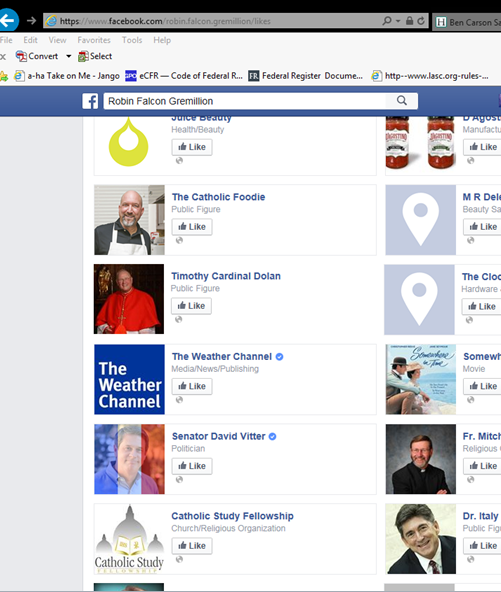
But yet, there it was, a Facebook “like” for gubernatorial candidate David Vitter by Robin Falcon Gremillion who earns $80,500 per year in her classified position as the Disclosure Division Director for the Board of Ethics. STATE ETHICS ORGANIZATONAL CHART

No biggie, except for the uneven application of the rules.

For instance, a supervisor for the Office of Risk Management, before it was privatized by Bobby Jindal, received an unsolicited ham from a vendor for Christmas. Because it was mailed and not delivered in person, she did in fact receive it and was promptly fined $250. Did we mention it was unsolicited?

GREMILLION FACEBOOK PAGE

Troopers’ Association’s first endorsement ever

On the other side of the ledger is that unprecedented endorsement by the Louisiana State Troopers Association that has much of the association’s membership more than a little rankled.

“It’s not that I don’t support (John Bel) Edwards, because I do,” said one member. LSTA Executive Director David Young said the endorsement is “rare.” “That would have to be rare, as in never, since this is the first time the LSTA has ever endorsed a candidate and the membership was not consulted on this action. I don’t know of a single member who was consulted,” he said.

http://blogs.theadvocate.com/politicsblog/2015/11/13/state-troopers-association-backs-john-bel-edwards/

He told LouisianaVoice that he felt the endorsement was made at the express wishes direction of State Police Superintendent Mike Edmonson. “He wants to be appointed for another four years and this was his way of playing up to the front-runner. If (David) Vitter had been ahead in the polls, I can promise you the endorsement would have gone to him. This was an overtly transparent move to put Edmonson in the good graces of the projected winner. He is desperate. He is the only one who could have done this. He had to know the general membership would be furious.”

He went on to say that the endorsement is not allowed because it is a “blatant violation of LSP policy and should be investigated.”

LSP policy provides that No commissioned officer of the State Police shall participate in political activity by:

  • Soliciting votes or contributions for any political candidate, organization or cause;
  • Making political contributions.
  • Making a public political statement or address
  • Wearing a campaign badge, ribbon or insignia.
  • Distributing political campaign cards, posters or buttons.
  • Attending a social function which is designed as a fund raiser where a contribution or ticket is required, even if a ticket is offered to the employee free of charge.
  • Becoming a candidate for office, serving as a member of any political committee or taking part in the management of a political party or organization.
  • Publicly displaying political literature, placards, bumper stickers or signs in or on any personal property (except by non-civil service employed spouse on community property).
  • Actively participating in an effort to recall from office an elected official (other than by signing a recall petition.
  • Becoming a candidate for any state, parish, municipal or other political office (other than position of classified employee serving on state civil service commission).

 Shot at LouisianaVoice

On Sunday (Nov. 15) Edmonson sent a lengthy “feel good” email message to all Department of Public Safety commissioned personnel in which he said he looked forward “to continuing to lead State Police through the election, the transition, and into the new administration.”

He also urged DPS personnel to “ignore internal political ‘noise’ and rumors that will characterize the next month.” He acknowledged that there were decisions he might reconsider but said, those were “few in number.” But then, in a direct shot at LouisianaVoice, he said, “I cannot dwell on those who would criticize the content of what we have done nor the means used to accomplish our goals.”

Earlier, in an address to state troopers, he characterized blog posts by LouisianaVoice about LSP as “B.S.,” and that those who commented on the posts without giving their names were “cowards.”

Fanning refugee phobia, courtesy of Vitter and Jindal

And speaking of cowards, Vitter wasted no time jumping on the anti-Syrian refugee bandwagon—much like Bobby Jindal and all the other hysterical neocons who are convinced that New Orleans is being overrun as this is being written by 10,000 Syrians bent on blowing up the Superdome. (Note: There are no plans to import 10,000 and to date, only 14 refugees have entered Louisiana. Also, of the seven identified Paris attackers, none were from Syria; they were all Europeans).

Both Vitter and Edwards have called for a halt to immigration of the refugees to Louisiana but that hasn’t stopped Vitter from trying his best—by lying through his teeth, of course—to tie Edwards to President Obama’s policy of accepting the refugees, though Edwards had zero to do with the decision.

As pointed out by Robert Mann, if Vitter is truly concerned about the non-existent “influx” of Syrian refugees, he should probably discuss the issue with wife Wendy. She is the general counsel for the Archdiocese of New Orleans which oversees Catholic Charities. Catholic Charities is the volunteer agency that assists refugees in settling in the New Orleans, Baton Rouge and Lafayette areas.  http://bobmannblog.com/2015/11/16/vitter-doesnt-want-syrian-refugees-in-louisiana-he-should-talk-to-his-wife/

But Vitter’s only objective, indeed, his only hope, is interjecting fear and loathing in the race. That’s what losers do. If he is really so concerned about the threat from the imaginary “influx” of terrorists from Syria, he may wish to explain his whereabouts during two of three Senate Armed Services Committee hearings on the volatile situation in Syria from 2012 through 2014. http://bobmannblog.com/2015/11/16/vitter-absent-from-2-u-s-senate-armed-services-committee-hearings-on-syria-2012-14/

He would have had plenty of time to ask all the right questions at those hearings—had he only been there.

Vitter’s and Jindal’s fanning the flames and hatred have been effective. Catholic Charities in Baton Rouge has been receiving death threats after it was learned that a single refugee was settled in the Capital City. And that refugee has since moved on to Washington, D.C.

Thank you, Bobby. Thanks Vitter. You lived down to our expectations.

Bye-bye Bobby party starts early

Perhaps it is only fitting that following his hysterical executive order to suspend that dreaded “influx” of refugees, Jindal suspended his hopeless quest for the Republican presidential nomination, with the ego-laced comment that “This is not my time.” Well, Bobby, you surely got that right. Want a clue as when will be your time? Hint: Think never.

http://finance.yahoo.com/news/bobby-jindal-not-time-231232217.html;_ylt=AwrT6VrdtUtWyKgAC3IPxQt.;_ylu=X3oDMTByNWU4cGh1BGNvbG8DZ3ExBHBvcwMxBHZ0aWQDBHNlYwNzYw–

Of course, Jindal won’t go simply away. He just had to pose one more threat to our weary psyche. “One of the things I will do is go back to work at the think tank I started a few years ago—where I will be outlining a blueprint for making this the American century,” he said.

Whoo boy. Just what we need: More harebrained ideas to save American exceptionalism from little Booby.

To paraphrase the title of Joe Namath’s autobiography, I can’t wait until tomorrow ‘cause it gets crazier every day.

Read Full Post »

Imagine your dentist boss comes to you with a proposition:

Why don’t you help the board investigator do investigations for the board of dentistry? You can make some extra spending money by posing as a patient and presenting fake symptoms and false medical histories in hopes of gaining information and diagnosis that could be used against dentists in board hearings. The board can really use your help in putting the bad guys away.

What could go wrong, right? Your boss is a long-time member of the Louisiana State Board of Dentistry. He assures you this is done all the time. He even nicknames you “The Pink Panther” for your investigative efforts. Your thoughts go to all the extra money you will have for Christmas gifts this year.

A similar scenario happened with Karen Moorhead when she worked as a dental assistant for Dr. White Graves, a long-time board member, in Monroe. Moorhead testified that she worked “six or seven” undercover operations for board investigator Camp Morrison. She even testified to working undercover as an employee in an office that was under investigation by the LSBD.

The only problem is that no one told Ms. Moorhead what she was doing was against the law. Louisiana requires anyone getting paid to do undercover investigations have a valid private investigator’s license. Anyone caught doing this type of work without one is in violation of Louisiana criminal law, subjecting the offender for fines of up to $10,000 and up to a year in jail.

R.S 37:3507.2

http://law.justia.com/codes/louisiana/2011/rs/title37/rs37-3507-2

It shall be unlawful for any person knowingly to commit any of the following acts:

(1) Provide contract or private investigator service without possessing a valid license.

(2) Employ an individual to perform the duties of a private investigator who is not the holder of a valid registration card.

http://lsbpie.com/lawregulations.aspx

ETHICS AND PRIVATE INVESTIGATOR LAWS

Ms. Moorhead has found herself a defendant in an ongoing civil trial since 2011 because of this highly questionable and unethical, if not illegal, activity. Instead of hiring an independent attorney, she relied on the attorney provided by the board of dentistry, the very organization that got her in trouble in the first place. In fact, the board had the legislature change the law in order to cover her defense. She now claims attorney-client privilege with the Louisiana Attorney General’s office, and claims insurance coverage underwritten for state civil service employees. Never mind that Moorhead was an independent contractor doing work for a board contractor. Morrison’s contract specifically required him to hold an errors and omissions (E&O) insurance policy for such purposes that indemnifies the state against his actions. One former board member contends that the LSBD has spent over $500k on this suit. (Any state employee who is the subject of a civil lawsuit for actions taken in the scope of his or her employment is entitled to legal representation provided at the state’s expense. In the case of criminal prosecution for job-related actions, the employee may retain legal counsel of the employee’s choice and is entitled to have those legal costs reimbursed in the event of an acquittal. Moorhead, as a contractor, should not be entitled to legal representation provided by the state.)

More troubling, however, is the advice that her attorney has given her. The attorney Professional Rules of Conduct prohibit representing multiple clients when a conflict of interest exists between them. Barbara Melton, law partner to infamous Jimmy Faircloth, is a contract attorney for the board of dentistry—and she is defending both board investigator Camp Morrison and Moorhead at the same time. According to some legal analysts, that’s a major conundrum. One legal expert laid it out like this, “It’s apparent that Moorhead and Morrison may not share the same best interests. If I was hired to do a completely illegal job and was told that it was legal by supposedly reputable people and then found myself sued over it that would be a problem. I wouldn’t hesitate to sue the investigator, the board of dentistry, and possibly the boss that suggested the employment and got me into this mess in the first place.”

However, that’s not the advice that Melton seems to have given her. How could she recommend suing the board of dentistry and Morrison, who are both her clients? That recommendation should be off the table. Because of this conflict and lack of sound advice, Moorhead could find her troubles just beginning.

Several dentists have come together and are planning to file a civil class action suit against the Board of Dentistry and its agents. Moorhead’s involvement in “six or seven” cases, makes her the glue that ties this class action together. Moorhead may also have perjured herself in at least one deposition and during a board hearing. Finally, a recent affidavit from a Kenner dentist and Camp Morrison’s own billing records have Moorhead working undercover in an office that the board was investigating.

Although Moorhead originally bragged about working in this office, her story has changed and she remembers seeking but never being offered the job. This stands in stark contrast to the affidavit and billing records in hand. It’s possible that Moorhead may now risk jail time for perjury and continued ligation from multiple sources. She may have also committed tax fraud by not properly listing the income from these undercover jobs. Many believe the trouble Moorhead may be facing stems from the questionable legal advice she has been given. Meanwhile, the board attorney Barbara Melton has never missed a paycheck. She continues to represent the board of dentistry as a contract attorney.

Moorhead may want to check on her legal options, which some insist should include possibly adding her attorney to the list of people to sue. Moorhead certainly doesn’t appear to be innocent of the claims against her. But instead of stopping and ceasing to dig, her attorney appears to have helped her dig the hole deeper. It now appears to be one which she may not be able to escape.

The question must now be where the Attorney General’s office is in all this mess.

Buddy Caldwell is quick to issue press releases about child porn arrests, consumer fraud and CNSI. But he has been shamefully silent on the issue of going after offending power-mad, ego-driven Board of Dentistry members. These members have repeatedly demonstrated their intent to persecute dentists not in response to legitimate complaints but pursuant to board-initiated complaints generated by investigators and legal counsel. There is more than ample evidence to show that the board is set not on cleaning up the industry but in extracting hundreds of thousands of dollars from dentists denied the opportunity to properly defend themselves before a kangaroo court comprised of the same board members who bring the charges.

And while the attorney general’s job is to represent state agencies, he could be doing the board a service by offering his counsel to refrain from tromping on dentists’ due process rights. After all, should a class action lawsuit ensue, it’s going to cost the state a boatload of money to defend—and to pay any adverse judgment if that is the result. For no other reason than preventive maintenance, Caldwell should be offering his advice.

What has transpired thus far comes nowhere near the concept of due process. An attorney general committed to doing the job he was elected would have addressed this glaring problem long ago.


Read Full Post »

By numerous accounts, the Louisiana State Board of Dentistry has allegedly operated like a crime syndicate for at least two decades and is responsible for the possible harassment, extortion, money laundering, and fraud of its agents. These allegations have been made for years but may now be proven. State and federal criminal charges are expected in the upcoming months. At least one legal expert expects federal racketeering laws to be used to prosecute former board agents, and possibly even current or former board members and staff. A paralleling class-action civil suit may not be too far behind.

The board investigator was employed by the LSBD for over two decades until his contract was recently terminated. He roamed the state, under color of law, harassing dentists and beating the bushes to generate revenue. Not surprisingly, he had state contracts that allowed him to self-generate his own fees. He seemed to be aided by the board general counsel, who often served in dual capacity as board counsel and board prosecutor, a violation of legal ethics rules and common sense. Because he only had a duty to his client the board of dentistry to act in its best interest, anyone that he prosecuted was denied due process. The same would be true if a police force handled its own prosecutions without an independent prosecutor; there would be no fundamental perception of fairness. He has also been known to hide behind the cloak of administrative law in denying defendants’ rights afforded under the US Constitution. He self-generated his own fees, and had apparently selfish financial motives for seeing dentists prosecuted. In 2012, he was found by the Louisiana 4th Circuit Court of Appeals to have violated the due process of a Louisiana dentist. This investigator and attorney were perhaps given cover by a few complicit board members and staff to carry out their harassment and extortion schemes.

The investigator has employed unlicensed investigators for years in what many have deemed elaborate entrapment schemes. His undercover operations sent in phony patients to dental offices, often complaining about fake symptoms and giving false medical histories. This was done for the purpose of collecting information to be used against dentists being investigated by the board for prosecution. At least one woman used in this capacity has even perjured herself under oath. The same unlicensed investigator that initially claimed under oath to have worked 6-7 investigations and even bragged about working in a dental office that was being investigated. Although she seems to have developed amnesia and has recanted previous testimony, she now claims she has only worked one or two investigations and applied-for but never actually worked in an office undercover. However, a Kenner dentist has issued a sworn affidavit saying that she indeed held employment in HIS office during the time the board was investigating complaints against him. Conducting investigations without a license is a violation of Louisiana law and carries a maximum penalty of one year in jail and up to a $10,000 fine. The dental board has been no help in getting to the truth. An unnamed state official recently stated “The board of dentistry has circled the wagons and is being uncooperative with our investigation.”

It is believed that the investigator has been utilizing these undercover investigators for decades, but he denies that claim. He has testified that the first time he did this was in 2007, although there are numerous contradictions to this testimony. One dentist claims he sent in an undercover operative into his office in 2006. When it was realized that He had broken the law in his investigation, the Louisiana Attorney General’s office stepped in to stop the investigation and future prosecution. The current board president acknowledged in a hearing that these undercover ops have been used for years by the dental board in their investigations. One former board member, that held his board position for almost 30 years, testified that the board has been doing this since “before I was born.” Based on his appearance, one might estimate that to be around the turn of the last century.

The investigator is currently under investigation by the PI board for utilizing unlicensed investigators. The Louisiana State Board of Private Investigator Examiners opened an investigation into his illegal activity and the scope exploded because of major criminal implications. The LSBPIE pulled in other state and federal agencies once it realized that he perjured himself, filed fraudulent reports with the board, created false scenarios that were used to prosecute dentists, and even submitted multiple fraudulent billing records to the state of Louisiana. These tactics have also gotten the investigator and two of his unlicensed investigators into trouble in a civil lawsuit. Not surprisingly, the board of dentistry purportedly misled the legislature into changing the law to cover the legal expenses of both the investigator and the unlicensed investigators being sued for entrapment. By one former board member’s account, the board of dentistry has spent over $500K defending the investigator, who was a state contractor, and two unlicensed investigators he hired as his “independent contractors”; this despite the fact that his contract held a specific clause requiring him to carry an insurance policy that indemnifies the state against such lawsuits. All three defendants claim to be utilizing insurance coverage earmarked specifically for Louisiana civil service employees, The legal defense of these defendants, although they have clearly broken the law, is being funded by the tax dollars of Louisiana citizens.

PRIVATE INVESTIGATOR INVOICE SHOWING KAREN MOORHEAD AS WORKING FOR HIM (BEGINNING PAGE 58)

The attorney also finds himself in hot water with the Louisiana Bar and recently had his contract with the board terminated. He had a complaint turned into the Louisiana Attorney Disciplinary Committee for violating a dentist’s due process. This fact can’t be denied after a decision by a Louisiana appeals court in Haygood v. LSBD. In the aforementioned case, the board general counsel acted in the role of “independent counselor,” a role that requires neutrality and separation from the board. This independence isn’t possible since he was the board’s general counsel. He used his position to antagonize, harass, and control the board hearing to ensure a favorable verdict for the board of dentistry. Such tactics are the very reason that the LSBD has NEVER lost a board hearing. In his response to the bar complaint, he noted that he simply served in the capacity of independent counsel, and that he took NO part in the investigation or the deliberations. However, according to his own billing records, eye-witness testimony, and emails, both responses are demonstrably false. He was actively involved in the investigation from the onset, and even recommended fines and penalties that were harsher than what the disciplinary panel wanted to levy during deliberations. He is awaiting a hearing by the Bar, and one legal analyst predicts he may be disbarred or not allowed to practice administrative law for an extending period of time.

The next few months will prove crucial as investigations continue and indictments are issued. One dentist predicts the investigator will be the first to fall, but will not go down alone. He appears extremely bitter about his recent departure from the board and the way he was let go after two decades of service. According to a former board member, a long-time board employee recently left the board because of the egregious acts committed by the board over the last several years. These acts are believed to have been documented and turned over to state authorities in their criminal investigation. This allegedly includes information about a board employee that destroyed evidence in the case of a medical doctor that was harassed by dental board agents. This same employee has testified to working an undercover op, posing as a patient in a Lafayette dental office under investigation. Finally, it is believed this employee may have committed payroll fraud, as it is believed she was clocked in at the board of dentistry while she was attending college classes and finishing up her degree. The truth of these apparent criminal acts, stands in stark contrast to board president’s story that former board employee left because of the impending move of the board office to Baton Rouge that will occur in 2017.

Louisiana dentists that believe they have been unfairly targeted or prosecuted are beginning to ban together to file a joint civil action against the board and these agents.

The Power Broker

Barry Ogden ruled the Louisiana State Board of Dentistry with an iron fist for over two decades, armed with a complicit general counsel and a rogue investigator. The three men were nicknamed the “un-holy trinity” by those observers that followed their trail of tears. In the 2014 legislative session, state senator Martini introduced and passed legislation, with the goal of curbing these abuses.

State board uses intimidation, harassment, fines to generate funds to pay for lucrative contracts worth millions of dollars

Ogden has recently testified to the abuses of power, lack of transparency, and due process violations that took place under his watch. Anyone committed to justice and fairness should be alarmed.  Anyone fined or punished under these men should take notice. According to Ogden, your constitutional rights were probably violated, although he doesn’t actually come out and say it. Nevertheless, it’s hard for him to hide the big, giant pink elephant in the room. But he thinks you are probably “making a mountain out of a mole hill.”

Ogden, known for his fashionable footwear, kicks caution to the wind and plays fast and furious with laws he doesn’t seem to understand, he misinterprets, or chooses to ignore out of convenience. Ogden discusses:

  • How he ignored the internal rules the board set up to help avoid violating someone’s due process.
  • How the disciplinary oversight committee operates from a set of secretive, evolving rules.
  • How investigations require no due process, and “whatever happens, happens.”
  • How the board has no need for burden of proof through informal or Bertucci hearings (which are a waste of time in his opinion)
  • How a burden of proof  is only required in formal hearing, which the board NEVER loses
  • How the board has a system of informal hearings, where 3 dentists vote and Ogden and the president may choose to override when they are sure they have gotten it wrong or don’t understand the issue.
  • How Camp Morrison has utilized unlicensed investigators for years, a violation of state law, and considered an entrapment scheme by many.
  • How Morrison’s job is to “do justice” and “there is no need for truthfulness in an investigation.”

These are just a few of the hits. Ogden continuously serves and volleys with the truth like he has played in more than his fair share of ping pong matches. But that’s a story for another day. He reveals some interesting facts about a certain board member that had dementia, the rifts between the LSBD and the LDA, and the fact that the LSBD should have no deference over fee disputes.  Ogden claims, “We only got complaints on advertising from other dentists who was just siccing a dog on a competitor.”

If you or anyone you know believe they have been the recipient of these malicious schemes, please contact boardclassactionsuit@gmail.com and share your story.


Read Full Post »

A government employee must not be influenced by extraneous factors when making decisions and “never accept for himself or his family, favors or benefits under circumstances which might be construed by reasonable persons as influencing the performance of governmental duties.

—Code of Ethics for Government Service.

Senators may not hold government officials captive by tying their personal finances or benefits to their official acts.

—Senate Ethics Manual.

Read Full Post »

« Newer Posts - Older Posts »

