Feeds:
Posts
Comments

Archive for the ‘Corruption’ Category

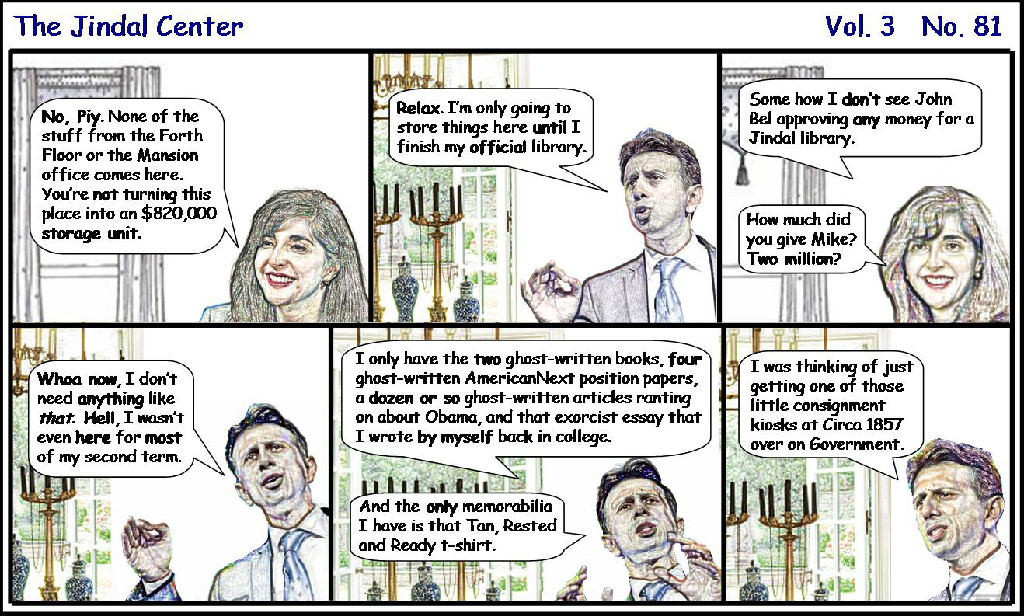
JINDAL MEMENTOES

(CLICK ON IMAGE TO ENLARGE)

Did Bobby Jindal take one last opportunity to defy a state law on his way out the door this week?

Technically, he may have.

Consider the wording of Senate Bill 190 by State Sen. Dan Claitor (R-Baton Rouge):

The legislature recognizes that it is essential to the maintenance of a democratic society that public business be performed in an open and public manner, and that the citizens be advised of and be aware of the performance of public officials and the deliberations and decisions that go into making public policy. Toward this end, the provisions of this Section, as well as the rest of this Chapter, shall be construed liberally so as to facilitate, rather than hinder, access to public records.

SB 190 was signed into law by Bobby Jindal as Act 145. The bill was designed to lift the veil of secrecy on documents originated by Louisiana’s governors. The new law applies to all documents generated by the governor, his chief of staff, deputy chief of staff and his executive counsel. http://www.legis.la.gov/legis/ViewDocument.aspx?d=959869

Records of the office of the governor relative to fiscal or budgetary matters, Including, but not limited to records of communications between the legislative auditor’s office and the office of the governor relative to fiscal or budgetary matters, shall be public records.

It exempts for eight years intra-office communications by the governor’s staff.

Record(s) of the office of the governor relating to intra-office communications of the governor and his internal staff may be privileged from disclosure.

But after eight years, even those intra-office communications between staff members shall become public, according to the act.

Any exemption granted by this Section shall lapse eight years after the creation of the record to which the exemption is applicable. After the lapse of eight years, the records of the office of the governor, as maintained by the state archivist and deposited with the state archives program pursuant to R.S. 44:417, shall be public record.

Most important of all, the bill, which became law effective at 12:00 noon on Monday, requires that the governor and his staff preserve all records generated and originated within the executive branch and to transfer all records to the archives division of the secretary of state.

The governor and his internal staff shall preserve all records to which this Section is applicable and at the conclusion of his term of office, the governor shall transfer all such records to the custody of the archives division of the secretary of state. For purposes of this Section, “internal staff” of the governor includes the governor’s chief of staff, deputy chief of staff, executive counsel, and director of policy, but shall not include any employee of any other agency, department, or office.

All this sound well and good. Others had tried and failed to shed the light of public disclosure on the governor’s office. Similar bills had either died a quiet death in committee or, if passed, were vetoed by Jindal.

So how did Claitor’s bill manage to obtain Jindal’s signature enacting it into law?

Well, for starters, it was passed as Jindal’s term was winding down. But even then, word is that Jindal said he would veto Claitor’s bill if it were to take effect while he still occupied the fourth floor of the State Capitol.

So in effect, what Jindal was saying was transparency was a grand and wonderful thing so long as it did not apply to him. It was fine and dandy for his successor to be held accountable but he was determined to veto the bill if it took effect while he was still in office.

No problem, he was assured. The bill would go into effect at precisely 12:00 noon on Monday, January 11, 2016. Jindal was scheduled to leave office exactly one minute later.

The only problem was, the program ran a little late on inauguration day and John Bel Edwards did not actually take the oath of office until 12:25 p.m.

Meanwhile, throughout the weekend leading up to this week’s inauguration ceremonies, Jindal’s minions were frantically deleting thousands of emails in the governor’s office at across the street at Division of Administration.

Obviously, Jindal felt he would no longer be in office when the bill became law and thus exempt from its provisions.

But technically, he remained in office for nearly a half-hour after the new law took effect. Therefore, he was bound by the dictates of the new statute and by deleting those thousands of emails, he was in flagrant violation of the very bill that he signed into law a scant six months earlier.

The provisions of this Act shall be given prospective application only. Any record having been used, being in use, possessed, or retained for use by the governor in the usual course of the duties and business of his office prior to the effective date of this Act shall be subject to the provisions of (the law) as it existed prior to the effective date of this Act.

Granted, many of the emails may well have been mundane in nature. Who cares, after all, what the office staff will order up to the fourth floor of the State Capitol for lunch? But others were certainly germane to the administration of state government and by deleting them, it can only make the job of Jindal’s successor more difficult.

Claitor, contacted about the procedural violation, said he was not surprised. “The administration’s pages on the state website were disappearing, too,” he said.

“In my mind,” he said, “his actions certainly violate the spirit, if not the letter of the law.”

It seems somehow ironic that Jindal’s devious, scheming tactics would in the end expose him to potential prosecution for the illegal dumping of eight years worth of emails.

The term poetic justice also comes to mind.

Read Full Post »

Our “Bye-Bye Bobby Bash,” the inspiration of reader Earthmother, was a huge success on Sunday (Jan. 10), just about 24 hours before Jindal leaves office as one of the most reviled governors in Louisiana history.

Before getting down to our celebration, we observed a moment of silence in honor of the late C.B. Forgotston. Those of you who read LouisianaVoice regularly know that I quoted him often. He was an inspiration to me and he will be missed. He may not have been with us in body, but he was certainly with us in spirit.

In attendance were Jerel Giarrusso (Earthmother) and husband Ted Hansen, Stephen Winham and wife Betty, several of our loyal readers, and our mystery cartoonist. Also on hand was Murphy Painter who was persecuted and prosecuted by the Jindal administration. It was LouisianaVoice and LouisianaVoice alone that said long before his federal criminal trial that Painter was not only innocent, but a target of reprisals by Jindal for Painter’s refusal to knuckle under to a major Jindal campaign contributor (Saints owner Tom Benson). Not a single news outlet, other than LouisianaVoice, peeled back the layers to look beneath the façade of lies and fabricated charges against Painter, to examine the real reasons for the administration’s actions. Painter was not only acquitted of all charges but the state then had to reimburse some $300,000 in legal fees incurred by Painter who, instead of taking his licks and walking away as the Jindalites apparently thought he would do, stood and fought for his honor and integrity. In the end, he prevailed.

We handed out special party favors as a memento of the absurdity of Jindal’s tenure.

When we arrived at Superior Grill, there were 12 state police officers having a late lunch. I offered them our party favors but they refused, either out of loyalty to or fear of State Police Superintendent Mike Edmonson. One of the officers, an administrative type, dismissed my offer with a curt, “I’m good.”

Oh well, I offered.

I want to take this opportunity to offer a special word of deep appreciation to all who attended and to all my readers who were unable to attend. Without you, LouisianaVoice has no meaning. With your support, however, we managed to expose a lot of wrongdoing and even change a couple of things (the Edmonson amendment which attempted to sneak in a $50,000 increase in Edmonson’s retirement comes immediately to mind).

With your continued support, we will continue to keep watch over the incoming administration and especially over the legislature which is no less responsible for our present fiscal mess than Jindal because it was those 144 men and women who enabled him.

Below are a few photos taken at today’s event. Click on the photos to enlarge them.

Enjoy.

LEFTOVER SIGN FROM 2011 CAMPAIGN

She brought her 2011 campaign sign all the way from Ruston. (Sorry but I lost your name but I knew your father, Peewee Edwards well. He ran Village Plaza Cinema in Ruston and Mrs. Edwards ran Fran’s Book Nook for years.)


SOMEBODY BROUGHT A CAKE

Somebody (Earthmother) brought a cake.


A PRETTY DIVERSE GROUP

Part of our diverse group.


EARTHMOTHER'S PINATA

Jerel Giarrusso, aka Earthmother, made this inspirational piñata. Unfortunately, the proprietor of Superior Grill said his insurance policy would not allow us to actually break it, so we simply acted out our attacks for the camera.


JEREL GIARRUSSO, AKA EARTHMOTHER TAKES HER TURN

Earthmother got her pretend licks in.


NO ONE WAS MORE DESERVING AT POKING THE PINATA THAN MURPHY PAINTER

After what the Jindal administration did to him in its futile attempt at destroying his reputation and its unsuccessful prosecution of him, no one was more deserving of taking a whack at our Jindal piñata than Murphy Painter.


YOURS TRULY TAKES A WHACK AT EARTHMOTHER'S PINATA

Yours truly gets his turn.


Read Full Post »

“The petty thief is imprisoned but the big thief becomes a feudal lord.”

Zhuangzi


There it was, splashed across the Metro page of Tuesday’s Baton Rouge Advocate:

“OMV audit: More than $200,000 stolen”

The entire matter is heavily weighed down by irony but you’d never know it from reading the story.

It seems that a new audit of the Department of Public Safety and Corrections (DPS) has revealed that two employees of the Louisiana Office of Motor Vehicles (OMV) misappropriated more than $211,000 before being arrested.

The two, Heather Prather of Baker in East Baton Rouge Parish and Angelle Temple of Marksville in Avoyelles Parish were actually arrested in early 2015—nearly a year ago—and fired for felony theft, injuring public records and malfeasance in office.


“Steal a little and they throw you in jail. Steal a lot and then they make you king.”

Bob Dylan


“Upon investigation, OMV management determined that the OMV employees had diverted public funds for personal use and violated state laws,” according to the Legislative Auditor’s Office.

Apparently the two issued receipts to paying customers but then either altered, voided or simply did not post the transactions. There was no indication as to whether or not the two knew each other or if they conspired together or acted separately in misappropriating the funds.

And yes, $211,000 is a lot of money and nothing in this post should be interpreted as excusing the women’s actions.

But isn’t it odd that the media would give such prominence to this story while overlooking official misappropriation of public funds?

Take, for example, the lingering case of high ranking State Police official Jill Boudreaux and the unmet demand that she repay nearly $60,000 in money she received to which she was not entitled. That little matter is still unresolved after almost six years.

And then there is Bobby Jindal. He allowed the taxpayers of Louisiana to pick up the tab for the cost of more than $3 million for State Police security details. Those costs were incurred while he spent more than two-thirds of his final year in office campaigning out-of-state for the Republican presidential nomination. A reasonable person would assume his campaign would have paid for that protection since his travels had zero to do with his job as governor of Louisiana.

But few lately have accused Jindal of being reasonable. The cost of flights, taxis, auto rentals, lodging, laundry and meals cost Louisiana taxpayers more than $640,000 in addition to the salaries of state troopers assigned to his out-of-state security detail. None of that has been refunded by Jindal’s campaign.


“He who uses the office he owes to the voters wrongfully

and against them is a thief”

Jose Marti

Boudreaux, Undersecretary for DPS, which has management oversight responsibility for OMV, first said the office would consider a policy of no longer accepting cash as a safeguard against theft by employees.

Later, however, she and the Auditor’s Office agreed that OMV only needs a better system of controls over accepting cash. State Police public information officer Doug Cain said the goal of OMV was to continue to provide convenience to the customer while at the same time, assuring “due diligence to have accountability on the process.”

Due diligence appears to have been lacking in efforts to have Boudreaux repay the $59,000 she was paid as part of an early retirement incentive offered nearly six years ago.

In April of 2010, the Jindal administration, in an offer to implement across the board savings, made a one-time incentive package offer to various state agencies as a means to encourage state employees to take early retirement.

Handled properly, it appeared at the time—and still does appear—to have been an economical and compassionate way to nudge employees who wanted out but who could not afford to retire, into making the decision to walk away, thus reducing the number of state employees which in turn translated to long-term savings in salaries and benefits paid by the state.

On April 23 of that year, DPS Deputy Undersecretary Jill Boudreaux sent an email to all personnel informing them that the Department of Civil Service and the Louisiana State Police Commission had approved the retirement incentive as a “Layoff Avoidance Plan.”

In legal-speak, under the incentive eligible applicants would receive a payment of 50 percent of the savings realized by DPS for one year from the effective date of the employee’s retirement.

In simpler language, the incentive was simply 50 percent of the employee’s annual salary. If an employee making $50,000 per year, for example, was approved for the incentive, he or she would walk away with $25,000 in up-front payments, plus his or her regular retirement and the agency would save one-half of her salary from the date of retirement to the end of the fiscal year. The higher the salary, the higher the potential savings.

The program, offered to the first 20 DPS employees to sign up via an internet link on a specific date, was designed to save the state many times that amount over the long haul. If, for example, 20 employees, each making $50,000 a year, took advantage of the incentive, DPS theoretically would realize a savings of $1 million per year thereafter following the initial retirement year.

That formula, repeated in multiple agencies, could produce a savings of several million—not that much in terms of a $25 billion state budget, but a savings nonetheless.

The policy did come with one major caveat from the Department of Civil Service, however. Agencies were cautioned not to circumvent the program through the state’s obscure retire-rehire policy whereby several administrative personnel, the most notable being former Secretary of Higher Education Sally Clausen, have “retired,” only to be “rehired” a day or so later in order to reap a monetary windfall.

“We strongly recommend that agencies exercise caution in re-hiring an employee who has received a retirement incentive payment within the same budget unit until it can be clearly demonstrated that the projected savings have been realized,” the Civil Service communique said.


“A man with a briefcase can steal millions more than any man with a gun.”

Don Henley


Basically, to realize a savings under the early retirement incentive payout, an agency would have been required to wait at least a year before rehiring an employee who had retired under the program.

Boudreaux, by what many in DPS feel was more than mere happenstance, managed to be the first person to sign up on the date the internet link opened up for applications.

In Boudreaux’s case, her incentive payment was based on an annual salary of about $92,000 so her incentive payment was around $46,000. In addition, she was also entitled to payment of up to 300 hours of unused annual leave which came to another $13,000 or so for a total of about $59,000 in walk-around money.

Her retirement date was April 28 but the day before, on April 27, she double encumbered herself into the classified (Civil Service) Deputy Undersecretary position because another employee was promoted into her old position on April 26.

A double incumbency is when an employee is appointed to a position that is already occupied by an incumbent, in this case, Boudreaux’s successor. Double incumbencies are mostly used for smooth succession planning initiatives when the incumbent of a position (Boudreaux, in this case) is planning to retire, according to the Louisiana Department of Civil Service.

http://www.civilservice.louisiana.gov/files/HRHandbook/JobAid/5-Double%20Incumbency.pdf

Here’s the kicker: agencies are not required to report double incumbencies to the Civil Service Department if the separation or retirement will last for fewer than 30 days. And because State Civil Service is not required to fund double incumbencies, everything is conveniently kept in-house and away from public scrutiny.

On April 30, under the little-known retire-rehire policy, Boudreaux was rehired two days after her “retirement,” but this time at the higher paying position of Undersecretary, an unclassified, or appointive position.

What’s more, though she “retired” as Deputy Undersecretary on April 28, her “retirement” was inexplicably calculated based on the higher Undersecretary position’s salary, a position she did not assume until April 30—two days after her “retirement,” sources inside DPS told LouisianaVoice.

Following her maneuver, then-Commissioner of Administration Angelé Davis apparently saw through the ruse and reportedly ordered Boudreaux to repay her incentive payment as well as the payment for her 300 hours of annual leave, according to those same DPS sources.

It was about this time, however, that Davis left Gov. Bobby Jindal’s administration to take a position in the private sector. Paul Rainwater was named to succeed Davis on June 24, 2010, and the matter of Boudreaux’s payment quickly slipped through the cracks and was never repaid.

Granted, $59,000 is not a lot in the over scheme of things—especially with the state facing a budgetary shortfall of nearly $2 billion. But as the late Sen. Everette Dirksen said, “A million here and a million there and pretty soon you’re taking about real money.”

Well, no matter the amount, it’s real money.

Perhaps when Jay Dardenne takes over as the incoming Commissioner of Administration, he may wish to take another look at the manner in which Boudreaux took $59,000 in extra cash and then defied the directive by Davis to repay the money.

Read Full Post »

To say we were disappointed in John Bel Edwards’s decision to reappoint State Police Superintendent Mike Edmonson would be an understatement. What LouisianaVoice has learned—and published—about problems throughout LSP, particularly in Troop D, should be reason enough to turn Edmonson away.

Edwards made two major mistakes in arriving at his decision. First, he listened to the Louisiana Sheriffs Association and Louisiana Police Chiefs Association. Second, he did not listen to the voices of state troopers whose morale has hit rock bottom and who have made their feelings known, albeit anonymously, in the comment sections of our posts. Realistically, they have no voice to compete with the sheriffs and chiefs.

The sheriffs association had its reasons for wanting Edmonson reappointed.

Edmonson, after all, has hired numerous officers whose only qualifications are that they are related in some way to some sheriff or police chief. Together, they are quite powerful and their endorsement, coming as it did when the outcome of the governor’s election was still in question, was an important coup for Edwards. At the time, Edwards’s opponent, U.S. Sen. David Vitter was hammering Edwards with a withering barrage of TV ads claiming that Edwards wanted to turn thousands of dangerous convicts loose on a helpless citizenry. And it’s difficult for a candidate to win a given parish, especially against those kinds of attacks, without the local sheriff’s support.

One would think, however, that Edwards, when first approached by the sheriffs and chiefs would have been more circumspect. It was Edwards, after all who in 2014 called for an investigation of the manner in which that retirement boost for Edmonson of $30,000 to $50,000 (the numbers vary) was sneaked through in the closing hours of the 2014 legislative session. https://louisianavoice.com/2014/07/19/reps-john-bel-edwards-and-kevin-pearson-will-request-investigation-of-edmonson-retirement-amendment-source/

Edmonson, of course, initially denied any hand in the bill amendment offered up by State Sen. Neil Riser. But as events unfolded, it became clear that Edmonson was behind the effort from the beginning.

Unfortunately, in the world of hard ball politics, crucial endorsements have a way of overriding good judgment.

On Oct. 27, three days after the first primary, I sent an e-mail to Edwards in which I asked him his intentions regarding an Edmonson reappointment. He wrote back that he had no intentions either way and I gave him the benefit of the doubt. Here is that e-mail exchange:

On Oct 27, 2015, at 10:57 AM, Tom Aswell wrote:

Please tell me your intentions as to the re-appointment of Mike Edmonson.

Tom Aswell

LouisianaVoice


From: John Bel Edwards  Sent: Tuesday, October 27, 2015 12:50 PM To: Tom Aswell  Subject: Re: QUESTION

I don’t intend one way or the other


We won’t go so far as to say Edwards misled us, but we do know how backroom political tradeoffs are made and even back then we were hearing that the deal had already been cut.

We will leave this with a word of advice for Edwards that he may or may not chose to take to heart: You would be very wise to keep Edmonson on a short leash. Take any complaints you may hear about him seriously even though no state trooper in his right mind would dare come forward with a public beef for genuine fear of reprisals.

Short leash, Governor.

Read Full Post »

LouisianaVoice has learned of new developments in the ongoing saga of the State Police Internal Affairs investigation at Troop D.

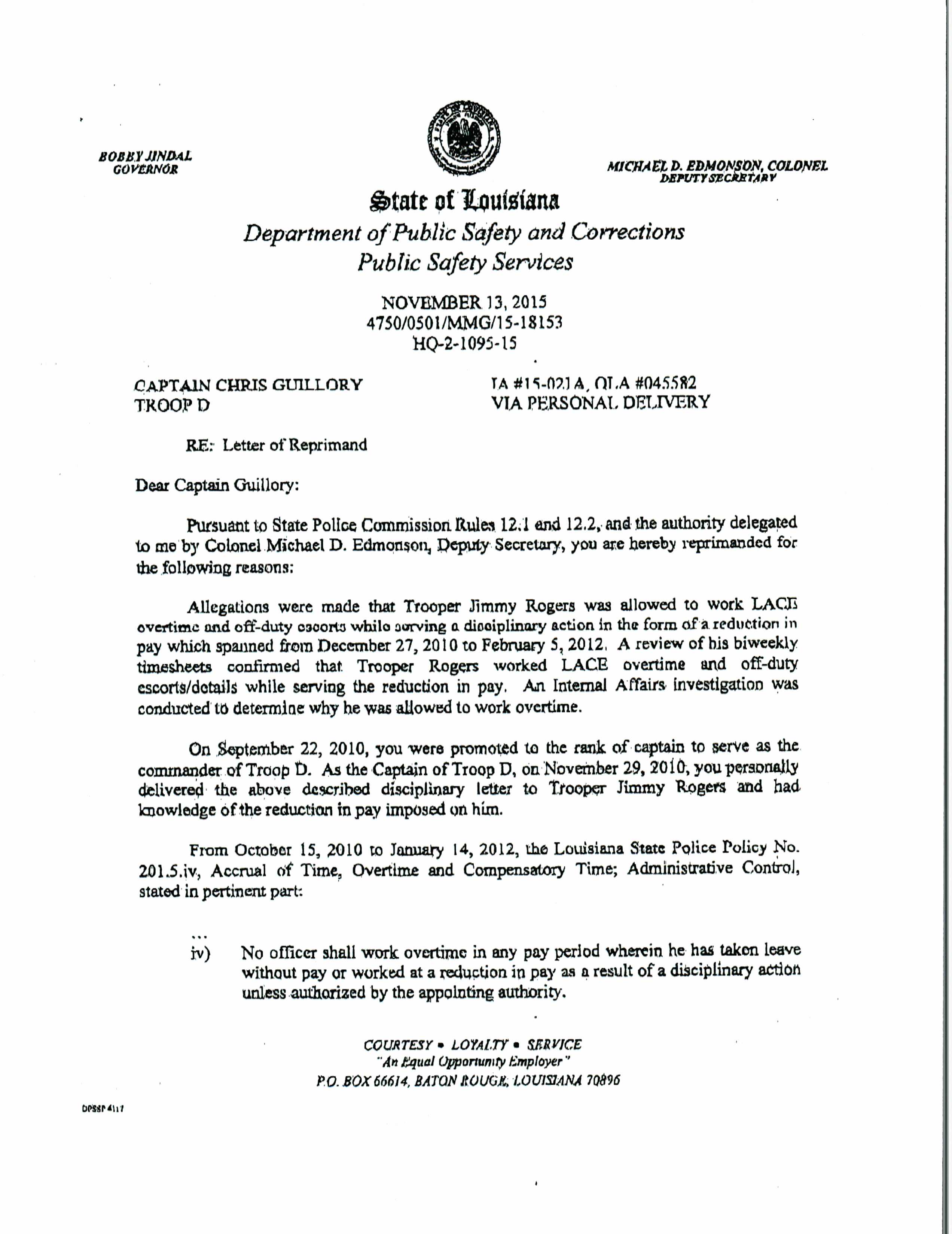
We first learned that Troop D Commander Capt. Chris Guillory has filed an appeal of an undetermined disciplinary action for unknown actions. We now know what that discipline was as well as what the alleged infraction was, and it substantiates what we wrote about back in August.

The stark reality of Jindal administration’s double standards found in discipline of State Trooper for text, phone threats

It was also brought to our attention that certain retired state troopers are no longer welcome at meetings of affiliate members of the Louisiana State Troopers Association (LSTA), especially those retirees who might question the wisdom of the LSTA’s making campaign contributions to political candidates.

Pursuant to a public records request made to the State Police Commission which hears all disciplinary appeals by state troopers, we learned that Guillory has retained Baton Rouge attorney Jill Craft to handle his appeal. That appeal is scheduled to be heard on Feb. 11. (Belated editor’s note: our public records request to the State Police Commission was for appeal records for Chris Ivey, Ryan Roberts, Ronald Picou and Brett McCloud. Our records on the Chris Guillory appeal were obtained through separate but confidential sources.)

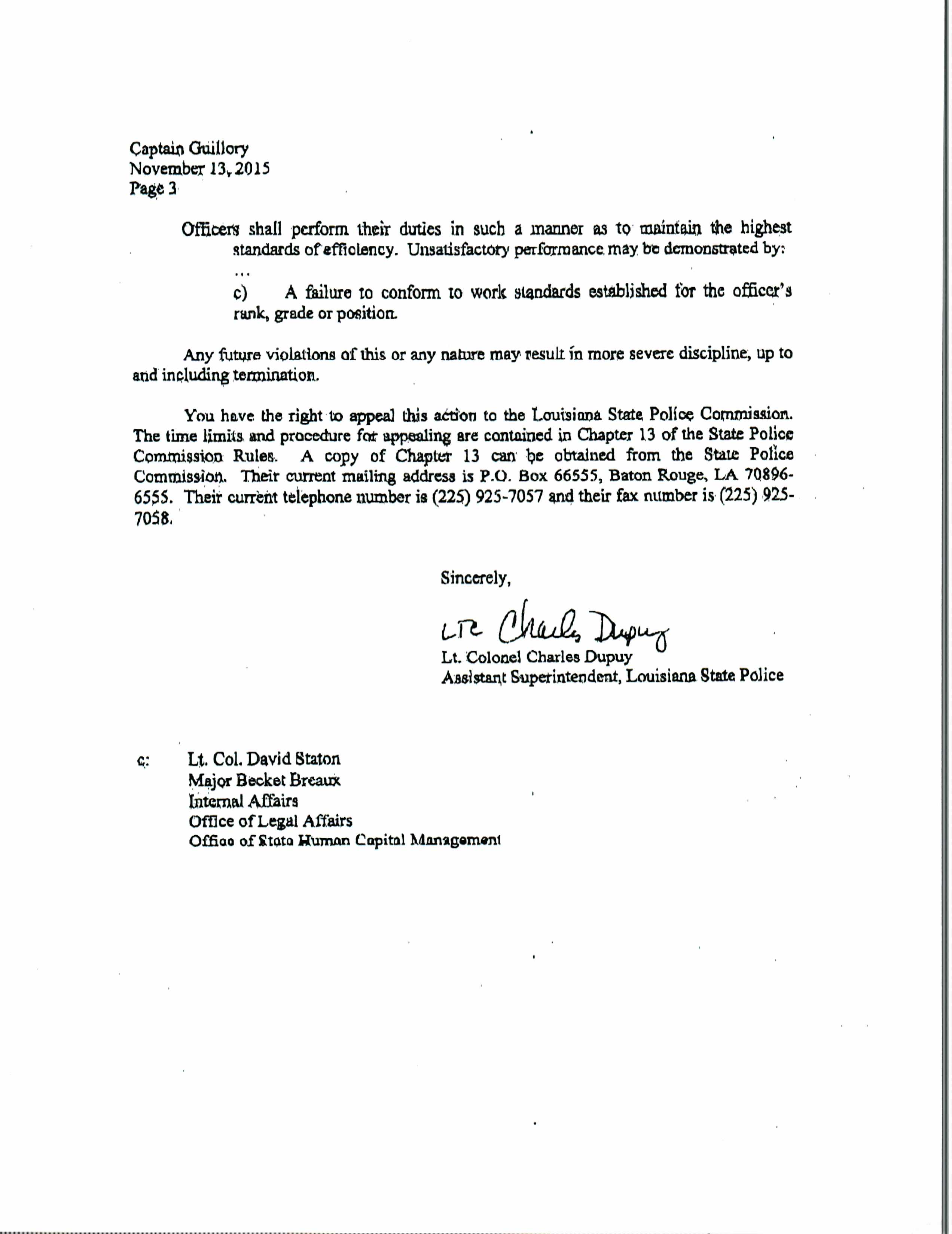
The letter of reprimand was signed by Lt. Col. Charles Dupuy who serves as Assistant Superintendent of State Police under Superintendent Mike Edmonson.

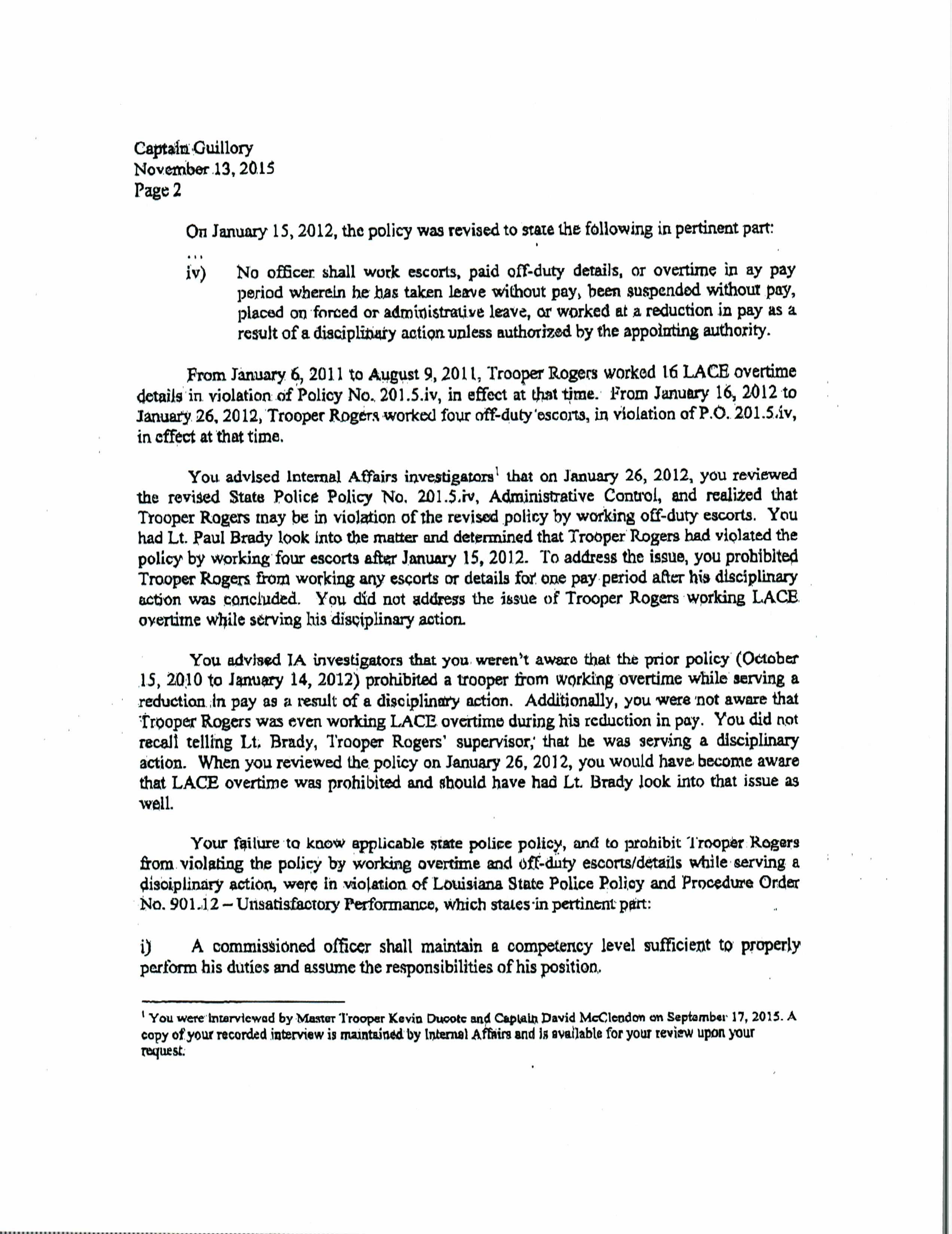
Here is Dupuy’s letter (click on images to enlarge):

REPRIMAND LETTER 1REPRIMAND LETTER 2

REPRIMAND LETTER 3In his letter, Dupuy referred to allegations first addressed by LouisianaVoice that Trooper Jimmy Rogers was allowed to work LACE overtime and off-duty escort details—all “while serving a disciplinary action in the form of a reduction in pay which spanned from December 27, 2010, to February 5, 2012.”

LACE, which stands for Local Area Compensated Enforcement Program, is a program by which state troopers are paid by local jurisdictions for extra traffic enforcement (read: quotas).

Rogers was disciplined by letter of Nov. 19, 2010, by Edmonson to a 240-hour reduction in pay (a 10 percent reduction for 30 pay periods, or 60 weeks. That represented a total penalty of more than $4,800 but LouisianaVoice said in August that there was speculation that he more than made up for that reduction by being allowed to work overtime on LACE and off-duty escorts of oversized loads.

“A review of his (Rogers’s) biweekly timesheets confirmed that Trooper Rogers worked LACE overtime and off-duty escorts/details while serving the reduction in pay,” Dupuy said in his letter of November 13. “An Internal Affairs investigation was conducted to determine why he was allowed to work overtime.

“On September 22, 2010, you were promoted to the rank of captain to serve as commander of Troop D. As the Captain of Troop D, on November 29, 2010, you personally delivered the above described disciplinary letter to Trooper Jimmy Rogers and had knowledge of the reduction in pay imposed on him,” Dupuy wrote.

Dupuy said that from January 6, 2011, to August 9, 2011, “Trooper Rogers worked 16 LACE overtime details in violation of (policy) in effect at that time. From January 16, 2012, to January 26, 2012, Trooper Rogers worked four off-duty escorts.”

Guillory told Internal Affairs investigators he was unaware of the policy, according to Dupuy’s letter, and that he failed to inform Rogers’s immediate supervisor that Rogers was serving a disciplinary action.

That, said Dupuy, placed Guillory in violation of the State Police Procedure Order which constituted unsatisfactory performance, which says in part:

  • A commissioned officer shall maintain a competency level sufficient to properly perform his duties and assume the responsibilities of his position.

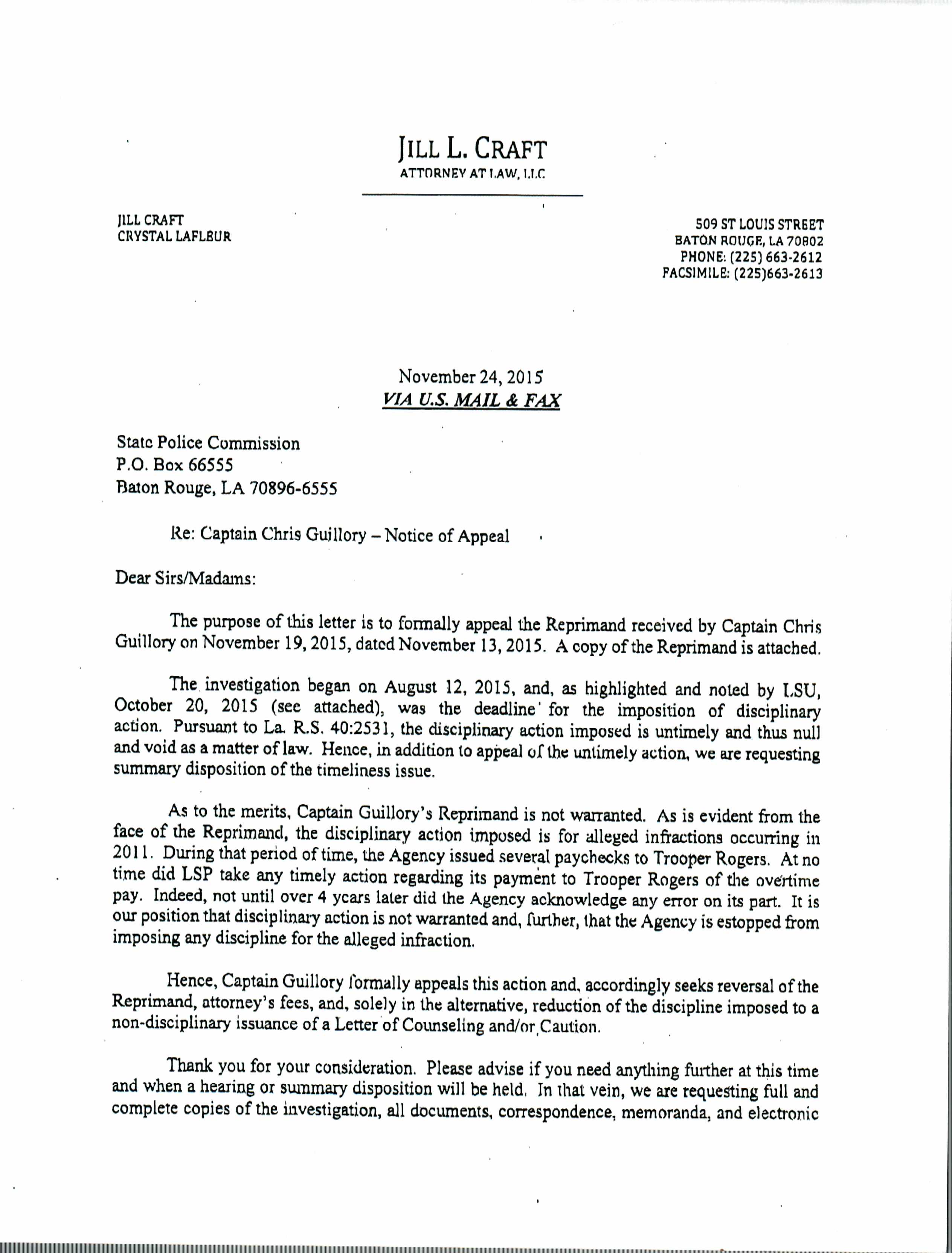
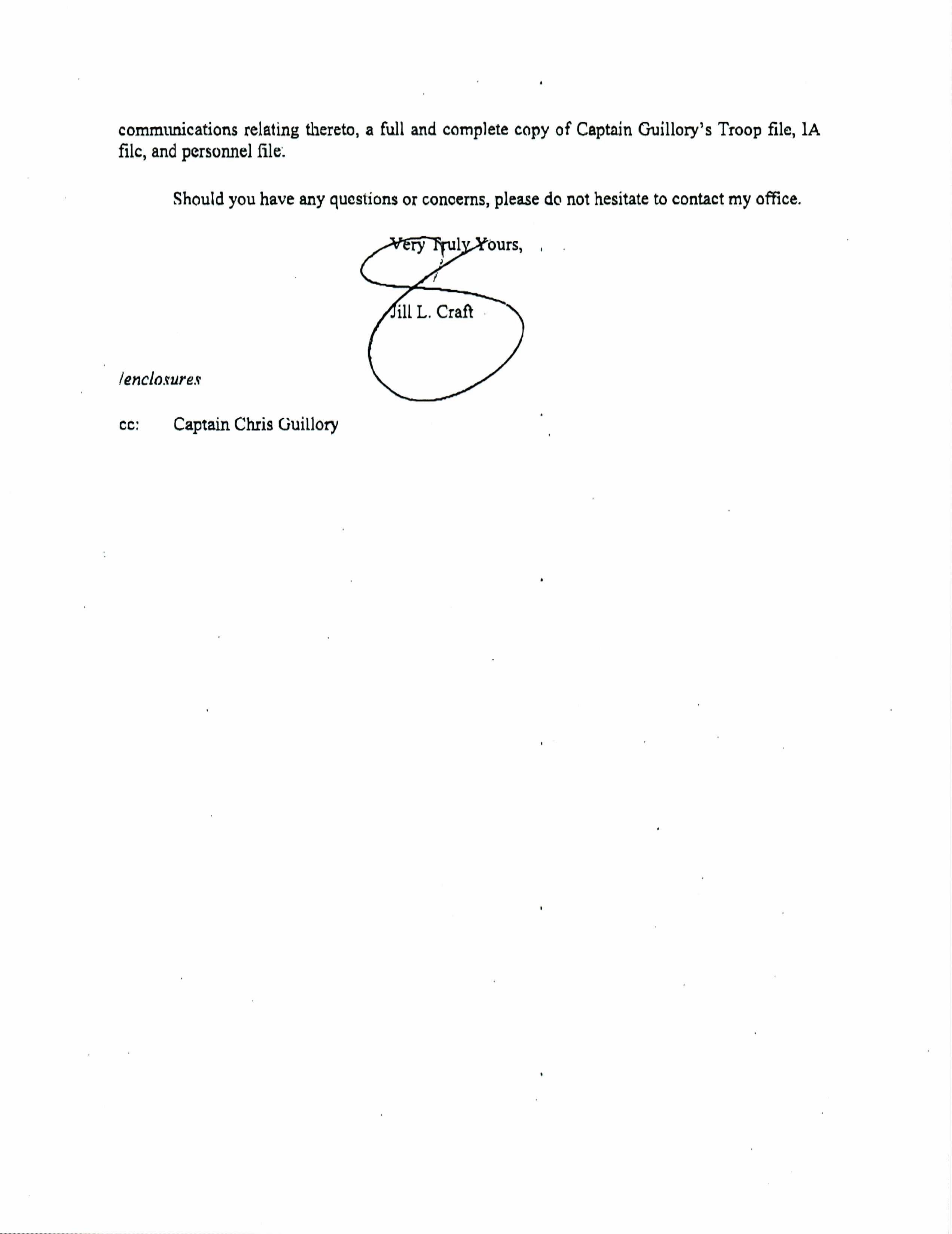
Craft, in her Nov. 24 letter, put the State Police Commission on notice of appeal. Here is her letter:

JILL CRAFT LETTER 1JILL CRAFT LETTER 2

She said in that letter that Guillory’s reprimand “is not warranted,” based not on his violation of procedures, but on a couple of technicalities.

She said that during the time period in question, LSP issued several paychecks to Rogers. “At no time did LSP take any timely action regarding its payment to Trooper Rogers of the overtime pay. Indeed, not until over 4 years later did the agency acknowledge any error on its part.”

Craft also said LSP did not impose its discipline within the prescribed 60-day time limit from the beginning of its investigation to announcement of the punishment. LSP can request an extension of time, however, and one source said it was believed that such extension was requested in a timely manner.

“The investigation began on August 12, 2015, and…October 20, 2015, was the deadline for the imposition of disciplinary action,” she wrote. Pursuant to state statute, she said, the disciplinary action imposed on November 13 “is untimely and thus null and void as a matter of law.”

In another matter, it would appear the LSTA hierarchy are beginning to circle the wagons in defense of growing criticism from within over the board’s recently revealed campaign contributions. An attempt was made by LSTA incoming President James “Jay” O’Quinn to turn retired state trooper Carl Bennett away from a meeting of LSTA affiliate Troop L on Monday night in Mandeville.

“I was there a whole two minutes when Jay O’Quinn asked me to step outside and informed me the meeting was for dues paying members and I wasn’t a member and had to leave,” Bennett said. “I told him that I was there to find out some information about this back dues business to re-join and that I intended to act as a guest and not participate in the discussion or the meeting. He told me I had to leave anyway. I made it clear to him that I…had to go there (to the meeting) because our retiree representative doesn’t respond to us. Retiree David Brabham then stood up and told the whole bunch of them that if I had to leave, he was leaving, too but (that) they hadn’t heard the last from him.”

Bennett said “It sort of hurts to be ejected from the Troop building that you spent the biggest part of your life in—especially when the ones who didn’t want me there were either not even born or toddlers when I was a trooper there.”

Retired trooper Jerry Patrick said he was an affiliate president for six years “and I never turned a retiree away.”


Read Full Post »

« Newer Posts - Older Posts »