Feeds:
Posts
Comments

Archive for the ‘Corruption’ Category

You would think a room full of lawyers wouldn’t have to be told the legal definition of a public meeting as it pertains to cameras. But then again, members of the Louisiana State Law Institute’s Children’s (LSLI) Code Committee aren’t used to media coverage.

So, it might be somewhat understandable that they were a little surprised when blogger Robert Burns showed up with a video camera. But freaked out to the point that members demanded that Burns turn off his camera? Seriously?

It’s a poor reflection on a committee, whose membership includes a judge and a ton of lawyers, to even suggest, let alone demand, that Burns, who publishes the video blog Sound Off Louisiana, shut his camera off during its meeting on Friday. And it’s even more astonishing that one member, an attorney, would tell Burns that his interpretation of the open meeting laws entitled him to record the meeting on video was incorrect.

Judge Ernestine Gray, a judge of Orleans Parish Juvenile Court since 1984, should certainly know better than to chirp, “As an individual, I have a right not to be on there (the video).”

Um…sorry, your honor, but you do not have that right. This was an open meeting of an official state government body and the open meetings statutes clearly contradict your claim. And it’s a sad indictment of our judicial system that you, a sitting judge, should lay claim to such blatantly inaccurate privilege.

The committee was meeting pursuant to House Concurrent Resolution 79 of the 2016 legislative session in which State Rep. Rick Edmonds (R-Baton Rouge) requested that LSLI “study and make recommendations to the legislature regarding abuse of incentives in the adoption process.”

The full text of HCR 79 can be seen HERE.

LSLI was to have a report to the legislature “no later than 60 days prior to the 2018 regular session of the legislature.” That would put the committee’s deadline somewhere around Jan. 18, 2018 and more than a year after passage of HCR 79, nothing had been done by the committee, which found itself up against an imposing deadline when it convened last Friday.

In fact, member Isabel Wingerter kept repeating during the meeting that there was no way the committee could have a report completed in time for proposed legislation to be introduced in 2018.

Edmonds, however, told members that while he had gone through the committee out of respect, there would be legislation filed for the upcoming session and that he already had a number of co-sponsors for his anticipated bill.

Abuses in the child adoptive process is a subject that Burns has already done extensive work on and, with his assistance, LouisianaVoice is going to be taking a long look at those who broker adoption deals between birth parents and adoptive parents and how those individuals can sometimes become part of a “bidding process,” playing one set of adoptive parents against another in order to broker a better deal.

It’s a murky area, virtually unknown outside the immediate circle of those families actually involved in the process of adoption and frankly, those involved would like to keep it that way. While LouisianaVoice is coming in a little behind the curve already established by Burns, we feel strongly that the entire process deserves a thorough investigation—from the aforementioned so-called “bidding process,” to the shirking of responsibility for investigating same by various state agencies who consistently punt when the subject of a possible criminal enterprise is brought to their attention.

All that probably explains the sensitivity to video on the part of the committee members but it certainly does not excuse either their attempted evasion of the open meetings law or of their trying to make up new law on the fly.

The meeting started with LSLI staff attorney Jessica Braum can be heard on the video whispering to Burns to turn his camera off. “It’s a public meeting,” Burns responds, “and I’m going to videotape it.

Burns said Braum made her request after being prodded to do so by fellow LSLI member attorney Todd Gaudin.

Moments later, Burns was again confronted, this time by committee member Isabel Wingerter who asked if he was videotaping the meeting to which Burns responded, “Clearly, yes.”

“We are not sure that’s appropriate,” Wingerter said. “What would you do with the film?”

Burns responded with a question of his own: “Is this or is this not a public meeting of a public body?”

“Yes, it is.”

“That’s all I have to explain,” Burns said, “and I’m not going to explain any further.”

It was at this point in the exchange that Judge Gray said she had a right not to be on video. “Not if you’re part of a public body,” Burns said. “Not if you’re attending a public meeting.”

Baton Rouge attorney Todd Gaudin inquired of Wingerter if Burns would be publishing the video. When Wingerter relayed the question to Burns, he again responded, “Is this a public meeting?” When she again affirmed that it was, Burns said, “It has every right to be republished.”

And this was when it really got interesting. Gaudin, whose practice primarily is in the area of adoption services and who served as the attorney for a prospective adoptive couple who ended up losing the child to another couple at the last minute, told Burns, “I don’t agree with your interpretation of the statute.”

That’s quite a statement coming from someone who is supposed to know the law.

Burns, digging his heels in, told the committee, “I have a right to videotape these proceedings and short of law enforcement coming in here and dictating it be turned off and escorting me out, the camera stays on.”

The camera stayed on.

And for Gaudin’s erudition, it can be found in R.S. 42:13. Here is the link: Public policy for open meetings.

And just in case he’s too busy to read the entire statute, here are the relevant parts:

  • “Meeting” means the convening of a quorum of a public body to deliberate or act on a matter over which the public body has supervision, control, jurisdiction, or advisory power. It shall also mean the convening of a quorum of a public body by the public body or by another public official to receive information regarding a matter over which the public body has supervision, control, jurisdiction, or advisory power.
  • “Public body” means village, town, and city governing authorities; parish governing authorities; school boards and boards of levee and port commissioners; boards of publicly operated utilities; planning, zoning, and airport commissions; and any other state, parish, municipal, or special district boards, commissions, or authorities, and those of any political subdivision thereof, where such body possesses policy making, advisory, or administrative functions, including any committee or subcommittee of any of these bodies enumerated in this paragraph.
  • Every meeting of any public body shall be open to the public unless closed pursuant to R.S. 42:16, 17, or 18. (R.S. 42:16, 17, and 18 give very specific reasons under which a public body may enter into executive session—that that is a moot point since the committee never entered into executive session.)

And there is this statute which addresses the right to video record public meetings:

23. Sonic and video recordings; live broadcast

  • A. All or any part of the proceedings in a public meeting may be video or tape recorded, filmed, or broadcast live.
  • B. A public body shall establish standards for the use of lighting, recording or broadcasting equipment to insure proper decorum in a public meeting.

Again, it’s worth mentioning that the members of the LSLI Children’s Code Committee are law school graduates.

Could it be that Gaudin, Wingerter, Judge Gray, and Braum were all absent on Videotaping Public Meetings day?

Read Full Post »

The top brass at the Office of State Fire Marshal (OSFM) are doing what bureaucrats always do when they come under criticism from the media—especially when they think subordinates might be feeding information to reporters:

They initiate a witch hunt to ferret out those who might be leaking information.

But unconfirmed reports filtering out of OSFM headquarters reveal an even stranger tactic undertaken in the office’s investigation of a suspected arson in St. Tammany in which the body of Fire District 12 Chief Stephen Krentel’s wife was found with a gunshot wound to her head.

Sources tell LouisianaVoice that OSFM, with all its available arson investigators at its disposal, hired a psychic to solve the suspected arson case. We have to wonder if the psychic was certified by the National Association of Fire Investigators (NAFI) or if he/she was simply certified by OSFM and then allowed carry a weapon.

And all this time, we have been told by State Fire Marshal Butch Browning and Deputy Fire Marshal, Fire Chief, or whatever his title is, Brant Thompson that OSFM had the best-trained, most efficient investigators in the nation. So, why a psychic then?

But back to our original story.

Word relayed to LouisianaVoice is that a meeting room on the second floor of OSFM has had its windows papered over and a sign taped to the door warning unauthorized personnel to stay out while IT workers comb through employees’ state email accounts and cell phone records in an effort to find the mole.

Well, happy hunting, Thompson and Browning. Yes, you have subordinates talking to LouisianaVoice—and a hint: it’s more than one—but they’re not stupid enough to use their state cell phones or state email accounts.

Perhaps the psychic can tell you who’s talking to LouisianaVoice.

As our late friend C.B. Forgotston would say: you can’t make this stuff up.

Read Full Post »

Former Director of the Office of Alcohol and Tobacco Control Murphy Painter was acquitted of all the dubious charges brought against him by the Jindal administration after Painter refused to bend the rules for granting alcohol permits to a vendor for Tom Benson’s Champions’ Square in New Orleans. (See our original story HERE.)

But now, three years after his hard-fought battle to clear his name, events are only now coming to light that illustrate just how far the Jindal administration was willing to go in violating Painter’s Fourth Amendment rights against unlawful search and seizure in order to build what it thought would be a slam dunk criminal case against him.

Instead, the state ended up having to pay Painter’s legal fees of $474,000.

Documents obtained by LouisianaVoice also show that investigators lied—or at least distorted the truth beyond recognition—about Painter and that the state tampered with and/or destroyed crucial evidence, much of it advantageous to Painter’s case.

Benson, after all, was a huge contributor to Jindal campaigns and the state’s agreeing to lease office space from Benson Towers at highly inflated rates apparently was not enough for the owner of the Saints; that liquor permit needed to be approved, rules notwithstanding, and when Painter insisted on playing by the book, he was called before the governor and summarily fired and federal charges of sexual harassment were doggedly pursued by an administration eager to put him away for good.

But he fooled them. He was acquitted, and he filed a civil lawsuit against his accuser, which he won at the trial court level but lost on appeal (See story HERE). He currently has another civil lawsuit pending against the Office of Inspector General (OIG).

Now the state is dragging that litigation out in the hopes that with his limited finances and the state’s ability to draw on taxpayer funds indefinitely, he can be waited out until he no longer has the financial resources to seek the justice due him.

Briefs, motions, requests of production of documents, interrogatories, continuances—all designed to extend the fight and to keep the lawyers’ meters running and the court costs mounting—are the tactics of a defendant fearful of an adverse ruling. If that were not the case, it would be to the state’s advantage to try the case ASAP.

And never mind that every brief, every motion, every interrogatory, every request for production, and every continuance means the state’s defense attorneys are getting richer and richer—all at the expense of taxpayers who are the ones paying the state’s legal bills.

But all that aside, LouisianaVoice has come into possession of documents that clearly show the state was in violation of Painter’s constitutional rights and that an investigator for OIG simply colored the truth in the reports of the OIG “investigation” of complaints against him.

That investigator, who now works for the East Baton Rouge Parish coroner’s office, was inexplicably dismissed from Painter’s civil lawsuit against the state by the First Circuit Court of Appeal. Painter has taken writs on that decision to the Louisiana Supreme Court as that civil litigation rocks on in its sixth year of existence. I’ll get back to him momentarily.

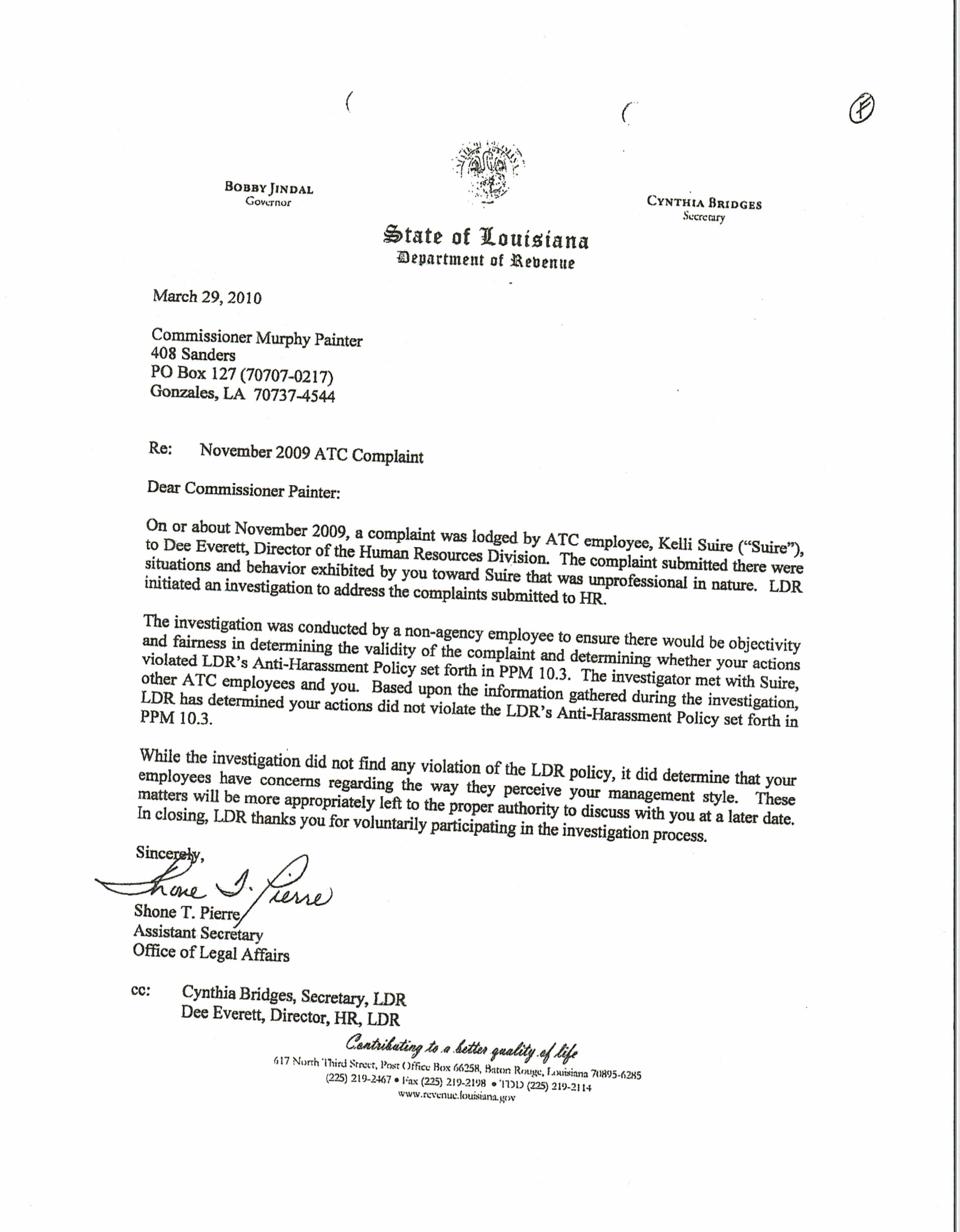
The events leading up to Painter’s firing and subsequent federal indictment began innocently enough with a March 29, 2010, letter to Painter from then-Department of Revenue Secretary Cynthia Bridges. She was writing pursuant to a complaint lodged by ATC employee Kelli Suire who would later the catalyst in Painter’s firing. Bridges, however found no violations by Painter regarding the complaint of “unprofessional” behavior toward Suire, but said concerns about his management style would be left “to the proper authority to discuss with you at a later date.”

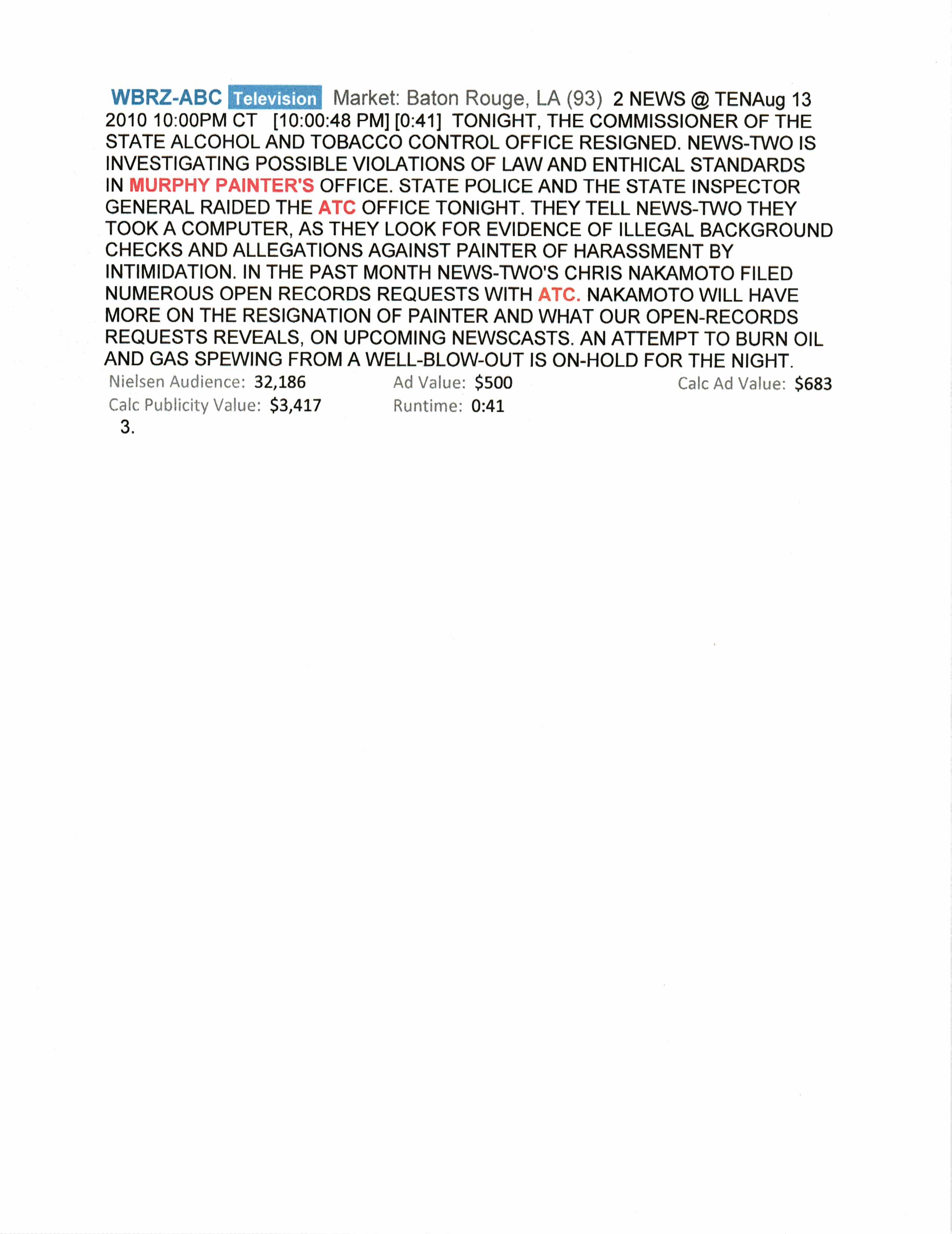
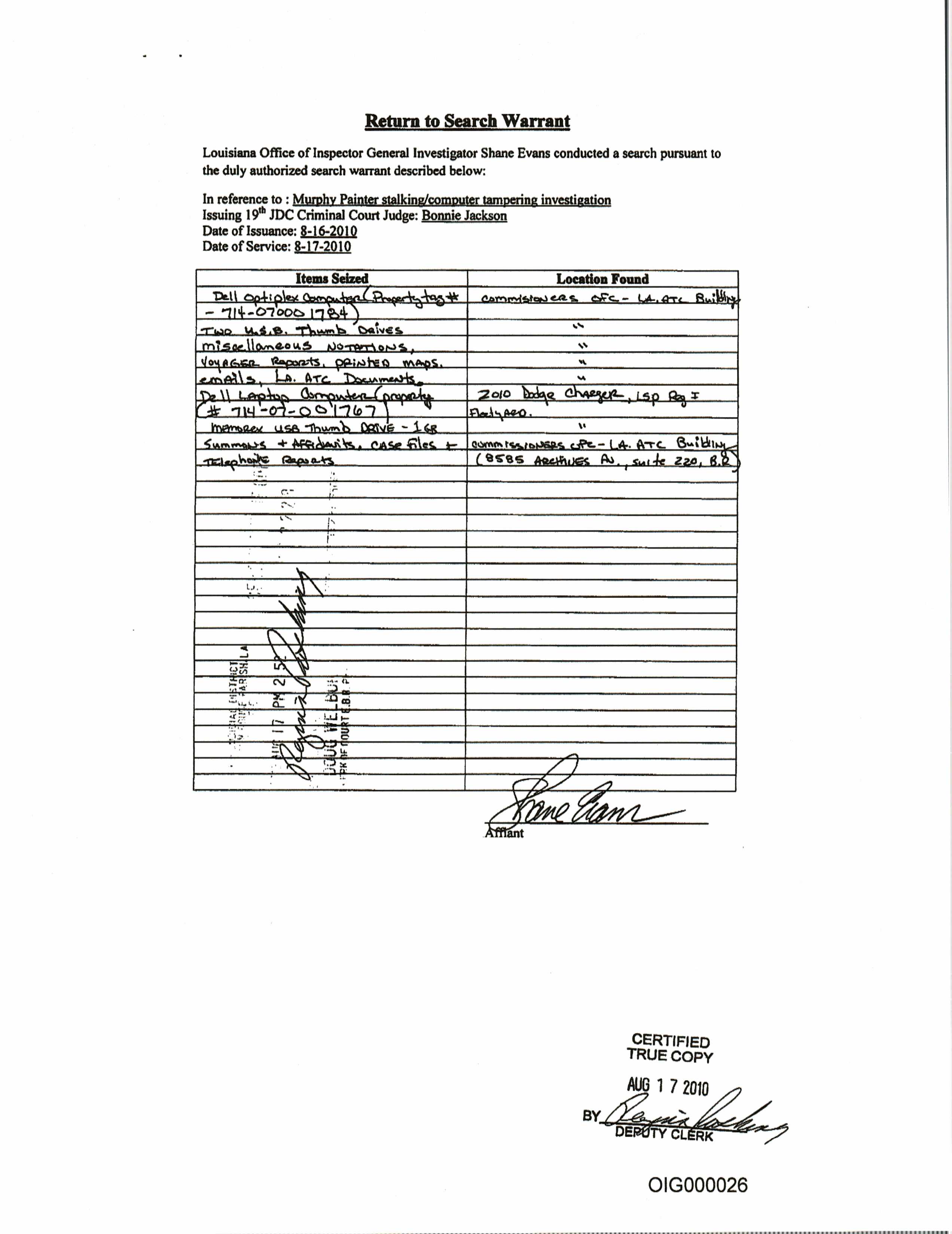
Then on Aug. 13, 2010, more than four months following Bridges’s letter, Baton Rouge television station WBRZ reported that Painter “resigned” and the OIG’s office simultaneously raided ATC offices, seizing Painter’s state desktop and laptop computers, three thumb drives, notes, affidavits, reports, maps, ATC documents, telephone reports, and a 2010 Dodge Charger assigned to Painter.


There was only one problem with the timing.

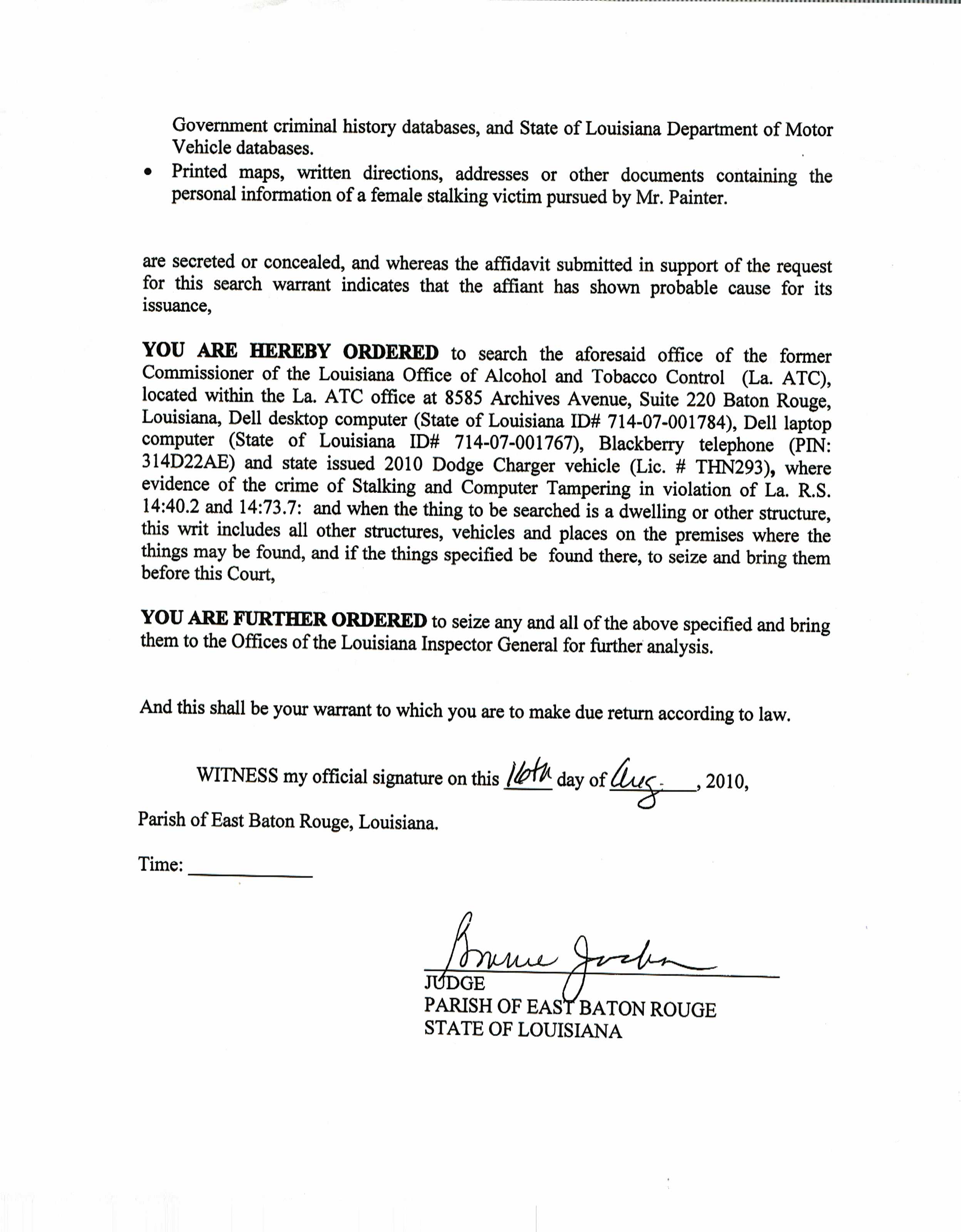
Bonnie Jackson, 19th Judicial District Judge, did not sign the search warrant authorizing the raid and search of Painter’s office until Monday, Aug. 16.

That would appear to have made the previous Friday’s raid—pulled off three days before a judge had signed the search warrant—illegal and a clear violation of the Fourth Amendment which says, “The right of the people to be secure in their persons, houses, papers, and effects, against unreasonable searches and seizures, shall not be violated, and no warrants shall issue, but upon probable cause, supported by oath or affirmation, and particularly describing the place to be searched, and the persons or things to be seized.” (Emphasis added.)

The second violation, the destruction of evidence was not learned until three years later when Painter’s computer was finally returned and he found that some 4,000 files had been deleted. Much of that, of course, would have been routine state business related to ATC operations but there was other information contained in the files, Painter says, that could have helped exonerate him from the charges that were lodged against him by the Jindal administration. It is not only illegal to destroy evidence, but also to destroy state documents—even if they do not constitute evidence.

The third violation, this one by OIG, involved the apparent misrepresentation of testimony given in interviews by an attorney and his assistant who had experienced difficulty in obtaining a liquor license on the part of his client, a business with multiple out-of-state owners, a situation which made the licensure procedure more involved.

The attorney, Joseph Brantley, and Painter had exchanged emails whereupon Painter invited Brantley to come to the ATC offices so that the problem could be worked out. “Why don’t you come by here around 3:00 p.m. or 4:00 if that works for you tomorrow and we will go over ours versus yours,” Painter said in his email at 12:26 p.m. on Sunday, Dec. 14, 2008. Brantley responded three minutes later, asking, “Is it OK if I bring the lady that has been doing the primary work (on the file)?”

OIG investigator Shane Evans, who now works for the East Baton Rouge Parish coroner’s office as its chief investigator, then laid the groundwork for the sexual harassment charges to be brought against Murphy when he wrote in a report of his interview with Brantley on Oct. 13, 2010:

“Mr. Brantley advised that Toby Edwards was a former assistant (paralegal) of his, that she is an attractive woman, and that after the meeting in late 2008, Mr. Painter granted the permit immediately.”

In his report of his interview with Edwards, also on Oct. 13, 2010, Evans wrote:

“During the meeting with Mr. Painter, he told Ms. Edwards that he had run her driver’s license and looked at her photograph. He said that was the only reason that he had granted them the meeting. (That is blatantly false: Copies of the Dec. 14, 2008, email exchange between Painter and Brantley obtained by LouisianaVoice clearly show that Painter invited Brantley to a meeting before he ever knew of Edwards’s existence.) She took his statement as the only reason he decided to meet with them is because he thought she was attractive. Ms. Edwards said his statement and demeanor made her very uncomfortable. She said she was very glad Mr. Brantley was present.

“She also said that she found it unusual that the permit had been repeatedly turned down but once she met with Mr. Painter face-to-face, her client immediately received the permit.”

Another report by OIG, the result of a second interview with Edwards on Nov. 5, 2012, described both Brantley and Edwards as “uncomfortable” during the meeting with Painter.

A second interview of Brantley on Nov. 7, 2012 produced yet a fourth OIG report that said, in part, that Edwards wore a “professional,” semi-low-cut shirt. “Mr. Brantley noticed that Mr. Painter noticed and glanced at Ms. Edwards’s chest during the meeting.

“…According to Mr. Brantley, Mr. Painter ‘clearly looked at’ Ms. Edwards’s chest,” the report says. Mr. Brantley even told Ms. Edwards that Mr. Painter was attracted to women, maybe more ‘than the average guy.’ Although Ms. Edwards would have attended the meeting anyway, Mr. Brantley took her to the meeting ‘for effect.’ He thinks that the meeting was more successful than it would have been otherwise if Ms. Edwards had not attended.

Pretty damning stuff, right?

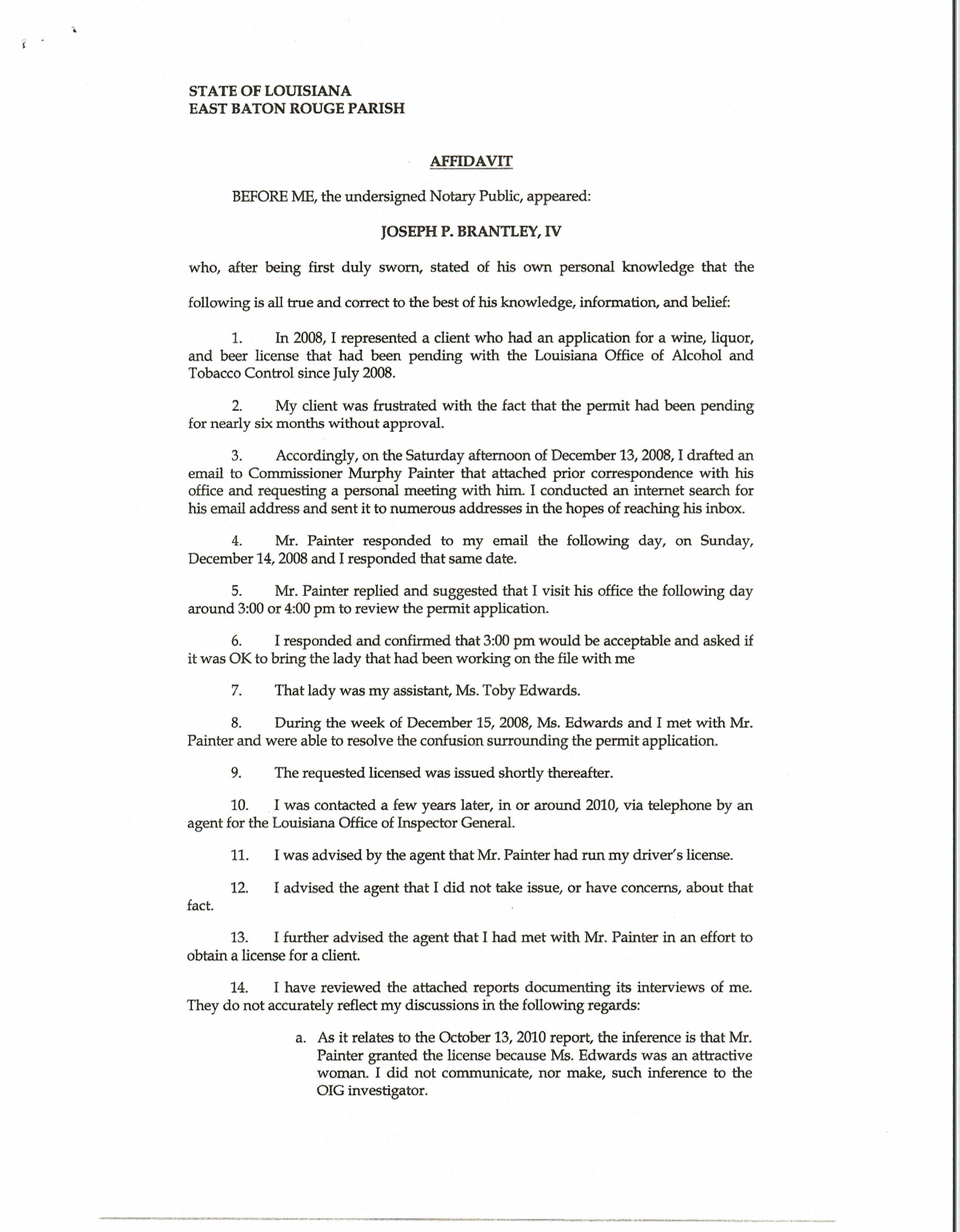
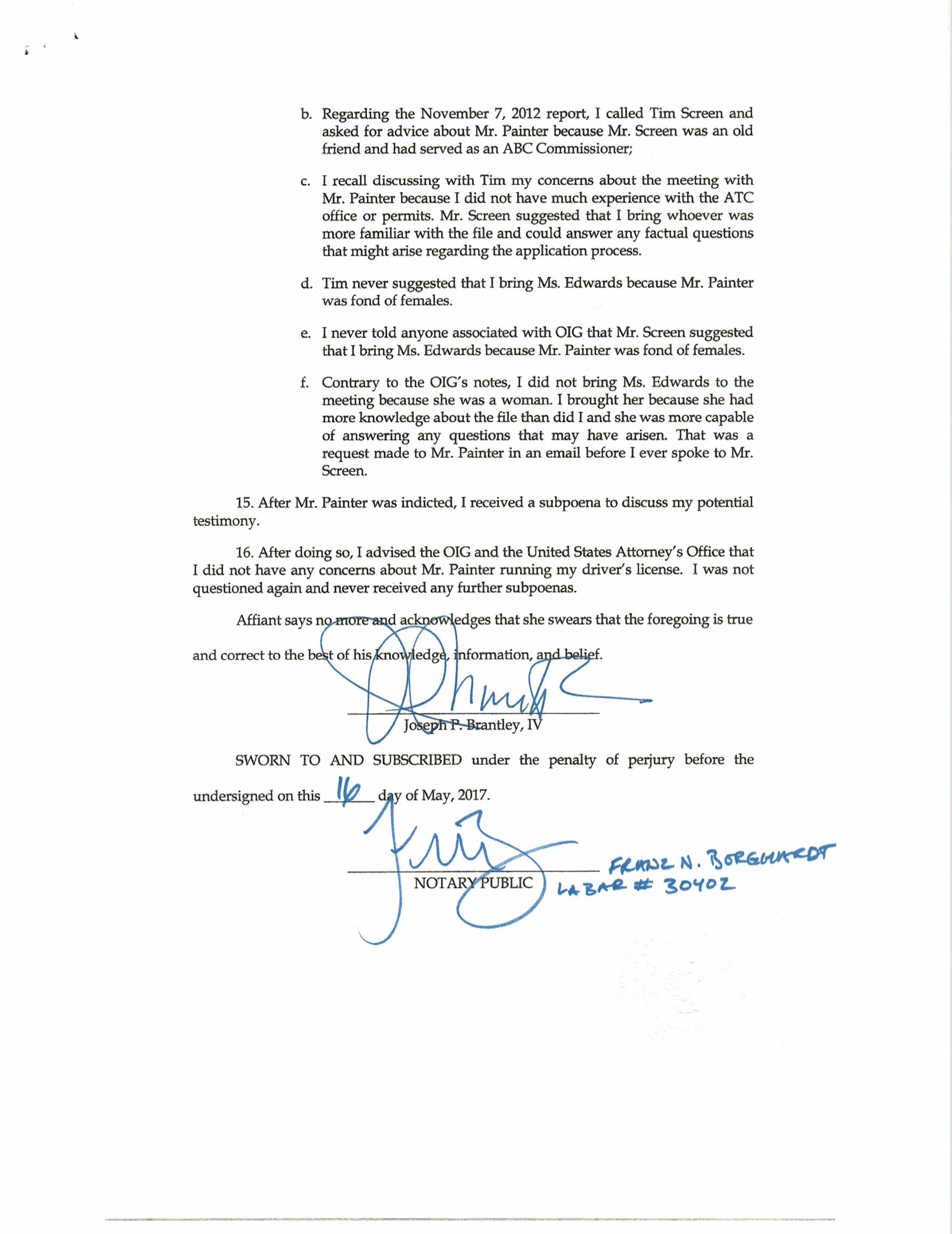
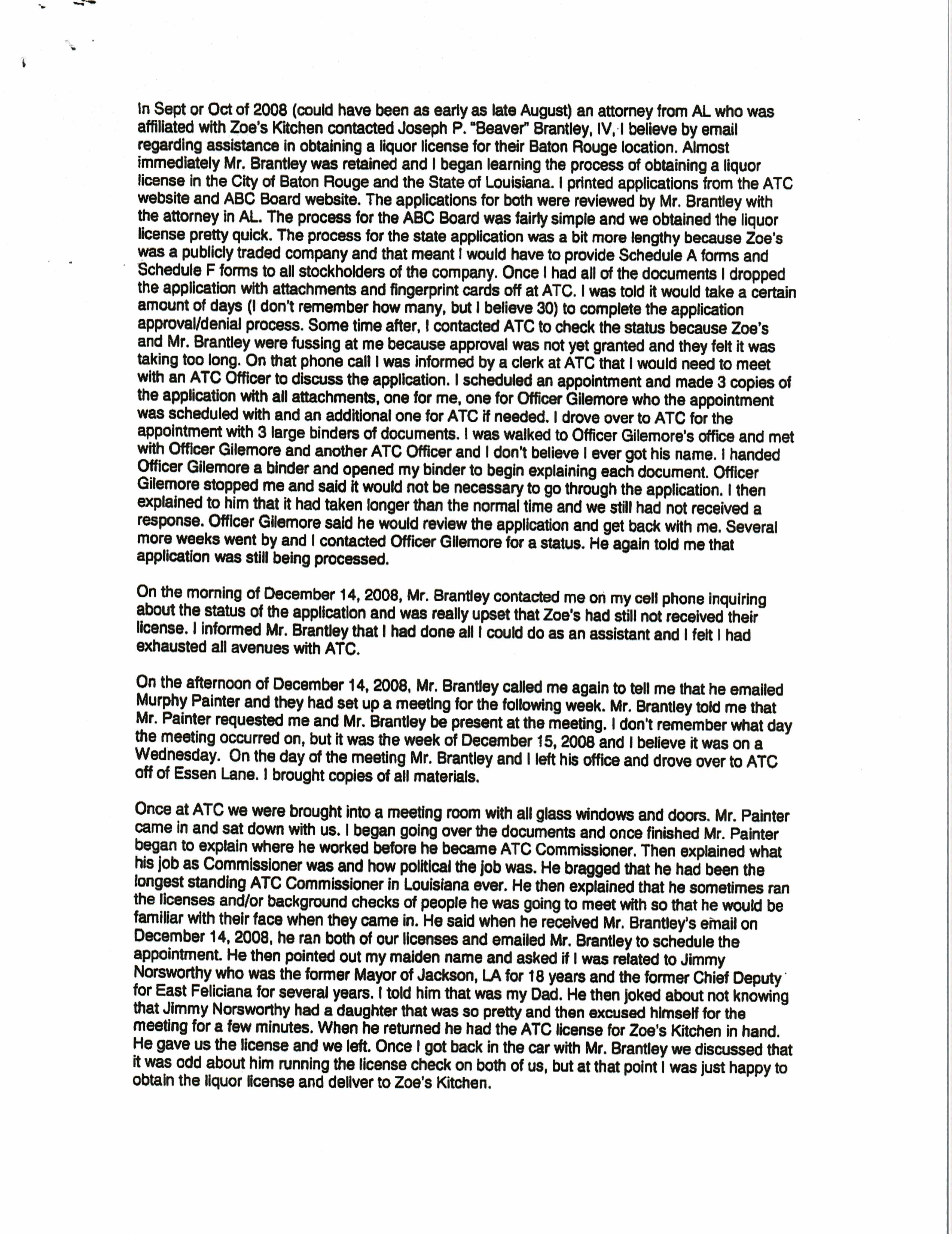
Well, it would be except for affidavits signed and sworn to by Brantley and Edwards (now Pierce), which provide quite a contrasting version of events.

Brantley, after reviewing the OIG reports, flatly denied ever telling Evans or any other OIG investigator that Edwards took part in the meeting with Painter because Painter was fond of females.

“I brought her because she had more knowledge about the file than did I and she was more capable of answering any questions that may have arisen.”

Edwards pointedly noted that the meeting took place in a room “with all glass windows and doors.” She said she also learned at the meeting that Painter was a long-time acquaintance of her father, a former deputy sheriff in East Feliciana Parish and joked to her that he didn’t know her dad “had a daughter that was so pretty.” She said he then excused himself for a few minutes and later returned with a license for Brantley’s client.

Here are both of those affidavits:


So, with a little tweaking of the facts, a man’s career was ruined, his occupation stripped from him and his finances gutted—all because he insisted that a major campaign contributor submit the proper forms before obtaining a liquor license for his Sunday parties outside the New Orleans Superdome.

This is Louisiana at its worst, folks, and it’s a clear example of how the political establishment can crush you if you don’t have the right contacts and sufficient financial resources to match those of the state’s taxpayers.

Read Full Post »

Before Louisiana voters trek to the polls in record low numbers on Oct. 14, there are a few things to consider about State Sen. Neil Riser, one of four candidates for the job of state treasurer, who, besides failing to help landowners being fenced out of their hunting lands, actually took campaign cash from a family member of the one erecting the fences.

Riser, author of that infamous bill amendment in the waning minutes of the 2014 legislative session that would have given State Police Superintendent Mike Edmonson an additional $100,000 or so per year in retirement benefits, has received some other interesting contributions as well.

The Louisiana Safety Association of Timbermen gave $2,500 to his senate re-election campaign in March 2014 and only 18 months later filed for BANKRUPTCY on behalf of its self-insurance worker’s compensation fund, leaving quite a few policy holders in the lurch.

Several nursing homes have contributed $2,500 each to his treasurer campaign. The nursing home industry, heavily reliant on state payments on the basis of bed occupancy, consistently benefited from favorable legislation by the Louisiana Legislature over the past decade that discouraged home care for the elderly.

But by far the biggest beneficiary of Riser’s legislative efforts is Vantage Health Plan, Inc., of Monroe which contributed $1,000 in 2015 to his Senate re-election campaign and another $1,000 to his treasurer campaign in March of this year.

Vantage has received six state contracts totaling nearly $242 million during the time Riser has served in the State Senate.

But it was Riser, along with Sens. Mike Walsworth of West Monroe, Rick Gallot of Ruston and Francis Thompson of Delhi, who pushed Senate Bill 216 of 2013 through the Legislature which cleared the way for the state to bypass the necessity of accepting bids for the purchase of the state-owned former Virginia Hotel and an adjoining building and parking lot. That was done expressly for the purpose of allowing Vantage to purchase the property for $881,000 despite there being a second buyer interested in purchasing the property from the state, most likely for a higher price.

By law, if a legislative act is passed, the state may legally skip the public bid process to accommodate a buyer. This was done even though a Monroe couple, who had earlier purchased the nearby Penn Hotel, wanted to buy the Virginia and convert it into a boutique hotel. Thanks to Riser and the other three legislators, they were never given the opportunity.

And Vantage, from all appearances, really got a bargain. The building was constructed in 1925 at a cost of $1.6 million and underwent extensive renovations in 1969 and again in 1984, according to documents provided LouisianaVoice, all of which should have made the property worth considerably more than $881,000. Read the entire story HERE.

Internal documents revealed concerns by Vantage that if the building were to be offered through regular channels (public bids), “developers using federal tax credits could outbid Vantage.”

Another document said, “VHP (Vantage Health Plan) fears that public bidding would allow a developer utilizing various incentive programs to pay an above-market price that VHP would find hard to match.”

Finally, there was a handwritten note which described a meeting on Nov. 1, 2012. Beside the notation that “Sen. Riser supports,” (emphasis added) there was this: “Problem is option of auction—if auction comes there is possibility of tax credits allowing a bidder to out-bid.”

All of which raises the obvious question of why did the Jindal administration turn its back on the potential of a higher sale price through bidding, especially considering the financial condition of the state during his entire term of office? We will probably never know the answer to that.

One might think that that kind of effort on its behalf would be worth more than a couple of thousand in campaign cash to Vantage. Vantage could have at least shown the same gratitude as the relative of the owner of 55,000 of fenced hunting property in Riser’s district.

When landowners in Winn, Caldwell and LaSalle parishes felt they were being fenced out of their hunting rights back in 2013, they did what any citizen might do: they went to their legislator for help–in this case, Riser, who paid the obligatory lip service of expressing concern for landowners Wyndel Gough, Gary Hatten, and Michael Gough but who, in the end, did nothing to assist them.

Instead, as so often happens today in politics, he sold out to the highest bidder.

One the $5,000 contributors to Riser’s campaign is none other than Hunter Farms & Timber, LLC, of Lafayette. An officer in that firm is Billy Busbice, Jr., of Jackson, Wyoming.

William Busbice Sr., one-time chairman of the Louisiana Wildlife and Fisheries Commission, and Junior’s father, is a partner in Six C Rentals Limited Partnership of Youngsville, LA. Which purchased and proceeded to fence in some 55,000 acres of prime hunting land a few years back.

The original LouisianaVoice story on that dispute can be read HERE.

All of which only serves to underscore the long-held perception that we in Louisiana, by continually electing the type of public officials who are interested only in the next big deal, get the kind of representation we deserve.

Read Full Post »

Are State Fire Marshal deputies in violation of the law by wearing firearms while on duty?

That’s a fair question.

Many, if not most deputy fire marshals would prefer not to wear a weapon. Some whom we talked with are downright resentful that they are required to go through Police Officer Standards and Training (POST) certification to be qualified to be armed agents. It’s not the training they object to so much as the requirement that they carry a weapon.

But the fact remains that they are required to do just that.

But there may be legitimate questions as to the actual legality of such a requirement.

In 2009, State Fire Marshal Butch Browning wanted a bill introduced that would redefine and expand the authority of deputy fire marshals, a move opposed by command level brass at Louisiana State Police (LSP) who found the proposal to be inappropriate, based on the mission of the Louisiana Office of State Fire Marshal (LOSFM).

In a March 16, 2009, email to State Police command and on which LSP’s Office of Legal Affairs was copied, Browning wrote, “I wanted to follow up on the legislation on full police powers for our investigators. Currently, they have powers to carry firearms and (to) make arrests for the arson crimes and I have the authority to commission them. Arson is now, more than ever, a bi-product of so many other crimes and our folks regularly uncover other crimes and times where their ability to charge with other crimes might help the arson investigation.

“Our people need full powers while conducting a (sic) arson investigation. This can be accomplished with adding to the fire marshal’s act or by your commissioning authority,” he wrote. “I have no preference. I just know they need this ability. You (sic) consideration in this matter is appreciated.”

Browning even prevailed upon then-State Rep. Karen St. Germain of Plaquemine (now Commissioner of the Office of Motor Vehicles) to draft a bill to redefine the role of deputy fire marshals. From what we can determine it appears that despite Browning’s pleas to expand the agency’s law enforcement authority the bill received no support from Gov. Bobby Jindal (likely at the urging of then-State Police Superintendent Mike Edmonson) and was never filed.

Why would a person who trained to be a boiler inspector be required to pack heat?

The same goes for nursing home, child care facilities, and hospital inspectors.

Ditto those who inspect carnival rides.

Likewise, for jail, public school and other public building inspectors.

The fact is, the only conceivable area in which a deputy fire marshal might need to be armed is in the area of explosives and arson investigations, according to highly-placed LSP officials who insist there is little or no need for the creation of yet another police agency to augment LSP, Department of Public Service (DPS) officers, sheriffs’ departments, campus and local police departments.

Yet, just a couple of years ago, there they were: Armed deputy fire marshals patrolling the New Orleans French Quarter during Mardi Gras.

In order for Browning to get around the objections of LSP, he instituted cross-training whereby all deputy fire marshals, no matter their specialized training, must be qualified to inspect any type building, any carnival ride, any boiler, any jail, or any night club—and to be arson investigators to boot. That proposal, coinciding as it did with Jindal’s obsession with downsizing and consolidation of state government, tempered the governor’s initial reluctance to go along with Browning.

But in reality, the issue was never about improving response or streamlining the agency at all. It was about improving retirement benefits.

By allowing deputies—all deputies (and virtually all employees would ultimately be designated as deputies)—to become POST-certified and to carry weapons, it qualified employees (even clerical, if they wore a gun, as some now do), to have their jobs upgraded to hazardous duty as are state police and DPS police.

What that means is employees can now qualify to retire at 100 percent of their average salary for their top three years more than a decade earlier than State Civil Service employees. Here’s how it works:

State classified employees under Civil Service accrue retirement at 2.5 percent per year at a rate based on the average of their three highest earning years (excluding overtime) multiplied by years of service. So, a classified employee whose highest three-year average earnings are $50,000 must work 40 years to retire at 100 percent of his salary ($50,000 X 2.5 percent = $1,250 X 40 years = $50,000. Based on that same formula, if he worked 30 years, he would retire at $37,500). (This equation, of course, works for any pay level, not just $50,000.)

But hazardous duty employees accrue retirement at 3.5 percent of the average of their three highest years. That means the same three-year average pay of $50,000 would accrue retirement at a rate of 3.5 percent, or $1,750 per year, allowing him to retire at 100 percent of salary in just over 28 years.

Accordingly, Chief Deputy Fire Marshal Brant Thompson surmised that if deputies achieved POST certification, then they were fully imbued with general law enforcement authority and not the limited law enforcement authority laid out in state statutes. “That assumption is absolutely not true,” according to one long time law enforcement official familiar with how officers are commissioned. “Just because an individual has POST certification doesn’t empower that person to enforce all laws. That authority flows from the law or via the person issuing the commission. I’m not sure who commissions deputy marshals; I suspect it is Browning rather than the Superintendent of State Police.

“I know that when the LSP Colonel (Superintendent) issues a commission to campus police, for example, the commission makes it clear that law enforcement authority is limited to crimes occurring on the campus,” the former law enforcement officer said.

Browning is nothing if not determined in his quest to acquire full law enforcement authority for his marshals. The debate that began in 2009 has continued into 2016, at least. Gene Cicardo, who was appointed chief legal counsel for DPS upon the death of Frank Blackburn last September, was drawn into the dispute and wrote a memorandum to Edmonson and Deputy Superintendent Charles Dupuy that left Browning upset and unhappy, according to sources.

The contents of that memorandum are not known, but LouisianaVoice has made a public records request to LSP for that document.

Cicardo has since returned to private practice in Alexandria.

Meanwhile, we have armed boiler inspectors, carnival ride inspectors, nursing home inspectors and, conceivably, even State Fire Marshal Office clerical employees (aka Executive Management Officers) patrolling for criminal elements in the New Orleans French Quarter during Mardi Gras.

What could possibly go wrong?


Read Full Post »

« Newer Posts - Older Posts »