Feeds:
Posts
Comments

Archive for the ‘Contract’ Category

In our lowlights review for the first six months of 2014, we were reminded by State Rep. Jerome “Dee” Richard (I-Thibodaux) that we had omitted a major low point in Louisiana politics.

Accordingly, we will preface our second half with the June veto by Gov. Bobby Jindal of HB 142 by Richard and Sens. Francis Thompson (D-Delhi) and Mack “Bodi” White (R-Central) which was pass unanimously by both the House (84-0) and Senate (37-0).

Called by Richard as the only “piece of legislation that would’ve done anything in the form of reform,” HB142 called for a reduction in consulting contracts. Richard said the bill also “would’ve provided transparency in the way the state hands out contracts” and would have provided savings that would have been dedicated to higher education.

“It just made too much sense to Bobby,” Richard said.

Jindal, on the other hand, said the bill would “hinder the state’s efforts to continue to provide its citizens with timely, high-quality services.”

Such high-quality services as paying $94,000 to a firm to assistant students to learn to play during recess; paying consulting fees to Hop 2 It Music Co. or to the Smile and Happiness Foundation.

Jindal also said the bill would “cause significant delays and introduce uncertainty to executing a contract” and would “discourage businesses from seeking opportunities to provide services to the people of Louisiana.”

Which now brings us to the second half of political news that could only occur in Louisiana.

JULY

Troy Hebert back in the news:

Three former ATC supervisors, all black, have filed a federal lawsuit in the Baton Rouge’s Middle District claiming a multitude of actions they say Hebert took in a deliberate attempt to force the three to resign or take early retirement and in fact, conducted a purge of virtually all black employees of ATC.

Baton Rouge attorney J. Arthur Smith, III filed the lawsuit on behalf of Charles Gilmore of Baton Rouge, Daimian T. McDowell of Bossier Parish, and Larry J. Hingle of Jefferson Parish.

The lawsuit said that all three plaintiffs have received the requisite “right to sue” notice from the U.S. Department of Justice pursuant to Equal Employment Opportunity Commission (EEOC) complaints.

So, where are all those savings we were promised?

To probably no one’s surprise except a clueless Gov. Bobby Jindal, the takeover of the Louisiana Office of Group Benefits (OGB) by Blue Cross Blue Shield of Louisiana a scant 18 months ago has failed to produce the $20 million per year in savings to the state.

Quite the contrary, in fact. The OGB fund balance, which was a robust $500 million when BCBS took over as administrators of the Preferred Provider Organization (PPO) in January of 2013, now stands at slightly less than half that amount and could plummet as low as an anemic $5 million a year from now, according to figures provided by the Legislative Fiscal Office.

There is no tactful way to say it. This Jindal’s baby; he’s married to it. He was hell bent on privatizing OGB and putting 144 employees on the street for the sake of some hair-brained scheme that managed to go south before he could leave town for whatever future he has planned for himself that almost surely does not, thank goodness, include Louisiana.

So ill-advised and so uninformed was Jindal that he rushed into his privatization plan and now has found it necessary to have the consulting firm Alvarez and Marcel, as part of their $5 million contract to find state savings, to poke around OGB to try and pull the governor’s hand out of the fiscal fire. We can only speculate as to why that was necessary; Jindal, after all, had assured us up front that the privatization would save $20 million a year but now cannot make good on that promise.

We can save, but we have to let you go…

The Jindal administration announced plans to jettison 24 more positions at the Office of Group Benefits (OGB) as a cost cutting measure for the cash-strapped agency but is retaining the top two positions and an administrator hired only a month ago.

Affected by layoffs are eight Benefits Analyst positions, three Group Benefits Supervisory spots, one Group Benefits Administrator, seven Administrative Coordinators, an Administrative Assist, two Administrative Supervisors, one IT Application Programmer/Analyst and one Training Development Specialist.

All this takes place at a time whe OGB’s reserve fund has dwindled from $500 million at the time of the agency’s privatization in January 2013 to about half that amount today. Even more significant, the reserve fund is expected to dip as low as $5 million by 2016, just about the time Jindal leaves town for good.

Completing the trifecta of good news, we also have learned that health benefits for some 200,000 state employees, retirees and dependents will be slashed this year even as premiums increase.

Neil Riser helps Edmonson revoke the irrevocable:

One of the single biggest state political stories of the year was the surreptitious attempt of State Sen. Neil Riser to slip an amendment into an otherwise nondescript bill ostensibly addressing procedures in handling claims against police officers that would have given State Police Superintendent Mike Edmonson an illegal $55,000 per year retirement boost.

Events quickly began to spin out of control after Riser first denied, then admitted his part in the ruse and as retired state police opposed the move and public opinion mounted against the move, Edmonson, after first claiming he was entitled to the raise, finally relented and said he would not accept the increase.

Meanwhile, Jindal, who signed the bill, was eerily quiet on the issue despite speculation he was behind the attempt to slip the increase into the bill.

State Sen. Dan Claitor, just to make sure Edmonson didn’t go back on his word, filed suit to block the raise and a Baton Rouge judge agreed that the bill was unconstitutional.

The bill, which quickly became known as the Edmonson Amendment, along with the Office of Group Benefits fiasco, constituted the most embarrassing moments for a governor who wants desperately to run for president.

AUGUST

Selective—and hypocritical—moral judgments

Gov. Bobby Jindal weighed in early on the kissing congressman scandal up in Monroe. When rookie U.S. Rep. Vance McAllister was revealed on video exchanging amorous smooches with a female aide, Jindal was all over him like white on rice, calling for his immediate resignation.

Jindal’s judgmental tone was dictated more by the philosophical differences between the two (McAllister wanted the state to expand Medicaid, Jindal most assuredly did not) than any real issues based on morals as Jindal’s silence on the philandering of U.S. Sen. David Vitter who did a tad more than exchange affectionate kisses.

Edmonson Amendment spawns other state police stories:

LouisianaVoice, in its continuing investigation of the Department of Public Safety (DPS), learned that a number of DPS employees enjoy convenient political connections.

  • Dionne Alario, Senate President John Alario’s daughter-in-law, is a DPS Administrative Program Manager;
  • Alario’s son, John W. Alario, serves as a $95,000 per year director of the DPS Liquefied Petroleum Gas Commission.
  • DPS Undersecretary Jill Boudreaux retired on April 28 from her $92,000 per year salary but the day before, she double encumbered herself into the position and reported to work on April 30 in the higher position of Undersecretary. Commissioner of Administration Angéle Davis ordered her to repay the 300 hours of annual leave (about $46,000) for which she had been paid on her “retirement,” but Davis resigned shortly afterward and the matter was never pursued.
  • DPS issued a pair of contracts, hired the contractor as a state employee, paid her $437,000 to improve the Division of Motor Vehicles and ponied up $13,000 in airfare for trips to and from her home in South Carolina. The contractor, Kathleen Sill, heads up a company called CTQ but the company’s web page lists Sill as its only employee.
  • Boudreaux’s son-in-law Matthew Guthrie was simultaneously employed in an offshore job and was on the payroll for seven months of the State Police Oil Spill Commission.
  • Danielle Rainwater, daughter of former Commissioner of Administration Paul Rainwater was employed as a “specialist” for State Police.
  • Tammy Starnes was hired from another agency at a salary of $92,900 as an Audit Manager. Not only was her salary $11,700 more than state trooper Jason Starnes, but she is in charge of monitoring the agency’s financial transactions, including those of her husband.

Thanks, retirees; here’s your bill for medical coverage:

LouisianaVoice was first to break the news that the Jindal administration was planning to force retirees out of the Office of Group Benefits by raising premiums astronomically and slashing benefits.

The news sparked waves of protests from employees and retirees alike, prompted legislative hearings at which Commissioner of Administration Kristy Nichols looked more than foolish in their attempts to defend the ill-conceived plan.

The entire fiasco was the result of the Jindal administrations foolish decision to cut premiums, which allowed the state to be on the hook for lower contributions as well. The money the state saved on matching premiums went to help patch those recurring holes in the state budget. Meanwhile, because of the lower premiums, the $500 million OGB reserve fund shrank to about half that amount as OGB spent $15 million per month more than it received in premiums.

All this occurred just three years after then-Commissioner of Administration Paul Rainwater, in a letter on the eve of the privatization of OGB, promised the continuation of quality service, rates that would be “unaffected” with any increases to be “reflective of medical market rates.” More importantly, he emphatically promised that benefits “will NOT change.”

HHS_2013_SNPS_35_Day

OCTOBER

What premium decrease?

Contrary to the testimony of Commissioner of Administration Kristy Nichols that Buck Consultants recommended that the Office of Group Benefits reduce premiums for members, emails from Buck Consults said exactly the opposite. State Rep. John Bel Edwards (D-Amite) had asked Nichols during legislative committee hearings who recommended the decrease and she replied that the recommendation came from Buck. All witnesses before legislative committees are under oath when they testify.

Surplus, deficit, tomato, to-mah-to:

Nichols “discovered” a previously unknown “surplus” of $320 million in mystery money that set off a running dispute between her office and State Treasurer John Kennedy—an argument that eventually made its way before the Joint Legislative Committee on the Budget.

With a tip of our hat to cartoonist Bud Grace, we are able to show you how that surplus was discovered:
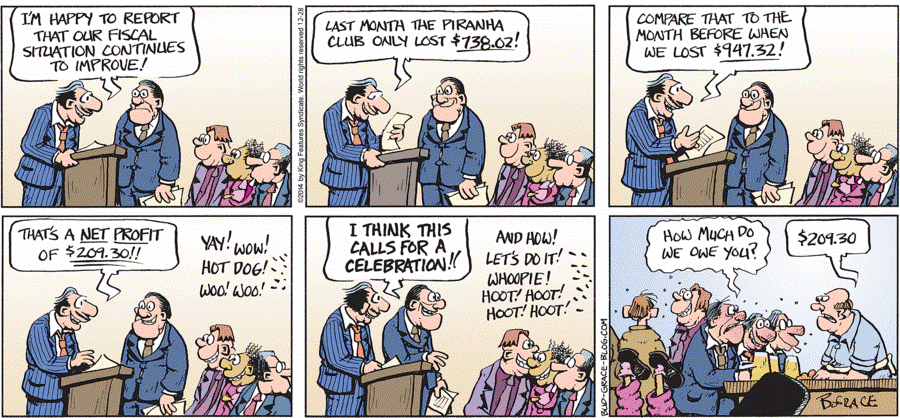
JINDAL SURPLUS SECRET

(CLICK ON IMAGE TO ENLARGE)

Murphy Painter vindicated, Jindal humiliated:

Jindal’s attempted prosecution persecution of fired Director of the Office of Alcohol and Tobacco Control Murphy Painter blew up in the governor’s face when Painter was first acquitted of criminal charges, costing the state nearly half a million dollars in reimbursement of Painter’s legal fees, but Painter subsequently won a defamation suit against his accuser.

Secret survey no longer a secret but “no one” more popular than Jindal:

A survey to measure state employee satisfaction in the Division of Administration (DOA) should be an eye opener for Commissioner of Administration Kristy Kreme Nichols and agency heads within DOA.

Meanwhile, LouisianaVoice has learned that Gov. Bobby Jindal (R-Iowa, R-New Hampshire, R-Anywhere but Louisiana) received some exciting news this week when a new poll revealed that no one was more popular among Republican contenders for the GOP presidential nomination.

The excitement was short-lived, however, when the actual meaning of the numbers was revealed.

It turns out that in a CNN poll of New Hampshire voters, Jindal tied with Rick Santorum with 3 percent, while “No one” polled 4 percent, prompting Comedy Central’s Stephen Colbert to joke that Jindal should adopt the slogan “Jindal 2016: No one is more popular.”

To shred or not to shred:

The controversy surrounding the sweeping changes being proposed for the Office of Group Benefits just got a little dicier with new information obtained by LouisianaVoice about the departure of Division of Administration executive counsel Liz Murrill and the possibly illegal destruction of public records from the Office of Group Benefits (OGB) and the involvement of at least two other state agencies.

While it was not immediately clear which OGB records were involved, information obtained by LouisianaVoice indicate that Murrill refused to sign off on written authorization to destroy documents from OGB.

We first reported her departure on Oct. 14 and then on Oct. 22, we followed up with a report that Murrill had confided to associates that she could no longer legally carry out some of the duties assigned to her as the DOA attorney.

But now we learn that the issue has spilled over into two other agencies besides OGB and DOA because of a state statute dealing with the retention of public documents for eventual delivery to State Archives, a division of Secretary of State Tom Schedler’s office.

Reports indicate that Schedler became furious when he learned of the destruction or planned destruction of the records because records should, according to R.S. 44:36, be retained for three years and then delivered to the state archivist and director of the division of Archives, records management and history.

NOVEMBER

Secret grand jury testimony of Greenstein made public:

The Louisiana Attorney General’s office, in an unprecedented move, released the 100-plus pages of testimony of Bruce Greenstein, former Secretary of the Department of Health and Hospitals but the testimony did little in revealing any smoking gun related to the state’s $180 million contract with CNSI. About the only thing to come out of his testimony was the indication of an incredible bad memory in matters related to his dealings with his former bosses at CNSI and a razor-sharp recall of other, more insignificant events.

Approval? We don’t need no stinkin’ approval:

The very first state agency privatized by Gov. Bobby Jindal was the Office of Risk Management (ORM) and after the state paid F.A. Richard and Associates (FARA) $68 million to take over ORM operations and then amended the contract to $75 million after only a few months, the agency was subsequently transferred three times to other firms. The only hitch was a specific clause in the original contract with FARA that no such transference was allowable without “prior written approval” from the Division of Administration. The problem? When LouisianaVoice made an FOIA request for that written approval, we were told no such document existed.

Edwards’ Last Hurrah:

Former Gov. Edwin Edwards, one of the most successful, colorful and charismatic politicians in Louisiana history, lost—decisively. Republican Graves Garrett rode the Republican tide to easily hand Edwards his first political defeat, dating back to his days on the Crowley City Council. Some may remember when Buddy Roemer led the field in 1987, forcing Edwards into a runoff. Technically, though, Edwards did not lose that election because he chose not to participate in the runoff, thus allowing Roemer to become governor. But he would return in 1991 to win his unprecedented fourth term.

DECEMBER

Friends of Bobby Jindal seeking donations:

A new web page popped up seeking donations for the Friends of Bobby Jindal, raising speculations of an attempt at a higher office (president?) since Jindal can’t run for governor again.

The new web page cited a speech by Jindal at a foreign policy forum at which he called for increased military spending.

Gimme the keys to the cars:

The Public Service Commission (PSC) became the second state agency (the State Treasurer’s office was the first) to openly defy Jindal when the administration demanded that the PSC relinquish possession of 13 vehicles as part of the administration’s cost-cutting measures.

We have already examined State Rep. Jerome “Dee” Richard’s attempt to cut consulting contracts which was passed unanimously by both the House and Senate but vetoed by Jindal.

But there was another veto that should be mentioned in context with Jindal’s penny wise but pound (dollar) foolish fire sale approach to state finances.

Earlier this year, State Sen. Jack Donahue (R-Mandeville) managed to get overwhelming passage of a bill that called for more oversight of the tax break programs by the state’s income-forecasting panel.

But Jindal, who never met a tax break he didn’t like, promptly vetoed the bill, saying it could effectively force a tax increase on businesses by limiting spending for the incentive programs.

Only he could twist the definition of removal of a tax break for business into a tax increase even while ignoring the fact that removal of those tax breaks could—and would—mean long-term relief for Louisiana citizens who are the ones shouldering the load. And for him to willingly ignore that fact borders on malfeasance.

Another (yawn) poor survey showing:

24/7 Wall Street, a financial news and opinion company, released a report which ranked Louisiana as the 11th worst-run state in America.

Louisiana, in ranking 40th in the nation, managed to fare better than New Jersey, which ranked 43rd, or eighth worst, something Jindal might use against Gov. Christ Christie if it comes down to a race between those two for the GOP nomination.

Louisiana had “one of the lowest median household incomes in the nation,” at just $44,164, the report said “and 10.7 percent of all households reported an income of less than $10,000, a higher rate than in any state except for Mississippi. Largely due to these low incomes, the poverty rate in Louisiana was nearly 20 percent (19.8 percent) and 17.2 percent of households used food stamps last year, both among the highest rates in the nation. The state’s GDP grew by 1.3 percent last year, less than the U.S. overall.

May we pray?

Meanwhile, Jindal prompted more controversy by having his favorite publisher and LSU Board of Supervisors member Rolfe McCollister run interference in securing the LSU Maravich Center for a political prayer event in January of 2015. The event will be sponsored by the controversial American Family Association and will not (wink, wink) be a political event, Jindal said.

And that, readers, is where we will leave you in 2014.

For 2015, we have an election campaign for governor to look forward to.

Just when you thought it couldn’t get any worse.

Read Full Post »

When Jeff Skilling took over as President and Chief Operating Officer of Enron in June of 1990, he did so only after insisting that the company convert from conventional accounting principles to a method preferred by his former employer, McKinsey & Co.

In 2001, hedge fund manager Richard Grubman said to Skilling, “You are the only financial institution that can’t produce a balance sheet or cash flow statement with their earnings.” By October of that same year, Enron had begun its death spiral in a historic collapse that would pull the giant accounting firm Arthur Andersen down with it.

The key to Enron’s failure was the mark-to-market accounting method, where anticipated revenues and profits are entered into the company’s books before they are ever received. The system allowed Enron to conceal losses and to inflate profits for nearly 11 years before its house of cards came crashing down.

On Thursday (Oct. 8), nearly seven years into his administration, Gov. Bobby Jindal (R-Iowa, R-New Hampshire, R-Anywhere but Louisiana) rolled out a new accounting formula with an alarmingly familiar ring to it.

Jindal, like Skilling, is a McKinsey alumnus.

Commissioner of Administration/Surrogate Gov. Kristy Kreme Nichols announced that the state, instead of having a deficit of $141 million as claimed by State Treasurer John Kennedy, will suddenly have a surplus of $178.5 million, a gaping difference of $319.5 million.

Nichols did not reveal how the $178.5 million was arrived at but Kennedy said the administration is switching to a cash balance form of accounting instead of the modified accrual basis employed by state governments. “If we use the methodology we have always used,” he said, “we don’t have a surplus. We have a $141 million deficit.

“The commissioner says the calculation has been inaccurate for years and it needs to be changed,” he said. “They have to explain why we have been doing it wrong all these years and why the Revenue Estimating Conference is doing it wrong.”

Nichols, an appointed state employee, was less than deferential to Kennedy, a statewide elected official when she sniped back at Kennedy, saying, “I’m surprised the treasurer is not reporting this.” She added that Kennedy is obligated to report available revenue. “He should probably do a review of the accounts to ensure there are no more outstanding revenues he is not reporting.”

Kennedy and Jindal have been at odds for years over fiscal policy, so it was no surprise to see Kristy Kreme, with her super-sized ego, get a little mouthy with the state treasurer. After all, she bolted from a House Appropriations Committee hearing on the Office of Group Benefits on Sept. 25 to take her daughter to a One Direction boy band concert at the New Orleans Smoothie King Arena where she watched from the comfort of Jindal’s executive suite.

Just as Enron misrepresented its finances for years, it now appears that the Jindal administration may be attempting the same tactic, prompting one political observer to say, “If cooking the books isn’t malfeasance, what is? The bond rating agencies and others rely on the CAFR (Comprehensive Annual Financial Report), where the year-end position is officially reported in decision making and they are not going to like this.”

Another Jindal critic asked rhetorically, “What happens when a state ends a fiscal year with a deficit of $141 million but the administration of the day pretends that there is actually a surplus of $178 million? I don’t think there is any precedent for such a thing ever happening anywhere. This is starting to sound like Enron!”

Odd as it may seem to make that comparison, the similarities between Jindal and Enron run much deeper than the latest developments surrounding the new accounting methods. Here are some points about Enron lifted from The Smartest Guys in the Room: the Amazing Rise and Scandalous Fall of Enron (Penguin Books, 2003), a probing book by Bethany McLean and Peter Elkind about the failed energy company: http://www.goodreads.com/book/show/113576.The_Smartest_Guys_in_the_Room

  • The Deutsche Bank once described Enron as “the industry standard for excellence.” Jindal boasted of instituting the “gold standard for ethics” in Louisiana.
  • When the chief accounting officer of Enron Wholesale expressed concern about wholesale electricity sales, she was reassigned. When another employee questioned Skilling on his claim that Enron was going to make $500 million, she was laid off that same day. When state employees or legislators complain or do not vote with the administration, they are teagued.
  • Pollster Frank Luntz said instability and chaos were defining features at Enron and the six company reorganizations in just 18 months were a “running joke” and that Enron’s lack of discipline was “destructive and demoralizing.” Jindal’s penchant for reorganization and reform has created a similar atmosphere within state government.
  • Enron sold assets and booked the one-time proceeds as recurring earnings. Nearly 40 percent of Enron’s 1998 and 1999 earnings came from sales of assets rather than from ongoing operations. Jindal over the past several years has sold state property, buildings, and entire agencies and turned state hospitals over to private entities.
  • Both Skilling and Jindal are alumni of the blue-chip consulting firm, McKinsey & Co., which wrote the Enron business plan and as far back as 1986, advised AT&T there was no future in the market for cell phones. McKinsey also was an advocate of mark-to-market accounting practices.
  • Both Skilling and Jindal thought—and think—like a consultant. Skilling felt that a business should be able to declare profits at the moment of the signing of an agreement that would earn those profits. But just because traders were reporting earnings under mark-to-market accounting, it did not necessarily follow that the money was in hand. See this link: http://theadvocate.com/news/10494146-123/jindal-budget-surplus-questioned
  • A Wall Street banker said of Skilling: “He’s either compulsively lying or he’s refusing to recognize the truth.” Another banker worried that Enron executives were not carrying out their fiduciary duties and questioned “sweetheart deals” negotiated by them.
  • Skilling believed that social policies designed to temper the markets were “wrongheaded” and counterproductive. “Wrongheaded” has been a favorite term invoked by Jindal whenever he has suffered setbacks at the hands of the courts on issues ranging from education reform to a revamp of state retirement plans.
  • When asked a question he didn’t like, Skilling, in a tactic learned from his days at McKinsey, responded by dumping “a ton of data on you.” Jindal’s one outstanding skill is to spew statistics and factoids in rapid-fire fashion that can overwhelm and confuse challengers.
  • Skilling, like Jindal, was considered brilliant and extremely articulate. He, like Jindal, always seemed to have the right answer and whenever he was asked about problems it was always someone else’s fault.
  • Skilling displayed no remorse for his own actions, nor did he have any sense that he hired the wrong people or emphasized the wrong values. (See above.)
  • Enron founder Ken Lay saw himself as a business visionary, much as Jindal portrays himself as a policy guru. Lay traveled the world to offer his wisdom on everything from energy deregulation to corporate ethics to the future of business. (Ditto)
  • At the end, Enron employees’ accounts were frozen even as top executives were walking away with fortunes.
  • Efforts by Enron and Arthur Andersen to avoid reporting $500 million in losses “only pushed the problem further off and added another tangle to the fragile web of accounting deceptions.” Do we really need to elaborate here?
  • Enron executives accepted the argument that wealth and power demanded no sense of broader responsibility which in turn led them to embrace the notion that ethical behavior requires nothing more than avoiding the explicitly illegal, that refusing to see the bad things happening in front of you makes you innocent and that telling the truth is the same thing as making sure no one can prove you lied.
  • Enron’s mission was nothing more than a cover story for massive fraud, much as Jindal’s administration is being exposed almost daily as a sham. The story of Enron, like that of Jindal, was a story of human weakness, of hubris and greed and rampant self-delusion, of ambition run amok, of a business model that didn’t work and of smart people who believed their next gamble would cover their last disaster—and most of all, of people who couldn’t—or wouldn’t—admit they were wrong.
  • Enron once aspired to be “the world’s greatest company” but rather became a symbol for all that was wrong with corporate America, exposing Lay’s flaws as a businessman that could no longer be hidden behind Enron’s impressive but misleading façade and Skilling’s glib rhetoric.
  • Despite Enron’s efforts to camouflage the truth, there was more than enough in the public record to raise the hackles of any self-respecting analyst (read: reporter). Analysts (read: reporters) are supposed to dive into a company’s financial records, examine footnotes and even elbow their way past accounting obfuscations. Their job, in short, is to analyze (re: report).

In the end, of course, Enron crumpled under the weight of its own corruption and mismanagement, destroying thousands of lives and even taking down one of the big five accounting firms in the process.

The Jindal administration with each passing day, with every revelation of some new scandal (the Edmonson Amendment, CNSI, the Murphy Painter fiasco, et al) and with each new flawed policy (the Office of Group Benefits debacle), is looking more and more like a train wreck that will adversely affect Louisiana citizens for years to come.

Just call it Enron East.

Read Full Post »

(Editor’s note: We’re re-posting yesterday’s story after our source informed us we had been given the incorrect name of the telephone answering service hired (on a no-bid contract) by DOA to attempt to provide answers to the growing concerns of members of the Office of Group Benefits)

The news out of Division of Administration (DOA) and the Office of Group Benefits (OGB) just keeps getting more and more bizarre and emerging revelations only serve to solidify the fact that Commissioner of Administration Kristy Kreme Nichols and OGB Executive Director Susan are woefully in over their respective heads.

It’s not just that the Jindal administration just hired two new six-figure salary employees from Blue Cross/Blue Shield (BCBS) to unfix what Kristy Kreme and Susan West fixed—although that’s part of it. Paying Thomas Groves $220,000 a year must smart, given that it is $50,000 more than West pulls down as head of the agency. Elise Cazes will make $106,512 as group benefits administrator.

And it’s not that the OGB trust fund has dwindled from a $540 million pre-Piyush Privatization balance to less than half that amount today—although that’s part of it.

And it’s not that costs to some 230,000 state employees, dependents and retirees who are members of OGB will be going up by some 47 percent and benefits will decrease, Kristy Kreme’s soothing assurances to the contrary notwithstanding—although that’s part of it.

And it’s not that legislators and legislative staff members are eligible to participate in a better plan, LSU First (an option not even available to Louisiana’s other public university employees)—although that’s part of it.

And it’s not that the administration lied to state employees back in 2012, telling us that there would be no premium increases or benefit cuts—although that’s certainly part of it and it doesn’t help that the administration continues to churn out many of those same lies.

And it’s not that most of the staff at an agency that was operating at smooth efficiency and was widely approved of by member employees was fired in order to allow BCBS to take over as the OGB third party administrator (TPA) to handle claims—although that was a big part of it.

No, it isn’t any one of those things. It’s all of them, the cumulative effect of an administration rolling over its loyal employees, forcing many of them into early retirement (if they’re eligible for retirement) or worse, unemployment.

But as if that weren’t bad enough, seemingly with each passing day, the plot at DOA and OGB continues more and more to take on the appearance of a theater of the absurd than it does an administration of mature individuals responsible for running a $25 billion a year state government.

The most recent blunder involved the layoff of about two dozen OGB employees “because there wasn’t enough work for them,’ leaving a skeleton staff unable to man the telephones to take questions from thousands of OGB members, particularly retirees, wondering if they were going to continue to have health coverage.

To fill that vacuum, BCBS employees were brought in to answer the phones but were unable to answer specific questions because of their unfamiliarity with OGB policies.

So then to solve that problem, 20 DOA employees were brought into OGB’s IT section but have done no better.

The obvious answer? Ansafone Communications.

Who?

Well, it’s not Answerphone, a company out of Albany, N.Y., as we were originally informed. Our IT (“I’ll Tell”) source informs us the spelling was given to us incorrectly and that it should have been Ansafone out of Santa Ana, California, and Ocala, Florida. And the contract is for about a million bucks, not the $2 million we were originally told.

Still, it’s another of those emergency contracts that DOA is issuing with reckless abandon with no requests for proposals, no bids and apparently, if the Alvarez & Marcel (A&M) contract, which went from about $4.2 million to more than $7 million at warp speed, is any indication, no ceiling.

Of course, all contracts must be approved by the Office of Contractual Review. But the Office of Contractual Review works for…(ahem), Kristy Kreme.

Not much more is known about Ansafone than we were able to learn about Answerphone except Ansafone does include a little more hype on its web page: http://www.ansafone.com/

Kristy Kreme assures us in a Baton Rouge Advocate news story  that Ansafone “in health care enrollment” and that “Ansafone representatives have experience with managing benefit plans and have been trained extensively on OGB and its offerings.” Apparently, their “extensive training” of a few days better qualifies them than the OGB employees who did that for years before they were shown the door.

http://theadvocate.com/news/10253537-123/ogb-hotline-hours-extended

It does have on its web page a cute “Five Star Recipe for Customer Service Failure,” however. http://www.ansafone.com/five-star-recipe-for-customer-service-failure/ Kristy Kreme and Susan West might want to peruse that a bit. Some of the ingredients included:

  • A “tablespoon of no communication,”
  • A “dash of not caring,” and
  • “4 ounces of empty promises.”

Sounds like something this administration cooks up virtually every day.

Frankly, we don’t see the need to pay these folks. In fact, Kristy Kreme may want to consider collecting royalties from Ansafone for stealing the Jindal recipe for failure.

So while our source provided us with the name of the wrong company, we will gladly take our one error, embarrassing though it certainly is, over the endless examples exhibited by Jindal, Kristy Kreme, and whoever happens to in charge today at OGB. We would print the name, but given the new salary structure there, we’re not exactly sure who that is and we don’t want another glaring error—not this soon, anyway.

Perhaps we can get some answers next Friday (Sept. 19) when the Joint Legislative Committee on the Budget meets in House Committee Room 5 at the state Capitol at 9 a.m. or the following Thursday (Sept. 25) when the House Appropriations Committee meets at 10 a.m. in the same committee room. Both meetings are being held to address OGB’s rising costs, falling revenue and dwindling benefits.

Maybe Kristy Kreme and Susan West can both appear and enlighten the legislators tag team-style with their combined wizardry.

But basically, what we know is this:

  • Two dozen OGB employees were fired because they didn’t have enough work to do;
  • BCBS employees had to help on the phone lines but were incapable of answering the multitude of questions from members;
  • About 20 DOA employees were brought in to help on the phone lines but that still wasn’t enough;
  • A firm with a sketchy web page about which little is known was hired at a cost of $1 million to provide 100 operators in California and 100 in Florida to help out on the phones with problems in Louisiana.

All things considered, we can only borrow a phrase from the Ol’ Perfesser, Casey Stengel who said of his 1962 New York Mets baseball team (that lost 120 of 162 games):

“Can’t anyone here play this game?”

Read Full Post »

cd00829bf871256d803a177dbf1227e8_gz5b[1]

(CLICK ON IMAGE TO ENLARGE)

My grandfather had a favorite expression he was fond of saying: “The stuck pig squeals the loudest.”

That may well explain the sudden onslaught of reassurances emanating from the Jindal administration in the form of press releases and op-eds, all telling us that our benevolent governor, expert that he is on health care, is taking care of and we shouldn’t worry about all those looming increased costs and reduced benefits.

But as it turns out, we may be about to see a new development to the controversy swirling around the proposed premium increases and benefit cuts for members of the Office of Group Benefits.

And just in case you might be wondering why your friendly legislator hasn’t been up in arms over the radical changes in health coverage being proposed for some 230,000 state employees, retirees and their dependents through the Office of Group Benefits (OGB) before now, there’s a reason.

If some similar action were taken to adversely affect their per diem, travel, and other perks, it would be quite another story. They’d have been squealing long before now.

But you see, 261 House members and staff and 151 senators and staff are not members of OGB and therefore, don’t have any skin in the game (my grandfather would have said they don’t have a dog in the hunt) being played by the administration and Blue Cross/Blue Shield of Louisiana.

So where do those 412 people get their health coverage?

LSU First.

And now two of those legislators who earlier fell out of favor with Gov. Bobby Jindal when they questioned the wisdom of privatizing OGB at the outset, Reps. Joe Harrison (R-Gray) and Cameron Henry (R-Metairie) are back and the governor can’t be happy about it.

And Henry is even putting out feelers about moving all 230,000 members of OGB to LSU First, saying it is something “we should explore for employees to get into since the Office of Group Benefits is fiscally unsound.”

Meanwhile, House Speaker Chuck Kleckley (R-Lake Charles), normally a wad of putty in Jindal’s hands, has suddenly grown something akin to a spine and called for a special hearing on Sept. 24 to take up the OGB changes. Other legislators also beginning make demands of the administration to have someone present to answer questions about the radical changes.

State Rep. John Bel Edwards (D-Amite), a candidate for governor, said he wanted administration representatives questioned under oath.

It was Edwards who originally requested that Kleckley call a meeting of legislators to discuss OGB. “The OGB fiasco is proof positive that privatization for the sake of privatization is foolish,” he said. “A reserve balance that recently exceeded $500 million is half that now and bleeding $16M per month due to mismanagement and budget chicanery, and the ultimate price will be paid by state retirees and employees through higher premiums, higher co-pays, higher deductibles, and higher co-insurance in exchange for fewer benefits, more forced generic drugs, and more preclearance of needed treatments and other changes that make crystal clear that the OGB beneficiaries will pay more for less.”

“I feel vindicated,” Harrison was quoted as saying by the New Orleans Times Picayune in reference to the depletion of the OGB trust fund which has shrunk from $540 million to less than half that since Jindal’s privatization plan went into effect. http://www.nola.com/politics/index.ssf/2014/09/louisiana_legislators_have_a_h.html#incart_river “Exactly what I said was going to happen is now happening,” Harrison said.

And Henry is even putting out feelers about moving all 230,000 members of OGB to LSU First, saying it is something “we should explore for employees to get into since the Office of Group Benefits is fiscally unsound.”

Jindal had Henry and Harrison removed from their respective committee assignments when the two refused to go along with Jindal’s legislative agenda during the 2013 legislative session.

Administration officials, in an attempt to discourage a mass exodus from OGB said state employees now in OGB may not find the LSU First plans to be a better option, invoking such terms as “better service,” “strike a balance,” “right sizing of benefits,” “wider range of options,” and “it’s all the fault of Obamacare.”

So, just what is LSU first, anyway?

LSU First is the health coverage offered employees throughout the LSU system and back near the end of the Mike Foster administration, a memorandum of understanding (MOU) was approved that allowed legislators and legislative staff members to opt out of OGB in favor of LSU First.

Senate 2003

House of Representatives 2003

The plan presently is not available to employees of Louisiana’s other institutions of higher learning or civil service employees other than those working for the Legislature.

So, why would anyone make the switch?

The answer to that is simple: Even before the pending revamp of OGB which will prove far more costly to members, LSU First was vastly superior in the benefits it offers. And now, with the increased premiums, higher deductibles and co-pays for OGB members (an overall cost increase of 47 percent), the contrast between the two plans is even more stark. http://www.lsufirst.org/wp-content/uploads/2012/01/2014_LSU_First_SPD.pdf

http://www.lsufirst.org/wp-content/uploads/2013/12/2014-SBC-Opt1.pdf

LSU established the plan for the fiscal year July 1, 2002 through June 30, 2003, adopting the “Definity Health Model Health Coverage Plan,” and the House and Senate climbed on board a year later, on July 1, 2003. The original MOU was signed in May of 2003 by then-LSU President William Jenkins, House Speaker Charles DeWitt, Jr. (D-Alexandria), and Senate President John Hainkel, Jr. (R-New Orleans).

No sooner said than done. The ink wasn’t even dry on the signatures on the MOU when legislators and staff members started a mass migration to the LSU plan. Additionally, civil service workers scattered throughout state government who were fortunate enough to have spouses working for LSU also switched.

The language in the MOU was such that any legislator who left the House or Senate and moved on to another state office or appointment was allowed to retain his or her coverage under LSU First. That would include, for example, people like former Gov. Mike Foster, Commissioner of Alcohol and Tobacco Control Troy Hebert, Lt. Gov. Jay Dardenne, and former House Speaker Jim Tucker.

LouisianaVoice made an inquiry of the LSU administrative types as to who pays the employer portion of the premiums and whether or not the governor, the commissioner of administration, and cabinet members were eligible for member in LSU First.

What we got back was less than satisfactory but entirely typical of the mindset of this administration. “We have fulfilled your public record request and any further questions can be directed to our University Relations office,” wrote Stephanie Tomlinson, coordinator, LSU Finance and Administration.

In other words, if one asks a simple question and does not specifically request documents or records, he is out of luck. This administration has no intention of helping someone seeking information and would prefer to toss obstacles in the path of transparency.

But we can play this game, too. We replied with the following email:

Okay, we’ll try it this way:

Please provide any and all documents and/or public records that identify all eligible members of LSU First medical coverage, including the governor’s office, Division of Administration and the various cabinet positions.

Please provide documentation and/or any and all public records that provides a breakdown of premium payments for LSU First, including employer/employee contributions and including which employer, i.e. the state, the House or Senate or LSU, pays the employer contributions.

Now that we have requested actual documents/records, we’ll see how they respond.

We did glean from the MOU, however, that the Legislature most likely is responsible for paying 70 percent of the premiums for legislators, legislative retirees, and staff members.

Meanwhile, Jindal communications officer Mike Reed, a native of Boston (Jindal apparently cannot find qualified Louisiana residents for these jobs), churned out a fact sheet that Commissioner of Administration Kristy Kreme Nichols proudly published verbatim as her own work as via an op-ed piece in today’s (Thursday’s) Baton Rouge Advocate under the heading Changes Good for Insurance Users, Taxpayers. (A hint, Kristy: U.S. Democratic Sen. John Walsh of Montana recently dropped out of his race for re-election after allegations of plagiarism.)

As for Reed, we can only hope that if he returns to Boston he doesn’t offer his services to the Red Sox. Mired in last place in the American League East, the Sox have enough problems without taking on another pitch man who can’t seem to find the strike zone.

Reed’s press release was directed at a recent well-researched column by political writer Jeremy Alford: For Health Care Woes, Jindal Prescribes Confusion. http://lapolitics.com/2014/09/for-health-care-woes-jindal-prescribes-confusion/

Reed sent the “fact sheet,” entitled Setting the Record Straight: LaPolitics Column on Healthcare reform in Louisiana, to state legislators on Wednesday. The four page letter was peppered with what Reed smugly, if inaccurately, described as “myth” followed by “Facts.”

Of course, being from Boston, it goes without saying that Reed is intimately familiar with all the nuances of Louisiana politics, including the sordid history of the administration’s recent health care issues. These include Jindal’s sticking his nose into the OGB operations and firing Director Tommy Teague who had taken the agency from a $60 million deficit to a $500 million fund balance, closing down or giving away state hospitals, the governor’s refusal of Medicaid expansion which led directly to problems at Baton Rouge General which last week announced it was closing its emergency room, forcing the administration to pump $18 million into the private hospital to keep its ER open to indigent patients forced to travel to the mid-city facility after closure of state-run Earl K. Long Hospital.

Undaunted, Reed waded into the fray, dutifully blaming everything on Obamacare just as his absentee boss would have him do. And Kristy Kreme eagerly published the tome under her byline.

https://webmail.east.cox.net/do/mail/message/view?msgId=INBOXDELIM16848

The whole thing evokes images to go with one of our favorite Sinatra songs: http://www.youtube.com/watch?v=K1fVQGESUTo

Bobby Jindal (Gov. R-L)

Read Full Post »

Gubernatorial candidate and Louisiana House Democratic Caucus Chairman John Bel Edwards (D-Amite) has sent a request to House Speaker Chuck Kleckley (R-Lake Charles) to convene a meeting of the House of Representatives in order to review controversial changes coming to the Office of Group Benefits (OGB).

Meanwhile, OGB has issued its own “fact sheet” in advance of the annual enrollment that begins Oct. 1 and closes Oct. 31 designed to defuse information released by the Legislative Fiscal Office that reflect dramatically higher premiums and slashed benefits.

FAQs

OGB’s FAQ data sheet, however, did not include developments reported by LouisianaVoice late Monday which revealed revamped coverage plans designed to force retirees out of OGB and into Medicare coverage. The problem with that strategy, of course, is anyone hired before April 1, 1986, who never worked in the private sector are not eligible for Medicare coverage.

At the same time, the Legislative and Political Director for the Louisiana Federation of Teachers (LFT) has released a series of emails between her and OGB in which she experienced ongoing difficulty in obtaining answers to questions about pending changes in premiums and coverage.

Edwards’ request would allow the house to review the proposal in a forum where all members could ask questions of the Division of Administration, OGB administrators, the Legislative Fiscal Office, and offer suggestions and comments regarding plan changes that will bring an average 47% cost increase to 230,000 plan members and their families.

“The Governor has quietly used your tax dollars as a personal piggy bank, spending the $500 million fund balance of OGB to pay bills that have nothing to do with OGB or its members.” Edwards said. “But over $100million of that balance was paid in directly by the members of OGB. Now that he misspent their money, he dares to add insult to injury by asking more than a quarter million Louisiana working families to pay higher prices for less health insurance coverage.”

Commenting on the dramatic cost increases OGB member will face in the new year, Edwards said, “The likes of Bernie Madoff and Allen Stanford would be proud of the Jindal Ponzi scheme that, like theirs, preys largely on retirees living on fixed incomes.”

Edwards’ letter to Kleckley cited the recent hiring of two new OGB officials at more than six figures each as well as the Alvarez and Marsal contract to find “efficiencies” inside OGB that now totals $7.5million in costs to the state. In a written statement made in conjunction with the letter Edwards asked, “Bobby Jindal, and those who stood by and watched him dismantle healthcare in our state, hold themselves out as fiscal conservatives. Since when does fiscal conservatism define the role of government as an institution that cuts services in order to pay six figures to private consultants?”

“Like all of the governor’s self-created crises, the solution always seems to be to ask more of the people of our state: more money, more patience, more suspended disbelief.” Edwards said.

“New facts have come to light since the session ended. We owe it to our constituents to examine this issue together and to offer up some bipartisan solutions to our concerns. This impacts people in every single part of the state,” said Edwards.

Edwards told LouisianaVoice he has received telephone calls from retirees who were crying over joint efforts by OGB and Blue Cross/Blue Shield to revamp programs that could make coverage for retirees cost prohibitive.

Here is his letter to Kleckley: http://d3n8a8pro7vhmx.cloudfront.net/johnbelforlouisiana/mailings/120/attachments/original/JBEtoKleckley.pdf?1409081088

“This is going to destroy families,” he said, “and we owe it to our constituents to do what we can to keep them whole.”

Mary-Patricia Wray, legislative and political director for the LFT, said she had talked with OGB Executive Director Susan West “after much prodding about why I couldn’t get answers about the plans from anyone else” after a July 30 meeting of the Joint Legislative Committee on the Budget.

She said that while OGB has provided a preview of the agency’s plan booklet and dates for informational meetings to other groups, “they have provided LFT with none of this information.

“While we represent 21,000 teachers and school employees, many of whom are active members of OGB, the ones who will have no option on the exchange, but will only be able to pick from the new more costly plans, OGB has refused to assist us in directing our members to the appropriate resources to help them select a plan.

“This is even amidst the layoffs at OGB that have left them, in our opinion, unable to properly service the members of the plan.

“We have no problem with assisting our members,” she said. “However, we do have a problem with being denied the tools needed to do that well—for no apparent reason.”

She said West “asked me specifically to call with questions so that I can deliver accurate information to active members or OGB. If she has time to deal with our organizations questions and concerns personally, presumably as the busiest person on staff, I am left to believe the I willful rejection of our inclusion in important meetings about plan details and member communications is simply retribution for our testimony at Joint Budget, since up to that time there was no I indication whatsoever that our attempts to be a team player and deliver accurate info to teachers a school employees was in any way burdensome to the staff of OGB.

“This is an incredibly disappointing communication—one that unfortunately aligns largely with the direction in which policy makers have taken OGB—one that has cut so many staff people to occasion private contracts that it can ostensibly claim those very cuts as the self-created crisis that “requires” it to fail to do its job at all.”


Read Full Post »

« Newer Posts - Older Posts »


