Feeds:
Posts
Comments

Archive for the ‘Commissions’ Category

Louisiana residents victimized by floods and hurricanes don’t need a reminder of the frustrating-ineptness of the Feeble Emergency Management Agency (FEMA) or of the soul-crushing corruption of the Department of Housing and Urban Discrimination (HUD).

FEMA trailers, more appropriately designed as egg incubators than dwellings for human beings, stand as mute testimony to mismanagement on a grand scale. At a COST of $150,000 to $170,000 per trailer, including purchase and set-up following the 2016 flood, only to SELL the units for as little as $5,000 each a year later, it’s difficult to imagine even the Pentagon being able to match FEMA in a waste-for-waste competition.

With 144,000 trailers PLACED following hurricanes Katrina, Rita, Gustav, and Ike, and another 4,500 (upgrades vastly superior to the earlier models but still little better than a tent) following the 2016 floods, one can readily see how FEMA now claims to be broke.

Another reason? Try this: Following Hurricane Katrina, The Shaw Group was contracted to place tarpaulins over damaged roofs at a rate of $175 per square (one hundred square feet per square) after Katrina. That’s $175 for draping a ten-foot-by-ten-foot square blue tarpaulin over a damaged roof. Shaw in turn sub-contracted the work to a company called A-1 Construction at a cost of $75 a square. A-1 in turn subbed the work to Westcon Construction at $30 a square. Westcon eventually lined up the actual workers who placed the tarps at a cost of $2 a square.

In normal circumstances, MIKE LOWERY, an estimator for an Austin, Texas, company, said, his company would charge $300 to tarp a 2000-square-foot roof in Austin. For that same size job, the government is paying $2,980 to $3,500, or about 10 times as much, plus additional administrative fees that couldn’t be readily calculated.

FEMA ISSUED 81,241 blue roof tarps across Louisiana after Hurricanes Katrina and Rita, said spokesman Aaron Walker ($14.2 million total cost: $8.1 million for Shaw as opposed to $162,000 for those who did the actual work).

But if you think that’s bad, consider this: “Overall, Restore Louisiana (the program set up to assist flood victims) has awarded $207 million of the $1.3 billion allotment from the federal government to homeowners,” according to a story in the Baton Rouge ADVOCATE. Of that amount, only $60.5 million has actually been paid to those driven out of their homes by the floods. The remaining $147 million is being paid in increments to contractors as work progresses.

At the same time, however, the state has shelled out $75 million to IEM, the contracted administrator for environmental reviews and program management. That means administrative costs are 23.4 percent higher than the amount actually spent helping flood victims. Said another way, the amount spent on actual work is only 80 percent of administrative costs so far.

IEM’s total contract to administer the $1.3 billion Restore Louisiana program is for an eye-popping $308 million. That computes to administrative costs that are 19.25 percent of the total contract but which appear to be running closer to 26.6 percent at the present time.

Contrast that, if you will, with contracts the Ruston firm of Hunt, Guillot has received to date to administer Community Development Block Grant (CDBG) funds for the recovery of hurricanes Katrina, Rita, Gustav, and Ike and to administer CDBG funds for the Restore Louisiana program set up immediately following the 2016 floods.

Hunt, Guillot received a contract for $18.2 million to administer the disbursement of $7.5 billion in grant funds for LOUISIANA. That contract ran from Oct. 31, 2007, to Oct. 30, 2010. The firm was given an additional contract of $3 million for the period of Feb. 1, 2011, through June 3, 2011 for Katrina and Rita recovery grant funds. IEM’s $308 million contract is 14.5 times the size of Hunt, Guillot’s $21.2 million in contracts even though Hunt, Guillot oversaw the disbursement of nearly six times the amount in federal grants that IEM is responsible for.

IEM’s contract was not without CONTROVERSY, but it probably didn’t hurt that IEM and the company’s CEO, Madhu Beriwal, combined to contribute $15,000 to the campaign of Gov. John Bel Edwards.

But even putting aside all the outrageous administrative costs that are eating up dollars intended to help flood victims, here is the one overriding factor that leads writers like Naomi Klein (The Shock Doctrine) and others to write INVESTIGATIVE REPORTS about the incestuous relationship between natural disasters and corruption?

Could it be that 19 months after thousands of Louisiana residents were forced out of their homes in South Louisiana, only $207 million of a total allocation of $1.3 billion for reconstruction has been approved and checks written for only $60 million even as administrative costs mount?

Could it be that a visit to observe activities at Restore Louisiana headquarters reminds visitors of the organizational skills of a sack of rats in a burning meth lab?

Could it be the frustration encountered by State Rep. Rogers Pope who, first told he qualified for an SBA loan of $250,000 (even though he never applied) but later told it was actually for a lesser amount, responded that he was not interested in a loan of any description but that $50,000 was nevertheless deposited in his bank account by the SBA—and when he insisted again that he did not want the money, was charged $384 in interest for the week that it was in his bank account? (for those of you who may be wondering, that computes to an annual interest rate of 40 percent.) And get this: Pope is a member of the Restore Louisiana Task Force and even he can’t deal with the feds.

Could it be that an applicant who applied for assistance was told that because he had obtained an SBA loan of $124,000, he was ineligible for a grant? The person in question here was yours truly and I was told that the loan was considered a benefit. I’m a 74-year-old retiree on a fixed income, with a brand-new $124,000 mortgage and I’m supposed to consider that a benefit?

What’s more, I’m told, even if I had been offered the loan, and turned it down, I’d still be ineligible because it was offered. (I think that’s what’s called a Catch-22.) And just to add insult to injury, I was told (after at least four separate on-site inspections by FEMA, Restore Louisiana, and Shelter at Home) I was only allowed $60,000 for reconstruction (someone needs to tell my contractor who charged what I considered to be a reasonable fee of $90,000 to make my home livable again—the remainder went to replace furniture and appliances).

I was told at the time of receiving the news of my ineligibility that I could, of course, appeal. “But the appeal won’t do any good,” the nice man said, “because we’re only going by the rules established by FEMA and HUD guidelines.” (A Catch-22 variable.)

It’s the kind of FUBAR guvmint that can send you to a padded room where you’re allowed only crayons as a means of communication.

And if you think I’m angry, consider the frustration level of Stephen Winham of St. Francisville.

Winham, often a LouisianaVoice guest columnist, for 12 years was the state’s budget director, serving under three governors, so he, of all people, should be accustomed to navigating the confusing waters of state bureaucracy. He was, nevertheless, finally moved to send the following email to an official of Restore Louisiana:

I have NEVER seen as poorly run a program as Restore Louisiana and I have seen some poorly run programs in my 21 years of state budget analysis.  If the contractor for whom you work represents the benefits of privatizing public services we are in deep manure, particularly since our worst governor ever, Bobby Jindal, moved us to new heights in that direction.

I have talked on the phone and communicated with your company many times.  I did not initially apply because I knew I was not eligible.  I allowed one of your employees to talk me into applying anyhow, so I did – I assume this was done to get the numbers up.  In subsequent steps, it was confirmed I was never eligible and should never have bent to the pressure put on me to apply.  In other words, I was officially ruled ineligible months ago.

This correspondence and any phone conversations I might have with you would be a waste of my time – your company is apparently going to get its money no matter what so I have no interest in saving you money.  Your company has spent $75 million on itself so far and only disbursed $60 million to the people who really need it – the homeowners.  Do you not see a problem with that?

Although I am not eligible, I have a sister-in-law who is.  My wife and I have tried to help her work through the many meaningless steps necessary to get her Restore Louisiana grant and she has not gotten a dime yet.  My wife has hauled her down to Celtic Studios more than once.  She has had visits from what I assume are project managers/coordinators many times.  She has completed the necessary paperwork at every step.  She has been advised of the amount of her “award” (her part of the $207 million in reported awards, $147 million of which apparently remain undisbursed), but has gotten ZERO.  The people who live across the street from my East Baton Rouge property just started LAST WEEK on work to restore their home pursuant to their Restore Louisiana “award”

I think your company is taking the public for a ride – oh, I know, this is federal money – I am doing my federal taxes today – I guess that never was my money to begin with, or something.  These things should be block granted.  If the eligible recipients take their grants down to a convenient casino and blow it rather than fixing their homes, that’s their problem and it is also better than creating what to me is essentially a pyramid of contractors and sub-contractors each getting their golden crumbs as the grants trickle down to the people who should be getting the money.

Sorry for taking this out on you and you probably haven’t even read this far, but on the off chance you have, LEAVE ME ALONE and devote your attention to eligible recipients many of whom have been waiting over a year and a half for relief.

Your federal—and state—guvmint hard at work for you, Mr. and Mrs. Taxpayer. The best we can hope for is that we never need the their “help” in the future.

(Editor’s note: for the record, a class-action lawsuit is being considered because of the discriminatory policies of HUD and FEMA. More details on that as they are forthcoming.)

Read Full Post »

Gov. John Bel Edwards and the Louisiana Legislature could probably learn a thing or two about building budgetary surpluses from the St. Landry Parish Fire Protection District No. 2—except at least one St. Landry Parish citizens thinks the surplus may be the result of smoke and mirrors and a little voodoo tax millage assessment.

On the other hand, the State Ethics Board appears to be taking its cue from the Attorney General’s office in stonewalling tactics.

The district had a bank balance of more than three times its annual budget at the end of 2016, according to a state AUDIT of the its books. The audit showed nearly $8.4 million in the bank as of Dec. 31, 2016, after expenses of $2.6 million.

And a formal complaint made to the Louisiana State Board of Ethics last May against the district and its secretary-treasurer has produced only a letter of acknowledgement but no results after nine months.

Despite annual revenues of nearly $3.7 million for both 2015 and 2016, the district’s board seemingly felt it could not afford to hire a qualified employee to apply generally accepted accounting principles in recording the districts financial transactions or preparing its financial statements, the audit indicated.

“A material weakness is a deficiency, or combination of deficiencies, in internal control such that there is a reasonable possibility that a material misstatement of the entity’s financial statements will not be prevented, or detected and corrected on a timely basis,” the audit said. “we identified certain deficiencies in internal control that we consider to be material weaknesses.”

Nor did the board seem to feel it was in a position to hire additional firefighters in order to cut back on more expensive overtime pay. Board members paid themselves nearly $16,600 in 2016 and paid out $1.2 million in salaries. An additional $329,677 was paid in overtime (listed as “extra shifts and call out time”).

Auditors recommended that the board examine the following options and implement policies and procedures in order to reduce excessive payroll expenditures:

  • Establish set annual/monthly salaries for management-level positions in order to eliminate overtime paid;
  • Hire additional firefighters in order to decrease overtime pay;
  • Better utilize volunteer firefighters in an effort to minimize costs.

While Edwards and the legislature might be scratching their heads if they knew of the district’s fiscal wizardry, a closer look at a curious tax millage might clear things up.

It seems that district voters may have once approved a 17.5 mill property tax but the district somehow managed to collect two identical millages of 17.5 mills each until January 2018, when one of the assessments expired.

St. Landry Parish resident and local taxpayer Charles Jagneaux, who filed the complaint with the state ethics board, which has been basically toothless since it was gutted by Bobby Jindal in one of his first acts as governor in 2008, has a theory about that dual tax millage.

“My understanding is that the second millage was passed by calling it a renewal when in fact, it was a second identical millage,” he said. “The board attempted to put the expiring millage on the ballot (for a renewal) this year but the parish council would not let them since there was a multi-million-dollar surplus.”

The ethics complaint was filed against Johnny Ardoin, secretary-treasurer of the district’s board. Ardoin, it turns out, is also a member of the Port Barre TOWN COUNCIL, which would appear to be a case of dual office-holding, illegal under Louisiana law.

As a point of clarification from a reader who is in a position to know, dual office holding falls under (drum roll, please…) the attorney general’s office, not the ethics board so the ethics board would not address that matter,

A second, more serious ethics violation, however, seems to arise from Ardoin’s membership on the fire district board.

The Port Barre Town Council appoints two members of the fire district’s board of commissioners.

That would seem to constitute a built-in conflict of interest for Ardoin. Given his position as a member of the town council, he is in the unique position to appoint himself to the fire district’s board of commissioners.

That ethics complaint, like most complaints to the state ethics board these days, is in all likelihood, a dead-end street, particularly as it regards dual office-holding. But even in cases when ethics fines are assessed, which is seldom, they often are ignored and never collected, thanks again to Bobby Jindal and his ethics reform agenda.

Read Full Post »

When an organization like the Louisiana State Troopers Association (LSTA) trots out sick children to promote its political agenda, one has to wonder about whether that organization is genuinely interested in helping the unfortunate or more focused on shamelessly exploiting them for the purposes of building and maintaining a political power base.

And when an attorney for that organization, its membership made up entirely of active and (some) retired state troopers, says it is a labor union, you have to wonder what, exactly, constitutes a labor union. State civil service employees are allowed to enter into collective bargaining agreements such as the one recently negotiated between the American Federation of State, County, and Municipal Employees (AFSCME) and the Louisiana Department of Health. But state employees are not allowed to strike as would your garden variety labor union. And therein lies an important distinction that attorney Floyd Falcon conveniently neglected to mention.

And when a state commission shirks from its responsibility to enact a RULE CHANGE (See agenda item no. 4) to ensure that state troopers, do not fall into the same trap that KENNER POLICE OFFICERS did a few years back with regard to political contributions, you have to wonder about the qualifications of those commission members to serve—and where their allegiance lies.

And when those same commission members emerge from an executive session with a RULING already neatly typed up (obviously agreed to in executive session) to summarily dismiss its investigation of those contributions—meaning there necessarily had to be a polling of members during the closed session to confirm a predetermined decision, an action blatantly illegal under the state’s open meeting laws—you have to assume a deal had been cut in advance despite the staged and choreographed dog and pony show passed off as a public hearing.

In short, there is little to distinguish this assemblage from the commission makeup of two years ago, when a completely different cast of characters occupied commission seats. The current makeup is comprised of members equally lacking in backbone, scared to death, apparently, to make any decision of consequence. The preferred game plan is to show up for the monthly meetings, occasionally issue a ruling on some trooper’s appeal of disciplinary action, exchange pleasantries and go home.

Some might even call it pontification.

But when it comes down to making hard decisions, the rule of the day is to punt or, in a term attributed to the Louisiana Legislature’s refusal to address real fiscal problems, kick the can down the road.

But on Thursday, things came to a head and it didn’t take long for things to get ugly.

In the end, it was SSDD, with the commission pulling the artful dodge despite months of repeated assurances to retired state trooper Leon “Bucky” Millet that his complaints were “not falling on deaf ears.” By the end of Thursday’s meeting, it was not only deaf ears, but also see no evil, speak no evil.

Millet has been a worrisome pain in the backside for the commission, appearing every month with procedural questions and challenges, only to be repeatedly told his concerns would be addressed at the proper time. Well, on Thursday, he threw the commission a curve. In light of the commission’s consistent stand that it had no jurisdiction over the LSTA’s political contributions, he noted that one LSTA member, a retired state trooper who has been rehired by the Department of Public Safety and who is, therefore, a member of Civil Service, only this week entered into a settlement over political activity whereby he has agreed to two weeks unpaid time off. Millet’s revelation, initially described as a conviction, prompted Falcon into his best lawyerly OUTBURST (pontification) in which he called Millet a flat out liar in much the same manner as he called me a “chronic complainer” a couple of years ago.

One might even be prone to believe that the old guard is still pulling the strings of the puppet commission members. Someone surely was.

Cowed by Falcon, who insisted the commission had no jurisdiction over the LSTA, no action was taken against individual state troopers involved in the decisions to contribute thousands of dollars to political candidates, including Bobby Jindal and John Bel Edwards among others.

Falcon and the commission were right in the assertion that the commission has no jurisdiction over the LSTA since it is a private organization (and let’s be honest; it’s not a union, it’s a fraternity that operates its own bar—at one time even on State Police property). No one argues that point. But the commission certainly has jurisdiction over the actions of individuals in the LSTA who made the decision to launder money through its executive director’s private checking account—and to reimburse him for “expenses”—in order to facilitate the contributions.

That way of doing it, by the way, begs the obvious question of just why did the LSTA do it in that manner if the contributions were legal and above-board? Huh? Answer that question, Mr. Falcon (Hint: the answer is they were not legal and above-board). Any layman can see right through that little scam of washing the money through Executive Director David Young’s personal bank account.

And then to pay $75,000 to John Bel Edwards’s political crony, Natchitoches attorney Taylor Townsend, to “investigate” the contributions only to see him come back to the commission and recommend that “no action be taken.” $75,000. No written report. $75,000. Just a verbal recommendation. $75,000. His contract (did I mention it was for $75,000?) called for a written report but it’s been two years now and the commission still hasn’t found sufficient cojones among its entire collective membership to demand that written report. $75,000.

But the most disgusting, most shameless, most exploitive part of the entire affair Thursday was the LSTA’s parading St. Jude’s patients and Dreams Come True children before the commission to demonstrate the fine, charitable work it does. No one denies that it gives to those organizations. It’s a fine thing to do and there’s not a person anywhere who would not commend the LSTA for that. But to use that as leverage for political gain is worse than reprehensible.

And too, the question remains: what in the name of benevolence does that have to do with the political contributions?

Better yet, why didn’t the LTSA take that money and give it to St. Jude’s or Dreams Come True instead of to politicians if you are so driven by goodwill? That would’ve been a helluva lot better use of the money than secretly funneling it to some politician as if the LSTA was trying to hide something—which it was. And as if LSTA might be trying to buy a little political influence—which it was.

A lot of folks give to St. Jude’s and Dreams Come True who do not make political contributions and if they do, they probably make them openly and legally, not through an employee’s personal bank account like a Russian oligarch laundering money through some shady real estate deal.

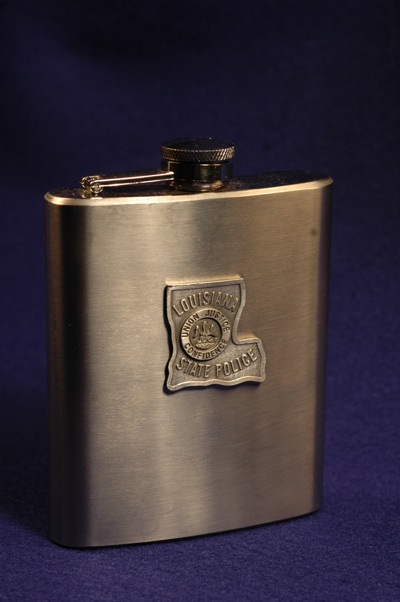
Here’s a good idea: do a video presentation of LSTA parties and post a photo of the liquor flask (I’m sorry, “pocket canteen”) sold by LSTA (complete with Louisiana State Police logo) on your Web page.

And be sure to emphasize how you support MADD in its efforts to curtail drunk driving.

And post those letters to the four retirees (including Millet) who you kicked out of the LSTA because they had the unmitigated gall to question those political contributions.

And tell us again how you want to keep civil service protection while at the same time be allowed to continue to make political campaign contributions.

And Mr. Falcon, Mr. Young, and Mr. Jay O’Quinn (LSTA President) please tell us again, the way you testified on Thursday, how, if the new rule prohibiting campaign contributions goes through, the LSTA will “cease to exist,” because truthfully, we’re in agreement with retired state trooper Jerry Patrick who asked: why, when for decades, LSTA made no political campaign contributions, it didn’t collapse then?

And Mr. Falcon, please enlighten us as to why, as you claimed Thursday, the LSTA “is no different than the Louisiana Sheriffs’ Association.” Because to us, the difference is quite plain. Sheriffs and their deputies are not classified (civil service) employees. State troopers, by contrast, most certainly are.

(Video of Millet-Falcon confrontation and link to dismissal of investigation courtesy of Robert Burns, who covered the commission meeting while I was taking physical therapy for a torn rotator cuff.)


Read Full Post »

Corruption.

As the March 12 opening day of the critical 2018 regular session approaches, and with the looming possibility of the call of a special session to address fiscal Armageddon, it’s an important word for Louisiana citizens to remember.

Corruption.

In a state where administrators, legislators, and judges all seem to be in it for personal enrichment, it’s a word that has become synonymous with political office—from small town mayors, city councils and police chiefs to the highest levels of state government.

Corruption.

Like a cancer, corruption metastasizes until it adversely affects every aspect of our lives: education, economics, environment, health, and not least, trust in our elected officials.

Michael Johnston and Oguzhan Dincer, both former fellows at Harvard Law School’s Edmond J. Safra Center for Ethics, recently collaborated to conduct their fourth Corruption in America Survey, an undertaking first initiated in 2014 and repeated annually.

Since 2016, the survey has been hosted by the newly-founded Institute for Corruption Studies, an independent research institute within the Illinois State University’s Department of Economics.

More than 1,000 news reporters/journalists covering state politics and issues related to corruption across 50 states participated in the survey. Reporters from every state except North Dakota and New Hampshire participated.

Click HERE to read the complete results.

To no one’s surprise, Louisiana ranks among the worst states in terms of executive, judicial, and legislative sleaze—in both legal and illegal corruption.

What, exactly, it meant by legal and illegal corruption? After all, corruption is corruption, is it not?

Well, yes and no. Illegal corruption was defined by Dincer and Johnston as “the private gains in the form of cash or gifts by a government official in exchange for providing specific benefits to private individuals or groups.”

How Gauche. Everyone knows that in Louisiana the preferred method is legal corruption, which the two researchers defined as “the political gains in the form of campaign contributions or endorsements by a government official, in exchange for providing specific benefits to private individuals or groups, be it by explicit or implicit understanding.”

For evidence of that, one need look no further than the LouisianaVoice STORY of Aug. 28, 2016, to see how Bobby Jindal, Attorney General Jeff Landry, and a gaggle of legislators fell all over themselves in protecting the big oil and gas companies from their responsibilities to clean up after themselves. Here is a more detailed look at .

Who better to serve as director of the Louisiana Offshore Terminal Authority than former State Sen. Robert Adley of Bossier Parish, the top recipient of OIL AND GAS CAMPAIGN CONTRIBUTIONS?

And Bobby Jindal handed out appointments to the most influential boards and commissions to his biggest campaign contributors like candy on a Halloween night and even upgraded a major highway in South Louisiana to benefit a company run by another large contributor.

Dincer and Johnston said that official legal corruption is moderately to very common in both the executive and legislative branches of government in a “significant” number of states, “including the usual suspects such as Mississippi, New Jersey, and New York,” but that “Alabama, Kentucky, and Louisiana are perceived to be the most corrupt states” in the executive, legislative, and judicial branches.

Illegal Corruption

Only 13 states were found to have moderately common to very common illegal corruption in their executive branches. Louisiana was one of those 13.

Only four states had illegal judicial corruption deemed to be moderately common (Alabama and Louisiana) or very common (Arkansas and Kentucky). Dincer and Johnston wrote that even a finding of only slightly common in illegal judicial corruption “is still worrying since it is the judicial branch of the government that is expected to try government officials charged with corruption.”

“State legislators are perceived to be more corrupt than the members of the executive branches in a number of states,” the researchers said.

To illustrate that, the survey found just six states with legislative illegal corruption that was very common (Alabama, Arkansas, Kentucky, and Louisiana) or extremely common (Oklahoma and Pennsylvania).

Legislators were found by LouisianaVoice to have leased luxury vehicles for family members, purchased season tickets to college and professional athletic sports teams, hired family members as campaign staff, paid personal income taxes and state ethics fines—all with campaign funds and all of which were illegal.

One legislator even profited by conveniently investing in Microsoft just as his committee was pushing through approval of one of the company’s software programs at the same time other states were taking similar action. The simultaneous approvals gave Microsoft stock a significant boost.

Legal Corruption

“Legal corruption is perceived to be more common than illegal corruption in all branches of government,” the report said, with Louisiana, Alabama, and Wisconsin scoring highest in legal corruption “in all branches of government.”

Those same three states, along with Arkansas, topped the list in legal corruption in the judicial branch where legal sleaze “is perceived to be ‘very common,’” it said, noting that in all four states, judges are elected as opposed to states where judges are chosen on merit and in which judicial corruption is not as common.

“…We expect our courts to rise above the day-to-day pressures and expectations of politics,” the report said. “That they apparently do not raises serious questions about the ways judges are elected in many states, how their campaigns are financed, and whether conflicts of interest arise as those who contribute to judicial campaigns are allowed to appear before those same judges as cases are tried.”

Louisiana, Alabama, and Wisconsin were joined by Arizona, Florida, Maryland, Missouri, New Mexico, North Carolina, Oklahoma, Texas, Hawaii, Illinois, Kentucky, Oregon, Georgia, New Jersey, and New York as states where legal executive corruption was found to be either “very common” or “extremely common.”

Legal legislative corruption was found to be “extremely common” in 12 states: Louisiana, Alabama, Georgia, Indiana, Maryland, Missouri, New Jersey, New York, Oklahoma, Oregon, South Carolina, and Texas.

Aggregate Corruption

Across the board, in terms of legal and illegal corruption in all three branches of government, few states do it better than Louisiana, results of the survey reveal, with the state ranking in the upper tier of corruption in all six listings.

That finding prompted the authors of the report to say that corruption in state government “is not just a matter of contemporary personalities and events, but is rather a result of deeper and more lasting characteristics and influences.

Nowhere, it would seem, is that truer than in Louisiana. Following is just a partial list of Louisiana public officials who have come face-to-face with corruption charges of varying degrees:


Louisiana Executive Corruption

Sherman Bernard: The first Louisiana Insurance Commissioners to be convicted, he served 41 months for extortion and conspiracy.

Doug Green: The second State Insurance Commissioner to go to jail, he was convicted on three counts of money laundering, 27 counts of mail fraud, and was sentenced to 25 years in prison.

Jim Brown: The third consecutive Louisiana Insurance Commissioner served six months for lying to the FBI.

Richard Leche: Louisiana Governor sentenced to 10 years in prison for accepting kickbacks on the purchase of 233 state trucks.

Edwin Edwards: Louisiana Governor sentenced to 10 years in prison after his conviction of extortion in connection with the awarding of state riverboat casino licenses.

Charles Roemer: Commissioner of Administration under Gov. Edwin Edwards, was convicted on one count of conspiracy to violate federal racketeering laws, violating the statute and engaging in wire and mail fraud as a result of the FBI’s Brilab operation which also resulted in the conviction of New Orleans mob boss Carlos Marcello. Roemer served 15 months in federal prison.

Jack Gremillion: Louisiana Attorney General of whom it was once said by Gov. Earl K. Long, “If you want to hide something from Jack Gremillion, put it in a law book,” was sentenced to three years in prison for lying to a federal grand jury about his interest in a failed loan and thrift company.

Gil Dozier: Louisiana Agriculture Commissioner, initially sentenced to 10 years in prison for extortion and racketeering but had eight years added after presiding federal judge learned Dozier had attempted to tamper with a juror and to hire a hit man for an unidentified target.

George D’Artois: Shreveport Public Safety Commissioner was implicated in the 1976 murder of Shreveport advertising executive Jim Leslie but he died in surgery before he could be tried.

Cyrus “Bobby” Tardo: former Sheriff of Lafourche Parish sentenced to 29 years, five months after pleading guilty in 1989 to solicitation for murder, conspiracy, possessing an unregistered destructive device and using an explosive to damage a sheriff’s car. His victim? His successor and the man who defeated him for reelection as sheriff, Duffy Breaux.

Duffy Breaux: Lafourche Parish Sheriff sentenced to four years, nine months in prison for conspiracy, mail fraud, obstruction of justice in 1995.

Eugene Holland: The first of three consecutive St. Helena Parish sheriffs to be convicted of a federal crime, sentenced to 16 months in prison for the theft of public funds to cover his utility bills and to pay for renovations to his house and barn. Pleaded guilty in 1996.

Chaney Philips: The second of three consecutive St. Helena Parish sheriffs to serve prison time after his conviction on nine counts of conspiracy, mail fraud, engaging in illegal monetary transactions, theft involving a federally-funded program, money laundering, and perjury—all related to his time not as sheriff but as parish assessor before being elected sheriff. Sentenced to seven years.

Ronald “Gun” Ficklin: Third consecutive St. Helena Parish sheriff to be convicted of federal criminal charges. Sentenced to five years, three months for trafficking cars with altered vehicle identification numbers, altering VINs, mail fraud, helping convicted felon possess a fun. Pleaded guilty in 2007.

Jiff Hingle: Plaquemines Parish Sheriff pleaded guilty in 2011 to conspiracy to commit mail fraud and bribery, sentenced to 46 months in prison.

Bodie Little: Winn Parish Sheriff convicted in 2012 of drug trafficking, sentenced to 13 years, four months in prison.

Royce Toney: Ouachita Parish Sheriff, pleaded guilty in 2012 to hacking a deputy’s email and phone records and then trying to cover up his snooping. Sentenced to four years’ probation.

Walter Reed: St. Tammany Parish District Attorney (22nd JDC) sentenced to four years in prison in April 2017 for conspiracy, wire fraud, mail fraud, money laundering, making false statements on tax returns. Sentence on hold during appeals process.

Harry Morel, Jr.: St. Charles Parish District Attorney (29th JDC) pleaded guilty in April 2016 to obstruction of justice in FBI inquiry into whether he used his position to solicit sex from women seeking official help. Sentenced to three years in prison.

Aaron Broussard: Former Jefferson Parish President pleaded guilty in 2012 to conspiring to accept bribes from a parish contractor. Sentenced to 46 months in prison. While parish officials other than district attorneys and sheriffs are not generally listed here, Broussard is because of his high national profile following Hurricane Katrina.

Ray Nagin: New Orleans Mayor convicted in 2014, sentenced to 10 years in prison for bribery, wire fraud, money laundering, conspiracy, tax evasion for illegal dealings with city vendors. As with the case of Broussard above, mayors not normally included in this list because of the sheer volume. But because of his high profile following Katrina and as mayor of state’s largest city, it was decided to include him.


Louisiana Legislative Corruption

Larry Bankston: Former chairman of the Senate Judiciary B. Committee that handled gambling legislation was convicted in 1997 on two counts of interstate communications in the aid of racketeering involving alleged bribes from a Slidell video poker truck stop owner. Sentenced to 41 months in prison. Re-admitted to Louisiana State Bar by State Supreme Court. Currently suing State Attorney General for the cancellation of his contract to represent a state agency.

Gaston Gerald: State Senator convicted in 1979 of extorting $25,000 from a contractor. Sentenced to five years in prison. Re-elected while in prison and put a prison acquaintance on Senate payroll as an aide before he was expelled from the Senate in 1981.

Sebastian “Buster” Guzzardo: State Representative among more than 20 persons, including the leader of the New Orleans Marcello crime family and three reputed New York mobsters, convicted in the Worldwide Gaming investigation. Conviction was for conducting an illegal gambling business and for aiding a mob-controlled video poker company. Sentenced in 1996 to three months in prison.

Girod Jackson, III: State Representative who pleaded guilty in 2013 to tax evasion and tax fraud in connection with his business dealings with the Jefferson Parish Housing Authority. Sentenced to three months in prison, nine months of home detention despite recommendations of 12 to 18 months imprisonment.

William Jefferson: 18-year veteran of U.S. House of Representatives convinced in 2009 on 11 of 16 felony counts for taking bribes in connection with a Nigeria business deal. Seven of the 11 counts on which he was convicted were overturned on appeal. Sentenced to five years, five months after appeals. In 2006, following Hurricane Katrina, Jefferson interrupted rescue operations by using a Louisiana National Guard detachment to recover personal effects from his home. (His sister, Orleans Parish Assessor, also sentenced to 15 months in prison after admitting to funneling $1 million in public funds to her family’s bogus charities.)

Charles Jones: State Senator from Monroe, convicted in 2010 of filing false tax returns and for tax evasion, sentenced to 27 months in federal prison and ordered to pay more than $300,000 in restitution. Was re-admitted to Louisiana State Bar on Monday (Jan. 29, 2017).

Harry “Soup” Kember: State Representative was sentenced to five years in prison after his 1986 conviction of mail fraud for pocketing part of a $150,000 state grant he secured for a constituent’s company.

Derrick Shepherd: State Senator sentenced to three years in prison in 2010 after admitting that he laundered money for a corrupt bond broker, netting $65,000 for the scheme.

Rick Tonry: Served only four months as a U.S. Representative from the 1st Congressional District after pleading guilty in 1977 to receiving illegal campaign contributions, promising favors in return for contributions and for buying votes in the 1976 Democratic primary.


Louisiana Judicial Corruption

Ronald Bodenhimer: The 24th Judicial District Judge was among four judges to be caught up in the FBI Wrinkled Robe investigation of Jefferson Parish Courthouse corruption and one of two to receive jail time. He was sentenced to 46 months in prison after pleading guilty in 2003 to planting drugs on a critic of his New Orleans East marina, for bond splitting, and for attempting to fix a child custody case on behalf of Popeyes Chicken Founder Al Copeland.

Wayne Cresap: The 34th JDC Judge for St. Bernard Parish was sentenced to five years in prison after pleading guilty in 2009 to accepting more than $70,000 in bribes and for letting inmates out of jail without paying their bonds.

Alan Green: Another of the four Judges of the 24th JDC in Jefferson Parish. Sentenced to 51 months in prison after his 2005 conviction of a $10,000 mail fraud scheme to take bribes from a bail bonds company.

William Roe: The 25th JDC Judge for Plaquemines Parish was sentenced in 2010 to three months in prison for unauthorized use of movables for pocketing more than $6,000 in reimbursements for legal seminars that he attended as judge. The money should have been deposited in a public account instead.

Thomas Porteous, Jr.: Only the eighth federal judge to be removed from office by impeachment in the Republic’s history, he was convicted in 2010 by the U.S. Senate on four articles charging him with receiving cash and favors from lawyers who had dealings in his court, used a false name to elude creditors, and deliberately misled Senators during his confirmation hearings. As if to underscore the gravity of the charges, all 96 senators present voted guilty on the first article which addressed charges during his time as a state court judge and his failure to recuse himself from matters involving a former law partner with whom he was accused of granting favors for cash.

There are scores of other examples, including city and parish elected officials, local police chiefs, and even a legislator who resigned rather than be expelled for spousal abuse. And former Louisiana State Penitentiary at Angola Warden Burl Cain retired in 2016 under an ethics cloud even though he was official cleared of ethics charges. His son, Nate Cain and Nate’s former wife, Tonia, were indicted in August 2017 on 18 federal fraud charges over purchases he was said to have made with state credit cards during his tenure as warden of Avoyelles Correctional Center in Cottonport.

Additionally, LouisianaVoice over the past three years documented numerous instances of abuse of power and outright corruption from troop commanders all the way up to the upper command of Louisiana State Police.

There were dozens more not listed and sadly, there will continue to be corruption in all three branches of state government so long as the people of this state continue to look away and ignore the widespread malfeasance and outright skullduggery.

And by ignoring the problem, we are necessarily condoning it.

Read Full Post »

The ongoing soap opera of the Louisiana State Police Commission (LSPC), which in no way resembles its membership makeup of a little more than a year ago, continues unabated.

In a relatively short time, the commission has undergone a complete membership turnover, has seen two commission chairmen resign under pressure, a member resigning in protest over what he called a lack of integrity on the part of fellow commissioners, the resignations or removals of other members, and the forced resignation of its executive director.

Now that former executive director, Cathy Derbonne, is back with a vengeance—and with an attorney known in Baton Rouge for taking on the establishment in a take-no-prisoners frontal assault.

Derbonne and her attorney, Jill Craft, have filed suit against the Louisiana State Police Commission, claiming that then-Commission Chairman T.J. Doss, commission member Jared Caruso-Riecke, Louisiana State Police upper command (including then-Superintendent Mike Edmonson) conspired to force her from the job she had held for eight years.

DERBONNE PETITION

She claims in her lawsuit that the reprisals started after she initiated an investigation into reports that members of the commission and the Louisiana State Troopers Association (LSTA) had violated regulations against political activity by making monetary contributions to several political campaigns, including that of Bobby Jindal and John Bel Edwards.

She alleges in her petition that Doss was sharply critical of her at the LSTA convention held in Lafayette in June 2016. She claims that Doss said the furor over the political contributions were her fault and that she “had lost her mind.”

She says a year later, on July 14, 2016, Doss was detailed from his job in Troop G in Shreveport to Baton Rouge headquarters “with the purpose of closely monitoring and observing (Derbonne’s) daily routine,” and the following day he appeared unannounced in her office to ask when was the last time she had been evaluated “which petitioner (Derbonne) understood was a threat.”

When she brought an unlawful pay increases of as much as 32 percent for Edmonson and four of his top deputies to the attention of the Legislative Fiscal Office in September 2016, many of her administrative duties were taken from her by the commission through the efforts of Doss.

She said on Jan. 7 of this year she received an anonymous letter warning her that Doss, by then elevated to commission Chairman, was leading a “secret charge” for her removal. Five days later, at the Jan. 12 commission meeting, she was told that the commission had the necessary votes to remove her. They pressured her to resign, saying they would humiliate her in public.

She did resign but says in her lawsuit that she was harassed and “constructively discharged” in reprisal for her engaging in activities protected under state statute.

She is requesting a trial by jury.

Only two members, Jared-Riecke and Eulis Simien, Jr., remains from the commission membership that convened on Jan. 12. The commission’s primary function is to consider appeals of disciplinary action against state troopers. But like the administration of former Superintendent Edmonson, it has been rocked with one controversy after another which has made it nearly impossible for it to formulate any cohesive action other than damage control and finding new creative ways to embarrass the Edwards administration.

Read Full Post »

« Newer Posts - Older Posts »
