Feeds:
Posts
Comments

Archive for the ‘Commissions’ Category

The hits just keep coming.

Another victory in a public records lawsuit—sort of—while a state tax official goes and gets himself arrested for payroll fraud, and three members of the Louisiana State Police Commission (them again?) find themselves on the hotseat for apparent violations of state regulations that already cost some of their predecessors their positions.

All in a day’s work in Louisiana where the sanctimonious, the corrupt, the unethical, and the unbelievable seem to co-mingle with a certain ease and smugness.

The Lens, an outstanding non-profit news service out of New Orleans, has just won an important fifth with the Orleans Parish District Attorney when the Louisiana Supreme Court DENIED WRITS by the district attorney’s office in its attempt to protect records of fake subpoenas from the publication.

The Fourth Circuit Court of Appeal in October had AFFIRMED a November 2017 ruling by Orleans Civil District Court which had ordered the DA to turned over certain files pursuant to a public records request dating back to April 2017.

As in other cases reported by LouisianaVoice, the court, while awarding attorney fees to The Lens, stopped short of finding that the DA’s denial of records was “arbitrary and capricious,” meaning the DA’s office would not be fined the $100 per day allowed by law for non-compliance with the state Public Records Act.

And because the district attorney was not held personally liable for non-compliance, he will not have to pay the attorney’s fees either; that will be paid by the good citizens of New Orleans.

And, in all probability, the next time the DA’s office or any other public official in New Orleans decides to withhold public records from disclosure, he or she will also skate insofar as any personal liability is concerned with taxpayers picking up the costs.

Until such times as judges come down hard on violations of public records and public meeting laws, officials will have no incentive to comply if there is something for them to conceal.

The records requests were the result of the practice by the DA of issuing FAKE SUBPOENAS (and this preceded Trump’s so-called “fake news”) to force reluctant witnesses to speak with prosecutors—a practice not unlike those bogus phone messages from the IRS that threaten us with jail if we don’t send thousands of dollars immediately.

The New Orleans Times-Picayune described the practice as an “UNDERHANDED TRICK.”

Meanwhile, former Livingston Parish Tax Assessor and more recently Louisiana Tax Commission administrator CHARLES ABELS has been arrested on charges of payroll fraud, improper use of a state rental vehicle and for submitting unauthorized fuel reimbursement requests for the vehicle.

Abels was elected Livingston Parish assessor, an office held up until that time by his grandfather, with 51 percent of the vote in 1995. He served only one term, however, being defeated by current assessor Jeff Taylor in 1999.

In 2002, he was hired as a staff appraiser by the Louisiana Tax Commission. He said at the time that he was a recovering alcoholic who was trying to turn his life around. He was promoted to administrator of the commission during the tenure of Gov. Bobby Jindal.

He was arrested last march on a domestic violence charge but the case was never prosecuted.

One LouisianaVoice reader, a longtime critic of the Louisiana Tax Commission, said Abel’s arrest came as no surprise and that the entire agency is long overdue a housecleaning. “Let’s hope that the State of Louisiana doesn’t wind up on the hook financially for any misdeeds,” he said.

And then there is the Louisiana State Police Commission (LSPC) which just won’t go away.

Almost three years ago, two members became the second and third to RESIGN after reports that they had contributed to political campaigns in violation of the Louisiana State Constitution.

So, you’d think their successors would’ve learned from their indiscretions, right?

Nah. This is Louisiana, where prior actions are ignored if inconvenient and duplicated if beneficial.

But then again, this is the LSPC that paid Natchitoches attorney Taylor Townsend $75,000 to not issue a report on a non-investigation into political contributions by the Louisiana State Police Association (LSTA), contributions that were not paid directly to candidates (including John Bel Edwards and Bobby Jindal), but funneled instead through the personal bank account of LSTA Executive Director David Young so as to conceal the real source of funds.

And now, we have three of the commission members who combined to contribute more than $5,000 to political campaigns during their terms on the LSPC), either personally or through their businesses.

Whether the contributions were justified as having be made by a business (as claimed by State Rep. Mark Wright, R-Covington) or whether the money was contributed to a political action committee as opposed to an individual candidate appears to make no difference; they are all strictly prohibited under state law.

Despite his earlier obfuscation on the issue, Townsend did provide some clarity on the legality of political activity. Quoting from the Louisiana State Constitution, Townsend said, “Members of the State Police Commission and state police officers are expressly prohibited from engaging in political activity. More specifically, Section 47 provides that ‘No member of the commission and no state police officer in the classified service shall participate or engage in political activity…make or solicit contributions for any political party, faction, or candidate…except to exercise his right as a citizen to express his opinion privately…and to cast his vote as he desires.’”

But the real kicker came from a headline in the Baton Rouge Advocate, which proclaimed, “Three State Police commissioners under probe for possible unlawful political donations.”

Buried in that STORY was a paragraph which said LSPC Chairman Eulis Simien, Jr.” tasked the commission’s Executive Director Jason Hannaman to conduct an investigation into the allegations and report back with the findings. Hannaman, a civilian administrator for the board, said Thursday he hoped to complete the report by next month’s meeting.”

Oh, great. An in-house investigation. That should do it. Get a subordinate to investigate his bosses. At least Taylor Townsend carried out the appearance of an outside, independent investigation—until he proved by his inaction that it wasn’t.

What are the odds of this being truly independent and candid?
 

Read Full Post »

On Monday (Nov. 13), Public Service Commissioner Foster Campbell issued a glowing PRESS RELEASE in which he announced what he described as a project to provide high-speed internet service to more than 54,000 homes and businesses in the 24-parish PSC District 5.

Yet, only two months earlier, Campbell had appeared before the Claiborne Parish Police Jury to publicly trash a proposal by Claiborne Electric Cooperative to provide even faster and more comprehensive internet service to an estimated 65,000 homes and businesses in its five-parish service area—at a comparable customer cost.

Campbell, an Elm Grove populist Democrat who lost to John Kennedy in the 2016 U.S. Senate race, who lost to Bobby Jindal in the 2007 governor’s election and who three times ran unsuccessfully for the U.S. House from Louisiana’s 4th congressional district, seems to be running for something again but there don’t seem to be any other offices for him to seek.

In September, he presented his timeline of events concerning the approval process for Claiborne’s proposed high-speed broad internet service. One cooperative member who was present for that performance described Campbell’s remarks as “hyperbole,” adding that many of Foster’s claims “were outright wrong.”

“Then when he had his say, for which he caught a lot of flak from citizens in attendance, he promptly left as (Claiborne CEO) Mark Brown was given the opportunity to present his side of the situation,” the member said, pointing out that he is neither an employee nor a board member of Claiborne Electric. He asked that his name not be used.

“There was a marked difference in the points of view with Mr. Brown’s position being a lot more straightforward and fact-based,” he said. “That Campbell made his accusations and factually incorrect statements and then left without hearing Mr. Brown’s EXPLANATION was one of the rudest displays I’ve seen in a public forum.”

In his press release, Campbell said the “Connect America” program of the Federal Communications Commission (FCC) “is helping fiber, wireless and satellite internet providers meet the need for broadband service in unserved or underserved areas of North Louisiana.”

He said that FCC records indicate that 54,580 homes and businesses in his PSC district are eligible for high-speed internet service funded by Connect America.

That represents just a fraction of almost a million people—325,000 households—in the 24 parishes.

What Campbell describes as “high speed” internet is a download speed of 10 megabytes per second and an upload speed of one megabyte per second at an estimated cost of $60 per month per customer.

Claiborne’s proposal calls for the same $60 monthly rate for 50 megabytes to one gigabyte of service for 10,000 more customers in the five-parishes of Bienville, Claiborne, Lincoln, Union and Webster than for Campbell’s entire 24 parish district.

Campbell claims that if the Claiborne project fails, customers would be on the hook for the costs, ignoring the fact that the proposal calls for a construction phase-in that would allow the project to be scrapped if it did not meet projections.

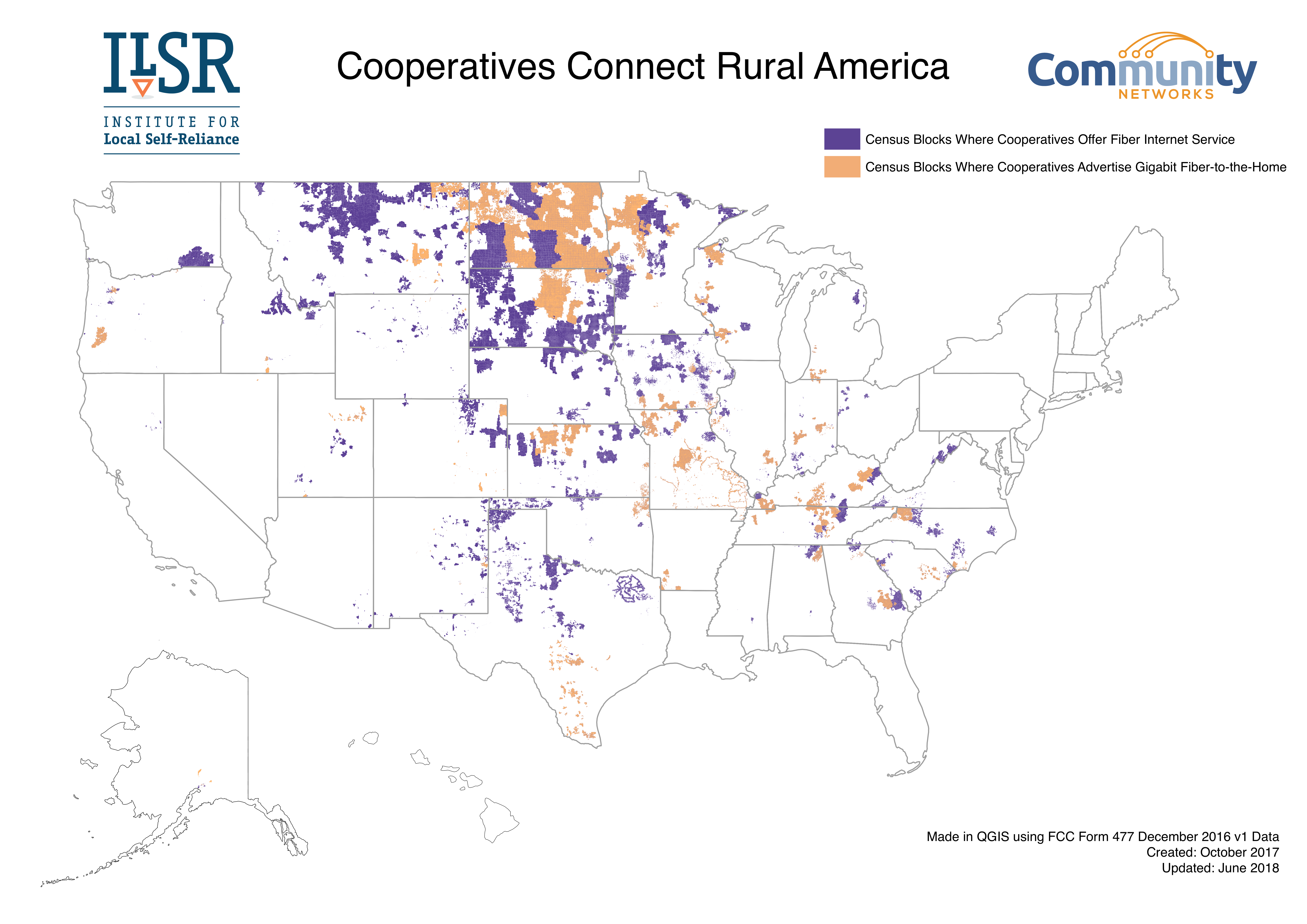
“Foster Campbell ignores the fact the 69 co-ops around the country have already done projects like that proposed by Claiborne and none of those have failed,” the Homer member said. “He also ignores that about 75 other co-ops around the country are in the process of starting fiber optic systems.”

(CLICK ON IMAGE TO ENLARGE)

Foster’s behavior is a strange reversal of traditional Democratic support for electric cooperatives begun under the administration of Franklin Roosevelt and championed by such notables as Lyndon Johnson. In fact, Foster’s rhetoric is reminiscent of Bobby Jindal’s REJECTION of that $80 million Commerce Department grant to install high-speed broadband internet for Louisiana’s rural parishes back in 2011.

In that case, Jindal was in lockstep with the AMERICAN LEGISLATIVE EXCHANGE COUNCIL (ALEC) which in 2010 had staked out its opposition to federal encroachment onto the turf of private business despite the fact that private business had been painfully slow in responding to the needs of rural America dating back to the early days of electric power and telephone service.

And therefore, since AT&T was a member of ALEC and since AT&T was opposed to the grant, therefore, so was Jindal. In Jindal’s case, AT&T had also made a six-figure contribution to his wife’s charitable foundation, giving Jindal another reason to take up the ALEC banner.

AT&T, in fact, even took the City of Lafayette to court to fight the city’s efforts to construct its own fiber optic high speed broadband internet system. It was a costly fight for both sides but Lafayette eventually emerged victorious despite AT&T’s best efforts.

Foster Campbell, in his press release noted that AT&T would be responsible for $17.2 million, or 79 percent of the FCC-funded broadband expansion into PSC District 5 while CenturyLink of Monroe would have responsibility for $3.9 million (18 percent) of the cost and satellite provider ViaSat would spend $1.5 million (3 percent).

So, why is Campbell now sounding so downright Jindalesque in his opposition to Claiborne Electric?

For that answer, one would have to take the advice FBI agent Mark Felt, aka Deep Throat, gave to reporter Bob Woodward during the Washington Post’s investigation of Nixon and Watergate:

Follow the money.

  • CenturyLink made two $1,000 contributions to Campbell’s various state campaign fund in 2011 and 2012, according to Louisiana Ethics Commission records.
  • Glen F. Post, III, of Farmerville in Union Parish, is President of CenturyLink. He personally contributed $11,500 to Campbell between 2003 and 2014.
  • Stacy Goff is Executive Vice-President of CenturyLink. He chipped in another $500 for Campbell in 2005.
  • AT&T gave $10,000 to Campbell in campaign contributions between 2003 and 2010.
  • William G. “Bud” Courson and James W. Nickel of Baton Rouge are registered lobbyists for AT&T. Their firm, Courson Nickel, LLC of Baton Rouge, contributed $2,000 to Campbell from 2002 to 2014.

CENTURYTEL

COURSON NICKEL

Post contributed another $3,000 to Campbell’s unsuccessful Senate campaign in 2016 and Nickel and Courson also contributed $500 and $1,000, respectively, to that campaign, federal campaign finance records show.

Altogether, Foster Campbell had at least 30,500 reasons to oppose Claiborne Electric’s proposal to provide high speed broadband internet service to its members.

Because he indisputably had skin in the game, he should have recused himself from the discussion in order to avoid any conflict of interests.

Therein lies the problem of regulators accepting contributions from those they regulate.

Read Full Post »

The Louisiana Supreme court maintains an attractive WEB PAGE that provides all sorts of information. Among other things, there are these handy features:

BIOGRAPHIES of JUSTICES;

BAR EXAM RESULTS;

FREQUENTLY ASKED QUESTIONS ABOUT the COURT;

POLICY for MEDIA;

There’s even a link to the ATTORNEY DISCIPLINARY BOARD, the board that hears complaints about attorneys’ professional and private practices and metes out punishment ranging from required counseling to disbarment.

That can be a good thing in case you’re looking for an attorney to represent you. You wouldn’t want to hire legal counsel who has a nasty habit of showing up drunk in court or who doesn’t ever get around to dispensing monetary awards to clients or worse, someone who neglects a case until it prescribes.

And the court’s DECISION and RULES link can be especially brutal. It lists each individual case and goes into minute detail in laying out every charge against an attorney, no matter how personal, and then announces to the world what the Supreme Court deems to be an appropriate punishment.

Woe unto any attorney who gets caught DRIVING UNDER the INFLUENCE or who forgets to PAY HIS TAXES.

Of course, the same goes for judges found guilty of judicial misconduct, right?

Well, to borrow a phrase from an old Hertz car rental commercial: not exactly.

There is a JUDICIARY COMMISSION and it does investigate and resolve complaints against judges—or so it says.

There’s even a handy-dandy JUDICIAL COMPLAINT FORM for anyone with a beef against a judge.

But try as you might, there doesn’t seem to be a link that lists actual complaints and actions taken against judges by the Judiciary Commission. An oversight, we were sure.

So, we placed a call to the Supreme Court. Surely, there was someone there who could direct us to the proper link so that we might know the status of say, one JEFF PERILLOUX, Judge of the 40th Judicial District in St. John the Baptist Parish.

Perilloux, 51, was suspended by the State Supreme Court following his indictment on charges he sexually assaulted three teenaged girls, friends of his daughter, while on a family vacation in Florida.

This is the same Judge Perilloux who, while a parish prosecutor in 2010, was arrested for DWI. In that incident, he threatened a State Trooper, falling back on the time-honored “Do you know who I am?” ploy, advising the trooper that, “I am the parish attorney. I’m not some lowlife.” Good to know, sir. Here’s your ticket.

Then there are the two judges from IBERVILLE PARISH who were suspended in 2016.

And who can forget the judges caught up in the OPERATION WRINKLED ROBE federal investigation?

Well, apparently, the Louisiana Supreme Court’s Judiciary Commission has no problem forgetting those cases. Or at least ignoring them. Try finding any mention of those on the Supreme Court’s information-laden web page.

So, we made a call to the Supreme Court.

But, alas, we encountered the old familiar stone wall when we inquired into the status of investigations into judicial misconduct. The person to whom we spoke did offer to direct us to the judicial complaint form so we had to explain a second time that we did not wish to file a complaint but instead, wanted to find information about action taken against wayward judges.

“We don’t release that information,” we were told. “The only way that gets publicized is if the media finds out about it.”

“But, but, but, you list attorney disciplinary action…It seems the public has as much right to know about judicial discipline as about attorney discipline—maybe even more of a right.”

“We don’t release information on judges.”

Here is the relevant rule applicable to records:

Rule XXIII, Section 23(a) of the Rules of this Court be and is hereby amended to read as follows:

Section 23.

(a) All documents filed with, and evidence and proceedings before the judiciary commission are confidential. The commission may provide documents, evidence and information from proceedings to the Louisiana Attorney Disciplinary Board in appropriate cases when approved by this court. In such cases, the confidentiality provisions of La. S. Ct. Rule XIX, Section 16A shall be maintained. The record filed by the commission with this court and proceedings before this court are not confidential.

In the event a judge who has received notice of an anticipated judiciary commission filing in accordance with Rule XV of the rules of the judiciary commission, moves in advance of the filing to place any or all of the anticipated judiciary commission filing under seal, the judiciary commission shall file under seal its recommendations, findings of fact and conclusions of law, the transcript of the proceedings, and exhibits. The filing shall remain under seal until such time as the court has acted upon the judge’s motion.

Which, I guess, is just another way of saying, “We take care of our own.”

Read Full Post »

Physicians Health Foundation (PHF), which for years has abetted the Louisiana Board of Medical Examiners in targeting vulnerable medical practitioners in a manner reminiscent of the tactics employed by the Louisiana State Board of Dentistry, now finds itself in the crosshairs of State Sen. John Milkovich (D-Shreveport).

Both boards have for years flown under the radar of governors, legislators and the media but more and more, attention is being given to their near-autonomous rule by intimidation and extortion.

PHF, also known as the Healthcare Professionals’ Foundation of Louisiana (HPFL), is located on Bluebonnet Boulevard in Baton Rouge and it currently is about halfway through a three-year, $1.35 million contract with the Board of Medical Examiners to run a “Statewide Operations of Physicians Health Program.”

And, since the Board of Dentistry has been mentioned, it might be worth noting that PHF also is just over a year into a three-year, $287,000 contract with that board to “develop, create and administer the Dental Health Professional Monitoring Program.”

By its own admission in a lawsuit to be discussed later in this post, it is not a treatment facility. So, just what does PHF (or HPFL) do to earn its money?

Well, for the Board of Medical Examiners, it appears to extract huge fees from medical professionals (which includes doctors, physician assistants, podiatrists, medical psychologists, dentists and dental hygienists) who are found to have addiction problems or who the board deems to have committed other transgressions.

And since its contract with the Board of Medical Examiners includes dentists, it is unclear why there is a need for a separate $287,000 contract with the Dentistry Board.

But like the Dental Board, the Board of Medical Examiners has set itself up as accuser, prosecutor, judge and jury in investigating complaints and handing down its decisions. Again, like the Dental Board, the Board of Medical Examiners even conducts its own hearings whenever a doctor appeals one of its decisions.

And the board remains a stellar undefeated record in 20 years of reviews of its decisions that are appealed.

Which probably is the reason Sen. Milkovich feels the need for his SB 286, which would establish a Physicians’ Bill of Rights designed to protect their rights whenever they are brought under the scrutiny of the board. More about that shortly.

In addition to its ability to suspend licenses of medical professionals, the board wields a big stick in its ability to coerce licensees into signing consent agreements to enter into rehab.

And those consent agreements often come with large price tags in the form of fees and penalties. Many state regulatory boards, the Board of Medical Examiners and the Dentistry Board included, receive their budgets not from legislative appropriations but from membership fees and financial penalties assessed against members accused and convicted of violations, some of which, though minor, still carry large fines.

Doctors and other medical practitioners apparently are referred to the rehab centers by PHF (or HPFL) whose spokesperson indicated to LouisianaVoice that it has a list of approved facilities in Louisiana, Mississippi and Alabama, among others.

PHF’s $1.35 million contract with the Medical Board runs from Aug. 1, 2016 through July 31, 2019.

One of those rehab centers is PALMETTO Addiction Recovery Center in Rayville.

That facility became involved in a lawsuit in 2009 after one of its staff members. Dr. Douglas Wayne Cook became sexually involved with one of the center’s patients. The husband of the victim sued Cook, who is no longer with Palmetto but who does continue to have a private practice in Richland Parish.


Milkovich’s bill, already reported out of committee favorably, is scheduled to be brought before the entire Senate on Monday.

“Under Louisiana’s current board system, physicians often face an uneven playing field, rigged proceedings, and a stacked deck,” Milkovich said. “Licensed, dedicated and highly qualified professionals may have their licenses threatened, suspended, or revoked, based on false accusations, anonymous complaints, and spurious charges. Doctors are often administratively charged by the board without even being informed of the identity of their accusers, the evidence against them, or even the substance of the accusations brought against them. This injustice is compounded by the heavy-handed and inequitable tactics employed by some Board staff.

“We understand that there must be a fair and sound disciplinary process for physicians, to protect the public. However, the goal of board proceedings for physicians should be impartiality, fairness, and integrity—not intimidation, falsification, and inequity.

“The aim of SB 286 is to level the playing field, un-stack the deck and render the Board’s adjudication of doctors more transparent. Everyone deserves Due Process. And that includes doctors.”

The bill, according to the BATON ROUGE ADVOCATE, would require stricter communication requirements during board investigations and would require that the board provide physicians under investigation written notice of complaints within 10 days or receipt. Moreover, the bill would require that the board reveal the identity of the complainant and would prohibit ex parte communications by board members prior to a hearing on the pending investigation.

One critic of the board, Dr. Greg Stephens said criminals and terrorists receive “more due process than we give doctors.” He and his former boss, Dr. John Gianforte, said they were coerced into consenting to voluntary license suspensions and mandated substance abuse treatment without either being allowed to give their side of the story.

They were suspended following claims that Stephens allowed unqualified staff members to write and sign prescriptions in his name while serving as medical director at a clinic in Shreveport when in fact, the prescription pad was stolen by two employees and Stephens’ name forged. Gianforte said the two employees were fired and one was later charged by law enforcement authorities.

Milkovich even cited a case where a New Orleans physician practicing at Tulane Medical Center committed suicide last November. His license was summarily suspended in June following an investigation but was reinstated in October. By then, however, the doctor had lost privileges, positions and future opportunities as a result of the investigation, the senator said.

In another case, the family of another doctor filed suit against PFL when the doctor, informed that he had had tested positive for drug use, committed suicide a few hours later. The doctor’s family was told by PFL that its programs and personnel had statutorily qualified immunity from legal liability regarding their activities and that they were further protected by a release and a hold-harmless agreement with the Physicians Health Program.

RAMEY V. DECAIRE

PHF was successful in getting the Louisiana Supreme Court to rule that it was exempt under the peremptory exception of no cause of action and the family’s lawsuit was dismissed. PHF, apparently not satisfied with merely winning, then went after the family for legal sanctions, claiming their suit was frivolous and without reasonable good faith. The trial court denied PHF’s motion and PHF appealed. The First Circuit Court of Appeal upheld the trial court and assessed costs against PHF.

Read Full Post »

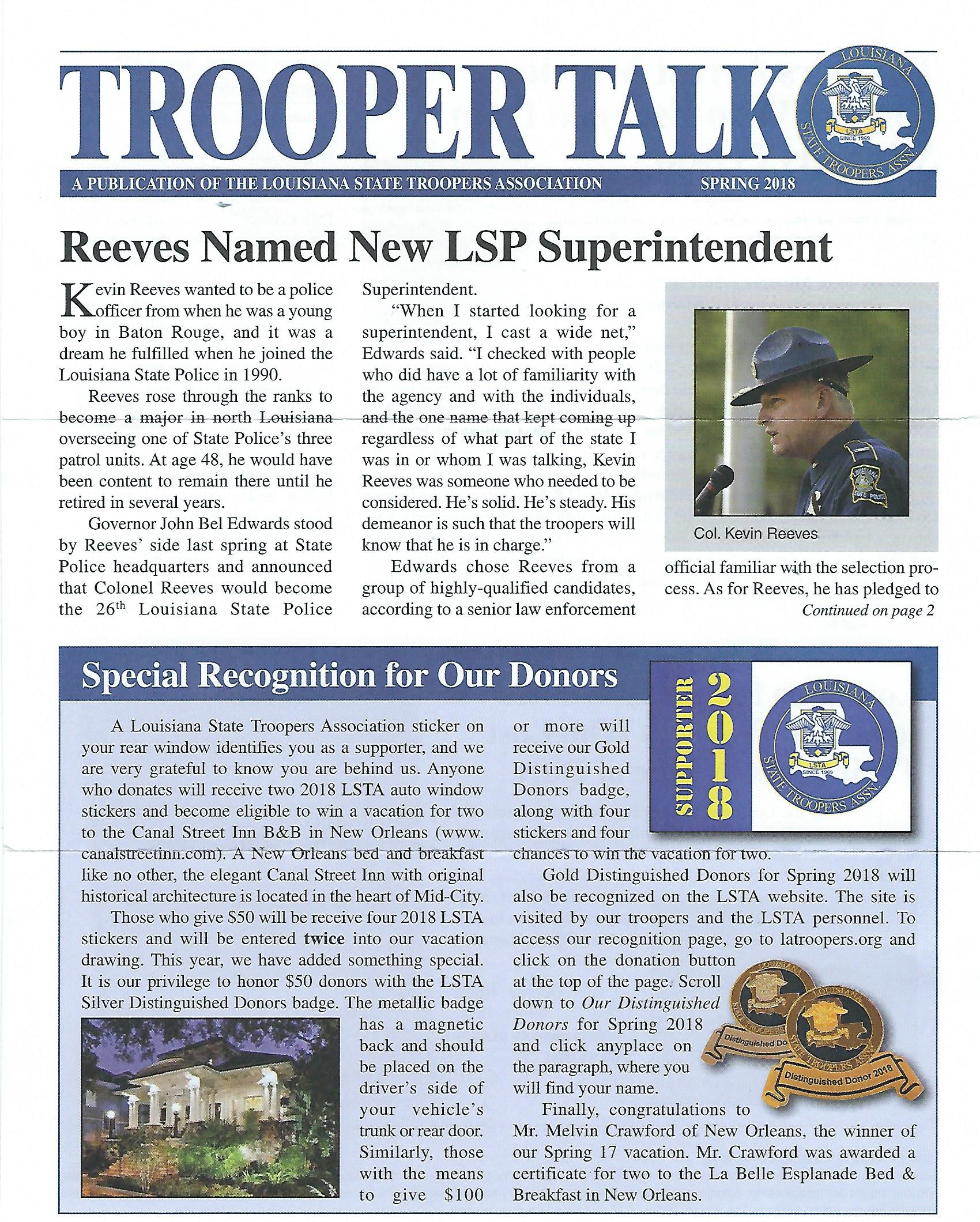
Just when you thought enough had been written about the Louisiana State Troopers Association (LSTA), wouldn’t you know that the organization sent out solicitation letters to three members it had kicked out a couple of years back because they questioned the group’s political activity?

Talk about adding insult to injury.

But that isn’t really the story here. What’s interesting about this solicitation is that the Spring 2018 edition of Trooper Talk actually appears to sending out a not-so-subtle message that if you contribute enough money, you will get a handy little magnetic decal to stick on your vehicle to alert troopers that you gave and probably shouldn’t get a ticket for doing 85 in a 65.

Full disclosure: the story at the top of the page is an LSTA story about the appointment of Col. Kevin Reeves as Superintendent of State Police. Reeves is in no way connected to the LSTA fundraiser. This bulletin is published independent of Louisiana State Police.

And while the LSTA loves to point out how many wonderful projects it supports via its fundraisers, this time the solicitation seems to go out of its way to assure donors that, except for the cost of the newsletter and the decals, 100 percent of the money stays with the LSTA.

Maybe that’s because the LSTA is confident that the State Police Commission, the state police equivalent to the Louisiana Civil Service Commission, won’t lift a finger to investigate the association for its POLITICAL ACTIVITY even though such activity is clearly illegal.

The commission already has hired Natchitoches attorney Taylor Townsend under a $75,000 contract to conduct a non-investigation investigation of tens of thousands of dollars of LSTA political contributions funneled through the private bank account of its executive director David Young.

So, now there’s this Trooper Talk which informs potential donors that any contribution will get them a couple of window stickers that will, in case you are pulled over for a traffic violation, tell troopers that you are a cheapskate who wouldn’t even pony up $50. But if you give between $50 and $100, you will get a dandy “Silver Distinguished Donors badge.” Those donors will also be entered twice in a drawing for a vacation for two in the Canal Street Inn Bed and Breakfast in New Orleans.

Now this is just any old silver distinguished donors badge. It has a genuine magnetic back “and should be placed on the driver’s side of your vehicle’s trunk or rear door.” (emphasis added.) (Now, why would they suggest placing them there? For better trooper visibility perhaps, hmmm?)

What about those who give $100 or more? Good question. Those generous supporters will get a “Gold Distinguished Donors badge” and four chances at that dream vacation in New Orleans. Those benefactors will also be recognized on the LSTA website. (The site is visited by our troopers and the LSTA personnel,” the solicitation letter said (wink, wink).

And while the letter stresses that the money will remain with the LSTA, it would be unfair not to point out that the organization does do considerable charitable work with children and the families of troopers killed in the line of duty.

On the other hand, however, the LSTA recently announced that it was providing monetary assistance to members who were victims of the 2016 floods in Louisiana. But several retired troopers who also victims of the same floods complained that they received no assistance whatsoever.

Some of those same retirees have filed a complaint with State Police headquarters in Baton Rouge about the latest fundraising solicitation and its indirect suggestion that a large enough donation might help donors avoid a ticket.


Read Full Post »

« Newer Posts - Older Posts »