Feeds:
Posts
Comments

Archive for the ‘Commissions’ Category

The Louisiana State Troopers Association (LSTA) has apparently declared war against LouisianaVoice and two of its own retirees who dared voice their objections to campaign contributions by the association that amounts to little more than money laundering.

On Saturday (Feb. 27) we received a copy of a LETTER TO LSTA MEMBERS which, among other things accuses me of “an abysmal lack of journalistic ethics. (I have redacted the names of the two retirees in order to prevent undue pressure on one in his current employment.) While it was not my intention to get into a verbal exchange with LSTA, I feel I must address certain issues raised in the letter.

First of all, and this is important: I did not choose to re-open the subject of training for Trooper Steven Vincent. Nor was it I who initially raised the issue, but a retired state trooper in a letter to Louisiana State Police (LSP) headquarters. I unwisely wrote about the letter but took down the post at the family’s request. Now it appears that LSTA wants to keep the issue alive which raises the question of just who is the insensitive party here. If LSTA wishes to continue the debate over that story, it will have to do so alone. Out of respect for the family’s wishes, I refuse to be drawn into any further discussion of the subject.

As for any “agenda” the LSTA claims I may have, I can only deduce the association is attempting to deflect attention away from its own actions via the time-worn ploy of going after the messenger. For the record, in 40 years of news reporting for several major daily newspapers, I have enjoyed a healthy and professional working relationship with Louisiana State Police—until July 2014. That seems to be when things started going south.

For those who may not remember, that was when Department of Public Safety (DPS) Deputy Secretary and State Police Superintendent Mike Edmonson, through his friend State Sen. Neil Riser (R-Columbia), attempted to sneak through an amendment to an otherwise benign bill on the last day of the legislative session that would have given Edmonson a retirement income boost of about $55,000, something no other state employee has been allowed to do (except for a lone state trooper in Houma who coincidentally fell under the same qualifications as Edmonson). The bill passed and Edmonson seemed well on his way to enhanced retirement riches despite his having made an “irrevocable” decision years earlier to enter into the Deferred Retirement Option Plan (DROP) which froze his retirement at his then-rank of captain.

Generous retirement benefit boost slipped into bill for State Police Col. Mike Edmonson on last day of legislative session

But a sharp-eyed observer tipped off LouisianaVoice to the deception and we broke the story which was quickly picked up by state and national news publications. http://www.washingtontimes.com/news/2014/jul/16/law-change-boosts-pension-for-state-police-leader/

The letter, most likely written at the direction of State Police Superintendent Mike Edmonson, goes after two retired state troopers who had the audacity to request board minutes, checks, receipts, budgets and tax documents. Edmonson is not on the LSTA board but he nevertheless is closely involved in its activities through board members who work for him.

It is interesting to note that no one person signed off on the letter. It closes with “Respectfully, the LSTA Board of Directors.” So, presumably, every member of the board is a party to the letter which said the board respects the right of members “to question LSTA policies and practices.” At the same time, the letter admitted that the board “voted unanimously not to provide any further information” to the two.

It also said it has not seen a groundswell of support from LSTA membership for the two.

That should seem obvious to anyone who has not been in a coma for the past six months. There has been ample evidence on this blog that LSP administration, rather than addressing serious problems within its organization, has chosen to go after whistleblowers, even to the extent of conducting an audit of state-issued cell phones to determine who has been talking to LouisianaVoice. No active trooper in his right mind would lend vocal support to anyone who questioned activities of LSP or LSTA for fear of reprisals.

The biggest concern to the retirees who have challenged LSTA for its endorsement of John Bel Edwards for governor (the first such endorsement in LSTA’s history), Edmonson’s unsuccessful efforts to get LSTA to write a letter to Edwards after his election pushing for the Edmonson’s reappointment (Edwards did reappoint Edmonson to another term as superintendent, most likely at the urging of the Louisiana Sheriffs’ Association which endorsed him), and the funneling of more than $45,000 in political campaign contributions to several political candidates through LSTA Executive Director David T. Young, who wrote the checks for the contributions on his personal checking account and was later reimbursed by LSTA. https://louisianavoice.com/2015/12/09/more-than-45000-in-campaign-cash-is-funneled-through-executive-director-by-louisiana-state-troopers-association/

Of the more than $45,000 doled out to candidates, $10,500 went to Edwards in 2013, 2014 and 2015. Another $10,250 went to Bobby Jindal in 2003, 2007 and 2011. Edwards has since returned his contributions after his campaign deemed them inappropriate. Jindal has not returned his contributions.

And while the LSTA letter attempts to paint me as lacking in journalistic ethics and while I, as publisher of LouisianaVoice, did report on irregularities within LSP and LSTA, it is important to remember these points:

  • I am not the one who tried to manipulate an illegal increase in my retirement income by having an obscure amendment tacked onto a bill in the final hours of the 2014 legislative session.
  • I am not the one who secretly laundered campaign contributions through the LSTA executive director’s personal checking account only to “reimburse” him for expenses at a later date.
  • I am not the one who denied an accounting of those activities to LSTA members.
  • I am not the one who promoted a lieutenant to captain and commander of Troop F after that lieutenant sneaked an underage woman into a casino in Vicksburg and then tried to use his position as a state trooper to bargain his way out of trouble (it didn’t work; he was fined $600 by the Mississippi Gaming Commission).
  • I am not the one who chose to mete out only token punishment to a state trooper who was found to have twice had sex with a woman while on duty—once in the rear seat of his patrol car.
  • I am not the one who again handed out only a slap on the wrist and then promoted an LSP lieutenant to captain and named him commander of Troop D—after the lieutenant was found to be abusing prescription drugs while on duty and who admitted to flushing extra pills when he learned there was an active investigation into his addiction.
  • I am not the one who lied about the Troop D commander’s refusal to take a complaint about one of his troopers from a citizen; I merely posted a recording of his denial after LSP Internal Affairs exonerated the commander following an intensive “investigation.”
  • I am not the one who asked LSTA to write a letter of recommendation to Gov.-elect Edwards recommending that Edmonson be reappointed.
  • I am not the future State Police superintendent who was disciplined for padding his overtime expenses during a visit to New Orleans by the Pope.
  • I am not the one who refused to provide radio logs of a state trooper in LSP Troop D that revealed he was being paid for working when he was, in fact, asleep at home (I received the radio logs from an independent source but again, the records speak for themselves).
  • I am not the one who took an early retirement buyout of about $59,000 only to return to work for LSP the very next day—with a promotion.
  • Nor am I the one who ignored a directive from then-Commissioner of Administration Angéle Davis to repay the money, only to have the problem mysteriously go away when the daughter of Paul Rainwater, Davis’s successor, was given a job at LSP.
  • I am not the one who is responsible for that same retire/rehire having her son-in-law on LSP payroll as an employee of the State Police Oil Spill Commission—at the very time he was working offshore for a private firm.
  • I am not the one who hired Senate President John Alario’s wife who somehow manages to supervise LSP personnel in Baton Rouge—from her home in Westwego—at $56,300 per year.
  • Nor am I the one who hired Alario’s son, John W. Alario, as director of the DPS Liquefied Petroleum Gas Commission at $95,000 per year.

No, I am not the one responsible for any of these things; I merely reported them. But the LSTA board must possess sufficient intelligence to understand that each of these things is a matter of public record and that I could never have carried out any vendetta, perceived or otherwise, against LSP unless what I wrote was accurate.

LSTA, in its letter to its membership, accuses me of taking “uncorroborated information at face value, never question the motivation of the source, and offer it for public consumption without ever seeking to determine its truthfulness.” They know better.

I invite the LSTA board to cite a single instance of my reporting anything that was “uncorroborated” either by public records or by interviews with multiple sources.

I also invite the actual author if the LSTA letter to come forward and identify himself and not hide behind the anonymous sobriquet of “LSTA Board of Directors.”
Read Full Post »

Thursday’s regular meeting of the State Police Commission was brief but there could be decidedly bad news for members of the Louisiana State Troopers Association (LSTA) who approved all those political contributions and the endorsement of John Bel Edwards for governor last year.

Meanwhile, the commission approved a settlement of Troop D commander Capt. Chris Guillory’s appeal of his letter of reprimand that gives him carte blanche to do just about anything he likes with impunity.

But even that didn’t stop his nemesis Dwight Gerst from filing a brand new complaint against Guillory with Louisiana State Police (LSP) internal affairs.

Commission attorney Lenore Feeney told the commission that it had no authority to investigate the association or its executive director David Young because LSTA is a private organization and Young is not a LSP employee.

But state troopers do come under the commission’s authority, she said. Any state trooper who was a part of the decisions to endorse a candidate or to funnel campaign contribution funds through the LSTA’s director “could face disciplinary action.” In fact, she said, the commission has a duty to determine who was responsible for the decision.

Well, it’s for certain that Young didn’t make an arbitrary decision to contribute more than $45,000 to various political candidates. And he certainly didn’t make the decision on his own to have the LSTA reimburse him. Those decisions had to be made by the LSTA board and the board consists of LSP officers.

It remains to be seen what, if any, action will be taken in regards to conducting an investigation of the circumstances of the endorsement and the contributions.

But the commission, without comment, approved a settlement agreement between Guillory and LSP that will replace a November letter of reprimand with a letter of counseling which will cleanse his record.

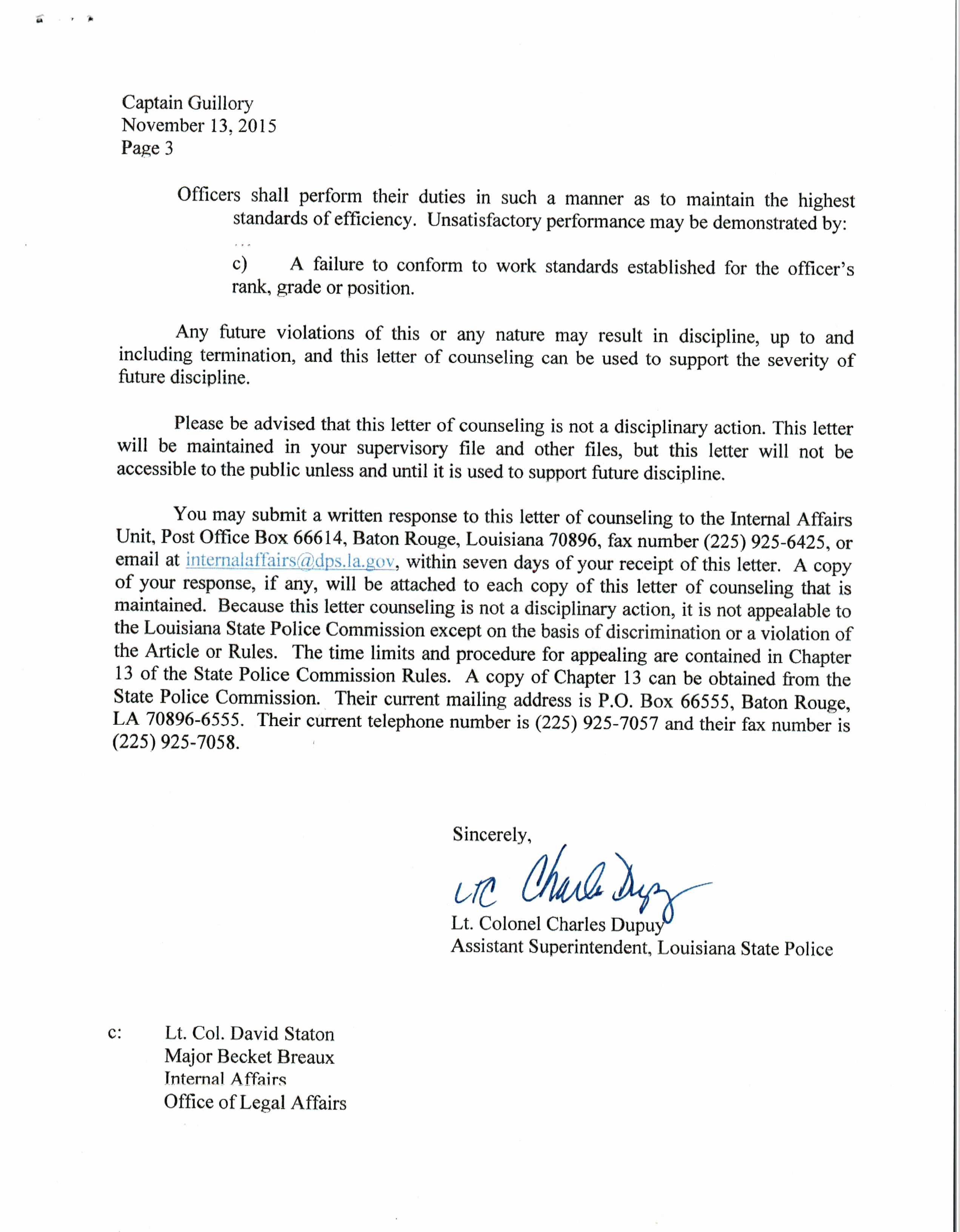
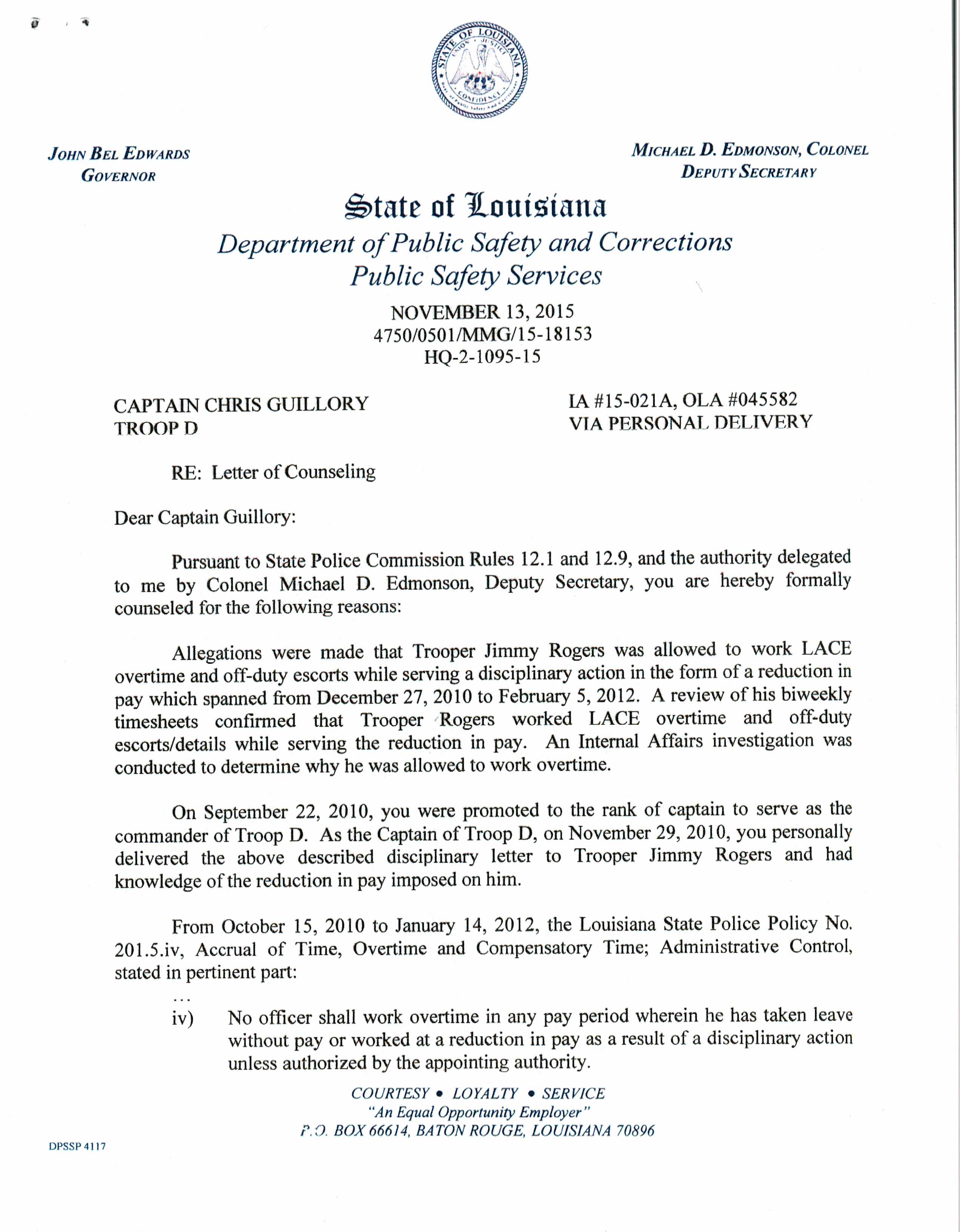
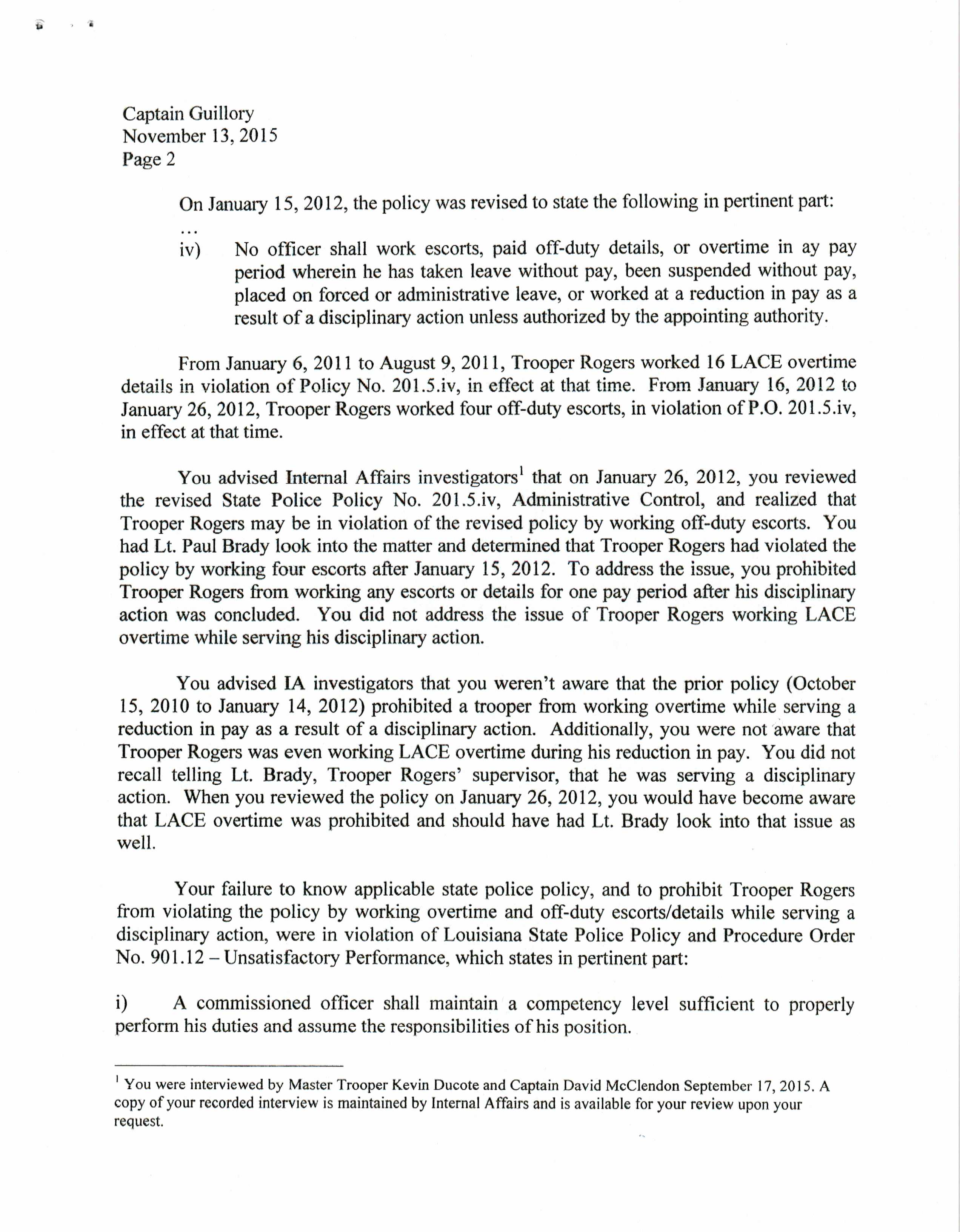
The reprimand was issued over Guillory’s allowing Trooper Jimmy Rogers to continue working special details for Local Area Compensated Enforcement Program for the Calcasieu Parish District Attorney’s office and to perform off-duty escorts while serving a discipline-related suspension. Here is the original letter of reprimand and Thursday’s settlement document:

IMAG1647IMAG1648IMAG1649IMAG1650


Guillory, while still a lieutenant, had previously been given a letter of reprimand after an investigation into his prescription narcotic use while on the job but was promoted to captain shortly afterward and named commander of Troop D.

A letter of reprimand remains on one’s record and is taken into account in promotion considerations. A letter of counseling, however, does not go into the individual’s personnel file and cannot be a factor when promotions are considered. Here is the original letter of reprimand and the subsequent settlement agreement.

This comes on the heels of LSP internal affairs decision denial of a complaint by Lake Charles resident Dwight Gerst, against Guillory. Gerst had complained that Guillory refused to accept his complaint against Rogers.

Subsequent to that IA denial, LouisianaVoice released an audio recording which clearly shows that Guillory did indeed refuse to accept Gerst’s complaint.

Following Thursday’s commission meeting, Gerst paid a visit to Internal Affairs and submitted a new complaint against Guillory on the basis of the contents of the recording.

Gerst said he was asked by IA why he had not provided the recording originally and his response was that he did not trust the investigators. It seems his fears were well-grounded, considering the manner in which Guillory was exonerated out of hand by investigators. The added exclamation point of reducing Guillory’s letter of reprimand to one of counseling only served to further validate those concerns and clearly illustrated the double standard employed by LSP in meting out discipline.

It’ll certainly be interesting to see how LSP will maneuver to deny Gerst once again and continue to enable Guillory.

Read Full Post »

When Louisiana State Troopers Association (LSTA) legal counsel Floyd Falcon defended political contributions in the 2015 gubernatorial campaign by LSTA, he cited a 1992 legal precedent which he said permitted the activity.

Apparently he had not counted on being outmaneuvered by a retired state trooper who was perfectly able to do his own legal research to counter Falcon’s argument at last week’s hearing before the State Police Commission.

Several retired state troopers, represented by spokesman Scott Perry, a retired captain with 26 years’ experience with LSP, appeared before the commission on Thursday (Jan. 14) to voice objections to the funneling of LSTA funds through its executive director David Young.

Perry was joined by retired Lt. Leon Millet who said more than $45,000 in political contributions were made without the knowledge or consent of the LSTA membership and that the action appeared to be a violation of the state constitution and State Police Commission regulations.

Perry, on Friday, followed his Thursday verbal request for an investigation with a written request. “Please accept this correspondence as a formal request pursuant to State Police Commission Rule ‘Chapter 16, Investigations,’” he wrote. Perry asked that the commission “investigate the allegation of Prohibited Political Active, 14.2 (A) (1), 14.2 (A) (4), 14.2 (A) (8), in regards to political endorsements and contributions.

“This request is made specifically against classified members of the Office of State Police acting in their capacity as elected officers of the Louisiana State Troopers Association.”

Following Perry’s address to the commission on Thursday, Falcon told the commission it had no authority to investigate LSTA because it is a private organization not subject to oversight by the commission.

Commission members agreed but pointed out that it is empowered to investigate illegal or questionable activity by individual state troopers. The commission is the equivalent of the Louisiana Civil Service Commission which serves the dual purpose of protecting the rights of state employees and investigating illegal or improper activities by state employees.

Falcon cited the 1992 case of Cannatella vs. the New Orleans Department of Civil Service. In that case, the Fourth Circuit Court of Appeal overturned a 30-day suspension handed down to police Sgt. Ronald Cannatella for violation of a city civil service rule prohibiting political activity. http://scholar.google.com/scholar_case?case=718580336782666189&q=cannatella+v.+department+of+civil+service&hl=en&as_sdt=8000006&as_vis=1

Cannatella was president of the Police Association of New Orleans (PANO) in January 1990 when PANO decided to endorse a candidate for mayor. PANO had polled its membership beforehand and Cannatella subsequently appeared at a public forum to announce the endorsement. The appellate court noted that Cannatella believed he was acting “pursuant to what he believed was a function of his position as the president of PANO.”

The court said that while the prohibition against political activity is “exclusively limited to commissioners and classified civil service employees and officers,” the prohibition “does not extend to a labor organization such as PANO, or its spokesperson, merely because its members are classified civil service employees.”

No sooner was Falcon finished citing the Cannatella case than Perry, who now works as an investigator for the Office of Inspector General, was on his feet. Perry presented a copy of a 2001 ruling by a three judge panel of the Fifth Circuit Court of Appeal. The ruling he held, while not a legal precedent, nevertheless differed significantly with the Cannatella case and was identical to the circumstances of the LSTA action.

In the case of Kenner Police Department vs. Kenner Municipal Fire & Police Civil Service Board, five officers who signed off on a contribution check in their capacity as members of the executive board of the city police association were fired.

In the opinion written by Judge Clarence McManus, the Fifth Circuit said that while Cannatella held that members of PANO had the right to endorse a candidate without exposing the members to penalties under the civil service laws, “…Cannatella is not controlling or binding on this court, as counsel for appellants seems to suggest.”

It said Cannatella is distinguishable because it involved a different statute governed by a different provision of the constitution. “In this case the appellants are indeed classified civil service employees. Therefore, the prohibition against political activity clearly applies to them,” the decision said. But, the court noted, the officers claimed they did not individually make any campaign contributions, but rather PACK did. (PACK is an acronym for Police Association for the City of Kenner.)

The court said the appellants’ assertion that the contribution and endorsement were actions taken by PACK and not the fire appellants individually “is simply untenable. As for the contention that being members of a labor union exempts them from any and all responsibility under the civil service laws, we find this argument unpersuasive. To allow the appellants to do indirectly through the union or an association that which they cannot do directly as classified civil service employees will permit them to circumvent the statute’s prohibition.” (Emphasis ours)

The civil service board held that the campaign contribution check “was personal action taken by the officers individually, and not an action of the association,” said the appellate court in upholding their termination.  http://caselaw.findlaw.com/la-court-of-appeal/1285153.html

LouisianaVoice broke the story of the LSTA contributions on December 9. https://louisianavoice.com/2015/12/09/more-than-45000-in-campaign-cash-is-funneled-through-executive-director-by-louisiana-state-troopers-association/

In the LSTA case, Young acknowledged that he made the contributions in his name and was subsequently reimbursed by the organization.

In a statement that would seem to conflict with LSTA’s own legal counsel’s argument, Young said there were questions about the ability of state employees making political contributions. “So in order to avoid any of that,” he told the Advocate, “if I make a contribution as a non-state employee, there could never be a question later that a state employee made a contribution.”

Except there now are questions. Commission Vice Chairman W. Lloyd Grafton of Ruston observed that it “almost makes me think there was something suspect here because of the check writing. Why wouldn’t the association have made the contribution? It looks like someone was trying to circumvent something.”

Prior to that date, on Dec. 4, LouisianaVoice broke another story that State Police Superintendent Mike Edmonson attempted to prevail upon the LSTA board to write a letter to then Gov.-elect John Bel Edwards endorsing Edmonson for reappointment to lead state police for another four years.

On Nov. 30, the board voted unanimously not to write the letter. Edwards subsequently reappointed Edmonson anyway, largely on the strength of the endorsement of the Louisiana Sheriffs’ Association and the Louisiana Police Chiefs’ Association.

Edmonson twice denied that he had requested the LSTA board’s endorsement but LSTA Interim President Stephen LaFargue confirmed to LouisianaVoice, also on two separate occasions, that Edmonson asked him about the prospects of LSTA sending a letter to Edwards asking that Edmonson be reappointed.

“Col. Edmonson attended the board meeting and he told me he was going to apply for reappointment,” LaFargue said. “He then asked about the possibility of the LSTA board writing a letter of endorsement. I told him I didn’t know, that it would have to be taken up by the board.” Because of questions raised by LouisianaVoice, the board subsequently agreed unanimously not to write the letter to Edwards.

A meeting summary of a Troop I (Lafayette) affiliate meeting noted that LaFargue also “took responsibility” for the LSTA’s endorsement of Edwards in the Nov. 21 runoff election against U.S. Sen. David Vitter. Edwards defeated Vitter by a 60-40 percentage point margin.

Edwards also was one of several candidates who received contributions from LTSA. Edwards spokesman Richard Carbo told the Baton Rouge Advocate last Thursday that the governor had no knowledge that Young was reimbursed by LSTA and that Edwards would return the $8,000 received from LSTA through Young “if the contributions were made improperly.” http://theadvocate.com/news/14574305-124/head-of-state-police-group-says-nothing-wrong-with-his-political-donations-gov-edwards-said-he-will

Louisiana State Police Commission Chapter 14 to which Perry referred specifically says that no member of State Police shall:

  • Participate or engage in political activity, including, but not limited to, any effort to support or oppose the election of a candidate for political office or support or oppose a particular political party in an election;
  • Make or solicit contributions for any political purpose, party, faction, or candidate;
  • Directly or indirectly, pay or promise to pay any assessment, subscription, or contribution for any political party, faction or candidate, nor solicit or take part in soliciting any such assessment, subscription or contribution, and no person shall solicit any such assessment, subscription or contribution of any classified employee in the State Police Service.

http://laspc.dps.louisiana.gov/laspc.nsf/c4b8169248104d4286256ead0069b9bd/582526be4d41dca786256ea000667ce2?OpenDocument

So in the end, we have:

  • State police officers who comprise the LSTA board making a political endorsement in direct contravention of rules and regulations.
  • The Superintendent of State Police leaning on the LSTA board in an effort to get the board to send the new governor a letter endorsing him for reappointment.
  • The executive board of the LSTA, comprised of state police officers under the jurisdiction of the State Police Commission making the decision to make more than $45,000 in political contributions—contributions that were laundered through its non-state employee executive director—by the director’s own admission, and without bothering to poll its membership for approval.

All three of which were in violation of State Police Commission regulations.

Any questions?


Read Full Post »

The legal counsel for the Louisiana State Troopers Association was true to the time-honored tradition of blaming the messenger for bad news during Thursday’s meeting of the Louisiana State Police Commission.

According to lawyer Floyd Falcon, yours truly is the bad guy in all the flap about the LSTA’s contributions to political campaigns during the recent election cycle.

Never mind that active troopers as well as retirees who are members of LSTA have openly voiced their objections to the decision of the LSTA board to launder more than $45,000 in contributions through executive director David Young.

As publisher of LouisianaVoice, I apparently am the problem. I am a “common complainant,” according to Falcon, who said he would refused to respond to any questions put to him by me.

I guess we’re just supposed to sit still and shut up and not ask questions about how our public officials comport themselves. Perhaps Mr. Falcon spent so much time watching the legislature do just that during the eight years of the Bobby Jindal administration that he truly believes that’s how it should be.

Well, Mr. Falcon, my grandfather always taught me to question motives and to never accept things at face value. “Never listen to what a politician says,” he told me over and over. “Listen to what they don’t say.”

And at Thursday’s commission meeting, there was plenty that wasn’t said.

Never mind that the contributions were fronted by Young who was then repaid from a slush fund handed by LSTA: I am the one who writes “convoluted stories,” according to Falcon.

Never mind that Falcon, when asked point-blank, said he did not know why the checks to various political candidates, including Gov. John Bel Edwards, were made in Young’s name.

Never mind that Young said he made the contributions as a non-state employee so “there could never be a question later that a state employee made a contribution,” which is against state civil service rules.

But the fact is, the state employees, in this case, state troopers, did make the contributions since the LSTA is supported in large part by membership dues from troopers and retired troopers.

When retired state trooper Scott Perry of Opelousas, complained that he was refused copies of checks and receipts after making a public records request, Falcon said those records were available for the asking.

When I asked him to confirm that, and he responded in the affirmative, I then asked why the checks and receipts for reimbursement to Young were not made available, Falcon bristled. “Mr. Aswell is not a member of LSTA. He is a common complainant and I decline to answer his questions,” he said.

If exposing questionable activities of governmental agencies and officials defines me as a “complainant,” it is a mantle I wear with considerable pride, Mr. Falcon’s intended insult notwithstanding. No less a statesman than Thomas Jefferson said, if given a choice of government without a free press or a free press without government, “I would not hesitate to choose the latter.”

Mr. Falcon may not like it, but I am every bit as qualified as a member of the Fourth Estate as any reporter for any medium. I hold a degree in journalism and I spent more than 25 years as a reporter and editor of several Louisiana newspapers and even owned and ran my own news service in the State Capital for a number of years, providing coverage of state government for about 30 newspapers across the state. Along the way I’ve managed to pick up a few awards for feature writing, breaking news coverage, and investigative reporting.

I will put my credentials as a reporter alongside Mr. Falcon’s credentials as an attorney any day of the week. And I damn sure don’t mind being labeled a “complainant.”

At least I didn’t go before the commission to argue that there was nothing for it to investigate as did Mr. Falcon. LSTA, he huffed, is a private entity and not subject to public records requests and not subject to any investigation by the State Police Commission. Well, that certainly makes everything hunky dory. LSTA, he said, is no different than a teachers union or other union of public employees. Well there is one slight difference, Mr. Falcon. The teachers unions and other public employee unions, when political contributions are made, they are done in the name of the union and not through some straw donor. And the union membership generally knows about the endorsements and contributions—or at least knows there will be endorsements and contributions to someone.

One retired member of LSTA, when informed of the contributions said, “Holy s—t! We had no idea this was going on.” Another said LSTA’s membership had never been told of the contributions. “They knew nothing about it,” he said. “We’re not supposed to get involved in politics.” https://louisianavoice.com/2015/12/09/more-than-45000-in-campaign-cash-is-funneled-through-executive-director-by-louisiana-state-troopers-association/

Tanny Devillier, a retired state police deputy commander, said he was “one of two members still alive” who founded LSTA in 1969. “LSTA was not created for political contributions,” he said. “It was created to provide support for troopers who suffered misfortune.”

“It almost makes me think there was something suspect here because of the check writing,” said commission Vice Chairman Lloyd Grafton. “Why wouldn’t the association have made the contribution? It looks like someone was trying to circumvent something.”

Perry, who now works as an investigator for the Office of Inspector General, cited Louisiana revised statute 18:1505.2 which says, “No person shall give, furnish, or contribute monies, materials, supplies, or make loans to or in support of a candidate or to any political committee, through or in the name of another, directly or indirectly. This prohibition shall not apply to dues or membership fees of any membership organization or corporation made by its members or stockholders, if such membership organization or corporation is not organized primarily for the purpose of supporting, opposing, or otherwise influencing the nomination for election, or election of any person to public office.”

He said if LSTA establishes a precedent of making campaign contributions, it will encourage candidates for every office “to come to LSTA with their hands out and that’s not what LSTA is for.”

Leon Millet, a retired lieutenant who served more than 20 years with LSP, reiterated the payments were made without the knowledge or consent of the membership. At the same time, he said members who are still active troopers refuse to come forward out of fear of reprisals.

State Police Commission Chairman Franklin M. Kyle III said the commission lacks jurisdiction over private groups such as LSTA but that the commission and LSTA have a “common denominator,” which he described as the shared membership of state troopers. He requested that LSTA provide more documentation on its finances and issued an invitation to the unhappy retired troopers present to reappear at a future meeting.

A spokesman for Gov. Edwards, Richard Carbo, told the Baton Rouge Advocate that if it is determined that the contributions were made improperly, the LSTA contribution to the Edwards campaign ($8,000) would be returned. http://theadvocate.com/news/14574305-124/head-of-state-police-group-says-nothing-wrong-with-his-political-donations-gov-edwards-said-he-will.

Meanwhile, Mr. Falcon, I will happily continue being the “common complainant” whenever I see things that don’t appear in the best interest of the citizens of Louisiana.

Read Full Post »

Two emails popped up on our computer on Wednesday that we simply could not ignore and while the messages concern men who have an intense dislike for each other, the emails are nevertheless related in ways that should offend every voter citizen in Louisiana.

If you were not already turned off by Bobby Jindal and David Vitter, these should do it. If not, then you are part of the problem.

The first is a response to one of our readers from U.S. Sen. David Vitter, the odds-on favorite to become Louisiana’s next governor.

Our reader had written Vitter to ask for his support for a constitutional amendment to overturn the 2010 Citizens United Supreme Court decision that said corporations and unions may not be restricted from spending money to support or denounce individual candidates in elections, in effect giving corporations the same rights as citizens. (The exception is that citizens may be sentenced to prison terms for white collar crimes while corporations may only be fined—usually in amounts far less than the financial gains realized from the criminal activity.)

Anyone who still does not see the manner in which money buys elections in this country—from legislators all the way up to president of the United States—either is a special interest lobbyist, a corporatist power broker, or someone who lives under a rock.

Vitter, in his response, somehow managed to morph the request for the regulation of campaign finance to the muzzling of free speech. “Thank you for contacting me in support of a constitutional amendment that would allow Congress and states to regulate campaign finance and political speech,” he said.

“As you know,” he said, “more than 40 Senate Democrats are supporting an amendment to the Constitution to allow regulations on political speech during federal elections. This proposal comes in response to multiple United States Supreme Court cases upholding the free speech protections enshrined in the First Amendment.”

Right away, he manages to turn it into a Democrat vs. Republican rather than a bipartisan issue. Somehow, when they get to Washington, they just have to make everything an us vs. them fight—like it would kill them to ever admit anyone in the other party might have a good idea. No wonder Congress has such a low approval rating, right down there with televangelists. And we just as quickly get the feeling that Vitter isn’t going to be very sympathetic to any suggestion of campaign reform. Not that’s any real surprise; a special super political action committee was set up on Vitter’s behalf earlier this year to help catapult him into the governor’s office. That PAC, The Fund for Louisiana’s Future, immediately funneled more than $3 million into his campaign.

But back to his email:

“Proponents of the amendment argue that corporations and individuals should be limited in their ability to indirectly support or oppose federal candidates, but the amendment would grant Congress power to pass new statutory limitations on political speech that could impact anyone,” he said.

Oh, please.

“I fear that its adoption would allow Congress to regulate everyone from the Sierra Club to the National Rifle Association, pro-life and pro-choice groups, and could even suppress publishers and producers from releasing new books and movies that pertain to a candidate.”

What unmitigated B.S.

“Moreover, nothing in this amendment is limited to corporations or billionaires; it could easily include limitations on the rights of every American. A free society must engage in robust discourse in search of truth,” he continued in his self-serving gooneybabble.

“Objectionable speech should be confronted in the free marketplace of ideas where the best ideas win out, not through government regulations.

“Never in the history of the Constitution have we amended the Bill of Rights. I firmly disagree that we should do so now, especially not a right so fundamental to who we are as a nation. Although we disagree, rest assured that I will keep your thoughts in mind.”

So the bottom line is Mr. Vitter, who desires to be our next governor, wants corporations, lobbyists and special interest organizations with the financial clout to continue to buy access while drowning out our voices—to club our ideas, letters, emails and small (read: meaningless) contributions into so much pulp with their millions of dollars.

Mr. Vitter’s version of free speech—speech that favors those who are connected and who have the financial resources to purchase elections and politicians—is precisely what is wrong with the political system in the United States—and Louisiana.

The plain truth is Vitter is trying to purchase the governor’s office with his PAC and well-heeled political supporters who are contributing to his campaign not in the interest of good government but in the expectation of some quid pro quo in the form of contracts or favorable legislation. In other words, the buddy system wins, the state of Louisiana loses.

That email is just the sort of thing that State Rep. John Bel Edwards (D-Amite) should plaster all over every newspaper and television station in the state to show the real manner in which David Vitter views democracy and free speech.

And those views have nothing to do with representative government. They are to be used as a vehicle to roll over honest, hard-working citizens and, in the process, to make them think he’s doing them a favor. It’s all about convincing the great unwashed to vote against their own best interests by waving the flag and finding new enemies to hate.

The other email was a report in Wednesday’s online edition of the Baton Rouge Business Report, edited by Rolfe McCollister, a Jindal appointee to the LSU Board of Supervisors and who served as campaign treasurer of Jindal’s gubernatorial campaign and who now serves a treasurer of his presidential campaign.

That story said Jindal, who announced he was a candidate for the Republican Presidential nomination just a week before the close of the second quarter fundraising period, raised $578,758 in that first week.

In all, he has raised more than $9 million, with the bulk of that (more than $8.6 million) raised through super PACs—the American Future Project, Believe Again, and the America Next non-profit—which only reinforces what we said above about the unlevel playing field created by PACs.

The report said that 87 percent of Jindal’s campaign donors contributed $100 or less.

That’s the same kind of garbage he once tried to feed us about the contributions to his governor’s campaign. Trouble is, readers should not listen to what he says but rather to what is not said.

In poring over his initial presidential campaign report (yes, we do that), we found 180 contributors gave the maximum $2,700. That included multiple members of the same household, or in the case of the Madden Construction family in Minden, eight separate Maddens contributed $2,700 each.

The 180 individual donors combined to account for $486,000 of that $578,758. Two of those donors were listed as giving additional checks of $5,400 each (which exceeds federal limits, but we’ll leave that to the Federal Elections Commission). Moreover, an organization identified as the Smoke Bend Political Action Committee ponied up another $5,000.

That runs the subtotal to $501,800.

Continuing down the list, we find that 14 individuals gave $1,000 each, 21 gave $500 each, 42 contributed $250 each, five gave $350 and two more chipped in $300 each.

Altogether, that comes to $538,800, or 93 percent of the total $578,758 and it leaves only about $40,000 for that 87 percent who gave $100 or less. Don’t listen to what they say; hear what they’re not saying.

So the point is, the big money donors simply overwhelm the small donors and to say that most of his donors were small donors is deliberately misleading and disingenuous.

But just for argument’s sake, let’s take a look at a few of major donors.

  • Rolfe McCollister (LSU Board of Supervisors member) and Gene McCollister of Baton Rouge, $2700 each;
  • Hank Danos (LSU Board) and Rodlyn Danos of Larose, $2700 each;
  • Jack Lawton (LSU Board) and Holly Lawton of Lake Charles, $2700 each;
  • Jim McCrery (LSU Board), $2700;
  • Robert Yarborough (LSU Board) and Marsha Yarborough of Baton Rouge, $2700 each;
  • Chester Lee Mallett (LSU Board) and son Brad Mallett of Iowa, LA., $2700 each;
  • James Moore (LSU Board) and Lynn Moore of Monroe, $2700 each;
  • Scott Ballard (LSU Board) and Kristi Ballard of Covington, $2700 each;
  • Blake Chatelain (LSU Board) of Alexandria, $2700;
  • David Madden, Connie Madden, Sharon Madden, Lydia Madden, James Madden, John Madden, Melissa Madden and Douglas Madden, all of Minden, $2700 each;
  • Former Congressman Robert Livingston and Bonnie Livingston of Alexandria, VA., $2700 each;
  • Former Commissioner of Administration Paul Rainwater of Baton Rouge, $2700;
  • Louisiana Department of Revenue Secretary Tim Barfield and Nan Barfield of Baton Rouge, $2700 each;
  • Publisher of Baton Rouge Business Report Julio Melara of Baton Rouge, appointed by Jindal to the Louisiana Stadium & Exposition District, $2700;
  • Robert Bruno of Covington, appointed by Jindal to the Louisiana Stadium & Exposition District, $2700;
  • J.E. Brignac of Prairieville, appointed by Jindal to the Louisiana Stadium & Exposition District, $2700;
  • William Windham of Bossier City, appointed by Jindal to the Louisiana Stadium & Exposition District, and Carol Windham, $2700 each;
  • Former Jindal Executive Counsel Jimmy Faircloth of Pineville, $2700.

Those are just a few, but they account for $94,500. Not too much in the way of contributions outside Louisiana. Apparently the price of being appointed to a prestigious board or commission is not only to vote the way you’re told (see LSU board’s vote on firing presidents, doctors and attorneys, and on giving away state hospitals) but to pony up campaign funds when the boss comes calling.

Conspicuously absent (with only a couple of exceptions), however, were the names of Indian-Americans who practically lined up to contribute to his gubernatorial campaigns of 2003, 2007 and 2011 before watching in dismay as he began to distance himself from his Indian heritage, claiming that he did not believe in hyphenated-Americans.


Read Full Post »

« Newer Posts - Older Posts »