Feeds:
Posts
Comments

Archive for the ‘Civil Service’ Category

(You may enlarge the type by clicking on the plus (+) sign above the image and moving the bar at the bottom to the right to read the entire text.)

On Feb. 15, an arrest warrant was issued for a north Louisiana employee of the Louisiana Department of Children and Family Services (DCFS) following an investigation of more than two months by the Office of Inspector General.

Kimberly D. Lee, 49, of Calhoun in Ouachita Parish, subsequently surrendered to authorities and was subjected to the indignity of being booked into East Baton Rouge Parish Prison on Feb. 17 after being accused of filing false reports about mandatory monthly in-home visits with children in foster care.

As is often the case, however, there is much more to this story.

A month earlier, on Jan. 10, LouisianaVoice received a confidential email from a retired DCFS supervisor who revealed an alarming trend in her former agency:

“I served in most programs within the agency, foster care, investigations, and adoptions,” she wrote. “Over my career I witnessed the eight years of (Bobby) Jindal’s ‘improvements.’

“Those ‘improvements’ endanger children’s lives daily. The blight is spread from the Secretary to the lowliest clerical worker in the agency. People are overworked and underpaid but it’s not just that. People are so distraught from the unrelenting stress that children are in danger. Add to that the inexperience of most front line workers and their supervisors’ inability to properly train new staff.”

She then dropped a bombshell that should serve as a wake-up call to everyone who cares or pretends to care about the welfare of children—from Gov. John Bel Edwards down to the most obscure freshman legislator:

“In the Shreveport Region, the regional administrator (recently) told workers that they may make ‘drive-by’ visits to foster homes, which means talking to the foster parents in their driveway. Policy says that workers will see both the child and the foster parent in the home, interviewing each separately (emphasis added). A lot of abuse goes on in foster homes. Some foster families are truly doing the best they can but they need counseling and guidance from their workers. The regional administrator’s answer to that one? Have the foster parent call their home development worker—another person who can’t get her job done now.”

She wrote that she had heard of two separate incidents “where a child new to foster care was taken to a foster home and left without paperwork, without contact information for the person in charge of the case and without knowing even the child’s name.”

Moreover, she said, vehicles used in the Shreveport Region “are old, run-down, and repairs are not allowed. The last time new tires were bought was in 2014. When one (of the vehicles) breaks down, they just tow it away. No replacement is ordered.”

Could those factors have pushed Lee to fudge on her reports? Did the actions attributed to her constitute payroll fraud or did budgetary cuts force her into cutting corners in order to keep up with an ever-increasing caseload? Lee says yes to the latter, that she was told by supervisors to get things done, “no matter what.” Child welfare experts said her actions and arrest shone a needed light on problems at DCFS: low morale, high turnover, fewer workers handing greater numbers of caseloads, and increasing numbers of children entering foster care.

http://theadvocate.com/news/14909284-31/louisianas-child-protection-system-understaffed-and-overburdened-after-years-of-cuts-child-advocates

To find our own answers, LouisianaVoice turned to a document published on Jan. 5 of this year by the Child Welfare Policy and Practice Group of Montgomery, Alabama.

The 77-page report, entitled A Review of Child Welfare, the Louisiana Department of Children and Family Services, points to:

  • A growing turnover rate for DCFS over the past three years from 19.32 percent in calendar year 2012 to 24.26 percent in 2014;
  • A 33 percent reduction in the number of agency employees to respond to abuse reports;
  • A 27 percent cut in funding since fiscal 2009, Bobby Jindal’s first year in office;
  • An increase in the number of foster homes of 5 percent;
  • An increase of 120.5 percent in the number of valid substance exposed newborns, from 557 to 1,330;
  • A trend beginning in 2011 that shows 4,077 children entered foster care but only 3,767 exited in 2015;
  • A 19 percent decrease in the number of child welfare staff positions filled statewide from 1,389 in 2009 to 1,125 in 2015.
  • Of the 764 caseworkers, 291, or 38 percent had two years’ experience or less and 444 (58 percent) had five years or less experience.

Moreover, figures provided by the Department of Civil Service showed that of the agency’s 3,400 employees, 44.5 percent made less than $40,000 a year and 19 percent earned less than $30,000.

In 2014 (the latest year for which figures are available), the median income for Louisiana for a single-person household was $42,406, fourth-lowest in the nation, as compared to the national single-person median income of $53,657.

http://www.advisorperspectives.com/dshort/updates/Household-Incomes-by-State.php

“The stresses within the system are at risk of causing poorer outcomes for some children and families,” the report says in its executive summary. “…Recent falling outcome trends in some of the areas that have been an agency strength in the past are early warnings of future challengers.”

Despite years of budgetary cuts under the Jindal administration, Louisiana has maintained “a high level of performance in achieving permanency for children in past years and currently is ranked first among states in adoption performance,” the report said.

The budget cuts, however, “have negatively affected the work force, service providers, organizational capacity and increasingly risk significantly affecting child and family outcomes” which has produced a front-line workforce environment “constrained by high caseload, much of which is caused by high turnover and increasing administrative duties and barriers that compromise time spent with children and families.”

And it is that threat to “compromise time spent with children and families” that brings us back to the case of Kimberly Lee and to the email LouisianaVoice received from the retired DCFS supervisor who cited the directive for caseworkers to make “drive-by” visits to foster homes, leaving children with foster homes with no paperwork, contact information or without even knowing the children’s names, and of the state vehicles in disrepair.

It’s small wonder then, in a story about how Jindal wrecked the Louisiana economy, reporter Alan Pyke quoted DCFS Secretary Marketa Garner-Walters as telling the Washington Post if lawmakers can’t resolve the current budget crisis, many Louisiana state agencies will see budget cuts of 60 percent. http://thinkprogress.org/economy/2016/03/07/3757416/jindal-louisiana-budget-crisis/

As ample illustration of Bobby Jindal’s commitment to social programs for the poor and sick, remember he yanked $4.5 million from the developmentally disadvantaged in 2014 and gave it to a Indy-type racetrack in Jefferson Parish run by a member of the Chouest family, one of the richest families in Louisiana—but a generous donor to Jindal’s gubernatorial campaigns and a $1 million contributor to his super PAC for his silly presidential run.

Well, thanks to the havoc wreaked by Jindal and his Commissioner of Administration Kristy Nichols, the legislature did find it necessary to pass the Nichols’ penny tax (not original with us but the contribution of one of our readers who requested anonymity) to help offset the $900 million-plus deficit facing the state just through the end of the current fiscal year which ends on June 30.

Were legislators successful? Not if you listen to Tyler Bridges, one of the more knowledgeable reporters on the Baton Rouge Advocate staff. “Legislators were neither willing to cut spending enough, nor raise taxes enough nor eliminate the long list of tax breaks that favor one politically connected business or industry over another,” he wrote in Sunday’s Advocate (emphasis added). http://theadvocate.com/news/15167974-77/a-louisiana-legislature-that-ducked-tough-budget-decisions-during-its-special-meeting-convenes-again

As is all too typical, most of the real “legislation” was done in the flurry of activity leading up the final hectic minutes of the special session, leaving even legislators to question what they had accomplished. In military parlance, it would be called a cluster—.

But that should be understandable. After all, 43, or fully 30 percent of the current crop of legislators, had to work their legislative duties around their busy schedules that called upon them to attend no fewer than 50 campaign fundraisers (that’s right, some like Neil Riser, Katrina Jackson, and Patrick Connick had more than one), courtesy of the Louisiana Oil and Gas Association, the Beer Industry League, CenturyLink and a few well-placed lobbyists. http://www.nola.com/politics/index.ssf/2016/03/louisiana_special_session_fund.html

It is, after all, what many of them are best at. (Seven of those were held at the once-exclusive Camelot Club on the top floor of the Chase Bank South Tower. We say “once-exclusive” because last week the Camelot announced that it was closing its doors after 49 years. Restrictions on lobbyists’ expenditures on lunches for legislators was given as one cause for the drop in club membership from 900 to 400. Not mentioned was the fact that Ruth’s Chris and Sullivan’s steak restaurants in Baton Rouge have become favorite hangouts for legislators and lobbyists during legislative sessions. One waiter told LouisianaVoice during the 2015 session that one could almost find a quorum of either chamber on any given night during the session—accompanied, of course, by lobbyists who only wanted good government.) https://www.businessreport.com/article/camelot-club-closing-afternoon-can-no-longer-viable-club-owner-says

LEGISLATORS’ FUNDRAISERS

Bridges accurately called the new taxes that will expire in 2018 “the type of short-term fix” favored by Jindal and the previous legislature “that they had vowed not to repeat.”

Can we get an Amen?

In the meantime, he observed that Gov. John Bel Edwards and Commissioner of Administration Jay Dardenne, because the legislature still left a $50 million hole in the current budget, will have to decide which state programs will be cut—again.

Emphasizing the risks to children, Garner-Walters told legislators in a committee hearing during the just-completed special session that state DCFS staff numbers 3,400, down a third from the 5,100 it had in 2008. “You can’t just not investigate child abuse,” she said.

Former Baton Rouge Juvenile Court Judge Kathleen Richey, now heading up Louisiana CASA (Court Appointed Special Advocate), a child advocacy non-profit, has expressed her concern over the budgetary cuts that make DCFS caseworkers’ jobs so much more difficult.

“Our political leaders need to understand that while infrastructure represents a physical investment in our future, our children represent an intellectual investment in our future,” she said. “We have to protect innocent children who have no one else to stand up for them.”

Read Full Post »

The Louisiana State Troopers Association (LSTA) has apparently declared war against LouisianaVoice and two of its own retirees who dared voice their objections to campaign contributions by the association that amounts to little more than money laundering.

On Saturday (Feb. 27) we received a copy of a LETTER TO LSTA MEMBERS which, among other things accuses me of “an abysmal lack of journalistic ethics. (I have redacted the names of the two retirees in order to prevent undue pressure on one in his current employment.) While it was not my intention to get into a verbal exchange with LSTA, I feel I must address certain issues raised in the letter.

First of all, and this is important: I did not choose to re-open the subject of training for Trooper Steven Vincent. Nor was it I who initially raised the issue, but a retired state trooper in a letter to Louisiana State Police (LSP) headquarters. I unwisely wrote about the letter but took down the post at the family’s request. Now it appears that LSTA wants to keep the issue alive which raises the question of just who is the insensitive party here. If LSTA wishes to continue the debate over that story, it will have to do so alone. Out of respect for the family’s wishes, I refuse to be drawn into any further discussion of the subject.

As for any “agenda” the LSTA claims I may have, I can only deduce the association is attempting to deflect attention away from its own actions via the time-worn ploy of going after the messenger. For the record, in 40 years of news reporting for several major daily newspapers, I have enjoyed a healthy and professional working relationship with Louisiana State Police—until July 2014. That seems to be when things started going south.

For those who may not remember, that was when Department of Public Safety (DPS) Deputy Secretary and State Police Superintendent Mike Edmonson, through his friend State Sen. Neil Riser (R-Columbia), attempted to sneak through an amendment to an otherwise benign bill on the last day of the legislative session that would have given Edmonson a retirement income boost of about $55,000, something no other state employee has been allowed to do (except for a lone state trooper in Houma who coincidentally fell under the same qualifications as Edmonson). The bill passed and Edmonson seemed well on his way to enhanced retirement riches despite his having made an “irrevocable” decision years earlier to enter into the Deferred Retirement Option Plan (DROP) which froze his retirement at his then-rank of captain.

Generous retirement benefit boost slipped into bill for State Police Col. Mike Edmonson on last day of legislative session

But a sharp-eyed observer tipped off LouisianaVoice to the deception and we broke the story which was quickly picked up by state and national news publications. http://www.washingtontimes.com/news/2014/jul/16/law-change-boosts-pension-for-state-police-leader/

The letter, most likely written at the direction of State Police Superintendent Mike Edmonson, goes after two retired state troopers who had the audacity to request board minutes, checks, receipts, budgets and tax documents. Edmonson is not on the LSTA board but he nevertheless is closely involved in its activities through board members who work for him.

It is interesting to note that no one person signed off on the letter. It closes with “Respectfully, the LSTA Board of Directors.” So, presumably, every member of the board is a party to the letter which said the board respects the right of members “to question LSTA policies and practices.” At the same time, the letter admitted that the board “voted unanimously not to provide any further information” to the two.

It also said it has not seen a groundswell of support from LSTA membership for the two.

That should seem obvious to anyone who has not been in a coma for the past six months. There has been ample evidence on this blog that LSP administration, rather than addressing serious problems within its organization, has chosen to go after whistleblowers, even to the extent of conducting an audit of state-issued cell phones to determine who has been talking to LouisianaVoice. No active trooper in his right mind would lend vocal support to anyone who questioned activities of LSP or LSTA for fear of reprisals.

The biggest concern to the retirees who have challenged LSTA for its endorsement of John Bel Edwards for governor (the first such endorsement in LSTA’s history), Edmonson’s unsuccessful efforts to get LSTA to write a letter to Edwards after his election pushing for the Edmonson’s reappointment (Edwards did reappoint Edmonson to another term as superintendent, most likely at the urging of the Louisiana Sheriffs’ Association which endorsed him), and the funneling of more than $45,000 in political campaign contributions to several political candidates through LSTA Executive Director David T. Young, who wrote the checks for the contributions on his personal checking account and was later reimbursed by LSTA. https://louisianavoice.com/2015/12/09/more-than-45000-in-campaign-cash-is-funneled-through-executive-director-by-louisiana-state-troopers-association/

Of the more than $45,000 doled out to candidates, $10,500 went to Edwards in 2013, 2014 and 2015. Another $10,250 went to Bobby Jindal in 2003, 2007 and 2011. Edwards has since returned his contributions after his campaign deemed them inappropriate. Jindal has not returned his contributions.

And while the LSTA letter attempts to paint me as lacking in journalistic ethics and while I, as publisher of LouisianaVoice, did report on irregularities within LSP and LSTA, it is important to remember these points:

  • I am not the one who tried to manipulate an illegal increase in my retirement income by having an obscure amendment tacked onto a bill in the final hours of the 2014 legislative session.
  • I am not the one who secretly laundered campaign contributions through the LSTA executive director’s personal checking account only to “reimburse” him for expenses at a later date.
  • I am not the one who denied an accounting of those activities to LSTA members.
  • I am not the one who promoted a lieutenant to captain and commander of Troop F after that lieutenant sneaked an underage woman into a casino in Vicksburg and then tried to use his position as a state trooper to bargain his way out of trouble (it didn’t work; he was fined $600 by the Mississippi Gaming Commission).
  • I am not the one who chose to mete out only token punishment to a state trooper who was found to have twice had sex with a woman while on duty—once in the rear seat of his patrol car.
  • I am not the one who again handed out only a slap on the wrist and then promoted an LSP lieutenant to captain and named him commander of Troop D—after the lieutenant was found to be abusing prescription drugs while on duty and who admitted to flushing extra pills when he learned there was an active investigation into his addiction.
  • I am not the one who lied about the Troop D commander’s refusal to take a complaint about one of his troopers from a citizen; I merely posted a recording of his denial after LSP Internal Affairs exonerated the commander following an intensive “investigation.”
  • I am not the one who asked LSTA to write a letter of recommendation to Gov.-elect Edwards recommending that Edmonson be reappointed.
  • I am not the future State Police superintendent who was disciplined for padding his overtime expenses during a visit to New Orleans by the Pope.
  • I am not the one who refused to provide radio logs of a state trooper in LSP Troop D that revealed he was being paid for working when he was, in fact, asleep at home (I received the radio logs from an independent source but again, the records speak for themselves).
  • I am not the one who took an early retirement buyout of about $59,000 only to return to work for LSP the very next day—with a promotion.
  • Nor am I the one who ignored a directive from then-Commissioner of Administration Angéle Davis to repay the money, only to have the problem mysteriously go away when the daughter of Paul Rainwater, Davis’s successor, was given a job at LSP.
  • I am not the one who is responsible for that same retire/rehire having her son-in-law on LSP payroll as an employee of the State Police Oil Spill Commission—at the very time he was working offshore for a private firm.
  • I am not the one who hired Senate President John Alario’s wife who somehow manages to supervise LSP personnel in Baton Rouge—from her home in Westwego—at $56,300 per year.
  • Nor am I the one who hired Alario’s son, John W. Alario, as director of the DPS Liquefied Petroleum Gas Commission at $95,000 per year.

No, I am not the one responsible for any of these things; I merely reported them. But the LSTA board must possess sufficient intelligence to understand that each of these things is a matter of public record and that I could never have carried out any vendetta, perceived or otherwise, against LSP unless what I wrote was accurate.

LSTA, in its letter to its membership, accuses me of taking “uncorroborated information at face value, never question the motivation of the source, and offer it for public consumption without ever seeking to determine its truthfulness.” They know better.

I invite the LSTA board to cite a single instance of my reporting anything that was “uncorroborated” either by public records or by interviews with multiple sources.

I also invite the actual author if the LSTA letter to come forward and identify himself and not hide behind the anonymous sobriquet of “LSTA Board of Directors.”

Read Full Post »

“The petty thief is imprisoned but the big thief becomes a feudal lord.”

Zhuangzi


There it was, splashed across the Metro page of Tuesday’s Baton Rouge Advocate:

“OMV audit: More than $200,000 stolen”

The entire matter is heavily weighed down by irony but you’d never know it from reading the story.

It seems that a new audit of the Department of Public Safety and Corrections (DPS) has revealed that two employees of the Louisiana Office of Motor Vehicles (OMV) misappropriated more than $211,000 before being arrested.

The two, Heather Prather of Baker in East Baton Rouge Parish and Angelle Temple of Marksville in Avoyelles Parish were actually arrested in early 2015—nearly a year ago—and fired for felony theft, injuring public records and malfeasance in office.


“Steal a little and they throw you in jail. Steal a lot and then they make you king.”

Bob Dylan


“Upon investigation, OMV management determined that the OMV employees had diverted public funds for personal use and violated state laws,” according to the Legislative Auditor’s Office.

Apparently the two issued receipts to paying customers but then either altered, voided or simply did not post the transactions. There was no indication as to whether or not the two knew each other or if they conspired together or acted separately in misappropriating the funds.

And yes, $211,000 is a lot of money and nothing in this post should be interpreted as excusing the women’s actions.

But isn’t it odd that the media would give such prominence to this story while overlooking official misappropriation of public funds?

Take, for example, the lingering case of high ranking State Police official Jill Boudreaux and the unmet demand that she repay nearly $60,000 in money she received to which she was not entitled. That little matter is still unresolved after almost six years.

And then there is Bobby Jindal. He allowed the taxpayers of Louisiana to pick up the tab for the cost of more than $3 million for State Police security details. Those costs were incurred while he spent more than two-thirds of his final year in office campaigning out-of-state for the Republican presidential nomination. A reasonable person would assume his campaign would have paid for that protection since his travels had zero to do with his job as governor of Louisiana.

But few lately have accused Jindal of being reasonable. The cost of flights, taxis, auto rentals, lodging, laundry and meals cost Louisiana taxpayers more than $640,000 in addition to the salaries of state troopers assigned to his out-of-state security detail. None of that has been refunded by Jindal’s campaign.


“He who uses the office he owes to the voters wrongfully

and against them is a thief”

Jose Marti

Boudreaux, Undersecretary for DPS, which has management oversight responsibility for OMV, first said the office would consider a policy of no longer accepting cash as a safeguard against theft by employees.

Later, however, she and the Auditor’s Office agreed that OMV only needs a better system of controls over accepting cash. State Police public information officer Doug Cain said the goal of OMV was to continue to provide convenience to the customer while at the same time, assuring “due diligence to have accountability on the process.”

Due diligence appears to have been lacking in efforts to have Boudreaux repay the $59,000 she was paid as part of an early retirement incentive offered nearly six years ago.

In April of 2010, the Jindal administration, in an offer to implement across the board savings, made a one-time incentive package offer to various state agencies as a means to encourage state employees to take early retirement.

Handled properly, it appeared at the time—and still does appear—to have been an economical and compassionate way to nudge employees who wanted out but who could not afford to retire, into making the decision to walk away, thus reducing the number of state employees which in turn translated to long-term savings in salaries and benefits paid by the state.

On April 23 of that year, DPS Deputy Undersecretary Jill Boudreaux sent an email to all personnel informing them that the Department of Civil Service and the Louisiana State Police Commission had approved the retirement incentive as a “Layoff Avoidance Plan.”

In legal-speak, under the incentive eligible applicants would receive a payment of 50 percent of the savings realized by DPS for one year from the effective date of the employee’s retirement.

In simpler language, the incentive was simply 50 percent of the employee’s annual salary. If an employee making $50,000 per year, for example, was approved for the incentive, he or she would walk away with $25,000 in up-front payments, plus his or her regular retirement and the agency would save one-half of her salary from the date of retirement to the end of the fiscal year. The higher the salary, the higher the potential savings.

The program, offered to the first 20 DPS employees to sign up via an internet link on a specific date, was designed to save the state many times that amount over the long haul. If, for example, 20 employees, each making $50,000 a year, took advantage of the incentive, DPS theoretically would realize a savings of $1 million per year thereafter following the initial retirement year.

That formula, repeated in multiple agencies, could produce a savings of several million—not that much in terms of a $25 billion state budget, but a savings nonetheless.

The policy did come with one major caveat from the Department of Civil Service, however. Agencies were cautioned not to circumvent the program through the state’s obscure retire-rehire policy whereby several administrative personnel, the most notable being former Secretary of Higher Education Sally Clausen, have “retired,” only to be “rehired” a day or so later in order to reap a monetary windfall.

“We strongly recommend that agencies exercise caution in re-hiring an employee who has received a retirement incentive payment within the same budget unit until it can be clearly demonstrated that the projected savings have been realized,” the Civil Service communique said.


“A man with a briefcase can steal millions more than any man with a gun.”

Don Henley


Basically, to realize a savings under the early retirement incentive payout, an agency would have been required to wait at least a year before rehiring an employee who had retired under the program.

Boudreaux, by what many in DPS feel was more than mere happenstance, managed to be the first person to sign up on the date the internet link opened up for applications.

In Boudreaux’s case, her incentive payment was based on an annual salary of about $92,000 so her incentive payment was around $46,000. In addition, she was also entitled to payment of up to 300 hours of unused annual leave which came to another $13,000 or so for a total of about $59,000 in walk-around money.

Her retirement date was April 28 but the day before, on April 27, she double encumbered herself into the classified (Civil Service) Deputy Undersecretary position because another employee was promoted into her old position on April 26.

A double incumbency is when an employee is appointed to a position that is already occupied by an incumbent, in this case, Boudreaux’s successor. Double incumbencies are mostly used for smooth succession planning initiatives when the incumbent of a position (Boudreaux, in this case) is planning to retire, according to the Louisiana Department of Civil Service.

http://www.civilservice.louisiana.gov/files/HRHandbook/JobAid/5-Double%20Incumbency.pdf

Here’s the kicker: agencies are not required to report double incumbencies to the Civil Service Department if the separation or retirement will last for fewer than 30 days. And because State Civil Service is not required to fund double incumbencies, everything is conveniently kept in-house and away from public scrutiny.

On April 30, under the little-known retire-rehire policy, Boudreaux was rehired two days after her “retirement,” but this time at the higher paying position of Undersecretary, an unclassified, or appointive position.

What’s more, though she “retired” as Deputy Undersecretary on April 28, her “retirement” was inexplicably calculated based on the higher Undersecretary position’s salary, a position she did not assume until April 30—two days after her “retirement,” sources inside DPS told LouisianaVoice.

Following her maneuver, then-Commissioner of Administration Angelé Davis apparently saw through the ruse and reportedly ordered Boudreaux to repay her incentive payment as well as the payment for her 300 hours of annual leave, according to those same DPS sources.

It was about this time, however, that Davis left Gov. Bobby Jindal’s administration to take a position in the private sector. Paul Rainwater was named to succeed Davis on June 24, 2010, and the matter of Boudreaux’s payment quickly slipped through the cracks and was never repaid.

Granted, $59,000 is not a lot in the over scheme of things—especially with the state facing a budgetary shortfall of nearly $2 billion. But as the late Sen. Everette Dirksen said, “A million here and a million there and pretty soon you’re taking about real money.”

Well, no matter the amount, it’s real money.

Perhaps when Jay Dardenne takes over as the incoming Commissioner of Administration, he may wish to take another look at the manner in which Boudreaux took $59,000 in extra cash and then defied the directive by Davis to repay the money.

Read Full Post »


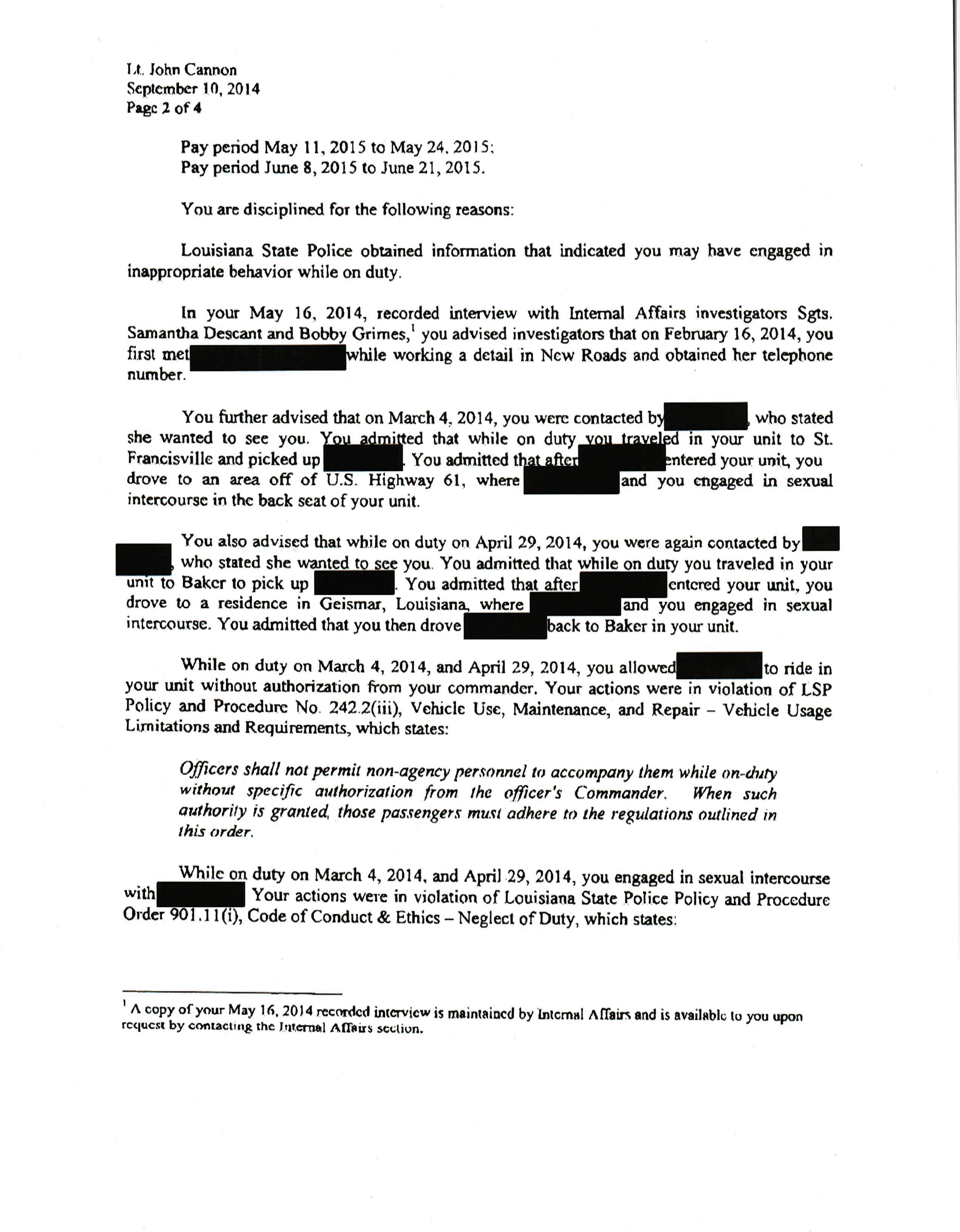
Louisiana Troop A State Police Lieutenant John Cannon remains on his $115,690 per year job despite having been reprimanded for numerous offenses including theft of satellite television signals, failure to file required Daily Activity Reports (DARs), unauthorized voiding of traffic tickets, failure to investigate a fleet crash, failure to deliver fatality packets to the families of traffic fatality victims, and twice having sex with a woman while on duty—with one of those times being in the rear seat of his patrol unit.

Legislators approved two double digit state police pay increases six months apart earlier this year even as more than 35,000 state civil service employees were learning that they again would not receive 4 percent pay increases. https://louisianavoice.com/2015/09/29/state-general-fund-has-yet-to-see-any-of-the-11-million-in-delinquent-fine-collections-to-pay-for-state-police-pay-raise/

http://theadvocate.com/news/13605105-128/no-pay-raises-for-most

Troop A includes the eight parishes of East and West Feliciana, Pointe Coupee, East and West Baton Rouge, Iberville, Livingston, Ascension and part of St. James. Cannon, a shift supervisor, has been a state trooper since 1990. He was promoted to sergeant in July of 2000 and to lieutenant in August of 2010.

LouisianaVoice obtained the 38-page state police internal affairs investigative file on Cannon through a public records request. That file indicates Cannon was never demoted for his actions. His most severe punishment included a 36-hour suspension without pay and a $904.96 per pay period reduction in pay for nine two-week pay periods (the equivalent of a 240-hour suspension)—from Oct. 27, 2014 through June 21, 2015, that was handed down by letter of Sept. 10, 2014 from Lt. Col. Charles Dupuy.

The internal affairs investigation of claims that Cannon had sex with a woman on two occasions while on duty was launched on May 15, 2014, after West Feliciana Parish sheriff’s deputies reported they had a woman in custody for possession of Lortab and marijuana. The woman, whose name was redacted throughout the report, told deputies that she twice had exchanged sex for money with Cannon.

She repeated her story to state police detectives but failed a polygraph test on the question of her being paid for sex, the report said. Cannon subsequently admitted to detectives that he had sexual intercourse with the woman but denied he paid her for sex although he did admit that he twice gave her money. He said the money was given immediately before or after each sexual encounter but that on the first occasion the money was to pay her cell phone and the second time was to pay her rent and that he was only trying to help her and to establish a friendship.

While the woman was twice subjected to polygraph tests and failed on the key point of payment for sex, the state police report never indicated that a similar test was administered to Cannon even though that was the only aspect of the entire affair that would have actually been criminal in nature.

The two first met on Feb. 16, 2014 in, New Roads in Pointe Coupee Parish where Cannon was working a seat belt grant. The woman told investigators that the two had multiple conversations by phone before meeting behind the parish library in New Roads on Feb. 21 “sometime between 9 and 11 p.m.,” but that they did not engage in sex on that occasion. She said they subsequently “negotiated sex on the phone.”

Cannon later called her at her father’s home in St. Francisville where she was living and told her he “needed her,” she said. The woman told authorities that she told Cannon she was out of money and that he later picked her up in his marked state police unit near her father’s residence and “immediately gave her $120, which she claimed was for sex,” according to the report. Cannon later said the amount was closer to $60 and was not for sex but for her cell phone bill. The report by internal affairs put the date as March 4, 2014.

She told investigators that their first sexual encounter took place in a wooded area south of St. Francisville just off U.S. 61 and lasted “approximately two minutes.” Afterward, she said, Cannon realized his patrol car was stuck and that she smoked a marijuana joint while he checked to see how badly the car was stuck. Apparently realizing how it might look if he were caught with her in such a secluded area, especially given the fact that he was dating an employee of the West Feliciana Parish Sheriff’s Office at the time, he ordered her to walk to the main highway and catch a ride while he called for someone to pull him out.

She did catch a ride to her father’s house while Cannon called the sheriff’s department for help in removing his vehicle.

Almost two months later, on April 29, Cannon picked her up—in his state police unit while on duty and in full uniform—from an apartment in Baker where she was living with her boyfriend. Cannon drove to a home she told authorities she believed to be in Baton Rouge but which Cannon later admitted was a friend’s home in Prairieville in Ascension Parish. They again had sexual intercourse in a bedroom of the home, that time for a duration of about three minutes, she said. She told investigators she requested $150 afterward but Cannon gave her only $100. He admitted that he stopped at a Regions Bank ATM on Highland Road in Baton Rouge in order to withdraw some cash. He said the amount he gave her was closer to $60 to $80 but when advised that she claimed it was $100, he told investigators it “was possible he could have given her that amount,” the report said.

The report reiterated Cannon’s claim that while he gave her money, it was to pay her phone bill and to pay her rent but was never given in exchange for sex

While en route from Baker to Prairieville, she activated Cannon’s patrol unit’s siren which resulted in other motorists moving out of the way and that she videoed the interior of his unit with her cell phone. She said she also took a photo of the house to show her boyfriend. She said Cannon was aware of her videoing the inside of his patrol car but that he did not know about her taking a picture of the house.

His 36-hour suspension ran from Oct. 10, 2014 through Oct. 13, 2014, and he was allowed to return to work from Oct. 15 through Oct. 26.

That 224-hour time frame actually covers 18 pay periods because, according to the specified dates of his suspension, he was suspended only on every other pay period, thus allowing him to work during alternate pay periods.

The suspension also contained no prohibition to Cannon’s being able to work overtime in order to make up for the $904.96 reduction in pay for each pay period for which he was suspended. LouisianaVoice has submitted a follow-up public records request for documents related to all overtime worked by him from Oct. 27, 2014, and June 21, 2015.

Cannon has had a checkered record in his 25 years as a state trooper.

  • On April 12, 1995, he received a letter of reprimand for his involvement in a traffic accident in his state police car, a not uncommon occurrence for state police.
  • On Jan. 25, 2001, he was suspended for 80 hours after being found in possession of an illegal satellite access card for Direct TV.
  • On June 6, 2003, he received an eight-hour suspension for failure to submit his Daily Activity Reports (DARs).
  • On April 27, 2006, he received a reduction in pay equivalent to a 24-hour suspension for failure to investigate a fleet crash.

And even after Dupuy’s letter of Sept. 10, 2014, which imposed the 240-hour suspension for his sexual misconduct while on duty, he received a reprimand but no suspension on March 18 of this year for his failure to act upon six traffic citation void slips and for failure to follow state police procedure with nine other citations.

Additionally, a review revealed that Cannon had seven fatality reports that are provided by state police as a courtesy to families of the deceased which he had not delivered. The fatalities had occurred between the dates of March 24, 2014, and Oct. 1, 2014, but still had not been delivered to families of the deceased as of Dec. 4, 2014.

And while technically, Cannon claims he was not paying for sex, a case could be made that because he was on duty at the time of his trysts, he was being paid for sex.

All of which raises the obvious questions: Was he being protected from above and if so, who was protecting him?

Here is Lt. Col. Dupuy’s letter of Sept. 10, 2014, to Cannon (Click on image to enlarge):

IMAG1320IMAG1321IMAG1322IMAG1323

Read Full Post »

Furtive plans by some agency heads to move certain unclassified employees into Civil Service classified positions before Bobby Jindal leaves office could be thwarted by Civil Service rules designed expressly to prevent such maneuvers.

LouisianaVoice received reports on Wednesday (Sept. 23) of plans to move some of Jindal’s appointees from unclassified to classified positions as a means of protecting them from potential termination by the new governor when he takes office on Jan. 11.

“Since the clock is ticking on the Jindal administration,” wrote one state employee, “his department heads are converting…unclassified folks into classified positions. Only trouble is, those positions don’t pay that well. [I] overheard a conversation by some HR (Human Resources) folks that they don’t know how to make the slip switch and include a $30,000 add-on to the classified position.”

But former Civil Service Director Shannon Templet, in one of her last actions before accepting the position of director of human resources for the Louisiana House of Representatives, may have put the kibosh on any such plans—or at least made any such attempt considerably more difficult.

General Circular 2015-033, issued to heads of state agencies and human resource directors on Sept. 1, addresses that very scenario although there still may be a small window of opportunity to circumvent a prohibition against converting appointees to unclassified positions. CIVIL SERVICE CIRCULAR 2015-033

The circular alluded to Civil Service Rule 22.2 which says all appointing authorities shall obtain the Civil Service Director’s approval before making a permanent appointment to any job at specified pay grades.

But the policy governing such appointments is applicable only between the date of any election for a statewide elected office (Oct. 24, 2015) through Inauguration Day (Jan. 11, 2016).

There appear to be no restrictions to such transfers between now and Oct. 24, which is nearly a full month away and some movement may have already occurred.

“Unless the director grants permission, vacancies covered under this rule cannot be filled on a permanent basis through a probationary or permanent appointment into a regular ongoing position,” the circular says. “This also applies to promotions and transfers into an agency while on permanent status.

“The process will be handled as follows:

  • Vacancies affected by this rule shall not be announced without obtaining prior approval of the director by means of a letter which includes justification explaining why the vacancy needs to be filled.
  • Agencies are to send letters requesting approval to fill to the Staffing Division.
  • Agencies will be notified via email of the director’s decision.
  • Verification of approval must be attached to the exam plan…for audit purposes.

Even if an appointive (non-classified) position should be converted to a classified one, the additional task of adjusting the position’s salary poses yet another problem—unless the appointee would agree to a major pay cut.

Because Civil Service classifications govern pay scales for every classified position in state government—as opposed to unclassified positions, which have no such restrictions—appointive posts generally pay much higher salaries than civil service jobs. Converting from unclassified to classified necessarily would dictate significant reductions in pay.

But even if that wrinkle could somehow be worked out, there is one more deterrent to such an underhanded tactic. Any transfer, lateral or otherwise, or new appointment generally carries with it a six-month (180 days) probationary period during which the employee may be terminated without cause.

As of today (Sept. 23), there are exactly 110 days until a new governor takes office.

Read Full Post »

« Newer Posts - Older Posts »