Feeds:
Posts
Comments

Archive for the ‘Campaign Contributions’ Category

As a recovering Republican, I feel I am in a unique position to suggest that all political party labels be abandoned in favor of candidates representing constituents as opposed to clinging stubbornly to the blind loyalty of some group of adherents referring to themselves as Democrat, Republican or Libertarian.

Civilized countries like Canada, Australia, and the United Kingdom have no legal political parties (although the media sometimes mistakenly refer to opposition groups as “parties”). If it’s good enough for them, it should suffice for us.

For once, I’d like to see a politician who is defined not by some label but by his own core beliefs and principles, formed independently and absent the dictates of a so-called “party” which is supported by special interests who dictate the philosophy of its labeled and packaged candidates.

I would much prefer to vote for someone because of he or she actually stands for something rather than putting party loyalty above all else. President Teddy Roosevelt had the political courage to stand up to his own Republican Party and demand corporate health regulations and to fight monopolistic trusts. Somehow, that courage has evaporated in the interest of party unity which, of course, encourages a more reliable flow of campaign contributions from the vested interests.

I don’t say this as a way of placing my intellect above that of my contemporaries (God knows that would be a foolish assumption on my part) but the two major parties in this country—all the way down to our petulant legislature—long ago arrived at loggerheads with each other to the detriment of those who put them in office.

It’s more than a little sickening to watch. Besides, we already have The Jerry Springer Show.

In a recent discussion with an old friend and long-time political observer, he noted that Democrats as a group refuse to accept anything proposed by Republicans and Republicans as a group counter in kind. Can anyone really wonder that Congress has a lower approval rating than porta-potty cleaner-uppers? (Coincidentally, it might be worth mentioning that the longer Congress is in session, the greater the demand for porta-potty cleaner-uppers.)

My friend, who spent his career in state government, confided in me that he promised himself long ago that if he ever became jaded with his job, he would retire. He is now retired.

So, why don’t we just be honest with ourselves and admit that our political system no longer functions as a two-party, give-and-take forum? When you had someone like Sam Rayburn as Speaker of the House, things got done in Congress even though there was Republican opposition. That’s because while there was opposition, the two sides left room for compromise. With Newt Gingrich, we instead got a governmental shutdown. (Rayburn, the longest-serving House speaker in history, by the way, died broke while our own Bobby Jindal, by contrast, became a multi-millionaire during his three years in Congress.)

Elected office is no longer considered a public service; it is instead, an avocation in and of itself, a stepping stone to the next move up. Witness the shameless pursuit of the presidency by Jindal and the equally self-serving ambition of Attorney General Jeff Landry, U.S. Rep. Garrett Graves and U.S. Sen. John Kennedy to oust John Bel Edwards as governor. Accordingly, you will not hear the first utterance by Landry, Graves or Kennedy in support of anything proposed by Edwards.

Likewise, should Donald Trump ever say or propose anything with a scintilla of original thought or meaningful purpose, you will never hear Nancy Pelosi or any other Democrat speak out in support. That just isn’t done any more. There’s no civility in politics, no room for compromise.

Witness the banal, hackneyed behavior of the Louisiana Legislature, particularly over the past 10, 20, 30 years.

Because the state has systematically failed to pay its mandated share into the state retirement system, we’re now saddled with an insurmountable unfunded liability in each of the state retirement systems.

For decades, taxpayers of Livingston, Ascension and East Baton Rouge parishes have been paying a millage to construct the Comite River Diversion Canal project to prevent flooding. The project is no nearer completion today than it was 25 years ago and we have the delays to thank, at least in part, for that horrendous flood of last August. And now guess what? After pissing away the monies that were supposed to have gone to flood control with those millage collections, some legislators, in their collective buffoonery, now want to snatch nearly $200 million from federal monies intended for flood victims to use instead for flood control.

It’s almost like gasoline taxes that were supposed to have gone to repair our roads and bridges and the revenue from gaming that was supposed to fund public education. Of course, as soon as those gaming funds were approved, the legislature jerked an identical amount from other funding, the Support Education in Louisiana First Fund, and the result for public education was another version of the old shell game. Now you see it, not you don’t.

Fast forward to the Jindal years when state employees suddenly found themselves going six years on end without a pay raise. Now those Jindal years have spilled over into the Edwards years and those same legislators are still playing a game called kick the financial can down the road and state employees are still falling further and further behind the inflationary curve. Prices are up, health insurance is up, but salaries remain stagnant—with the exception of State Police (not to be confused with Department of Public Safety officers who undergo the same training but have not enjoyed the 30 percent pay raise received by State Troopers).

And now, House Bill 302 by House majority leader Lance Harris (R-Alexandria) would assess parolees an additional $37 fee per month (from $63 to $100), the money to be used to fund a pay increase for parole officers. As has become almost a ritual, the vote was split along party lines.

It’s really a beautiful thing to watch these guys cherry pick their personal little projects—like Harris’s fee assessment. I’m sure the rest of Louisiana’s civil service employees are applauding his magnanimous gesture toward the beleaguered parole officers.

Not to diminish the seriousness of their plight, but parole officers aren’t the only state civil service employees who are hurting. And Harris is not the only member of the legislature who is completely out of touch with the daily struggles of state employees, many of whom were victims of last year’s floods.

This is serious business and Harris and his colleagues should get together and try to figure out how the state’s fiscal problems can be addressed without the same old tired political rhetoric spouted along party lines. It’s time for compromise and hard decisions and the legislature, as a body, is not showing any inclination of making those hard decisions.

The governor’s plan is not perfect—far from it. But neither is the continued petty bickering of the legislature getting anything done. You’re not being paid to come to Baton Rouge to participate in some kind of elementary school blame game. You were sent here to solve problems and put this state back on sound financial footing.

Instead, you plaster an “R” or a “D” to your respective foreheads and start squawking like a couple of tomcats in a dark alley—even as you hold out your hands for political contributions from the special interests who pay you to just keep squawking like you always have.

A hint: We can see you and we can hear you and you’re not impressing anyone.

Drop the party labels and declare yourselves not as Republican or Democrat but as Louisianans.

Do the right thing. Do your jobs.
Read Full Post »

The Louisiana State Troopers Association (LSTA) must really be hurting financially.

First, there was the flak about the illegal campaign contributions LSTA’s board decided to launder through the private bank account of its Executive Director David Young that brought unwanted attention to the association.

Then there was the persistent objections to that decision by several retired state troopers who are members of the association but, like the rest of the LSTA membership, were never consulted on the decision to involve the group in partisan politics.

Their objections became such an annoyance that four of the retirees, men who dedicated their entire working life to protecting the public and trying to make our highways safer, were voted out of the association. Just booted out. No thank-you, no going away party. Nothing except a letter saying they were no longer welcome as members of the brotherhood.

Eventually, the State Ethics Commission investigated the illegal contributions—illegal because state classified employees are forbidden from participating in partisan politics or for contributing to political campaigns—and levied a $5,000 fine against the association.

On the heels of that action the FBI served subpoenas on 18 members of the association, directing them to appear before a federal grand jury investigating association activities. That grand jury convenes on April 13.

As all this was going on, many State Troopers were victims of the floods that plagued Louisiana during 2016 and the LSTA generously pledged $1,000 to members who were adversely affected by the floods.

Included on its WEB PAGE is the following statement:

“We are committed to improved pay and benefits; to assure a better working environment; to provide support when needed; and to increase the quality of life for our members. We also strive to improve the public services provided by our members to our community.”

Somehow, though, the retiree members, those who likely needed help the most, were overlooked when those $1,000 checks went out. Several retirees have contacted LouisianaVoice to say they never received any help from the association.

Obviously, LSTA is short of funds. Why else would it, instead of helping out those retirees who were flooded (among them excommunicated member Leon “Bucky” Millet), reach out to them instead for contributions?

That’s right. Millet, a retiree who was booted out for protesting too much and who had his home flooded, recently received a solicitation letter from LSTA.

The letter which went out over LSTA President James O’Quinn’s signature, noted that the association uses contributions “to persuade government (apparently through campaign contributions) to provide better and safer conditions for our troopers. We use it to support community oriented programs that serve to enhance positive relationships between troopers and the communities they serve.”

The letter contained no mention of how contributions are also used for elaborate parties and to pay for travel all over the country for members to attend such work-related events as the Washington Mardi Gras.

“Because we’re grateful to those who are grateful for us, we like to recognize our donors with gifts. For our spring fundraising campaign, we have our much-requested official LSTA Field Cap. We also have our new 2017 window stickers, our wonderful spring vacation drawing and special recognition for our high-end donors.”

We’re pretty sure that a long-standing member who was expelled for asking legitimate questions would love to affix that sticker to his windshield and cruise on down the road wearing his official LSTA Field Cap.

Ending its solicitation on a personal note, the letter said, “Please consider a donation, Mr. Millet. We could use it.”

Yes. No doubt, the association may even use some of those contributions for legal fees.

Read Full Post »

A question for Public Service Commissioner Mike Francis:

How much is enough?

And that’s not a rhetorical question. We really want to know what your limits are.

According to Francis, a wealthy man in his own right, he should be entitled to a free lunch.

Literally.

You see, the political campaigns of Public Service Commission (PSC) members, the Louisiana Insurance Commissioner and judges at every level are financed in large part by the very ones they regulate or do business with on a daily basis.

But apparently that association is not cozy enough for Francis, who wants to remove all restrictions on accepting free meals from representatives of utilities, motor carriers, and others regulated by the PSC.

Granted, the PSC purports to hold itself to a higher standard than actual ethics rules allow. Legally, elected officials are allowed to accept up to $60 per day in food and beverage under the guise of “business” lunches or dinners. But, as Baton Rouge Advocate columnist and resident curmudgeon JAMES GILL writes, the PSC, at the urging of members Foster Campbell and Lambert Boissiere, rammed through a rule barring all freeloading.

That didn’t sit well with Francis, who is financially solvent enough to daily feed the entire commission out of his petty cash account.

Saying he wanted the commission to be run like a business, he sniffed that a working lunch is “pretty standard procedure in the real work world.”

Our question to Francis then is this: since when is government run like a business? Businesses are run to make a profit; government is run to provide services for its citizens. The two concepts are like the rails on a railroad track: they never cross though they often do appear to converge.

And then there is our follow up question to Mr. Francis: isn’t it enough that you manage to extract huge sums of money from the industries you regulate in the form of campaign contributions? Why would you need a free lunch on top of that?

After all, your campaign finance reports indicate you received $5,000 from AT&T, $5,000 from ENPAC (Entergy’s political action committee), $5,000 from Atmos Energy Corp. PAC, $2,500 from the Louisiana Rural Electric Cooperative, $2,500 from Dynamic Environmental Services, $2,500 from ADR Electric, $2,500 from carbon producing company Rain CII, $2,500 from Davis Oil principal William Mills, III, $2,500 each from Jones Walker and the Long law firms, each of whom represents oil and energy interests. There are plenty others but those are the primary purchasers of the Francis Free Lunch.

LouisianaVoice would like to offer a substitute motion to the Francis Free Lunch proposal. It will never be approved, but here goes:

Let’s enact a law, strictly enforced, that will prohibit campaign contributions from any entity that is governed, regulated, or otherwise overseen by those elected to the Public Service Commission, the Louisiana Insurance Commission, judgeships at all levels, Attorney General, and Agriculture Commissioner.

  • No electric or gas companies, oil and gas transmission companies, or trucking and bus companies or rail companies could give a dime to Public Service Commission candidates.
  • Lawyers would be prohibited from contributing to candidates for judge or Attorney General.
  • Insurance companies would not be allowed to make contributions to candidates for Insurance Commissioner.
  • Likewise, companies like Monsanto, DuPont, Dow, Syngenta, Bayer and BASF, who control 75% of the world pesticides market, and Factory farms like Tyson and Cargill, which account for 72 percent of poultry production, 43 percent of egg production, and 55 percent of pork production worldwide, could no longer attempt to influence legislation through contributions to candidates for Agriculture Commissioner.
  • Members of the Board of Elementary and Secondary Education (BESE) could no longer accept contributions from individuals or companies affiliated in any way, shape or form with education.

While we’re at it, the Lieutenant Governor’s office oversees tourism in the state. In fact, that’s about all that office does. So why should we allow candidates for Lieutenant Governor to accept campaign contributions from hotels, convention centers, and the like?

This concept could be taken even further to bar contributions from special interests to legislators who sit on committee that consider bills that affect those interests. Education Committee members, like BESE members, could not accept funds from Bill Gates or from any charter, voucher or online school operators, for example.

Like we said, it’ll never happen. That would be meaningful campaign reform. This is Louisiana. And never the twain shall meet. The American Legislative Exchange Council (ALEC) would see to that.

But wouldn’t it be fun to watch candidates scramble for campaign funds if such restrictions were to be implemented?

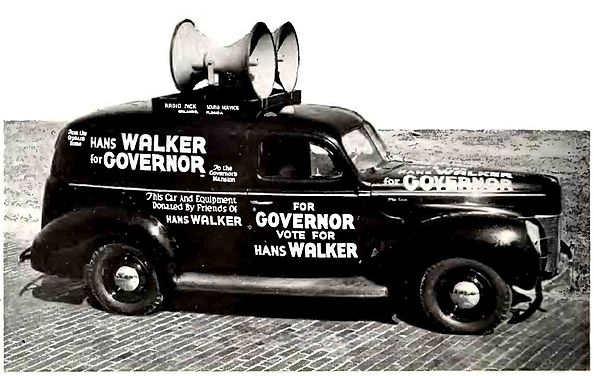
We might even see a return of the campaign sound trucks of the Earl Long era rolling up and down the main streets of our cities and towns after all the TV advertising money dries up.

Ah, nostalgia.

Read Full Post »

A couple of reports, unconfirmed to this point, have been swirling about concerning the ongoing investigation into that San Diego trip taken by State Police Superintendent Mike Edmonson and 16 or so subordinates, including the four who went by state vehicle via Las Vegas and the Grand Canyon. Altogether, the jaunt cost Louisiana taxpayers more than $73,000.

But there also are confirmed developments that might have raised some concern on the part of those who want to see an unbiased investigation that will lead to appropriate action on the part of Gov. John Bel Edwards. It seems, however, that initial concern has been defused.

First, the unsubstantiated reports that, while lacking official confirmation, come from those close to the investigation who are considered reliable.

  • Attorney General Jeff Landry’s office is said to have begun an investigation on its own, separate and apart from that of the governor’s office. A spokesperson for the AG said that could be neither confirmed nor denied. “Our office has a policy of not commenting on such matters so as not to compromise any investigation it may be conducting,” she said.
  • Another well-placed source said the FBI is also conducting an investigation of Edmonson and LSP, though Edmonson earlier denied any such investigation. Our source of that story said he initially provided information to the FBI but now that the agency’s investigation is underway, he has not been involved in further dialog with agents.

Conspicuously absent is any report that the Office of Inspector General, that fiercely independent investigative agency, has undertaken any effort to look into possible criminal wrongdoing at LSP. That could, of course, be because OIG isn’t as independent of the governor’s office as it likes to claim.

It likewise would be reassuring if East Baton Rouge Parish District Attorney Hillar Moore initiated a grand jury investigation or at least weighed in if for no other reason than to say he was taking a wait and see approach to the governor’s investigation. After all, any crime committed in the East Baton Rouge Parish falls under his jurisdiction.

The two unconfirmed reports aside, LouisianaVoice has learned that Mark Falcon, an attorney for the Division of Administration (DOA), is assisting DOA auditors in their investigation of LSP. Richard Carbo, communications director for the governor’s office, said, “He is not the lead investigator; he is assisting the auditors in their work.”

Mark Falcon did, however, assauge concerns when he offered full disclosure in informing Commissioner of Administration Jay Dardenne that he is the brother of Floyd Falcon, legal counsel for the Louisiana State Troopers Association (LSTA), the lobbying arm of LSP.

It was LouisianaVoice’s story about the LSTA’s practice of laundering illegal campaign contributions through the personal bank account of its executive director David Young more than a year ago that prompted Floyd Falcon to refer to me as “a chronic complainer,” a characterization that has likely only intensified in his mind, given the manner in which the LSP saga has played out thus far.

But Mark Falcon’s voluntary disclosure of his relationship with Floyd Falcon and the manner in which he presented it is encouraging and provides optimism that the DOA investigation will be complete and above-board.

That is particularly important because two of those who took that trip to San Diego had their travel and lodging expenses on the trip picked up by the LSTA. Only the meals for Trooper Alexandr Nezgodinsky, a native of San Diego, and Lt. Stephen Lafargue were paid for by the state. Several others who made the trip are also LSTA members but had their expenses paid by the state.

In another development, LouisianaVoice received a rather dubious response to a public records requests regarding other trips Edmonson took to receive various awards.

Here is a copy of our request:

From: Tom Aswell
Sent: Wednesday, February 22, 2017 3:55 PM
To: ‘Michele Giroir’; ‘Doug Cain’
Subject: PUBLIC RECORDS REQUESTS

Pursuant to LA. R.S. 44.1 (et seq.), I hereby submit my formal request for the opportunity to review all travel records, including airfare, other travel, lodging, meals, registration fees and any and all other expenses incurred by all personnel (by name) who attended the presentation of any and all of the below awards bestowed upon Col. Mike Edmonson:

  • FBI Washington DC, Top 25 Police Administrators Award, 2009;
  • Sheriff Buford Pusser National Law Enforcement Officer of the Year Award, 2013;
  • Human Trafficking, Faces of Hope Award, 2013
  • Inner City Entrepreneur (ICE) Institute—Top Cop Award, 2013
  • American Association of Motor Vehicle Administrators Martha Irwin Award for Lifetime Achievement in Highway Safety, 2014
  • New Orleans Convention and Visitors Bureau, Captain Katz Lifetime Award for Outstanding Achievement in Public Safety, 2015.

 Also, please provide me with the opportunity to review:

  • all travel records, including airfare, other travel, lodging, meals, registration fees and any and all other expenses incurred by all personnel (by name) who attended the Louisiana Sheriffs’ Association annual conventions/conferences in Destin/Sandestin, Florida for the years 2008 through 2016;
  • all travel records, including airfare, other travel, lodging, meals, registration fees and any and all other expenses incurred by all personnel (by name) who attended the Washington (D.C.) Mardi Gras festivities for the years 2008 through 2017;
  • all travel records, including airfare, other travel, lodging, meals, registration fees and any and all other expenses incurred by all personnel (by name) who attended the New Orleans Mardi Gras festivities for the years 2008 through 2016 (exclusive of security details assigned to the event).

Here is the response I received yesterday (Monday, March 6):

From: Michele Giroir
Sent: Monday, March 6, 2017 8:12 AM
To: Tom Aswell
Cc: Doug Cain; JB Slaton; Faye Morrison
Subject: RE: PUBLIC RECORDS REQUESTS

Mr. Aswell, in partial response to your below public records request, I have been advised that LSP does not maintain any records relating to travel expenses, etc., for attendance at the presentation of the following awards bestowed upon Col. Mike Edmonson:

  • FBI Washington DC, Top 25 Police Administrators Award, 2009;
  • Sheriff Buford Pusser National Law Enforcement Officer of the Year Award, 2013;
  • Human Trafficking, Faces of Hope Award, 2013
  • Inner City Entrepreneur (ICE) Institute –Top Cop Award, 2013
  • New Orleans Convention and Visitors Bureau, Captain Katz Lifetime Award for Outstanding Achievement in Public Safety, 2015

 The remaining requests are still being handling and further responses will be forthcoming.

Any questions that you may have should be addressed to Major Doug Cain.

With kindest professional regards, I am,

Sincerely,

Michele M. Giroir

Attorney Supervisor

 Not complete sold on that explanation, I emailed Cain:

“Doug, I find it inconceivable that LSP has no record of expenses for these trips. Is it the position that LSP keeps no such records or are you saying no expenses were incurred?”

His response? “No expenses.”

“Not even for those who went with him?” I wrote back (because we know by now he rarely travels alone).

“No sir,” he responded.

So the bottom line is we are being asked to believe that Edmonson, who packed 15 of his people off to San Diego, all of whom combined to run up expenses of more than $73,000, including salaries and travel, lodging and meal expenses, either took no one with him on the other trips and he didn’t consume any meals on his trips or perhaps he took traveling companions, none of whom spent a dime of state funds.

Either scenario requires a leap of faith to believe.

(To be incredulously continued.)

Read Full Post »

1399909

Bloomberg News Service on March 1 published a STORY that said global megabanks have paid $321 billion in fines for such non-banking-like practices as money laundering, market manipulation and even terrorist financing since the market crash of 2008.

And while $321 billion may sound impressive, Bloomberg failed to mention that because of those same banks, President George W. Bush had little choice but to sign the Emergency Economic Stabilization Act of 2008 that pumped more than twice that amount, $700 billion of taxpayer bailout funds, into the failed banks that precipitated the Great Recession of 2008.

Most financial advisers would describe that as a negative return on investment.

Adding insult to injury, $1.6 billion of that $700 billion was used to award multi-million dollar bonuses to CEOs of the very firms that got us into the mess to begin with. http://www.cbsnews.com/news/16b-of-bank-bailout-went-to-execs/

Bloomberg also failed to mention that those fines had little effect on those who perpetuated the crimes but did have a significant impact on stockholders and retirees, those, in other words, who had nothing to do with the massive fraud carried out on such a grand scale.

In fact, in 2010, former Countrywide Financial CEO Angelo Mozilo was fined $22.5 million and ordered to pay another $45 million in restitution as his penalty for reaping a profit of $141.7 million from stock sale, according to Mary Kreiner Ramirez and Steven A. Ramirez, authors of The Case for the Corporate Death Penalty (New York University Press, 2017). So, despite the penalties, he walked away with a net gain $74.2 million, or a 52 percent return, sending a clear signal his peers that “crime does in fact pay,” the authors wrote.

There are also two questions Bloomberg neglected to address:

  1. What the total cost of the runaway greed and reckless actions of firms like AIG, Lehman Brothers, Merrill Lynch, Goldman Sachs, Citigroup, Countrywide, and J.P. Morgan to stockholders, retirees and American taxpayers in general?
  2. How many top tier officers at these firms who condoned, encouraged and/or actively participated in the illegal practices went to jail?

The answer to the first question is an eye-popping $15 trillion, according to Ramirez and Ramirez.

The answer to the second question is just as unbelievable: ONE.

In fact, as of Jan. 28, that last date that STATISTICS were updated by the Bureau of Prisons, there were exactly 555 people serving federal jail sentences for banking, insurance, embezzlement and counterfeiting. That comes to .3 percent (three-tenths of one percent) of the total federal prison population.

By contrast, there were 82,109 in federal prison for non-violent drug offenses (46.4 percent of the total), and 14,853 imprisoned on immigration charges (8.4 percent).

At this point it might be fair to ask just who did the most lasting damage to the nation’s economy?

It would also be fair to question why, if only one Wall Street banker went to jail, how is that there are 555 imprisoned for banking- and insurance-related offenses? The answer to that is those offenders, situated on Main Street instead of Wall Street, lacked the political clout in Washington that the leaders of the megabanks enjoyed.

Is that an over-simplification of the circumstances? Probably, but it’s interesting to compare the actions of different White House administrations in handling financial crises.

President Obama’s first Attorney General, Eric Holder, in his “too big to fail” proclamation, said, “I am concerned that the size of some of these institutions becomes so large that it does become difficult for us to prosecute them when we are hit with indications…it (prosecution) will have a negative impact on the economy.”

Obama, for his part, said, “One of the biggest problems about the…financial crisis and the whole subprime lending fiasco is that a lot of that stuff wasn’t necessarily illegal, it was just immoral or inappropriate or reckless.”

Wasn’t necessarily illegal? Both statements stretch credulity to its breaking point and are in themselves, disgraceful because federal laws were clearly broken knowingly and willfully.

It wasn’t always that way. For example, in the wake of the savings and loan crisis of the 1980s and 1990s, more than 1,100 bankers were indicted and 839 were convicted.

Enron, the seventh-largest company in the U.S. at the turn of the century, is another example of how the feds went after those who played fast and loose with the rules. President George H.W. Bush called on Enron CEO Kenneth Lay to run the World Economic Summit in Houston in 1990 and in 1992, Lay co-chaired the reelection campaign of Bush the First.

Enron and its affiliates also contributed more than $888,000 to the Republican National Committee in 2000, the year that George W. Bush was elected President and another $1.3 million to the Republican Party. Lay and his wife personally contributed $238,000 to George W. Bush campaigns and inauguration celebrations and raised another $100,000 from friends. To the younger Bush, Lay was known as “Kenny boy.”

Still, Enron and its top executives were not immune from prosecution by Bush the Second.

Despite the access to the highest levels of government enjoyed by Enron and Lay, he and Jeff Skilling, his successor as Enron CEO, were indicted by the Department of Justice in 2004 and though the two combined to spend some $60 million on their defense, Lay was convicted on all counts and Skilling on 19 of 28 counts of securities fraud.

George W. Bush’s Attorney General John Ashcroft recused himself from the Enron investigation because Enron and Lay both were major financial supporters in Ashcroft’s Missouri unsuccessful Senate re-election campaign. His chief of staff, David Ayers, also took himself out of the investigation of Enron. That was as it should have been.

Enron’s accounting firm, Arthur Andersen, was convicted of shredding Enron documents and both Enron and Arthur Andersen soon ceased to exist.

The same fate befell CenTrust Savings Bank, Drexel Burnham Lambert investment bank, and WorldCom—all because of flagrant violations of federal securities laws and each was prosecuted by the administrations of the two Bushes. WorldCom, in fact, was the largest bankruptcy in history when it went under in 2002.

Evidently, those firms were not considered too big to fail.

By contrast, Obama’s Attorney General Holder and Lanny Breuer, chief of the Department of Justice (DOJ) Criminal Division, did not remove themselves from DOJ’s investigation of the investment banks that brought on the Great Recession of 2008. This despite the fact that both men had worked for the same law firm of Covington & Burling which included among its clients such eminent Wall Street banking firms as Bank of America (Countrywide’s successor), Citigroup, and JP Morgan Chase.

In fact, at the time Holder was tapped as attorney general, he was co-chairing Covington & Burling’s white-collar defense unit. Good training in case you’re ever called on to investigate your former bosses.

Breuer returned to Covington & Burling in 2013 followed by his boss Holder in July 2015, giving Holder at least a reason for his strained, if not borderline unprincipled logic for not pursuing criminal indictments against the megabanks.

Following Holder’s departure, Deputy Attorney General Sally Quillian Yates (Remember her? She’s the one President Trump fired after she refused to enforce his illegal immigration order) issued a DOJ memo (turns out she was pretty good at memos that cut right to the chase) on Sept. 9, 2015, that reversed Holder and Breuer’s DOJ policy toward pursuing individual accountability, both criminally and civilly, for corporate wrongdoing. The memorandum said the policy change was to maximize DOJ’s “ability to deter misconduct and to hold those who engage in it accountable.”

The comparison between the approaches of two Bushes and Obama to bankers’ disdain for securities laws to the detriment of the entire country represents a stark role reversal for the perceived political philosophies of the Republican and Democratic administrations.

And now, President Trump has expressed his determination to roll back the Dodd-Frank bill passed after the 2008 recession for the express purpose of preventing a recurrence of the runaway greed that nearly wrecked the world economy.

In fact, he wants to remove all regulation of Wall Street banks, quite possibly the most dangerous single cartel in American society.

Read Full Post »

« Newer Posts - Older Posts »

