Feeds:
Posts
Comments

Archive for the ‘Budget’ Category


DOT.CON(CLICK ON IMAGE TO ENLARGE)

By Stephen Winham (Special to LouisianaVoice)

Bob Mann has done an excellent piece on this:  http://bobmannblog.com/2015/06/02/shell-game-shouldnt-higher-education-leaders-have-more-integrity-than-bobby-jindal/#more-5553

Many news stories have been written about it.  I don’t have to tell you what it does – nothing, except appease Grover Norquist and, by association, our governor.

Oh, wait, it does actually do something else – It adds to the plethora of recent stories about our state and governor that keep us the laughingstock of the nation.  If the national media starts playing this up, it really is going to seem like they are reprinting a story from The Onion. The name, itself, is a joke – on many levels:  Student Assessment for a Valuable Education – Think about it.

How this utterly ridiculous bill can be treated as the salvation for higher education makes a mockery of the value we allegedly place on higher education.  It is beyond a shell game.  It is so stupid, in concept and premise, as to make it hard to treat seriously.  I get angry just thinking that such a thing could be introduced, much less actually passed.  It is difficult to give the bill enough credibility to even read it – and reading it doesn’t help much.

Create a fee.  Don’t collect the fee, but give a tax credit for it as if it had been paid.  Send the money that would have been collected had the fee been paid to the Board of Regents to be distributed to colleges and universities.

If there is really no fee, where is the SAVE money coming from?  The fiscal note shows no numbers.  Is the money going to magically appear out of nowhere, be printed by the state treasury, or what?  If there is no money, how can this possibly help higher education?  If there is to actually be money in the fund, where will it come from?

After you create a fund that has no source, you pretend this non-existent tax credit offsets the same amount in unrelated tax increases.

Grover Norquist must be about the most powerful person in the United States.  He gets thousands of politicians to sign a {non- legally binding} pledge to not raise taxes no matter what happens.  No matter how stupid or irresponsible it makes them look, these people, including our governor , treat the pledge as if lightening will strike them dead if they don’t.  And the legislature follows suit.

Or at least John Alario does. The Senate President (R-Westwego) has vowed to overcome defeat of the measure by the House by inserting the SAVE bill in every piece of legislation passed by the House in order to force passage.

How can this be?  In local politics, we would assume anybody with that much power must have a video of the person he controls doing something Bobby Jindal would consider a mortal sin (like subscribing to the theory of climate change, endorsing the metric system or worse, equal pay for women).  So, is it possible Grover has a video vault with thousands of pornos of every politician who has signed his pledge?  That makes almost as much sense as SAVE.

Read Full Post »


Editor’s note: (Even as Bobby Jindal is preparing for the publication of his second ghostwritten book, we at LouisianaVoice are working to complete the manuscript for our own book about the Bobby Years which will most likely offer a slightly different perspective on his eight years in the governor’s office. We hope to publish our e-book about the same time as Bobby’s epic. Until then, we will probably be posting less frequently and instead depending more on knowledgeable people like Stephen Winham to make contributions like the one below.)

By Stephen Winham (Special to LouisianaVoice)

“Figures don’t lie, but liars figure” – attributed to Mark Twain [and others]

Every day we are bombarded with numbers about our state and its finances.  We are told one day there is a $1.6 billion dollar structural deficit in Louisiana’s budget.  A few days later we are led to believe it is all but fixed – just a little tweaking and fiscal legerdemain at the end and we will be okay – for a little while, at least long enough for the governor to move on.

Governor Jindal tells us the number of state employees has been reduced by over30,000, but we are not told how many of them (the vast bulk) are still being paid by the state via contracts with private companies.  Not only that, we can’t find documentation among civil service or other official records to substantiate the 30,000 number itself.  The governor also claims to have reduced the budget by 26%, but we can’t figure out how he came to that percentage either.

One day we are told Governor Blanco left a $1.2 billion surplus that has now been squandered.  The next day we are told it was $800 million and that it wasn’t squandered.  One day we are told the budget is now and has always been in balance.  Then, we look at the Governor’s own Executive Budgets and see financial statements clearly showing operating budget deficits in 2 of the 3 first years of the Jindal administration (and as recently as FY2013-2014 – the last year the audited total is reported – when a subtle format change enabled use of the undesignated general fund balance to show a positive bottom line – more on this shortly).

We even read conflicting reports of the size of the budget.  The State General Fund, on which the most focus was placed before we started “sweeping” dedicated funds, is one number.  Total state funding from all sources is another, the total budget including federal funds is another and spending including double-counts resulting from interagency transfers by individual departments is yet another.  All these numbers get reported at different times by different sources.

So, are we being lied to, or is that too strong a term?  One thing is for sure – finding clear, consistent and unambiguous data about state finances is next to impossible.

Over a quarter of a century ago, state leaders agreed there was a need for one set of numbers upon which everybody could agree for things like how much revenue we could expect, how much spending could be expected to grow based on trend data, how many state employees there were, etc., etc..  After all, everybody was entitled to their own opinions, but there should be but one set of facts, right?  Right, but has this become a reality?  Obviously not.

Let’s take just one example of what I am talking about here – the Blanco surplus and what happened to it during the Jindal administration.  Examining this one issue requires me to bombard you with even more numbers, but I hope you will see why this is necessary to make my point.

Many consider the best measure of the surplus for a given year the Undesignated Unreserved General Fund Balance shown on the balance sheet of governmental funds contained in the Comprehensive Annual Financial Report (CAFR) prepared by the Division of Administration in accordance with Governmental Accounting Standards Board rules and audited by the legislative auditor.  This number reflects how much money was available in the general fund in a given year, how much we spent or firmly obligated, and how much was left.  But, as we will see, using this source is problematic, particularly since recent practice has been to use dedicated funds as if they weren’t and the CAFR reporting format has changed.

Blanco’s last budget submission was the one for fiscal year 2007-2008.  However, Governor Jindal took over the last 6 months of that budget year and the budget changed dramatically by fiscal year end.  For that reason, we could say 2006-2007 was Blanco’s last full budget.  The CAFR surplus as defined above for FY 2006-2007 was $1.158 billion.  The total fund balance line shows $1.778 billion.  The comparable numbers for FY 2007-2008 were $442 million and $783 million.

The Governor’s Executive Budget proposal includes a comparative statement each year that shows the audited budget for the prior year, the estimated budget for the current year, and the governor’s recommended budget for the coming year.  The audited actual prior year numbers appearing on these statements seem to be the most consistent budget numbers of those currently available.  Those statements show operating surpluses of $1.088 billion for fiscal year 2006-2007 and $865.7 million for 2007-2008.

So, how much of a surplus did Blanco leave Jindal?  It apparently depends on where you look, when you look, and how you define surplus.  For lack of a better source, I would choose the ACTUAL column of the Comparative Statements in the Executive Budget documents for the time being.  But, because budgets cross one year of administrations, it may be hard to come up with a definite answer from any source.

What happened to the surplus?  Well, using the governor’s own budget documents, we see the surplus decreased by $790 million (from $865.7 million to $76 million) between FY 2007-2008 and FY 2008-2009.  The subsequent statements show a deficit of $108 million at the end of the next fiscal year, and a deficit of $14 million the next year.  The statement shows a zero balance the following year (FY 2011-2012).  That analysis, and the fact we raided every fund we could to “balance” the budget in recent years tells me it got spent.  It would appear most of it was spent on capital outlay projects (the statement for FY 2008-2009 shows a reservation of $782 million for FY 2009-2010 capital outlay appropriations).  This is a good use, so let’s hope that’s where it went.  But, if so, why would anybody want to deny the surplus was used in the budget, much less that it ever existed in the first place?

If you find all of this confusing, join the club – it’s a big one.  Does it have to be this way? No.  We, all of us, could demand a governor back up his statements with hard evidence.  We could ask questions like this of his budget people, “When was the last time our budget was really balanced, and what can you show me to prove it?”

Somebody knows exactly how many employees no longer show up on the state’s payroll, but were shifted to private sector jobs paid for through state contracts.  Even if you don’t care about that, wouldn’t you like to see hard evidence of how many people actually work for the state?  Believe it, or not, that would seem to be currently impossible.

There are a lot of good data out there.  Look at the publications of the Legislative Fiscal Office and the House and Senate fiscal staffs for proof.  These folks are providing a lot of excellent information right now that is being ignored by most of the very people they work for, along with the mainstream media.  Go to their websites and see for yourself.  You might be amazed at the amount of understandable fiscal information you find there.  But our legislators and the press take the easy way out – they accept far too many ad hoc statements from almost anybody as fact without questioning them as to the basis.  As a result, we are ALL done a great disservice.

The truth is out there.  We simply need to agree on what the truth is and demand to see it and to see it consistently reported.

A warning to our next governor:  You are walking into a fiscal nightmare.  Find some good people – Consider the staffs of the legislative agencies above and look closely for career employees currently working at the Division of Administration and elsewhere who are competent, brave, and have the inside knowledge you desperately need. Do not look entirely for sycophants who put numbers together to please you. You certainly need moral support for your positions, but you have a greater need for people who will tell you the truth.  By retaining them, you, and we all, will be well-served.

(Stephen Winham is the retired Director of the Executive Budget Office for the State of Louisiana.)

Read Full Post »

Our friend C.B. Forgotston, who follows the legislature relentlessly, alerted us to this little tidbit this morning that illustrates just how far the legislature is willing to go to absolve itself of any responsibility in the current fiscal mess in which the state currently finds itself.

Year after year, when stinging budget cuts are imposed on higher education and health care, the same cry goes up from the citizenry: “Why are only higher ed and health care subjected to repeated budget cuts? Why aren’t other agencies made to share the pain?”

And year after year, the same response from legislators: “Because under the State Constitution, those are the only areas that can be cut.

“Our hands are tied,” they wail in unison.

Not so, says Forgotston, who once was a staff attorney for the legislature.

Of the $30 Billion in the current state budget, $3.9 Billion or only 13 percent is constitutionally-protected, he says.

Of the dedicated funds:

  • $3.3 Billion (85 percent of the constitutionally-dedicated funds) funds public elementary and secondary education’s Minimum Foundation Program (“MFP”) which is approved by the leges.
  • $318 Million (9 percent) pays the annual debt service on state borrowing (bonds).
  • $115 Million (3 percent) pays the supplemental pay for municipal policemen, firemen and deputy sheriffs.

What’s not protected?

            Of the $30 Billion budget, Forgotston says 87 percent is not constitutionally-protected. That includes:

  • NGOs (non-governmental organizations) and other local pork barrel projects in the Operating and Capital Outlay budgets.

The constitutional scapegoat

            The constitution is a convenient scapegoat for the governor and the legislators’ lack of political courage to set priorities,” he said, “especially, since none of them appear to have ever read the document.”

No matter. On Monday, they had a chance to do something about it and they didn’t.

They punted.

And the vote wasn’t even close.

The Senate Finance Committee deferred, by an 8-2 vote, Senate Bill 196 by State Sen. Jean Paul Morrell (D-New Orleans) which would have placed a constitutional amendment before Louisiana voters that would have repealed the constitutionally-imposed dedications. SB 196 TEXT

The Legislative Fiscal Notes, which accompany any bill dealing with fiscal matters, says there would be “no anticipated direct material effect on governmental expenditures.”

The fiscal notes also said, “Due to the elimination of approximately 20 constitutional funds and the requirement that the revenue source of such funds now flow into the State General Fund (SGF), the SGF will have approximately a statutorily dedicated fund balance transfer of approximately $3.9 billion in FY 16 and annual SGF revenue flow of approximately $730 million per year.” SB 196 FISCAL NOTES

Morrell lectured committee members as he testified on behalf of his bill, saying, “We fixed higher ed but not health care. We have too many ‘not me’s’ coming before you to defend their programs.

“If you kill this bill,” he cautioned members, “you’re saying to your constituents not only that your hands are tied but that you like your hands to be tied.”

Which is precisely what they did on motion from Sen. Dan Claitor (R-Baton Rouge).

Before the vote on Claitor’s motion, Sen. Fred Mills (R-St. Martinville) offered a substitute motion to approve the bill, sending it to the Senate floor. Only Sen. Bodi White (R-Central) voted with Mills in favor of the bill. Those voting against approval were committee Chairman Jack Donahue (R-Mandeville), committee Vice-Chairman Norbert Chabert (R-Houma), members Bret Allain (R-Franklin), Sherri Smith Buffington (R-Shreveport), Claitor, Ronnie Johns (R-Lake Charles), Eric LaFleur (D-Ville Platte), Edwin Murray (D-New Orleans), and Greg Tarver (D-Shreveport).

As an unspoken acknowledgement of the committee’s concern over a possible veto by Bobby Jindal, a fretful White went so far as to suggest to Morrell that he might get a more favorable consideration of his bill if he waited until next year “when we have a new governor.”

So, bottom line, it appears that legislators remain unwilling to confront a lame duck, largely absentee governor despite his abysmal approval ratings by Louisiana voters.

Something is wrong with this herd mentality, folks.

This is not the time to wait for a “new governor.” This is the time for bold, decisive action that says to Jindal, “We damned well dare you to veto this or we’ll throw it back in your face with a veto session like this state—or any other state—has never seen. We will bring the attention of the national media down upon your delusional head.”

Instead, they choose to wait.

Again.

Read Full Post »

It’s funny in a sick, perverted kind of way when you think about it.

Come to think of it though, that’s entirely appropriate; the Bobby Jindal administration has been nothing but seven years of sick, perverted exercises in futility and failed policies. It’s enough to make other states laugh at us—and they probably are.

Foremost among his many efforts at “reform” preached by this incoherent governor is his insistence on something he refers to as “freedom of choice” for parents of students in grades K-12. http://www.breitbart.com/big-government/2015/02/10/jindal-urges-parental-choice-limited-government-and-end-to-teacher-tenure-in-sweeping-education-policy-plan/

Speaking at the Brookings Institute in 2012, he said the U.S. does not provide equal opportunity in education. https://www.youtube.com/watch?v=nDCU-VlSgX0

Yet, when it comes to freedom of choice and equal opportunity for students in Louisiana’s colleges and universities, Jindal appears perfectly willing to “let them eat cake.”

Even as LSU and other universities and colleges face financial exigency in the face of another round of budget cuts, this time as much as $600 million and as more than 1,000 LSU students marched on the State Capitol on Thursday in protest, where was Jindal?

Out of state, as usual.

Damn him.

Damn his blasé attitude toward doing his job as the elected governor of Louisiana at a time when the state is in dire need of leadership.

Damn his resolve not to repeal corporate tax breaks, his administrations’ failure to properly audit severance tax payments to the oil and gas companies who have bankrolled his campaigns to the tune of about $1 million.

JINDAL SWINDLE

Following the rally Thursday, dozens of students converged on the Senate Education Committee which was meeting in the bowels of the Capitol. The five committee members, who for the most part, talked among themselves instead of listening as a witnessed testified on a bill about student records, paid the obligatory lip service in welcoming the students and then politely suggested they move up one floor to the Senate Finance Committee “because that’s where the money is,” according to one member.

Except it isn’t there. There is no money because of Jindal’s haphazard, slipshod, snow-cone stand brand of administration.

One Education Committee member even suggested that the students keep going—up “to the fourth floor.”

“Except no one’s there,” said another member, eliciting laughter at probably the most accurate statement made thus far this session.

It’s not, of course, as though Jindal is solely to blame for this fiasco. The legislature is complicit in allowing him to run roughshod over the citizens of this state on his way out the door and (he somehow still believes) to the White House.

If you don’t believe the legislators must share the blame in this, then explain how an attempt this week to finally accept Medicaid funds to help provide health care for 240,000 low-income Louisianians never got out of committee. Explain how attempts to increase the minimum wage and close the gender wage gap fail time after time but somehow legislation to allow the teaching that the earth is only 9,000 years old passes muster.

Therefore, the protest by the LSU students, one of those demonstrations inspired by social media, was the perfect opportunity for the four announced candidates for governor in this fall’s election.

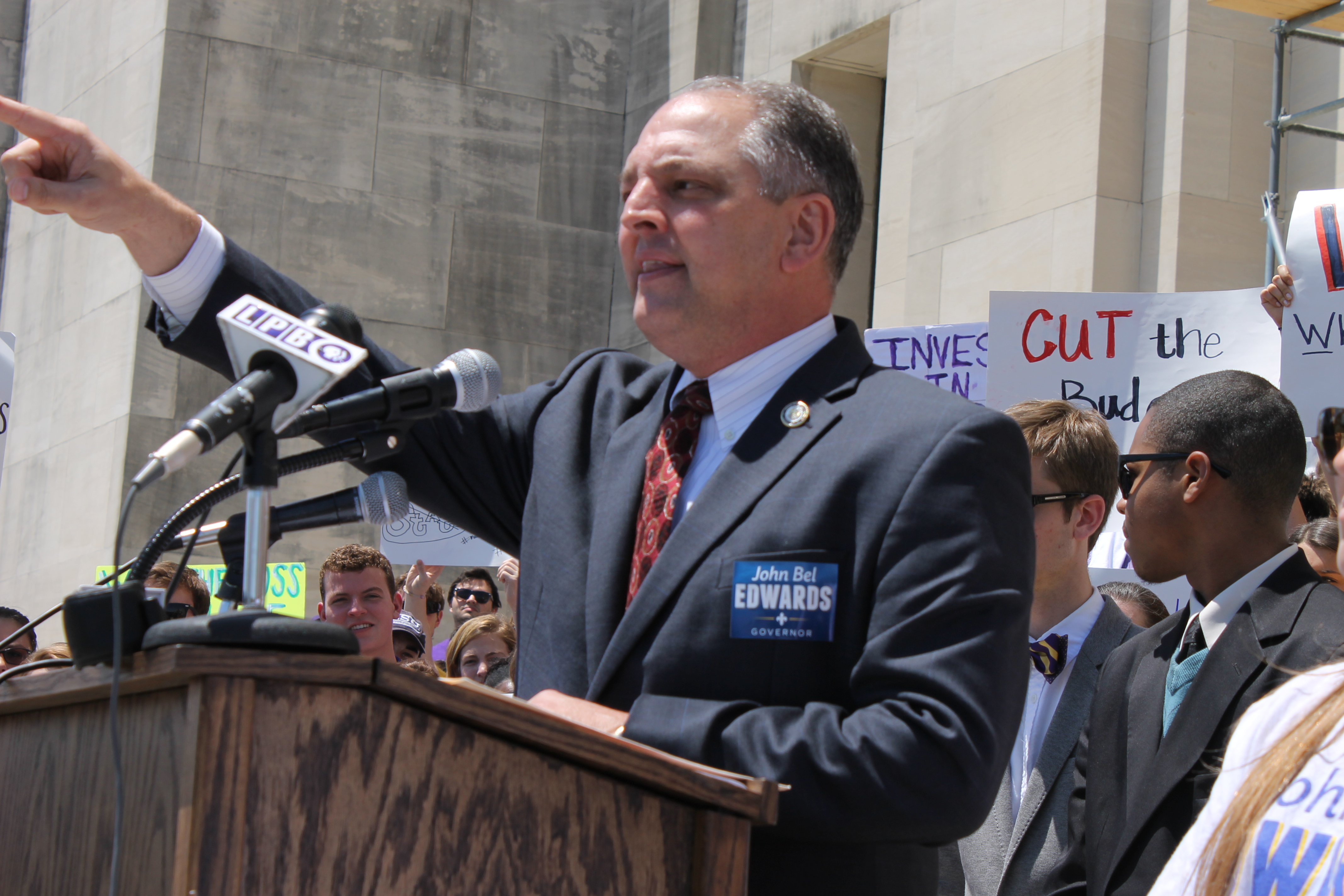
It would have been if they had all showed up. Perhaps that’s why State Representative John Bel Edwards (D-Amite) and the lone Democrat among the four candidates, got such an enthusiastic response from the students crowded onto the steps in front of the Capitol.

JOHN BEL EDWARDS

Rep. John Bel Edwards addresses LSU students on Thursday (click on image to enlarge).

Lt. Gov. Jay Dardenne, the only one of the four to hold an undergraduate degree from LSU and a former LSU Student Government President was apparently so busy he could only send a representative from his office. A missed opportunity if there ever was one.

Edwards tried to downplay the significance of that. “Well, to be fair, I was already in the building,” he laughed. “I didn’t have to go far.”

But neither did Dardenne. His office is across the street from the Capitol and LSU’s right fielder could probably peg a strike to his office window from the Capitol steps.

But Public Service Commission member Scott Angelle and U.S. Sen. David Vitter also were conspicuously absent. Nor was a single member of the LSU Board of Supervisors in attendance.

Of course, it would have been a sham for Angelle to make an appearance. He is, after all, joined at the hip with Jindal. Granted, Angelle was a Kathleen Blanco holdover, but held over he was and Jindal even made him his legislative liaison. Jindal also named him as interim Lieutenant Governor when Mitch Landrieu was elected mayor of New Orleans, and then appointed him to the LSU Board of Supervisors (that’s the same board that fires LSU presidents on a whim, costs the state hundreds of thousands of dollars defending a defenseless attempt to deny access to public records, and which gives away state hospitals in a deal that had been rejected by the federal government). http://www.nola.com/opinions/index.ssf/2015/03/lsu_board_jindal_resign.html

But why Vitter didn’t show is something of a mystery; there were so many attractive co-eds at the protest, after all.

Edwards told the students that he has “spent seven years fighting Jindal’s budgets. I did not vote for the budget last year and my solemn promise to you is that I will never vote for a budget that cuts funding for higher education.”

Edwards, who holds his undergraduate degree from West Point, received his law degree from LSU Law School. He told the students they are facing the potential of a 90 percent increase in tuition this fall. As expected, that was met with a chorus of boos. “No state has cut funding to higher education more than Louisiana,” he said. “I have a personal interest in seeing higher education fully funded. My daughter is a freshman at LSU.

“If you look behind you, you see a statue of Huey Long,” he said. “Say what you will about Huey Long, but at a time this state was in the throes of the Great Depression, Huey Long found money to build LSU, build roads and bridges throughout the state and to establish a great state hospital system. If he could find money to do all that during the Depression, we should be able to fund education today.”

But as Jindal prattles on about choice for students of K-12, he seems to have forgotten about the choice of post-secondary students: the choice to obtain an affordable education, the choice to remain in Louisiana and attend a tier 1 university, the choice to avoid devastating student loans that put graduates in deep financial holes even before their careers begin.

Read Full Post »

Thank goodness for late-inning rallies Thursday and Friday nights by LSU’s No. 1-ranked baseball team to beat No. 2 Texas A&M 4-3  and 9-6, respectively. Otherwise, the news just keeps getting worse for Louisiana.

That’s right; we had to flip all the way back to the sports section to find anything good to write.

That’s because even as the legislature grapples with that $1.6 billion budgetary shortfall, things were becoming unraveled elsewhere as the administration was hit this week not with a double- but a triple-whammy that could end up costing the state hundreds of millions of dollars and could conceivably end up costing another LSU president his job.

We will try to take the events in chronological order.

On Tuesday, the administration received word from the Center for Medicare & Medicaid Services that CMS AGAIN REJECTS the administration’s Cooperative Endeavor Agreements (CEAs) in connection with the controversial state hospital privatization plan pushed by Bobby Jindal “because the state has not met its burden of documenting the allowability of its claims for Federal Financial Participation (FFP).”

The decision apparently will cost the state $190 million, according to a letter to State Medicaid Director Ruth Kennedy from Acting CMS Director Nikki Wachino.

On the heels of that letter, Commissioner of Administration Kristy Nichols received notification from Attorney General Buddy Caldwell on Thursday that the state had been OVERPAID BY $17 MILLION in tobacco settlement money and would have to repay that amount to the tobacco companies who then will redistribute it to states that were underpaid.

And on Friday, State Treasurer John Kennedy announced that national investors had pulled out of a large portion of a major bond deal for LSU after concerns were raised on Wall Street by LSU President F. King Alexander who announced on Thursday that he was preparing paperwork for the state’s flagship university to file for financial exigency, or academic bankruptcy. http://www.nola.com/politics/index.ssf/2015/04/lsu_academic_bankruptcy.html

Kennedy, in a Friday news release, said his office was “trying to sort out the facts,” but essentially, a $114 million bond issue that was in the works appeared to fall flat when investors pulled out on about $80 million in commitments. The bond sale was to have funded a Family Housing Complex, residence halls and a Student Health Center and also would have saved interest on existing debt. http://campaign.r20.constantcontact.com/render?ca=e9da20fd-7c07-4e6d-9d75-82afa4fb05a9&c=cdce75a0-62fb-11e3-959d-d4ae52a459cd&ch=ce38f740-62fb-11e3-95d9-d4ae52a459cd

A BloombergBusiness report said that while investors who bought the $114 million of debt sold by LSU they were not told the school was considering filing for exigency. http://www.bloomberg.com/news/articles/2015-04-23/louisiana-state-bond-buyers-greeted-by-insolvency-plan-next-day

A declaration of exigency by LSU and other colleges and universities across the state would open the way for the schools to fire tenured professors. http://www.bloomberg.com/politics/articles/2015-04-23/louisiana-state-to-draft-insolvency-plan-as-jindal-plans-cuts

One state official confided in LouisianaVoice that Alexander, in his attempts to underscore the severity of the financial crisis in Louisiana higher education, currently facing still more deep budgetary cuts, may have overplayed his hand in making a “premature” announcement of such magnitude.

Meanwhile, word leaked out of a Board of Regents committee meeting Friday afternoon that as many as one-half to 75 percent of Louisiana colleges and universities may be unable to meet payroll by June unless some solution is found quickly to the fiscal crisis that has spread a mood of imminent doom across state campuses. That source said he does not believe a solution will be found until the last week of the session—if then.

With a vengeful governor like Bobby Jindal, anything perceived by him to place him in a bad light is met with severe repercussions, namely teaguing, and Alexander’s pronouncements have certainly reflected poorly on the administration.

For new readers who may not be familiar with the term, teaguing refers to Jindal’s firing of Melody Teague because of her testimony before the state government streamlining committee and the similar firing of her husband, Tommy Teague, only six months later from his job as Director of the Office of Group Benefits (OGB) when he failed to go along with the ill-fated privatization of that agency. Dozens of other state employees and legislators have been either fired or demoted from committee assignments by Jindal for lesser sins. LouisianaVoice learned today that Melody Teague, who was suffering from ALS, died in March. http://www.legacy.com/obituaries/theadvocate/obituary.aspx?pid=174404543

For his part, Jindal, after more than seven years in office, has finally admitted there is a problem with “corporate welfare” in Louisiana, i.e. corporations that do not pay any taxes to the state.

One classic example cited by Steve Spires of the Louisiana Budget Project was Wal-Mart, which is a Delaware-based corporation. Spires, speaking at a State of (Dis)Repair conference in Hammond on Thursday, noted that Louisiana Wal-Mart stores are leased by local entities who pay exorbitant rent to the corporate parent in Delaware, a state with no state income tax, thus avoiding income tax in Louisiana while reaping the benefits of other incentives such as Enterprise Zone designation and 10-year property tax exemptions.

Jindal has only in the past couple of weeks so much as acknowledged the state has a problem with its generous tax breaks for corporations which cost the state billions of dollars per year.

Thus, as the budget crisis grows progressively worse with each passing year, Jindal has resorted to more and more sleight of hand in patching over budget holes with one-money.

Caldwell, in his letter to Nichols and Kennedy, said a number of states had been underpaid in tobacco fund settlement money by the tobacco companies because of accounting errors, and that a corresponding number, including Louisiana, had been overpaid.

Louisiana, he said, was overpaid by about $17 million which will have to be repaid so the money can be redistributed to the proper states.

The CMS rejection has been a problem for the administration since the privatization deals with several private hospitals were signed, though DHH Secretary Kathy Kleibert has attempted to see the world through rose-colored glasses, always expressing optimism that the state’s plan would be approved.

Not so.

In her three-page letter to Ruth Kennedy, Wachino said, “After careful consideration, CMS cannot accept the arguments advanced by the State in its Request for Reconsideration. While CMS recognizes the State’s efforts at corrective action, such measures do not address the State’s noncompliance for the period in question (Jan. 1, 2013 through May 23, 2014). For the reasons stated above, as well as in CMS’s Dec. 23, 2014, disallowance letter, the…disallowance is affirmed.”

All in all, the state has seen better weeks.

Go LSU! We need a sweep badly!

Read Full Post »

« Newer Posts - Older Posts »