Feeds:
Posts
Comments

Archive for the ‘Attorney General’ Category

quid pro quo

ˌkwid ˌprō ˈkwō/

noun

A favor or advantage granted or expected in return for something.

Unless decisive action it taken over the next few days, our theory that nothing gets done about official chicanery, shady dealings and outright corruption will have been validated at the highest levels of state government.

And lest there are those who think I’m beginning to sound like a broken record, let me assure them that I will keep pounding the keyboard as long as I am physically and mentally able to put the glare of the spotlight on them and their deeds.

At one point in 2015, someone said to me, “Once Bobby Jindal leaves office, you won’t have anything to write about.”

Not a chance.

Unfortunately, as long as politicians are intoxicated by money and power, there will be plenty to write about. And, as Johnny Mathis sang his song The Twelfth of Never, “that’s a long, long time.”

Take Kristy Nichols, for example. Someone, please. (Sorry, Henny Youngman.)

Or, just for fun, compare the strikingly similar cases of Ascension Parish President Kenny Matassa and Louisiana Attorney General Jeff Landry.

Kristy, as LouisianaVoice reported last September, jumped the Jindal ship to join Ochsner Health System as Vice President of Government and Corporate Affairs (read: lobbyist).

https://louisianavoice.com/2015/09/17/more-on-kristys-new-job-it-seems-ochsner-gets-17-6-million-for-running-chabert-hospital/

The only problem with that was that as Commissioner of Administration for Jindal, she presided over virtually every facet of state government except the legislative and judicial branches, but worked closely with those as well. State law prohibited her from lobbying the administrative and legislative branches but apparently there was nothing to prevent her from lobbying local governmental entities.

On November 5, 2015, less than two months following our story, Kimberly L. Robinson, an attorney with the Jones Walker law firm, acting on behalf of Ochsner, requested an advisory opinion on the question of whether or not Kristy could legally lobby the state.

A month later, Gov.-elect John Bel Edwards named Robinson as the new Secretary of the Department of Revenue, prompting her resignation from Jones Walker.

http://www.nola.com/politics/index.ssf/2015/12/john_bel_edwards_appoints_kimb.html

Robinson was replaced by R. Gray Sexton as counsel for Kristy.

Sexton was an obvious choice, given his years as Chief Administrator for the Louisiana Board of Ethics. His knowledge of the system was so keen that in 2007, he pulled his own end-run when he resigned and the board immediately rehired him in a new capacity which allowed him to skirt a requirement under a newly-passed ethics law that he disclose clients in his private law practice (how’s that for irony?).

http://blog.nola.com/times-picayune/2007/07/ethics_administrator_quits_the.html

But back to Kristy’s dilemma.

On December 16, Sexton submitted a request to the ethics board to withdraw the request for an advisory opinion. Then, on January 22, 2016, Sexton submitted an Application for Declaratory Opinion on behalf of Kristy. That was followed by a request to withdraw the Application for Declaratory Opinion on March 31. The board granted the request to withdraw at its April 15 meeting.

The chronology was provided to LouisianaVoice in an e-mail Tuesday (Aug. 2) from Deborah S. Grier, Executive Secretary for the Board of Ethics. Here is that email:

——– Original message ——–

From: Deborah Grier <Deborah.Grier@LA.GOV>

Date: 8/2/16 9:14 AM (GMT-06:00)

To: azspeak@cox.net

Subject: RE: Opinion on Kristy Nichols: Public Records Requests

Good morning, Mr. Aswell:

Pursuant to your public records request of July 29, 2016 regarding an opinion issued by the Board with respect to former Commission of Administration Kristy Nichols’ employment as a lobbyist by Ochsner Health System, please be advised of the following:

A request for an advisory opinion dated November 5, 2015 was submitted by Kimberly L. Robinson with the Jones Walker law firm on behalf of Ochsner Health System and Kristy Nichols.  Ms. Robinson subsequently left the private practice of law and was replaced by R. Gray Sexton as counsel for Ms. Nichols as indicated in correspondence to our office from Mr. Sexton dated December 11, 2015.  On December 16, 2015, a request to withdraw the request for an advisory opinion was submitted to our office.  The Board considered and granted the request to withdraw the request for an advisory opinion at its December 18, 2015 meeting.

 Mr. Sexton, by correspondence dated January 22, 2016, submitted to the Board an Application for Declaratory Opinion on behalf of Ms. Nichols.  A request to withdraw the Application for Declaratory Opinion was received by this office on March 31, 2016.  The Board considered and granted the request to withdraw the Application for Declaratory Opinion at its April 15, 2016 meeting.
No opinion has been rendered by the Board with respect to this issue.
Should you have any questions or need additional information, please do not hesitate to contact me.

Sincerely,
Deborah

Deborah S. Grier
Executive Secretary
Louisiana Board of Ethics

So, what does all that mean?

Could it be that Ochsner and Kristy have decided to let sleeping dogs lie? After all, if she proceeds with lobbying efforts and no one files an official complaint, then it’s no harm, no foul, right? That would certainly run true to form for Jindal’s Gold Standard of Ethics.

A quick check by LouisianaVoice, however, revealed that Kristy is not registered among any of Ochsner Health System’s 10 lobbyists. Sexton told LouisianaVoice today that Ochsner had apparently decided not to pursue the matter and it was his understanding that the company was pursuing “other plans” for Nichols. “Ochsner has a number of other lobbyists,” he said.

So if she is not a registered lobbyist, then just what is it that she does to earn her keep as Vice President of Government and Corporate Affairs?

Or was her employment simply some form of payback as we initially suggested in light of the $31 million Ochsner received in takeover of the Leonard Chabert Medical Center by Southern Regional Medical Corp. and Ochsner as part of Jindal’s haphazard state hospital privatization plan?

https://louisianavoice.com/wp-content/uploads/2015/09/terms-of-the-ochsner-deal-at-leonard-chabert-medical-center.pdf

We’d no sooner received Ms. Grier’s email on Tuesday than the Baton Rouge Advocate posted a couple of stories, also on Tuesday, that caught our eye.

The first involved a claim by Gonzales City Council candidate Wayne Lawson that Ascension Parish President Kenny Matassa and Gonzales businessman Olin Berthelot attempted to bribe him not to seek a city council seat against incumbent Neal Bourque.

The Pelican Post news website first published the report that Matassa and Berthelot had offered Lawson $1,200 and a parish job if he would withdraw from the race. The deadline to withdraw was last Friday (July 29) at noon. Lawson, after posing for a photograph with the cash, a parish job application form and candidate withdrawal forms, returned the money and documents to Berthelot’s office without completing either of the forms.

http://www.theadvocate.com/baton_rouge/news/communities/ascension/article_d9fda80a-58df-11e6-884c-d3779607197c.html

Ricky Babin, District Attorney for the 23rd Judicial District, said his office would investigate Lawson’s claims. He said the Ascension Parish Sheriff’s Office and the Louisiana Attorney General’s Office are also investigating the allegations.

The Attorney General’s Office may be in something of a quandary as it embarks on that investigation, however.

The second Baton Rouge Advocate story, by reporter Gordon Russell, conjured up the ethics complained filed against Iberia Parish Sheriff Louis Ackal.

http://www.theadvocate.com/baton_rouge/news/politics/article_6f7a7990-58e9-11e6-9cd1-a36f0eb42bbf.html

https://louisianavoice.com/wp-content/uploads/2016/03/ethics-complaint.pdf

https://louisianavoice.com/2016/03/03/between-beating-guilty-pleas-sexual-harassment-lawsuit-and-ethics-complaint-iberia-sheriff-louis-ackal-has-his-plate-full/

https://louisianavoice.com/2016/03/09/one-week-after-louisianavoice-story-feds-hand-down-three-count-indictment-of-iberia-parish-sheriff-ackal-top-deputy/

In his story, Russell said that Landry, after trailing incumbent Buddy Caldwell by two percentage points in the primary election for Attorney General last October, received the endorsement of third place finisher Geri Broussard Baloney of Garyville in St. John the Baptist Parish, who had polled 18 percent.

With her endorsement in his back pocket, Landry, a former U.S. Representative, easily won the November runoff over Caldwell (who can forget Caldwell’s concession speech?). Soon thereafter, Baloney’s daughter, Quendi Baloney, was given a $53,000-a-year job by Landry.

At the time of her hire, all would-be employees of the AG’s office were required to sign a form agreeing to background checks and were also asked, in writing, if they had any criminal record.

In her case, she did. In 1999, she was charged with 11 felony counts of credit card fraud and theft, eventually pleading guilty to three counts, according to court records from Henrico County, Virginia. She was sentenced to six years in prison, all of it suspended.

Her new job? Well, it’s in the AG’s fraud section. More irony.

But in the end, her background is of less interest, given that her conviction was 17 years ago, than the fact that she was given her job as apparent payback for her mom’s endorsement of Landry following the first primary election in October.

A spokesperson for the AG’s office, Russell wrote, did not respond to questions about whether other candidates had applied for Quendi Baloney’s job or whether Landry had hired any other convicted felons.

For her part, Quendi Baloney told The Advocate that her arrest and conviction were “devastating,” but had made her a “stronger, harder-working ethical adult…”

She forwarded to The Advocate a link to the state’s new “Ban the Box” law which prevents state agencies from asking applicants about their criminal records. That law, however, did not take effect until after she was hired.

It’s going to be more than a little interesting to see how Landry’s investigation of Matassa and Berthelot unfolds in light of the same day’s revelations about his own actions.

But we’re willing to wager that when the dust settles on the issues of Matassa, Berthelot, Nichols, Ackal (the state ethics complaint, not the federal indictment) and Baloney, we’ll still be able to say:

Nothing gets done.

Read Full Post »

MAGNIFYING GLASS

By Ken Booth

Guest Columnist 

Under the provisions of Louisiana 44:1 et seq. (The Public Records Law), should any local or state government official raise questions as to whether requested records are public, the agency’s custodian of public documents is required to notify in writing the person making the request of the custodian’s determination and the reasons, including the legal basis. Said notice shall be made within three days of the request exclusive of Saturdays, Sundays, and legal holidays (emphasis added).

The law is pretty plain. It doesn’t say “may be made,” “might be made” or “should be made” within three days. The word used was shall.

MIKE EDMONSON PHOTO

But with the introduction of the new administration, elected and appointed officials in Louisiana seem to have decided they are exempt from provisions of the state law…one of them, the head of the State Police, of all people, even having “manufactured…own loophole for denying public records requests,” as reported by Louisiana Voice. https://louisianavoice.com/2016/06/01/lsp-stakes-out-claim-that-investigations-records-are-exempt-from-public-records-law-if-no-disciplinary-action-is-taken/

Are they perhaps taking their cues from federal officials?  Within the past week, for instance, the State Department told a federal court that processing a demand for documents relating to Hillary Clinton and her aides would take as long as 75 years and would stretch “generations.”

Besides Obama, of course, Nixon, both Bushes and Bill Clinton have regularly invoked executive privilege as a means of protecting documents from public scrutiny.

What brings this to mind are a series of demands for public records recently involving three areas of significant public interest but which have either gone unacknowledged or denied or even fought with lawsuits against the public seeking the records.  That’s a mean stretch even by Louisiana’s political and corruption standards.

When the weekly Ouachita Citizen sought to follow-up on a state audit that pointed to possible payroll fraud involving a law clerk for the 4th Judicial District Court, the court’s judges balked and denied the paper’s request for disciplinary action taken against court clerk Allyson Campbell over her alleged falsification of time sheets and other public documents.

When the newspaper filed a complaint with the District Attorney, the court filed a lawsuit against the newspaper which from a financial standpoint would effectively throttle further attempts to litigate the issue.

The paper has multiple public requests in at the office of state Attorney-General Jeff Landry which have for weeks gone unanswered.

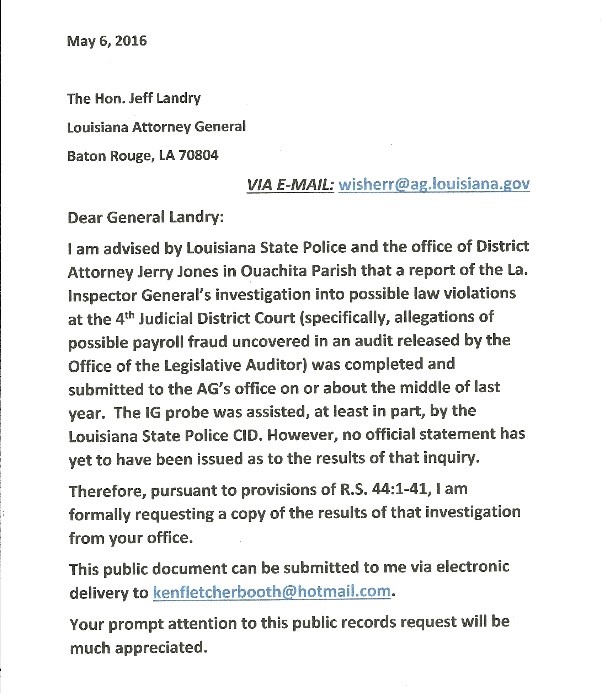
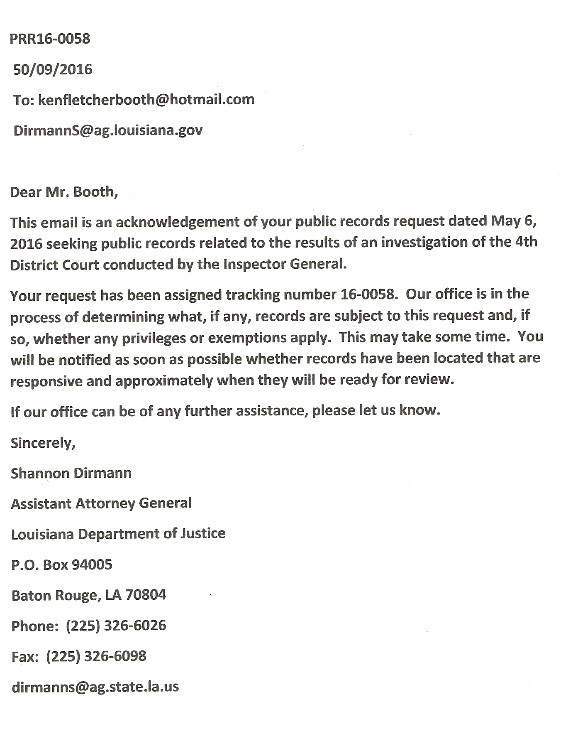
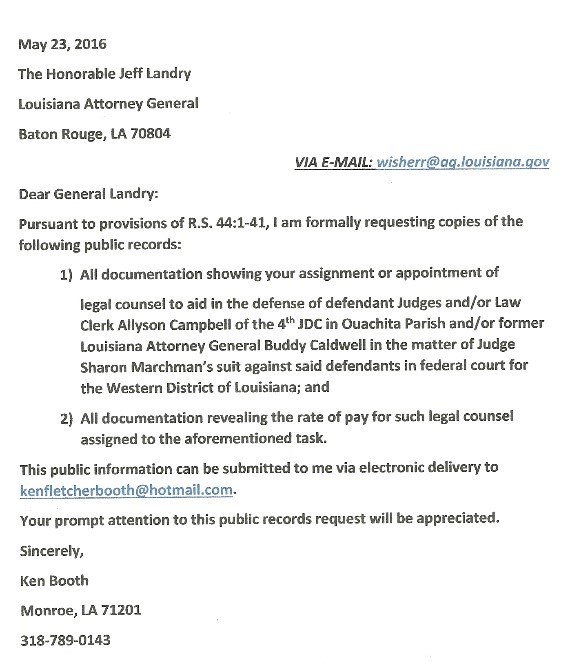
Similarly, a couple of my own requests (shown here) to the new “transparency-minded” and “aggressive” Republican Attorney-General remain without result except for one letter which said it “may take some time.”

In a June 7th E-mail to Landry’s office, I wrote: “I would very much appreciate either the documents requested sixteen days ago or an opinion from that office on why they cannot be produced. Please know this is a public records request that will not go away silently.”

Landry’s press secretary Ruth Wisher has made sure that reporters know that her boss doesn’t always return her texts. Well, that certainly makes everything hunky-dory.

BOOTH REQUEST

AG RESPONSE TO BOOTH

BOOTH FOLLOW UP REQUEST
           Known records requests to the AG’s office also demand access to a state police report on its investigation into the allegations of possible payroll fraud and destruction or concealment of court documents. A report on the findings from a companion investigation by the Inspector General’s office was released back on April 15th. The state police report is known to be in the hands of the Attorney General.

All of this is at odds with the very public Landry who has been throwing his weight around the capitol lately pushing for control of his agency’s own finances, making national headlines while trying unsuccessfully to crack down on illegal aliens, and squaring off (at least publicly) with the Gov. John Bel Edwards as if he hopes to succeed him some day.

But Landry and the 4th Judicial District Court in Ouachita Parish are not the only ones playing keep-away with public records.

LouisianaVoice has been repeatedly stymied by the Louisiana State Police with respect to sought after records.

In fact, as a recent LouisianaVoice post notes, Edmonson has manufactured his own loophole for denying public records requests after tiring, he suggests, of the public learning of “far too many instances of misconduct at LSP followed by a mindset of circling the wagons.”

Several high-profile cases of alleged improper State Trooper conduct have been determined to have been free of wrong doing and are therefore exempt  from public records laws if no diciplinary action is taken. That’s staking out a rather questionable claim by the Supertindent.

Curiously, however, his agency did release records showing payroll fraud had occurred at Troop D headquartered in Lake Charles when the lieutenant there was accused of having instructed the men under his command to pad their time sheets to reflect work that had not been performed.

Ironically, that’s the same charge investigated by the same LSP against the law clerk in Ouachita Parish, the report of which has been hidden from public scrutiny even amid growing speculation nothing will come of the charges against her or the Judges who approved her bogus time sheets. It should be noted that the Troop D lieutenant was found to have engaged in “no wrong doing” and access to any investigation findings with respect to him has been denied. However, a trooper he supervised and who figured in the padded time sheets was fired.

The Superintendent of the Louisiana State Police is appointed by the Governor with consent of the State Senate. Edmonson had—and continues to have—the support of Gov. Edwards.

Edwards is also credited with preserving through his influence, at least indirectly, the job of another Jindal administration hold-over department head, Education Superintendent John White. While White actually is appointed by the Board of Elementary and Secondary Education over which the governor has little control since most board members are elected, his stated support of White certainly didn’t hurt.

JOHN WHITE PHOTO

White, a 2012 BESE appointee, has been under considerable public fire over his steadfast defense of the Common Core program.

White has filed a lawsuit against two individuals seeking public records in five different requests from the Department of Education, presumably to block their access to dirty laundry in that agency as might be said of the lawsuit by the Judges in Monroe against The Ouachita Citizen.

Even considering Louisiana’s notorius reputation for politial scandals, suing private citizens or even the news media by government agencies has plunged the state’s standards to a new low.

As has been pointed out elsewhere the use of unlimited financial and legal resources—all paid for by the taxpayers—to block citizens with limited financial means is a dangerous threat to the very notion of checks and balances that are supposed to protect the public from abuse.

For those elected Louisiana officials to sit back and do nothing to put a stop to this unprecedented assault on the public’s right-to-know is pretty much tantamount to an endorsement of such actions.

And if the civilian public looks the other way when this kind of mess is exposed and doesn’t demand that it stop then expect the level of distrust to grow.


Read Full Post »

Editor’s note: Just when you think good, old-fashioned investigative reporting has gone the way of LINOTYPE MACHINES and hot lead typesetting, the Baton Rouge Advocate conducts a thorough probe of operations at the Louisiana State Penitentiary that has resulted in a wave of resignations if no indictments.

And then there is a twice-weekly publication up in West Monroe called The Ouachita Citizen headed by Publisher Sam Hanna, Jr. His paper’s ongoing investigation into the Fourth Judicial District Court is making a lot of people very uncomfortable and with good reason. So uncomfortable, in fact, that several judges in the 4th JDC actually filed a lawsuit against Hanna and The Citizen to prevent the publication from seeking public records to which they were legally entitled. Such action by the judges is unprecedented and appears frighteningly Nixonesque in its brazen attempt to thwart legitimate efforts to inform the citizens of Ouachita Parish. It’s the kind of action that should send chills down the spine of the electorate. Hanna has vowed to refuse to pay court costs assessed in that litigation. He has lost advertising revenue as a result of his coverage of the court.

Following is a lengthy story by Citizen reporters Zach Parker and Johnny Gunter published yesterday (Thursday, May 26) by the paper. One major point raised is the apparent conflict of interest in the Attorney General’s office conducting an investigation of the 4th JDC while at the same time defending four of the judges in a lawsuit brought against them by a fifth judge.

By Zach Parker and Johnny Gunter

The Citizen

Inquiries by The Ouachita Citizen into Fourth Judicial District Attorney Jerry Jones’ involvement in an investigation of Fourth Judicial District Court show the district attorney offered a false account of his communications with investigators, filed misleading court documents and did not refer this newspaper’s criminal complaint to authorities involved in the investigation.

Those activities formed part of Jones’ efforts to downplay the investigation into possible wrongdoing at the court as well as his involvement in the probe.

The investigation concerned allegations that law clerk Allyson Campbell committed payroll fraud and destroyed or concealed court records. Those accusations also are the focus of separate lawsuits, one filed in district court by Monroe businessman Stanley R. Palowsky III and the other in federal court by Fourth Judicial District Court Judge Sharon Marchman.

Jerry Jones restricts probe’s scope

In July 2015, Jerry Jones called on the Office of State Inspector General and Louisiana State Police to investigate public corruption. At that time, he was tight-lipped about the scope of the investigation, at first refusing to comment though he later clarified the investigation concerned Fourth Judicial District Court.

As revealed in comments to The Ouachita Citizen as well as to other media outlets, Jerry Jones restricted the scope of the investigation to an audit of the court’s finances released March 2, 2015 by the Louisiana Legislative Auditor’s Office. That audit said some court employees may have earned pay for hours not worked. As first reported by The Ouachita Citizen and later confirmed in open court, Campbell was the subject of auditors’ comments.

However, there were other allegations concerning Campbell that Jerry Jones sidestepped during interviews, repeatedly claiming the probe concerned the audit only. During interviews, he downplayed any outcome of an investigation into payroll fraud since Campbell was a salaried employee, not hourly, in spite of the allegations concerning falsified time sheets approved by court judges.

In March 2015, Ouachita Citizen reporter Johnny Gunter submitted a criminal complaint to Jones’ office, asking the district attorney to investigate not only allegations that Campbell had committed payroll fraud but also accusations by Palowsky and Monroe attorney Cody Rials that Campbell had destroyed or concealed documents they had filed with the court in their separate legal matters.

Little more than a week before the Inspector General and State Police launched their joint investigation, The Ouachita Citizen learned Jones had not begun an investigation, requested any documents or information from court officials in response to the newspaper’s criminal complaint.

Through The Ouachita Citizen‘s inquiries and reports, more details emerged concerning the scope of the court investigation. In a June 30, 2015 interview, retired Judge Ben Jones, who is the court’s administrator, informed The Ouachita Citizen that he had discussed the newspaper’s criminal complaint with Jerry Jones.

“He (Jerry Jones) indicated to us (the court) that he would respond to your criminal complaint and take appropriate action at such time that he thought appropriate,” Ben Jones said. “We are prepared, should he act on that criminal complaint, we are prepared to cooperate, and that’s what we’ll do. But at this point, he has not asked us for any information, any documents, or initiated any investigation.”

During that interview, Ben Jones repeatedly said Jerry Jones would conduct an investigation into the matters raised by The Ouachita Citizen‘s criminal complaint “with integrity” and would show court officials no special privileges.

Ben Jones was one of five district court judges named defendants along with Campbell in Palowsky’s lawsuit. In his lawsuit, Palowsky accused Ben Jones and judges Carl Sharp, Wilson Rambo, Fred Amman and Stephens Winters of covering up Campbell’s activities, a claim reiterated in Marchman’s lawsuit in U.S. District Court.

In the district attorney’s interviews with the press, Jerry Jones said the investigation into the court did not involve any judges.

Jerry Jones gives false account of communications with investigators

The Ouachita Citizen learned Jerry Jones concealed his communications with investigators as well as offered the newspaper conflicting accounts of a report on the investigation’s findings.

When asked in an April 25 interview whether he had engaged in any communications with the Inspector General or the State Police concerning the investigation, he said, “No. None at all.”

The District Attorney further distanced himself from the investigation at that time and said, “I haven’t had any communication with them other than having my assistant ask (Inspector General) Stephen Street about the status of the report,” referring to whether a report had been prepared on any findings in the court investigation.

He made that statement to the newspaper in spite of the fact that his office had received a letter from Street 10 days before, a letter which represented a report on the investigation’s findings. Street’s April 15 letter claimed there was no “sufficient cause” to file criminal charges against Campbell on the accusations of payroll fraud or document destruction was first reported by The Ouachita Citizen. According to that letter, Street was concluding his office’s investigation into the matter.

“Because the available facts do not provide sufficient cause for the arrest of Ms. Campbell for any criminal offense, we are closing our file and taking no further action on this matter,” Street wrote. “Ms. Campbell was interviewed and denied destroying or hiding any court records or pleadings. She stated that her work schedule was approved by her supervisor and that she worked the hours for which she was paid. Judge Carl Sharp supported her claim that all court documents were always available to him. He also confirmed that Ms. Campbell was a salaried employee whose hours were sometimes irregular.”

In a May 11 interview, The Ouachita Citizen asked Jerry Jones why he had misinformed the newspaper by saying he’d had no communications with investigators though he’d received the April 15 letter from Street. In response to that query, he again denied he had engaged in any communications with investigators.

The Ouachita Citizen then asked Jerry Jones about his written correspondence with Street: He declined to comment, saying he couldn’t answer that question and had referred his office’s investigation to the Attorney General’s office.

The Ouachita Citizen then informed him that the newspaper had obtained a copy of the April 15 letter revealing correspondence between Street and Jerry Jones on the investigation, at which point the district attorney paused and then said, “Okay, I made a mistake. You’re not getting another word out of me.”

Throughout the investigation Jerry Jones sought to distance himself from the court probe though the Inspector General’s letter as well as The Ouachita Citizen‘s inquiries to State Police all referred to the district attorney’s involvement. According to the newspaper’s inquiries, he was calling the shots in the investigation though he said he wasn’t investigating and didn’t have the manpower in his office to conduct such an investigation.

“We keep it separate,” he said in the April 25 interview. “I’m not investigating.”

Following The Ouachita Citizen‘s May 11 interview, Jerry Jones informed the newspaper that State Police had completed a written report that contradicted the findings revealed in Street’s April 15 letter. He said he would ensure the newspaper was provided with a copy of the State Police report he claimed existed.

The Ouachita Citizen submitted an inquiry and a public records request to State Police about the purported report, asking to obtain a copy. However, State Police authorities informed the newspaper that Jerry Jones had told them the investigation should be considered open, a status that would bar the release of documents pertaining to the investigation, including the unseen State Police report.

According to a May 11 statement from State Police spokesman Maj. Doug Cain, State Police investigators were awaiting clearance from Jones to release the investigative report.

Later that day, State Police informed The Ouachita Citizen that record would not be released, per instructions from Jerry Jones.

“The district attorney for the 4th JDC is awaiting additional information and the matter is considered still open at this time,” wrote Michele M. Giroir, State Police attorney supervisor in a May 11 email. “Therefore, pursuant to R.S. 44:3(A)(1), the records are exempt from disclosure at this time.”

Records dispute DA’s claim he transferred case to AG

Since early last year, Jerry Jones has repeatedly told The Ouachita Citizen he was not investigating but had referred that responsibility to the Attorney General’s office.

“You people keep saying I’m investigating, but I’m not,” he said. “I sent that to the AG’s office.”

At that time, Buddy Caldwell was Attorney General and had appointed a taxpayer-paid defense for Campbell in spite of questions raised by The Ouachita Citizen about the legality of that appointment. Caldwell’s involvement in the defense of Campbell later was cited as grounds for naming him a defendant in Marchman’s lawsuit.

In support of his claim he had transferred the responsibility of investigating to the Attorney General, Jerry Jones produced last year a motion to recuse he had filed at the Ouachita Parish Clerk of Court’s office in the court record for Stanley R. Palowsky III v. W. Brandon Cork and others, the lawsuit in which the allegations against Campbell first surfaced.

His Dec. 5, 2014, Motion to Recuse said, “Now into this Honorable Court comes Jerry L. Jones, Fourth Judicial District Attorney, who, with respect, represents: The District Attorney recuses himself and his office in the above captioned case and moves that same be sent to the Attorney General’s Office.”

However, Jerry Jones’ motion to recuse has laid untouched in the court record and was never sent to the Attorney General’s office, according to Ouachita Parish Clerk of Court Louise Bond.

Earlier this week, The Ouachita Citizen asked to review the court record for Palowsky v. Cork, which is secured in Bond’s office since, she said, it’s a “high profile case” and she did not want any parties claiming their documents had gone missing from it, referring to accusations from Palowsky that Campbell had either destroyed or concealed documents he filed in that same case.

After a review of the record by Bond and The Ouachita Citizen, there was no indication that Jerry Jones’ motion to recuse had ever been sent to the Attorney General’s office.

“I don’t see anything that shows we sent anything, but there’s nothing on there that shows where it should be sent,” she said.

Bond confirmed with her deputy clerks that the DA’s document had not been sent there. It hadn’t been sent because Jerry Jones’ document didn’t indicate who or where the motion should be sent, though it asked the Clerk of Court’s office to handle the matter.

“I checked and nothing was sent,” Bond said. “But there’s nothing on here showing us who at the Attorney General’s office should receive it or where even to send it.”

Bond told The Ouachita Citizen that the deputy clerk, B.J. Graham, who accepted Jerry Jones’ filing no longer worked at the Clerk of Court’s office. Graham had quit, according to Bond.

According to Bond, normally a mover in a legal matter will either indicate they have sent copies of the filing to other parties in the matter. If the filing does not bear the name, address or contact information of the person it should be sent to, like the DA’s filing, then the mover will attach a cover sheet with instructions, Bond said.

“Most of the time they say please serve to so-and-so, or it shows that they’ve already sent copies, but there are no instructions, either on a cover sheet or on the motion itself,” Bond said.

Jones’ motion to recuse was later signed as a judicial order by Judge Carl Sharp: “It is ordered that the Fourth Judicial District Attorney’s Office is recused from the above captioned case and same be sent to the Attorney General’s Office.”

Sharp is a defendant in both Palowsky’s and Marchman’s lawsuits. He is accused of covering up Campbell’s activities. Sharp also is one of the judges for whom Campbell clerks. Additionally, Sharp defended Campbell against the payroll fraud allegations during an interview with Inspector General investigators, according to Street’s letter.

Jerry Jones’ motion to recuse and Sharp’s order are available for viewing at www.ouachitacitizen.com

The Ouachita Citizen contacted the Attorney General’s office on numerous occasions, through telephone and email, to ask whether they had received any correspondence from Jerry Jones, including his recusal. Attorney General spokesperson Ruth Wisher suddenly ceased all communications with The Ouachita Citizen last week in spite of earlier pledging to answer the newspaper’s questions by Thursday, May 19. Attorney General Jeff Landry and Assistant Attorney General Shannon Dirmann also did not respond to communications from The Ouachita Citizen.

Two days after the Attorney General office’s last communication with The Ouachita Citizen concerning its questions, Landry’s office filed a pleading in Marchman’s federal lawsuit on behalf of Caldwell, the former Attorney General and defendant in the judge’s lawsuit.

Absence of investigation a key point in public records dispute

The Ouachita Citizen recently learned Jones did not refer the newspaper’s criminal complaint to some authorities investigating the court. Inspector General Stephen Street said state law protecting Inspector General records meant he could not reveal whether Jerry Jones had sent his office the newspaper’s criminal complaint or not.

“Due to OIG (Office of Inspector General) statutory confidentiality, I am unable to confirm or deny the receipt of the complaint to which you refer,” Street wrote in an email.

However, State Police did not receive the newspaper’s criminal complaint, according to Cain, the State Police spokesman.

“We are unaware of any complaint from The Ouachita Citizen through the DA’s office,” Cain said.

The Attorney General’s office did not respond to questions from The Ouachita Citizen about whether Jerry Jones had sent them this newspaper’s criminal complaint.

The Ouachita Citizen‘s criminal complaint was prompted by the district court’s refusal to produce public records from Campbell’s personnel file that could shed light on the allegations of payroll fraud and document destruction. The day after The Ouachita Citizen submitted its criminal complaint, the court sued the newspaper, asking for an ad hoc judge to determine whether Campbell’s right to privacy outweighed the public’s right to know.

In spite of The Ouachita Citizen submitting its criminal complaint with Jones in March 2015, there was no investigation called to target the court until after an ad hoc judge had ruled against this newspaper, declaring Campbell’s personnel file off-limits to public records requests.

During a court hearing before the ad hoc judge, The Ouachita Citizen argued the public should be granted access to Campbell’s personnel file since its public records requests – stemming from the allegations of payroll fraud – concerned public tax dollars (referred below as the “public fisc”). In response, the court argued there was no need for judicial intervention to make Campbell’s personnel file available to the public since the district attorney could exert his office’s authority to investigate if there were any reasonable grounds present in the newspaper’s criminal complaint.

Delivering the court’s argument was Monroe attorney Jon Guice, who also represented the five district court judges in Palowsky’s lawsuit and is a defendant in Marchman’s lawsuit.

“The response to his argument about the protection of the public fisc is it is handled by the law and you need not intervene in that,” Guice continued during the May 19, 2015 hearing on the public records requests. “His client (The Ouachita Citizen) is well aware that the legislative auditor sent a copy of its findings to the district attorney.

“They have also asked the district attorney to avail himself of that report and to do his duties to investigate, and if there is an issue there for him to address it. So, this court need not feel as though it has a duty of protection of the public fisc when there is an expressed officer, i.e., the district attorney who the legislative auditor has provided its findings and whom the paper has asked to honor his obligation. So if there is something there then that’s the way that is to be handled.”

After the ad hoc judge ruled against The Ouachita Citizen, details in Palowsky’s and Marchman’s lawsuits have suggested Guice, Ben Jones, the court administrator, and other court officials manipulated the documents present in Campbell’s personnel file before the ad hoc judge reviewed it to determine whether it was subject to The Ouachita Citizen‘s public records requests.

Jerry Jones later told The Ouachita Citizen he had agreed with Ben Jones to postpone acting on The Ouachita Citizen‘s criminal complaint until after the ad hoc judge had ruled in the court’s case against the newspaper.

When Ben Jones was asked about that arrangement during a June 30, 2015 interview, he said, “I am not prepared to say I had any agreement with Jerry Jones to wait until after the final judgment but he has elected, obviously, to delay any action until, I mean, to my knowledge, no action has been taken so far.”

“I have no idea when any action might be taken, but I take him at his word that he will respond to the complaint, and he has indicated that he would honor his obligation to respond to the complaint,” Ben Jones continued. “That’s all I can tell you about that. I have talked to him, but I’m not at liberty to say everything about that conversation.

“But I will say this to you. I know Jerry Jones and I am convinced that any investigation that he initiates will be one done with integrity. I absolutely believe that to be the case. He will go wherever the findings take him. That’s how he is, and that’s a good thing. It is our expectation that he will show us no special privileges or special deference. I expect him to respond to the request that he investigate with integrity, and I don’t fear that at all.”


Read Full Post »

 isBy Tom Aswell and Ken Booth

If there was ever any question that there is a deliberate ongoing effort by the Louisiana State Police (LSP) to deny access to public records, those doubts were laid to rest by a pair of responses to LouisianaVoice—one from LSP and the other from the Office of Inspector General.

It all began innocently enough with a routine request made for files into the turmoil and legal battle among judges of the 4th Judicial District Court which includes the parishes of Ouachita and Morehouse.

Judge Sharon Marchman filed suit against four of her colleagues on the 4th JDC bench over her claims that they were covering for a legal clerk who Marchman suspected was not at work during times she was being paid. https://louisianavoice.com/2016/05/05/disorder-in-the-court-guest-columnist-ken-booth-reveals-disturbing-events-that-taint-several-judges-of-4th-jdc/

Oddly enough, the clerk is the highest-paid law clerk in the 4th JDC—despite the fact that she is not even an attorney, normally the number one criteria for a law clerk.

The clerk, Allyson Campbell, is the sister of prominent Monroe trial lawyer Catherine Creed, the daughter of George Campbell, regional president of Regions Bank who in turn is married to the daughter of another prominent attorney, Billy Boles who was instrumental in the growth of Century Telephone and who is a major contributor to various political campaigns.

Another major screw-up in 4th Judicial District Court (and again Judge Larry Jefferson is right in the middle of it all)

State Police were reported last June to be conducting a joint investigation, along with the OIG, but no report on that investigation has ever been issued by either agency.

So naturally, in keeping with our uncompromising belief in the public’s right to know, we asked.

Here is the identical request made by LouisianaVoice to both agencies on May 5:

Pursuant to the Public Records Act of Louisiana (R.S. 44:1 et seq.), I respectfully request the following information:

Please allow me to review the file on the Fourth Judicial District 2015 investigation.

Here is the response received on Wednesday, May 11, from LSP:

Mr. Aswell, I have been advised that the district attorney for the 4th JDC considers this an open matter as he is awaiting additional information.  Therefore, any responsive records maintained by LSP are not subject to release at this time as they are exempt from disclosure pursuant to R.S. 44:3(A)(1). With kindest professional regards, I am,

Sincerely,

Michele M. Giroir

Attorney Supervisor

But wait. A full day before receiving the LSP denial (on Tuesday, May 10) we received quite a different response from the OIG. OIG 4TH JDC REPORT

On the first page, OIG General Counsel Joseph Lotwick explained that “records prepared or obtained by the Inspector General in connection with investigations conducted by the Inspector General shall be deemed confidential and protected from disclosure.”

But Lotwick, in that same letter, also said he was attaching a copy of an April 15 letter from Inspector General Stephen Street to 4th JDC District Attorney Jerry Jones “as it is a public record.” The five-paragraph letter of nearly a month ago noted that the 4th JDC management controls “did not make possible a determination of the hours Ms. Campbell worked on any given workday. Investigators confirmed that alleged violations of policy applicable to Ms. Campbell were investigaged (sic) and addressed by 4th JDC authorities.

“Because the available facts do not provide sufficient cause for the arrest of Ms. Campbell for any criminal offense, we are closing our file and taking no further action in this matter.”

So, despite claims by LSP that the investigation remains open, Louisiana’s Inspector General Stephen Street says an investigation by his department along with detectives from the state police found nothing wrong with the work hours of a law clerk for the 4th Judicial District Court.

A state audit had pointed to possible payroll fraud when an inspection of time sheets revealed the chief law clerk had turned in time sheets for work on days she was not even at the courthouse. Those time sheets were approved by her supervising judges.

The 41-year-old law clerk, Allyson Campbell was also a society columnist for the News-Star, the Monroe daily newspaper at the time.

According to lawsuits filed against her by an attorney alleging she destroyed or concealed files in his cases before the court, Campbell, who indicated she might be doing her job at a Monroe restaurant/bar frequented by lawyers, business people and Judges.

Documents show one picture obviously taken in a restaurant was captioned “Seafood nachos at the office.”

In 2014 Campbell published a column entitled A modern guide to handle your scandal, declaring “half the fun is getting there and the other half is in the fix.”

“Send it out,” she wrote. “Lies, half-truths, gorilla dust, whatever you’ve got. You’re no one until someone is out to get you.” She continued, “That special somebody cared enough to try and blacken your reputation and went and turned you into a household name? Bravo. You’re doing something right.”

The allegedly falsified Campbell time sheets, said to have been borne out by courthouse security camera video showing she was a no-show there on the questioned “work days,” and a subsequent allegation of cover-up by four Ouachita Parish District Court Judges, prompted Judge Marchman, to file a federal court lawsuit against all of them for retaliating against her for “trying to expose Campbell’s history of payroll fraud and document destruction” while acting under color of law.

Whether Marchman was aware is not known, but Street had by then already decided interviews his office had conducted at the courthouse led him to conclude “the available facts do not provide sufficient cause for the arrest of Ms. Campbell for any criminal office, [and] we are closing our file and taking no further action in this matter.

In his April 15 letter to Jones, Street outlined how “several 4th Judicial District Judges, as well as other local attorneys, “the current and former court administrator, employees of the Clerk of Court, (Louise Bond),” and other court employees and assistants, as well as Campbell herself, were interviewed. Campbell, he wrote, had denied destroying or hiding or destroying any court records or pleadings.”

District Attorney Jones at the outset referred the allegations of wrongdoing to the State Police who wound up working in concert with the IG’s north Louisiana investigator, Heath Humble.

Since then, the DA has consistently referred all questions regarding the status of the case to the office of the Louisiana Attorney General, Jeff Landry.

Accordingly, my public records request for documentation or any statement regarding the status of the investigation long since closed by the local and state investigators was answered by Shannon Dirmann, an Assistant Attorney General who wrote on May 9: “Our office is in the process of determining what, if any, records are subject to this request, and, if so, whether any privileges or exemptions apply. This may take some time. You will be notified whether records have been located and are responsive.” (Emphasis added) In other words, “we’ll get back to you.”

Interesting indeed, since Lotwick responded to a similar records request one day later (on May 10) from LouisianaVoice with a copy of Street’s letter to Jones—“as it is a public record.”

“I trust that this response is sufficient,” he wrote in his letter to LouisianaVoice.

Well, certainly more sufficient—and much more informative than anything provided by LSP.


Read Full Post »

A Shreveport dentist found guilty by the same individuals on the Louisiana State Board of Dentistry who investigated and prosecuted him (accuser, prosecutor and judge—all in a neat little package) has written a letter to Attorney General Jeff Landry questioning the propriety of the state’s defending a private investigator formerly under contract to the board but who may not have carried errors and omission insurance normally required of companies and individuals contracted with the state.

Here is the text of the letter to Landry by C. Ryan Haygood, DDS:

             I wanted to bring your attention to the illegal conduct of the Louisiana State Board of Dentistry and its agents that are currently being defended in multiple Louisiana State and federal courts by your office.

            Multiple dentists asked Buddy Caldwell’s office to investigate the egregious conduct of the LSBD and its agents over the years, but were ignored. However, Caldwell did choose to have his office defend their members and agents when they were sued for malicious conduct. Your office is currently representing Camp Morrison, Dana Glorioso, Karen Moorhead, and Barry Ogden. The board of dentistry had the legislature change the law after the suit was filed to cover the defense of Morrison, Glorioso, and Moorhead.

            Morrison was a state contracted investigator for the board of dentistry who was required (but failed) to have his own insurance coverage; and the other two, Moorhead and Glorioso, were his independent contractors. None of them were ever state employees. All are now claiming coverage through the FARA insurance program designated for state employees. All claim attorney-client privilege with your office, which is providing them with a legal defense through Barbara Melton with The Faircloth Group.

            Morrison is currently under investigation by the State Inspector General’s office and is expected to be criminally charged for fraud, perjury, and billing fraud to the state. Many dentists complained for years about his criminal acts, extortion, and harassment techniques. The other two worked for him as undercover investigators without a license, which is a criminal act under Louisiana law. Karen Moorhead also perjured herself under oath.

            It is my understanding that the Attorney General’s office cannot, by statute, defend someone who has broken the law. As you might imagine, Buddy Caldwell’s office did no due diligence into the matter before it was quickly passed off to his friends at The Faircloth Group. According to one former board member, Faircloth has billed more than $500,000 for their defense.

            Additionally, your office recently undertook the defense of Sam Trinca, Dean Manning, and James Moreau who are members of the board of dentistry, as well as the board of dentistry itself which were all recently named as defendants. It is probable that at least two of these defendants have perjured themselves in relation to this matter. Furthermore, the board of dentistry recently bragged in their August 2015 board meeting that because they were officially named as defendants in this case, they would be saving money since the state would be undertaking their costs of defense. Once again, I don’t believe your office was ever charged with defending criminal conduct in such matters. I ask your office to please examine this role as their attorney.

            There was a definite problem with risk management system under Caldwell who worked overtime to keep this case alive. Instead of working to fix the problem so that the state isn’t paying multiple claims for numerous dentists in the future, Caldwell acted as an enabler for improper and unlawful conduct. I ask you to please investigate this matter personally and make a determination to not continue defending this crew. I think if you look at the record, you’ll be as appalled as I am.

Edwards asked to replace LSBD members

At the same time, LouisianaVoice has learned that Gov. John Bel Edwards recently surprised some observers by replacing several longtime members of the Auctioneer Licensing Board after learning of that board’s questionable acts and egregious behavior.

84-year-old Widow Files Pro Se Lawsuit Against Auctioneer Licensing Board over sale of her residence, rental property

Some dentists, our source said, are now calling on Edwards to do the same for the Louisiana State Board of Dentistry (LSBD), which some, especially dentists, consider one of the most corrupt boards in Louisiana.

Multiple state agencies are currently examining the smoke coming from the Canal Street offices of LSBD. The board is currently being investigated by the Office of the Inspector General, the Attorney General, and the Legislative Auditor pursuant to complaints of corrupt acts and behavior.

In case Governor Edwards needs suggestions on whom to replace first, our source had a couple of suggestions:

  • Dean Manning is currently being sued along with other former board members, staff, and agents for his role in a board hearing in which a Louisiana dentist alleges the board participated in criminal conspiracy and unfair trade practices against him by revoking his license to practice in Louisiana. The Louisiana 4th Circuit Court of Appeals overturned the board’s decision on grounds that the board general counsel Brian Begue, serving as the “independent counsel,” violated the dentist’s right to due process. The court notes among other things that Begue acted over-zealously to deny the right to a fair hearing by harassing the dentist, openly questioning his integrity on the stand, acting as a de facto prosecutor, as well as judge and jury. Manning did nothing to stop Begue from doing this. In fact, the dentist alleges that Manning actually encouraged the process. In reference to the hearing, a Louisiana 2nd Circuit decision suggests the potential of a corrupted investigation and a strong inference that other members of the board engaged in conduct attributed to the dentist’s local competitor to remove the dentist from the local marketplace. The court goes on to say that if these allegations regarding Dies’ behavior are ultimately proved, “they would strongly suggest that Dr. Dies’ conduct was motivated less by altruistic concern for the public than animus to suppress a competitor. They would also prove that other board members agreed with Dr. Dies to engage in conduct to accomplish these objectives.”
  • Ike House was placed on the board of dentistry after he testified as a witness in the same hearing listed above. House testified that one of his long-time patients did not have periodontal disease. The dentist charged by the board for “fraudulent diagnosis of periodontal disease” claims the patient did indeed have a severe level of periodontal disease that was causing loss of bone and periodontal attachment around her teeth. The patient saw the dentist after leaving House’s office for care with the new doctor. She was surprised to hear that she had a severe level of disease and that Dr. House had let her mouth deteriorate under his care. Dr. House was faced with the precarious position of admitting that he was guilty of negligence or testifying against the dentist.

LSBD members need to be well-informed, fair, and just. Most of all, they need to put the law and protecting the public over their own self-interests or that of their friends. It’s time to make some changes at the LSBD.

You have our suggestions on where to start.

Louisiana must do better.

Oh…and let’s replace the director and staff while we’re at it. There should be many great candidates in Baton Rouge from which to choose when the board moves its headquarters to the Capital City.


Read Full Post »

« Newer Posts - Older Posts »