Feeds:
Posts
Comments

Archive for February, 2026

For those who perhaps assumed the dispute between DR. FERESHTEH EMAMI and the administration at Southeastern Louisiana University was an outlier and that all was generally well on the Hammond campus, think again.

There are at least three other disputes between professors and the school’s administration in addition to efforts by the university to charge exorbitant rates for copies of public records—or even examining records. Access to view public records is supposed to be available at no charge, according to Louisiana’s PUBLIC RECORDS ACT, (R.S. 44:1 et seq).

As for accessing public records, it’s pretty much a crap shoot. When LouisianaVoice attempted to learn if SLU had paid for a fluff piece on school President William Wainwright in CEO MAGAZINE, we were first told by SLU spokesperson Mike Rivault that the school had three working days in which to respond to our request.

It doesn’t.

R.S. 44:1 et seq clearly says that the custodian of public records must provide the requested records immediately if they are not in use. If they are in use, the custodian must respond immediately with a date—within three working days—as to when they will be available.

When so informed, Rivault said the payment for the pay-to-play piece was made by the school’s foundation and that he would obtain the information for us by the next day.

He didn’t. When a follow-up request was made, he replied that there was no such record.

Yet, Rivault had earlier quoted an actual price of $1250 to another individual for the same information. Bear in mind, if you will, that a simple accounting for a single cost item should probably run more than one page—a $1250 page. Yet another request for the same information by the group Louisiana Citizens Against Censorship (LACAC) was met with the bargain basement price of a paltry $128 which, according the state law, is still a tad steep.
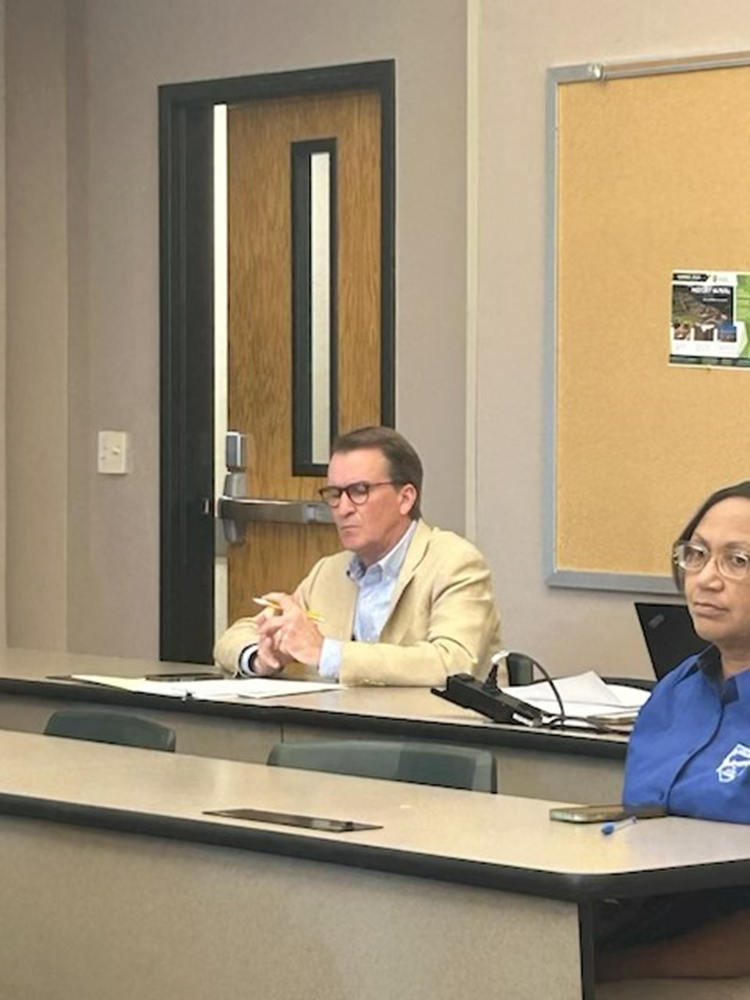
SLU’s Senior Marketing and Communications Leader Mike Rivault. At right is Louisiana Federation of Teachers representative Tara LaFrance.

But hey, that’s chicken feed at for a public record at SLU. One other individual, a professor on campus, was quoted $21,000 at $25 per page just to view another set of records.

But public records requests and SLU’s non-compliance aside, there are larger issues that beg the attention of the courts.

In Steven J. Rushing v. John Yeargain, a case that has its origins in September and October of 2018, more than seven years ago, Rushing is appealing the DISMISSAL of his lawsuit by the U.S. Middle District Court in February 2025.

In another curious lawsuit, it seems that Peter Gratton, a history an assistant professor of political science may have actually had the appeal of his termination denied before the appeal board had even met to consider his appeal.

Rushing, who has acknowledged he suffers from depression and bipolar II and is “an idealist and a gadfly” unable to ignore what he considers an injustice, claims he was heckled and removed from a faculty senate meeting on Oct. 3, 2018, subsequently refused the school’s efforts to have him undergo psychological evaluation and eventually fired from his music professorship position.

He claims that his intended addressed to the faculty senate on Sept. 26 and Oct. 3, 2018, “were not routine workplace grievances, but instead research findings protected by academic freedom and commentary on matters of public concern, including:

Fraud, misrepresentation, and breach of public trust at Southeastern Louisiana University, such as administrative deception, violations of SELU fraud policies, and false budgetary claims regarding the use of public funds at a state university;

  • Lack of faculty governance and procedural compliance for FS meetings, highlighting violations of Faculty Senate Constitution and Bylaws, suppression of faculty proposals, and administrative manipulation, restricting the ability of faculty to conduct true open meetings;
  • Insufficient leadership accountability and oversight of the Faculty Senate Executive Council, raising issues of transparency in the governing of a publicly funded university;
  • Academic freedom and the right to publish, emphasizing the public’s interest in promoting scholarship, teaching, and research;
  • Viewpoint discrimination and free-speech suppression, addressing how the selective silencing of faculty based on criticisms of institutional policy in a faculty-governance forum violates the First Amendment;
  • Grievance and due process failures, exposing failure to provide due process as required by university policy and state law, and failure to investigate illegal acts.
  • Broader reforms and public accountability in Louisiana’s higher education system, urging adherence to contractual, ethical, financial, and academic standards.

Gratton began his sixth year as an assistant professor at SLU in 2023. Once in his sixth year, he became eligible for tenure review and he so informed his department head of his intent to apply. SLU, however, notified Dr. Gratton of his non-reappointment during his sixth year. While the decision to grant tenure is within the discretion of SLU, Dr. Gratton’s eligibility for tenure review during his sixth year is not discretionary based on SLU’s and the Board of Supervisors’ own policies, his lawsuit asserts.

He said SLU’s Policy on Termination and Non-reappointment of Faculty, “[n]otice that a probationary appointment is not to be renewed shall be given to the faculty in advance of the expiration of the appointment “at least 12 months before the expiration of an appointment after two or more years of uninterrupted service at the institution.” That required notice, he says, was not given.

He says in his petition that on Aug. 30, 2023, he received a letter from the department chair requesting that he (Gratton) change the date on the My 31, 2023, non-reappointment letter “to render it compliant” with the school’ policy on termination. He says he refused to do so.

He said he informed his department head of his intent to apply for tenure on Sept. 5, 2023, a full 10 days ahead of the Sept. 15 deadline. Once a faculty member expresses intent, the tenure review process commences, he said. Instead, SLU notified Dr. Gratton of his “non-appointment” on Sept. 11, 2023, with an effective date of Dec. 17, 2024.

Because he felt SLU had deviated from its own policies, he filed an internal grievance with the university. The Faculty Senate Grievance Committee chair did not attend the committee meeting so it was ruled that the committee did not have authority to adjudicate the issues relating to tenure, promotion and reappointment.

Consequently, Gratton simultaneously filed an external grievance with the Louisiana State Board of Supervisors for Colleges and Universities.

This is where it begins to get a bit dicey.

Prior to the commencement of the (board of supervisors’) committee hearing—and before Gratton had an opportunity to be heard—“Dr. Gratton discovered, in the electronic folder for the hearing, the decision of the board with respect to Dr. Gratton’s grievance.

“This decision Dr. Gratton discovered before the hearing was identical to the decision conveyed to Dr. Gratton after the hearing and stated the process used by [SLU] regarding Dr. Gratton’s grievance be upheld and that no further consideration be given” his appeal.

Uh oh.

Someone screwed up by releasing the final decision of the board before the board even met. That equates to sloppy—but perhaps typical—Louisiana political chicanery.
Read Full Post »

Guest column by Dayne Sherman

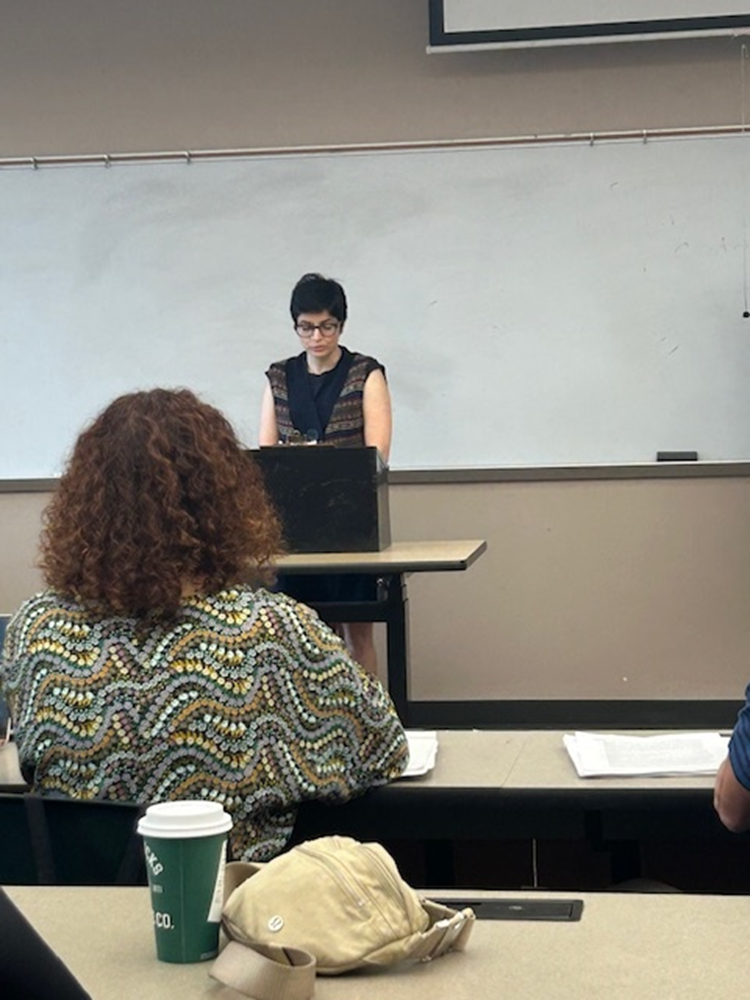
On Friday morning, 38 people assembled at Southeastern Louisiana University’s Fayard Hall to witness Dr. Fereshteh Emami’s grievance hearing. Emami, a celebrated analytical chemist and associate professor with tenure at SLU, was summarily fired from the Lake Maurepas Monitoring Project, after speaking to the media about her scientific findings. This hearing was the first leg in the process to try to win her job back.

Dr. Fereshteh Emami and her attorney, William Most, during Friday’s grievance committee hearing at Southeastern Louisiana University. In foreground, with back to camera is grievance committee member Mario Krenn, Ph.D.

The room was packed, an odd occurrence for a grievance hearing at “Sleepy Louisiana University – SLU” in my hometown and at my alma mater.

Standing at the classroom lectern, Dr. Emami gave a strong, logical, and persuasive speech as to why she believed she was fired from the project for reporting potentially hazardous pollution in Lake Maurepas, a lake my family has fished on for well over 100 years. The Air Products grant, $10 million for SLU to “greenwash” their big carbon capture CO2 sequestration project, was and is a corporate-federal boondoggle. She didn’t toe the party line. And it cost her a research position. Not her tenured faculty position yet, but her job doing research. She made it clear that she fled the repression and religious persecution in Iran and proudly became an American citizen. Only to meet rank corruption in Hammond, Louisiana, among these quasi-intellectuals.

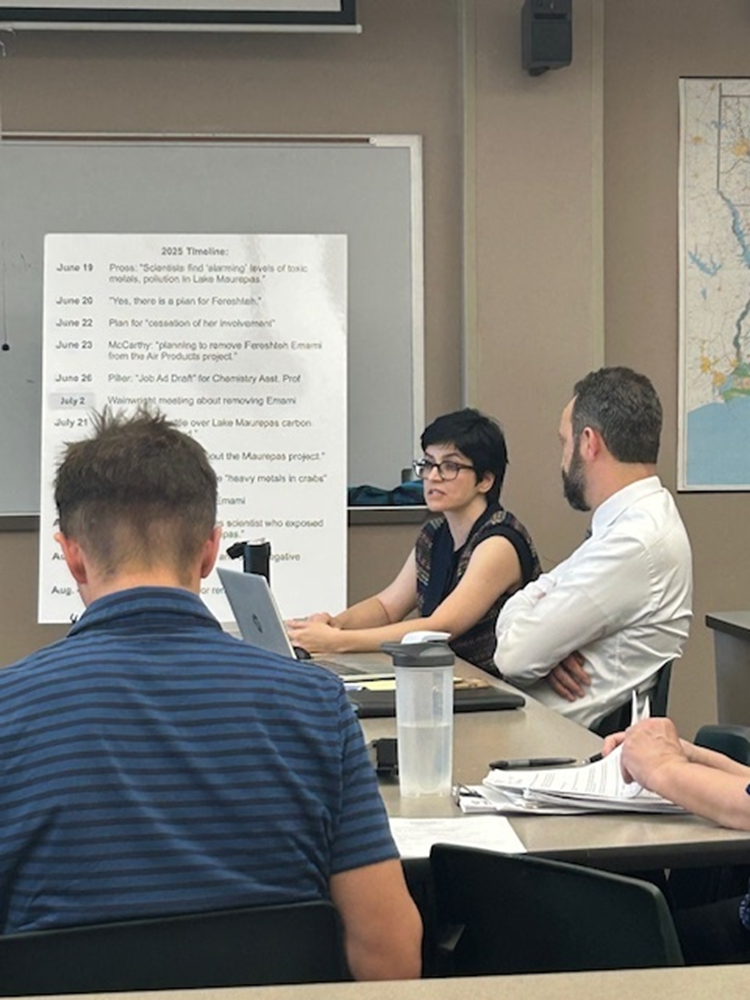
Fereshteh Emami, Ph.D., gives her presentation to Southeastern Louisiana University grievance committee Friday. In foreground, with back to camera, is grievance committee member Monique LeBlanc, Ph.D.

Dr. Emami requested four outcomes from the hearing:

1. An outside investigator to look into her firing and the Lake Maurepas Monitoring Project scandal.

2. For SLU to follow the First Amendment and FIRE’s guidelines in SLU media policies.

3. SLU to provide her and the committee with unredacted emails that were unearthed by public records requests.

4. To receive her old position back in the monitoring project with back pay.

Two moribund professors and a staff member bloviated the SLU administrative party line in their statements. Declaring that Dr. Emami was too slow in reporting data. Baloney! Those three rascals are, in my opinion, simpletons and administration toadies. They couldn’t catch a cold with three weeks’ notice! Yet they are pretending Dr. Emami was lagging. Give me a break! They are not even worth listing their names here in this column. Their presentations were sloppy, mean-spirited, contradictory, and bullying. Unworthy of an academic career in Louisiana or elsewhere. On the contrary, the evidence of published peer reviewed journal articles by Dr. Emami’s team showed she was on time and doing well in her research.

Make no mistake: This case is about carbon capture and sequestration in Louisiana and the dangers of exercising academic freedom at Southeastern Louisiana University. It’s all about retaliation. And as I say repeatedly: follow the money.

In the spirit of full disclosure, I am a tenured professor at SLU and THE elected faculty grievance committee chair. However, I could not in good conscience serve as committee chair at this time. I voluntarily recused myself from serving on the committee due to SLU President William Wainwright’s and Library Director David Sesser’s constant attacks against me. (This column in no way represents the views of the SLU administration. I speak only for myself, a private citizen.)

Two major points in the hearing stood out:

First, the University stooges sent an internal document of “evidence” to the grievance committee and DID NOT share it with Dr. Emami and her lawyer William Most (He was forbidden to speak at the hearing even though Dr. Emami had requested it. She is on FMLA leave and wanted his help in presenting.) Moreover, Emami shared her evidentiary documents with the full committee and the SLU administrative hacks. Not giving the documents to Dr. Emami was likely a rookie mistake by the grievance committee. At the end of the day, not sharing evidence with Dr. Emami was prejudicial and unfair. In the rest of the country, it would have caused mistrial or dismissal.

The other major issue was Wainwright’s absence from the hearing. He is the SLU President and didn’t bother to show up, despite sending many of his university staff members and the UL System attorneys to the hearing. He was on Dr. Emami’s witness list. Where was he? Was Wainwright cozying up to carbon capture lobbyists? Was he sitting for another pay-to-play CEO Magazine feature article? Or was he hiding in a bathroom somewhere on campus waiting for the hearing to end?

I suspect Old Wainwright just chickened out. Afterall, this is his first time working full-time at a university in his life. He’s used to working at unaccredited vo-techs and running prison welding programs in Bumfuzzle. An undeniable truth in Louisiana: it’s rarely what you know. It’s who you know.

What happens next?

The process is simple and straightforward, but it is not unlike Louisiana politics in general, a saga full of potential collusion and corruption. In good faith, the SLU faculty grievance committee will deliberate in private and make their decision on Dr. Emami’s four requests. They can approve any one of them, none of them, or all of them. They will send their decision to Wainwright. I have no doubt Willie Wainwright will veto anything the group decides that is in Dr. Emami’s favor. He has much to lose, since he personally made the terrible decision to fire her. That is the “Dysfunction Southeastern Family Way.”

Afterward, Dr. Emami will decide if she would like to appeal Wainwright’s decision to the University of Louisiana System Board of Supervisors, a true kangaroo court of Jeff Landry sycophants with no integrity whatsoever, from my personal perspective and experience.

Indeed, I went to the Baton Rouge grievance appeal hearing on December 5, 2024, for former SLU Philosophy Professor Dr. Peter Gratton. According to Dr. Gratton’s recent lawsuit, the malevolent UL System hearing board ACCIDENTALLY placed their written decision to REJECT his termination appeal PRIOR to the meeting taking place, a violation of every legal precedent since Moses stood with the tablets of stone. Perhaps the UL System’s incompetent lawyers screwed up by letting the cat out of the bag. Or maybe it was a low-level staffer’s mistake in putting the written decision in Dr. Gratton’s eFolder by accident. Regardless, it’s going to be an interesting case to watch.

But back to Dr. Emami. After the UL System blesses the SLU corruption, as they surely will, she can then file a federal lawsuit with the courts. And may a jury of her peers decide wisely.

Dr. Fereshteh Emami stood tall at the hearing. She will stand tall against the SLU bullies in federal court as well. All of Louisiana should stand with her.

–Dayne Sherman is an author, advocate, activist, and an academic. He’s working on a memoir titled He’s a Problem: My Battle Against Book Burners, Bullies, and Bigots.

Read Full Post »

A simple question for State Rep. Michael Echols (R-Monroe): Considering Louisiana’s near-or-at-the-bottom in virtually every state ranking, from OBESITY to POVERTY to ECONOMIC CLIMATE to POLITICAL CORRUPTION to EDUCATION to CRIME to QUALITY OF LIFE, don’t you think your time and efforts would be better served addressing those issues rather than fawning over Cankle Ankles Trump by AUTHORING A BILL to name the new Mississippi River bridge after him?

Here’s the bill:

For that matter, it would seem that Echols would be too concerned about the HIGH CRIME RATE IN MONROE to fret over the naming of a bridge in Baton Rouge.

‘Groom of the Stool’ Michael Echols

Echols gushed, “President Trump has been a transformational leader for the people of Louisiana. It would be my highest honor to name a new Mississippi River bridge in Baton Rouge after the greatest President of our time.”

Transformational? No question about that. But “greatest” of our time? Hell, why doesn’t Echols just follow trump around with a roll of toilet paper to demonstrate his utter subservience like the medieval GROOM OF THE STOOL?

If Rep. Echols persists in tilting at this particular windmill, we can only assume he’s perfectly okay with:

  • pedophilia,
  • rape,
  • enriching oneself off his position,
  • enacting tax breaks for his rich pals while dumping on the middle class,
  • inflicting immeasurable harm on the environment,
  • attempting to annex an entire country against the will of its citizens,
  • poisoning the air, water and land along the Mississippi river by industry,
  • wholesale arrests of innocent children,
  • killing protestors,
  • initiating investigations and even indictments of those with whom he disagrees and
  • inciting an insurrection of our very government.

Harsh? Of course, but given your blind allegiance to a man with 34 felony convictions, one is left with little room for latitude in judgment.

It raises this obvious question for Echols and his fellow Trump-worshiping Repugnantcans:

Read Full Post »

Remember when the REPUGNANTCAN PARTY MANTRA was to “get the government out of our lives”?

Yeah, I remember, too, even if the party of the rich and powerful has forgotten.

Take Opinion 25-0069 by the Louisiana Attorney General’s office, for example.

The opinion, requested by State Rep. Beryl Amadee (R-Houma), was authored by Assistant Attorney General Amanda LaGroue, attempts to further restrict access to objectionable material in public libraries, a thinly-disguised effort at censorship, a favorite ploy of authoritative governments throughout history.

Basically, LaGroue’s opinion pretends to safeguard the “fundamental rights of parents to direct the reading, listening and viewing choices of their minor children,” when in fact, it is intended as little more than a means to keep “objectionable” material away from everyone, no matter that some of us never asked for “protection.”

The primary reason for alarm is not that we won’t be able to read racy material with sexual content—we can get a bellyful of that off the Internet any time we wish—but that it opens the door to far more widespread censorship. It’s a slippery slope to the government’s being able to silence criticism such as already being experienced by STEPHEN COLBERT at CBS, which earlier KNUCKLED UNDER to Cankle Ankles Trump.

Louisiana Citizens Against Censorship, an all-volunteer 501(C)(4) organization, however, has been quick to challenge the legal opinion (it should be pointed out here that AG opinions are just that—opinions—and are not legally binding).

In a two-page response to the opinion, the organization said, “Louisiana Citizens Against Censorship (LA-CAC) strongly disagrees with the Attorney General’s expansive interpretation of the term “access” in La. R.S. 25:225 as including a minor’s mere ability to “physically encounter” library materials.”

  • Parents have the right to guide their own children’s reading — not everyone else’s. Public libraries should empower parental choice through opt-in tools, not impose blanket restrictions that affect all families.
  • Public libraries serve the entire community. They are not instruments of ideological enforcement but institutions committed to intellectual freedom and diverse viewpoints.
  • Professional librarians, not political bodies, are trained to curate collections. Decisions about acquisitions should rely on established professional standards, not fluctuating political pressures or vague community standards.
  • Book restriction policies disproportionately target marginalized voices. Across the country, books challenged as “sexually explicit” frequently include works by or about LGBTQ+ individuals, people of color, and survivors of abuse.
  • There is a constitutional difference between obscenity and content some find uncomfortable. The Supreme Court’s obscenity standard in Miller v. California, 413 U.S. 15 (1973) is narrow. Most materials targeted in library disputes do not meet this definition and are fully protected speech.
  • Libraries are spaces of voluntary engagement. Simply being able to “physically encounter” a book on a shelf does not compel reading it. Families remain free to supervise, restrict, or guide their children’s selections.
  • Overbroad restrictions invite litigation and waste taxpayer resources. Policies that chill access to constitutionally protected materials are likely to face costly legal challenges. The response cited three legal precedents in which the U.S. Supreme Court has upheld unfettered access to material from libraries.

“The Attorney General’s opinion effectively equates ‘access’ with passive exposure and opens the door to segregating or cordoning off lawful materials based on subjective determinations of ‘sexually explicit’ content,” LA-CAC said. “Such an approach raises serious constitutional concerns:

  • It risks viewpoint discrimination, which is presumptively unconstitutional.
  • It substitutes political pressure for professional library standards.
  • It chills the freedom of minors—who do possess First Amendment rights—to explore ideas.
  • It burdens families who do not wish to have government gatekeepers substitute their judgment for parental discretion.”

The organization further asserted:

  • Parents have the right to guide their own children’s reading — not everyone else’s. Public libraries should empower parental choice through opt-in tools, not impose blanket restrictions that affect all families.
  • Public libraries serve the entire community. They are not instruments of ideological enforcement but institutions committed to intellectual freedom and diverse viewpoints.
  • Professional librarians, not political bodies, are trained to curate collections. Decisions about acquisitions should rely on established professional standards, not fluctuating political pressures or vague community standards.
  • Book restriction policies disproportionately target marginalized voices. Across the country, books challenged as “sexually explicit” frequently include works by or about LGBTQ+ individuals, people of color, and survivors of abuse.
  • There is a constitutional difference between obscenity and content some find uncomfortable.
  • The Supreme Court’s obscenity standard in Miller v. California, 413 U.S. 15 (1973) is narrow. Most materials targeted in library disputes do not meet this definition and are fully protected speech.
  • Libraries are spaces of voluntary engagement. Simply being able to “physically encounter” a book on a shelf does not compel reading it. Families remain free to supervise, restrict, or guide their children’s selections.
  • Overbroad restrictions invite litigation and waste taxpayer resources. Policies that chill access to constitutionally protected materials are likely to face costly legal challenges.

Urging lawmakers and library boards to interpret La. R.S. 25:225 “narrowly and in harmony with constitutional protections,” LA-CAC said the protection of parental rights “should not come at the expense of other parents’ rights, minor’s First Amendment freedoms, or the long-standing role of public libraries as bastions of intellectual freedom.

“Ultimately, the freedom to read is not a partisan issue—it is a fundamental constitutional right.”

Accordingly, the organization called for policies that:

  • Respect constitutional limits
  • Preserve professional collection standards, and
  • Protect the freedom to read for all Louisiana families.

Read Full Post »

If things keep going the way they’ve been transpiring, it shouldn’t be too much longer that Gov. Squeaky Toy Landry has installed a political hack in the top spot of every college and university in Louisiana.

Last Saturday, LouisianaVoice had a story that noted Landry, through the Board of Regents, over which he has considerable sway, has ALREADY INSTALLED HIS PICKS as presidents of five state universities—McNeese State, Southeastern Louisiana University, Louisiana Tech, Northwestern State and LSU.

Now comes word that a presidential search committee will begin interviews in Baton Rouge Thursday for the post of president of the University of Louisiana Lafayette (ULL). As of the present time, 12 candidates are scheduled for interviews but the smart money says that Landry already has his mind made up and the search committee likely already has its marching orders.

Make no mistake, the Repugnantcan Party has as a top priority the complete restructuring of education in America and last time we checked Louisiana was still part of the U.S.

We got the first hint several years ago when then-State Rep. RAY GAROFALO (R-Meraux) introduced a bill in 2021 which he said would emphasize the “good” of slavery. The bill, which never made it out of committee, would have imposed a ban on “divisive concepts” and said teachers SHOULD NOT ACKNOWLEDGE institutionalized sexism or racism. That bill was so odoriferous that even Garofalo’s fellow Repugnantcan legislators were repulsed by it.

Ray Garofalo receiving the Louisiana Family Forum Outstanding Family Advocate Award

Wikipedia described Garofalo as a “non-practicing attorney.” Perhaps he needed a little practice before becoming a legislator. His effort at burnishing the story of slavery resulted in his being removed as chair of the House Education Committee.

Unfortunately, that didn’t put much of a dent in the Repugnantcans’ efforts to whitewash history, including any mentions of the genocide of Native Americans in general and the Trail of Tears in particular in favor of force-feeding “Christianity” through posting of the Ten Commandments in Louisiana and Texas classrooms and the distribution of Bibles in Oklahoma public schools.

Determined efforts continue to put a happy face on American slavery, genocide, the denial of civil and voting rights for Blacks and women.

Need further evidence? Try this on for size:

What happens when an industry awards a research grant to a university and the findings are detrimental to that industry?

When colleges face conflicting research grants, they must adhere to federal regulations and institutional policies to ensure the integrity of their research. These regulations require schools to promote objectivity by disclosure and management of financial conflicts. Each application for research funding must be certified any conflict existence as a safeguard against bias.

Yet, when Ivor van Heerden faulted the U.S. Army Corps of Engineers for the levee failures during Hurricane Katrina, LSU lost no time in canning the scientist. LSU, after all was the recipient of millions of dollars in federal research grants and anything that could cast shade on the feds could conceivably cost the school, as the late columnist James Gill so succinctly point out in 2013.

Not so, said LSU emphatically. RETRIBUTION and financial considerations had nothing to do with the firing of van Heerden. But the aggrieved scientist sued the university and LSU unwisely spent $457,000 in legal fees defending the lawsuit which, after 2 ½ years, was SETTLED in van Heerden’s favor for an additional $435,000.

Remember STEVEN HATFIELD? He worked for the LSU National Center for Biomedical Research and Training in July 2002 until he was considered a “person of interest” in the mailing of anthrax-laced letters. Also fired was Hatfield’s supervisor, the head of the research center where Hatfield worked. Think financial considerations (read: federal grants) had anything to do with that decision? The upshot of that kneejerk reaction was that the Justice Department ended up settling for $2.825 million in cash and an annuity that pays Hatfield $150,000 a year for 20 years.

So now, one of the applicants for President of ULL is Ramesh Kolluru, interim president of the school following the abrupt resignation of Joseph Savoie last July. Kolluru, before his elevation to the interim president’s office, was the school’s vice president for research, innovation and economic development.

Kolluru was approached last year by an industry-friendly lobbying group called “Committee of 100 for Economic Development, Inc.,” or C100. That was following the Environmental Protection Agency’s three-day public hearing in Baton Rouge about whether Louisiana should be given enforcement responsibility of carbon capture and storage projects in the state. Carbon capture and storage, or CCS, is a method of reducing greenhouse gases by capturing carbon dioxide from the pollution of industrial smokestacks. The captured carbon is transported via pipeline and, ultimately, injected deep underground.

One of the proposed injection sites is in Lake Maurepas in Tangipahoa Parish where a professor has already been reined in for adverse findings of that proposition. The funding for that research was provided by one of the industries proposing to store the carbon

C100 desired to continue recruiting support for state control of CCS so, Michael Olivier, former head of C100 ASKED KULLURU TO HELP. “We will be seeking influential business leaders in regions of the state to sign OpEds and we will use social media to influence public opinion in the upcoming EPA ruling. Would you be that person in Acadiana? He asked, according to emails obtained through a public records request.

Kolluru’s response? “Absolutely!” So much for objectivity and non-bias in research.

Climate scientist and Penn State University professor Michael Mann called the relationship between C100 and ULL “deeply problematic,” according The Lens, a respected New Orleans online news service.

Any odds on who might ultimately be selected the new permanent ULL President?

Read Full Post »

« Newer Posts - Older Posts »