For those who perhaps assumed the dispute between DR. FERESHTEH EMAMI and the administration at Southeastern Louisiana University was an outlier and that all was generally well on the Hammond campus, think again.
There are at least three other disputes between professors and the school’s administration in addition to efforts by the university to charge exorbitant rates for copies of public records—or even examining records. Access to view public records is supposed to be available at no charge, according to Louisiana’s PUBLIC RECORDS ACT, (R.S. 44:1 et seq).
As for accessing public records, it’s pretty much a crap shoot. When LouisianaVoice attempted to learn if SLU had paid for a fluff piece on school President William Wainwright in CEO MAGAZINE, we were first told by SLU spokesperson Mike Rivault that the school had three working days in which to respond to our request.
It doesn’t.
R.S. 44:1 et seq clearly says that the custodian of public records must provide the requested records immediately if they are not in use. If they are in use, the custodian must respond immediately with a date—within three working days—as to when they will be available.
When so informed, Rivault said the payment for the pay-to-play piece was made by the school’s foundation and that he would obtain the information for us by the next day.
He didn’t. When a follow-up request was made, he replied that there was no such record.
Yet, Rivault had earlier quoted an actual price of $1250 to another individual for the same information. Bear in mind, if you will, that a simple accounting for a single cost item should probably run more than one page—a $1250 page. Yet another request for the same information by the group Louisiana Citizens Against Censorship (LACAC) was met with the bargain basement price of a paltry $128 which, according the state law, is still a tad steep.
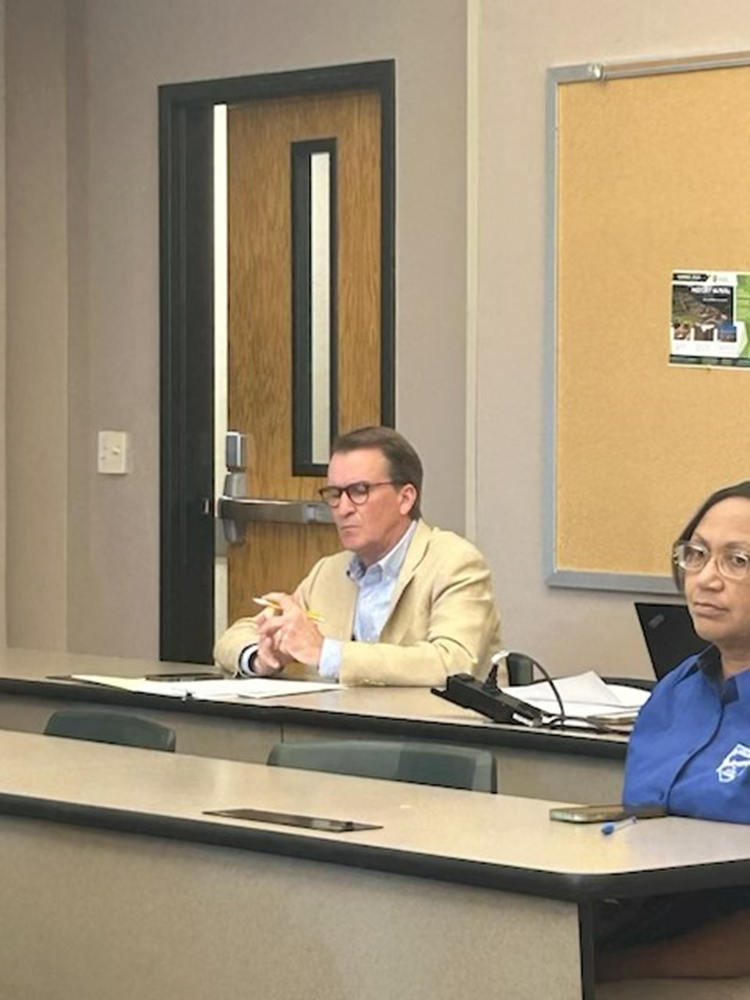
SLU’s Senior Marketing and Communications Leader Mike Rivault. At right is Louisiana Federation of Teachers representative Tara LaFrance.
But hey, that’s chicken feed at for a public record at SLU. One other individual, a professor on campus, was quoted $21,000 at $25 per page just to view another set of records.
But public records requests and SLU’s non-compliance aside, there are larger issues that beg the attention of the courts.
In Steven J. Rushing v. John Yeargain, a case that has its origins in September and October of 2018, more than seven years ago, Rushing is appealing the DISMISSAL of his lawsuit by the U.S. Middle District Court in February 2025.
In another curious lawsuit, it seems that Peter Gratton, a history an assistant professor of political science may have actually had the appeal of his termination denied before the appeal board had even met to consider his appeal.
Rushing, who has acknowledged he suffers from depression and bipolar II and is “an idealist and a gadfly” unable to ignore what he considers an injustice, claims he was heckled and removed from a faculty senate meeting on Oct. 3, 2018, subsequently refused the school’s efforts to have him undergo psychological evaluation and eventually fired from his music professorship position.
He claims that his intended addressed to the faculty senate on Sept. 26 and Oct. 3, 2018, “were not routine workplace grievances, but instead research findings protected by academic freedom and commentary on matters of public concern, including:
Fraud, misrepresentation, and breach of public trust at Southeastern Louisiana University, such as administrative deception, violations of SELU fraud policies, and false budgetary claims regarding the use of public funds at a state university;
- Lack of faculty governance and procedural compliance for FS meetings, highlighting violations of Faculty Senate Constitution and Bylaws, suppression of faculty proposals, and administrative manipulation, restricting the ability of faculty to conduct true open meetings;
- Insufficient leadership accountability and oversight of the Faculty Senate Executive Council, raising issues of transparency in the governing of a publicly funded university;
- Academic freedom and the right to publish, emphasizing the public’s interest in promoting scholarship, teaching, and research;
- Viewpoint discrimination and free-speech suppression, addressing how the selective silencing of faculty based on criticisms of institutional policy in a faculty-governance forum violates the First Amendment;
- Grievance and due process failures, exposing failure to provide due process as required by university policy and state law, and failure to investigate illegal acts.
- Broader reforms and public accountability in Louisiana’s higher education system, urging adherence to contractual, ethical, financial, and academic standards.
Gratton began his sixth year as an assistant professor at SLU in 2023. Once in his sixth year, he became eligible for tenure review and he so informed his department head of his intent to apply. SLU, however, notified Dr. Gratton of his non-reappointment during his sixth year. While the decision to grant tenure is within the discretion of SLU, Dr. Gratton’s eligibility for tenure review during his sixth year is not discretionary based on SLU’s and the Board of Supervisors’ own policies, his lawsuit asserts.
He said SLU’s Policy on Termination and Non-reappointment of Faculty, “[n]otice that a probationary appointment is not to be renewed shall be given to the faculty in advance of the expiration of the appointment “at least 12 months before the expiration of an appointment after two or more years of uninterrupted service at the institution.” That required notice, he says, was not given.
He says in his petition that on Aug. 30, 2023, he received a letter from the department chair requesting that he (Gratton) change the date on the My 31, 2023, non-reappointment letter “to render it compliant” with the school’ policy on termination. He says he refused to do so.
He said he informed his department head of his intent to apply for tenure on Sept. 5, 2023, a full 10 days ahead of the Sept. 15 deadline. Once a faculty member expresses intent, the tenure review process commences, he said. Instead, SLU notified Dr. Gratton of his “non-appointment” on Sept. 11, 2023, with an effective date of Dec. 17, 2024.
Because he felt SLU had deviated from its own policies, he filed an internal grievance with the university. The Faculty Senate Grievance Committee chair did not attend the committee meeting so it was ruled that the committee did not have authority to adjudicate the issues relating to tenure, promotion and reappointment.
Consequently, Gratton simultaneously filed an external grievance with the Louisiana State Board of Supervisors for Colleges and Universities.
This is where it begins to get a bit dicey.
Prior to the commencement of the (board of supervisors’) committee hearing—and before Gratton had an opportunity to be heard—“Dr. Gratton discovered, in the electronic folder for the hearing, the decision of the board with respect to Dr. Gratton’s grievance.
“This decision Dr. Gratton discovered before the hearing was identical to the decision conveyed to Dr. Gratton after the hearing and stated the process used by [SLU] regarding Dr. Gratton’s grievance be upheld and that no further consideration be given” his appeal.
Uh oh.
Someone screwed up by releasing the final decision of the board before the board even met. That equates to sloppy—but perhaps typical—Louisiana political chicanery.






 Louisiana Voice
Leave a comment