If things keep going the way they’ve been transpiring, it shouldn’t be too much longer that Gov. Squeaky Toy Landry has installed a political hack in the top spot of every college and university in Louisiana.
Last Saturday, LouisianaVoice had a story that noted Landry, through the Board of Regents, over which he has considerable sway, has ALREADY INSTALLED HIS PICKS as presidents of five state universities—McNeese State, Southeastern Louisiana University, Louisiana Tech, Northwestern State and LSU.
Now comes word that a presidential search committee will begin interviews in Baton Rouge Thursday for the post of president of the University of Louisiana Lafayette (ULL). As of the present time, 12 candidates are scheduled for interviews but the smart money says that Landry already has his mind made up and the search committee likely already has its marching orders.
Make no mistake, the Repugnantcan Party has as a top priority the complete restructuring of education in America and last time we checked Louisiana was still part of the U.S.
We got the first hint several years ago when then-State Rep. RAY GAROFALO (R-Meraux) introduced a bill in 2021 which he said would emphasize the “good” of slavery. The bill, which never made it out of committee, would have imposed a ban on “divisive concepts” and said teachers SHOULD NOT ACKNOWLEDGE institutionalized sexism or racism. That bill was so odoriferous that even Garofalo’s fellow Repugnantcan legislators were repulsed by it.
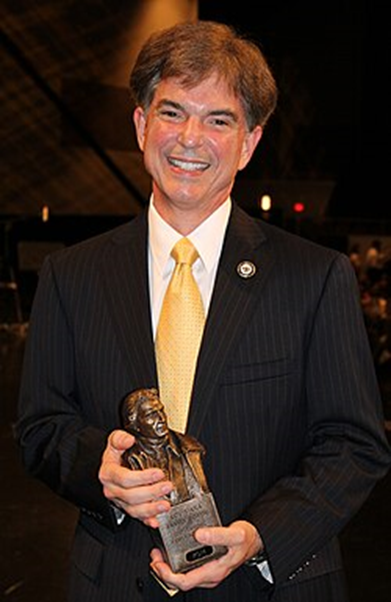
Ray Garofalo receiving the Louisiana Family Forum Outstanding Family Advocate Award
Wikipedia described Garofalo as a “non-practicing attorney.” Perhaps he needed a little practice before becoming a legislator. His effort at burnishing the story of slavery resulted in his being removed as chair of the House Education Committee.
Unfortunately, that didn’t put much of a dent in the Repugnantcans’ efforts to whitewash history, including any mentions of the genocide of Native Americans in general and the Trail of Tears in particular in favor of force-feeding “Christianity” through posting of the Ten Commandments in Louisiana and Texas classrooms and the distribution of Bibles in Oklahoma public schools.
Determined efforts continue to put a happy face on American slavery, genocide, the denial of civil and voting rights for Blacks and women.
Need further evidence? Try this on for size:
What happens when an industry awards a research grant to a university and the findings are detrimental to that industry?
When colleges face conflicting research grants, they must adhere to federal regulations and institutional policies to ensure the integrity of their research. These regulations require schools to promote objectivity by disclosure and management of financial conflicts. Each application for research funding must be certified any conflict existence as a safeguard against bias.
Yet, when Ivor van Heerden faulted the U.S. Army Corps of Engineers for the levee failures during Hurricane Katrina, LSU lost no time in canning the scientist. LSU, after all was the recipient of millions of dollars in federal research grants and anything that could cast shade on the feds could conceivably cost the school, as the late columnist James Gill so succinctly point out in 2013.
Not so, said LSU emphatically. RETRIBUTION and financial considerations had nothing to do with the firing of van Heerden. But the aggrieved scientist sued the university and LSU unwisely spent $457,000 in legal fees defending the lawsuit which, after 2 ½ years, was SETTLED in van Heerden’s favor for an additional $435,000.
Remember STEVEN HATFIELD? He worked for the LSU National Center for Biomedical Research and Training in July 2002 until he was considered a “person of interest” in the mailing of anthrax-laced letters. Also fired was Hatfield’s supervisor, the head of the research center where Hatfield worked. Think financial considerations (read: federal grants) had anything to do with that decision? The upshot of that kneejerk reaction was that the Justice Department ended up settling for $2.825 million in cash and an annuity that pays Hatfield $150,000 a year for 20 years.
So now, one of the applicants for President of ULL is Ramesh Kolluru, interim president of the school following the abrupt resignation of Joseph Savoie last July. Kolluru, before his elevation to the interim president’s office, was the school’s vice president for research, innovation and economic development.
Kolluru was approached last year by an industry-friendly lobbying group called “Committee of 100 for Economic Development, Inc.,” or C100. That was following the Environmental Protection Agency’s three-day public hearing in Baton Rouge about whether Louisiana should be given enforcement responsibility of carbon capture and storage projects in the state. Carbon capture and storage, or CCS, is a method of reducing greenhouse gases by capturing carbon dioxide from the pollution of industrial smokestacks. The captured carbon is transported via pipeline and, ultimately, injected deep underground.
One of the proposed injection sites is in Lake Maurepas in Tangipahoa Parish where a professor has already been reined in for adverse findings of that proposition. The funding for that research was provided by one of the industries proposing to store the carbon
C100 desired to continue recruiting support for state control of CCS so, Michael Olivier, former head of C100 ASKED KULLURU TO HELP. “We will be seeking influential business leaders in regions of the state to sign OpEds and we will use social media to influence public opinion in the upcoming EPA ruling. Would you be that person in Acadiana? He asked, according to emails obtained through a public records request.
Kolluru’s response? “Absolutely!” So much for objectivity and non-bias in research.
Climate scientist and Penn State University professor Michael Mann called the relationship between C100 and ULL “deeply problematic,” according The Lens, a respected New Orleans online news service.
Any odds on who might ultimately be selected the new permanent ULL President?






 Louisiana Voice
Leave a comment