There was a point during Cankle Ankle’s two-hour ramble-tamble monologue, otherwise known as the State of the Union Address, last night when he actually made sense—or would have if the words had come from anyone but Donald J. Trump:
Let’s also ensure that members of Congress cannot corruptly profit from using insider information.
They stood up for that. I can’t believe it. I can’t believe it. Did Nancy Pelosi stand up, if she’s here? Doubt it. Pass the Stop Insider Trading Act without delay. I wasn’t sure if anybody even on this side was even going to applaud for that. I’m very impressed. Thank you. I’m very impressed.But when it comes to the corruption that is plundering — it really, it’s plundering America — there’s been no more stunning example than Minnesota, where members of the Somali community have pillaged an estimated $19 billion from the American taxpayer. Oh, we have all the information.
And in actuality the number is much higher than that, and California, Massachusetts, Maine and many other states are even worse. This is the kind of corruption that shreds the fabric of a nation, and we are working on it like you wouldn’t believe. So tonight, although started four months ago, I am officially announcing the war on fraud to be led by our great vice president, JD Vance.
He’ll get it done. And we’re able to find enough of that fraud — we will actually have a balanced budget overnight. It’ll go very quickly. That’s the kind of money you’re talking about. We’ll balance our budget. The Somali pirates who ransacked Minnesota remind us that there are large parts of the world where bribery, corruption and lawlessness are the norm, not the exception.
Really? Let’s roll the tape.
- Phillip Esformes, who owned more than 30 nursing homes in the Miami area, was charged by the U.S. Justice Department in July 2016 with what at the time was described as “the largest single criminal health care fraud case ever brought against an individual” when he was accused of running a $1.3 billion fraud and money-laundering scheme. He was eventually sentenced to a 20-year prison sentence which was commuted by Trump in 2020. Four years after his commutation, in October 2024, he was arrested for domestic abuse after he allegedly assaulted his wife and father-in-law in separate incident—and for witness tampering and property damage.
- Rick Scott was CEO of Columbia/HCA that routinely inflated bills, billed for services never rendered and pushed unnecessary medical procedures to maximize reimbursements from Medicare and Medicaid. A 1997federal raid uncovered false cost reports, kickbacks to doctors and upcoding of medical diagnoses that resulted in inflated payments from government programs. Scott was forced to resign in the wake of the largest: LARGEST MEDICARE’MEDICAID FRAUD CASE IN HISTORY. He walked away with $300 million in stock and a $5 million severance package while HCA pleaded guilty to 14 corporate felonies and paid fines of $1.7 billion. Scott, meanwhile, went on to become Repugnantcan governor of Florida and then was elected to the U.S. Senate where he continues to serve.
- Former Trump advisor Eric Herschmann, is defending former pro wrestler Ted “Teddy” DiBiase Jr. in that nasty FRAUD CASE IN MISSISSIPPI that has also involved former NFL quarterback Brett Farve, former head of the Mississippi Department of Human Services John Davis and former Repugnantcan Gov. Phil Bryant. That case involves the misappropriation of about $100 million.

Now then, about that insider trading which suddenly appears to weigh on Trump’s conscience:
It’s somehow ironic that the drifting grifting president would suggest that others not be allowed to game the system considering how he and his family have milked the system for untold millions (maybe billion, who knows?) just during the first year of his final term in office. They have used the office of the president to accumulate as much as they possibly can, legally and illegally.
Nevertheless, let’s delve into this insider trading a bit and we learn that the practice knows no political labels: Repugnantcans and Democrats are both guilty. It’s ironic that Trump should champion a law stopping the practice when the STOP TRADING ON CONGRESSIONAL KNOWLEDGE (STOCK) act attempted to do the same thing in 2012—during the (gasp!) Obama administration. Of course, Agent Orange would never give credit for such progressive legislation to Obama.
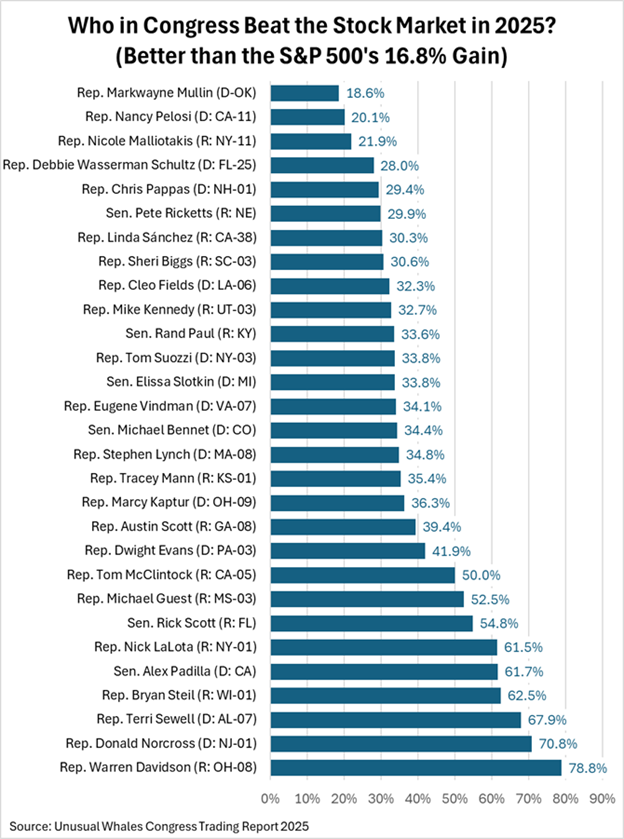
It’s almost uncanny how well some members of Congress managed to beat the stock market in 2025
Rember Louisiana’s very own Billy Tauzin. He was an influential House member when he negotiated an agreement whereby Medicare/Medicaid would be unable to negotiate the price of prescription pharmaceuticals. While folks were still scratching their heads in confusion as to why he would do such a thing, he abruptly quit Congress and went to work as head of PhRMA, the lobbying arm of the pharmaceutical industry. Suddenly the scales were removed from our eyes.
In one of the more ironic twists, KALB-TV IN ALEXANDRIA had, of all people, Julia Letlow and Cleo Fields preview Trump’s State of the Union Speech on Tuesday. You’ve probably seen the ads (don’t know how you could miss ‘em unless you live under a rock) shaming Letlow for her belated reports of stock trading. And Fields himself is listed as one of the members of Congress who consistently beat the stock market during 2025.
So, what exactly has produced this sudden pang of conscience among our 535 members of Congress in the collective concern over insider trading?
Well, to begin with, it’s an ELECTION YEAR and there are just some things that demand bipartisanship, even in Congress and what better way than to try to make the suckers voters back home think they’re actually trying to do something constructive?
But as with any other effort to initiate reform in Congress, a word of caution:
Don’t hold your breath.










 Louisiana Voice