It was on this date 64 years ago, Dec. 11, 1961, that the U.S. Supreme Court overturned the convictions of 16 Southern University students who had been arrested for participating in a SIT-IN AT THE KRESS DEPARTMENT STORE in Baton Rouge the previous year..
Sadly, it took a Mississippi non-profit NEWS SERVICE to commemorate the anniversary of that landmark case. Louisiana media, particular those located in Baton Rouge, somehow let that date slip by unnoticed.
Following a sit-in Greensboro, N.C., the all-white Louisiana Board of Education warned that any student taking part in a similar protest would face “stern disciplinary action.”
The board could not have pulled off a greater blunder. All that did was to spark a united sense of determination among seven students who headed to Kress’ lunch counter on Third Street in downtown Baton Rouge on March 28, 1960. They were promptly jailed and nine other students conducted a sit-in at two other locations and they, to, were arrested. That prompted a march through Baton Rouge to the State Capitol by 3500 students.
Southern’s President Felton Clark, most likely under duress from the Jimmie Davis administration and in fear of his job, expelled the 16 students who had participated in the sit-inns and NAACP attorney and future U.S. Supreme Court justice Thurgood Marshall enrolled to represent them and the Kennedy administration filed a friend of the court brief in support of the students who were subjected to humiliation and cruel treatment at the hands of whites.
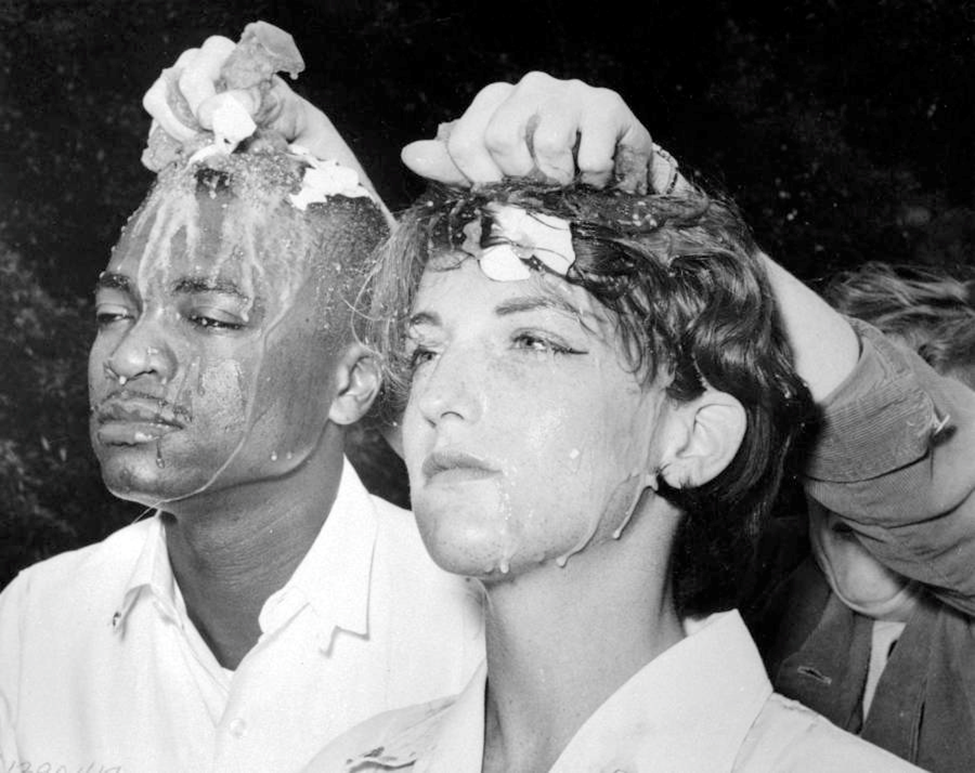
Sit-in participants have raw eggs cracked over their heads by white segregationists.
After their convictions were overturned, more sit-ins and another mass demonstration followed, leading to more arrests of 23 protestors, including CORE Field Secretary Dave Dennis.
Even more protests and demonstration followed until in 1963, the lunch counters were eventually desegregated. A half-century later, Southern University bestowed honorary degrees to the expelled students.
While Davis had run for governor on a promise to uphold segregation, his predecessor, Earl Long was far more insightful, despite his notorious 1959 mental breakdown.
Even as the state was in the throes of the tumultuous civil rights movement, Long knew desegregation was inevitable even if people like firebrand Leander Perez of Plaquemines Parish did not. Exasperated at Perez/s persistent legislative battle to enforce segregation, Long shouted at Perez, “Whatcha gonna do now, Leander? The feds got the atom-bomb!”






 Louisiana Voice
Leave a comment