Problem is, perception is everything and the perception, his double-speak notwithstanding, is that he is simultaneously suing a state agency and appointing the assistant attorney general wo will defend that agency.
That doesn’t quite pass the conflict-of-interest smell test.
Moreover, he penned a letter to another Baton Rouge lawyer earlier this week in which he put his long-standing character of non-professionalism on vivid display,
Of course, he probably thought the contents of that letter would remain shrouded in secrecy like a few other shadowy activities:
The hiring the daughter of a third-place opponent in 2015 primary election to the AG’s FRAUD SECTION despite her past conviction and suspended prison sentence on three counts of … credit card fraud,
The hiring Harvey Gulf executive Shane Guidry as a “special agent/investigator,” who in turn appointed Landry to the Harvey Gulf Board at a salary of between $50,000 and $100,000, a move that the New Orleans Metropolitan Crime Commission called “A PRETTY CLEAR CONFLICT” since state law forbids work outside the AG’s office.
His pet project for FINDING MISSING CHILDREN turned out to be a scheme concocted by a grifter that drew support from a number of heavy-hitting Texas politicos as well as Landry. While attracting influential support, the program didn’t actually find any missing children.
He was part of a $17 million scam to hire MEXICAN WELDERS and pipefitters under H-2B visa rules through three companies owned by him and his brother, Ben Landry.
So, as you can see by the above examples, our attorney general-governor wannabe is not above twisting and distorting the rules governing his office so it should come as no surprise that has set his office up as both plaintiff and defendant in a lawsuit against Gov. John Bel Edwards and the State Pardon Board in an effort to stop capital clemency hearings requested by Edwards.
And when Baton Rouge attorney J. Arthur Smith, III had the temerity to to suggest that Landry might have a conflict of interest in serving in both capacities, Landry’s response was a few light years from being professional.
Landry opened his two-page letter by saying, “Your letter indicating that a conflict exists calls into question your competency as a lawyer.”
You mean competency like sitting on the Harvey Gulf board? Like hiring a convicted felon (for fraud, no less) to your office’s fraud division as payback for her mother’s endorsement? Or maybe owning a company that supplied foreign workers to a contractor for a large pipeline project?
Ever heard of the Consumer Finance Protection Bureau? CFPB is a federal agency charged with protecting consumers from predatory lending and banking practices. In July, 26 Republican attorneys general signed a PETITION asking the U.S. Supreme Court to allow them to intervene on behalf of lenders who were suing to ABOLISH CFPB. Guess who one of those attorneys general was? I’ll save you the intrigue: Jeff Landry.
For that answer, you may wish to check the rankings of the 32 states that still offer little or no regulation of predatory lenders. Just as an example, one who borrows $500 in LOUISIANA from one of these lenders can expect to be required to repay a total of $935 after just four months. That’s an annual percentage rate of 405 percent, 7th highest of the 32 states. (Idaho borrowers would be called upon to repay a total of $1,500 on that $500, an annual percentage rate of 652 percent, highest of the 32 states.)
And Landry is one of the 26 attorneys general who wants abolish the only agency standing between lenders and these plunderers. Does that sound like a candidate who really has the best interest of Louisianans at heart?
But back to that Sept. 26 letter. Landry goes to great pains to explain how the Louisiana Constitution dictates that he (a) is suing the board to enforce the state’s open meetings laws because he said the board hired Smith’s firm illegally (without a vote and without the hiring being on the board’s meeting agenda) and (b) the ethical rules for private law firms “are not necessarily applicable to the Attorney General’s Office.”
Otherwise, he said, “every employee, department, and appointed or elected official in state government could raise a potential conflict if it ever received legal services from the Attorney General.”
“There is no constitutional or statutory mandate for the Attorney General’s Office to represent the board,” Landry wrote. “As a courtesy, there has been a longstanding practice of the Attorney General providing an Assistant Attorney General to provide general advice and legal representation as needed.”
Consider his solicitor general, Liz Murrill, who is seeking his job now that he’s trying to move across the lake to the Capitol. The Baton Rouge law firm Taylor Porter currently has several contracts with the state totaling $865,000. Her husband, John Murrill, is a partner in the firm.
Smith was terminated after only one day of defending the pardon board and replaced by Joshua Force of the New Orleans firm Sher Garner Cahill Richter Klein & Hilbert.
And while the choice of contract attorneys to serve as assistant attorneys general is the responsibility of the attorney general, it’s somewhat interesting to note that Sher Garner has made $10,500 in campaign contributions to Landry in 2015 and 2020 and currently has four state contracts worth $790,000, including two with the attorney general’s office valued at $270,000.
So apparently, ethics and conflicts of interest, like beauty, are in the eyes of the beholder and Landry is quickly becoming beholden to a lot of special interests that appear to call his ethics into question.
Not sure what this helicopter cost, but the cost of that cup of coffee or whatever this driver wanted at the truck stop down the street probably isn’t going to cover it. The driver attempted to exit at Denham Springs this morning and to negotiate a left turn under Interstate 12, apparently en route to a local truck stop. Unfortunately, neither he nor his escort driver accounted for the lack of clearance under I-12 and the resulting collision separated the chopper’s rotor housing. That’s it in the foreground. Needless to say, traffic, already a mess in Denham Springs during morning rush hour, was pretty much backed up.
oil stains the plastic covering over the helicopter that once was attached to the rotor housing (left) that was knocked to the pavement when the truck driver discovered the hard way that there was insufficient clearance under I-12 in Denham Springs this morning. Deductions from the driver’s paycheck aren’t likely to cover the damage.
Every election cycle I end up asking the same rhetorical questions:
Are these current candidates the best we have to offer?
Why, instead of so damn many attack ads, don’t the candidates put forth more effort in explaining exactly how they would go about addressing our myriad problems?
What is the real motive behind all the PAC money being poured into the various campaigns?
I say these are rhetorical questions because for the most part, we pretty much know the answers and they’re not answers that do us proud as a supposedly free society.
On the national front, which is a year away yet, we have critics on one side saying a candidate is too old for the job. On the other side, people are saying with equal conviction (no pun intended) that someone with 91 felony counts pending against him should not be even eligible to run for the position of CEO of the most powerful country in the world.
But the 2024 presidential election aside, let’s consider the current campaign for governor and some of the other statewide and legislative offices up for grabs next month.
I don’t even have to discuss the PAC motives. Money talks, BS walks and when an industry’s political action committee pours money into a campaign there’s always a reason. A $3 million outlay might net a $100 million return if the right candidate wins. So, having cleared the air on that question, let’s take a look at the other two.
Again, is this bunch of wannabes the best this state has to offer? Probably. Because what decent person would want to expose himself to the half-truths and outright lies about his character and his political philosophy?
Take, for instance, the race for attorney general. Liz Murrill is likely to succeed her boss Jeff Landry who is the odds-on favorite to be the next governor. Apparently not taking anything for granted, someone has begun a vicious attack ad campaign against State Rep. John Stefanski of Morgan City who is also seeking the office along with three other hopefuls. If you take those ads to heart, you’d think Stefanski had a key to every jail in Louisiana and that he personally was turning killers loose to prey on the rest of us. Never is it mentioned that under our form of government, every person, even those accused of the most heinous crimes imaginable, is innocent until proven guilty and is entitled to legal representation.
I don’t know John Stefanski and I know nothing about him other than he must be the epitome of all that is evil, according to the TV ads. But TV political ads are known to distort facts and that’s patently unfair not only to the targeted candidate, but also to voters. Of course, that doesn’t matter if it helps a candidate get elected.
Murrill, on the other hand stands foursquare in favor of law and order. Well, hell, who isn’t? How many candidates have you heard run on a platform of anarchy?
The empty banter reminds me of every election for mayor-president of East Baton Rouge Parish for the past 20-30 years. You can count on candidates to run on a platform of improving public education in Baton Rouge and East Baton Rouge Parish. The problem with that pledge is that the mayor-president has zero authority in public education. That’s the exclusive turf of the East Baton Rouge School Board, not the mayor’s office. But inconvenient facts don’t inhibit candidates’ from claiming they’ll solve public education’s problems.
Which brings up another sticking point with me. Judges. I don’t know of any judicial elections on the Oct. 14 ballot but invariably when there is one, candidates will promote themselves as “tough on crime,” ones who “put criminals behind bars,” and who “will cleanse the streets of the criminal element.” All well and good, of course – if you’re running for district attorney. A judge’s job is not to pre-determine who is unfit to be walking among the rest of us. A judge’s job is to administer justice in a fair and impartial manner, not to be an advocate for anyone.
Now to the governor’s race. Thanks to the attack ads, we now know in no uncertain terms that Landry is a scoundrel, Stephen Waguespack is a political hack posing as an outsider, and Shawn Wilson, the current Secretary of the Department of Transportation and Development, is inept as an administrator. All you have to do to know that is to drive on Louisiana highways.
Louisiana’s roads and highways have been in deplorable condition for as long as I’ve been driving (I’m 80 now and I’ve been driving since I was 15), so it seems a bit unreasonable to expect wholesale improvements in four years.
So, thanks to all those informative TV attack ads, no one is fit to serve in any position of trust in state government and I’m certain as the presidential campaign heats up, we will learn the same enlightening but depressing news about national offices — from U.S. Representative and Senator to President.
Of course, the way politicians – on the state and national levels – bend and sway to the latest political breeze instead of attempting to address the very serious issues of poverty, hunger, inflation, education, crime (including white collar) and civil rights, to say no one is fit to serve might not be too far from the truth.
These state clowns have a little more than three weeks to offer up sound, well-thought-out solutions to Louisiana’s problems. Merely saying they’re for law and order, lower taxes, and jobs just doesn’t cut it as a platform. And TV ad footage of legislators strolling majestically into an empty House or Senate chamber is amateurish at best and insulting at worst.
Everyone who is above room temperature wants law and order, better jobs, education and roads. Tell us how you plan to make college more affordable, how you plan to increase the minimum wage, how you plan to stem outward migration, how you plan to keep homeowner and auto insurance affordable, how you plan to increase teacher pay, what are your plans for protecting the environment, how you plan to move us away from having one of – if not the – highest incarceration rates in the civilized world, how you would protect our disappearing coastline and how you would address the backlog of maintenance and repairs so desperately needed on our university campuses?
That’s just for starters. Being governor, insurance commissioner or legislator should not be a popularity contest; it should be a decision based on which candidate can most reasonably address these problems.
So, stop the asinine attack ads. We’re sick of them and they serve no purpose. Just stop. Give us some real solutions, dammit!
I’m no Nostradamus, not by a long shot (but I did stay at a Holiday Inn Express last night). Just to give you an idea of my ability to read tea leaves, in 2015, as I watched Donald Trump descend the escalator in Trump Tower as a theatrical prelude to his announcing his candidacy for the Republican president nomination, I smirked at my TV and said aloud to no one in particular, “He’ll crash and burn in six weeks.”
Well, we know how that turned out.
But yesterday, I wrote here that it was a certainty that the federal lawsuit filed by the Livingston Parish School Board against two social media giants would quickly mushroom into a class action case.
Little did I know at the time (honest) that it already had. Today, I learned that nearly 200 school districts (so far; one law firm claims the number is closer to 500 for his firm alone) have enrolled as plaintiffs in what is about to become the next big legal battle that has the potential to rival the lawsuits against big tobacco, the 2010 BP Deepwater Horizon oil spill in the Gulf of Mexico or the opioid litigation.
Yesterday, I WROTE THAT the Livingston Parish School Board was going after Instagram and its parent company, Meta, and TikTok and its parent, ByteDance.
Now we learn that those four defendants have been joined by co-defendants Snapchat, Google, Facebook and YouTube in the class action du jour.
The CLASS-ACTION STORY, posted by Reason, an online news service, quoted The Wall Street Journal as saying the 200 lawsuits have been consolidated in the U.S. District Court in Oakland, California. The Journal said plaintiff attorneys (like Fayard Honeycutt in Denham Springs, which filed the action on behalf of the Livingston board) are soliciting school boards throughout the country to file lawsuits against social-media companies on allegations that their apps cause classroom disciplinary problems and mental health issues which divert resources from education.
It was not immediately clear whether the Livingston Parish action would be part of that consolidation. That lawsuit is 182 pages in length compared to 287 pages for the class-action PETITION.
I wrote yesterday that the local lawsuit appeared to be a “boilerplate” petition that did not originate locally. A so-called boilerplate document is one written for more than one entity and distributed to potential users who simply plug in local data and names to make it appear to be locally generated.
The American Legislative Exchange Council (ALEC) is a frequent practitioner of boilerplate legislative bills it generates for state legislatures across the country. There have been instances when legislators, who are members of ALEC, didn’t bother to edit the “model legislation” closely enough have submitted bills without making proper edits, which made the bills inappropriate for a given state until they were amended and re-submitted.
The plaintiff attorneys in the larger class-action suit are claiming that:
The social media defendants have targeted children as a core market;
Children are uniquely susceptible to harm from social media apps;
Defendants designed their apps to attract and addict youth;
Millions of children use defendants’ products “compulsively”;
Defendants’ apps have created a youth mental health crisis
Defendants’ apps contribute to the sexual exploitation and “sextortion” of children;
Defendants could have taken steps to avoid harming plaintiffs (but did not)
Algorithms maximize engagement at a harmful level;
Facebook and Instagram user interfaces are designed to encourage addictive engagement;
Instagram encourages bullying, body-shaming and other negative social comparisons;
Meta, YouTube and ByteDance (TikTok) have failed to implement effective age-verification;
TikTok, Google, YouTube, Facebook and Instagram have defective parental controls, and have “impediments” to discontinuing use;
Snapchat’s defective features are designed to promote compulsive and excessive use;
The petition, like the Livingston School Board lawsuit, emphasizes the dangers of sexual exploitation posed by adult predators who surf social media looking for victims in order to produce and distribute child sexual abuse materials (CSAM). The class action suit said social media “can increase risky and uninhibited behavior in children, making them easier targets to adult predators for sexual exploitation, sextortion and CSAM.”
The lawsuit even lays the responsibility for teen deaths, ostensibly from suicide brought on by cyber-bullying.
As a general rule, plaintiff law firms in cases like this are rolling the dice and take most, if not all, of the financial risks, i.e., filing fees, expert fees, deposition costs, discovery, etc. and do not charge a fee up front, choosing instead to hope for a favorable decision or settlement and to take their fee on the back end, usually 25 percent to 30 percent of the award or settlement. And it’s usually then that the fun begins when observers can sit back and watch the lawyers fight it out amongst themselves over who gets what. That’s usually when it really gets nasty – and entertaining.
Now, having seen my prediction of a class-action lawsuit occur so quickly and with such deadly accuracy, I’m now on my way out the door to buy a Powerball ticket and to place my wagers on the Super Bowl champion.
Every now and then a story is so big that reporters are unable to understand the potential repercussions of its implications. Another factor, the gutting of print media newsrooms, has depleted reporting staffs at newspapers, causing a major void in what should be routine reporting.
Either way, the story goes unreported until one day everyone wakes up and realizes the story is of such magnitude that it has the very real potential to affect a wide swath of the nation’s economy by attacking established corporate giants like big tobacco and pharmaceutical companies.
That’s precisely what has happened in Livingston Parish where the parish school board has quietly filed what may well turn out to be the next big – really big – courtroom battle. And even though the Livingston Parish School Board is the only plaintiff for now, you can look for this to mushroom into a gigantic class-action battle between legions of high-powered lawyers on both sides. And it’s most likely going to get quite bloody before all is said and done.
A Baton Rouge TV station had a SUPERFICIAL STORY, four paragraphs long, which never brushed up against the lawsuit’s potential implication and to date, has done no follow-up. The Baton Rouge Advocate likewise had a sketchy story but said precious about the matter. Rest assured, before the dust has settled on this, there will be similar actions filed in every state and the national media will eventually catch on to the fact that there’s a big story brewing – and when that happens, just remember it first started bubbling in Livingston Parish, Louisiana.
The school board has rolled the dice in naming two social media platforms as defendants in a FEDERAL LAWSUIT in which the board claims, among other things, that TikTok and Instagram are designed to make their platforms “addictive to all users, and to children in particular.” Also named as defendants were Meta Platforms, Inc., Bytedance, Inc. cable and Wifi providers Charter Communications and Cox Communications. Instagram is a subsidiary of Meta and TikTok is a subsidiary of Bytedance.
The lawsuit reads suspiciously like the work of a boilerplate petition that is almost certain to pop up in most other states, if not all 50. In fact, if I didn’t know better, I’d say it almost appears to be the work of the American Legislative Exchange Council (ALEC), which drafts model legislation for lawmakers in every state. Whatever, the 105-page petition almost certainly did not originate in Denham Springs, Louisiana.
The petition quotes “disillusioned former Silicon Vallen executive” Tristan Harris as saying, “It’s (social media) seducing you; it’s manipulating you. It wants things from you… social media isn’t a tool waiting to be used. It has its own goals, and it has its own means of pursuing them by using your psychology against you. If you’re not paying for the product, then you are the product” she said.
Another interviewee, the petition says, put it even more bluntly: “There are only two industries that call their customers ‘users’: illegal drugs and software.”
But even more ominous was the concern voiced that many who follow children on social media “are adult males that have a sexual interest in children,” according to Jon Rouse, a 38-year police veteran whom the petition said heads a group targeting child sex offenders for Interpol. “Child sex offenders will gravitate toward where there are children. Pedophiles prefer looking at videos,” he said.
An official with the Department of Homeland Security who once led the agency’s child-exploitation unit, cited TikTok as a platform often used by predators to meet children. He was quoted by the petition as saying, “It is a perfect place for predators to meet, groom and engage children,” adding that TikTok was the “platform of choice” for predators.
Teenage girls, the lawsuit said, “who are particularly vulnerable to online sexual interactions, have the majority of these experiences of sexually explicit messages on Instagram and Snapchat.”
The lawsuit cites internal documents which said defendants Meta and Instagram conducted internal studies that determined that Instagram was harmful to its child users. “Rather than coming clean, defendants kept this information hidden from the public, and doubled down on making the Instagram platform as addictive as possible.” (Can you say “shades of the ‘SEVEN DWARFS’” of the tobacco litigation?)
One local teacher – and parent of a teenager – was more than a little skeptical about the wisdom of the lawsuit. “Instagram,” she said, “is the social medial choice of millennials, NOT of those who are currently enrolled in grade school. The kids use Snapchat. So, they’re suing the wrong platform. [It] shows their age and how clueless and out of touch they are.” She also pointed out that the school district communicates school closures, registrations, etc., “and school teams communicate with players and schools communicate with parents all via Facebook, which is owned by Meta.”
One of the giveaways that the lawsuit is boilerplate to be adapted to individual states was the wording that the Livingston Parish School Board is a “quasi-government body” under Louisiana law. In truth, there is nothing “QUASI” about it – it’s a full-fledged public body in every legal sense.
That aside, the school board claims that while the Internet “holds tremendous potential to benefit children and their families,” the defendants, TikTok and Instagram, employ tactics of “intentional manipulation of children” and that they do so “with full knowledge that their products cause profound mental and physical harm to children.”
“Because Instagram views its users as its product, and because it can only monetize its users while they are on the Instagram platform, Instagram is incentivized to keep its users on the platform as long as possible and as often as possible, the lawsuit said. “Competition for users’ attention is fierce,” and social media platforms – like defendant’s – “are purposely designed to addict their users. Defendant has both in-house and external research initiatives designed to document and improve engagement reporting and have project that use neuromarketing and virtual reality techniques to measure effectiveness.”
The petition claims that the mobilization of those resources “indicates that the platform is built not for user experience, but for maximization of profit. And this maximization of profit is achieved through addiction.”
Even worse, attorney Blayne Honeycutt said in the petition that Instagram’s own internal research has shown that fostering addiction is harmful to its adolescent user base. “Yet defendant ignores this information and continues to add features to keep children hooked,” he said.
Likewise, a TikTok internal document obtained by the New York Times confirmed that the goal was to “get people addicted” so that in a relative short time, [the] platform’s algorithm can detect user’s musical tastes, his physical attraction, whether he’s depressed, if he might be into drugs, and other sensitive information.”
But TikTok, unlike other social media companies, has direct ties – and fealty – to a foreign government which, through data collection, creates “unique problems, not just from a national security standpoint, but even from a privacy/ethics vie,. the lawsuit says.”
Past examples of landscape-altering lawsuits include class action litigation case settlements involving tobacco ($206 billion), opioids ($26 billion), and the BP Deep Horizon oil spill of Aug. 20, 2010 ($20.8 billion). Closer to home, there was the 1982 train derailment in the town of Livingston (a paltry $39 million).
One other attempt at a class-action lawsuit involved Hurricane Katrina in 2005 and the US Army Corps of Engineers that was tossed on a technicality in plaintiff attorneys’ first attempt and then thwarted by the involvement of the Louisiana Attorney General’s office on the second try.
What do all these cases have in common with the latest litigation against the two social media platforms? A relatively small firm (only five attorneys, according to one online service; three, according to another, four, according to a sign in front of the firm’s offices) in Denham Springs was involved in each and every one of those cases and took a share of the massive legal fees the cases generated.
Attorney fees for the opioid lawsuit totaled $2.3 billion. For the tobacco settlement, attorneys shared a pot of $8.2 billion and for the BP oil spill settlement, lawyers divvied up $680 million – and the firm Fayard & Honeycutt was right there to share in the fee disbursements. Fayard’s cut in the BP settlement alone was $35 million.
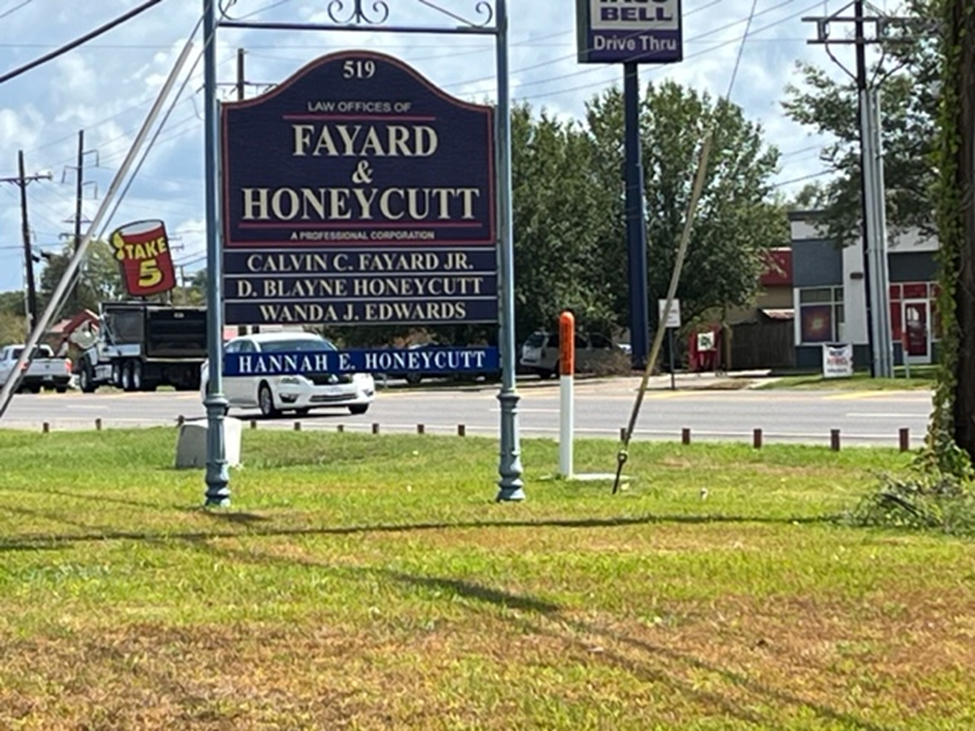
But you’d never know it by looking at the nondescript offices of Calvin Fayard and partner Blayne Honeycutt on Florida Boulevard in Denham Springs, especially when compared to a couple of personal injury law firms in nearby Baton Rouge. But then, looks can be deceiving because make no mistake, Fayard & Honeycutt are major players on a stage that transcends day-to-day goings-on in the Livingston Parish Courthouse.
Tucked back from Florida Boulevard, aka U.S. 190, in Denham Springs is the law firm of Fayard & Honeycutt.
A sign standing vigil in front of the the Fayard-Honeycutt firm lists only four staff attorneys. Two of those are named Honeycutt.
Through the years, they have made only one major misstep. They attempted to sue the US Army Corps of Engineers for its shoddy work on the levee system that was breached during Hurricane Katrina in 2005, causing flooding of much of New Orleans.
They enlisted Louisiana Attorney General Charles Foti as co-plaintiff on behalf of the State of Louisiana but the suit was thrown out when it was ruled that they could not sue the corps. So, the obvious solution was to sue the State of Louisiana for the general ineptitude of the levee boards.
But wait. Because Foti was working with the plaintiff attorneys, they were legally barred from suing the state since Foti’s job was to defend the state, thereby creating an inconvenient conflict of interest.
Not that the full effort was not put forth by Fayard, who hosted US District Judge Stanwood R. Duval, Jr. at the LSU-Alabama football game in Tuscaloosa in 2005 even as Fayard was in the process of formulating his ill-fated class-action lawsuit to be heard by that same Judge Duval. Things get a bit intertwined here because:
Fayard’s daughter Caroline, who had recently graduated from the University of Michigan was, coincidentally – and conveniently – Duval’s law clerk.
Fayard had married attorney Frances East Gray, in 2003 in a high-dollar ceremony on Nantucket Island and had fetched Judge Duval along as his guest (they were, after all, old law school classmates and good buddies).
About that same time, Judge Duval also got married – to his longtime law clerk, Janet Daley, who, along with Caroline Fayard, was in a unique position of influence.
Two months earlier, on September 15, 2005, Fayard, together with a couple other attorneys, had already filed a class action lawsuit, Chehardy v. Wooley, in the 19th Judicial District state court in Baton Rouge but that case was later subdivided and eventually transferred to Federal District Court for the Eastern District of Louisiana in New Orleans, where it was incorporated into the Katrina Canal Breaches Consolidated Litigation. With upwards of $200 billion at stake, the case was assigned to (wait for it)… Judge Duval. Certainly, that Tuscaloosa trip in November was only to watch a football game and not an opportunity for Calvin Fayard, to plan ex-parte the management of these and other cases that were flooding (no pun intended) into the court. You can read all about it in more detail by going HERE.
But then came the ruling giving the Corps immunity and the involvement of the Louisiana Attorney General which prevented filing an action against the state. Another attorney, not beholding to the original cluster of attorneys, Ashton O’Dwyer of New Orleans, then began his own class-action against the state but powerful sources in state government saw to it that O’Dwyer would encounter not only powerful political resistance but the forces aligned against him would retaliate in such a way that he would eventually be arrested and be disbarred despite decades of near flawless legal practice as a partner in one of New Orleans’ more prestigious law firms.
So, now the firm of Fayard and Honeycutt is back for another bite of the apple. And remember where you heard it: this legal action is not going to be acted out in a vacuum. The Livingston Parish School Board may stand as the only plaintiff for now, but the smart money says there will be others – many, many others – who will be jumping on this litigious bandwagon. The payout is far too big for one relatively small law firm – or school board – to tilt at this windmill alone.
It’s the kind of opportunity that can bring political foes like Gov. John Bel Edwards and Attorney General – and current gubernatorial candidate – Jeff Landry together in a common cause. Oh, wait. That’s already BEEN DONE in the BP spill litigation, hasn’t it?
LouisianaVoice does not accept advertising because we insist on an independent voice. Likewise, we do not charge a subscription fee for our blog.
That is not to say we do not have expenses—lots of them. Moreover, we would love to add a reporter to provide even better coverage of the underbelly of Louisiana politics.
Your contribution would help us immensely in meeting our growing expenses. Simply click on the “Donate” button here and contribute whatever you feel appropriate.
Thank you.
Tom Aswell, Publisher
Got a tip?
Got a news lead for LouisianaVoice to investigate? Have a suggestion for a story? Your identity will never be revealed. Just send an email to louisianavoice@outlook.com
Read my books!
Read more Books!
Order your Piyush Bumper Sticker Now!
Click image to order
$2.50 each or three for $6.00









 Louisiana Voice