Feeds:
Posts
Comments

Archive for September, 2022

Read Full Post »

Depending on the year that figures are compiled by the U.S. Department of Justice, either Louisiana or Oklahoma has the highest rate of incarceration in the world.

Broken down further, the U.S. has the highest rate of incarceration and one of those two state routinely swap the title from year to year for the highest rate among the 50 states, thus the highest rate in the world. Higher than China, higher than Russia, higher any of the states in the Mid East. Highest in the world.

In 2018, for example, Oklahoma had an incarceration rate of 1,079 per 100,000 population, followed closely by Louisiana’s rate of 1,052 per 100,000. The NEXT FOUR were all from the South: Mississippi (1,039), Georgia (970), Alabama (946), and Arkansas (900).

Louisiana had held onto the highest rate for years until Gov. John Bel Edwards pushed through sweeping prison reform that resulted in early releases for a number of prisoners but by 2021, it had regained the unwelcome number-one position with an incarceration rate of 1,094 per 100,000 population (Oklahoma, meanwhile, had fallen to a rate of 993 while Mississippi had moved into second place at 1,031.

The national incarceration rate for 2021 was 664 per 100,000, a rate that was only 60.7 percent of Louisiana’s.

But there is one statistic that is indisputable: Louisiana had the second-highest rate of wrongful convictions per capita in the nation from 1989 to 2015, according to the NATIONAL REGISTRY OF EXONERATIONS.

In pure numbers, Louisiana, a relatively small state, population-wise, had “only” 45 exonerations of wrongfully convicted individuals during that same time, ninth-highest in the U.S. The eight states with higher numbers were, in order: Texas (205), New York (189), California (153), Illinois (151), Michigan (55), Florida (54), Ohio (53), and Pennsylvania (52).

But when population was factored in, Louisiana was second highest in the rate of exonerations per capita (1.93 times the national rate) only to Illinois (2.34).

But a more disheartening statistic showed that of the nation’s 3,143 counties/parishes, two Louisiana Parishes ranked in the top four in the rate of exonerations per capita – meaning those two parishes ranked highly in convicting the wrong person of crimes.

Orleans Parish, with 18 wrongful convictions from 2012 to 2015, had the highest rate of all 3,143 counties at 9.33 times the national rate, according to the National Registry report.

Jefferson Parish was fourth in the nation at 5.03 times the national rate of exonerations, a dismal showing for both parishes. Though neither parish ranked in the top ten in the number of exonerations, their rates eclipsed the rates of the Bronx, the District of Columbia, Cook County (Chicago), Illinois, Dallas, Kings County (Brooklyn), NY, and Harris County (Houston), Texas.

The advent of DNA testing, of course, has been instrumental in many of the exonerations but local district attorneys who obtained the convictions in the first place – and often even their successors – have been inexplicably reluctant to have evidence tested for DNA, even often at the defense’s expense.

Even when DNA evidence proves a person was wrongfully convicted, prosecutors often dig in their heels in incomprehensible efforts to keep the individual in jail.

In Jefferson Parish, two black youths were convicted in the 1997 robbery/murder of a store owner in Westwego.

One person drove the getaway car while a second entered the store. Hearing the gunshots, the driver was pulling away when the shooter came running out, threw down his ski mask and dove into the car through the open passenger window.

Soon afterwards, TRAVIS HAYES was spotted driving a similar car and RYAN MATTHEWS was with him. The pair was arrested, charged, convicted, and sentenced to death. Matthews spent five years on death row because the jury never learned that the ski mask DNA did not match either Matthews or Hayes. Nor were jurors ever told that Hayes’s car’s electric window on the front passenger side was stuck in the up, or closed, position.

The Innocence Project took the case and won Matthews’s release with the newly-discovered evidence. Prosecutors were told at the same time that since Matthews had been shown to be innocent, Hayes should be released as well.

No, said prosecutors, Hayes was a different case. It was curious logic that stretched credulity to the breaking point, but nevertheless, Hayes languished another 30 months on death row before he was eventually exonerated.

Harry Connick, Sr. was district attorney for Orleans Parish for 30 years and his office was notorious for withholding exculpatory evidence which resulted in the wrongful convictions of several defendants, among them one JOHN THOMPSON, convicted of murder in a carjacking gone bad and sentenced to death on May 8, 1985.

Thompson remained on death row for 14 years and in April 1999, just 30 days before his scheduled execution, an investigator for the Innocence Project discovered there was a blood stain from the killer that prosecutors had tested – in fact, the test had been rushed by prosecutors – only to find that the blood type was not Thompson’s. The DA’s office never revealed this evidence to the defense as required by law.

When Thomson was finally exonerated, he sued the DA’s office and won a $14 million judgement, which was appealed all the way up to the U.S. Supreme Court where Clarence Thomas was the deciding vote that overturned the award.

He did finally receive $330,000 in state compensation, a paltry amount for 14 years of his life that was taken away by a DA’s office that valued a conviction – any conviction – more than an innocent man’s life, more than apprehending the real killer who, as far as anyone knows, is still out there.

Only 32 when he was wrongfully convicted, Thompson died of a heart attack in 2017 at age 55.

Read Full Post »
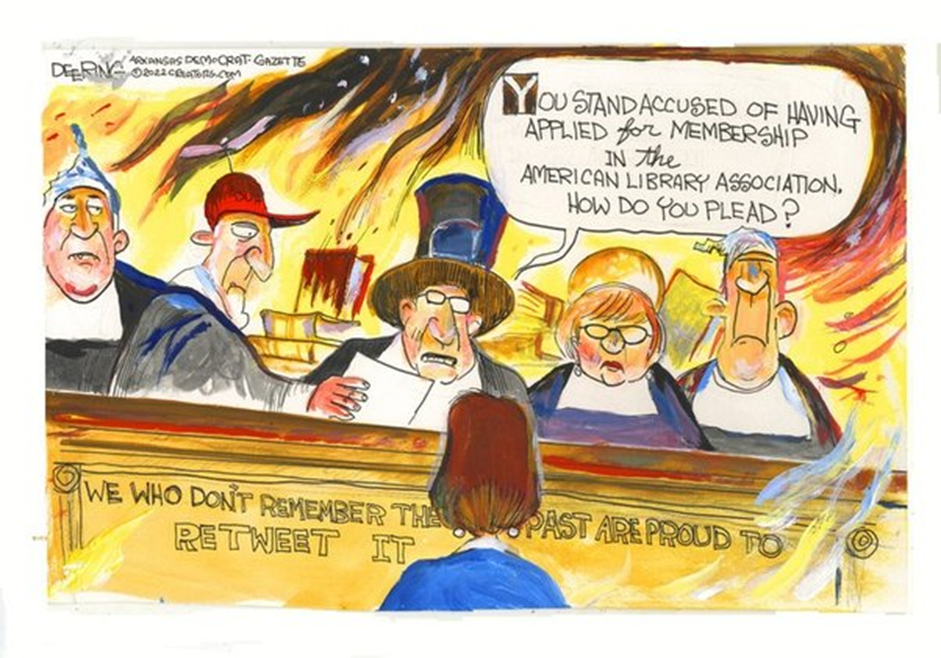
Last month I WROTE A PIECE about the Livingston Parish Council’s plans to move books deemed objectionable away from the children’s sections of the public libraries in the parish.

I attended that night’s meeting of the council and several in attendance, including the proponent of the book removals, Michael Lunsford, signed cards prior to the meeting indicating a desire to speak on the proposed resolution to support a letter to all the parish librarians.

We were even told after the meeting began that those having signed cards in advance of the meeting would be given four minutes to speak and those who had not submitted the cards but decided to speak anyway would be given two minutes.

But then, when Parish President Layton Ricks offered the resolution to the council, the motion was made quickly (too quickly, I might add), seconded, and passed unanimously – without allowing a single person in attendance the opportunity to speak. Ricks didn’t even extend the courtesy of making copies of the letter available to attendees.

So much for democracy in action.

Ricks’s letter was three pages in length, so I’ll spare you the details other than to say he did approach the volatile subject of censorship in a conciliatory manner, and to touch on the main point.

Acknowledging that “there are two sides to every story,” he wrote, “It appears to me that people on both sides of this issue are more interested in proving that their views are correct and everyone else is wrong than they are about addressing the real issue: What is best for our children. (sic) That should be the common goal.”

He then wrote, “…I encourage you to look beyond the arguments of adults caught up in their own battle of wills and remember the true issue at stake. I don’t have the right to ask that these books be totally removed from the library. However, in my opinion, if there is a concern about the content of a book, let’s at least put it in an adult section that is monitored by library staff or accessible only to children accompanied by a parent or guardian.”

Well, that was polite enough and may possibly have even diffused opposing viewpoints somewhat – had copies of the letter been made available in advance. It took a public records request for LouisianaVoice to obtain the document.

But the real underlying issue still goes back to the suspected ultimate end-game goal of the driving force behind the movement in Livingston (and the state’s other 63 parishes), one Michal Lunsford of St. Martin Parish.

I suggested in that August post and in an earlier one back LAST DECEMBER that it was just the first step toward book banning efforts.

“What’s next after you pull those books?” I wrote back then about efforts in Lincoln Parish that, it turned out, was just the opening salvo in this culture war. “What else might offend your sensibilities,” I wrote, “publications about slavery and injustices suffered by Blacks? Books about wrongful convictions of the innocent? Overcrowding of prisons because of harsh punishment enacted by “law and order” politicians for minor offenses? What about books that document American genocide, aka the near-eradication of Native Americans? Everything critical of any political viewpoint you happen not to share? Perhaps a certain cookbook because you happen to not like broccoli?”

I ended that rant by suggesting that some of the people in my home town of Ruston pull out their Bibles and read Matthew 7:1-3.

I reprised that post last month when I suggested that books about women’s rights (the struggle for women’s suffrage, for example), teachings about the Civil War because the topic of slavery would be unavoidable, the struggle for civil rights (such as Baton Rouge’s Bob Mann’s exemplary book, The Walls of Jerico). I even tossed out the possibility of an assault on the right to vote for blacks, women, or non-property owners.

In that piece, I overlooked encroachment on our freedom to choose which TV shows we deem to watch (probably because I happen not to watch much TV other than the news – not local news so much because I think it only exists to keep lawyer ads from bumping together).

But now US Rep. Mike Johnson from up Shreveport way has even waded into that discussion by taking on Danny DeVito and his new sitcom Little Demon.

The absurdity of Johnson’s taking time out from the nation’s problems of crime, environment, and economy to pick a fight with an animated cartoon is beyond description but he’s found a way to insert himself into the controversy that most didn’t even know existed.

DeVito does the voice of Satan in the cartoon. His daughter does the voice of Satan’s daughter, whose soul Satan tries to wrest control of from her mother, a mortal woman.

During Sunday night’s telecast of the LSU football game (who can forget that heartbreak?), ABC, whose parent company is Disney, ran a promo of the Disney show and Johnson claims he had to hurry and hit the remote to shield his 11-year-old daughter from the evil spirit of the preview which, I suppose, he felt might possess her body or pull her into the television a-la the 1982 movie Poltergeist. Johnson even fretted over how many other children might have been “exposed to it” or “how many millions more will tune in” to the series. (I would love to have seen and heard his take on the John Denver-George Burns 1977 movie Oh, God! but he was probably in the Marines about then and getting his tattoo.)

Well, he and all those who are so concerned about the content of libraries had better turn their attention to other sources. Online porn is oh-so-easily available over the Web and how many of these concerned parents keep a close watch over their kids’ computers and cellphones?

And parents might want to seriously consider “shielding,” as Johnson would put it, their children from reading certain parts of the BIBLE.

Johnson is horrified at the thought of a cartoon Satan but apparently is unconcerned about a talking snake. I wonder if he wants his daughter reading Numbers 31:17-18 (instructing God’s warriors to kill all male babies and women but to take female children for their own pleasure)? Or how about Lot offering up his two daughters for sex to the men of his neighborhood? Or of Lot later impregnating those same daughters? And what about all the mass murders perpetrated by God? Does he really want his daughter reading about a flood that wiped out all but the family of one man? Or of the plagues he sent on Egypt, including more mass murders of babies? Or still more mass murders of Egyptian soldiers by drowning? Lunsford’s companion at the Livingston meeting said the Bible “doesn’t condone” the killing but I beg to differ. Perhaps she should brush up on Genesis, Exodus, Deuteronomy, Numbers, and Leviticus.

They’ve already banned certain math textbooks in Florida. Math, for Pete’s sake! And Gov. DeSantis has even gone so far as to establish so-called “voting police” and Texas Gov. Greg Abbott is offering a $10,000 bounty for neighbors to spy on neighbors.

Sorry, folks, but I just can’t shake this feeling that we’re headed down a slippery slope of banning books that tell of the dark chapters of our history – of Native American genocide, slavery, lynchings, civil rights struggles, and tens of thousands of Americans who died in wars that were fought for all the wrong reasons.

And lest some of you think I’m unpatriotic for offering up such criticism, I disagree vehemently. Patriotism is not “My Country Right or Wrong,” nor is it loyalty any political party – ANY political party – or politician. Patriotism is loving one’s country (and I do) and when seeing democracy wavering down a dangerous path, saying so – for the same reason we correct our children when they err or when we call 911 when witnessing a crime.

Read Full Post »

The news that the state wants to transfer about two dozen teenagers now incarcerated in the Bridge City facility for youths to the Louisiana State Penitentiary at Angola probably hasn’t penetrated north Louisiana. Bridge City is in the New Orleans area (Jefferson Parish) after all, and it’s more of a regional story than one of general statewide interest.

But that doesn’t mitigate the seriousness of Gov. Edwards’s decision to house juveniles at a prison for hardened criminals. The argument could be made that the ones being transferred are already candidates for a lifetime of recidivism.

But while that argument may well have merit, the question remains: Should we be sending juveniles to an adult facility that is the nation’s largest maximum-security prison and which has the reputation as one of the worst prisons in America?

That prospect prompted Tulane University psychiatrist and professor Dr. Monica Stevens to tell U.S. District Judge Shelly Dick that such a move would be “unprecedented,” and that she “couldn’t ethically sign off on this.”

The decision by Edwards to move the youths was born of desperation after six juveniles escaped from Bridge City in July of this year. It was just the latest of several escapes and riots at the facility and the decision was made despite a federal law that prohibits youths from being incarcerated within sight of sound of adults.

The problems at Bridge City are not new. In fact, legislators have had at least six years – even after they were finished grandstanding and pontificating – to address problems at the facility and yet those problems remain.

In May 2016, the SENATE AND GOVERNMENTAL AFFAIRS COMMITTEE, just weeks after its lovefest with then-State Police Superintendent Mike Edmonson, tore into Department of Juvenile Justice Director Mary Livers. Leading the assault was committee chairperson Karen Carter Peterson. The committee spewed such vitriol that Livers ultimately retired. The irony of that was Livers had testified to the senators about the problems of high turnover at Bridge City.

Even as Livers attempted to relate the problems at Bridge City, she was repeatedly interrupted by Peterson, who seemed to think the hearing was all about her and who made certain that everyone in attendance was aware that she was an attorney.

Along with the 30 vacancies at Bridge City, Livers noted that her agency’s budget had been cut by 40 percent, a cut implemented by Bobby Jindal who never saw a social program he liked.

“The youth there have lots of problems or they wouldn’t be in a facility like Bridge City,” Livers said. “The problems are historic. When you have more than 100 kids in a facility, you have problems. Today Bridge City is at 136 youth. That’s too many kids in one place, not enough space. It’s a recipe for problems. We have a difficult time keeping people.”

Peterson asked why there was such a high turnover—a question Livers had already addressed in describing the working conditions at Bridge City. But she gamely tried again. “There is a variety of reasons,” she said. “Most say the job was not what they thought it would be. They don’t like being called into service and working all kinds of hours because of vacancies.”

“That goes back to you,” Peterson snapped. “It’s not enough to take responsibility. You’ve been there a long time. You say you take responsibility but nothing gets done.” This from the person who chaired the State Democratic Party into near-oblivion.

Looking back, it’s surprising that Peterson was able to stay for the full 80-minute duration of the hearing, what with her ongoing destruction of the State Democratic Party, her preparations for a future run (unsuccessful) for Congress, and her furtive gambling habit.

But never mind all that. It was her moment to shine, along with fellow senators Jean-Paul Morrell, Wesley Biship, and Jim Fannin. There was an abundance of bluster and finger-wagging in that hearing (good for TV soundbites).

Typically, after they were finished with their chest-thumping and public humiliation of a well-meaning but overwhelmed civil servant and the TV camera crews had packed up their equipment and left, the issue of Bridge City was, for the lawmakers, over. There were no more political points to be scored, so why waste time if the legislators didn’t have anything to gain?

In fact, it was a lose-lose situation, so even as Livers was calling it a career because of the lack of support for her agency, the political talking heads could go home, satisfied in the knowledge they’d found a scapegoat in Livers and driven her from office.

Problem solved.

So, here we are, six years of legislative inaction later. And the problems at Bridge City are, if anything, worse than before.

That can mean only one thing: time for another legislative committee meeting.

Read Full Post »

(Click on image to enlarge)

For that matter, where are these other Louisiana Trump apologists:

Steve Scalise?

Clay Higgins?

Mike Johnson?

Jeff Landry?

Tony Perkins?

You’ve been awfully quiet lately, fellas.

Read Full Post »

« Newer Posts


