Feeds:
Posts
Comments

Archive for January, 2016

© 2016

A joint investigation by LouisianaVoice and Fox8 News has revealed that a federal investigation has been launched into allegations that former Louisiana Office of Alcohol and Tobacco Control director Troy Hebert used his position to extort sex from a woman who experienced problems with ATC over a liquor license for her New Orleans restaurant.

New Orleans businessman Amer Bader, who initially told LouisianaVoice he had been visited by the FBI, told a former ATC agent he exchanged text messages with Hebert. In those texts, he accused Hebert of extorting sexual favors from a woman friend of Bader’s who was experiencing problems in licensing her restaurant with ATC. He later said it was not he who was visited by federal agents, but his friend who runs the Star Steak House on Decatur Street.

The restaurant, according to the former agent, was delinquent in paying its taxes and its license expired on May 31, 2015. Following an appearance at ATC in Baton Rouge, Hebert allegedly contacted her and offered to help, according to the source who voluntarily came forward. The two began meeting for dinner, the anonymous source told LouisianaVoice via email on Dec. 18. She said Hebert eventually took the woman to an apartment he keeps above the Copper Monkey Grill at 725 Conti St. in New Orleans where they engaged in sex.

She said the woman, whom she identified as Sarah Palmer, took photos of the interior of the apartment on her cell phone and that she also saved text messages from Hebert despite his admonition to delete the photos and texts. Those photos and text messages were eventually turned over to the FBI, the source said.

Hebert, in response to Bader’s text messages, reportedly claimed that he did not seduce the woman but that she seduced him.

LouisianaVoice reached Hebert by phone late Tuesday and asked for a statement. Hebert requested that we put any questions in writing and email them to him, so we did:

  • Did you in fact offer to help (Sarah Palmer) with her licensing?
  • Did you offer to help her financially with paying for her children’s school?
  • Did you issue temporary permits so she could continue to sell alcohol?
  • Does the director of ATC have authority to issue temporary permits in cases of delinquent sales tax remittances?
  • Did you dismiss the case against her? If so, why?
  • Did you have sex with Sarah Palmer?
  • Did you exchange emails with Amer Bader regarding your relationship with Sarah Palmer?
  • Who provided legal representation for restaurant and bar owners before the ATC when you were director?

Hebert offered this written statement by email:

“Like Paul Harvey use to say, this is ‘the rest of the story.’

“Star Steak House in the French Quarter was facing suspension/revocation of their alcohol permit because Ms. Palmer’s Middle Eastern manager, who is a convicted felon, was breaking the law and pocketing thousands of state sales tax dollars from the business.

“At the ATC hearing, Ms. Palmer stated that she was committed to keeping her business open legally and her 20-plus employees working. She was advised that she would have to remove her manager from any and all dealings with the business and work out a payment plan with the Department of Revenue (LDR) to pay all taxes owed the state.

“She was granted a temporary permit to give her and LDR time to work out a payment plan in which they did. It is customary to grant several 35-day temporary permits rather than permanent ones to ensure that all details have been worked out. Ms. Palmer was asked on several occasions to finalize the proper paper work to resolve this issue completely, which she did not. At that point and time, no more permits were issued and ATC learned the business had actually closed. Because you cannot collect from a business that no longer exists, the charges were dropped.

“At no point and time did I or ATC do anything illegal or unethical and the records and policy clearly reflect that. It is standard procedure to try and allow a business to remain open, if possible, in order for the state to collect the taxes owed as well as save innocent people’s jobs. ‘You can’t get blood out of a turnip.’ To try and suggest otherwise is simply a ploy to discredit me and a great agency for doing our job dealing with those who don’t do theirs.

“During the course of this time, Ms. Palmer’s manager, whom I suggested that she fire, began threatening me. Due to the numerous other threats and the torching of my car, I reached out to the FBI for help and protection of my family and I (sic).

“Your sources that say the FBI is investigating me must have their wires crossed. Why would the FBI investigate me for doing my job and was threatened for doing so? Common sense says that if there is an investigation, it is about the people who threatened my life and family for fighting for the good law-abiding taxpayers of our state.

“I love my wife and children with all my heart and would never do anything to jeopardize that or put them in harm’s way.

“As a respected public servant for 25 years and now a private citizen, any malice, defamation, suggestions or slander from your reporting against my character that will cause irreparable harm to me personally, professionally or politically will be dealt with in the court of law. I do not mean to come across disrespectful, but sometimes you cannot put the toothpaste back in the tube.”

He also included a copy of a Nov. 19, 2015, letter to U.S. Attorney General Loretta Lynch in which he claimed he and his family had been threatened. In his letter, he said FBI offices in New Orleans and Baton Rouge had declined to assist him.

Hebert also forwarded an email from Palmer to him dated Oct. 13, 2015 which said, “I am proposing the following terms in order to satisfy my tax issues with the state.

  • 10 percent down on the balance that I currently owe;
  • Remaining money owed would be paid over a course of 12 months as long as I stay current on the money due each and every month.”

That email, however, was not part of the file on the restaurant obtained from ATC by LouisianaVoice, an indication it was a private communication between Palmer and Hebert and outside official channels.

In a separate email to WVUE-TV, he also said, “Is it your station’s policy to report such damaging allegations against someone’s reputation from only a source and not an actual confirmation from the FBI?”

The FBI, of course, neither confirms nor denies the existence of criminal investigations.

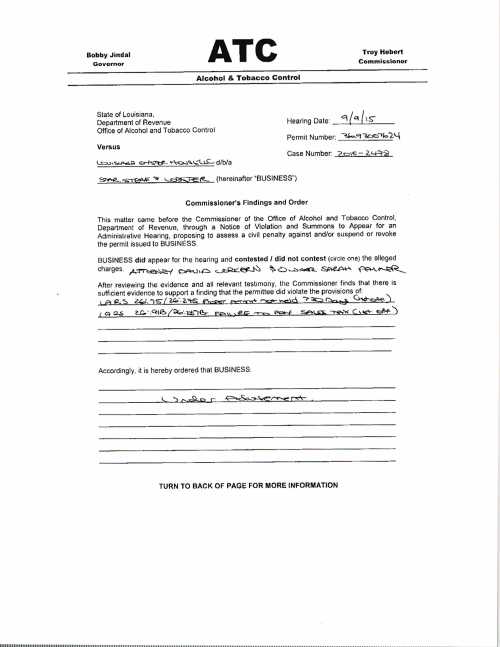
LouisianaVoice obtained public records from ATC which show that Hebert issued a “Commissioner’s Findings and Order” on Sept. 9 in which he suspended the woman’s license upon finding there was “sufficient evidence to support a finding that the permittee (Louisiana Oyster House, dba as Star Steak and Lobster at 237 Decatur Street) did violate the provisions” of:

  • LA. R.S. 26:75/26:295 (proper permit not held, first offense) and
  • LA R.S. 26:91B/16:287B (failure to pay state sales tax, first offense). HEARING NOTE PAGE 1
HEARING NOTE PAGE 2

(CLICK ON IMAGES TO ENLARGE)

The confidential source, who has requested anonymity, said the day following the hearing attended by Palmer, she received a call from Hebert “offering to help her get her license back.”

In a Dec. 18 email to LouisianaVoice, the source said, “He wanted to meet her for a drink to discuss it. She met with him and he told her he would reinstate her license if she would go out with him. She agreed and went to dinner with him at a local restaurant. He was accompanied by two of his bodyguards (ATC agents) who remained outside the restaurant while he dined with her. He even took her to his French Quarter apartment on top of the Copper Monkey Bar on Conti St. He revoked the suspension of her license the next day, and did not make her pay the fine. He continued to go out with her and have sex with her,” she wrote. copper monkey3

She said that Palmer “has evidence of her relations with him consisting of pictures and text messages. She has kept quiet until now for fear that he will retaliate against her business.”

The following day, Dec. 19, she sent another email in which she reiterated her claim that Palmer possessed photos of Hebert’s apartment on her cell phone. “He has also sent her numerous text messages from his state-issued cell phone telling her how much he wants to see her. Two weeks ago, he called her and said be sure to erase the text messages but she didn’t because she did not trust him. He even told her that he was going to help her with some money for her kids’ schools. She also has not had to pay the fines. He keeps pushing them back. She believes they will disappear before the new commissioner takes office.”

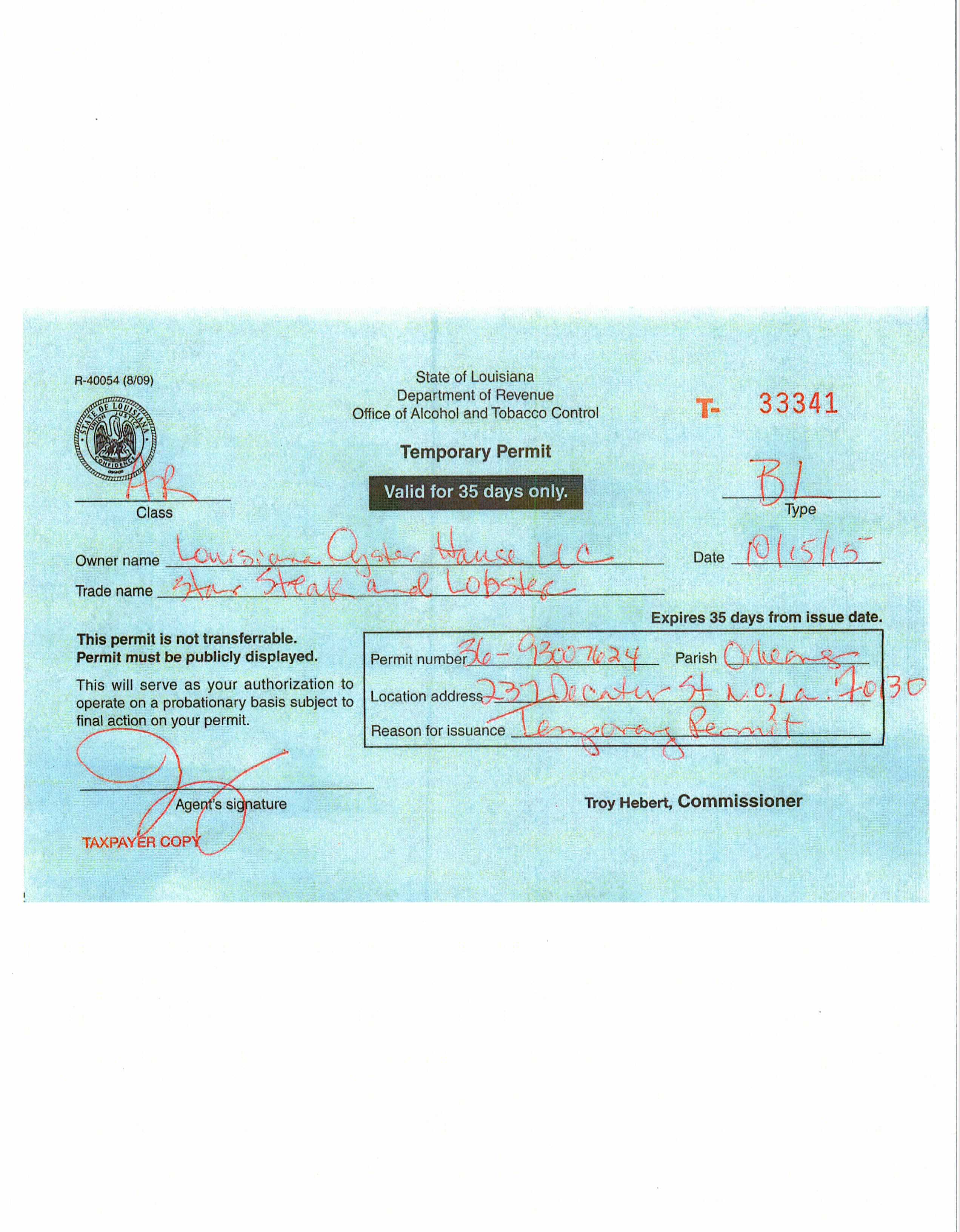
A temporary permit was in fact issued on Sept. 11, according to records obtained from ATC offices in Baton Rouge. Subsequent temporary permits were issued on Oct. 15 and Nov. 20. Each permit was marked “Valid for 35 days only.” SEPT. TEMPORARY PERMIT

OCT. TEMPORARY PERMITNOV. TEMPORARY PERMIT

And while each of the temporary permits bore the name and title of ATC Commissioner Hebert, the person who signed each of them was Judy Pontin, executive management officer for ATC’s New Orleans office.

Pontin is the sister of Chris Young, a New Orleans attorney who represents bar and restaurant owners before ATC and who is a lobbyist for the Beer Industry League of Louisiana. Another brother is John Young, former Jefferson Parish President and unsuccessful candidate for lieutenant governor in last fall’s statewide election. Pontin was hired by Hebert on Nov. 4, 2013 at a salary of $71,000. JUDY PONTIN

JUDY PONTIN

On Jan. 6, just four days before he left office, Hebert issued a second “Commissioner’s Findings and Order” on the restaurant but this time he wrote, “After reviewing the evidence and all relevant testimony, the Commissioner finds the following:

“There is not sufficient evidence (emphasis ours) to support the finding that the permittee did violate the provisions of:

  • LA R.S. 26:75 & 26:275—Proper Permit not held;
  • LA. R.S. 2691B & 26:287B—Failure to Pay Sales Tax. DISMISSAL LETTER PAGE 1DISMISSAL LETTER PAGE 2

“It is hereby ordered that this matter be dismissed,” he wrote as one of, if not the final act in his capacity as ATC commissioner.

There followed on last Wednesday (Jan. 20), a flurry of several quick emails pertaining to the application process for renewal of the restaurant’s license, a development that does not square with Hebert’s claim that the restaurant had closed. The first, at 9:52 a.m., was a forward from ATC attorney Linda Pham to fellow attorney Jacqueline Wilson of an earlier (8:18 a.m.) message from a Lorie Hebert and given “high importance,” which said, “I received a phone message from an atty. David Corkern about this mandatory case set for today at 2:30 p.m.” The reference was to the license for Star Restaurant and Corkern was the attorney for manager Sarah Palmer.

At 9:31 a.m., Pontin forwarded a pdf attachment to Wilson and at 10:04 a.m., Pontin sent an email to Palmer saying, “Please see attached the 2015 renewal application we discussed as per or (sic) phone conversation. If you have any further questions please do not hesitate to call. That was likely the same attachment that Pontin had sent to Wilson at 10:04 a.m.

The anonymous source, who has sent 11 separate emails to date, said she had seen text messages from Hebert to Palmer and “there are witnesses who followed their dinners.”

Seven of her emails were sent between Dec. 18 and Dec. 27. Then her messages went dark before suddenly resuming on Saturday (Jan 23). “I have stayed clear because FBI is now actively involved,” she said on Saturday by way of explaining why her communications ceased for nearly a month. “They have made contact with Palmer and have seized photos, emails and text messages,” she said.

“The FBI now has evidence but is expanding (its) investigation further,” she said. “The investigation (is) going in this direction: Hebert makes trouble for a business. Then his number-one assistant Judy (Pontin), maiden name Young, sister to (attorney) Chris Young, sends word to (the) targeted business to hire Chris Young and pay big fees to get them off Hebert’s radar. Once Young is hired (and the) fee paid, problem disappears. Once (the) deal is done, Chris Young calls his sister Judy in Hebert’s office and the coverup begins.”

Asked how she knew Palmer, she said simply, “She is a girlfriend of mine.”

Tomorrow: LouisianaVoice examines political contributions by New Orleans strip clubs which were passed over in ATC’s “Operation Trick or Treat” sweep of the French Quarter in October.


 

Read Full Post »

Predictably, the business community is in high dudgeon over Gov. John Bel Edwards’ initial proposals to address the fiscal mess left by his predecessor—you know, the guy who thought he was presidential timber.

Judging from the early reaction of his die-hard opponents, including the Louisiana’s Rush Limburger wannabe Jeff (so) Sadow, Edwards is already a major flop just two weeks into the job. As much as I detest Mike Foster’s love child, I gave him nearly four years before abandoning any hope that he had the slightest concern for the people of this state.

Personally, I can’t think of a single person on the face of the good earth who could come into this job and successfully turn the state around in eight years, let alone four. It’s a daunting task that no sane candidate should relish.

In coaching, no one wants to be the one to follow a legend. You want to be the one who follows the one who follows the legend. Well, no one should want to be the one to inherit a disaster. You want to be the one who follows the one who tried to right the ship so if things are looking up, you can ride the momentum and take credit for the recovery.

With that in mind, here are a few observations:

The Baton Rouge Advocate on Sunday ran an outstanding analysis of the undeniable disaster in high education funding left by Jindal. The story was especially timely in light of Edwards’ announcement of even more draconian cuts facing high ed as he tries to cope with $750 million in budget deficits for the current fiscal year and a $1.9 billion budget gap for next fiscal year—all to be covered with shrinking revenues. http://theadvocate.com/news/14621878-123/special-report-how-startling-unique-cuts-have-transformed-louisianas-universities

LSU President F. King Alexander has gone on record as saying summer school may have to be cancelled at LSU. That’s the same type of dire warning as his “financial exigency” threat last year. That worked to get legislators’ attention and warded off the threatened bankruptcy. This threat of the cancellation of summer classes is a similar wakeup call to lawmakers—if they can get their heads from the place where only their proctologists can find them.

Even Jindal’s head cheerleader Rolfe McCollister inexplicably allowed Jeremy Alford to reveal in McCollister’s Baton Rouge Business Report that Edwards learned to his surprise that Piyush had approved millions of dollars in pay raises and made almost two dozen board and commission appointments that were not announced.

As a sign that McCollister may not be paying enough attention to his publication, he also allowed an Associated Press story that said Jindal left Edwards a gaggle of economic development deal IOUs.

But when Edwards suggested a tax package to help meet the fiscal disaster head-on, you’d have though from LABI’s reaction, that he was demanding the first-born of every businessman in the state.

Never mind that the Tax Foundation released a report last week that revealed that Louisiana has the sixth-lowest tax burden in America in the 2012 fiscal year.

While the rest of the country was paying an average of one dollar for every $10 earned in state and local taxes (exclusive of federal taxes), Louisiana citizens were paying only 76 cents for every $10 earned.

The per capita state and local taxes of $2,940 paid is fourth-lowest in the country and the state’s cigarette tax is one of the lowest. Edwards is seeking to increase the 86-cent cigarette tax to $1.08, which would bring Louisiana more in line with other states.

The state’s effective property tax rate of .5 percent is third lowest but the combined state and local sales tax rate (arguably the most regressive tax) of 8.9 percent is third highest.

Edwards says the days of using budget gimmicks are over. “This administration will remove the smoke and mirrors and provide the facts about where we are,” he said, in a not-so-subtle slap at Jindal. http://theadvocate.com/news/14619324-75/gov-john-bel-edwards-outlines-budget-options

State Sen. Jack Donahue, in a rare exhibition of lucidity for a legislator, told The Advocate, “…the proof of the pudding is in the eating, and so what did we spend (state revenue) on? Motion pictures; we spent it on solar power; we spent it on enterprise zone tax credits; we spent it on new market tax credits. We spent millions and millions and millions of dollars on all those things; so obviously, they were more important than our education.” http://theadvocate.com/news/14621878-123/special-report-how-startling-unique-cuts-have-transformed-louisianas-universities

Well, Senator, you said it. And you were oh, so accurate to employ the pronoun “we.” Hindsight, as they say, is 20/20 and yours is flawless. Other than Edwards, Rep. Rogers Pope, and Sens. Ed Murray and Dan Claitor, and maybe a couple others, I can’t recall many objections to the Jindal giveaway years coming from either chamber over the past eight years.

So now, Edwards wants to roll back some those insanely, ill-advised, foolish, thoughtless corporate tax breaks, and the corporate world is already screaming rape. Hey, guys, the honeymoon is—or should be—over. It’s way past time for the middle- and low-income citizens of this state to be relieved of the heaviest tax burdens while you guys get all those tax breaks, exemptions and incentives to create minimum-wage jobs—if jobs are even created at all. I mean, does anyone really think oil and gas will leave Louisiana when the oil and gas is here? To get to it, they have to come here. Do we really need Enterprise Zone credits for Wal-Marts in St. Tammany Parish?

As Edwards said, it’s time for the governor’s office to be “not business as usual.”

He will make mistakes. He will do things I don’t agree with. I was never under the illusion that I would agree with every single action he takes. No politician, like a rooster in a henhouse, could ever please everyone all the time.

And when he does displease me, I will say so. But for now, I’m more than willing to at least let him get his feet wet. We all owe him that much.


Read Full Post »

Teresa Buchanan, welcome to the club. You’re in good company.

First it was Steven Hatfield. Next was Ivor van Heerden.

Then, in rapid-fire order came Drs. Fred Cerise and Roxanne Townsend followed by Raymond Lamonica and John Lombardi. The message, in no uncertain terms, was toe the line or clean out your desk.

And on Thursday (Jan. 21), The Daily Reveille, LSU’s student newspaper, apparently cratered to pressure from a state representative’s wife and killed an insightful column by senior political science major Michael Beyer—all because Beyer has the unmitigated gall to offer up a critical column of State Rep. Neil Abrabson’s torpedoing of Rep. Walt Leger’s election as Speaker of the House. Beyer’s online column may have been figuratively spiked by LSU, but thanks to Lamar White’s CenLamar blog, we’re able to link to it here: http://cenlamar.com/2016/01/20/speaking-truth-to-power-lsu-student-responds-to-state-rep-neil-abramson/

No wonder LSU hired Joe Alleva as athletic director. When the Duke lacrosse players were falsely accused of rape, he promptly suspended the remainder of the lacrosse team’s season before DNA test results were known and fired its coach—after DNA tests came back negative.

This is the same Joe Alleva who was forced to eat crow in the now-he’s-fired, now-he’s-our-coach Les Miles debacle back in November. Washington Post columnist John Feinstein (a Duke alumnus) said Alleva was “a pleasant man whose next original idea would be his first.”

http://www.washingtonpost.com/wp-dyn/content/article/2007/05/28/AR2007052800929.html

Not to dump on Alleva too much, but his track record at Duke and LSU is pretty much the poster child for the LSU personnel handbook and HR policy. The Duke debacle was so bad that after the three players were cleared and their accuser exposed as a liar, prosecutor Michael Nifong was disbarred for dishonesty and ethics violations related to the case.

Let’s review that honor roll of rolled heads cited earlier.

  • Jesse H. Cutrer and Carl Corbin: LSU Reveille editor Cutrer of Kentwood and assistant editor Corbin were expelled and five others suspended when they refused to knuckle under to U.S. Sen. Huey Long way back in 1934. The issue was a letter to the editor by a sophomore student not even on the Reveille staff. The letter was critical of Long’s naming a star LSU football player to the state senate. Twenty-two other students who were suspended were reinstated and the seven who left LSU were all invited to the prestigious University of Missouri Journalism School, paid for in part by LSU board member J.Y. Fauntleroy of New Orleans. The man who executed the firings was LSU president James Monroe Smith, who later went to prison on corruption charges.
  • Steven J. Hatfill: Hired on July 1, 2002, Hatfill was placed on paid leave a month later after FBI agents conducted a search of his apartment in Frederick, Maryland on live TV—complete with helicopters circling overhead. His crime? He was suspected of being involved in anthrax mailings. Though he was familiar with the effects of anthrax, his area of expertise was Ebola and his job at LSU was training emergency personnel to respond to terrorist attacks and natural disasters. Saying LSU was making no judgment as to Hatfill’s guilt or innocence and that the decision “was not reached quickly or easily,” Chancellor Mark Emmert promptly fired Hatfill before his first day on the job. Hatfill was subsequently found innocent and six years later he was paid $4.6 million by the U.S. Department of Justice as settlement of his lawsuit. http://www.nytimes.com/2008/06/28/washington/28hatfill.html?_r=0
  • Dominique Homberger: The biology professor wasn’t fired but was removed from teaching in April 2010 for setting too high a standard for her students. She eschewed grading on a curve, insisting instead that her students achieve mastery of the subject matter instead of simply more mastery than the worst students in the class. In short, she refused to dumb down her course material. https://www.insidehighered.com/news/2010/04/15/lsu
  • Ivor van Heerden: van Heerden was fired by LSU in May of 2010 after he had the temerity to criticize the U.S. Army Corps of Engineers’ levee and floodwall construction designs. He also built storm-surge models, one of which predicted major flooding in St. Bernard Parish, eastern New Orleans and the Lower 9th Ward. Apparently the LSU administration did not care much for accuracy. He was also stripped of his title as deputy director of the LSU Hurricane Center. http://www.nola.com/news/index.ssf/2009/04/ivor_van_heerden_who_pointed_f.html
  • John Lombardi: The LSU system president was cut loose in April of 2012 because he didn’t go along with Bobby Jindal’s programs, including the privatization of the LSU medical centers. He also publicly opposed other initiatives advanced by Jindal. The firing was done by vote of the LSU Board of Supervisors, all of whom were appointed by Jindal. The board had a reputation of subservience to Jindal as expressed by board member Alvin Kimble of Baton Rouge. “We are laying a lot of blame on the wrong person,” he said. “It needs to be laid at the legislature’s feet and the governor’s feet. You guys (fellow board members) are doing what you have been instructed to do. http://www.nola.com/politics/index.ssf/2012/04/lsu_board_fires_system_preside.html
  • Drs. Fred Cerise and Roxanne Townsend: Two of the LSU Health System’s premier physicians, Cerise and Townsend were axed in September 2012 following a July meeting at which former Secretary of Health and Hospitals Alan Levine pitched a plan to privatize the state’s system of LSU medical centers. Cerise and Townsend made the mistake of expressing reservations about Levine’s proposal. But Bobby Jindal wanted the privatization done and he passed the word down the Board of Supervisors and two of Louisiana’s best doctors were gone. https://louisianavoice.com/2013/08/21/cerise-townsend-firing-came-soon-after-fateful-2012-levine-meeting-with-lsu-officials-to-discuss-lsumc-privatization/
  • Raymond Lamonica: The LSU System general counsel resigned under pressure as chief legal advisor to the university. He also was on the wrong side of Jindal. http://www.nola.com/education/index.ssf/2012/09/lsu_general_counsel_resigns_wi.html

As, apparently, was Teresa Buchanan. But she is fighting back. Like those Duke lacrosse players, the tenured associate professor of 19 years’ experience is determined to clear her name. She hopes to get her job back as well—and she has some big guns on her side. http://theadvocate.com/news/14637878-123/report-fired-lsu-professor-plans-to-file-lawsuit-against-school-for-violating-free-speech-rights

In her federal lawsuit filed Wednesday (Jan. 20) in U.S. Middle District Court in Baton Rouge, she is represented by the Foundation for Individual Rights in Education. FIRE, based in Philadelphia and Washington, D.C., has been around only since 2014. Already, however, it has negotiated favorable settlements in eight of 11 actions brought on behalf of students and faculty at colleges and universities in several states.

In firing Buchanan last June, LSU claimed her teaching methods violated sexual harassment policy for her occasional use of profanity and sexual language in preparing her students to become effective teachers, FIRE said in its press release Thursday.

“LSU’s policy mirrors the language of the ‘blueprint’ sexual harassment policy propagated by the U.S. Department of Education and Justice in 2013. FIRE and other civil liberties advocates have warned this controversial language threatens the free speech and academic freedom rights of faculty and students.

“FIRE predicted that universities would silence and punish faculty by using the Department of Education’s unconstitutional definition of sexual harassment—and that’s exactly what happened at LSU,” it said. “Now Teresa is fighting back to protect her rights and the rights of her colleagues.”

She was fired despite unanimous support from the LSU faculty senate which approved a resolution urged the university’s administration to reconsider its decision to terminate her. That resolution was ignored. Last September, the American Association of University Professors formally censured the LSU administration.

“You will not find another person who loves LSU more than I do,” she said at her press conference on Thursday. “I come from a line of LSU people on both sides of my family and I received two of my degrees from there.”

She said in firing her, the LSU administration “violated LSU’s promises of free speech and academic freedom for its faculty.

FREE said Buchanan “prepared her student teachers for the real-world rigors of working with children and parents from diverse communities. For this, LSU fired her. The LSU faculty senate and the American Association of University Professors have censured the LSU administration for its action. We think a federal court will likewise find its actions unacceptable.”


Read Full Post »

When Louisiana State Troopers Association (LSTA) legal counsel Floyd Falcon defended political contributions in the 2015 gubernatorial campaign by LSTA, he cited a 1992 legal precedent which he said permitted the activity.

Apparently he had not counted on being outmaneuvered by a retired state trooper who was perfectly able to do his own legal research to counter Falcon’s argument at last week’s hearing before the State Police Commission.

Several retired state troopers, represented by spokesman Scott Perry, a retired captain with 26 years’ experience with LSP, appeared before the commission on Thursday (Jan. 14) to voice objections to the funneling of LSTA funds through its executive director David Young.

Perry was joined by retired Lt. Leon Millet who said more than $45,000 in political contributions were made without the knowledge or consent of the LSTA membership and that the action appeared to be a violation of the state constitution and State Police Commission regulations.

Perry, on Friday, followed his Thursday verbal request for an investigation with a written request. “Please accept this correspondence as a formal request pursuant to State Police Commission Rule ‘Chapter 16, Investigations,’” he wrote. Perry asked that the commission “investigate the allegation of Prohibited Political Active, 14.2 (A) (1), 14.2 (A) (4), 14.2 (A) (8), in regards to political endorsements and contributions.

“This request is made specifically against classified members of the Office of State Police acting in their capacity as elected officers of the Louisiana State Troopers Association.”

Following Perry’s address to the commission on Thursday, Falcon told the commission it had no authority to investigate LSTA because it is a private organization not subject to oversight by the commission.

Commission members agreed but pointed out that it is empowered to investigate illegal or questionable activity by individual state troopers. The commission is the equivalent of the Louisiana Civil Service Commission which serves the dual purpose of protecting the rights of state employees and investigating illegal or improper activities by state employees.

Falcon cited the 1992 case of Cannatella vs. the New Orleans Department of Civil Service. In that case, the Fourth Circuit Court of Appeal overturned a 30-day suspension handed down to police Sgt. Ronald Cannatella for violation of a city civil service rule prohibiting political activity. http://scholar.google.com/scholar_case?case=718580336782666189&q=cannatella+v.+department+of+civil+service&hl=en&as_sdt=8000006&as_vis=1

Cannatella was president of the Police Association of New Orleans (PANO) in January 1990 when PANO decided to endorse a candidate for mayor. PANO had polled its membership beforehand and Cannatella subsequently appeared at a public forum to announce the endorsement. The appellate court noted that Cannatella believed he was acting “pursuant to what he believed was a function of his position as the president of PANO.”

The court said that while the prohibition against political activity is “exclusively limited to commissioners and classified civil service employees and officers,” the prohibition “does not extend to a labor organization such as PANO, or its spokesperson, merely because its members are classified civil service employees.”

No sooner was Falcon finished citing the Cannatella case than Perry, who now works as an investigator for the Office of Inspector General, was on his feet. Perry presented a copy of a 2001 ruling by a three judge panel of the Fifth Circuit Court of Appeal. The ruling he held, while not a legal precedent, nevertheless differed significantly with the Cannatella case and was identical to the circumstances of the LSTA action.

In the case of Kenner Police Department vs. Kenner Municipal Fire & Police Civil Service Board, five officers who signed off on a contribution check in their capacity as members of the executive board of the city police association were fired.

In the opinion written by Judge Clarence McManus, the Fifth Circuit said that while Cannatella held that members of PANO had the right to endorse a candidate without exposing the members to penalties under the civil service laws, “…Cannatella is not controlling or binding on this court, as counsel for appellants seems to suggest.”

It said Cannatella is distinguishable because it involved a different statute governed by a different provision of the constitution. “In this case the appellants are indeed classified civil service employees. Therefore, the prohibition against political activity clearly applies to them,” the decision said. But, the court noted, the officers claimed they did not individually make any campaign contributions, but rather PACK did. (PACK is an acronym for Police Association for the City of Kenner.)

The court said the appellants’ assertion that the contribution and endorsement were actions taken by PACK and not the fire appellants individually “is simply untenable. As for the contention that being members of a labor union exempts them from any and all responsibility under the civil service laws, we find this argument unpersuasive. To allow the appellants to do indirectly through the union or an association that which they cannot do directly as classified civil service employees will permit them to circumvent the statute’s prohibition.” (Emphasis ours)

The civil service board held that the campaign contribution check “was personal action taken by the officers individually, and not an action of the association,” said the appellate court in upholding their termination.  http://caselaw.findlaw.com/la-court-of-appeal/1285153.html

LouisianaVoice broke the story of the LSTA contributions on December 9. https://louisianavoice.com/2015/12/09/more-than-45000-in-campaign-cash-is-funneled-through-executive-director-by-louisiana-state-troopers-association/

In the LSTA case, Young acknowledged that he made the contributions in his name and was subsequently reimbursed by the organization.

In a statement that would seem to conflict with LSTA’s own legal counsel’s argument, Young said there were questions about the ability of state employees making political contributions. “So in order to avoid any of that,” he told the Advocate, “if I make a contribution as a non-state employee, there could never be a question later that a state employee made a contribution.”

Except there now are questions. Commission Vice Chairman W. Lloyd Grafton of Ruston observed that it “almost makes me think there was something suspect here because of the check writing. Why wouldn’t the association have made the contribution? It looks like someone was trying to circumvent something.”

Prior to that date, on Dec. 4, LouisianaVoice broke another story that State Police Superintendent Mike Edmonson attempted to prevail upon the LSTA board to write a letter to then Gov.-elect John Bel Edwards endorsing Edmonson for reappointment to lead state police for another four years.

On Nov. 30, the board voted unanimously not to write the letter. Edwards subsequently reappointed Edmonson anyway, largely on the strength of the endorsement of the Louisiana Sheriffs’ Association and the Louisiana Police Chiefs’ Association.

Edmonson twice denied that he had requested the LSTA board’s endorsement but LSTA Interim President Stephen LaFargue confirmed to LouisianaVoice, also on two separate occasions, that Edmonson asked him about the prospects of LSTA sending a letter to Edwards asking that Edmonson be reappointed.

“Col. Edmonson attended the board meeting and he told me he was going to apply for reappointment,” LaFargue said. “He then asked about the possibility of the LSTA board writing a letter of endorsement. I told him I didn’t know, that it would have to be taken up by the board.” Because of questions raised by LouisianaVoice, the board subsequently agreed unanimously not to write the letter to Edwards.

A meeting summary of a Troop I (Lafayette) affiliate meeting noted that LaFargue also “took responsibility” for the LSTA’s endorsement of Edwards in the Nov. 21 runoff election against U.S. Sen. David Vitter. Edwards defeated Vitter by a 60-40 percentage point margin.

Edwards also was one of several candidates who received contributions from LTSA. Edwards spokesman Richard Carbo told the Baton Rouge Advocate last Thursday that the governor had no knowledge that Young was reimbursed by LSTA and that Edwards would return the $8,000 received from LSTA through Young “if the contributions were made improperly.” http://theadvocate.com/news/14574305-124/head-of-state-police-group-says-nothing-wrong-with-his-political-donations-gov-edwards-said-he-will

Louisiana State Police Commission Chapter 14 to which Perry referred specifically says that no member of State Police shall:

  • Participate or engage in political activity, including, but not limited to, any effort to support or oppose the election of a candidate for political office or support or oppose a particular political party in an election;
  • Make or solicit contributions for any political purpose, party, faction, or candidate;
  • Directly or indirectly, pay or promise to pay any assessment, subscription, or contribution for any political party, faction or candidate, nor solicit or take part in soliciting any such assessment, subscription or contribution, and no person shall solicit any such assessment, subscription or contribution of any classified employee in the State Police Service.

http://laspc.dps.louisiana.gov/laspc.nsf/c4b8169248104d4286256ead0069b9bd/582526be4d41dca786256ea000667ce2?OpenDocument

So in the end, we have:

  • State police officers who comprise the LSTA board making a political endorsement in direct contravention of rules and regulations.
  • The Superintendent of State Police leaning on the LSTA board in an effort to get the board to send the new governor a letter endorsing him for reappointment.
  • The executive board of the LSTA, comprised of state police officers under the jurisdiction of the State Police Commission making the decision to make more than $45,000 in political contributions—contributions that were laundered through its non-state employee executive director—by the director’s own admission, and without bothering to poll its membership for approval.

All three of which were in violation of State Police Commission regulations.

Any questions?


Read Full Post »

The legal counsel for the Louisiana State Troopers Association was true to the time-honored tradition of blaming the messenger for bad news during Thursday’s meeting of the Louisiana State Police Commission.

According to lawyer Floyd Falcon, yours truly is the bad guy in all the flap about the LSTA’s contributions to political campaigns during the recent election cycle.

Never mind that active troopers as well as retirees who are members of LSTA have openly voiced their objections to the decision of the LSTA board to launder more than $45,000 in contributions through executive director David Young.

As publisher of LouisianaVoice, I apparently am the problem. I am a “common complainant,” according to Falcon, who said he would refused to respond to any questions put to him by me.

I guess we’re just supposed to sit still and shut up and not ask questions about how our public officials comport themselves. Perhaps Mr. Falcon spent so much time watching the legislature do just that during the eight years of the Bobby Jindal administration that he truly believes that’s how it should be.

Well, Mr. Falcon, my grandfather always taught me to question motives and to never accept things at face value. “Never listen to what a politician says,” he told me over and over. “Listen to what they don’t say.”

And at Thursday’s commission meeting, there was plenty that wasn’t said.

Never mind that the contributions were fronted by Young who was then repaid from a slush fund handed by LSTA: I am the one who writes “convoluted stories,” according to Falcon.

Never mind that Falcon, when asked point-blank, said he did not know why the checks to various political candidates, including Gov. John Bel Edwards, were made in Young’s name.

Never mind that Young said he made the contributions as a non-state employee so “there could never be a question later that a state employee made a contribution,” which is against state civil service rules.

But the fact is, the state employees, in this case, state troopers, did make the contributions since the LSTA is supported in large part by membership dues from troopers and retired troopers.

When retired state trooper Scott Perry of Opelousas, complained that he was refused copies of checks and receipts after making a public records request, Falcon said those records were available for the asking.

When I asked him to confirm that, and he responded in the affirmative, I then asked why the checks and receipts for reimbursement to Young were not made available, Falcon bristled. “Mr. Aswell is not a member of LSTA. He is a common complainant and I decline to answer his questions,” he said.

If exposing questionable activities of governmental agencies and officials defines me as a “complainant,” it is a mantle I wear with considerable pride, Mr. Falcon’s intended insult notwithstanding. No less a statesman than Thomas Jefferson said, if given a choice of government without a free press or a free press without government, “I would not hesitate to choose the latter.”

Mr. Falcon may not like it, but I am every bit as qualified as a member of the Fourth Estate as any reporter for any medium. I hold a degree in journalism and I spent more than 25 years as a reporter and editor of several Louisiana newspapers and even owned and ran my own news service in the State Capital for a number of years, providing coverage of state government for about 30 newspapers across the state. Along the way I’ve managed to pick up a few awards for feature writing, breaking news coverage, and investigative reporting.

I will put my credentials as a reporter alongside Mr. Falcon’s credentials as an attorney any day of the week. And I damn sure don’t mind being labeled a “complainant.”

At least I didn’t go before the commission to argue that there was nothing for it to investigate as did Mr. Falcon. LSTA, he huffed, is a private entity and not subject to public records requests and not subject to any investigation by the State Police Commission. Well, that certainly makes everything hunky dory. LSTA, he said, is no different than a teachers union or other union of public employees. Well there is one slight difference, Mr. Falcon. The teachers unions and other public employee unions, when political contributions are made, they are done in the name of the union and not through some straw donor. And the union membership generally knows about the endorsements and contributions—or at least knows there will be endorsements and contributions to someone.

One retired member of LSTA, when informed of the contributions said, “Holy s—t! We had no idea this was going on.” Another said LSTA’s membership had never been told of the contributions. “They knew nothing about it,” he said. “We’re not supposed to get involved in politics.” https://louisianavoice.com/2015/12/09/more-than-45000-in-campaign-cash-is-funneled-through-executive-director-by-louisiana-state-troopers-association/

Tanny Devillier, a retired state police deputy commander, said he was “one of two members still alive” who founded LSTA in 1969. “LSTA was not created for political contributions,” he said. “It was created to provide support for troopers who suffered misfortune.”

“It almost makes me think there was something suspect here because of the check writing,” said commission Vice Chairman Lloyd Grafton. “Why wouldn’t the association have made the contribution? It looks like someone was trying to circumvent something.”

Perry, who now works as an investigator for the Office of Inspector General, cited Louisiana revised statute 18:1505.2 which says, “No person shall give, furnish, or contribute monies, materials, supplies, or make loans to or in support of a candidate or to any political committee, through or in the name of another, directly or indirectly. This prohibition shall not apply to dues or membership fees of any membership organization or corporation made by its members or stockholders, if such membership organization or corporation is not organized primarily for the purpose of supporting, opposing, or otherwise influencing the nomination for election, or election of any person to public office.”

He said if LSTA establishes a precedent of making campaign contributions, it will encourage candidates for every office “to come to LSTA with their hands out and that’s not what LSTA is for.”

Leon Millet, a retired lieutenant who served more than 20 years with LSP, reiterated the payments were made without the knowledge or consent of the membership. At the same time, he said members who are still active troopers refuse to come forward out of fear of reprisals.

State Police Commission Chairman Franklin M. Kyle III said the commission lacks jurisdiction over private groups such as LSTA but that the commission and LSTA have a “common denominator,” which he described as the shared membership of state troopers. He requested that LSTA provide more documentation on its finances and issued an invitation to the unhappy retired troopers present to reappear at a future meeting.

A spokesman for Gov. Edwards, Richard Carbo, told the Baton Rouge Advocate that if it is determined that the contributions were made improperly, the LSTA contribution to the Edwards campaign ($8,000) would be returned. http://theadvocate.com/news/14574305-124/head-of-state-police-group-says-nothing-wrong-with-his-political-donations-gov-edwards-said-he-will.

Meanwhile, Mr. Falcon, I will happily continue being the “common complainant” whenever I see things that don’t appear in the best interest of the citizens of Louisiana.

Read Full Post »

« Newer Posts - Older Posts »