Feeds:
Posts
Comments

Archive for May, 2015

By Monique Harden (Special to LouisianaVoice)

Before state lawmakers on the Louisiana House of Representatives Education Committee on May 7 unanimously agreed to pass House Bill 180, which would prohibit the building of a new school on a waste site, an official with the LA Department of Environmental Quality gave a full-throated defense of the department’s astounding decision to do just the opposite.

The LDEQ gave the thumbs up to a plan by the Recovery School District to build a new school on the old Clio Street/Silver City Dump in New Orleans. According to Chance McNeely, an Assistant Secretary at the LDEQ who spoke to the Education Committee, the LDEQ uses “the safest, most stringent standard,” but “didn’t find anything that pointed to a toxic landfill or dump site there.” This conclusion is absurd. Governmental records show that this dump received more than 150 tons of waste on a daily basis and operated from the late 1890s to the late 1930s. According to the technical reports prepared by environmental consulting firms working for the RSD, which the LDEQ purportedly reviewed, the site of this former waste dump remains contaminated to this day. These reports show “unacceptable levels” of toxins at the ground surface down to 15 feet below ground that exceed the risk-based standard for residential use and would “pose a risk to children occupying the site.”

It is more than eye-opening that the LDEQ would turn a blind eye to information showing the existence of the Clio Street/Silver City Dump and revealing present-day soil contamination that can harm human health. The LDEQ lacks credibility in concluding that it is safe to build a school on a waste dump.

When McNeely discouraged the idea of avoiding the health risks at the former waste dump by looking at an alternative school site he raised the ire of Representative Wesley Bishop from New Orleans.  McNeely suggested that “probably the same thing” would be found at the alternative site as was found at the former waste dump.  When Rep. Bishop asked McNeely to explain why, McNeely admitted that he was not familiar with the alternative site.  Showing his frustration with McNeely, Rep. Bishop declared, “You’re not making any sense.”

Perhaps the only “sense” driving the LDEQ’s apparent opposition to House Bill 180 is the pressure of approving the RSD’s plan to build the school on the former waste dump in order for the RSD to collect $69 million dollars from FEMA.  According to McNeely, “FEMA requires that, if you’re gonna spend that money, you gotta confirm that there’s not a contamination that would be a danger.”

 Monique Harden is an attorney and co-director of Advocates for Environmental Human Rights, a public interest law firm in New Orleans, LA.

…And for the record, we have, courtesy of Ms. Harden, the transcript of the testimony of Chance McNeely, assistant secretary, Office of Environmental Compliance, Louisiana Department of Environmental Quality.

You may remember Chance McNeely, who moved over from the governor’s office (with a big raise) to become the DEQ Environmental Compliance Officer while simultaneously attending law school. Here are links to some of our earlier posts about Chance:

If you think Chance McNeely’s appointment to head DEQ compliance was an insult, just get a handle on his salary

Taking a chance on Chance: or how I stopped worrying and learned to love the proposed M6 open burn at Camp Minden

Environmental Compliance head McNeeley once worked for GOP Rep. Luetkemeyer who leads the way in science denial

TRANSCRIPT OF STATEMENT ON HOUSE BILL No. 180

by

CHANCE McNEELY, ASSISSTANT SECRETARY

OFFICE OF ENVIRONMENTAL COMPLIANCE

LOUISIANA DEPARTMENT OF ENVIRONMENTAL QUALITY

(We have attempted to edit out numbers that do not belong. If we missed any and you see numbers that look out of place, ignore them; they’re just the line numbers for the official transcript.)

Chance McNeely: “I would just say. If I may just give you a little bit of history that you guys may already be aware of, but I’ll just proceed anyway. Obviously, we had the Industrial Revolution in the last century. And all of that pre-dated any environmental regulations or laws. So in the sixties and seventies, we started environmental regulations. And so, in the time between there, we obviously had contamination that would take place in various locations. This is not unique to Louisiana. This is something that every state deals with. And so, I just, I guess my comment would be that the point of RECAP [Risk Evaluation and Corrective Action Plan] is to put sites back into commerce. And if RECAP says that it’s, if our system shows that it’s safe, we stand by that system. And I think it’s important for y’all to be aware that there are statewide implications for this bill.

Rep. Carmody: Mr. McNeely, you’re with the Department of Environmental Quality. In these situations where – again, I’m not familiar with the areas in New Orleans were talking about here – but these former sites, impacted sites, the school has then come back over at some point and built on top of them. And the [unintelligible] I was just kind of given was that the remediation plan, I guess presented, has gone through DEQ approval process to say that in order to address the concerns regarding the high standards for some of these chemicals to a depth of – whatever it was – three feet, this has to be removed. And then at that point, encapsulation on top of that should create a barrier to prevent the migration of any of these chemicals. Correct?

Chance McNeely: That’s right. I mean, it’s essentially taking three feet of dirt out, 40 putting six feet of dirt in. Well, before you put the six feet of dirt in, you put a layer – like a fabric –so if you ever dig down and hit that, you know to stop. There’ll be six feet of dirt on top of that that’s clean. And then most of the facility, you know, it’s going to be the school built on top of it. So, there’s not, I assume that there, I think there is going to be some grass area, but a lot of it’s going to be covered with the building.

Rep. Carmody: Do all of these qualify as Brownfields sites?

Chance McNeely: Ummm

Rep. Carmody: And the reason I guess I’m asking you that question is that if it’s a Brownfields site, you don’t go all the way to the bottom of that hole until you finished digging out everything you find, is it?

Chance McNeely: Right. And that’s part of RECAP, where they evaluate all the factors. For schools, it’s treated like residential standards. So this is the safest, most stringent standard for remediation that we have. And we stand by it. So does the EPA. We kind of lead the nation in RECAP. We got a great program. And so it’s, again, we do stand by our standards and say that it is safe.

Rep. Carmody: Just to clarify, you’re here for informational purposes only as a representative of the Department of Environmental Quality.

Chance McNeely: That’s correct.

Rep. Patricia Smith: Question I have for you is when you mitigate a particular site do you inform anyone who’s building there what’s there? Are they aware when they first build 60 of what is actually in the ground?

Chance McNeely: I guess the way to explain that – I’ll use the example that we’re talking about. So the Recovery School District is being funded by the feds, FEMA. FEMA requires that, if you’re gonna spend that money, you gotta confirm that there’s not a contamination that would be a danger. And so, RSD does sampling. We have oversight of that. That’s how we got involved in this is that FEMA requires RSD to make sure that the site is okay. And so that’s how the sampling got done and we got involved. Again, we have oversight. We approved all the sampling plans, everything like that. We run it through our RECAP system to determine, you know, the risks. I’ll also point out and I’ll say that, you know, the sampling that came back was consistent with urbanization throughout the, you know, 1900s. We didn’t find anything that pointed to a toxic landfill or dump site there. So, you know, we’re talking about lead. Lead is the primary thing that we found. And we all know there’s lots of sources of lead, you know, that have existed. And you’re gonna pretty much find that in a lot of urban areas.

Rep. Smith: Well, the question I have though is the school opened in 1942. I’m sure that folks knew it was a dump site at that time. 1942 standards compared to 2015 standards ought to be quite different.

Chance McNeely: They are. There were no standards back then.

Rep. Smith: There probably were no standards. You’re absolutely right. Therefore, there ought to be more stringent standards when we’re looking at something that was already there to be able to determine whether or not anything was emitted from it. You got samples. Did you go all the way down to the 15 foot level for any samples that you know of?

Chance McNeely: I believe we did. I believe we went all the way down. It’s either 12 or 15 feet, I believe.

Rep. Smith: But even if you build and you’re looking at only the three foot level, what’s to say that you cannot disturb what’s under the layer that you put in there? There’s nothing to say that. A bulldozer or something can go farther down – just like folks hit water lines, gas lines, you know, that are underground. So, what’s to say that it doesn’t go beyond that?

Chance McNeely: Again, dig down three feet. Put that fabric in. If you ever get to that point, you see it, and you know you’re supposed to stop. But, during construction, we’re talking about constructing on top of six feet of clean, new soil. And so, the reason you need six feet is out of an abundance of caution. You know, if they had any kind of pipe burst or something that it would be in that six feet of barrier without ever having to down 95 to the area that has any contamination.

Rep. Smith: I guess because of the fact that dump sites and waste sites, Brownfields, and all these are mostly in urban, African American communities. That when we begin to build that’s where we’re building. When we begin to build and looking at trying to replace schools that often times they’re not many places to go unless we look for new 100 sites outside of the urban areas where these have been located and that’s an atrocity in itself. We know that.

Chance McNeely: My response to that would be we’re on the same page. The point of a Brownfields program and RECAP is to put contaminated properties back into commerce. We don’t want to have to build schools for the children of New Orleans way 105 outside of town. We want them to be in town. And there’s contamination in town that we address through RECAP.

Rep. Wesley Bishop: Quick question for you. I am familiar with this area. I am familiar with this district. It’s in my district. And the one thing that stands, I think, as a stark testament as to why we should not be doing this is Moton School. Moton School is in my district. Reason why I know is because my mother-in-law is the principal of Moton Elementary School. And when you look at it right now, you drive in my district, that school has sat there abandoned for years for the very same concerns that we’re talking about. You put that same remediation piece in place. You remediate this particular area, it would actually make it good. The one thing no one has been able to answer for me is why in the world do we have this conversation when we talk about our kids. I can’t figure that one out. My understanding and, Representative Bouie, correct me if I’m wrong, this situation came about based upon the Booker T. Washington High School. I’m also saying also that there is a $40 million budget to erect a new Booker T. Washington High School. I understand that there are some alumni, who have some concerns as to whether or not this will slow down the process. And that’s a valid concern because we’re many years beyond Hurricane Katrina and it’s still not built. But I also understand that there is an alternative site that’s present right now that you could build this very school on right now. Only $4 million has been spent to remediate this process. So, basically you eat the $4 million. As an attorney, it makes sense to eat the $4 million. Because if you don’t and you build this school, the number of lawsuits you’re going to face based upon parents [unintelligible] sent their kids into what most folks consider to be harm’s danger would pale in comparison. Rep. Bouie, can you talk a little bit about the alternative site that’s available for the building of this school?

Rep. Bouie: [Discussion of the Derham School property as an alternative site.] 

Chance McNeely: If I may, if it’s the pleasure, if it’s determined that the site has to move, my understanding would be that, you know, FEMA would still require sampling. And I’ll just tell you they’re probably going to find the same thing they found [stops].

Rep. Bishop: But is there reason to believe that a landfill [unintelligible] at the new site? 

Chance McNeely: I’m not familiar with that site.

Rep. Bishop: You’re not making any sense. How do you get to interject that into the argument when you have no reason to believe that that’s the case?

Chance McNeely: Because what we found through sampling at the current site has nothing to do with a landfill. It has to do with is standard urbanization: lead. It’s not, we 140 didn’t find anything that said, “Oh, there was a hazardous landfill here.”

Rep. Bishop: I disagree with you totally, sir.

Chance McNeely: Ok.

Rep. Bishop: I disagree with you. I know you gotta job to do and gotta come and make this argument, but I totally disagree with what you said.

Read Full Post »

Additional checks by LouisianaVoice into the expenditure of campaign funds after leaving office has revealed that Troy Hebert, director of the Office of Alcohol and Tobacco Control was something of a piker in what appear to be his inappropriate expenditures of $39,000 in campaign contributions long after he left the Louisiana Senate in November of 2010.

Campaign reports examined by LouisianaVoice show that two former governors combined to spend more than $600,000 on what would appear to be such non-allowable expenditures as clerical salaries, club memberships, consulting fees, federal taxes, internet fees, office equipment, and something called “constituent relations” long after there were no longer any constituents. shall not be used for any perso

Three other former legislators who, like Hebert, now serve in other appointive capacities in state government were also checked at random and found to have combined for a little more than $22,000 in post-office-holding expenditures that appear to be for purposes specifically disallowed by the Louisiana Board of Ethics.

But former governors Kathleen Blanco and Mike Foster have made generous use of their leftover campaign bank accounts by paying hundreds of thousands of dollars for similarly disallowable purchases and expenditures.

Campaign expenditures for former governors Buddy Roemer and Edwin Edwards were not available on the State Ethics Board’s web page.

At the same time, we found one former legislator who has not spent a penny of his leftover campaign funds—for anything. Democrat Dudley “Butch” Gautreaux of Morgan City has spent none of his campaign funds—for any purpose—since leaving office in January of 2012. We sincerely hope there are others.

Foster, a Republican, accounted for more than $201,000 in apparent non-allowable expenditures from his campaign fund. He had the following expense items listed in his campaign expenditure report:

  • $3,000 for internet service;
  • $66,675 for clerical payroll;
  • $70,000 for copiers and other office equipment and maintenance contracts;
  • $9,400 in dues to the Camelot Club and City Club, both in Baton Rouge;
  • $4,300 in workers’ compensation insurance premiums for office staff;
  • $25,000 for bookkeeping services;
  • $9,800 in federal income tax payments on office staff;
  • $13,500 for “constituent services”;
  • $403 in payments to M.J. Foster Farms—an apparent reimbursement to himself for unknown expenditures.

In addition, Foster contributed to numerous causes, including $1,000 to a lamppost restoration drive in his hometown of Franklin and other charitable civic and church organizations and several political candidates. Only his contributions to political candidates and to the Louisiana Republican Party appeared to have been allowable under Ethics Board regulations.

Democrat Blanco easily eclipsed Foster with more than $400,000 in expenditures described in various Ethics Board opinions as not allowable for purposes “related to a political campaign or the holding of a public office.”

Some of her questionable expenditures included:

  • $188,000 for communication consulting;
  • $88,000 in clerical salaries;
  • $67,000 in donations to various causes;
  • $64,500 in tech support;

To be fair, however, there was brief speculation that Blanco would oppose Jindal in his re-election campaign of 2011 until health considerations took her out of that race. Any funds spent in exploration of a possible run would probably be looked upon favorably as campaign-related. Charitable contributions are allowed under certain conditions, such as in the cases of pro-rata refunds of unused contributions but otherwise such use of campaign funds for charitable donations is not allowed. We found an Ethics opinion that addresses that very issue: James David Cain

Like Foster, she also contributed generously to several political candidates as well as to the Louisiana Democratic Party, all allowable under Ethics Board regulations.

Former Sen. Anne Duplessis (D-New Orleans), now a member of the LSU Board of Supervisors ($13,440), former Rep. Kay Katz (R-Monroe), now a member of the Louisiana Tax Commission ($7,700), and former Rep. and former Sen. Noble Ellington (R-Winnsboro), now Chief Deputy Commissioner of Insurance ($1,300), each also had combined expenditures from their respective campaign funds totaling about $22,400 for purposes not allowed, according to Ethics Board regulations.

Small as those expenditures were when contrasted to Blanco, Foster or even Hebert, however, the samplings of more than $662,000 in questionable expenditures found by LouisianaVoice for only six former office holders—and the many examples of misuse of campaign funds by current officer holders—illustrates the critical lack of oversight of the manner in which office holders and former office holders alike live the good life off, what for many of them, is tax-free income most times in the tens of thousands of dollars but in some cases, six figures.

Campaign funds are contributed by donors, such as lobbyists, corporations, or other special interests who want something in return, like a favorable vote on a key issue. And because the politicians generally oblige, the donors couldn’t care less how campaign funds are spent. The funds are donated for the wrong reasons, so why should they care if they are spent for the wrong reasons?

That in a nutshell is what is wrong with our political system today. Far too much quid pro quo, a few winks, a couple of drinks over steak or lobster and donors look the other way as the recipient enjoys nice restaurants, club memberships, luxury car leases and tickets to college and pro athletic events and perhaps the occasional hooker.

Two things can occur to rein in this abuse:

The Louisiana Legislature, in a rare (and we do mean rare) moment of integrity and soul-searching, could enact binding laws governing who can contribute to campaigns (such as tracking the federal elections laws prohibiting corporate contributions), limiting PAC funds and spelling out in detail how campaign funds may and may not be spent.

But don’t look for that to happen in this or any other lifetime. Like corporations and banks, politicians just aren’t going to self-regulate without including a gaggle of hidden loopholes in any legislation that might happen to address the issue. You can bet any legitimate attempt will either be killed outright or amended to death in committee.

The other—and this, sadly, is just as unlikely—the voters of Louisiana will, in unity, say “ENOUGH!” They will, like Peter Finch as Howard Beale in Network, scream out their windows, “I’m mad as hell and I’m not going to take it any more” and they will turn out of office any legislator who so much as buys the first ticket to a football game or dines at a fine restaurant or leases a luxury auto with campaign funds. And in equal unanimity, they will demand reimbursement of all funds wrongly spent by current and former office holders alike.

But a final word of caution: That would be in a perfect world so don’t hold your breath.


Read Full Post »

By the content of that comment from the writer calling himself Earthpapa, we figured we must have hit a nerve with our report about Troy Hebert’s “campaign” expenditures on hotels and LSU tickets after he left office.

But the fact is, an apology is in order. We said he spent $4,930 in campaign funds on LSU tickets after he left office.

On double checking our figures, we find the actual amount is $4,991.

But the lengthy comment by Earthpapa appeared to have Hebert’s footprints all over it and the strident tone of his missive indicated to us that we had scored a direct hit, or very close to it.

And while we’re not saying with any definitiveness that Hebert was the author of the comment, it was enough to send us diving back into his campaign report for other expenditures incurred after he left the Louisiana Senate in November of 2010 to become head of the Office of Alcohol and Tobacco Control (ATC).

(As an aside, the State Ethics Board has said that if campaign funds are not to be used for the purpose of campaigning or holding office, they are to be returned to the donors on a pro rata basis. Accordingly, if 100 donors give $1,000 each and $50,000 is left over and not to be used, then theoretically, the 100 donors would receive refunds of 50 percent of their contributions, or $500 each.)

But Hebert, apparently playing by his own rules, has continued to spend campaign funds at least through last December on such things as Christmas cards, advertising, postage, office supplies, stationery, flowers, food, newspaper advertising, subscriptions, gifts, clerical salaries for his New Iberia office and, of course, those LSU tickets—all expenditures not allowed under state campaign regulations.

Specifically, the Ethics Board says, “Funds must be expended for a use related to a political campaign or the holding of a public office.” (Emphasis by the Board.) But Hebert has not held office nor has he sought political office since becoming ATC director. shall not be used for any perso  may not be used for any personal use unrelated to holding of public office

In all, Hebert (aka Earthpapa?) has shelled out more than $36,300 in non-campaign-related expenditures since December of 2010, according to his own campaign finance records. TROY HEBERT CAMPAIGN EXPENDITURES POST-SENATE

A breakdown of expenditures, in addition to the $4,991 in LSU tickets, includes:

  • $3,539 on newspaper advertising;
  • $14,454 on souvenirs (logo hats and shirts) and office supplies;
  • $1,785 for postage, Christmas cards and newspaper, magazine and cable subscriptions;
  • $1,250 on ornaments, gifts and lunches;
  • $8,500 in political contributions to other candidates (which is allowable);
  • $4,500 in salaries to two clerical employees in a New Iberia office from December of 2012 (the month after he left office) through December of 2013, two years after he left office.

There was no explanation as to why the ATC director needed an office in New Iberia or why his campaign funds had to be used to pay office staff salaries.

In November and December of 2014, three years after leaving office, he spent $3,585 at Erin Oswalt Photography for Christmas cards and in December of 2010, he spent $492 with Oswalt on postcards, campaign expense reports reveal.

His campaign also purchased $1,028 in postage between December of 2010 and December of 2014—not counting the eyebrow-raising $676 in campaign funds spent in December of 2014 for Christmas card postage.

Again, it’s difficult to conceive why the director of a state agency would need to purchase more than $1,700 in postage stamps over a four-year period using campaign funds long after he left office in open violation of campaign regulations.

Perhaps Hebert Earthpapa will contact us and explain the use of campaign funds for non-campaign purposes.

Read Full Post »

The Jindal administration would love to shut us down and shut us up.

But we’re not going anywhere.

Thanks to our readers, we continue to receive support in our efforts to fight the administration on the battlefront of public records. We won the first round, lost the second round and the third was a split decision, now awaiting probable appeal.

To continue our fight we need your help as our fundraiser enters the final two days.

Whatever you can afford to invest in solid, hard-hitting stories that the other media do not cover will be appreciated.

This is not a slur at the other media; it’s just that we’d rather not sit through the legislative committee meetings where witnesses pour out their hearts on emotional issues that are important to them while the committee members laugh and talk amongst themselves, leave the room for extended periods and otherwise go through the emotions of hearing testimony on matters about which the decision has already been made. (Trust us on this: testimony is heard in most cases on controversial bills only because the law requires it; there is no requirement that such testimony actually be considered in the decision-making process.)

That’s why we do what we do, but we need your help. Please click on the  Donate Button with Credit Cards button to the right or if you don’t like making online payments, send your investment to:
Capitol News Service/LouisianaVoice

P.O. Box 922

Denham Springs, LA. 70727-0922

Read Full Post »


Because of our limited staff (one, plus a few occasional contributors), we often fall behind in our efforts to keep up with the news of our misbehaving public officials. We try to keep up, but these guys are pretty slick and very resourceful in finding new ways to siphon off funds, whether they be state funds or contributions from campaign supporters.

So, today, we will highlight a couple of politicos who are very tight: Bobby Jindal and his director of the Office of Alcohol and Tobacco Control (ATC), Troy Hebert (whose wife just happens to be the Jindal children’s pediatrician, we’re told).

We have an update on the status of Frederick Tombar III, who, like Hebert was appointed to a high-level position in the Jindal administration only to harass himself out of a job.

Tombar, it seems, has landed on his feet after leaving his $260,000 a year job as director of the Louisiana Housing Corporation because of some sexually explicit emails he sent to two female employees—one, a contract employee and the other an actual employee of the agency.

Both women attempted to put off Tombar’s advances because of fear of losing their jobs but eventually each filed complaints and Tombar left before he could be interviewed during an investigation by Ron Jackson, Human Resources Director for the Division of Administration.

Not to worry. We’re told by sources that Tombar, of New Orleans, had a soft landing at Cornerstone Government Affairs consulting company where he will work alongside two former state Commissioners of Administration, Mark Drennan and Paul Rainwater. http://www.cgagroup.com/index.html

http://www.cgagroup.com/team/RainwaterPaul.html

http://www.cgagroup.com/team/mark_drennen.html

Efforts to reach both Drennan and Rainwater for comment were unsuccessful.

It’s not known what Tombar’s salary at Cornerstone will be, but we are willing to bet it doesn’t approach the quarter-million a year he was making as a Jindal appointee.

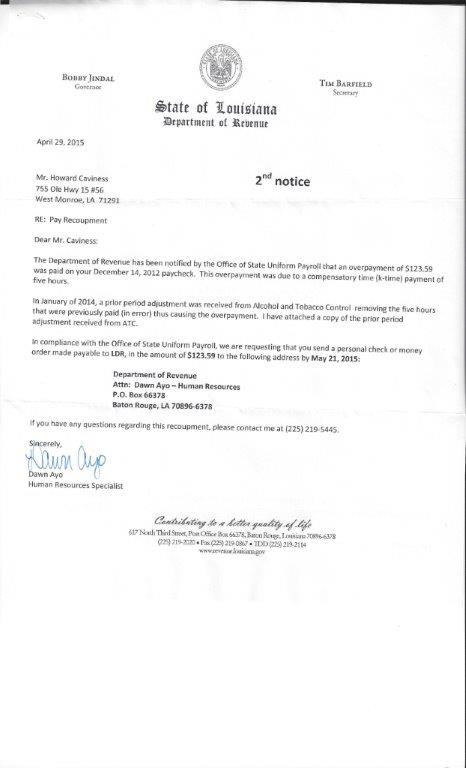
That other appointee mentioned earlier, Troy Hebert, of whom much has been written here, little of it good, recently sent a bill to former ATC agent Howard Caviness of West Monroe who now serves as Grambling State University chief of police. Well, actually, the bill was not from Hebert, but from the agency under which he serves, the Department of Revenue (LDR).

The invoice, for all of $123.59 is for an alleged overpayment to Caviness in Dec. of 2012, according to the letter dated April 29 which is stamped “2nd notice.” Supposedly, the $123.59, when collected, will go to help patch over Jindal’s $1.6 billion budget deficit. LDR letter

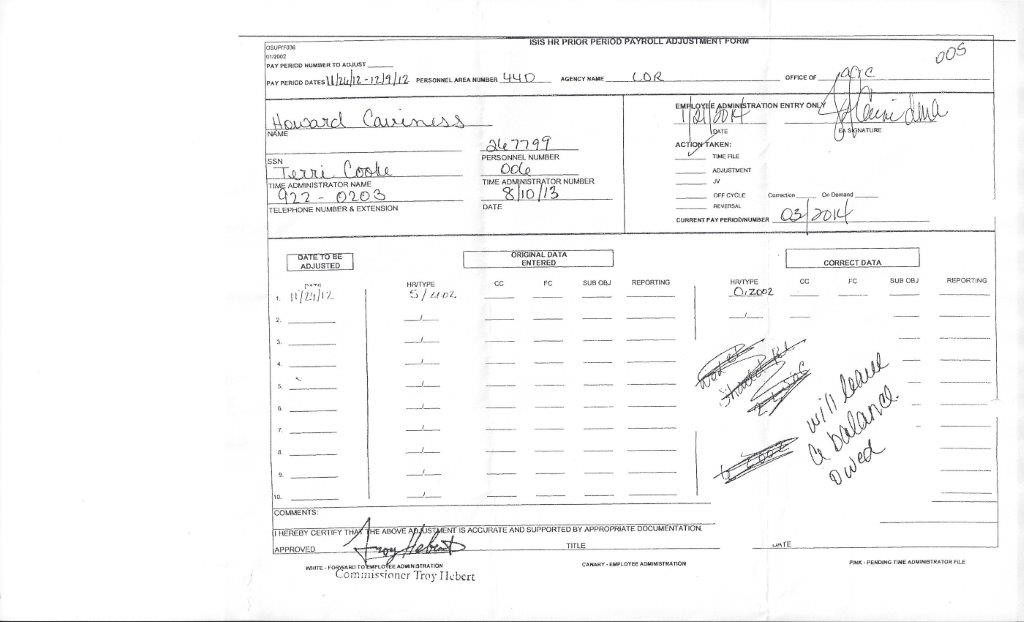
Attached to the letter is a time sheet for the two-week time period of Nov. 26—Dec. 9, 2012, with no explanation other than a hand-scrawled, “will leave a balance owed.” ATC timesheet

(CLICK ON IMAGES TO ENLARGE)

Caviness, contacted by LouisianaVoice, feels the action is in retaliation for his having testified on behalf of another former agent, Brett Tingle, who Hebert fired while Tingle was recovering from a heart attack.

Reprisals against a state employee by officials in the Jindal administration? Surely not!

But that would fit the modus operandi of Hebert and would give credence to a third former agent who revealed she was ordered to conduct an investigation of LouisianaVoice publisher Tom Aswell (that would be me). That former agent admitted that she did indeed follow through on the investigation but found me “rather boring.” We’ll take boring any day.

But we did our own nosing around and found that Hebert played pretty fast and loose with campaign donors’ money while he was still a state senator—and even after he left office to take over operations at ATC after Jindal did a number on former ATC Director Murphy Painter.

At the top of the list, as with the case of so many office holders, was his $12,165 expenditure for the purchase of what seems to be the most sought-after perk of all state politicians: LSU football tickets—$4,930 of that well after he left the House of Representatives in 2010 to become head of ATC. It’s somewhat difficult to see how whose expenditures, especially the $4,930 spent after he left office, could be justified as being “related to the holding of public office,” as state campaign expense laws clearly dictate. related to a campaign  personal use  cannot use campaign funds for personal use

But, as they say in those cheesy TV commercials, “Wait! There’s more!”

Our boy Troy also shelled out the following amounts for other seeming unrelated purposes:

  • Nov. 11, 2014: All State Sugar Bowl tickets, $590 (again, quite a stretch in tying this to holding public office); SUGAR BOWL
  • April 22, 2009: Sullivan’s Restaurant, Baton Rouge, $2,323.10 for a fundraiser; RESTAURANTS
  • April 1, 2010: Delta Airlines, $691.80 (no explanation of any destination, but his House district was pretty small and probably didn’t require air travel to get around Iberia Parish; TRAVEL
  • April 1, 2010: Hilton Hotel, Washington, D.C., $1,505.70. Ah! There’s his destination for that Delta flight. But what was he running for in Washington? HOTELS
  • May 10, 2011: Monteleone Hotel, New Orleans, $500. About those two hotel bills: state regulations limit hotel rooms to a mere $120 per night. Perhaps someone should sent Hebert a bill for the difference. Oh, wait. The rooms were paid out of campaign funds, not the state treasury. So that makes it okay, we guess.  travelguide

Still, $15,452 in campaign expenditures which somehow just don’t pass the smell test for legitimate campaign expenditures, especially $5,520 of which was spent after he left office.

And then there’s Jindal.

Since 2009, a year after he first took office, he has racked up an eye-popping expenditure of $169,597 in hotel room costs alone. TRAVEL

Even more revealing, all but $30,000 of that ($139,660) has been since his re-election in October of 2011, evidence that he has spent precious little time in Louisiana performing the “job he always wanted,” and the job to which he was elected.

Jindal also spent more than $185,000 in campaign money since 2003 on air travel, his campaign expense records show. Because his travel expenses were about equally divided between pre- and post-re-election in 2011, it would indicate that much of his lodging was provided by organizations to whom he was speaking.

By running as an “undeclared” candidate for the Republican presidential nomination, he was able to make free use of campaign funds he reaped while running for and serving as governor. That would explain why he is so cagey about his non-candidacy candidacy: the rules change and federal regulations kick in once he is a declared candidate. His self-serving claim to be “praying for guidance” over his decision has little or nothing to do with it; it’s all about the way he can spend the money.

Read Full Post »

« Newer Posts - Older Posts »

