Given the chance, a reality TV show profiling our state elected officials and political appointees would surely eclipse Duck Dynasty in the ratings—except viewers outside Louisiana would swear the stories were nothing but lowbrow fiction.
When Gov. Bobby Jindal announced the appointment of Butch Browning as State Fire Marshal shortly after taking office in 2008, for example, it turned out to be one of a series of appointments that have come back to embarrass the administration [aside from the fact that the administration appears immune to embarrassment]. Yet, as with almost all the other poor choices, he is resistant to making needed changes in leadership—thereby solidifying his image as a Stand by My Man governor.
The lone exception to that mindset is Bruce Greenstein, former Secretary of the Department of Health and Hospitals—but that dismissal came only after word leaked out of a federal investigation of possible improprieties surrounding a contract Greenstein awarded to his former employer.
While Troy Hebert, Director of the Office of Alcohol and Tobacco Control (ATC) and State Police Superintendent Mike Edmonson have garnered the lion’s share of negative attention, Browning, for the most part, has managed to fly beneath the radar despite several events that occurred during his watch that probably should have demanded closer examinations and, in just about any other administration, dismissal.
Over the next few days, LouisianaVoice will be conducting the scrutiny that Jindal obviously eschews as we look at some of the eye-opening events and practices within the State Fire Marshal’s office.
Browning was appointed on March 8, 2008, barely a month after Jindal began his first term. “Ensuring the safety of Louisiana children and families is an incredibly important mission and the state has benefitted from his leadership, knowledge and service,” Jindal said in a canned press release at the time.
Browning began his public career as a deputy sheriff for East Baton Rouge Parish in 1986 and was named Gonzales Fire Chief in 1998.
“I passionately share the vision of Gov. Bobby Jindal and Col. Mike Edmonson to come together as one,” he said somewhat prophetically at the time of his appointment.
Browning managed to keep his nose relatively clean for a couple of years but in mid-April of 2012 Browning resigned, albeit briefly, in the midst of a pair of simultaneous investigations of his office to accept a job in an area plant, saying the offer was “too good to pass up,” only to return—with a substantial raise in pay—less than two weeks later.
His brief retirement and return just happened to coincide with an investigation launched that, oddly enough, Browning claimed later to be unaware of and which prompted efforts in the Legislature to abolish the investigating agency, a subject to which we will return later in this series. It’s all part of the surreal Louisiana political atmosphere to which we seem to have become inured.
His problems actually originated when the Metropolitan Crime Commission in New Orleans forwarded allegations of mismanagement and fraud against Browning in late 2011.
Among those allegations were claims that Browning’s employees traveled to Tuscaloosa, Alabama, in May of 2011 as one of many recovery teams dispatched there following a series of deadly tornadoes. Those employees, the accusations said, were instructed to bill the Federal Management Emergency Administration (FEMA) for 18-hour work days. The complaint said the hours were billed even though the employees took two days off to attend LSU-Alabama baseball games. It also said that while FEMA did not pay the firefighters, the state did. FEMA, however, was unable to confirm whether or not it had paid the firefighters.
Two other allegations accused Browning of suppressing a finding that a certificate should not have been issued by one of his inspectors for a carnival ride on which two teenagers were subsequently injured and that he paid two members of his office to serve as drivers and security for attendees to a National State Fire Marshal’s conference in New Orleans.
Meanwhile, it was learned that Browning was making public appearances in his dress uniform, complete with military medals from World War II and the Korean War—except for one inconvenient little oversight: he never even served in the military, much less served in either of the two wars. In fact, he wasn’t even born until well after the conclusion of both wars.
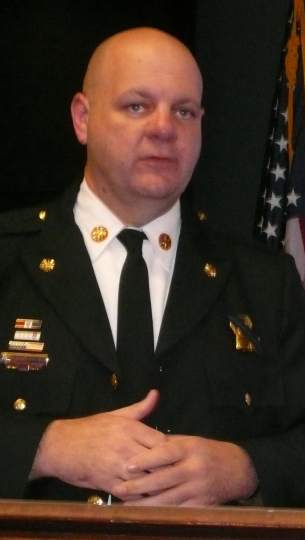
Browning proudly wears military medals in this file photo.
There also is the pesky federal law called the Stolen Valor Act, which makes it a federal misdemeanor for anyone to wear military commendations they did not earn.
That brought the wrath of veterans down upon Browning. “We take pride in what we wear,” said one Marine officer. “Marines don’t hand out ribbons like candy. You have to earn it.” A couple of others called his wearing the medals and ribbons “disrespectful” and U.S. Rep. Steve Scalise (R-New Orleans) said, “There’s nothing more disgraceful than trying to present yourself as someone who served in the military when you didn’t.”
“We’ve been informed that Mr. Browning never served in the military, yet he was wearing military ribbons awarded to every branch of the military service that span World War II, the Korean war and the Kosovo campaign,” said Rafael Goyeneche, President of the Metropolitan Crime Commission who called Browning’s wearing the ribbons “problematic.”
Every branch of the military service? Well, at least he was an equal opportunity fraud, though he did explain that he received the ribbons from the Gonzales Fire Department where he served as chief before his appointment to the State Fire Marshal’s post by Jindal.
On April 18, 2012, Browning, while denying that he was the target of any investigation, suddenly announced his “retirement,” saying he was accepting a job offer as a superintendent at a petrochemical plant in Ascension Parish that he described as “too good to pass up.” His resignation was effective immediately, he said.
But passion apparently trumped too good to pass up for on April 30, just 12 short days later, he was reinstated as he gushed, “my passion is public service.”
But his return reportedly presented a problem. Sources told LouisianaVoice that when he resigned, he was paid for 300 hours of unused annual leave, or about $13,000. When he returned, he was required to repay the money but those same sources said he no longer had the money.
But records show that State Police Superintendent Mike Edmonson, who doubles as Deputy Superintendent of the Department of Public Safety (DPS) and apparently as DPS problem solver, simply bumped Browning’s salary by $8,000 per year, from $92,000 to $99,000 even though he returned at the same Assistant Secretary position as before—apparently so he could afford to repay the $13,000. How many of us would quit our jobs for 12 days in exchange for an $8,000 raise in pay?
Problem solved.
Well, not quite.
While Edmonson was laudatory in welcoming Browning back into the fold, Goyeneche was not nearly so forgiving of Browning—or of Edmonson, for that matter—and the political fallout was almost instantaneous.
Edmonson, metaphorically spreading rose petals in Browning’s path, said the DPS Internal Affairs Section had investigated the allegations and found “no factual evidence” to support the claims. “That investigation has shown me that Butch did not abuse his power or violate the public trust,” he added.
This from a man who, only two years later, would attempt to engineer a lucrative $55,000 a year increase to his own retirement through a furtive, last-minute amendment to an otherwise unrelated Senate bill steered past an unsuspecting and distracted legislature in the closing hours of the 2014 session—with the abetting of Gov. Bobby Jindal and the author of the amendment, State Sen. Neil Riser (R-Columbia).
Edmonson said Browning’s worst sin was to sign papers as a matter routine but which he did not thoroughly read but which were done with no criminal intent or fraud. He said he told Browning he wanted him back on the job—apparently sans military decorations—after an “outpouring” of public support.
Goyeneche, meanwhile, was livid and described the expedited exoneration of Browning as “Louisiana politics at its worst” (see the LouisianaVoice masthead) and unconscionable. “I think this is a political decision and not a decision based on its merits as Fire Marshal,” Goyeneche said. “If the standard is going to be whether Butch Browning broke the law then this is a sad day in Louisiana. State police make decisions every day to discipline officers on administrative issues and this is someone who has made several managerial blunders.”
Browning, for his part, said he welcomed input that would result in positive changes. “The integrity of the Office of State Fire Marshal is one of my top priorities,” he pontificated with self-puffery. “It’s what the public expects.”
In the coming days, we will examine how Browning, with a little help from his friends, manages to continue to survive integrity breaches and how a critical report by one state investigative agency result in a legislative effort to abolish the agency—kill the messenger, as it were—rather than consider correcting deficiencies investigators cited in Browning’s office.
Read Full Post »




 Louisiana Voice