Feeds:
Posts
Comments

Archive for February, 2014

“In no event will coverage be provided to any subscribers, as of March 1, 2014, unless the premiums are paid by the subscriber (or a relative) unless otherwise required by law.”

—Blue Cross Blue Shield of Louisiana spokesman John Maginnis, explaining why BCBS of Louisiana will no longer comply with terms of the federal Ryan White Program.

Ryan White grantees “may use funds to pay for premiums on behalf of eligible enrollees in Marketplace plans, when it is cost-effective for the Ryan White program. The third-party payer guidance CMS released (in November) does not apply to” Ryan White programs.

—CMS spokesperson Tasha Bradley, refuting BCBS’s interpretation of a CMS anti-fraud directive issued in November.

Read Full Post »

First Gov. Bobby Jindal refused to expand the state’s Medicaid program and then he vetoed a $4 million appropriation aimed at shortening a waiting list for home-based services for the developmentally disabled.

And now there is this:

AIDS patients in Obamacare limbo as insurers reject checks.”

That was the headline on the Reuters story that moved on the Internet at 9:23 a.m. on Saturday. The upshot of the story was that hundreds of HIV/AIDS patients in Louisiana attempting to obtain coverage under the Affordable Care Act are in danger of being rejected by the insurance plan they selected.

Just as significant is the roar of stony silence emanating from the State Capitol’s fourth floor office of Bobby Jindal who, six years ago first swore an oath to uphold the rights of all the citizens of Louisiana—even those several hundred adversely affected by the latest BCBS decision. Some would even speculate that Jindal may have leaned on BCBS, which holds two contracts worth $1.1 billion with the state through the Office of Group Benefits.

Others might even raise the question that if Jindal did influence the decision, did he do so at the behest of the Louisiana Family Forum?

The issue revolves around a dispute over federal subsidies and the interpretation of federal rules about preventing Obamacare fraud

BCBS, the state’s largest carrier, is rejecting checks from a federal program that is specifically designed to assist HIV/AIDS patients in paying for AIDS drugs and for insurance premiums under the Ryan White CARE (Comprehensive AIDS Resources Emergency) Act.

Ryan White, a hemophiliac from Kokomo, Indiana, was diagnosed with AIDS at age 13 from a contaminated blood transfusion. He and his mother Jeanne White Ginder fought for his right to attend school. He died in 1990 at age 18, a month before his high school graduation and only months before Congress passed the act that bears his name.

The Ryan White Program is the single largest federal program designed specifically for people with HIV and benefits more than half a million patients each year. It provides care and support services to individuals and families affected by the disease, serving as the “payer of last resort” by filling the gaps for those who have no other source of coverage or who face coverage limits.

But now, inexplicably, BCBS says it will no longer accept third-party payments such as those provided by the Ryan White Program.

“In no event will coverage be provided to any subscribers, as of March 1, 2014, unless the premiums are paid by the subscriber (or a relative) unless otherwise required by law,” said BCBS spokesman John Maginnis (no, not the journalist).

The decision stems from a series of communications from the Centers for Medicare and Medicaid Services (CMS), the lead Obamacare agency. In September, CMS informed insurers that Ryan White funds “may be used to cover the cost of private health insurance premiums, deductibles and co-payments” for Obamacare plans.

But in November, CMS warned care providers and “other commercial entities” that because of the risk of fraud, it had “significant concerns” about their supporting premium payments and assistant Obamacare consumers pay deductibles and other costs.

BCBS seized on that to say it had implemented a policy, “across our individual health insurance market, of not accepting premium payments from any third parties who are not related” to the subscriber, according to Maginnis.

Not so fast, says CMS. “The third-party payer guidance CMS released (in November) does not apply” to the Ryan White programs, it said.

Hundreds of HIV/AIDS patients who are not eligible for Medicaid depend on Ryan White payments for Obamacare. That is because Gov. Bobby Jindal chose not to expand the low-income Medicaid program and Obamacare federal subsidies do not kick in until people are at 100 percent of the federal poverty level.

The only other carrier currently refusing to accept such payments is BCBS of North Dakota, according to a CMS spokesperson but that policy is currently under review.

Jessica Stone, a member of U.S. Sen. Mary Landrieu’s staff, in an email to health care advocates, wrote, “BCBS LA told me their decision was not due to the CMS guidance or any confusion (as we thought before) but was in fact due to adverse selection concerns” in an effort by insurers to keep AIDS patients from enrolling in their plans.

Adverse selection refers to the situation where an insurer attracts patients with chronic conditions and expensive care. John Peller, vice president for policy at the AIDS Foundation in Chicago, said the action “sure looks to us like discrimination against sick people.”

BCBS LA denied that. “We welcome all Louisiana residents who chose Blue Cross and Blue Shield of Louisiana,” Maginnis said.

One observer said it shouldn’t matter who pays the premiums. “All the insurer should care about is whether the premiums are paid or not. I once loaned money to a friend and had problems getting him to pay me back. His girlfriend finally paid me some of the money. If I had been like BCBS, I would have refused her money, preferring to get it from him—and I would have gotten nothing. This makes no sense whatsoever.”

Perhaps Jindal intends to ignore the 13,400 HIV/AIDS victims served by the program in Louisiana and use the $50.7 million in Ryan White funds the state receives to help plug next year’s all but certain budget deficit.

Read Full Post »

Earlier this week we sat down with best selling author John Barry, former vice president of the Southeast Louisiana Flood Protection Authority, to discuss the authority’s litigation against 97 oil and gas companies. Because of the importance of the pending litigation and the opposition of the Jindal administration to efforts to hold the oil companies responsible for the damage done to the Louisiana coastline, this story is being posted simultaneously by CenLamar, Something Like the Truth, LouisianaVoice and Forward-Now.

He glances down at the cellphone lying on the tabletop in the State Capitol restaurant and says almost apologetically, “I never had one of these until two years ago.” He laughs at his own reluctance to accept modern technology. “When I got it, somebody sent me a message welcoming me to the 20th century. Not the 21st, but the 20th.”

That is the first impression one gets of John M. Barry, the soft-spoken point man in the ongoing lawsuit by the Southeast Louisiana Flood Protection Authority-East (SELFPAE) against 97 oil and gas companies over the destruction of the state’s coastal wetlands.

He speaks in a voice so low that we were forced to move to another table, away from the television that had been directly above us and which kept churning out obnoxious lawyer ads, an irony not lost on the restaurant’s only two customers.

Barry, a gifted researcher and writer is author of several bestselling books, among them 2005’s The Great Influenza: The Story of the Deadliest Pandemic in History, which was named the year’s outstanding book on science or medicine, and his stark 1998 chronicle Rising Tide: The Great Mississippi Flood of 1927 and How it Changed America. Rising Tide won the Francis Parkman Prize of the Society of American Historians for the year’s best book of American history. It was also named as one of nine pieces of literature essential to understanding America by GQ.

He owns a home in Washington, D.C. and when asked if he is originally from that area, he confides that he was born in Rhode Island but also owns a home in New Orleans. Then he dropped a small biographical bombshell: one of his first jobs was as an assistant football coach at Tulane University. “I was on the coaching staff of the 1973 team that beat LSU (14-0) for the first time in 25 years,” he said with a trace of understandable pride. The first money he ever earned from writing, in fact, was from a story he sold to a coaching magazine about ways to change blocking assignments at the line of scrimmage. Sports Illustrated in 2006 chose one of his stories about football for an anthology of the best football writing of all time.

Four decades removed from that historic game, Barry is on another history-making quest: that of convincing an oil-friendly state legislature to help make big oil repair the damage done to Louisiana’s fast-eroding coastline and marshlands.

Lest one think he was originally chosen to serve on SELFPAE because of his celebrity status, it should be known that following Hurricane Katrina, the Louisiana congressional delegation asked him to chair a bipartisan working group on flood protection and he sits on advisory boards at MIT’s Center for Engineering Systems Fundamentals as well as the Johns Hopkins Bloomberg School of Public Health and on the board of the Society of American Historians and American Heritage Rivers. He has been a keynote speaker at a White House Conference on the Mississippi Delta and is co-founder of the $100 million Riversphere in New Orleans, the first facility in the world dedicated to comprehensive river research.

“I don’t get paid for what I’m doing now,” he said. “I spend most of my time on the road talking to newspaper editors and legislators, making my case for the lawsuit. I’m living off my savings. I still get royalties from the books, but it isn’t enough to live on.” He chuckles at a suggested comparison to Don Quixote and then continues. “I’m meeting with every individual legislator who will listen.” He is attempting to convince lawmakers not to intervene and terminate the litigation.

Those meetings pit him against Gov. Bobby Jindal and Jindal’s hand-picked front man Garret Graves—at least until Feb. 17 when Graves will step down as Chairman of the Coastal Restoration Authority, to be succeeded by Jerome Zeringue, former Terrebonne Parish levee authority director. There is some speculation that Graves will seek the 6th District congressional seat being vacated by Rep. William Cassidy, who is running against incumbent Mary Landrieu for the U.S. Senate.

Despite Jindal’s opposition to the lawsuit and his decision not to reappoint him to the authority, Barry refuses to disparage the governor “I’ve known him since before he ever ran for office. I don’t agree with him on the issue of the litigation but on balance, he’s been a good governor,” he said. “He could be a great governor if he would get the oil companies to take responsibility for the damage they’ve done to our coastline. The lawsuit isn’t the problem. The problem is the loss of our coast land.

“It’s not my suit anymore,” he is quick to add, pointing out that he no longer serves on the authority. But that is not to say he doesn’t have a keen interest in the litigation. Because of his ongoing interest, he has formed an organization called Restore Louisiana to fight attempts by the oil industry to either get the lawsuit declared groundless, illegal or unconstitutional or to resist any movement by the legislature to intervene to stop the lawsuit.

Barry said a 2006 study by the Department of Natural Resources (DNR) revealed that 76 percent of the land loss was caused by the oil industry. “The Environmental Protection Agency (EPA) said Louisiana has the lowest enforcement rate in the nation,” he said, adding that DNR has looked the other way too many times when big oil’s interests conflicted with that of Louisiana’s citizens.

Barry said the difference between his fight and that of fictional character Don Quixote is that “everyone knows we are right. Our polls show that 70 percent of the people feel that the oil companies are the problem because they have not lived up to their promises to clean up their messes,” he said. “Garrett (Graves) said the authority’s job is to protect the levees. He said he has $18 billion for coastal restoration but $14 billion of that has been spent on the levees so there is no $18 billion going forward.

“Gambit magazine of New Orleans said I had a lot of courage but what I’m doing doesn’t require courage,” he said. What can they do to me?” At the same time, however, he acknowledged that there has been considerable political pressure on authority members who support the litigation. “Steve Estopinal, an engineer, has had his job threatened and Paul Kemp had to change jobs.

“I’m on the road a lot and that’s not been easy. I don’t like being away from my family but my motivation is simple: I want the Louisiana coast to survive. That’s why I’m on the road 10 hours per day.”

Read Full Post »

It will be interesting to see if Alvarez and Marsal (A&M), with its $5 million contract, will find any significant savings in its whirlwind four-month tour of the labyrinth that is Louisiana state government.

We’ve been poking around the Louisiana Department of Economic Development (LED) and we’ve come up with a number of contracts—83 to be precise—which look as though they could be a duplication of some services provided by the Louisiana Workforce Commission. The 83 contracts, ranging from $8,000 to $717,000, were issued to 63 individuals and 20 companies and totaled more than $8.5 million. Before you go searching for your calculators, we’ll save you the trouble: it works out to about $102,600 per contract.

Of the 83 contracts, 63 at a combined cost of $6.3 million were issued to “provide assistance as requested in connection with LED’s FastStart program, including but not limited to the development and/or delivery of materials for training classes for the LA. FastStart Program.” The others were for writing, editing, graphic design, art work, video production, development of a PowerPoint production and “to establish a database of potential trainees for continued pre-hire training using a customized assessment instrument to determine skills proficiencies based on individual company requirements…for the Louisiana FastStart (LFS) Program as may be requested by LED.” (Emphasis ours.)

It is one contract in particular that got our attention. But first, a little background:

Louisiana FastStart is a single-source workforce solutions provider that works at no cost with businesses to anticipate and address workforce needs in the startup or expansion process.

http://wwwprd.doa.louisiana.gov/laservices/publicpages/ServiceDetail.cfm?service_id=3467

The FastStart process includes project evaluation, workforce solutions, material development, pre-employment identification, course (classes) delivery, evaluation and feedback, customized training, core skills training, warehouse and distribution, research and development.

The thing that makes us believe A&M could obliterate many, if not all, of these contracts is the fact that the Louisiana Workforce Commission (LWC) appears to provide many of these very same services. http://www.laworks.net/Downloads/employment/employerhandbook.pdf

LWC aids employers in finding any type of employee by registering professional, semi-professional, skilled and unskilled applicants and even provides access to its Business and Career Solutions Center for businesses to conduct job interviews. The center employs the latest computer technology to select qualified applicants for job screening and referral.

LWC also offers several Business and Career Solutions centers throughout the state which provide online job listings, education, skills and interest assessments, job counseling and placement assistance, computer access, basic skills upgrades.

http://www.laworks.net/WorkforceDev/WFD_MainMenu.asp

LWC, in fact, has more than $130 million in contracts with individuals, companies, community action agencies and local governments for the purpose of training applicants and finding them jobs.

But LED’s $717,000 contract no. 718453 with a company called LR3 would appear to warrant closer examination.

The president of LR3 is one Lionel Rainey, III, who people in Baton Rouge will recognize as the public face of a concerted effort to break away from Baton Rouge and to create a separate city of St. George in East Baton Rouge Parish.

That effort has sharply divided the residents of unincorporated South Baton Rouge with opponents wanting to remain part of the greater community of Baton Rouge. For the proponents, the motivation would seem to be education or more specifically, charter schools.

State Rep. Bodi White (R-Central) is a major supporter of the pullout even though Central is on the northern edge of East Baton Rouge Parish.

More than a year ago and before the St. George pullout movement was formalized, White called on businesses in South Baton Rouge in an effort to drum up financial support for a charter school in that part of the parish.

Lately, as momentum on both sides has picked up, local television has begun covering the issue on almost a daily basis. Each time a TV news story airs, Rainey invariably is the spokesperson for the proponents.

But what about that contract with LED?

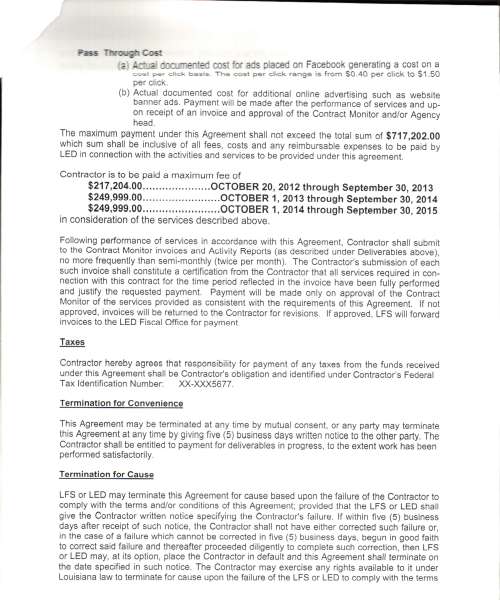
Well, first of all, it was awarded on a no-bid basis. In other words, LED never issued a request for proposals (RFP) nor did LR3 ever submit a proposal despite having no obvious qualifications for creating an Internet database system.

When asked about the no-bid contract, LED responded by pointing out that contracts for social services may be awarded “without the necessity of competitive bidding or competitive negotiation,” provided the director of the Office of Contractual Review determines that certain conditions apply, one of which is that the total contract amount is less than $250,000 per 12-month period.

At the same time, LED’s response acknowledged that service requirements “shall not be artificially divided so as to exempt contracts from the (RFP) process.”

And that’s where things get a bit dicey.

LATRAC, the state database for contracts, lists the amount of Contract no. 718453 as $717,202 over three years (Oct. 20, 2012 through Sept. 30, 2015) while the LED contract document breaks the contract into three amounts: $217,204 the first year and $249,999 in the second and third years.

Contract Number 718453
Contract Title LR3 CONSULTING, LLC
Contract Description DEVELOPMENT, ESTABLISHMENT AND/OR DELIV- ERY OF A DATABASE   OF POTENTIAL TRAINEES FOR CONTINUED PRE-HIRE TRAINING USING A CUSTOMIZED   ASSESSMENT INSTRUMENT TO DE- TERMINE SKILLS PROFICIENCIES BASED ON INDIVIDUAL   COMPANY REQUIREMENTS (ED6); 100% STATUTORY DEDICATION – LED FUNDS
Agency DED – OFFICE OF THE SECRETARY
Amount $717,202.00
Begin Date 10/20/2012
End Date 9/30/2015
Approval Date 12/3/2012
Document Type OTHER CONTRACT – CFMS
Status ENCUMBRANCE SUCCESSFUL
Contractor LR3 CONSULTING LLC
Contractor City and State BATON ROUGE , LA

Not only did LED appear to be circumventing the RFP procedure by breaking the contract into three sections, but there appear to also be questions about another state regulation that says agency heads shall take into account, in the following order, “the professional or technical competence of offers, the technical merits of offers, and the compensation for which services are to be rendered, including fee.”

First, there appears to have been no “offer” from LR3, which only incorporated as a business on Sept. 19, 2012—barely a month before its $717,000 contract with LED took effect on Oct. 20, 2012.

PTDC1281

So, to recap, we have a company that is barely a month old landing a $717,000 contract with a state agency without benefit of competitive bidding, or without a formal proposal from a contracting firm that provided no evidence of its qualifications to perform work that appears to be already available through another state agency, LWC.
PTDC1248

And then there’s LR3’s billing address.

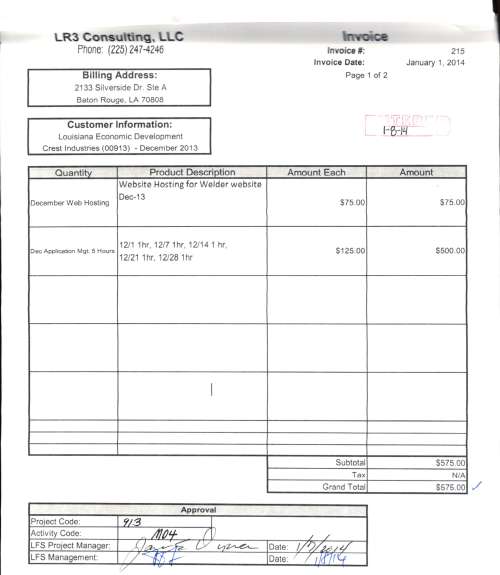
Invoices submitted to LED by LR3 give its billing address as 2133 Silverside Drive, Suite A, in Baton Rouge.
PTDC1291

Rainey is also listed as president of Vote Guards Dot Org., of the same address.

But there also are three other businesses of 2133 Silverside Drive, Suite A, Baton Rouge, according to the Louisiana Secretary of State’s corporate web page: Phoenix Consulting Group, BP Oil Claim Solutions, LLC, and EFL Angels Foundation.

All three list Meredith Eicher as a corporate officer.

Meredith Eicher, along with her sister Ashley, was sentenced to five months in prison in 1990 after pleading guilty to two counts of aiding and abetting mail fraud in connection with the collapse of Champion Insurance Co.

She also was ordered to serve two years’ probation after her release and fined $10,000.

Champion, the third largest insurer in the state, collapsed in June of 1989, leaving $150 million in unpaid claims. Her father, John Eicher, was sentenced to 46 months in prison in connection with the collapse which also implicated then State Insurance Commissioner Doug Green, who received $2.7 million in bribes from the Eichers. He received a 25-year federal sentence.

All in all, when one takes the St. George pullout effort that is supported by a political figure at the opposite end of East Baton Rouge Parish and led by an individual whose newly founded company, housed in the same office as four other companies—three of which have as a corporate officer someone who participated in the defrauding of $150 million in insurance claims 25 years ago—lands a $717,000 no-bid contract with the state, one has to ask….

What could possibly go wrong?

Read Full Post »

Two months ago, when the Federal Communications Commission allotted $8 million to expand broadband Internet access in rural Louisiana areas, U.S. Sen. Mary Landrieu was quick to praise, perhaps a bit prematurely, the “investment” while Gov. Bobby Jindal remained uncharacteristically silent.

Despite Landrieu’s laudatory claim that the funds would “upgrade the digital infrastructure in rural communities,” the $8 million represented only 10 percent of an $80 million grant for Louisiana that was rescinded in October of 2011 because of Jindal’s aversion to what then Commissioner of Administration Paul Rainwater deemed a “top-down, government-heavy approach that would compete with and undermine, rather than partner with the private sector…”

What Rainwater—and through him, his boss, Jindal—did not acknowledge is that the Jindal administration’s obsession with protecting the private sector at the expense of broadband Internet service to customers in the rural areas of the central and northeastern parts of the state was part of the 12-year-old official position staked out by the American Legislative Exchange Council (ALEC) in August of 2002. http://alecexposed.org/w/images/6/6f/9A15-Municipal_Telecommunications_Private_Industry_Safeguards_Act_Exposed.pdf

Also ignored by the Jindal administration—and ALEC—is that broadband service in the U.S. is woefully inadequate when compared with countries like South Korea, Japan and even Portugal and Italy. http://www.scientificamerican.com/article/competition-and-the-internet/

And it’s even worse in the country’s rural areas. http://deltafarmpress.com/blog/broadband-service-rural-areas-promise-still-exceeds-reality

No doubt you’ve seen those cute AT&T commercials featuring the man sitting at a table with children. He asks a question and gets feedback from the kids and the commercial ends with, “It’s not complicated.”

Indeed it is not. In 2008, Jindal’s very first year as governor, he signed SB-807 into law as Act 433 over the objections of the Louisiana Municipal and State Police Jury associations. The bill, the Consumer Choice for Television Act, was authored by then-Sen. Ann Duplessis (D-New Orleans). It passed the Senate by a 34-1 vote with only Dale Erdy (R-Livingston) voting no. Absent and not voting were Sens. Robert Adley (R-Benton), Jody Amedee (R-Gonzales) and Sheri Smith Buffington (R-Keithville).

AT&T, which contributed $10,000 to Jindal’s campaign since 2007, supported the bill. AT&T also contributed $250,000 to the Supriya Jindal Foundation for Louisiana’s Children.

It’s not complicated.

It also passed overwhelmingly in the House by a 94-9 vote. The only members casting no-votes were Reps. James Armes (D-Leesville), Thomas Carmody (R-Shreveport), Greg Cromer (R-Slidell), Jean Doerge (D-Minden), Ricky Hardy (D-Lafayette), Lowell Hazel (R-Pineville), Robert Johnson (D-Marksville), Sam Jones (D-Franklin), and Chris Roy (D-Alexandria). Rep. James Morris (R-Oil City) was absent and did not vote.

The only ALEC member to go against the official doctrine was Carmody. He attended ALEC’s 2010 annual meeting in San Diego at which the organization’s Telecommunications & Information Technology Task Force passed an official resolution in potential opposition to private telephone and cable companies by public bodies such as city councils and parish governments. https://louisianavoice.com/2012/05/09/could-loss-of-that-80-6-million-broadband-internet-federal-grant-last-fall-have-been-deliberately-orchestrated-by-alec/

Other members of the Louisiana Legislature who attended that meeting included Reps. John LaBruzzo (R-Metairie), Robert Johnson (D-Marksville), Tim Burns (R-Mandeville), State Chairman Joe Harrison (R-Gray), Bernard LeBas (D-Ville Platte) and Sen. Yvonne Dorsey (D-Baton Rouge).

Act 433 well may even have been written by AT&T, which is a member of ALEC and a member of ALEC’s Communications and Technology Task Force. AT&T chipped in $50,000 to the ALEC cause in 2010 and was a member of the Louisiana Host Committee for ALEC’s 2012 annual meeting in New Orleans. Jindal was the recipient of ALEC’s Thomas Jefferson Freedom Award at that 2012 meeting. http://www.alec.org/hundreds-of-state-legislators/

It’s not complicated.

And lest one think that Louisiana’s loss of the $80 million broadband grant in 2011 was the exception, consider this:

  • Early this year, the Kansas Legislature undertook Campaign Stop Google Fiber—and any cities that may wish to invest in broadband network technologies. Included in legislation introduced in the legislature were stipulations that except with regard to unserved areas, a municipality may not themselves offer to provide or lease, construct, maintain or operate any facility for the purpose of allowing a private entity to offer, provide, carry or deliver video, telecommunications or broadband service. http://www.dailykos.com/story/2014/01/30/1273848/-Kansas-moves-to-Stop-Broadband-Internet-to-residents?detail=email
  • In February of 2011, the Minnesota Cable Communications Association (MCCA) initiated a public battle with National Public Broadband (NPB) by inundating Lake County with a flurry of public records request designed to slow NPB’s efforts to bring broadband Internet to rural areas of Lake County.

While MCCA correctly asserts that Lake County should act transparently, the barrage of requests submitted by the association makes its intent to protect its own financial interests over those of rural residents of the county is quite apparent. Its monopoly is, after all, being threatened and those cable services that are overpriced and which provide as little speed as possible are fighting back.

Certainly it’s only coincidental that AT&T, CenturyLink, Charter Communications, Comcast, Excel Communications, Fair Point Communications, Sprint Nextel, Verizon, and Cox Communications are members of ALEC. All but Excel and Fair Point serve on ALEC’s Communications and Technology Task Force. http://www.sourcewatch.org/index.php/ALEC_Corporations.

It’s not complicated.

So, given Jindal’s cozy relationship with ALEC and given ALEC’s opposition to public participation in expanding broadband Internet service to rural areas in competition with ALEC members, it’s perfectly understandable why Jindal eschewed that “top-down” management of the $80 million grant.

It’s not complicated.

And it is equally apparent that the monopolistic advantage enjoyed by private sector providers be protected at all cost—even at the cost of creating some 900 miles of cable over 21 rural parishes that would support several Louisiana universities with expanded optical fiber networking capacity.

It’s not complicated.

Top-down management apparently is good only when it originates from the fourth floor of the State Capitol. Just ask any legislator, former state employee, or board or commission member who has dared to contradict him on any issue.

It’s not complicated.

Read Full Post »

« Newer Posts


